Tag Archives: Thoma

The Country Store: Family Groceries, the Best of Brandy, and Excellent Beer

The Bavarian William Henry Thoma of Garnavillo, Clayton County, Iowa, was a businessman by the age of thirty.1 In 1859, the Clayton County Journal reported:

“William Thoma, Grocer, Main Street, Garnavillo, Iowa, keeps constantly on hand all kinds of family groceries, such as Coffee, Sugar, Tea, Milasses, ice, &c. The best of Brandy and excellent Beer is also always to be found at this establishment.”2

William must have found success as a grocer and purveyor of alcoholic beverages, as his business was apparently in operation for at least two decades. He was named a merchant in the 1860 census,3 and in the 1870 census it was noted that he was the keeper of a “country store.”4 This must have allowed him to provide a comfortable lifestyle for his wife and eleven children; in 1870, he owned real estate valued at $12,000 and personal estate valued at $3,000.5

William_Thoma_1870

1870 U.S. census, Clayton County, Iowa, population schedule, Garnavillo, p. 13 (penned), dwelling 87, family 86, Wm Toma; digital image, Ancestry.com (http://www.ancestry.com : accessed 16 April 2014), citing National Archives microfilm M593, roll 383.

After William’s death in the summer of 1876,6 his widow, Anna Margaretha (Poesch) Thoma, with a handful of young children still at home, took over as merchant. She maintained the business for a number of years, while her eldest son assisted as a clerk in the store.7

I like to wonder whether William’s store was anything like that featured at Iowa’s Living History Farms, which boasts the fictional 1875 Town of Walnut Hill. Images of the picturesque Greteman Brothers General Store can be seen here. It’s well worth a visit if you find yourself in central Iowa and have ever wondered what life was like for your Midwestern ancestors in the years following the Civil War. The impact of the Industrial Revolution on rural communities is visible, although, according to the Living History Farms, “The railroad will always be a few years away for Walnut Hill.”8

Of course, I also have to wonder whether William and Anna Margaretha (Poesch) Thoma were anything like Nels and Harriet Oleson of Little House on the Prairie. Let’s just hope that their children weren’t as spoiled as the infamous Nellie and Willie!

Continue reading

Friendship Clubs and Funny Quotes: Finding Family in Yearbooks

Several years before they would meet and marry, teenagers Fern and Jerry were unsuspecting students at Central High School in Sioux City, Woodbury County, Iowa.1 They were not in the same grade, and this was a large school; Fern moved to Sioux City only in time for her senior year, and as Jerry graduated two years later, it’s possible that they never crossed paths during their brief overlap as students at the imposing sandstone building dubbed “The Castle on the Hill.”2

Fern_Thoma_Yearbook_1925

The Maroon and White, Vol. XXI (Sioux City, Iowa: Central High School, 1925), 67; digital image, Ancestry.com (http://www.ancestry.com : accessed 24 March 2014).

Fern Lavonne Thoma graduated from Central High School in 1925. In her yearbook photo, she wore a long necklace and, true to the times, styled her hair in a fashionable, chin-length bob. The only club that Fern had joined was the “Friendship Club,” which, apparently, was mandatory for all female students.3 From what I remember her telling me, she enjoyed her time at this school, especially a banquet for the upperclassmen during which the school gymnasium was decorated like a boat. She thought this event was “just wonderful!”4

Gerald_Adam_Yearbook_1927

The Maroon and White, Vol. XXIII (Sioux City, Iowa: Central High School, 1927), 34; digital image, Ancestry.com (http://www.ancestry.com : accessed 24 March 2014).

Gerald “Jerry” Joseph Adam graduated from Central High School in 1927. According to the yearbook, he was in the general course of study and had been involved in Civics, no surprise given his penchant for writing to politicians later in his life, as well as the Spanish Club. His handsome photo was paired with the quote, “Who shows you your place when you go to the Princess?”5 As a teenager, Jerry earned money as an usher at the Princess Theatre in downtown Sioux City, surely a popular place among his movie-going peers.6

In fact, Fern and Jerry reportedly met while on their way to the movies. Fern and her friend Florence were walking downtown when two young men, who were known to Florence, drove up in their rental car and offered the girls a ride. Fern approached the front to sit next to the driver, when Jerry suggested that she sit in the back with him. Fern later claimed that Florence had set her up, while Jerry liked to say that when he first laid eyes on Fern, he proclaimed, “That’s the girl I’m going to marry!”7

If you would like to find yearbook photos of your ancestors (or even yourself), check out the yearbook collections on Ancestry.com. In my experience, yearbooks don’t always appear as strong “shaky leaf” matches, so I have found it helpful to search specifically within the category “Schools, Directories & Church Histories” in order to bring all relevant results to the top.

Also consider searching the yearbooks individually as your ancestor’s full name may not have been given for every appearance, particularly if he or she was an underclassman or appeared in additional club or athletic photographs. As a bonus, see if you can find his or her autograph scrawled in the back of the book. You never know what you might learn about the glory days of your ancestor’s youth!

Continue reading

The Twenties by Day

LeotaAlphaBellFenton

Leota (Fenton) Thoma, Alpha (Fenton) Gibson, and Belle (Fenton) Hoffman, ca. 1920s; digital image 2013, privately held by Melanie Frick, 2014.

As seen in this photograph, the trends of the Roaring Twenties were not just for flappers – although daytime fashions were significantly less flashy than what one tends to associate with the era. Here, sisters Leota, Alpha, and Belle, from left to right, pose together sporting bobs and simple patterned dresses. Although the sisters were likely in their late forties or early fifties when this photograph was taken, they clearly made an effort to keep up with the times.

Alpha Doretta, Minnie Belle, and Anna Leota Fenton were born in Saline County, Kansas, the daughters of George W. and Sarah Ellen (Hall) Fenton.1 After their father’s death, their mother remarried, and eventually, the family relocated to northwestern Iowa.2 At the time that this photograph was taken, Alpha, the wife of Clare Gibson, lived in Colorado,3 whereas Belle, the wife of Joseph Hoffman, and Leota, the wife of George Thoma, lived in different counties in Iowa.4 It was likely a rare occasion that the sisters were able to be together.

Leota, Alpha, and Belle wear popular styles of what would have been considered day dresses or house dresses in this decade, as seen on Vintage Dancer: 1920s Day / House Dresses and Aprons. Likely made of cotton, their dresses feature lively prints and straight, comfortable cuts. Both Belle, right, and Alpha, center, wear dresses made of fabric printed with spirals or swirls. Both have sleeves cuffed above the elbow, and have belted, dropped waists. Leota wears a standard long apron with patch pockets over her dress, but it can be seen that her floral-patterned dress hits, appropriately, just below the knee. Her dress has contrasting fabric sewn at the hem and the cuffs, and she clutches a striped cloche hat in her hand.

This look was quite a change from the romantic, Gibson Girl-esque styles of just a quarter century before, as seen in an earlier photograph of Leota. However, it looks like these ladies might have had quite a bit of fun with their makeovers during this decade, before more conservative styles returned with the Great Depression.

Continue reading

An Ancestor with an Alias

When I learned that George Hiram Thoma of Garnavillo, Clayton County, Iowa used an alias as a young man, it took me by surprise. He was born to Fred and Matilda (Hammond) Thoma in 1880,1 and the state census indicates that he remained in his home county in northeastern Iowa at least until 1895.2 At some point thereafter, according to family lore, George left home and bicycled across Iowa. Whether he went by bicycle or not, it was said that his move may have been spurred on by his poor relationship with his father.3

GeorgeHiramThoma

George Hiram Thoma, seated left, with an unidentified young man, ca. 1900; digital image 2013, privately held by Melanie Frick, 2014.

Records place George across the state in northwestern Iowa on 23 March 1902, at which time, using the name George A. Neilson, he married Anna Leota Fenton in Ashton, Osceola County, Iowa.4 This was no trick of penmanship or recorder’s error; three affidavits, written by George, his mother, and his younger brother, were attached to the marriage document decades later, each attesting to the fact that George A. Neilson and George Hiram Thoma were one and the same person.5 It is worth noting that George still named his correct place of birth and even the correct names of his parents on the original marriage document, with the exception, of course, of assigning the Neilson surname to them as well.6 Evidently, he was not prepared or had no reason to invent an elaborate backstory regarding his origins.

None of the affidavits, however, explained why George had married under an assumed name.7 One has to wonder whether his wife even knew what she was getting into! Prior to his marriage, I suspect that he might be found in the 1900 U.S. census as George Thoma, a clerk in Belden, Cedar County, Nebraska. Notably, he boarded with a family by the name of Nelson, and a Nielsen also resided in the household.8 Although this may or may not be the correct George Thoma, we do know that within weeks of his marriage, he moved to Center, Knox County, Nebraska, where he was an employee of the Edwards and Bradford Lumber Company.9

Within a few years of his marriage, George relocated with his family to Sioux City, Woodbury County, Iowa. There, his daughter’s birth was recorded with the surname Neilson,10 and according to the city directories, George continued to use his assumed name at least until 1909.11 I have been unable to locate the family in the 1910 U.S. census – they had likely left Sioux City by that time to return to Nebraska, where they moved from place to place for the next decade. However, they had certainly reverted to the use of the Thoma surname no later than World War I.12

Was this alias purely symbolic, in order to emphasize George’s separation from his father, or, perhaps, the ties that he forged with another family? Or was it part of an effort to hide, whether from his father, from love, or from the law? This is one family mystery that I would love to solve!

Continue reading

Warm Winter Furs

NormaThomaFernThoma1917

Norma Arlene Thoma and Fern Lavonne Thoma, ca. 1917-1918, Decatur, Burt County, Nebraska; digital image 2013, privately held by Melanie Frick, 2013.

Although I remember when my great grandmother first showed me this photograph, years ago, I wish I could remember more of what she had to say about it. I believe that the furs that she and her younger sister wore may have been a special gift. From left to right are sisters Norma and Fern Thoma of Decatur, Burt County, Nebraska, most likely photographed during the winter of 1917-1918. At this time, Fern would have been ten years old,1 and Norma would have been a few months shy of her third birthday.2 They lived in town, a community of eight hundred, as their father was a grocer.3

The girls seem to have been posed specifically to show off their matching fur hats, collars, and muffs. Have you ever felt a fur muff? They really are very warm, perfect to shelter little fingers from the biting cold of a Nebraska winter. Norma and Fern are also bundled into long wool coats, and Fern wears what seem to be stylish gaiters or “spats” over her shoes, such as those seen at The Quintessential Clothes Pen: An Exploration of Historic Costume.

With the holidays approaching, I can’t help but wonder if these furs might have been a Christmas gift, or if the girls may have worn them in honor of the day. In that spirit, I would like to take this opportunity to wish very happy holidays to all of my readers, as well as to offer a big thank you for following The Homestead!


SOURCES
1 Iowa State Department of Health, birth certificate no. 419687 (1907, issued 1942), Fern L. Thoma; Division of Vital Statistics, Des Moines.
2 Nebraska State Department of Health, birth certificate no. 2-84091 (1915, issued 1943), Norma A. Thoma; Division of Vital Statistics, Lincoln.
3 Bill Weaver, “Nebraska State Gazetteer and Business Directory – 1917 – Decatur,” NE GenWeb Project: Burt County, Nebraska On-Line Resources (http://www.rootsweb.ancestry.com/~neburt/olres/gazbus17.html : accessed 15 December 2013), entry for Geo. H. Thomas [Thoma].

Across Generations: The Power of a Snapshot

If you will be spending the holidays with family this year, consider snapping a few two, three, or even four generation photographs, should you have the opportunity.

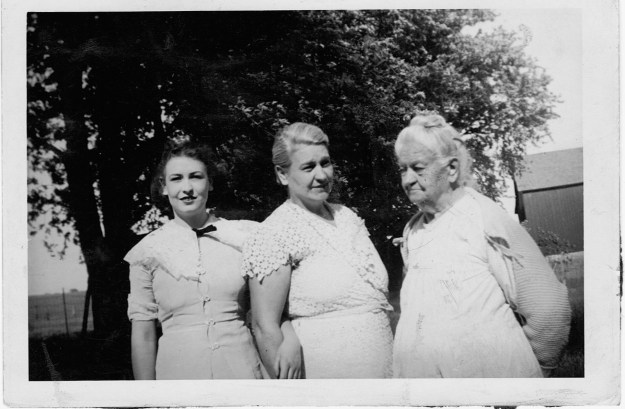
JackieRoselynMatildaHammondThoma

Jacqueline (Cuzins) Hedeman, Roselyn (Thoma) Friend Cuzins Chaney Bohringer, and Matilda (Hammond) Thoma, ca. 1938-1947; digital image 2010, privately held by Melanie Frick, 2013.

Why? This is one of only two photographs that I have of my third great grandmother, Matilda (Hammond) Thoma of Clayton County, Iowa. Matilda was born in 1859, and spent most of her life in the same county. She married and raised five children, four of whom survived to adulthood.1

Matilda is pictured here with her daughter, Roselyn, center, and her granddaughter, Jacqueline, left, who links arms with her mother. The occasion may not have seemed important at the time – only Jacqueline is facing the camera, and Roselyn and Matilda seem to have been caught unaware – but not only is this a rare photograph of Matilda, it’s also the only picture that I have of her with her daughter and granddaughter. This priceless three-generation photograph seems to have been a casual snapshot, likely taken by a family member.

After her husband’s death, Matilda lived with Roselyn in Texas,2 and later with Jacqueline in Wisconsin,3 suggesting that she had a close relationship with both women. This photograph was probably taken at some point after 1940, when Jacqueline would have turned twenty, or perhaps shortly before.4 Both Roselyn and Matilda passed away in 1947, Roselyn at age fifty-four,5 and Matilda at age eighty-eight.6

Seeing Matilda here with her daughter and granddaughter gives a glimpse into what she may have been like as a younger woman. Matilda wears a comfortable pinafore over a striped dress, her white hair fixed in a bun high on her head. Roselyn looks very much like her mother, right down to her nose and ears. She wears a short-sleeved eyelet dress. Jacqueline wears the bright lipstick of the era and a smart buttoned dress. Her sleeves are rolled up; it must have been a warm day. Jacqueline, too, resembles her mother, and, in turn, her grandmother.

I, for one, am very happy that someone just so happened to take this photograph. I’m even happier that this relatively flimsy print managed to survive seventy years. Even a snapshot can become a treasured family photograph.


SOURCES
1 1910 U.S. census, Clayton County, Iowa, population schedule, Guttenberg, enumeration district (ED) 209, sheet 4-B, p. 25 (penned), dwelling 76, family 77, Mathilda Thoma; digital image, Ancestry.com (http://www.ancestry.com : accessed 20 November 2013), citing National Archives microfilm publication T624, roll 397.
2 1930 U.S. census, Harris County, Texas, population schedule, Houston, enumeration district (ED) 209, sheet 5-B, p. 7201 (penned), dwelling 82, family 107, Mathilda Thoma; digital image, Ancestry.com (http://www.ancestry.com : accessed 20 November 2013), citing National Archives microfilm publication T626, roll 2349.
3 1940 U.S. census, Grant County, Wisconsin, population schedule, Wyalusing, enumeration district (ED) 22-56, sheet 1-A, p. 7201 (penned), dwelling 82, family 107, Matilda Thomas; digital image, Ancestry.com (http://www.ancestry.com : accessed 20 November 2013), citing National Archives microfilm publication T627, roll 4481.
4 “Iowa, County Births, 1880-1935,” index, FamilySearch (https://familysearch.org : accessed 20 November 2013), Jacquelin Thoma Cuzins, 1920.
5 “Texas, Deaths, 1890-1976,” index and images, FamilySearch (https://familysearch.org : accessed 20 November 2013), Roselyn Bohringer, 19 May 1947; citing certificate number 19651, State Registrar Office, Austin; FHL microfilm 2218598.
6 Wisconsin State Board of Health, death certificate, Matilda H. Thoma (1947), Vital Records Office, Madison.

Tombstone Tuesday: Paulus and Elisabeth (Schmidt) Thoma

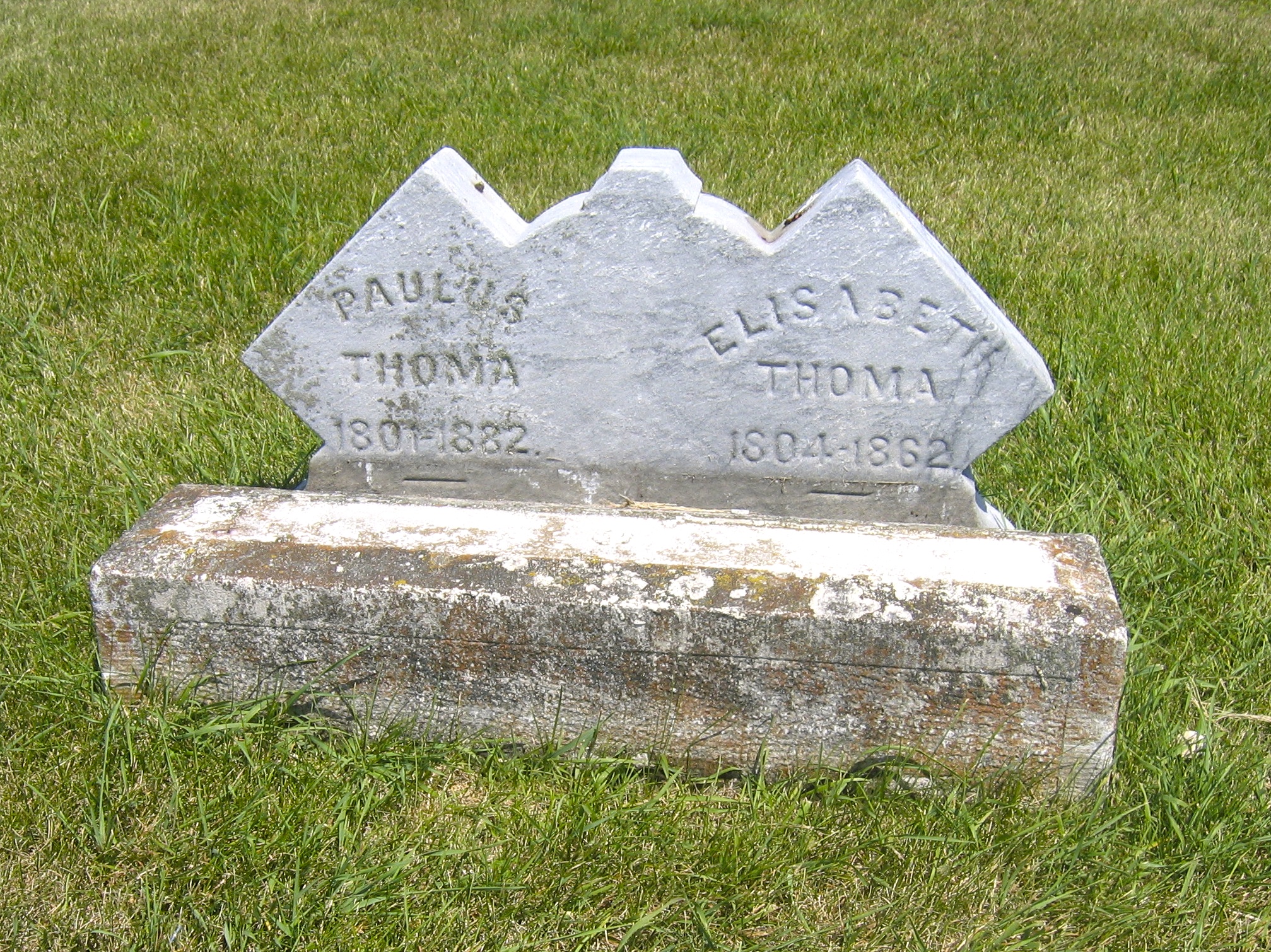
July 009

Grave of Paulus Thoma (1801-1882) and Elisabeth Thoma (1804-1862), Garnavillo City Cemetery, Garnavillo, Clayton County, Iowa; digital image 2007, privately held by Melanie Frick, 2013.

The mid-nineteenth century saw what could be considered a virtual exodus of families who left their home village in Bavaria for the farmland of northeastern Iowa. Paulus and Elisabeth (Schmidt) Thoma of Weißenstadt, Wunsiedel, Bavaria, Germany were among them. Paulus was a weaver by trade,1 and together, he and Elisabeth raised eight children: John Conrad, William Henry, Anna Rosina, Frederick, Anna Sabina, Maria Magdalena, Ursula Pauline, and Anna Margaretha.

In 1852, Paulus and Elisabeth traveled with seven of their children from Bremen to New Orleans, undoubtedly an exhausting journey. They were accompanied on the Uhland by ten others from Weißenstadt, a small sampling of the immigrant families who had likely been linked for generations and chose to resettle together in America.2 Upon arrival in New Orleans, the Thoma family traveled by way of the Mississippi River to reach their destination of northeastern Iowa.3 Several years later, Paulus and Elisabeth were joined by their eldest son and his family.4

Once settled, Paulus apparently put his weaving aside for a farmer’s life in Garnavillo, Clayton County, Iowa. I thought perhaps he would have raised sheep for wool, but, at least as of 1860, crops of wheat, Indian corn, and oats seem to have been his primary focus. At this time, he farmed over two hundred acres of improved land.5

Elisabeth (Schmidt) Thoma passed away in 1862, after only ten years in Iowa.6 Five years after her death, Paulus, now well into his sixties, remarried to Maria Krueger.7 By 1870, Paulus was declared on the census to be an “invalid” due to “old age.”8 He survived for more than a decade longer, however, although his “old age” was noted again on the 1880 U.S. census.9 Ultimately, he survived his first wife by twenty years; Paulus passed away in 1882, and he and Elisabeth share a headstone at the Garnavillo City Cemetery in Garnavillo, Clayton County, Iowa.10


SOURCES
1 “New Orleans, Passenger Lists, 1813-1945” digital images, Ancestry.com (http://www.ancestry.com : accessed 1 November 2013), manifest, Uhland, Bremen, Germany to New Orleans, arriving 18 June 1852, Paulus Thoma; citing National Archives microfilm M259, roll 36.
2 “New Orleans, Passenger Lists, 1813-1945” digital images, Ancestry.com, manifest, Uhland, Bremen, Germany to New Orleans, arriving 18 June 1852, Paulus Thoma.
3Diane Haddad, “Riverboat Migration Records,” Family Tree Magazine (http://www.familytreemagazine.com/article/Whatever-Floats-Your-Riverboat : accessed 1 November 2013).
4 “New York, Passenger Lists, 1820-1957” digital images, Ancestry.com (http://www.ancestry.com : accessed 30 October 2013), manifest, Anna Delano, Bremen, Germany to New York, arriving 23 June 1855, J.C. Thoma; citing National Archives microfilm M237, roll 153.
5 1860 U.S. census, Clayton County, Iowa, agriculture schedule, Garnavillo, p. 5 (penned), line 11, Paul Thoma; digital image, Ancestry.com (http://www.ancestry.com : accessed 23 October 2013), citing “Selected U.S. Federal Census Non-Population Schedules, 1850-1880.”
6 Grave of Elisabeth [Schmidt] Thoma, 1804-1862, Garnavillo City Cemetery, Garnavillo, Clayton County, Iowa; digital image 2007, privately held by Melanie Frick, 2013.
7 “Iowa, County Marriages, 1838-1934,” index, FamilySearch (https://familysearch.org : accessed 01 Nov 2013), Paulus Thoma and Mary Krueger, 1867.
8 1870 U.S. census, Clayton County, Iowa, population schedule, Garnavillo, p. 17 (penned), dwelling 116, family 114, Paul Toma; digital image, Ancestry.com (http://www.ancestry.com : accessed 23 October 2013), citing National Archives microfilm M593, roll 383.
9 1880 U.S. census, Clayton County, Iowa, population schedule, Garnavillo, Enumeration District (ED) 133, p. 362 (stamped), dwelling 207, family 218, Paul Thoma; digital image, Ancestry.com (http://www.ancestry.com : accessed 23 October 2013), citing National Archives microfilm T9, roll 333.
10 Grave of Paulus Thoma, 1801-1882, Garnavillo City Cemetery, Garnavillo, Clayton County, Iowa; digital image 2007, privately held by Melanie Frick, 2013.

A Hand-Colored Photograph

My great-grandmother kept this hand-colored photograph of her mother in a small, red velvet frame on her writing desk. Anna Leota Fenton of Ashton, Osceola County, Iowa married in the spring of 1902 when she was twenty-two years old.1 She may have had her photograph taken at the time of her marriage.

AnnaLeotaFenton

Anna Leota (Fenton) Thoma photograph, ca. 1902, Ashton, Iowa; digital image 2001, privately held by Melanie Frick, 2013.

Anna Leota Fenton, who typically went by her middle name or the nickname “Ota,” poses demurely in this photograph. The hand-colored copy comes with no suggestions as to the photographer or the original medium, but it seems to have been a typical portrait of the day. Did Leota request that the photograph be colored, or was this arranged later by her daughter?

The photograph has been colored in a way that looks quite natural.2 Leota’s eyes are blue-green, and her hair a light brown. Her dress has been colored a deep mauve or soft burgundy, perhaps the original color of the dress, perhaps not, and she wears a matching ribbon in her hair. There is a small gold-colored brooch at the side of her throat.

Leota’s hairstyle is one that was popular at the turn of the twentieth century. It is full and soft around her face, with a tendril or two escaping, and it is fastened in a high bun in the back. Although few details of her dress can be seen in this head-and-shoulders pose, her dress does have a high collar to the chin and full sleeves. The bodice appears to be “pouched” with soft vertical pleats.3

How do you feel about colorized photographs? This week, I read here about the Subreddit page History in Color, which features historical photographs colorized by both amateurs and professionals. Some of them are really beautiful, making scenes from the Civil War or the Great Depression look like they took place yesterday. These photographs could be great for engagement in the classroom – some students might relate more to history if all of the pictures weren’t in black and white!


SOURCES
1 “News of Osceola County,” Sibley (Iowa) Gazette, 27 March 1902, p. 8, col. 1.
2 Maureen A. Taylor, Family Photo Detective (Cincinnati: Family Tree Books, 2013), 62.
3 Taylor, Family Photo Detective, 112.

Vintage Swimwear

This is a fun photograph that I thought I would share before the summer completely slips away. This snapshot was labeled on the back, and, years ago, I was also able to hear its story from my late great-grandmother, Fern Lavonne (Thoma) Adam of Sioux City, Woodbury County, Iowa. Well, more than its story, I remember her laughing about her bathing suit! The photograph was taken in 1924, at the river near Scribner, Dodge County, Nebraska.

Fern Lavonne (Thoma) Adam photograph, 1924; digital image 2010, privately held by Melanie Frick, 2013.

Fern Lavonne (Thoma) Adam photograph, 1924, Scribner, Nebraska; digital image 2010, privately held by Melanie Frick, 2013.

Fern lived in Scribner, where her father opened a grocery store, for a few years in the early 1920s. She remembered attending dances there, as well as learning to drive. Her father gave her a lesson immediately when she remarked that she would like to learn, and the next day, when she asked for another lesson, he told her to go ahead on her own!1 Apparently, Fern also enjoyed taking advantage of the opportunity to swim in the Elkhorn River during her short time in Scribner. She is pictured here at center; at left is Lucille Romberg, and at right is Helen Kellner. These young ladies must have been good friends in the summer of 1924, when Fern would have been sixteen years old.

In order to learn more about vintage bathing suits, I turned to Threaded, the Smithsonian’s blog about fashion history. From there I learned that a company by the name of Jantzen devised a “swimming suit” made of wool in 1915, and that by 1921, the name had stuck.2 My great-grandmother and her friends appear to be wearing typical knitted wool swimsuits of the era, comprised of long, sleeveless, v-necked tunics, fitted shorts, and, in my great-grandmother’s case, knee high stockings, rolled at the top. The girls wear their hair inside knit swimming caps, the one on the left being slightly more elaborate with a small brim. They all squint in the sun and lean together for the photograph, happy and relaxed on a summer’s day.

Have you come across any photographs featuring early styles of swimwear?


SOURCES
1 Fern Lavonne (Thoma) Adam, conversations with the author, 2001.
2 “The Swimsuit Series, Part 1: A History of Women’s Suits,” Threaded, 22 June 2012 (http://blogs.smithsonianmag.com/threaded/2012/06/the-swimsuit-series-part-1-a-history-of-womens-suits/ : accessed 6 September 2013).