Author Archives: Melanie Frick

Unknown's avatar

About Melanie Frick

Melanie Frick, MLS, holds a Certificate in Genealogical Research and has been researching her family history for two decades. An Iowa native with Midwestern roots, she lives in the Pacific Northwest.

A Glimpse Inside the Family History Library

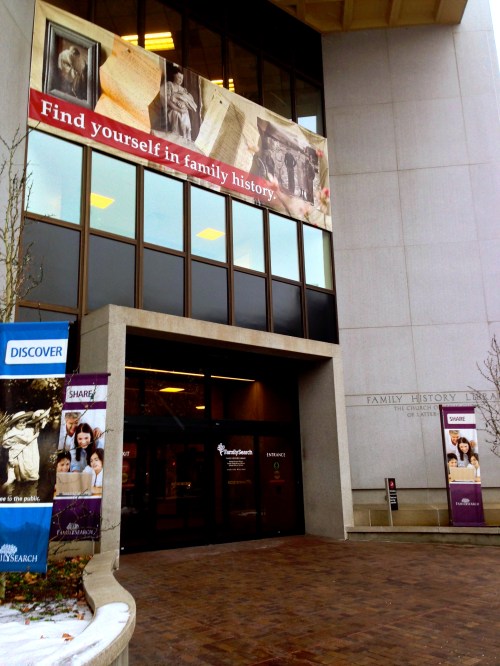
During my time in Salt Lake City last week for the APG Professional Management Conference, I was able to spend a day at the Family History Library. This was, at the same time, both very exciting, and very overwhelming!

FHLBefore going, I had reviewed these tips for research at the Family History Library, and the volunteers were so helpful that I was able to get to work within minutes. I had come prepared with a list of microfilms that I hoped to look at, and I checked up on the originals of many documents that I’d found indexed elsewhere – usually verifying the information in the index, but, in at least one example, finding an important error. I also spent hours poring through a single microfilm for the name of one of my most elusive ancestors, who, according to the microfilm index, should have been in there twice. Finally, bleary eyed and hungry, I had to admit that I’d come up empty, and decided that that is one microfilm that I will be ordering to view again at my local Family History Center, this time with fresh eyes.

So, with some successes and some frustrations, it was in many ways a typical day of research – but for once, every microfilm I could possibly want was at my fingertips!

2014 APG Professional Management Conference

Greetings from snowy Salt Lake City! I’ve had an exciting few days here at the Family History Library and the APG Professional Management Conference, hosted by the Association of Professional Genealogists.

IMG_1980The conference opened yesterday after lunch with an introduction from Kimberly Powell, APG President, and a lecture from D. Joshua Taylor, who recently appeared in Genealogy Roadshow, “New Industries, New Worlds: Working for Entertainment and Corporate Clients.” As an audience member pointed out, much of his advice would also be applicable to everyday client research. For the remainder of the afternoon, I enjoyed Harold Henderson’s workshop, “The Story of Jethro’s Story: The Making of a NGSQ Article.” Writing for the National Genealogical Society Quarterly is definitely one of my long-term goals, and it was extremely helpful to have the process of crafting a research article broken down in a frank discussion.

Today, I was able to fit in a few more worthwhile lectures. Judy G. Russell, The Legal Genealogist, opened with “‘Good Name in Man or Woman’ – Protecting a Professional Reputation.” Judy is a delightful speaker and she raised valid points for genealogy business owners. I also knew that I would learn a lot from CeCe Moore at “Advanced DNA for Professionals – How Professionals Conduct a DNA Study,” and I certainly did. The number of DNA tests I would like family members to take is always growing! I rounded out the day with “The Pursuit from Genealogy Hobbyist to Professional,” by Claire V. Brisson-Banks, a thoughtful lecture on “Discovering and Communicating Your Unique Value: Personal Branding for Professional Genealogists” by Melissa A. Johnson, and “Gaining Recognition in the Genealogical Community: Climbing the Professional Ladder” by Jean Wilcox Hibben.

One of the greatest benefits of this conference was the opportunity to meet so many of the genealogists who inspire me in person! Both the dessert reception on Friday night and the Saturday luncheon were lots of fun, and it was convenient having all of the conference events take place at the hotel. (The Family History Library, by the way, was only a five minute walk away – the location couldn’t have been better!)

Would I recommend the APG Professional Management Conference? Absolutely! It’s smaller than other conferences I’ve attended, which makes networking and quality discussion come easily, and the lecture topics are highly relevant to genealogy professionals. I hope to return next year!

An Ancestor with an Alias

When I learned that George Hiram Thoma of Garnavillo, Clayton County, Iowa used an alias as a young man, it took me by surprise. He was born to Fred and Matilda (Hammond) Thoma in 1880,1 and the state census indicates that he remained in his home county in northeastern Iowa at least until 1895.2 At some point thereafter, according to family lore, George left home and bicycled across Iowa. Whether he went by bicycle or not, it was said that his move may have been spurred on by his poor relationship with his father.3

GeorgeHiramThoma

George Hiram Thoma, seated left, with an unidentified young man, ca. 1900; digital image 2013, privately held by Melanie Frick, 2014.

Records place George across the state in northwestern Iowa on 23 March 1902, at which time, using the name George A. Neilson, he married Anna Leota Fenton in Ashton, Osceola County, Iowa.4 This was no trick of penmanship or recorder’s error; three affidavits, written by George, his mother, and his younger brother, were attached to the marriage document decades later, each attesting to the fact that George A. Neilson and George Hiram Thoma were one and the same person.5 It is worth noting that George still named his correct place of birth and even the correct names of his parents on the original marriage document, with the exception, of course, of assigning the Neilson surname to them as well.6 Evidently, he was not prepared or had no reason to invent an elaborate backstory regarding his origins.

None of the affidavits, however, explained why George had married under an assumed name.7 One has to wonder whether his wife even knew what she was getting into! Prior to his marriage, I suspect that he might be found in the 1900 U.S. census as George Thoma, a clerk in Belden, Cedar County, Nebraska. Notably, he boarded with a family by the name of Nelson, and a Nielsen also resided in the household.8 Although this may or may not be the correct George Thoma, we do know that within weeks of his marriage, he moved to Center, Knox County, Nebraska, where he was an employee of the Edwards and Bradford Lumber Company.9

Within a few years of his marriage, George relocated with his family to Sioux City, Woodbury County, Iowa. There, his daughter’s birth was recorded with the surname Neilson,10 and according to the city directories, George continued to use his assumed name at least until 1909.11 I have been unable to locate the family in the 1910 U.S. census – they had likely left Sioux City by that time to return to Nebraska, where they moved from place to place for the next decade. However, they had certainly reverted to the use of the Thoma surname no later than World War I.12

Was this alias purely symbolic, in order to emphasize George’s separation from his father, or, perhaps, the ties that he forged with another family? Or was it part of an effort to hide, whether from his father, from love, or from the law? This is one family mystery that I would love to solve!

Continue reading

A New Year’s Eve Party?

HenryMelanieAdamParty_2

Henry and Melanie (Lutz) Adam, ca. 1910, Sioux City, Woodbury County, Iowa; digital image 2010, privately held by Melanie Frick, 2014.

Happy New Year! …or at least, I think that’s what might have been said when this photograph was taken about a century ago. Featured are Henry and Melanie (Lutz) Adam of Sioux City, Woodbury County, Iowa, with Henry seated at lower right and Melanie in white above his raised hand.

Could this photograph have been taken at a New Year’s Eve party? The curtains are drawn in the living room or parlor where the photograph was taken, which suggests to me that it could be after dark. Furthermore, it’s clear that the alcohol is flowing. One man can be seen taking a drink, while several others clutch glasses and bottles. (Alas, I can’t make out the labels.) Nearly everyone wears some sort of silly hat made of cloth or paper, and only three older children are present in the photograph – no little ones.

Note that three of the men in front, including Henry, make a gesture with their thumbs to the sides of their noses and their fingers extended flat, pressed together. They aren’t quite thumbing their noses in the way that I have seen, so I wonder what this gesture might have meant.

Of the nineteen people gathered here, only Henry seems to be ready for the camera. Most, including Melanie, look to the side, perhaps at another photographer, or are caught in the midst of conversation. Whether this gathering was for New Year’s Eve or not, one can easily imagine the chaotic scene as an attempt was made to corral this lively group of friends for a memorable photograph. Cheers!

Warm Winter Furs

NormaThomaFernThoma1917

Norma Arlene Thoma and Fern Lavonne Thoma, ca. 1917-1918, Decatur, Burt County, Nebraska; digital image 2013, privately held by Melanie Frick, 2013.

Although I remember when my great grandmother first showed me this photograph, years ago, I wish I could remember more of what she had to say about it. I believe that the furs that she and her younger sister wore may have been a special gift. From left to right are sisters Norma and Fern Thoma of Decatur, Burt County, Nebraska, most likely photographed during the winter of 1917-1918. At this time, Fern would have been ten years old,1 and Norma would have been a few months shy of her third birthday.2 They lived in town, a community of eight hundred, as their father was a grocer.3

The girls seem to have been posed specifically to show off their matching fur hats, collars, and muffs. Have you ever felt a fur muff? They really are very warm, perfect to shelter little fingers from the biting cold of a Nebraska winter. Norma and Fern are also bundled into long wool coats, and Fern wears what seem to be stylish gaiters or “spats” over her shoes, such as those seen at The Quintessential Clothes Pen: An Exploration of Historic Costume.

With the holidays approaching, I can’t help but wonder if these furs might have been a Christmas gift, or if the girls may have worn them in honor of the day. In that spirit, I would like to take this opportunity to wish very happy holidays to all of my readers, as well as to offer a big thank you for following The Homestead!


SOURCES
1 Iowa State Department of Health, birth certificate no. 419687 (1907, issued 1942), Fern L. Thoma; Division of Vital Statistics, Des Moines.
2 Nebraska State Department of Health, birth certificate no. 2-84091 (1915, issued 1943), Norma A. Thoma; Division of Vital Statistics, Lincoln.
3 Bill Weaver, “Nebraska State Gazetteer and Business Directory – 1917 – Decatur,” NE GenWeb Project: Burt County, Nebraska On-Line Resources (http://www.rootsweb.ancestry.com/~neburt/olres/gazbus17.html : accessed 15 December 2013), entry for Geo. H. Thomas [Thoma].

A Yearbook from the Southern State Normal School, Springfield, South Dakota, 1916

The Southern State Normal School in Springfield, South Dakota, also called the Springfield Normal School, offered a college education for those who had completed high school. A First Grade Teaching Certificate could be acquired in just one year of study, while a State Certificate and Life Diploma could be acquired in two years.1 If your ancestor was a teacher in South Dakota, he or she may have attended the Southern State Normal School or a similar institution of higher learning.

Echo1916SouthernStateNormalSchool

The Echo, Vol. 1 (Springfield, South Dakota: Southern State Normal School, 1916); private collection of Melanie Frick. This volume was generously shared with the author by a relative.

I am fortunate to have a copy of The Echo, a yearbook put forth by the Southern State Normal School in 1916. The Echo offers a treasure trove of information about those who were affiliated with the school from 1915-1916, as it includes photographs of most of the students and faculty as well as details about everything from an individual’s year of study, to school clubs and organizations, to inside jokes among classmates shared in the form of clever poems and quotations.2

For example, I learned that when sisters Andrea and Louise Nelson attended college there, they were both members of the Y.W.C.A. and the Southern Normal Literary Society, where Andrea served a term as Secretary.3 What startled me, however, was a class poem that named, “Louise, so dumpy and fat.”4 I do hope that was a joke well taken, because while Louise didn’t necessarily have a willowy figure, she was quite pretty and stylish! The Echo shared that she also played on the girls’ basketball team.5

As copies of The Echo are likely not accessible to most researchers, I would like to offer look-ups for anyone seeking information about the individuals listed below, who were named in The Echo as faculty, students, or graduates of the Southern State Normal School at Springfield, Bon Homme County, South Dakota:

Continue reading

The Traveling Photographer’s Ram

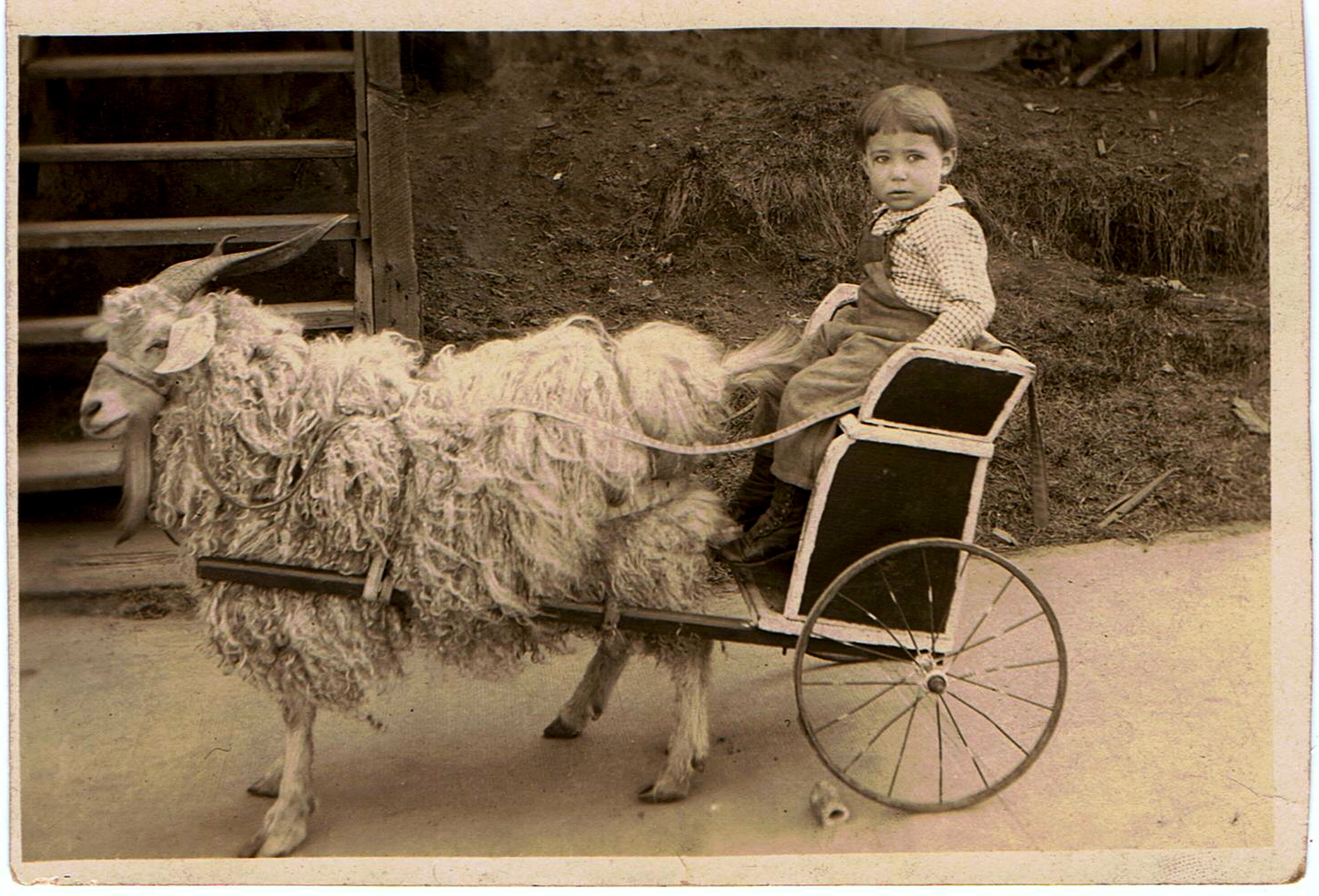
LeonAdam

Leon Francis Adam, ca. 1916, Sioux City, Woodbury County, Iowa; digital image 2010, privately held by Melanie Frick, 2013.

Only a handful of photographs exist of little Leon. He was barely five years old when he tumbled into a bonfire and died from his burns.1 This photograph, however, taken when he was perhaps three years old, gives a glimpse into his brief but surely happy childhood.

Leon Francis Adam was born in Sioux City, Woodbury County, Iowa, on 23 August 1913.2 He was the second and youngest son of Henry Joseph and Melanie Veronica (Lutz) Adam.3 It wasn’t uncommon at this time for photographers to travel through towns with some sort of enticing animal in tow – often a pony,4 or, in this case, a wooly ram pulling a two-wheeled cart. Mothers must have smiled to see their children flock to the attraction, making their parting with a few pennies for a photograph that much easier. This particular photograph is a picture postcard, a format that reached its peak circa 1905-1920.5

Leon is wearing simple play clothes – tiny overalls, a check shirt, and black, button-up shoes. His expression is cautious, and he appears to look not at the photographer but at someone off to the side, likely his mother, offering encouragement. Note the bone placed in front of the wheel of the cart, perhaps necessary to avoid a situation of a runaway ram!

Did your young ancestors ever pose with a pony, ram, or other barnyard animal?


SOURCES
1 “Plays in a Fire; Lad Dies of Burns,” unidentified newspaper from Sioux City, Iowa, September 1918.
2 Grave of Leon Adam, 1913-1918, Calvary Cemetery, Sioux City, Woodbury County, Iowa; image date unknown, privately held by Melanie Frick, 2013.
3 “Plays in Fire; Lad Dies of Burns,” 1918.
4 “Wayback Wednesday: Remembering the Pony Photographer” The Family Curator, 14 August 2013 (http://www.thefamilycurator.com/home/2013/8/14/wayback-wednesday-remembering-the-pony-photographer.html : accessed 13 December 2013).
5 Maureen A. Taylor, Family Photo Detective (Cincinnati: Family Tree Books, 2013), 65.

Tombstone Tuesday: Hedwig Cichos

“She was a good old German,” recalled one of the grandchildren of Hedwig “Hattie” (Cichos) Lutz Rindfleisch of Minnesota Lake, Faribault County, Minnesota.1 Raised in what is now Poland, Hattie came to America in 1873 at the age of eighteen.2 Although she married twice, neither of her husbands was buried at her side.

GraveHedwigCichosLutzRindfleish

Grave of Hedwig (Cichos) Lutz Rindfleisch (1855-1944), Saint John the Baptist Catholic Cemetery, Blue Earth County, Minnesota; image date unknown, privately held by A.S. [personal information withheld], 2013.

Hattie’s first husband, Joseph Lutz,3 died of tuberculosis in 1887.4 According to family lore, a wooden cross once marked his grave, but it has long since disappeared.5 Hattie was still a young woman at this time, however, and with four children at home, she made what was no doubt a practical decision to remarry less than a year after his death.6 Unfortunately, Albert Rindfleisch, with whom she had five more children, was said to have struggled with alcoholism.7 By 1900, he had left his family, and he allegedly made his way to Milwaukee.8 Records indicate that he may have wound up at the Milwaukee County Infirmary, formerly known as the Milwaukee County Almshouse and Poor Farm.9

In his absence, Hattie supported her family as a seamstress, and, with three acres of land, proved to be remarkably self-sufficient. She kept a milk cow and chickens, saving the egg money for groceries, and she also raised pigs. She prepared her own ham, bacon, sausage, braunschweiger, and pickled pigs feet. Hattie surely also grew her own vegetables; one of her grandchildren remembers her making sauerkraut for what must have been hearty, home-cooked meals.10

Hattie was eighty-nine years old when she passed away on 10 November 1944. She is buried at Saint John the Baptist Catholic Cemetery on the border of Blue Earth County and Faribault County, Minnesota.11


SOURCES
1 William “Bill” Catlin, conversation with the author, September 2002; notes in author’s files. The late Mr. Catlin was the grandson of Hedwig (Cichos) Lutz Rindfleisch and was acquainted with her until her death, at which time he was thirty years old.
2 “New York, Passenger Lists, 1820-1957,” digital images, Ancestry.com (http://www.ancestry.com : accessed 9 December 2013), manifest, S.S. Hansa, Bremen to New York, arriving 13 November 1873, Hedwig Cluchas [Cichos]; citing National Archives microfilm M237, roll 384.
3 “Minnesota, Marriages, 1849-1950,” index, FamilySearch (https://familysearch.org : accessed 9 Dec 2013), Joseph Lutz and Hedwig Joice or Tchrichor [Cichos], 19 April 1875.
4 “Mr. Joseph Lutze,” Wells (Minnesota) Advocate, 5 May 1887.
5 William “Bill” Catlin, conversation with the author, 2002.
6 “Minnesota, County Marriages, 1860-1949,” index and images, FamilySearch (https://familysearch.org : accessed 9 Dec 2013), Albert Rindfleisch and Hedwig Lutz, 29 December 1887.
7 William “Bill” Catlin, conversation with the author, 2002.
8 1900 U.S. census, Faribault County, Minnesota, population schedule, Minnesota Lake, Enumeration District (ED) 92, sheet 10-B, p. 4834 (handwritten), dwelling 178, family 178, Hattie Rindfleisch; digital image, Ancestry.com (http://www.ancestry.com : accessed 9 December 2013), citing National Archives microfilm T623, roll 763.
9 1930 U.S. census, Milwaukee County, Wisconsin, population schedule, Wauwatosa, Enumeration District (ED) 40-385, sheet 7-B, p. 5401 (handwritten), Milwaukee County Infirmary, Albert Rindfleisch; digital image, Ancestry.com (http://www.ancestry.com : accessed 9 December 2013), citing National Archives microfilm T623, roll 763.
10 William “Bill” Catlin, conversation with the author, 2002.
11 Find A Grave, Inc., Find A Grave, digital image (http://www.findagrave.com : accessed 9 December 2013), photograph, Hedwig B. Rindfleisch (1855-1944), Memorial No. 23967168, Saint John the Baptist Catholic Cemetery, Blue Earth County, Minnesota; photograph by judyvv.

A Mystery Solved: Identifying a Family Photograph

Last year, my cousin’s wife and I embarked on a combined research effort to track down the descendants of Christian Jens Jacobsen Walsted (1833-1899) of Aalborg, Denmark. Christian, a shoemaker,1 married twice, first to Mariane Jensen,2 and later to Johanne Marie Larsen.3 In all, seven of his children survived to adulthood, and all eventually immigrated to America. In 1900, less than a year after Christian’s death, Johanne joined several of their children in western Iowa.4

This unidentified photograph was shared with my cousin’s wife by one of the many helpful descendants with whom we made contact.5 In all of our hours of research, we had never thought that we might come up with a photograph of our central subjects! Given that this photograph was taken in Aalborg, we immediately felt that it could be Christian and his second wife, Johanne. A librarian at the Museum of Danish America thoughtfully suggested that it might have been taken to commemorate their twenty-fifth wedding anniversary. This would date it to 1892.6

ChristianWalstedJohanneLarsdatter1892

Christian Jens Jacobsen and Johanne Marie (Larsen) Walsted, ca. 1892, Aalborg, Denmark; privately held by L.V. [personal information withheld], 2013.

At the time of their anniversary, Christian would have been fifty-eight years old,7 and Johanne would have been fifty-five.8 These seem to be plausible ages for the couple in the photograph, particularly given the gray in the man’s beard. The woman wears a flattering black dress and a headpiece over her hair. Her sleeves are puffed, but not in an exaggerated fashion.9 The man wears a three-piece suit and what appears to be a watch chain. He sits in a finely carved chair at a studio, which, according to the photograph, was located at Slotsgade 15 in Aalborg. A photographer allegedly operated at this location from 1891-1910.10

Later, I would hear from another descendant who possessed an identified copy of this same photograph,11 verifying our suspicion that it was, indeed, a photograph of Christian and Johanne (Larsen) Walsted. Success!

If you have a mystery photograph, be sure to find out if any of your relatives also have a copy. If you are able to locate a copy that is identified, and if the identification matches the clues in the photograph, you’re in luck. However, even if you come across a copy that is not identified, you may be able to narrow down who is in the photograph based on the branch of the family that held it, or who initially passed it down.


SOURCES
1 Abbey of Our Lady Parish (Aalborg, Denmark), Christian Jens Jacobsen Valsted (1899).
2 Dronninglund Parish (Dronninglund, Denmark), Christian Jens Jacobsen Valsted and Mariane Jensen (1863).
3 Dronninglund Parish (Dronninglund, Denmark), Christian Jens Jacobsen Valsted and Johanne Larsen (1867).
4 “New York, Passenger Lists, 1820-1957” digital images, Ancestry.com (http://www.ancestry.com : accessed 6 December 2013), manifest, S.S. Norge, Copenhagen to New York, arriving 1 May 1900, Johanne Walsted; citing National Archives microfilm T715, roll 119.
5 J.W. [personal information withheld], to Melanie Frick, e-mail, 27 May 2012, “Photo,” Personal Correspondence, Walsted Family, Frick Research Files; privately held by Frick.
6 M.M. [personal information withheld], The Danish Immigrant Museum [now Museum of Danish America], to Melanie Frick, e-mail, 30 May 2012, “Danish Wedding Photograph,” Personal Correspondence, Walsted Family, Frick Research Files; privately held by Frick.
7 Dronninglund Parish (Dronninglund, Denmark), Christian Jens Jacobsen Valsted and Johanne Larsen (1867).
8 Dronninglund Parish (Dronninglund, Denmark), Christian Jens Jacobsen Valsted and Johanne Larsen (1867).
9 Joan Severa, Dressed for the Photographer: Ordinary Americans and Fashion, 1840-1900 (Kent, Ohio: Kent State University Press, 1995), 458.
10 “Fotografer,” Aalborg Leksikon (http://aalborgleksikon.dk/Fotografer.htm : accessed 6 December 2013).
11 D.A. [personal information withheld], to Melanie Frick, e-mail, 1 June 2012, “Walsted Photo,” Personal Correspondence, Walsted Family, Frick Research Files; privately held by Frick.

The Citizens of the Big Creek Settlement: From Reconstructed Census Records to a Legislative Petition

In September, I attended the Illinois State Genealogical Society’s free webinar, “’To the Honorable, the General Assembly’ – The Treasure Trove in Legislative Petitions,” presented by the always informative Judy G. Russell of The Legal Genealogist.1

Judy’s advice about how and where to find legislative petitions was helpful, as was her point that one won’t often find an indexed list of the names of all of the signers of a given petition (darn!). Instead, she suggested, look specifically for petitions that were created where your ancestor lived, and that concerned a cause that your ancestor was likely to have cared about.2

It was also emphasized how handy petitions can be when they fall between a census year.3 In fact, the names of the signers on some petitions have also been used to reconstruct early census records. I recently noticed an instance of this when searching for my Stilley ancestors of southern Illinois on Ancestry.com. My search brought me to “U.S. Census Reconstructed Records, 1660-1820.”4

In one example, several men with the surname Stilley are listed as having resided at the Big Creek Settlement, Illinois Territory, in 1810. However, a closer look at the entry shows that the men were named on a petition dated 6 December 1812.5 This petition concerned the desire of the “poor Industrious Inhabitants, faithful Citizens of the United States” to acquire land west of the Ohio and Mississippi rivers, and a proposition for the sale of no more than 200 acres of said land to each male citizen over the age of eighteen, or each female head of household, for a cost of twelve and a half cents per acre. Allowing the inhabitants to acquire land, the petitioners continued, would further serve to “prevent Rebellions, remove animosities, Cement an union, and promote happiness” throughout the United States.6

Although, to my knowledge, none of these particular Stilleys were my direct ancestors, the presence of these names on the petition suggests to me that, at the very least, some of the extended family had started to settle in this western territory as early as 1812, perhaps paving the way for other members of the Stilley family to follow.


SOURCES
1 Judy G. Russell, “’To the Honorable, the General Assembly’ – The Treasure Trove in Legislative Petitions,” Illinois State Genealogical Society: ISGS Webinars, 2013.
2 Judy G. Russell, “’To the Honorable, the General Assembly’ – The Treasure Trove in Legislative Petitions.”
3 Judy G. Russell, “’To the Honorable, the General Assembly’ – The Treasure Trove in Legislative Petitions.”
4 “U.S. Census Reconstructed Records, 1660-1820,” database, Ancestry.com (http://www.ancestry.com : accessed 3 December 2013); citing Territorial Papers of the United States, vol. 16, p. 274.
5 “U.S. Census Reconstructed Records, 1660-1820,” database, Ancestry.com (http://www.ancestry.com : accessed 3 December 2013), entries for David Stilley, John Stilley, and Stephen Stilley, 1810, Big Creek Settlement, Illinois Territory; citing Territorial Papers of the United States, vol. 16, p. 274.
6 “To James Madison from the Citizens of the Big Creek Settlement, 6 December 1812 (Abstract),” Founders Online, National Archives (http://founders.archives.gov/documents/Madison/03-05-02-0396 : accessed 3 December 2013); The Papers of James Madison, Presidential Series, vol. 5, 10 July 1812–7 February 1813, ed. J. C. A. Stagg, Martha J. King, Ellen J. Barber, Anne Mandeville Colony, Angela Kreider, and Jewel L. Spangler (Charlottesville: University of Virginia Press, 2004), pp. 485–486.