Category Archives: Photograph Analysis

A Wedding Party

Not everyone had a wedding portrait made. In my experience, it was even less common for a wedding portrait to include the wedding attendants or witnesses. However, when Henry Joseph Adam and Melanie Veronica Lutz married on 24 October 1905, they posed for a formal photograph with four attendants.

HenryAdamMelanieLutzWedding1905

Henry and Melanie (Lutz) Adam wedding photograph, 1905, Sioux City, Iowa; digital image 2010, privately held by Melanie Frick, 2013.

Melanie, the bride, appears to wear her brown hair loose behind her shoulders, unless this is an illusion created by a shadow. The dark material of her dress, featuring a pleated bodice and v-neck, contrasts with a high white collar. A decorative watch is pinned at her bodice, and a small brooch is at her throat. To the right, her attendant, Permelia Adam, wears a white pleated bodice with full sleeves and a large bow off-center at the collar. Blanche Adam also wears a white bodice, although it features decorative buttons and lace detail. An elegant string of pearls rests at her throat, above the high collar. Like Permelia, Blanche wears a large bow in her hair.

Henry, the groom, wears a dark suit with a crisp white collar and white bow tie. His suit fastens higher than those of his attendants; Theodore Adam wears a polka dot tie, and Herman Adam sports a vest and bow tie. The men have all combed their dark hair with side parts and fashionable waves.

Carnations were apparently in vogue in 1905, or perhaps they were a favorite of the bride. Melanie wears two long-stemmed white carnations, facing downward, pinned to her bodice. Henry wears one as well, although the stem is hidden by his lapel. Although Permelia seems to wear a carnation, the stem is so long that the blossom itself cannot be seen, and the male attendants wear darker flowers that are indistinct against their suits. Only Blanche goes without a flower.

The Adam-Lutz wedding was held at St. Jean the Baptiste Catholic Church in Sioux City, Woodbury, Iowa on a Tuesday morning. Forty guests attended, the majority of whom were relatives.1 As Melanie had no family in the area, it is understandable that only her husband’s relations would have made up their wedding party; Permelia and Theodore were Henry’s brother and sister, while Blanche and Herman were his cousins. After the ceremony, an informal wedding breakfast was served at the home of Henry’s parents, which was decorated, unsurprisingly, with flowers.2


SOURCES
1“Adam-Lutze,” Sioux City (Iowa) Tribune, 28 October 1905.
2“Adam-Lutze,” Sioux City (Iowa) Tribune, 28 October 1905.

A Hand-Colored Photograph

My great-grandmother kept this hand-colored photograph of her mother in a small, red velvet frame on her writing desk. Anna Leota Fenton of Ashton, Osceola County, Iowa married in the spring of 1902 when she was twenty-two years old.1 She may have had her photograph taken at the time of her marriage.

AnnaLeotaFenton

Anna Leota (Fenton) Thoma photograph, ca. 1902, Ashton, Iowa; digital image 2001, privately held by Melanie Frick, 2013.

Anna Leota Fenton, who typically went by her middle name or the nickname “Ota,” poses demurely in this photograph. The hand-colored copy comes with no suggestions as to the photographer or the original medium, but it seems to have been a typical portrait of the day. Did Leota request that the photograph be colored, or was this arranged later by her daughter?

The photograph has been colored in a way that looks quite natural.2 Leota’s eyes are blue-green, and her hair a light brown. Her dress has been colored a deep mauve or soft burgundy, perhaps the original color of the dress, perhaps not, and she wears a matching ribbon in her hair. There is a small gold-colored brooch at the side of her throat.

Leota’s hairstyle is one that was popular at the turn of the twentieth century. It is full and soft around her face, with a tendril or two escaping, and it is fastened in a high bun in the back. Although few details of her dress can be seen in this head-and-shoulders pose, her dress does have a high collar to the chin and full sleeves. The bodice appears to be “pouched” with soft vertical pleats.3

How do you feel about colorized photographs? This week, I read here about the Subreddit page History in Color, which features historical photographs colorized by both amateurs and professionals. Some of them are really beautiful, making scenes from the Civil War or the Great Depression look like they took place yesterday. These photographs could be great for engagement in the classroom – some students might relate more to history if all of the pictures weren’t in black and white!


SOURCES
1 “News of Osceola County,” Sibley (Iowa) Gazette, 27 March 1902, p. 8, col. 1.
2 Maureen A. Taylor, Family Photo Detective (Cincinnati: Family Tree Books, 2013), 62.
3 Taylor, Family Photo Detective, 112.

A Trip to Koblenz

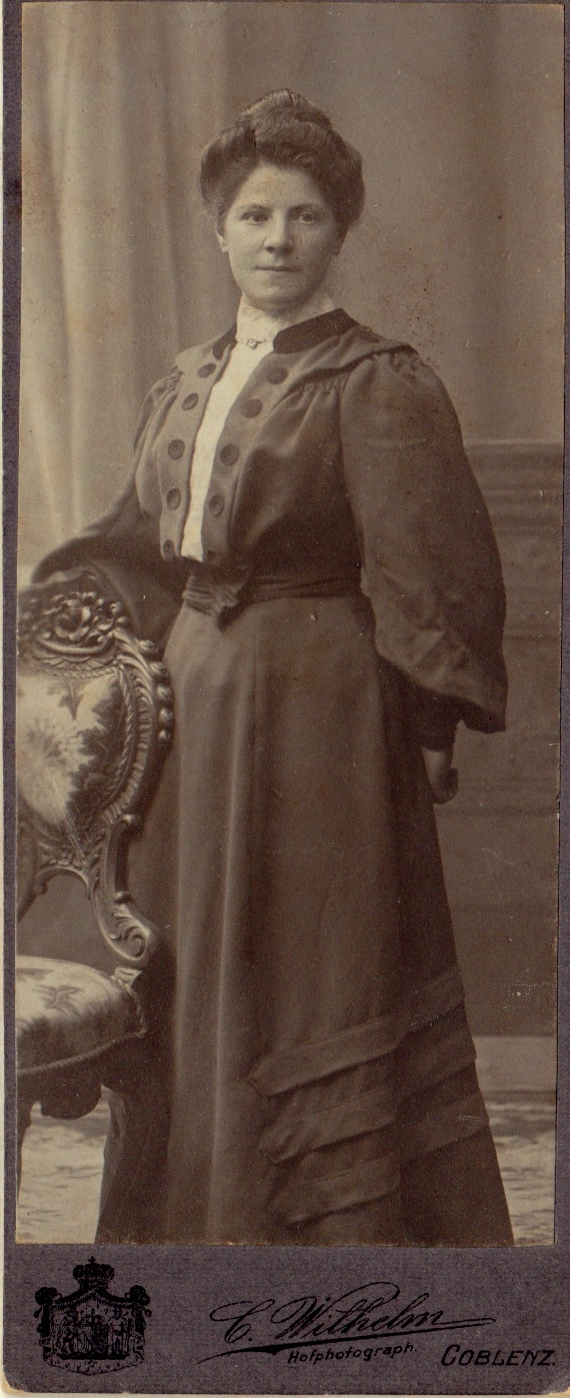
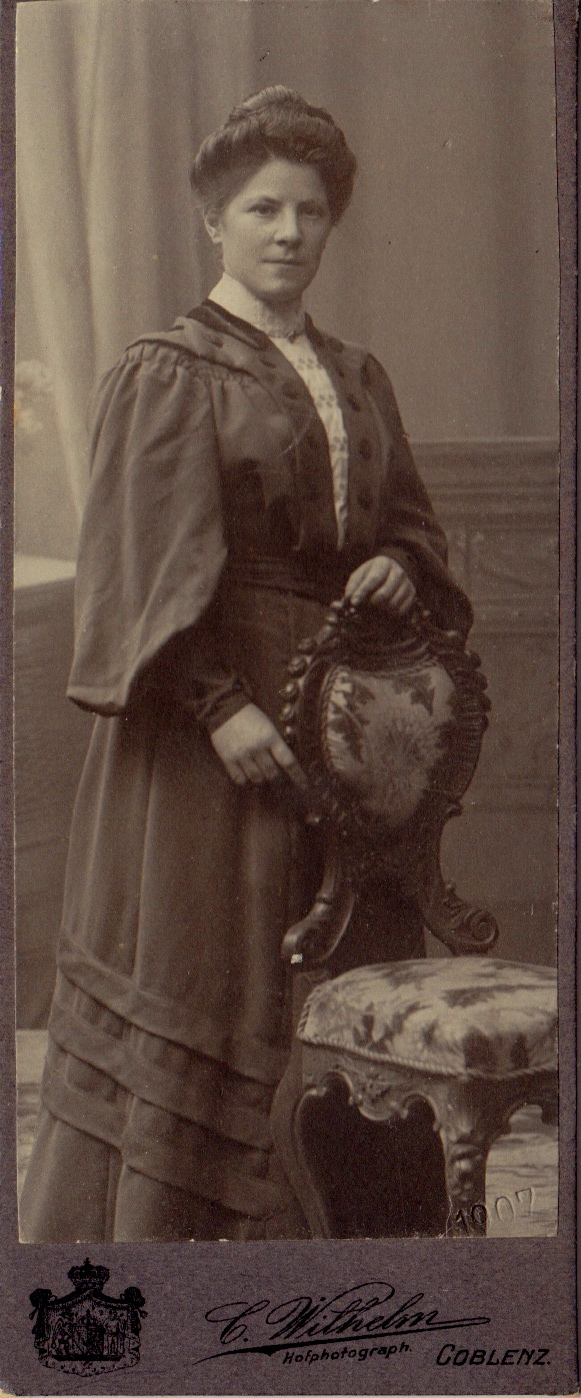
It may have been a special occasion when Ida (Heitz) Möll of Traben-Trarbach, Mosel, Germany, traveled fifty miles northeast to the town of Koblenz, also on the Mosel River, to have her photograph made. In 1907, Ida turned twenty-two.1 She would not marry until 1914, so her photograph was not taken in honor of her wedding.2 Perhaps she had traveled to Koblenz with her family, whether it was a semi-regular trip made for the purposes of shopping or visiting, or a rare chance to experience a larger city. Whatever the reason, in 1907, Ida made her way to Koblenz, likely by train, and came away with two photographs of herself in different poses.

ida_heitz_2 - Version 2

Ida (Heitz) Möll photograph, 1907, Koblenz, Germany; digital image 2011, privately held by Melanie Frick, 2013.

ida_heitz

What can we learn from these photographs? Ida was photographed at C. Wilhelm’s Hofphotograph studio in what was called, at that time, Coblenz. The photographs are narrower than others that I have seen before. The date “1907” is stamped in the lower corner of one of the photographs, a date that appears to be accurate based on the clothing Ida wears. Her dress, made of a heavy fabric that seems suited to cool weather, features a high collar, a skirt with soft gathers, a bodice that is puffed gracefully over her waistband, and sleeves that are very full at the top but fitted at the forearm. Her hair is styled in a Gibson Girl manner, puffed full around her face and coiled and fastened in the back.3 Note the side part struggling to make an appearance – perhaps she hadn’t been styling her hair in this manner for very long!

No rings adorn Ida’s fingers; in fact, the only jewelry she wears appears to be a brooch at her throat. Her dress, however, is quite fine, with circular embellishments on the bodice, a dark, possibly velvet collar and a shirtwaist featuring what looks like lace or cutwork. Even her skirt has matching fabric attached in a pattern of three bands.

In both photographs, Ida poses with an ornate, carved chair with a floral cushion. In one of the photographs, her gaze is direct; in the other, she looks slightly away from the camera. Her posture is excellent, her expression serious, and she looks older than her age. It’s clear that she made an effort to look her best for the occasion, whatever it may have been.


SOURCES
1 Heitz-Möll Family Tree; Frick Family; privately held [personal information withheld].
2 Heitz-Möll Family Tree; Frick Family; privately held [personal information withheld].
3 Maureen A. Taylor, Family Photo Detective (Cincinnati: Family Tree Books, 2013), 112.

Ada Zingara, Sideshow Performer

Tucked into the slots of an antique album filled with photographs of an unidentified family of Kaukauna, Outagamie County, Wisconsin, are several photographs of sideshow performers.1

Ada Zingara photograph, ca. 1890s, Chicago, Illinois; digital image 2013, privately held by Melanie Frick, 2013.

Ada Zingara photograph, ca. 1890s, Chicago, Illinois; digital image 2013, privately held by Melanie Frick, 2013.

The name Ada Zingara is handwritten on the back of this photograph, which features a woman posing in a rather scandalous fashion. Her dress is short, and she stands with one leg elevated on a bench as she pretends to fasten her pointy-toed shoe. Her stockings feature bold zigzags, and her dress is patterned as well. The bodice is trimmed with lace and loose cap sleeves, and the border of her lace-trimmed petticoat is also visible. She wears earrings, and a large, bejeweled crucifix lies at her throat. What is most striking is her hairstyle: Ada’s hair is teased into an Afro.

A search for Ada Zingara informed me that, in the early 1900s, she was a snake charmer. A 1906 sideshow advertisement specified that she had a den of “Five Big Anacondas.”2 However, I wondered why she was not posing with snakes in this picture, which was surely printed for publicity. And why did she have such a dramatic hairstyle?

Further research informed me that the circus great P.T. Barnum began exhibiting women with this hairstyle in the 1865, calling them Circassian Beauties. According to reports of the time, the women of the mountainous region near the Black Sea were particularly beautiful, and were prized by Turkish sultans who kidnapped them for their harems. Barnum capitalized on this sensational story, seeking first to purchase one of these slave girls abroad, and eventually settling for a local girl with teased hair (which was not an accurate Circassian style) who was merely marketed as a Circassian.3 Eventually, as the popularity of the Circassian Beauties waned, the women adopted other acts, including routines as equally alluring snake charmers.4

A close look at her face reveals that Ada Zingara is not very young. There are lines around her eyes, which gaze warmly at the camera. Her lips part in a faint smile, showing her teeth – and a possible missing tooth. Why did Ada turn to sideshows, and what became of her? What was her real name?

What I find especially interesting is the fact that this photograph occupies the very first page of the album – the page usually reserved for an important family member or the primary subject of the album.4 Of course, it’s possible that the photographs were rearranged in the years that this album made its way from its original home to the antique store. Whatever the case, it should be noted that this is not the only photograph of a circus or sideshow performer located in the album. The family of Kaukauna, Wisconsin must have enjoyed these attractions!

Did your ancestors collect photographs of circus or sideshow performers?


SOURCES
1 Unidentified Album of a Kaukauna, Wisconsin Family, ca. 1870-1900; privately held by Melanie Frick, 2013.
2 “Ada Zingara,” The Billboard, 14 April 1906, digital image, Old Fulton Post Cards (http://www.fultonhistory.com : accessed 27 September 2013).
3 Wikipedia (http://www.wikipedia.org), “Circassian Beauties,” rev. 18:32, 3 July 2013.
4 Katherine H. Adams and Michael L. Keene, Women of the American Circus, 1880-1940 (Jefferson, North Carolina: McFarland and Company, 2012), 142; digital images, Google Books (http://books.google.com : accessed 27 September 2013).
5 “’Reading’ A Family Photo Album,” Photo Detective with Maureen A. Taylor, 22 September 2013 (http://blog.familytreemagazine.com/photodetectiveblog/ : accessed 27 September 2013).


Edwardian Children’s Fashions

Gerald Joseph Adam photograph, ca. 1910-1911, Sioux City, Iowa; digital image 2010, privately held by Melanie Frick, 2013.

Gerald Joseph Adam photograph, ca. 1910-1911, Sioux City, Iowa; digital image 2010, privately held by Melanie Frick, 2013.

Gerald “Jerry” Adam of Sioux City, Woodbury, Iowa, is pictured here at left with his cousin, Alvin Joseph Bauer, and Alvin’s cousin, Helen Ann Thomas. The three toddlers stand on a sidewalk and hold hands, supporting the youngest in the middle. Jerry speaks to someone who has caught his attention outside of the frame, while Alvin gazes directly at the camera, wide eyed and solemn. Little Helen has a sweet smile for the photographer.

All of the children wear dark shoes and thick stockings. Jerry’s dress is the most elaborate, made of a light-colored plaid or gingham fabric with matching knickerbockers. It features two rows of white buttons, a bow at the throat, and a drop waist with a dark belt. His hair is curled in chin-length ringlets. The other, younger children are dressed more simply. Alvin wears a shapeless, light-colored gown without adornment. His hair is short, slickly parted on the side. Helen wears a similarly loose gown, though it appears to have a light calico pattern. Her dress has a collar, over which hangs a slim necklace and pendant. Her hair is also short, though wavy in texture.

In the Edwardian era, it continued to be common for young children, regardless of gender, to wear comfortable gowns. While it undoubtedly made changing soiled clothing a quicker task, dresses also allowed for easier movement. Pants – and haircuts – for little boys were often reserved for the time at which they would start school. In 1907, The Ladies’ Home Journal made a comparison of practical and impractical children’s clothing, writing:

“The first boy is in for a good time, and yet he looks the thorough little man with his bloomer trousers underneath his one-piece suit. Then look at his ‘nice’ but unhappy little companion who is made a ridiculous caricature of a man in his wee trousers so out of place on little legs.”1

When was this picture taken? Jerry was born in June 1908,2 Helen was born in August 1908,3 and Alvin was in August 1909,4. It should be noted that Alvin, the youngest, was already walking when this picture was taken, dating the picture no earlier than the late summer of 1910. Several additional clues date the photograph slightly later. The children do not wear coats, but appear to be dressed in layers. Furthermore, the trees in the background are completely bare. It seems most likely that this photograph was taken in the late fall of 1910 or the early spring of 1911.

Could the photograph have been taken on a holiday, perhaps Thanksgiving or Easter, when the families might have gotten together? Or was this simply a play date of a century ago? Regardless, I’m sure that my great grandfather would have had something to say about this photograph of him wearing long curls and a dress!

Have you found that your grandfathers wore dresses as children?


SOURCES
1 “Edwardian Clothing: Good Taste and Bad Taste in Dressing Children,” Victorian Magazine, (http://www.victoriana.com/edwardianfashions/edwardianchildren.php : accessed 20 September 2013).
2 “Iowa, Births and Christenings Index, 1857-1947,” database, Ancestry.com (http://www.ancestry.com : accessed 20 September 2013), entry for Herald [Gerald] Joseph Adam, 19 June 1908, Sioux City.
3 “Iowa, Births and Christenings Index, 1857-1947,” database, Ancestry.com (http://www.ancestry.com : accessed 20 September 2013), entry for Helen Ann Thomas, 22 August 1908, Sioux City.
4 “Iowa, Births and Christenings Index, 1857-1947,” database, Ancestry.com (http://www.ancestry.com : accessed 20 September 2013), entry for Alvin Joseph Bauer, 7 August 1909, Sioux City.

Identifying Photographs of the Civil War Era

Antique photographs can come with unique distinctions that suggest that they were made during the Civil War era. Neither of these photographs has been identified, but both come from a photograph album, purchased at an antique shop, with ties to the family of Jesse M. and Elizabeth Jane (Baker) Smith of Mount Pleasant, Henry County, Iowa.1 Both provide excellent examples of the ways in which Civil War era photographs might be marked or otherwise adorned.

Unidentified tintype of woman and child, ca. 1865; digital image 2012, privately held by Melanie Frick, 2013.

Unidentified tintype of woman and child, ca. 1865; digital image 2012, privately held by Melanie Frick, 2013.

The first image in the album, which features a woman and, presumably, her young daughter, is set inside an embossed white paper mat with a patriotic pattern of stars. An embossed notation on the side of this mat states that it was patented 7 March 1865, suggesting that the tintype was made shortly thereafter.2 The woman has crimped her hair at the temples in a manner that was popular in the latter half of the decade,3 and the young girl, perhaps six years old, wears her hair long and loosely curled. While the mother is corseted and in a fine gown supported by a hoop skirt, the daughter is dressed in a much looser – and more comfortable – style, though she also wears jewelry as well as what appears to be flowers or decorative combs in her hair.

The name “Laura” is handwritten in pencil near the top of the mat. Unfortunately, the only Laura that I could find directly related to the couple associated with this album was not born until 1867.4 Perhaps there was another Laura in the extended family, or perhaps it was labeled as such simply because it came from “Laura’s side of the family,” as opposed to, for example, the family of her spouse. Regardless, the relationship between the mother and daughter pictured here, dressed in their best during a tumultuous period in American history, can still be appreciated today.

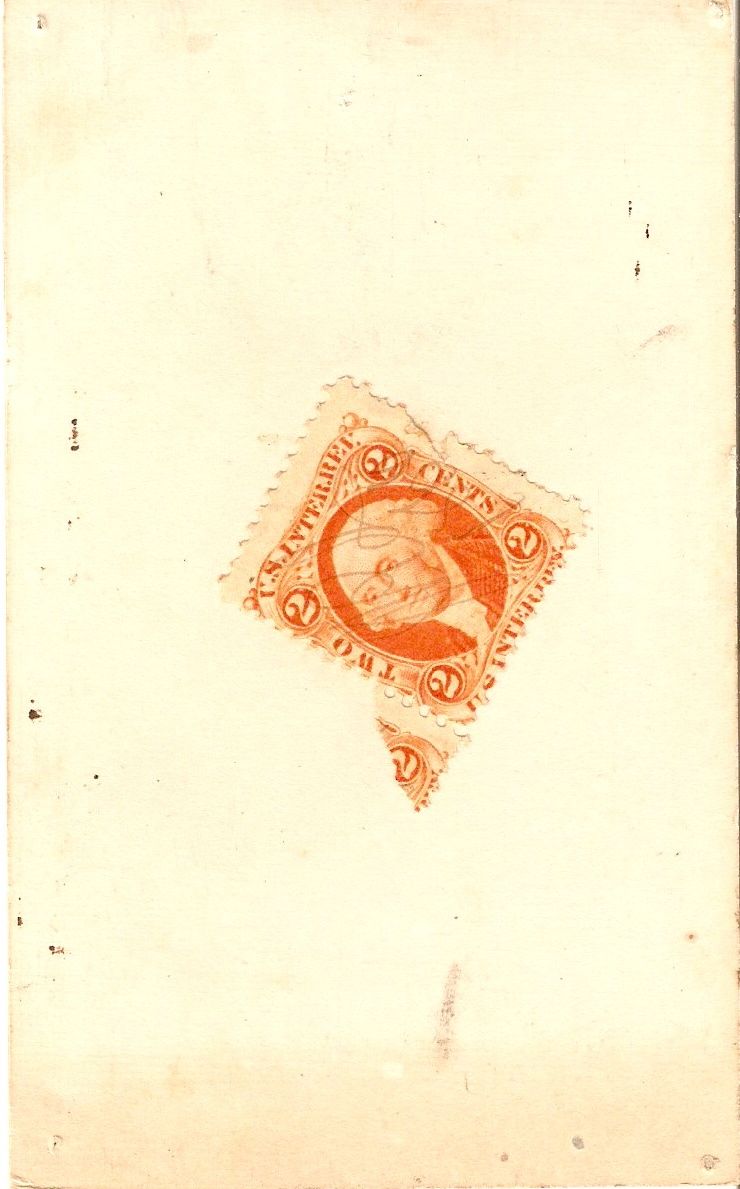
Tax revenue stamp of unidentified photograph of couple, 1866; digital image 2012, privately held by Melanie Frick, 2013.

Tax revenue stamp of unidentified photograph of couple, 1866; digital image 2012, privately held by Melanie Frick, 2013.

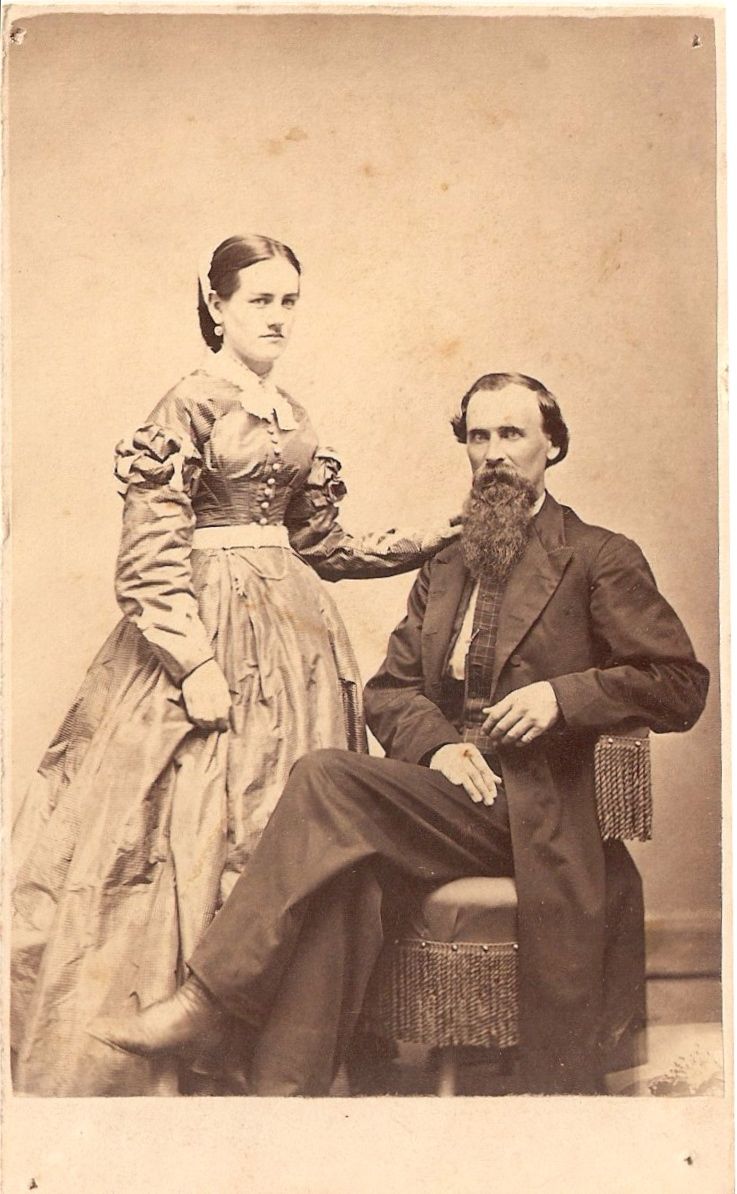
Unidentified photograph of couple, 1866; digital image 2012, privately held by Melanie Frick, 2013.

Unidentified photograph of couple, 1866; digital image 2012, privately held by Melanie Frick, 2013.

Another photograph with a distinct Civil War flavor comes with a helpful clue.  The couple in the photograph above appears impeccably dressed. The bearded man wears a typically roomy sack-cut coat,5 accented with a dark plaid vest, and the woman, whose hair is held back with combs in a style that was common at the time,6 wears a solid-colored gown with elegant puffed sleeves and buttons adorning the bodice. Affixed to the back of this carte de visite is an orange two-cent stamp. This stamp, which features George Washington, was a tax revenue stamp. It is canceled with the photographer’s initials, along with the date: 1866. As it turns out, this photograph was taxed near the tail end of the period during which photographs were subject to a tax; the period of taxation lasted only from 1 September 1864 to 1 August 1866.7

This photograph has tack holes in each of its four corners, suggesting that it was put on display at one time, tacked up perhaps on the wall of a home or on a writing desk. Evidently, in the years before it made its way into an album and was subsequently forgotten, this photograph was important enough to someone that he or she wished to look upon it every day. Today, we are left to wonder what became of the couple pictured within, and why they chose to have their photograph taken on this day in 1866, not long after the conclusion of the Civil War.

What signs of the Civil War era have you spotted in a photograph?


SOURCES
1 Jesse M. and Elizabeth Jane (Baker) Smith Album, ca. 1860-1920; privately held by Melanie Frick, 2013.
2 “What Do You Know About Tintypes?,” Ohio Historical Society Collections Blog, 5 August 2011 (http://ohiohistory.wordpress.com/2011/08/05/what-do-you-know-about-tintypes/ : accessed 13 September 2013).
3 Joan Severa, Dressed for the Photographer: Ordinary Americans and Fashion, 1840-1900 (Kent, Ohio: Kent State University Press), 206.
4 1870 U.S. census, Henry County, Iowa, population schedule, Center, p. 14, dwelling 109, family 109, Laura B. Smith; NARA microfilm publication M593, roll 395.
5 Severa, Dressed for the Photographer, 209.
6 Severa, Dressed for the Photographer, 206.
7 Maureen A. Taylor, Family Photo Detective (Cincinnati: Family Tree Books, 2013), 54-55.

Vintage Swimwear

This is a fun photograph that I thought I would share before the summer completely slips away. This snapshot was labeled on the back, and, years ago, I was also able to hear its story from my late great-grandmother, Fern Lavonne (Thoma) Adam of Sioux City, Woodbury County, Iowa. Well, more than its story, I remember her laughing about her bathing suit! The photograph was taken in 1924, at the river near Scribner, Dodge County, Nebraska.

Fern Lavonne (Thoma) Adam photograph, 1924; digital image 2010, privately held by Melanie Frick, 2013.

Fern Lavonne (Thoma) Adam photograph, 1924, Scribner, Nebraska; digital image 2010, privately held by Melanie Frick, 2013.

Fern lived in Scribner, where her father opened a grocery store, for a few years in the early 1920s. She remembered attending dances there, as well as learning to drive. Her father gave her a lesson immediately when she remarked that she would like to learn, and the next day, when she asked for another lesson, he told her to go ahead on her own!1 Apparently, Fern also enjoyed taking advantage of the opportunity to swim in the Elkhorn River during her short time in Scribner. She is pictured here at center; at left is Lucille Romberg, and at right is Helen Kellner. These young ladies must have been good friends in the summer of 1924, when Fern would have been sixteen years old.

In order to learn more about vintage bathing suits, I turned to Threaded, the Smithsonian’s blog about fashion history. From there I learned that a company by the name of Jantzen devised a “swimming suit” made of wool in 1915, and that by 1921, the name had stuck.2 My great-grandmother and her friends appear to be wearing typical knitted wool swimsuits of the era, comprised of long, sleeveless, v-necked tunics, fitted shorts, and, in my great-grandmother’s case, knee high stockings, rolled at the top. The girls wear their hair inside knit swimming caps, the one on the left being slightly more elaborate with a small brim. They all squint in the sun and lean together for the photograph, happy and relaxed on a summer’s day.

Have you come across any photographs featuring early styles of swimwear?


SOURCES
1 Fern Lavonne (Thoma) Adam, conversations with the author, 2001.
2 “The Swimsuit Series, Part 1: A History of Women’s Suits,” Threaded, 22 June 2012 (http://blogs.smithsonianmag.com/threaded/2012/06/the-swimsuit-series-part-1-a-history-of-womens-suits/ : accessed 6 September 2013).

A Tintype Wedding Portrait

One of my favorite aspects of genealogical research is photograph analysis. I can never take just one glance at an old photograph, as I love to detect clues about the eras, lifestyles, and relationships depicted within. I hope to share a photograph and analysis on a weekly or monthly basis, including both photographs from my family’s collection, as well as photographs, unidentified or not, that I’ve come across in antique stores.

Timothy Adam and Odile Millette photograph, 1867, Springfield, Massachusetts; digital image 2013, privately held by Melanie Frick, 2013.

Timothy Adam and Odile Millette photograph, 1867, Springfield, Massachusetts; digital image 2013, privately held by Melanie Frick, 2013.

This is a scan of a tintype of my third great grandparents, Timothy Adam and Odile Millette of Springfield, Hampden, Massachusetts, who were married on 22 September 1867.1 At the time of their marriage, Timothy and Odile, both of French Canadian heritage, were twenty years old. Timothy worked as a dresser at a cotton mill; prior to their marriage, it seems likely that Odile would have worked at a mill as well.

This tintype has several features worth noting. Smaller than my hand, the original has hand painted pink accents on the cheeks of the couple. The corner of the tintype has been bent, but the overall quality of the image is good.

Was this tintype made at the time of the couple’s marriage? First of all, we know that tintypes were in use from 1856-1930. They gained popularity in the 1860s as they were inexpensive to produce – Timothy and Odile may have paid only a few cents for this image at a local studio.2

In the image, Odile stands at Timothy’s side while he sits in a chair. His feet are planted firmly on the ground, and Odile rests her hand on his shoulder. Timothy’s gaze focuses directly on the camera, while Odile gazes slightly above. Their expressions are serious, but not unpleasant.

Timothy wears a three-piece suit for the occasion. He appears to be a slight young man, and his dark suit is somewhat loose fitting – perhaps it was not brand new, as closer fitted, ready-made styles became popular in this decade.3 There is trim at the borders and cuffs of his suit, which he wears with a white collar, a cravat, appropriate for a formal occasion, and what may be a pocket watch at the lapel.4 Timothy’s hair is parted on the side, and he sports a faint mustache.

Odile wears a skirt and waist style of dress, the simple waist accented by jet buttons. Over this, she wears a Spanish jacket in a contrasting color with a bold trim.5 Her otherwise plain skirt features a belt or sash and a wide hoop, which is compressed slightly by her position against her husband’s chair. Her dark hair has a center part and is pulled back into a plain snood, or hair net, in an everyday style. She wears earrings, and a brooch adorns her high collar.

Odile’s style of dress reflects a fashion seen in the 1860s. In May 1863, Peterson’s printed the following:

“[…] All the thin summer goods are very much risen in price, so that the present fashion of wearing old skirts, with Spanish and Zouave jackets, is a most convenient one […] pretty jackets in velvet, silk, and cloth […] very useful for wearing with old skirts, the bodices of which are worn out.”6

Furthermore, in June 1866, Godey’s noted “a charming assortment of fancy jackets” worn by women.7 Though the high prices of fabric reported in 1863 were most likely a result of the Civil War, which concluded two years prior to Odile’s wedding day, as she was a young millworker of limited means, it does not seem unreasonable to assume that she might have remade an old dress in an economical fashion for the occasion. With her dark complexion, a Spanish jacket proved an attractive choice.

The clothing and hairstyles worn by the couple indicates that the image was made in the 1860s, and the apparent age of the couple suggests that it was made in the latter half of the decade. It therefore seems likely that this was indeed a wedding portrait of Timothy Adam and Odile Millette, who would have had their picture made on or around 22 September 1867 in Springfield, Hampden, Massachusetts. It provides a unique glimpse into an important day in the lives of two young people of French Canadian heritage, who sought opportunity in the textile mills of New England in the years following the Civil War.

Do you have any tintypes in your family collection?


SOURCES
1 “Massachusetts, Marriages, 1841-1915,” digital image, FamilySearch (https://familysearch.org : accessed 30 Aug 2013), Timothy Adams and Julia Mellett, 22 September 1867, Springfield. Odile Millette used the name Julia early in her life.
2 Maureen A. Taylor, Family Photo Detective (Cincinnati: Family Tree Books, 2013), 37.
3 Joan Severa, Dressed for the Photographer: Ordinary Americans & Fashion, 1840-1900 (Kent, Ohio: Kent State University Press, 1995), 259.
4 Severa, Dressed for the Photographer, 209.
5 Severa, Dressed for the Photographer, 277.
6 Severa, Dressed for the Photographer, 241.
7 Severa, Dressed for the Photographer, 277.