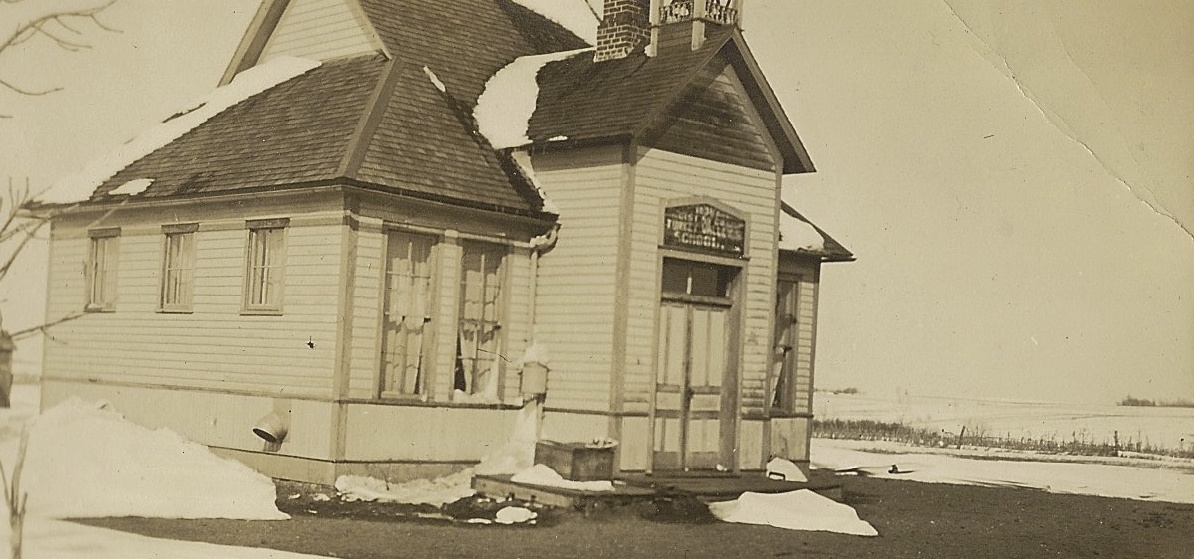
Tag Archives: 1900s

A Chicago Couple

FredWieseEmmaStube

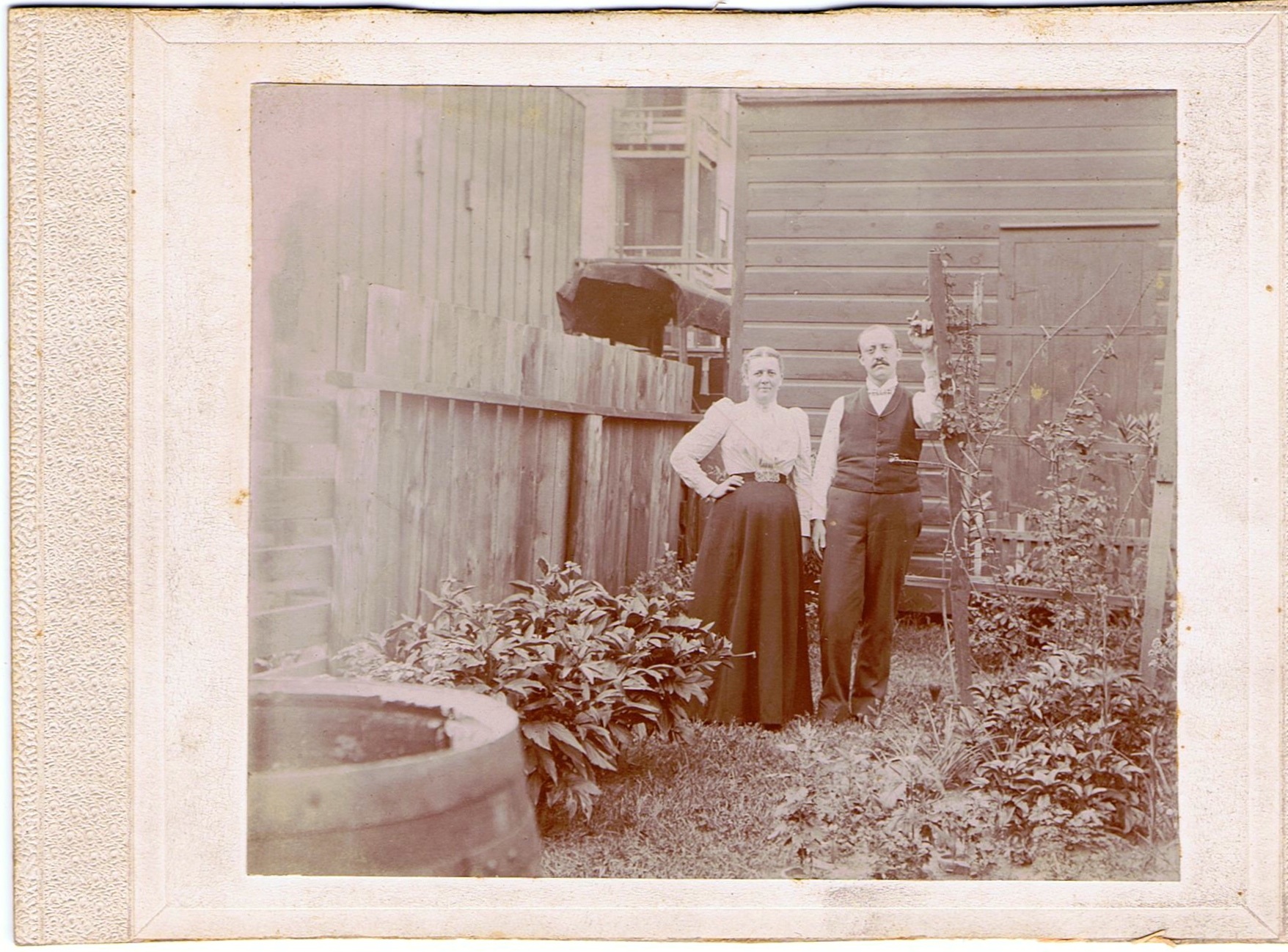
Fred and Emma (Stube) Wiese, ca. 1900; digital image 2010, privately held by Melanie Frick, 2014.

This glimpse into a backyard garden at the turn of the twentieth century features Fred and Emma (Stube) Wiese of Chicago, Cook County, Illinois. Fred rests his hand on a trellis while Emma stands close by his side, her hand on her hip. Their arms barely brush together as they gaze directly at the camera.

Emma wears everyday attire in the form of a simple dark skirt and a collared shirtwaist. Her skirt is belted high, with an adornment of some kind at the center of the waistband. It looks to me like she could have been pregnant at the time that this photograph was taken, which seems entirely possible as she was pregnant no less than five times between 1887 and 1900.1

However, Emma’s sleeves are not nearly as full as those seen during much of the 1890s, nor are they as tight as those of the decade prior. Perhaps this suggests that the photograph dates closer to 1900,2 which is when her youngest child was born.3 She and her husband were both in their early thirties at this time, and I don’t feel that they could have been significantly younger in this photograph.4

Fred wears somewhat loose trousers and a collared shirt, set off by a buttoned vest and a checked bow tie. Most notably, he sports a full mustache, and what hair he has is cut short. With the exception of his pants, which typically would be more fitted, this, too, fits the time period.5

The photograph, pasted on an embossed white card, is clear and of good quality, despite the fact that it is a seemingly casual shot. Might it have been taken by a traveling photographer who passed through the neighborhood, offering his services? Fred and Emma are not dressed in their best, although their simple attire was certainly presentable enough for a photograph. Perhaps their urban garden was a source of pride, making it an ideal spot for the couple to pose together.

Continue reading

Drunkenness, Death Threats, and a Divorce Petition

On the 5th of February 1902, Sarah Ellen (Hall) Hoffman of Ashton, Osceola County, Iowa, who was then forty-four years old, signed her name to a petition that she sincerely hoped would grant her a divorce. John Hoffman was her second husband; her first husband had died of an accidental gunshot wound, and it was now eighteen years since she had remarried. As detailed in the statement of facts prepared for the court by her attorney, O. J. Clark, this marriage was now in shambles.1

It was established that the plaintiff and the defendant had lived together since the time of their marriage – except recently, as “the defendant has been away from home considerable.”2 It was added, “At times he will work and earn money, but will not use any of his earnings to or for the support of the family, but will stay at home most of the time helping to eat up what the plaintiff and children earn.”3 Then, the chilling details of their marriage spilled forth:

“That the plaintiff has always conducted herself toward the defendant as a loving and dutiful wife, but that the defendant, disregarding his duties towards your petitioner, has always been abusive and ugly towards her, and of late years has become brutally coarse, violent and vulgar towards your petitioner, often calling her the most vile names in the presence of her children and so does without any cause therefore, often striking, kicking and otherwise abusing your petitioner, without cause, often leaving black and blue marks on the person of your petitioner for weeks at a time as the result thereof. That at times the defendant, without cause, threatens to kill your petitioner, threatens to put a hole through your petitioner’s body, threatens to cut her heart out and to kill your petitioner with a knife. That on one occasion said defendant attempted to carry out his threat of killing your petitioner with a butcher knife, and attacked her therewith, when her daughter in attempting to prevent defendant’s harming your petitioner, received the blow with the knife herself on the hand, cutting the cord to one of her fingers off and otherwise injuring her hand, so that she has very little use of said finger, and thus, to that extent has made her a cripple for life. That the threats thus made, the kicking and striking are of very frequent occurrence when he is at home, that he sleeps with his clothes on, and at times in the night will begin his abuse of your petitioner without cause, and threaten to kill her with his knife, and will begin to open and shut his knife so that the plaintiff can hear it click and thus frighten her and worry her all night at a time.”4

OsceolaCountyIowaDivorce1902

Osceola County, Iowa, Circuit Court File 3036, Sarah E. Hoffman v. John Hoffman, for “Petition in Equity,” 20 March 1902; Clerk of District Court, Sibley. The surname Hoffman appeared in this text as Huffman, but in some instances the “u” was overwritten with an “o.” Thus, I have transcribed the name as Hoffman.

In recent years, the defendant had become “addicted to the use of intoxicating liquors, and is an habitual drunkard, which habit he has acquired since their said marriage.”5 The statement continued, “That the plaintiff’s health has become undermined and broken, and if this treatment continues her health will give out entirely and she fears she will die there from – if the defendant does not in fact kill her outright.”6 It’s truly appalling to think what my third great-grandmother must have endured, and it’s to her credit that she had the strength to initiate a divorce at this time.

It would be interesting to learn what grounds for divorce were required in Iowa in 1902; apparently, in this case, habitual drunkenness, horrific abuse, and failure to provide support were sufficient. The divorce was granted in March of that year, at which time Sarah received custody of the couple’s teenage son, possession of the kitchen and household furniture, a return to her former name, and, most importantly, a chance for a better life.7

Continue reading

An Ancestor with an Alias

When I learned that George Hiram Thoma of Garnavillo, Clayton County, Iowa used an alias as a young man, it took me by surprise. He was born to Fred and Matilda (Hammond) Thoma in 1880,1 and the state census indicates that he remained in his home county in northeastern Iowa at least until 1895.2 At some point thereafter, according to family lore, George left home and bicycled across Iowa. Whether he went by bicycle or not, it was said that his move may have been spurred on by his poor relationship with his father.3

GeorgeHiramThoma

George Hiram Thoma, seated left, with an unidentified young man, ca. 1900; digital image 2013, privately held by Melanie Frick, 2014.

Records place George across the state in northwestern Iowa on 23 March 1902, at which time, using the name George A. Neilson, he married Anna Leota Fenton in Ashton, Osceola County, Iowa.4 This was no trick of penmanship or recorder’s error; three affidavits, written by George, his mother, and his younger brother, were attached to the marriage document decades later, each attesting to the fact that George A. Neilson and George Hiram Thoma were one and the same person.5 It is worth noting that George still named his correct place of birth and even the correct names of his parents on the original marriage document, with the exception, of course, of assigning the Neilson surname to them as well.6 Evidently, he was not prepared or had no reason to invent an elaborate backstory regarding his origins.

None of the affidavits, however, explained why George had married under an assumed name.7 One has to wonder whether his wife even knew what she was getting into! Prior to his marriage, I suspect that he might be found in the 1900 U.S. census as George Thoma, a clerk in Belden, Cedar County, Nebraska. Notably, he boarded with a family by the name of Nelson, and a Nielsen also resided in the household.8 Although this may or may not be the correct George Thoma, we do know that within weeks of his marriage, he moved to Center, Knox County, Nebraska, where he was an employee of the Edwards and Bradford Lumber Company.9

Within a few years of his marriage, George relocated with his family to Sioux City, Woodbury County, Iowa. There, his daughter’s birth was recorded with the surname Neilson,10 and according to the city directories, George continued to use his assumed name at least until 1909.11 I have been unable to locate the family in the 1910 U.S. census – they had likely left Sioux City by that time to return to Nebraska, where they moved from place to place for the next decade. However, they had certainly reverted to the use of the Thoma surname no later than World War I.12

Was this alias purely symbolic, in order to emphasize George’s separation from his father, or, perhaps, the ties that he forged with another family? Or was it part of an effort to hide, whether from his father, from love, or from the law? This is one family mystery that I would love to solve!

Continue reading

A South Dakota Thanksgiving

How did your ancestors celebrate Thanksgiving? As the cooking commences, I can’t help but wonder when Thanksgiving truly became a tradition among the different branches of my family tree, and how the celebrations might have varied.

NelsonFamilyFarm

Fred and Christine (Schmidt) Nelson Family Farm, Yankton County, South Dakota, ca. 1911-1917; digital image 2013, privately held by [personal information withheld].

I do know that the family of Fred and Christine (Schmidt) Nelson of Tabor, Yankton County, South Dakota celebrated the holiday more than a century ago. In 1908, their daughter Anna, seventeen, wrote in her diary, “Nov. 26, Thanksgiving day. Uncle Andrew, Aunt Mary and little cousins, also John S[ch]neider came down and had dinner with us and spent the day. It was cloudy most of the day and a rather cold wind.”1

Her guest list indicates that they had quite a crowd for dinner. By 1908, the Nelson family numbered ten,2 so with the addition of John Schneider and Andrew and Inger Marie “Mary” (Schmidt) Schmidt, who came with their three young children,3 the number at the table was brought to sixteen.

TurkeyValleySchool

Turkey Valley School, date unknown, Turkey Valley, Yankton County, South Dakota; digital image 2010, privately held by [personal information withheld].

As the Nelson children grew and completed school, several of the six daughters scattered about the county on teaching assignments. In the fall of 1916, Andrea, age nineteen, boarded with the Skov family in Turkey Valley. Andrea was in the midst of her first term as a schoolteacher, having recently graduated from the Springfield Normal School.4

On 18 November 1916, Andrea wrote to her parents, explaining that she had spoken to the members of the local school board to ask if she could take off the day after Thanksgiving:

“Mr. Hinseth said that for his part he didn’t care how many we took off as he had no kids to send and Mr. Mikkleson said sure we could take the day then could see later about making it up. […] I haven’t asked Mr. Andreason about the day but it won’t do him much good to kick as it’s three against one.”5

Andrea was pleased, as this meant that she could return home for Thanksgiving and the three days following. No doubt she was eager to show off her new overshoes, purchased the previous afternoon in Irene. Although she reported woefully that they had made a dent in her monthly “warrant,” she continued, “Mr. Skov gave his ‘womenfolks’ a scolding because we hadn’t gotten overshoes a week ago Sat. when we were in town so I thot [sic] I had better get me a pair yesterday or I’d be scolded again, ha!”6

With these overshoes, Andrea would have been prepared for the blustery winter days on the eastern South Dakota prairie, and she would have stayed warm for the duration of the forty-mile journey home for the holidays. Now, if only we knew what was served for dinner!


SOURCES
1 Nelson, Anna. “Diary.” MS. Yankton County, South Dakota, 1908. Privately held by [personal information withheld].
2 1910 U.S. census, Yankton County, South Dakota, population schedule, Township 93 Range 57, enumeration district (ED) 447, sheet 2-A, p. 186 (stamped), dwelling 24, family 24, Fred Nelson; digital image, Ancestry.com (http://www.ancestry.com : accessed 26 November 2013), citing National Archives microfilm publication T624, roll 1489.
3 1910 U.S. census, Yankton County, South Dakota, population schedule, Township 93 Range 57, enumeration district (ED) 447, sheet 3-A, p. 187 (stamped), dwelling 46, family 48, Andrew Schmidt; digital image, Ancestry.com (http://www.ancestry.com : accessed 26 November 2013), citing National Archives microfilm publication T624, roll 1489.
4 The Echo, Vol. 1, “Andrea Nelson,” Springfield, South Dakota, 1916; privately held by [personal information withheld].
5 Andrea Nelson to Fred and Christine (Schimdt) Nelson, letter, detailing Thanksgiving plans, 18 November 1916; privately held by [personal information withheld].
6 Andrea Nelson to Fred and Christine (Schmidt) Nelson, letter.

The Lutz Sisters

HattieJuliaAnnaMelanieLutz

Sisters Hedwig, Julia, Anna, and Melanie Lutz, ca. 1900, Minnesota; digital image 2010, privately held by Melanie Frick, 2013.

Julia, Anna Marie, Hedwig “Hattie” Eulalie, and Melanie Veronica Lutz were the daughters of French and Polish immigrants, respectively Joseph and Hedwig (Cichos) Lutz of Minnesota Lake, Faribault County, Minnesota.1 By the time that this photograph was taken, circa 1900, Joseph had passed away, and Hedwig had remarried and given birth to five additional children.2 Her eldest daughters must have been close, however, as they chose to have a photograph taken of just the four of them.

Standing with her arms protectively behind her seated sisters is Hattie, who would have turned nineteen in the year 1900.3 Although her position suggests that she was the eldest, she was not; it’s possible that she may have been the tallest, however, if the photographer were to have posed the sisters based on height. She is also the only sister wearing a dress with a white collar, offering contrast; the other sisters seem to be wearing their good black dresses. None of the dresses, however, are alike, each having unique decorative pleats, panels, and/or bows. The collars are extremely high, perhaps an example of what would have been known as “officer’s” collars.4

Julia is seated at right, her dark eyes serious. She would have turned twenty-four in 1900, and was the eldest of the sisters.5 Seated at the center is Anna, who would have turned twenty-two that year.6 Melanie, the youngest, is at left; she would have celebrated her sixteenth birthday in 1900.7

At this time, all four sisters had left their mother’s household.8 Julia was married with two young children at home; she and her husband kept a hotel,9 and Anna was employed as a servant there.10 Hattie lived with her elderly maternal grandparents.11 As Melanie cannot be located in the 1900 U.S. census, she may have been away at school, where she trained to become a teacher. Later in life, Julia, Anna, Hattie, and Melanie made their homes in four different communities across three different states, but their sisterly bond is apparent in this photograph of them as young women.


SOURCES
1 “Minnesota, Marriages, 1849-1950,” index, FamilySearch (https://familysearch.org : accessed 15 Nov 2013), Joseph Lutz and Hedwig Joice, 19 April 1875. Cichos was likely transcribed incorrectly as Joice.
2 1900 U.S. census, Faribault County, Minnesota, population schedule, Minnesota Lake, enumeration district (ED) 92, sheet 10-B, p. 4834 (penned), dwelling 178, family 178, Hattie Rendfleisch; digital image, Ancestry.com (http://www.ancestry.com : accessed 15 November 2013), citing National Archives microfilm publication T623, roll 763. Rendfleisch was a variation of Rindfleisch.
3 “Minnesota, Births and Christenings, 1840-1980,” index, FamilySearch (https://familysearch.org : accessed 15 Nov 2013), Hedwig Lutz, 06 September 1881.
4 Joan Severa, Dressed for the Photographer: Ordinary Americans and Fashion, 1840-1900 (Kent, Ohio: Kent State University Press, 1995), 526.
5 “Minnesota, Births and Christenings, 1840-1980,” index, FamilySearch (https://familysearch.org : accessed 15 Nov 2013), Julia Lutz, 13 December 1876.
6 “Minnesota, Births and Christenings, 1840-1980,” index, FamilySearch (https://familysearch.org : accessed 15 Nov 2013), Anna Lutz, 12 May 1878.
7 “Minnesota, Births and Christenings, 1840-1980,” index, FamilySearch (https://familysearch.org : accessed 15 Nov 2013), Melanie Veronica Lutz, 28 May 1884.
8 1900 U.S. census, Faribault Co., Minn., pop. sch., Minnesota Lake, ED 92, sheet 10-B, p. 4834, dwell. 178, fam. 178, Hattie Rendfleisch.
9 1900 U.S. census, Nobles County, Minnesota, population schedule, Adrian, enumeration district (ED) 209, sheet 2-B, p. 43 (penned), dwelling 29, family 29, Julia McColm; digital image, Ancestry.com (http://www.ancestry.com : accessed 15 November 2013), citing National Archives microfilm publication T623, roll 778.
10 1900 U.S. census, Nobles County, Minnesota, population schedule, Adrian, enumeration district (ED) 209, sheet 2-B, p. 43 (penned), dwelling 29, family 29, Anna M. Lutz; digital image, Ancestry.com (http://www.ancestry.com : accessed 15 November 2013), citing National Archives microfilm publication T623, roll 778.
11 1900 U.S. census, Faribault County, Minnesota, population schedule, Minnesota Lake, enumeration district (ED) 92, sheet 5-A, p. 4719 (penned), dwelling 73, family 73, Hattie Lutz; digital image, Ancestry.com (http://www.ancestry.com : accessed 15 November 2013), citing National Archives microfilm publication T623, roll 763.

Finding Your Danish Immigrant Ancestors

KathrineChristensen03

Kathrine Christensen at the Christensen family home photograph, 1905, Vestervig, Thisted, Denmark; digital image 2013, privately held by [personal information withheld].

When searching for Danish immigrant ancestors, you might feel as though they have been lost in a sea of Scandinavians. Nielsens, Larsens, and Hansens abound. Given names might be different than those used in American records. Family members might not have traveled together. All of these factors, on top of the typical transcription errors that make life exciting for genealogists, can make Danish immigrants difficult to track down.

I met a challenge of this nature when attempting to locate the siblings of my mother’s grandmother, who carried the woefully common Christensen surname. As it turned out, between approximately 1889 and 1906, at least six of the nine surviving children of Laust and Ane (Nielsen) Christensen of Vestervig, Thisted, Denmark1 left the thatched roof of the only home they had ever known for America, traveling one or two at a time over a period of seventeen years. All came, at least temporarily, to Newell, Buena Vista, Iowa.

Else Marie Christensen was the first to arrive in northwestern Iowa. It was there that she married Anton Mikkelsen in the summer of 1889, when she was seventeen.2 Fully ten years later, in 1899, Niels H. Christensen and Ane Petrine “Anine” Christensen journeyed together to join their older sister in Newell.3 Niels settled there, where he married Kathrine “Katie” Larson;4 Anine moved west to the urban center of Sioux City, Woodbury, Iowa, where she married John P. Hansen.5

In 1900, their brother Laurits Anton “Louis” Christensen arrived.6 He too settled in Newell, and married Anna Marie Godfredson.7 Kristine “Christina” Christensen came to America in 1905, along with her husband, Jens C. Pedersen, and her young niece,8 the daughter of her widowed brother Christen Christensen, who had remained in Denmark.9 They settled first in Newell, before moving to Sioux City.10

The following year, in the summer of 1906, Kathrine Christensen, my great-grandmother, was the last to leave home,11 leaving only her aforementioned brother and sisters Johanne Christensen and Ane Marie Christensen in Denmark.12 Kathrine, twenty, also joined her siblings in Newell before moving on to Sioux City. It is there that she married Jens “James” Jacob Walsted in 1909.13

Where can you find Danish immigration records? If you’ve been over- (or under-) whelmed with your search results on databases such as Ancestry.com or Ellis Island’s Passenger Search, I recommend visiting the Dansk Demografisk Database. By selecting “Emigrants,” you will be able to access an index of Danes who traveled via Copenhagen or Hamburg. The search options are flexible; try searching for everyone of a particular surname who originated in the same parish, or search for anyone bound for the same destination. It goes without saying to be creative with spellings, although, in my experience, this index remains truer to the original Danish spellings than others. With the information you find here, you might just have luck turning up a passenger list with your ancestor’s name!


SOURCES
1 “Denmark, Marriages, 1635-1916,” index, FamilySearch (http://www.familysearch.org : accessed 30 October 2013), entry for Laust Christensen and Ane Nielsen, 1868.
2 “Iowa, County Marriages, 1838-1934,” index, FamilySearch (https://familysearch.org : accessed 30 Oct 2013), Anton Mikkelson and Elsa Marie Kristensen, 1889.
3 “New York, Passenger Lists, 1820-1957” digital images, Ancestry.com (http://www.ancestry.com : accessed 30 October 2013), manifest, S.S. Paris, Liverpool, England to New York, arriving 13 February 1899, Niels Christensen and Anine P. Christensen; citing National Archives microfilm T715, roll 47.
4 “Iowa, County Marriages, 1838-1934,” index, FamilySearch (https://familysearch.org : accessed 30 Oct 2013), Niels Christensen and Kathrine Larson, 1901.
5 1920 U.S. census, Woodbury County, Iowa, population schedule, Sioux City, Enumeration District (ED) 232, p. 4857 (penned), sheet 6-B, dwelling 129, family 129, Anine Hanson; digital image, Ancestry.com (http://www.ancestry.com : accessed 30 October 2013), citing National Archives microfilm T625, roll 521.
6 “Border Crossings: From Canada to U.S., 1895-1956” digital images, Ancestry.com (http://www.ancestry.com : accessed 30 October 2013), manifest, S.S. Parisian, Liverpool, England to Quebec, arriving 9 June 1900, Laurids Christensen; citing National Archives microfilm M1464, roll 6.
7 “Iowa, County Births, 1880-1935,” index, FamilySearch (https://familysearch.org : accessed 30 Oct 2013), Lewis A. Christensen and Anna Marie Godfredsen in entry for Ludvig Arnold Christensen, 1907.
8 “New York, Passenger Lists, 1820-1957” digital images, Ancestry.com (http://www.ancestry.com : accessed 30 October 2013), manifest, S.S. Helig Olav, Liverpool, England to New York, arriving 24 July 1905, Karoline M. Pederson; citing National Archives microfilm T715, roll 602.
9 [personal information withheld], to Melanie Frick, Ancestry.com message, 7 August 2013, “Cecelia,” Christensen Family File; privately held by Melanie Frick.
10 1920 U.S. census, Woodbury County, Iowa, population schedule, Sioux City, Enumeration District (ED) 234, p. 5951 (penned), sheet 5-A, dwelling 90, family 97, Christina Peterson; digital image, Ancestry.com (http://www.ancestry.com : accessed 30 October 2013), citing National Archives microfilm T625, roll 521.
11 “New York, Passenger Lists, 1820-1957” digital images, Ancestry.com (http://www.ancestry.com : accessed 30 October 2013), manifest, S.S. Cedric, Liverpool, England to New York, arriving 22 July 1906, Kathrine Kristensen; citing National Archives microfilm T715, roll 744.
12 “Public Member Trees,” database, Ancestry.com (http://www.ancestry.com : accessed 30 October 2013), “Christensen Twete,” entries for Christen Christensen (b. 1869), Johanne Christensen (b. 1876), and Ane Marie Christensen (b. 1879); submitted by [personal information withheld], citing Vestervig Church Book.
13 Sioux City, Iowa, Marriage Register, Book E: 1906-1910, James Walsted and Kathin Christinsen, 1909.
A Wedding Party

Not everyone had a wedding portrait made. In my experience, it was even less common for a wedding portrait to include the wedding attendants or witnesses. However, when Henry Joseph Adam and Melanie Veronica Lutz married on 24 October 1905, they posed for a formal photograph with four attendants.

HenryAdamMelanieLutzWedding1905

Henry and Melanie (Lutz) Adam wedding photograph, 1905, Sioux City, Iowa; digital image 2010, privately held by Melanie Frick, 2013.

Melanie, the bride, appears to wear her brown hair loose behind her shoulders, unless this is an illusion created by a shadow. The dark material of her dress, featuring a pleated bodice and v-neck, contrasts with a high white collar. A decorative watch is pinned at her bodice, and a small brooch is at her throat. To the right, her attendant, Permelia Adam, wears a white pleated bodice with full sleeves and a large bow off-center at the collar. Blanche Adam also wears a white bodice, although it features decorative buttons and lace detail. An elegant string of pearls rests at her throat, above the high collar. Like Permelia, Blanche wears a large bow in her hair.

Henry, the groom, wears a dark suit with a crisp white collar and white bow tie. His suit fastens higher than those of his attendants; Theodore Adam wears a polka dot tie, and Herman Adam sports a vest and bow tie. The men have all combed their dark hair with side parts and fashionable waves.

Carnations were apparently in vogue in 1905, or perhaps they were a favorite of the bride. Melanie wears two long-stemmed white carnations, facing downward, pinned to her bodice. Henry wears one as well, although the stem is hidden by his lapel. Although Permelia seems to wear a carnation, the stem is so long that the blossom itself cannot be seen, and the male attendants wear darker flowers that are indistinct against their suits. Only Blanche goes without a flower.

The Adam-Lutz wedding was held at St. Jean the Baptiste Catholic Church in Sioux City, Woodbury, Iowa on a Tuesday morning. Forty guests attended, the majority of whom were relatives.1 As Melanie had no family in the area, it is understandable that only her husband’s relations would have made up their wedding party; Permelia and Theodore were Henry’s brother and sister, while Blanche and Herman were his cousins. After the ceremony, an informal wedding breakfast was served at the home of Henry’s parents, which was decorated, unsurprisingly, with flowers.2


SOURCES
1“Adam-Lutze,” Sioux City (Iowa) Tribune, 28 October 1905.
2“Adam-Lutze,” Sioux City (Iowa) Tribune, 28 October 1905.

A Hand-Colored Photograph

My great-grandmother kept this hand-colored photograph of her mother in a small, red velvet frame on her writing desk. Anna Leota Fenton of Ashton, Osceola County, Iowa married in the spring of 1902 when she was twenty-two years old.1 She may have had her photograph taken at the time of her marriage.

AnnaLeotaFenton

Anna Leota (Fenton) Thoma photograph, ca. 1902, Ashton, Iowa; digital image 2001, privately held by Melanie Frick, 2013.

Anna Leota Fenton, who typically went by her middle name or the nickname “Ota,” poses demurely in this photograph. The hand-colored copy comes with no suggestions as to the photographer or the original medium, but it seems to have been a typical portrait of the day. Did Leota request that the photograph be colored, or was this arranged later by her daughter?

The photograph has been colored in a way that looks quite natural.2 Leota’s eyes are blue-green, and her hair a light brown. Her dress has been colored a deep mauve or soft burgundy, perhaps the original color of the dress, perhaps not, and she wears a matching ribbon in her hair. There is a small gold-colored brooch at the side of her throat.

Leota’s hairstyle is one that was popular at the turn of the twentieth century. It is full and soft around her face, with a tendril or two escaping, and it is fastened in a high bun in the back. Although few details of her dress can be seen in this head-and-shoulders pose, her dress does have a high collar to the chin and full sleeves. The bodice appears to be “pouched” with soft vertical pleats.3

How do you feel about colorized photographs? This week, I read here about the Subreddit page History in Color, which features historical photographs colorized by both amateurs and professionals. Some of them are really beautiful, making scenes from the Civil War or the Great Depression look like they took place yesterday. These photographs could be great for engagement in the classroom – some students might relate more to history if all of the pictures weren’t in black and white!


SOURCES
1 “News of Osceola County,” Sibley (Iowa) Gazette, 27 March 1902, p. 8, col. 1.
2 Maureen A. Taylor, Family Photo Detective (Cincinnati: Family Tree Books, 2013), 62.
3 Taylor, Family Photo Detective, 112.

A Trip to Koblenz

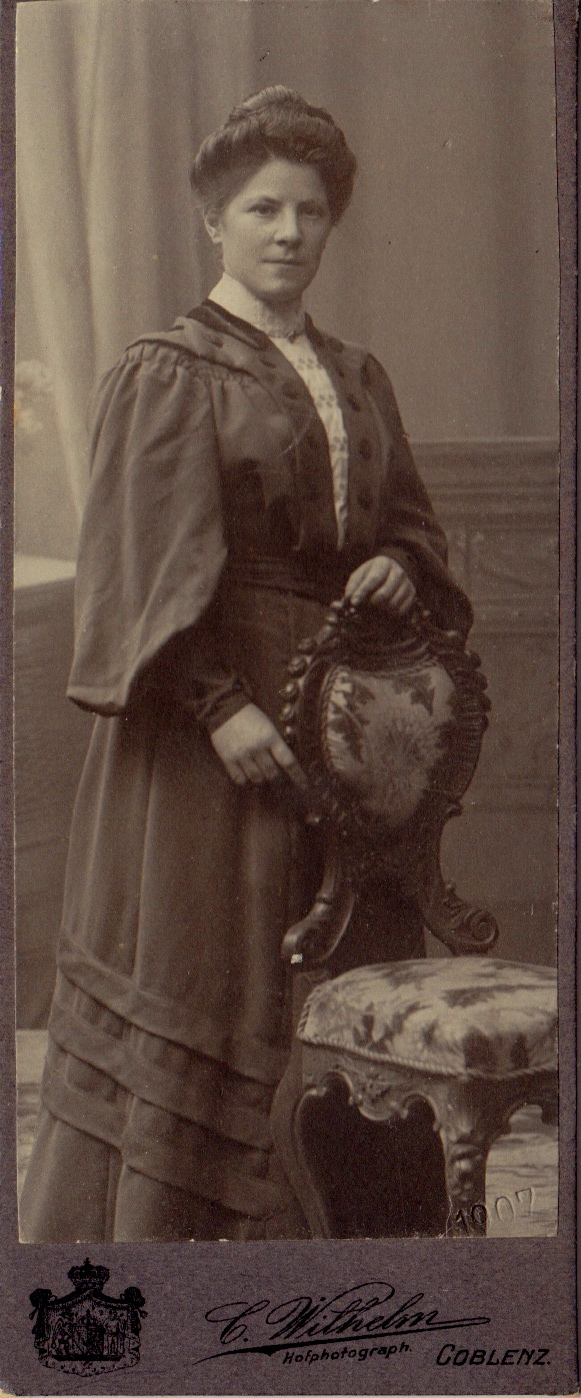
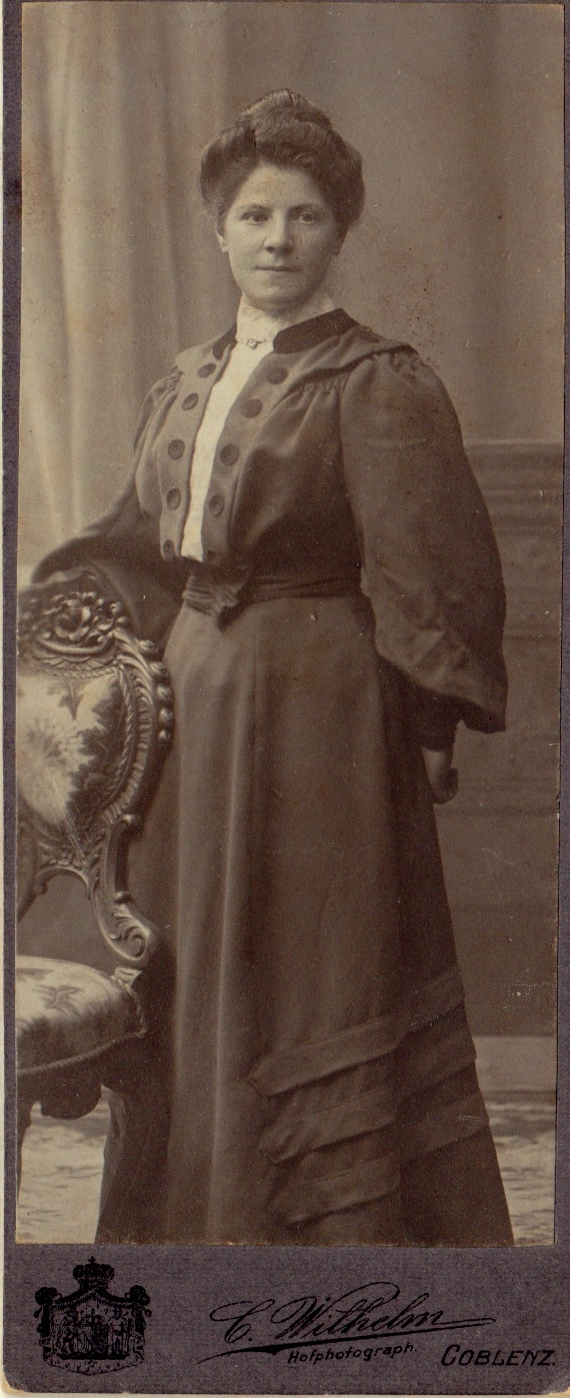
It may have been a special occasion when Ida (Heitz) Möll of Traben-Trarbach, Mosel, Germany, traveled fifty miles northeast to the town of Koblenz, also on the Mosel River, to have her photograph made. In 1907, Ida turned twenty-two.1 She would not marry until 1914, so her photograph was not taken in honor of her wedding.2 Perhaps she had traveled to Koblenz with her family, whether it was a semi-regular trip made for the purposes of shopping or visiting, or a rare chance to experience a larger city. Whatever the reason, in 1907, Ida made her way to Koblenz, likely by train, and came away with two photographs of herself in different poses.

ida_heitz_2 - Version 2

Ida (Heitz) Möll photograph, 1907, Koblenz, Germany; digital image 2011, privately held by Melanie Frick, 2013.

ida_heitz

What can we learn from these photographs? Ida was photographed at C. Wilhelm’s Hofphotograph studio in what was called, at that time, Coblenz. The photographs are narrower than others that I have seen before. The date “1907” is stamped in the lower corner of one of the photographs, a date that appears to be accurate based on the clothing Ida wears. Her dress, made of a heavy fabric that seems suited to cool weather, features a high collar, a skirt with soft gathers, a bodice that is puffed gracefully over her waistband, and sleeves that are very full at the top but fitted at the forearm. Her hair is styled in a Gibson Girl manner, puffed full around her face and coiled and fastened in the back.3 Note the side part struggling to make an appearance – perhaps she hadn’t been styling her hair in this manner for very long!

No rings adorn Ida’s fingers; in fact, the only jewelry she wears appears to be a brooch at her throat. Her dress, however, is quite fine, with circular embellishments on the bodice, a dark, possibly velvet collar and a shirtwaist featuring what looks like lace or cutwork. Even her skirt has matching fabric attached in a pattern of three bands.

In both photographs, Ida poses with an ornate, carved chair with a floral cushion. In one of the photographs, her gaze is direct; in the other, she looks slightly away from the camera. Her posture is excellent, her expression serious, and she looks older than her age. It’s clear that she made an effort to look her best for the occasion, whatever it may have been.


SOURCES
1 Heitz-Möll Family Tree; Frick Family; privately held [personal information withheld].
2 Heitz-Möll Family Tree; Frick Family; privately held [personal information withheld].
3 Maureen A. Taylor, Family Photo Detective (Cincinnati: Family Tree Books, 2013), 112.