Tag Archives: 1910s

A New Year’s Eve Party?

HenryMelanieAdamParty_2

Henry and Melanie (Lutz) Adam, ca. 1910, Sioux City, Woodbury County, Iowa; digital image 2010, privately held by Melanie Frick, 2014.

Happy New Year! …or at least, I think that’s what might have been said when this photograph was taken about a century ago. Featured are Henry and Melanie (Lutz) Adam of Sioux City, Woodbury County, Iowa, with Henry seated at lower right and Melanie in white above his raised hand.

Could this photograph have been taken at a New Year’s Eve party? The curtains are drawn in the living room or parlor where the photograph was taken, which suggests to me that it could be after dark. Furthermore, it’s clear that the alcohol is flowing. One man can be seen taking a drink, while several others clutch glasses and bottles. (Alas, I can’t make out the labels.) Nearly everyone wears some sort of silly hat made of cloth or paper, and only three older children are present in the photograph – no little ones.

Note that three of the men in front, including Henry, make a gesture with their thumbs to the sides of their noses and their fingers extended flat, pressed together. They aren’t quite thumbing their noses in the way that I have seen, so I wonder what this gesture might have meant.

Of the nineteen people gathered here, only Henry seems to be ready for the camera. Most, including Melanie, look to the side, perhaps at another photographer, or are caught in the midst of conversation. Whether this gathering was for New Year’s Eve or not, one can easily imagine the chaotic scene as an attempt was made to corral this lively group of friends for a memorable photograph. Cheers!

Warm Winter Furs

NormaThomaFernThoma1917

Norma Arlene Thoma and Fern Lavonne Thoma, ca. 1917-1918, Decatur, Burt County, Nebraska; digital image 2013, privately held by Melanie Frick, 2013.

Although I remember when my great grandmother first showed me this photograph, years ago, I wish I could remember more of what she had to say about it. I believe that the furs that she and her younger sister wore may have been a special gift. From left to right are sisters Norma and Fern Thoma of Decatur, Burt County, Nebraska, most likely photographed during the winter of 1917-1918. At this time, Fern would have been ten years old,1 and Norma would have been a few months shy of her third birthday.2 They lived in town, a community of eight hundred, as their father was a grocer.3

The girls seem to have been posed specifically to show off their matching fur hats, collars, and muffs. Have you ever felt a fur muff? They really are very warm, perfect to shelter little fingers from the biting cold of a Nebraska winter. Norma and Fern are also bundled into long wool coats, and Fern wears what seem to be stylish gaiters or “spats” over her shoes, such as those seen at The Quintessential Clothes Pen: An Exploration of Historic Costume.

With the holidays approaching, I can’t help but wonder if these furs might have been a Christmas gift, or if the girls may have worn them in honor of the day. In that spirit, I would like to take this opportunity to wish very happy holidays to all of my readers, as well as to offer a big thank you for following The Homestead!


SOURCES
1 Iowa State Department of Health, birth certificate no. 419687 (1907, issued 1942), Fern L. Thoma; Division of Vital Statistics, Des Moines.
2 Nebraska State Department of Health, birth certificate no. 2-84091 (1915, issued 1943), Norma A. Thoma; Division of Vital Statistics, Lincoln.
3 Bill Weaver, “Nebraska State Gazetteer and Business Directory – 1917 – Decatur,” NE GenWeb Project: Burt County, Nebraska On-Line Resources (http://www.rootsweb.ancestry.com/~neburt/olres/gazbus17.html : accessed 15 December 2013), entry for Geo. H. Thomas [Thoma].

A Yearbook from the Southern State Normal School, Springfield, South Dakota, 1916

The Southern State Normal School in Springfield, South Dakota, also called the Springfield Normal School, offered a college education for those who had completed high school. A First Grade Teaching Certificate could be acquired in just one year of study, while a State Certificate and Life Diploma could be acquired in two years.1 If your ancestor was a teacher in South Dakota, he or she may have attended the Southern State Normal School or a similar institution of higher learning.

Echo1916SouthernStateNormalSchool

The Echo, Vol. 1 (Springfield, South Dakota: Southern State Normal School, 1916); private collection of Melanie Frick. This volume was generously shared with the author by a relative.

I am fortunate to have a copy of The Echo, a yearbook put forth by the Southern State Normal School in 1916. The Echo offers a treasure trove of information about those who were affiliated with the school from 1915-1916, as it includes photographs of most of the students and faculty as well as details about everything from an individual’s year of study, to school clubs and organizations, to inside jokes among classmates shared in the form of clever poems and quotations.2

For example, I learned that when sisters Andrea and Louise Nelson attended college there, they were both members of the Y.W.C.A. and the Southern Normal Literary Society, where Andrea served a term as Secretary.3 What startled me, however, was a class poem that named, “Louise, so dumpy and fat.”4 I do hope that was a joke well taken, because while Louise didn’t necessarily have a willowy figure, she was quite pretty and stylish! The Echo shared that she also played on the girls’ basketball team.5

As copies of The Echo are likely not accessible to most researchers, I would like to offer look-ups for anyone seeking information about the individuals listed below, who were named in The Echo as faculty, students, or graduates of the Southern State Normal School at Springfield, Bon Homme County, South Dakota:

Continue reading

The Traveling Photographer’s Ram

LeonAdam

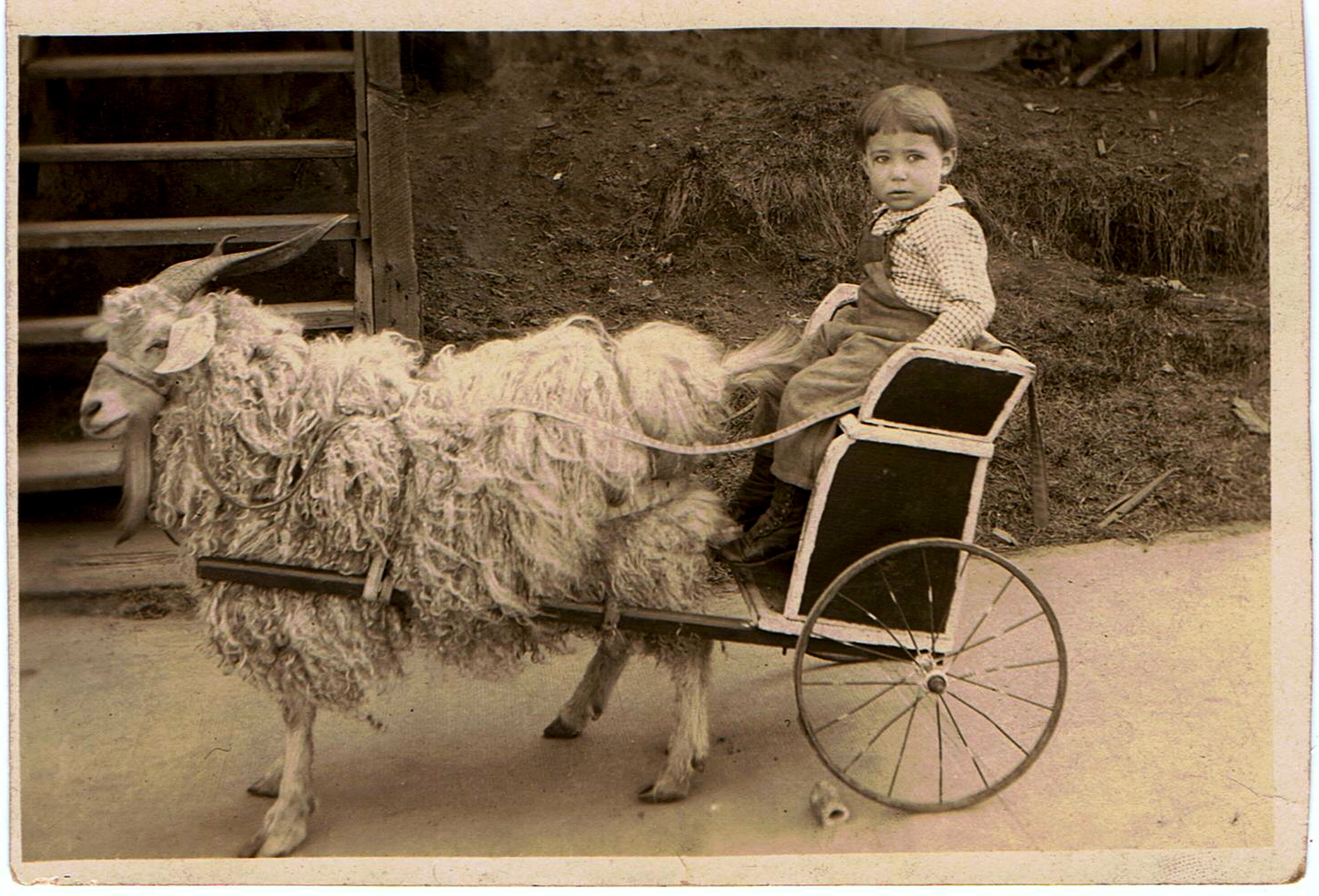
Leon Francis Adam, ca. 1916, Sioux City, Woodbury County, Iowa; digital image 2010, privately held by Melanie Frick, 2013.

Only a handful of photographs exist of little Leon. He was barely five years old when he tumbled into a bonfire and died from his burns.1 This photograph, however, taken when he was perhaps three years old, gives a glimpse into his brief but surely happy childhood.

Leon Francis Adam was born in Sioux City, Woodbury County, Iowa, on 23 August 1913.2 He was the second and youngest son of Henry Joseph and Melanie Veronica (Lutz) Adam.3 It wasn’t uncommon at this time for photographers to travel through towns with some sort of enticing animal in tow – often a pony,4 or, in this case, a wooly ram pulling a two-wheeled cart. Mothers must have smiled to see their children flock to the attraction, making their parting with a few pennies for a photograph that much easier. This particular photograph is a picture postcard, a format that reached its peak circa 1905-1920.5

Leon is wearing simple play clothes – tiny overalls, a check shirt, and black, button-up shoes. His expression is cautious, and he appears to look not at the photographer but at someone off to the side, likely his mother, offering encouragement. Note the bone placed in front of the wheel of the cart, perhaps necessary to avoid a situation of a runaway ram!

Did your young ancestors ever pose with a pony, ram, or other barnyard animal?


SOURCES
1 “Plays in a Fire; Lad Dies of Burns,” unidentified newspaper from Sioux City, Iowa, September 1918.
2 Grave of Leon Adam, 1913-1918, Calvary Cemetery, Sioux City, Woodbury County, Iowa; image date unknown, privately held by Melanie Frick, 2013.
3 “Plays in Fire; Lad Dies of Burns,” 1918.
4 “Wayback Wednesday: Remembering the Pony Photographer” The Family Curator, 14 August 2013 (http://www.thefamilycurator.com/home/2013/8/14/wayback-wednesday-remembering-the-pony-photographer.html : accessed 13 December 2013).
5 Maureen A. Taylor, Family Photo Detective (Cincinnati: Family Tree Books, 2013), 65.

A South Dakota Thanksgiving

How did your ancestors celebrate Thanksgiving? As the cooking commences, I can’t help but wonder when Thanksgiving truly became a tradition among the different branches of my family tree, and how the celebrations might have varied.

NelsonFamilyFarm

Fred and Christine (Schmidt) Nelson Family Farm, Yankton County, South Dakota, ca. 1911-1917; digital image 2013, privately held by [personal information withheld].

I do know that the family of Fred and Christine (Schmidt) Nelson of Tabor, Yankton County, South Dakota celebrated the holiday more than a century ago. In 1908, their daughter Anna, seventeen, wrote in her diary, “Nov. 26, Thanksgiving day. Uncle Andrew, Aunt Mary and little cousins, also John S[ch]neider came down and had dinner with us and spent the day. It was cloudy most of the day and a rather cold wind.”1

Her guest list indicates that they had quite a crowd for dinner. By 1908, the Nelson family numbered ten,2 so with the addition of John Schneider and Andrew and Inger Marie “Mary” (Schmidt) Schmidt, who came with their three young children,3 the number at the table was brought to sixteen.

TurkeyValleySchool

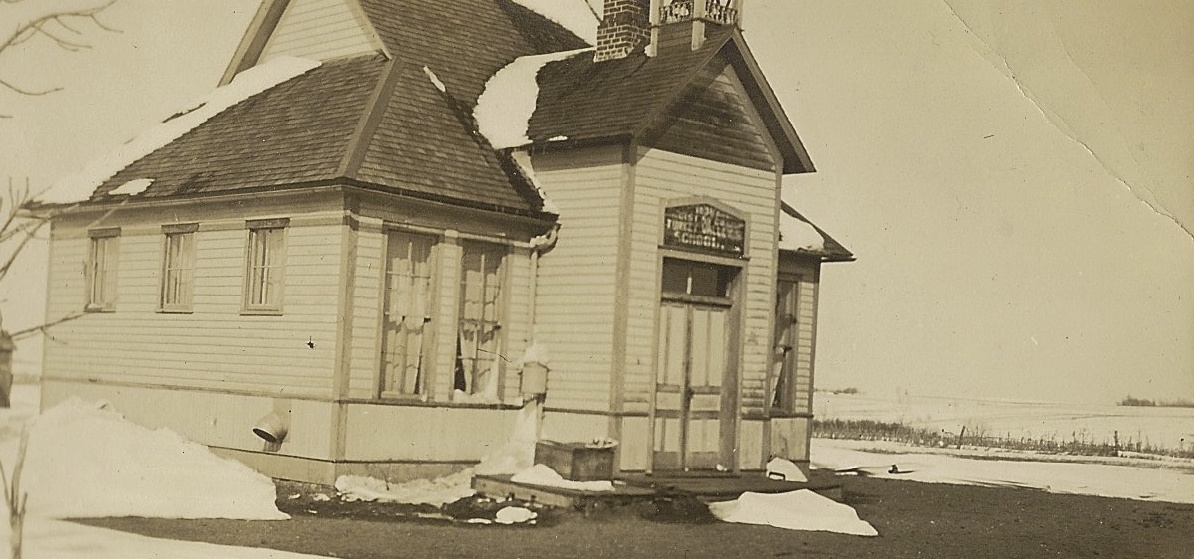
Turkey Valley School, date unknown, Turkey Valley, Yankton County, South Dakota; digital image 2010, privately held by [personal information withheld].

As the Nelson children grew and completed school, several of the six daughters scattered about the county on teaching assignments. In the fall of 1916, Andrea, age nineteen, boarded with the Skov family in Turkey Valley. Andrea was in the midst of her first term as a schoolteacher, having recently graduated from the Springfield Normal School.4

On 18 November 1916, Andrea wrote to her parents, explaining that she had spoken to the members of the local school board to ask if she could take off the day after Thanksgiving:

“Mr. Hinseth said that for his part he didn’t care how many we took off as he had no kids to send and Mr. Mikkleson said sure we could take the day then could see later about making it up. […] I haven’t asked Mr. Andreason about the day but it won’t do him much good to kick as it’s three against one.”5

Andrea was pleased, as this meant that she could return home for Thanksgiving and the three days following. No doubt she was eager to show off her new overshoes, purchased the previous afternoon in Irene. Although she reported woefully that they had made a dent in her monthly “warrant,” she continued, “Mr. Skov gave his ‘womenfolks’ a scolding because we hadn’t gotten overshoes a week ago Sat. when we were in town so I thot [sic] I had better get me a pair yesterday or I’d be scolded again, ha!”6

With these overshoes, Andrea would have been prepared for the blustery winter days on the eastern South Dakota prairie, and she would have stayed warm for the duration of the forty-mile journey home for the holidays. Now, if only we knew what was served for dinner!


SOURCES
1 Nelson, Anna. “Diary.” MS. Yankton County, South Dakota, 1908. Privately held by [personal information withheld].
2 1910 U.S. census, Yankton County, South Dakota, population schedule, Township 93 Range 57, enumeration district (ED) 447, sheet 2-A, p. 186 (stamped), dwelling 24, family 24, Fred Nelson; digital image, Ancestry.com (http://www.ancestry.com : accessed 26 November 2013), citing National Archives microfilm publication T624, roll 1489.
3 1910 U.S. census, Yankton County, South Dakota, population schedule, Township 93 Range 57, enumeration district (ED) 447, sheet 3-A, p. 187 (stamped), dwelling 46, family 48, Andrew Schmidt; digital image, Ancestry.com (http://www.ancestry.com : accessed 26 November 2013), citing National Archives microfilm publication T624, roll 1489.
4 The Echo, Vol. 1, “Andrea Nelson,” Springfield, South Dakota, 1916; privately held by [personal information withheld].
5 Andrea Nelson to Fred and Christine (Schimdt) Nelson, letter, detailing Thanksgiving plans, 18 November 1916; privately held by [personal information withheld].
6 Andrea Nelson to Fred and Christine (Schmidt) Nelson, letter.

The Nelson Family

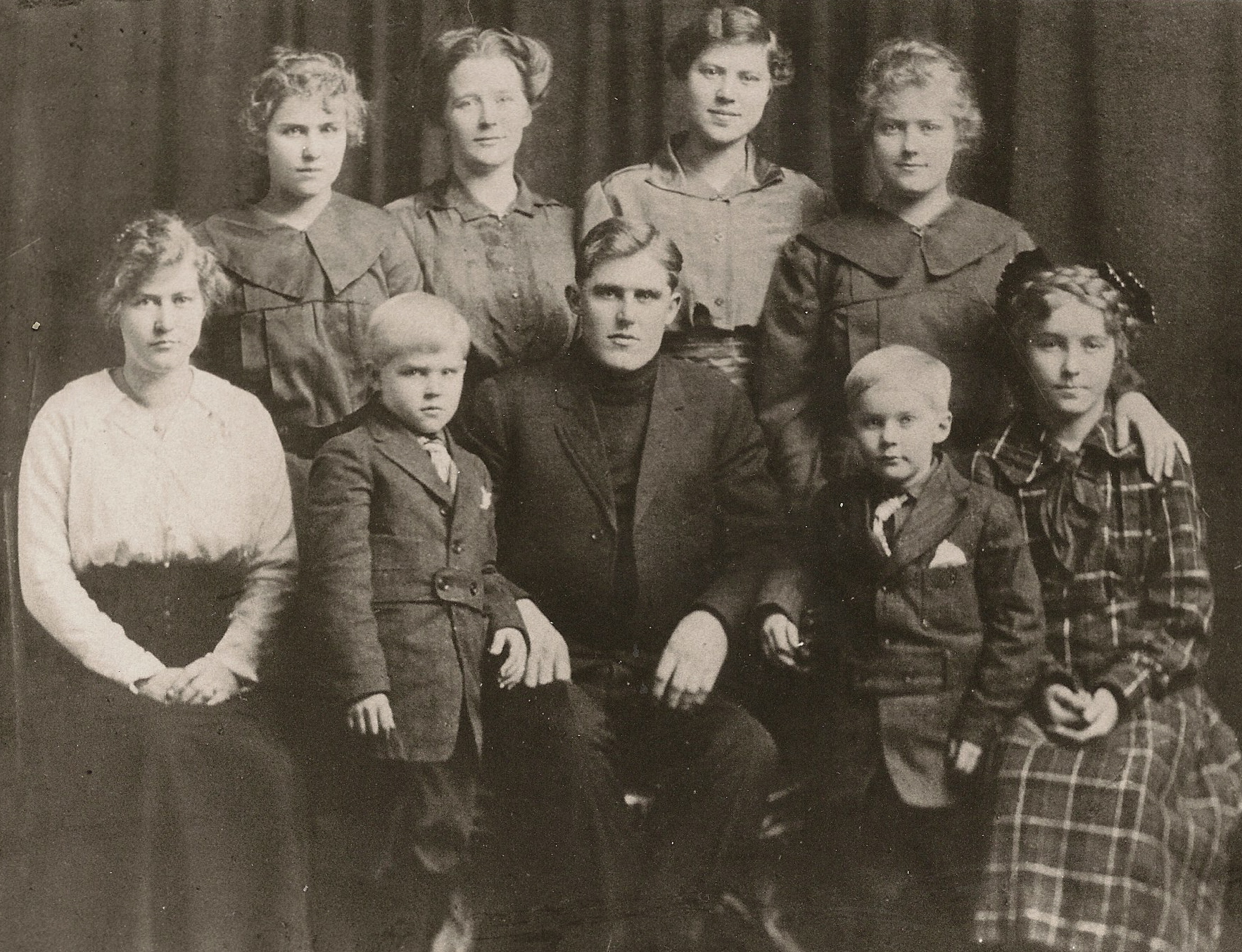
The nine children of Fred and Christine (Schmidt) Nelson of Tabor, Yankton County, South Dakota pose together here circa 1915. These six sisters and three brothers span nineteen years in age; from eldest to youngest, they are Anna, Julia, Ole, Andrea, Louise, Helena, Mary, Fred, and Myron Nelson. [Update: Since writing this piece, I have located another copy of this photograph with a date of December 1917 handwritten on the back.]
FredNelsonChildren1915

Family of Fred and Christina (Schmidt) Nelson, ca. 1915, Yankton County, South Dakota; digital image 2010, privately held by [personal information withheld], 2013.

A strong family resemblance can be seen in the nine Nelson siblings. Anna and Julia stand at center; they are wearing plain buttoned blouses and skirts, as is Andrea, seated left. Louise and Helena, standing at left and right, wear almost identical dresses with wide collars, pleated bodices, and belted waists. Their dresses were almost certainly sewn by hand from the same pattern.

Mary, the youngest sister, seated at right, is dressed in the most striking manner in a plaid dress with a ring of beautiful braids coiled atop her head. As the story goes, while they were growing up, the Nelson sisters would line up each morning to braid the hair of the sister standing before them.1 Someone clearly spent extra time on Mary’s hair on the morning that this photograph was taken!

The brothers, regardless of age, wear sturdy wool jackets. Ole’s jacket is open over a dark shirt or sweater that seems to be in the style of a turtleneck, while young (and very blond) Fred and Myron wear their jackets buttoned over shirts and ties. They lean towards Ole, their arms propped beside his on the arms of his chair.

In 1915, not all of the Nelson children remained at home, although all continued to live in the area. Anna, the eldest, was married, and had started a family.2 Julia was a schoolteacher,3 the profession pursued by her younger sisters, Andrea and Louise, who were students at the nearby Springfield Normal School.4 They would soon be followed by Helena and Mary, who at this point likely still attended the local school with Fred and Myron. Ole, the eldest brother, was a carpenter, and worked on the family farm.5

Was there an occasion for this photograph? In March of 1915, Fred and Christina (Schmidt) Nelson would have celebrated their twenty-fifth wedding anniversary.6 Perhaps a photograph of their progeny was in order, either by their request or as a gift from their children. Regardless, this is the last known photograph of all of the Nelson children together, and it’s a lovely one.


SOURCES
1 Phyllis (Wiese) Adam, conversations with the author, 2012; notes in author’s files.
2 1920 U.S. census, Yankton County, South Dakota, population schedule, Mission Hill, Enumeration District (ED) 251, p. 6151 (penned), sheet 1-B, dwelling 10, family 10, Anna Jorgensen; digital image, Ancestry.com (http://www.ancestry.com : accessed 4 November 2013), citing National Archives microfilm T625, roll 1726.
3 “South Dakota, State Census, 1915,” index and images, FamilySearch (https://familysearch.org : accessed 04 Nov 2013), Julia Nelson, Tabor, Yankton, South Dakota, United States.
4 The Echo, Vol. 1 (Springfield, South Dakota: Springfield Normal School, 1916); private collection of Brian Adam [personal information withheld].
5“South Dakota, State Census, 1915,” index and images, FamilySearch (https://familysearch.org : accessed 04 Nov 2013), Ole Nelson, Tabor, Yankton, South Dakota, United States.
6“In Memoriam: Christine M. Nelson,” undated clipping, ca. January 1961, from unidentified newspaper.

Edwardian Children’s Fashions

Gerald Joseph Adam photograph, ca. 1910-1911, Sioux City, Iowa; digital image 2010, privately held by Melanie Frick, 2013.

Gerald Joseph Adam photograph, ca. 1910-1911, Sioux City, Iowa; digital image 2010, privately held by Melanie Frick, 2013.

Gerald “Jerry” Adam of Sioux City, Woodbury, Iowa, is pictured here at left with his cousin, Alvin Joseph Bauer, and Alvin’s cousin, Helen Ann Thomas. The three toddlers stand on a sidewalk and hold hands, supporting the youngest in the middle. Jerry speaks to someone who has caught his attention outside of the frame, while Alvin gazes directly at the camera, wide eyed and solemn. Little Helen has a sweet smile for the photographer.

All of the children wear dark shoes and thick stockings. Jerry’s dress is the most elaborate, made of a light-colored plaid or gingham fabric with matching knickerbockers. It features two rows of white buttons, a bow at the throat, and a drop waist with a dark belt. His hair is curled in chin-length ringlets. The other, younger children are dressed more simply. Alvin wears a shapeless, light-colored gown without adornment. His hair is short, slickly parted on the side. Helen wears a similarly loose gown, though it appears to have a light calico pattern. Her dress has a collar, over which hangs a slim necklace and pendant. Her hair is also short, though wavy in texture.

In the Edwardian era, it continued to be common for young children, regardless of gender, to wear comfortable gowns. While it undoubtedly made changing soiled clothing a quicker task, dresses also allowed for easier movement. Pants – and haircuts – for little boys were often reserved for the time at which they would start school. In 1907, The Ladies’ Home Journal made a comparison of practical and impractical children’s clothing, writing:

“The first boy is in for a good time, and yet he looks the thorough little man with his bloomer trousers underneath his one-piece suit. Then look at his ‘nice’ but unhappy little companion who is made a ridiculous caricature of a man in his wee trousers so out of place on little legs.”1

When was this picture taken? Jerry was born in June 1908,2 Helen was born in August 1908,3 and Alvin was in August 1909,4. It should be noted that Alvin, the youngest, was already walking when this picture was taken, dating the picture no earlier than the late summer of 1910. Several additional clues date the photograph slightly later. The children do not wear coats, but appear to be dressed in layers. Furthermore, the trees in the background are completely bare. It seems most likely that this photograph was taken in the late fall of 1910 or the early spring of 1911.

Could the photograph have been taken on a holiday, perhaps Thanksgiving or Easter, when the families might have gotten together? Or was this simply a play date of a century ago? Regardless, I’m sure that my great grandfather would have had something to say about this photograph of him wearing long curls and a dress!

Have you found that your grandfathers wore dresses as children?


SOURCES
1 “Edwardian Clothing: Good Taste and Bad Taste in Dressing Children,” Victorian Magazine, (http://www.victoriana.com/edwardianfashions/edwardianchildren.php : accessed 20 September 2013).
2 “Iowa, Births and Christenings Index, 1857-1947,” database, Ancestry.com (http://www.ancestry.com : accessed 20 September 2013), entry for Herald [Gerald] Joseph Adam, 19 June 1908, Sioux City.
3 “Iowa, Births and Christenings Index, 1857-1947,” database, Ancestry.com (http://www.ancestry.com : accessed 20 September 2013), entry for Helen Ann Thomas, 22 August 1908, Sioux City.
4 “Iowa, Births and Christenings Index, 1857-1947,” database, Ancestry.com (http://www.ancestry.com : accessed 20 September 2013), entry for Alvin Joseph Bauer, 7 August 1909, Sioux City.