Tag Archives: genealogy

A New Year’s Eve Party?

HenryMelanieAdamParty_2

Henry and Melanie (Lutz) Adam, ca. 1910, Sioux City, Woodbury County, Iowa; digital image 2010, privately held by Melanie Frick, 2014.

Happy New Year! …or at least, I think that’s what might have been said when this photograph was taken about a century ago. Featured are Henry and Melanie (Lutz) Adam of Sioux City, Woodbury County, Iowa, with Henry seated at lower right and Melanie in white above his raised hand.

Could this photograph have been taken at a New Year’s Eve party? The curtains are drawn in the living room or parlor where the photograph was taken, which suggests to me that it could be after dark. Furthermore, it’s clear that the alcohol is flowing. One man can be seen taking a drink, while several others clutch glasses and bottles. (Alas, I can’t make out the labels.) Nearly everyone wears some sort of silly hat made of cloth or paper, and only three older children are present in the photograph – no little ones.

Note that three of the men in front, including Henry, make a gesture with their thumbs to the sides of their noses and their fingers extended flat, pressed together. They aren’t quite thumbing their noses in the way that I have seen, so I wonder what this gesture might have meant.

Of the nineteen people gathered here, only Henry seems to be ready for the camera. Most, including Melanie, look to the side, perhaps at another photographer, or are caught in the midst of conversation. Whether this gathering was for New Year’s Eve or not, one can easily imagine the chaotic scene as an attempt was made to corral this lively group of friends for a memorable photograph. Cheers!

The Lutz Sisters

HattieJuliaAnnaMelanieLutz

Sisters Hedwig, Julia, Anna, and Melanie Lutz, ca. 1900, Minnesota; digital image 2010, privately held by Melanie Frick, 2013.

Julia, Anna Marie, Hedwig “Hattie” Eulalie, and Melanie Veronica Lutz were the daughters of French and Polish immigrants, respectively Joseph and Hedwig (Cichos) Lutz of Minnesota Lake, Faribault County, Minnesota.1 By the time that this photograph was taken, circa 1900, Joseph had passed away, and Hedwig had remarried and given birth to five additional children.2 Her eldest daughters must have been close, however, as they chose to have a photograph taken of just the four of them.

Standing with her arms protectively behind her seated sisters is Hattie, who would have turned nineteen in the year 1900.3 Although her position suggests that she was the eldest, she was not; it’s possible that she may have been the tallest, however, if the photographer were to have posed the sisters based on height. She is also the only sister wearing a dress with a white collar, offering contrast; the other sisters seem to be wearing their good black dresses. None of the dresses, however, are alike, each having unique decorative pleats, panels, and/or bows. The collars are extremely high, perhaps an example of what would have been known as “officer’s” collars.4

Julia is seated at right, her dark eyes serious. She would have turned twenty-four in 1900, and was the eldest of the sisters.5 Seated at the center is Anna, who would have turned twenty-two that year.6 Melanie, the youngest, is at left; she would have celebrated her sixteenth birthday in 1900.7

At this time, all four sisters had left their mother’s household.8 Julia was married with two young children at home; she and her husband kept a hotel,9 and Anna was employed as a servant there.10 Hattie lived with her elderly maternal grandparents.11 As Melanie cannot be located in the 1900 U.S. census, she may have been away at school, where she trained to become a teacher. Later in life, Julia, Anna, Hattie, and Melanie made their homes in four different communities across three different states, but their sisterly bond is apparent in this photograph of them as young women.


SOURCES
1 “Minnesota, Marriages, 1849-1950,” index, FamilySearch (https://familysearch.org : accessed 15 Nov 2013), Joseph Lutz and Hedwig Joice, 19 April 1875. Cichos was likely transcribed incorrectly as Joice.
2 1900 U.S. census, Faribault County, Minnesota, population schedule, Minnesota Lake, enumeration district (ED) 92, sheet 10-B, p. 4834 (penned), dwelling 178, family 178, Hattie Rendfleisch; digital image, Ancestry.com (http://www.ancestry.com : accessed 15 November 2013), citing National Archives microfilm publication T623, roll 763. Rendfleisch was a variation of Rindfleisch.
3 “Minnesota, Births and Christenings, 1840-1980,” index, FamilySearch (https://familysearch.org : accessed 15 Nov 2013), Hedwig Lutz, 06 September 1881.
4 Joan Severa, Dressed for the Photographer: Ordinary Americans and Fashion, 1840-1900 (Kent, Ohio: Kent State University Press, 1995), 526.
5 “Minnesota, Births and Christenings, 1840-1980,” index, FamilySearch (https://familysearch.org : accessed 15 Nov 2013), Julia Lutz, 13 December 1876.
6 “Minnesota, Births and Christenings, 1840-1980,” index, FamilySearch (https://familysearch.org : accessed 15 Nov 2013), Anna Lutz, 12 May 1878.
7 “Minnesota, Births and Christenings, 1840-1980,” index, FamilySearch (https://familysearch.org : accessed 15 Nov 2013), Melanie Veronica Lutz, 28 May 1884.
8 1900 U.S. census, Faribault Co., Minn., pop. sch., Minnesota Lake, ED 92, sheet 10-B, p. 4834, dwell. 178, fam. 178, Hattie Rendfleisch.
9 1900 U.S. census, Nobles County, Minnesota, population schedule, Adrian, enumeration district (ED) 209, sheet 2-B, p. 43 (penned), dwelling 29, family 29, Julia McColm; digital image, Ancestry.com (http://www.ancestry.com : accessed 15 November 2013), citing National Archives microfilm publication T623, roll 778.
10 1900 U.S. census, Nobles County, Minnesota, population schedule, Adrian, enumeration district (ED) 209, sheet 2-B, p. 43 (penned), dwelling 29, family 29, Anna M. Lutz; digital image, Ancestry.com (http://www.ancestry.com : accessed 15 November 2013), citing National Archives microfilm publication T623, roll 778.
11 1900 U.S. census, Faribault County, Minnesota, population schedule, Minnesota Lake, enumeration district (ED) 92, sheet 5-A, p. 4719 (penned), dwelling 73, family 73, Hattie Lutz; digital image, Ancestry.com (http://www.ancestry.com : accessed 15 November 2013), citing National Archives microfilm publication T623, roll 763.

Military Monday: A Civil War Compiled Service Record

In honor of Veteran’s Day, I thought I would share the Compiled Military Service Record (CMSR) of my one and only direct ancestor who served in the Civil War, namely John Fenton of Company M of the 3rd Illinois U.S. Cavalry.1

John Fenton, of Bole, Nottinghamshire, England,2 came to America with his wife and children before 1850.3 They settled first in Summit County, Ohio,4 and later lived in Montgomery County, Illinois. By the time the Civil War rolled around, John was a widower with four children between the ages of nine and eighteen: Sarah Alice, Harriet, John, and George W. Fenton.5

This slideshow requires JavaScript.

On 14 September 1861, John enlisted as a Private in Company M of the 3rd Illinois U.S. Cavalry in Pana, Christian, Illinois, for a term of three years. He was now forty-six years old – no longer a young man, he would have been nearly fifty before his term of service was complete. John stood at 5 feet 9 inches tall, and had a dark complexion, black hair, and hazel eyes.6

As of 1860, John had made his living as a farm laborer, boarding with three of his children in the household of another family.7 One of his daughters boarded with a family in the next county.8 Perhaps, being that John was apparently a horseman, a three-year stint in the cavalry seemed to be as good of an option as any in terms of bringing in steady pay. John’s daughters were old enough to look after their younger brothers, and perhaps – hopefully – there were friends or relatives willing to take them in while he served. The pension file submitted by his minor son, decades later, may answer some of these lingering questions.9

John’s service was relatively short lived. Soon after his enlistment, the Regiment made its way to Missouri; John spent time on prisoners’ guard in Rolla, and may have seen action at the Battle of Pea Ridge in Arkansas. In late April of 1862, John left the site of Pea Ridge with the train of wounded, arriving in the hospital in Lebanon, Laclede, Missouri. After a lingering illness, it was there that he died of typhoid fever on 7 July 1862 at the age of forty-seven.10 Although John was initially buried at Lebanon, his grave was likely unmarked and his body may since have been exhumed and reburied the National Cemetery in Springfield, Missouri.11

How can you obtain your ancestor’s Compiled Military Service Record (CMSR)? I acquired John Fenton’s CMSR in person at the National Archives in 2011, when I still lived near Washington, D.C. It was a definitely an experience to be able to view and photograph the original document at my leisure; although the National Archives can seem intimidating, I was able to place my request without any problems and there were plenty of staff members and volunteers willing to point me in the right direction as needed. If you don’t find yourself there anytime soon, and if the CMSR that you seek isn’t available online or on microfilm at a local branch of the National Archives, you can still request a copy for a fee, using information located in indexes online. The online ordering system is easy to use – just be prepared to wait for your record to arrive in the mail!


SOURCES
1 Compiled service record, John Fenton, Pvt. Co. M, 3 Illinois Inf.; Carded Records, Volunteer Organizations, Civil War; Records of the Adjutant General’s Office, 1780s-1917, Record Group 94; National Archives, Washington, D.C.
2 Compiled military service record, John Fenton, Pvt. Co. M, 3 Ill. Inf., Civil War, RG 94, NA-Washington.
3 1850 U.S. census, Summit County, Ohio, population schedule, Stow, p. 931 (penned), dwelling 33, family 52, John Fenton; digital image, Ancestry.com (http://www.ancestry.com : accessed 11 November 2013), citing National Archives microfilm M432, roll 732.
4 1850 U.S. census, Summit Co., Oh., pop. sch., Stow, p. 931 (penned), dwell. 33, fam. 52, John Fenton.
5 1860 U.S. census, Montgomery County, Illinois, population schedule, Audubon Post Office, p. 319 (penned), dwelling 2284, family 2287, John Fenton; digital image, Ancestry.com (http://www.ancestry.com : accessed 11 November 2013), citing National Archives microfilm M653, roll 214.
6 Compiled military service record, John Fenton, Pvt. Co. M, 3 Ill. Inf., Civil War, RG 94, NA-Washington.
7 1860 U.S. census, Montgomery Co., Ill., pop. sch., Audubon P.O., p. 319 (penned), dwell. 2284, fam. 2287, John Fenton.
8 1860 U.S. census, Christian County, Illinois, population schedule, Pana, p. 319 (penned), dwelling 574, family 5114, Harriet Fenton; digital image, Ancestry.com (http://www.ancestry.com : accessed 11 November 2013), citing National Archives microfilm M653, roll 161.
9 “U.S., Civil War Pension Index: General Index to Pension Files, 1861-1934,” digital images, Ancestry.com (http://www.ancestry.com : accessed 11 November 2013); John Fenton (Co. M, 3rd Ill. Inf.) index card; imaged from General Index to Pension Files, 1861-1934, T288 (Washington, D.C.: National Archives [n.d.]), roll 150.
10 Compiled military service record, John Fenton, Pvt. Co. M, 3 Ill. Inf., Civil War, RG 94, NA-Washington.
11 “Union Soldiers Buried at Lebanon, Missouri 1862-1865,” Judy’s Stuff (http://freepages.genealogy.rootsweb.ancestry.com/~judysstuff/burials/Lebanon.htm : accessed 11 November 2013).

Identifying Photographs of the Civil War Era

Antique photographs can come with unique distinctions that suggest that they were made during the Civil War era. Neither of these photographs has been identified, but both come from a photograph album, purchased at an antique shop, with ties to the family of Jesse M. and Elizabeth Jane (Baker) Smith of Mount Pleasant, Henry County, Iowa.1 Both provide excellent examples of the ways in which Civil War era photographs might be marked or otherwise adorned.

Unidentified tintype of woman and child, ca. 1865; digital image 2012, privately held by Melanie Frick, 2013.

Unidentified tintype of woman and child, ca. 1865; digital image 2012, privately held by Melanie Frick, 2013.

The first image in the album, which features a woman and, presumably, her young daughter, is set inside an embossed white paper mat with a patriotic pattern of stars. An embossed notation on the side of this mat states that it was patented 7 March 1865, suggesting that the tintype was made shortly thereafter.2 The woman has crimped her hair at the temples in a manner that was popular in the latter half of the decade,3 and the young girl, perhaps six years old, wears her hair long and loosely curled. While the mother is corseted and in a fine gown supported by a hoop skirt, the daughter is dressed in a much looser – and more comfortable – style, though she also wears jewelry as well as what appears to be flowers or decorative combs in her hair.

The name “Laura” is handwritten in pencil near the top of the mat. Unfortunately, the only Laura that I could find directly related to the couple associated with this album was not born until 1867.4 Perhaps there was another Laura in the extended family, or perhaps it was labeled as such simply because it came from “Laura’s side of the family,” as opposed to, for example, the family of her spouse. Regardless, the relationship between the mother and daughter pictured here, dressed in their best during a tumultuous period in American history, can still be appreciated today.

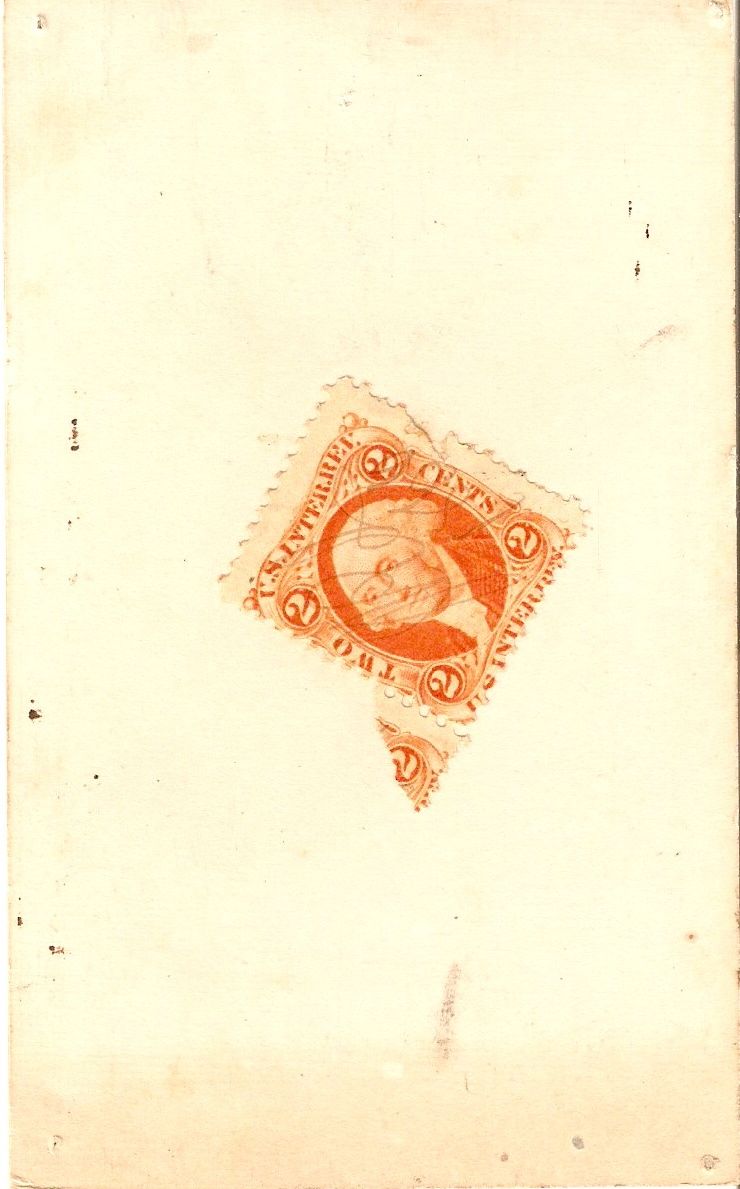
Tax revenue stamp of unidentified photograph of couple, 1866; digital image 2012, privately held by Melanie Frick, 2013.

Tax revenue stamp of unidentified photograph of couple, 1866; digital image 2012, privately held by Melanie Frick, 2013.

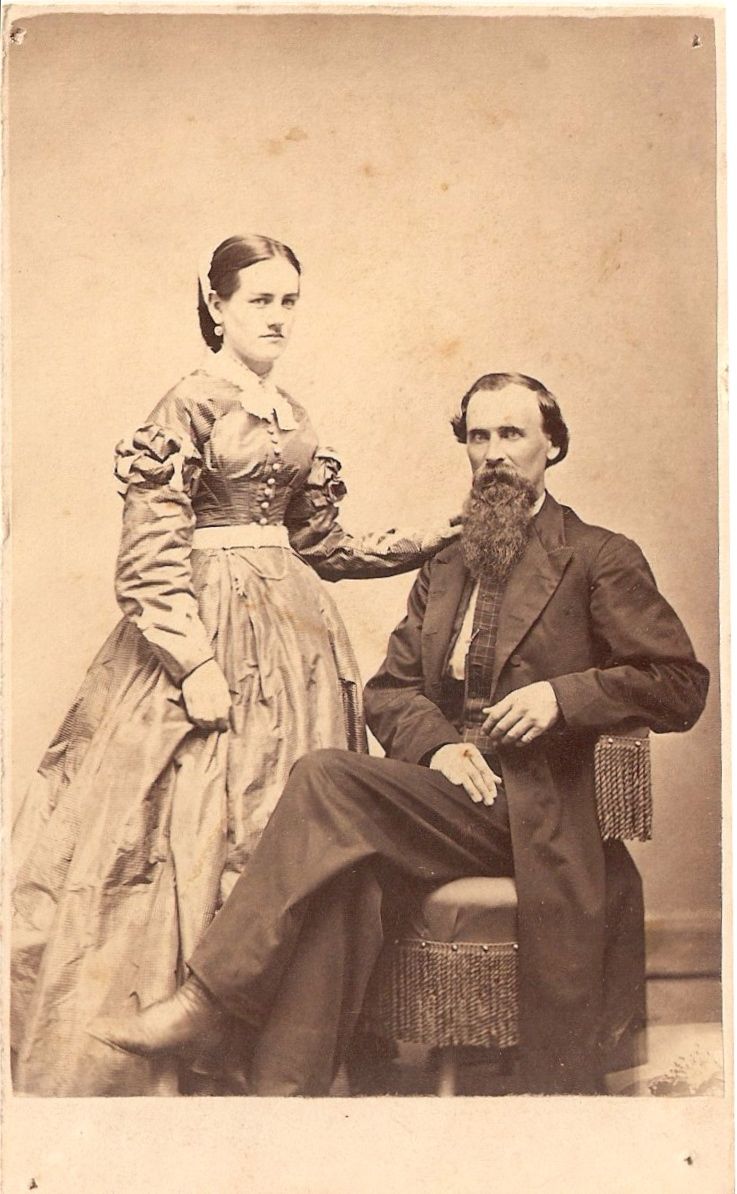
Unidentified photograph of couple, 1866; digital image 2012, privately held by Melanie Frick, 2013.

Unidentified photograph of couple, 1866; digital image 2012, privately held by Melanie Frick, 2013.

Another photograph with a distinct Civil War flavor comes with a helpful clue.  The couple in the photograph above appears impeccably dressed. The bearded man wears a typically roomy sack-cut coat,5 accented with a dark plaid vest, and the woman, whose hair is held back with combs in a style that was common at the time,6 wears a solid-colored gown with elegant puffed sleeves and buttons adorning the bodice. Affixed to the back of this carte de visite is an orange two-cent stamp. This stamp, which features George Washington, was a tax revenue stamp. It is canceled with the photographer’s initials, along with the date: 1866. As it turns out, this photograph was taxed near the tail end of the period during which photographs were subject to a tax; the period of taxation lasted only from 1 September 1864 to 1 August 1866.7

This photograph has tack holes in each of its four corners, suggesting that it was put on display at one time, tacked up perhaps on the wall of a home or on a writing desk. Evidently, in the years before it made its way into an album and was subsequently forgotten, this photograph was important enough to someone that he or she wished to look upon it every day. Today, we are left to wonder what became of the couple pictured within, and why they chose to have their photograph taken on this day in 1866, not long after the conclusion of the Civil War.

What signs of the Civil War era have you spotted in a photograph?


SOURCES
1 Jesse M. and Elizabeth Jane (Baker) Smith Album, ca. 1860-1920; privately held by Melanie Frick, 2013.
2 “What Do You Know About Tintypes?,” Ohio Historical Society Collections Blog, 5 August 2011 (http://ohiohistory.wordpress.com/2011/08/05/what-do-you-know-about-tintypes/ : accessed 13 September 2013).
3 Joan Severa, Dressed for the Photographer: Ordinary Americans and Fashion, 1840-1900 (Kent, Ohio: Kent State University Press), 206.
4 1870 U.S. census, Henry County, Iowa, population schedule, Center, p. 14, dwelling 109, family 109, Laura B. Smith; NARA microfilm publication M593, roll 395.
5 Severa, Dressed for the Photographer, 209.
6 Severa, Dressed for the Photographer, 206.
7 Maureen A. Taylor, Family Photo Detective (Cincinnati: Family Tree Books, 2013), 54-55.

Vintage Swimwear

This is a fun photograph that I thought I would share before the summer completely slips away. This snapshot was labeled on the back, and, years ago, I was also able to hear its story from my late great-grandmother, Fern Lavonne (Thoma) Adam of Sioux City, Woodbury County, Iowa. Well, more than its story, I remember her laughing about her bathing suit! The photograph was taken in 1924, at the river near Scribner, Dodge County, Nebraska.

Fern Lavonne (Thoma) Adam photograph, 1924; digital image 2010, privately held by Melanie Frick, 2013.

Fern Lavonne (Thoma) Adam photograph, 1924, Scribner, Nebraska; digital image 2010, privately held by Melanie Frick, 2013.

Fern lived in Scribner, where her father opened a grocery store, for a few years in the early 1920s. She remembered attending dances there, as well as learning to drive. Her father gave her a lesson immediately when she remarked that she would like to learn, and the next day, when she asked for another lesson, he told her to go ahead on her own!1 Apparently, Fern also enjoyed taking advantage of the opportunity to swim in the Elkhorn River during her short time in Scribner. She is pictured here at center; at left is Lucille Romberg, and at right is Helen Kellner. These young ladies must have been good friends in the summer of 1924, when Fern would have been sixteen years old.

In order to learn more about vintage bathing suits, I turned to Threaded, the Smithsonian’s blog about fashion history. From there I learned that a company by the name of Jantzen devised a “swimming suit” made of wool in 1915, and that by 1921, the name had stuck.2 My great-grandmother and her friends appear to be wearing typical knitted wool swimsuits of the era, comprised of long, sleeveless, v-necked tunics, fitted shorts, and, in my great-grandmother’s case, knee high stockings, rolled at the top. The girls wear their hair inside knit swimming caps, the one on the left being slightly more elaborate with a small brim. They all squint in the sun and lean together for the photograph, happy and relaxed on a summer’s day.

Have you come across any photographs featuring early styles of swimwear?


SOURCES
1 Fern Lavonne (Thoma) Adam, conversations with the author, 2001.
2 “The Swimsuit Series, Part 1: A History of Women’s Suits,” Threaded, 22 June 2012 (http://blogs.smithsonianmag.com/threaded/2012/06/the-swimsuit-series-part-1-a-history-of-womens-suits/ : accessed 6 September 2013).

Welcome!

Hello, and welcome to The Homestead! My name is Melanie Frick, and while I’m new to the world of genealogy blogging, genealogy has been an important part of my life for over a decade. I’m sure any genealogist can relate to the most frequent questions I receive when someone learns what I do: Where did your ancestors come from? How far back does your family tree go? I always struggle to give a brief answer to these questions, because I realize that to answer the questions completely would be more than one would bargain for when making polite conversation.

My ancestors were Danish immigrants who homesteaded in southeastern South Dakota, and frontiersmen who made the trek from coastal North Carolina to southern Illinois at the dawn of the nineteenth century. They were Acadians who were forcibly exiled to Massachusetts in the midst of the French and Indian Wars, and German farmers who found their paradise in the peaceful rural communities of northeast Iowa. They were immigrants who made their homes in the hustle and bustle of Chicago, and pioneers who made their lives on the plains of Kansas. They were French fur traders in the harsh landscape of seventeenth century Quebec, and English immigrants who supported their new nation in the Civil War. They were husbands and fathers, wives and mothers, farmers, soldiers, businessmen, teachers, midwives, millworkers.

Inger Marie (Hansen) Bramsen photograph, ca. 1870; digital image ca. 2001, privately held by Melanie Frick, 2013. The location, condition, and characteristics of the original are unknown.

Inger Marie (Hansen) Bramsen photograph, ca. 1870; digital image ca. 2001, privately held by Melanie Frick, 2013. The location, condition, and characteristics of the original are unknown.

They were raised in dank sod houses, in cabins, in sturdy farmhouses and village homes, in crowded tenements. They were taught to read and write at home, in convents, in one-room schoolhouses. They were never taught to read or write. They married one, two, three, four times. They raised a dozen children. They buried baby after baby. They buried their spouses. They divorced. They celebrated their golden anniversaries. They saw their farms and businesses fail. They saw their farms and businesses succeed. They mourned homelands that they would never see again. They returned to their homelands to find their loved ones gone, their homes abandoned, their communities changed. They stayed in the same village for all of their days. They crossed oceans, continents, always in search of a better life. They died of gunshot wounds, consumption, influenza, drowning, alcoholism, buggy accidents, airplane crashes, cholera, typhoid, diphtheria, tetanus, suicide, senility, heart failure, pneumonia, old age. Their graves are marked by towering headstones. Their graves were never marked. No one remembers their names.

These are the stories I love to tell.

What will happen on The Homestead? For now, I plan to explore what I find most enjoyable to write, and what others find most enjoyable to read. I will write about my own genealogical research and historical events that impacted our ancestors, as well as tips and tricks for identifying old photographs, archiving genealogical material, and breaking down brick walls. I may even include the occasional book or product review.

I hope that you will enjoy following along with my experiences as a young professional in the field of genealogy, and I look forward to hearing from my readers. Thanks for stopping by!