Tag Archives: Iowa

An Iowa Homestead

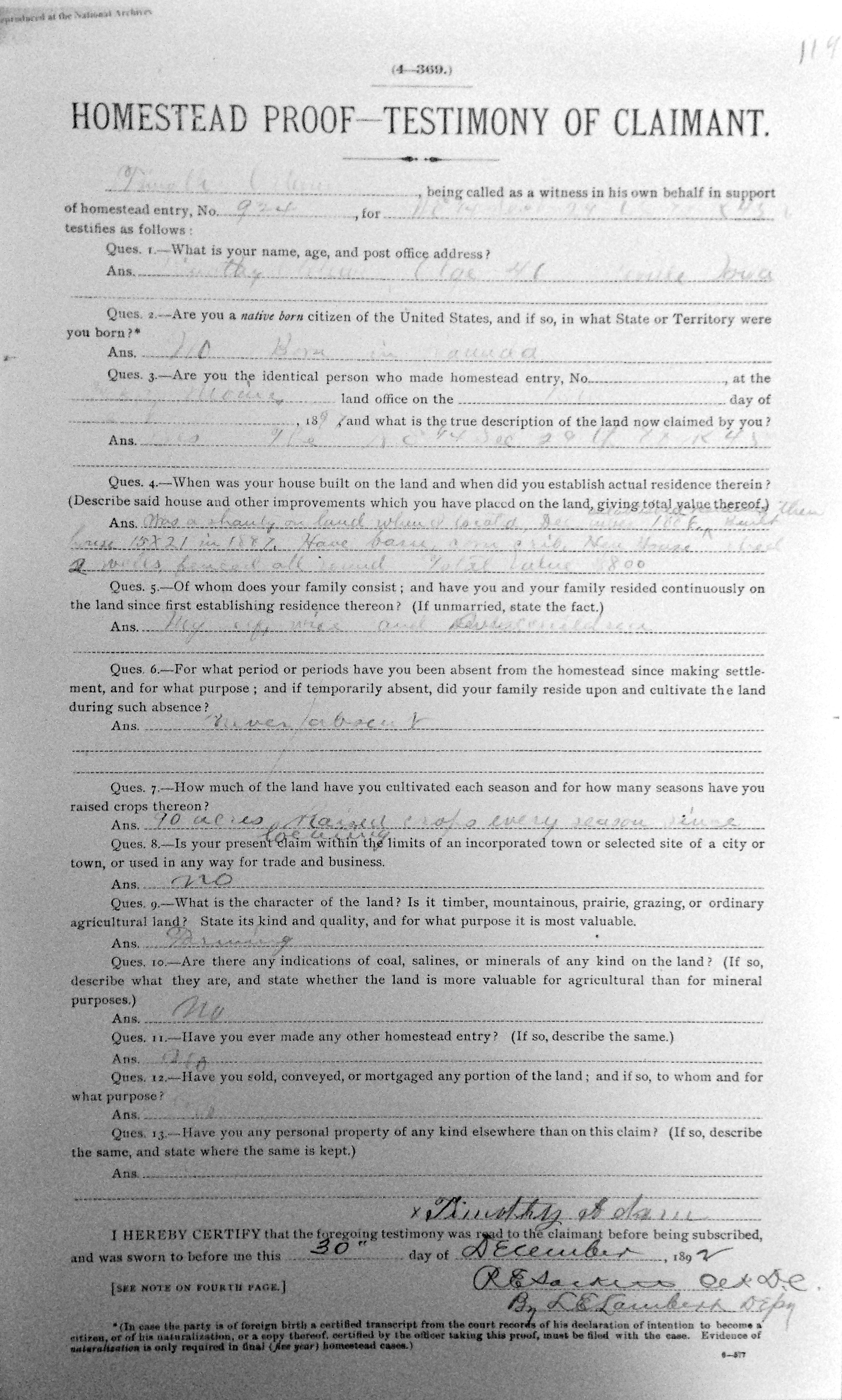
Winter was well on its way when Timothy Adam claimed a homestead near Moville, Woodbury County, Iowa, in December 1886. At that time, only a claim shanty existed on the property.1 I have to wonder if Timothy weathered the winter alone, with his wife and children situated somewhere in town, or if they joined him in what certainly must have been far from ideal living conditions. In any case, the next year, Timothy built a house that measured fifteen by twenty-one feet – three hundred and fifteen square feet for a family of six.2

IMG_3179

Timothy Adam (Woodbury County) homestead file, final certificate no. 2560, Fort Des Moines, Iowa, Land Office; Land Entry Papers, 1800-1908; Records of the Bureau of Land Management, Record Group 49; National Archives, Washington, D.C.

The Homestead Act was signed by President Abraham Lincoln on 20 May 1862.3 My first ancestor who took advantage of the one hundred and sixty acres offered to qualified applicants who lived on the land for five years and made specified improvements was Jens Madsen Schmidt, a Danish immigrant who settled in South Dakota in 1870.4 I had assumed that any ancestors who claimed homesteads in the years to follow would have had to journey even further west to find available land, but as it turns out, this was not necessarily the case. It would be sixteen years before Timothy would claim his homestead to the east, in northwestern Iowa.

The new yet modest house must have seemed positively roomy in comparison to the original shanty, and perhaps it was an improvement over what may have been an even more crowded situation back in Massachusetts. Timothy had been born and raised in St. Pie, Quebec, but by the time he was twenty, he had settled in Indian Orchard, Hampden County, Massachusetts, with his wife, Odile Millette.4 For nearly two decades, they relied on the cotton mills to earn a living, although Timothy was a carpenter by trade.5 Life in Massachusetts was likely difficult; Odile reportedly gave birth to ten children, of whom only five survived to adulthood.6 At least one succumbed to scarlet fever.7

Life in Iowa proved to be a fresh start for the family. Within a few years, the homestead boasted a barn, corn crib, hen house, shed, two wells, and fencing, valued altogether at eight hundred dollars. Timothy had cultivated ninety acres, and had raised crops every season. In addition, he had become a naturalized citizen. Finally, in 1893, at the age of forty-five, Timothy Adam became the proud owner of the NE 1/4 of Section 29, Township 88N, Range 45W in Woodbury County, Iowa.8

Continue reading

The Country Store: Family Groceries, the Best of Brandy, and Excellent Beer

The Bavarian William Henry Thoma of Garnavillo, Clayton County, Iowa, was a businessman by the age of thirty.1 In 1859, the Clayton County Journal reported:

“William Thoma, Grocer, Main Street, Garnavillo, Iowa, keeps constantly on hand all kinds of family groceries, such as Coffee, Sugar, Tea, Milasses, ice, &c. The best of Brandy and excellent Beer is also always to be found at this establishment.”2

William must have found success as a grocer and purveyor of alcoholic beverages, as his business was apparently in operation for at least two decades. He was named a merchant in the 1860 census,3 and in the 1870 census it was noted that he was the keeper of a “country store.”4 This must have allowed him to provide a comfortable lifestyle for his wife and eleven children; in 1870, he owned real estate valued at $12,000 and personal estate valued at $3,000.5

William_Thoma_1870

1870 U.S. census, Clayton County, Iowa, population schedule, Garnavillo, p. 13 (penned), dwelling 87, family 86, Wm Toma; digital image, Ancestry.com (http://www.ancestry.com : accessed 16 April 2014), citing National Archives microfilm M593, roll 383.

After William’s death in the summer of 1876,6 his widow, Anna Margaretha (Poesch) Thoma, with a handful of young children still at home, took over as merchant. She maintained the business for a number of years, while her eldest son assisted as a clerk in the store.7

I like to wonder whether William’s store was anything like that featured at Iowa’s Living History Farms, which boasts the fictional 1875 Town of Walnut Hill. Images of the picturesque Greteman Brothers General Store can be seen here. It’s well worth a visit if you find yourself in central Iowa and have ever wondered what life was like for your Midwestern ancestors in the years following the Civil War. The impact of the Industrial Revolution on rural communities is visible, although, according to the Living History Farms, “The railroad will always be a few years away for Walnut Hill.”8

Of course, I also have to wonder whether William and Anna Margaretha (Poesch) Thoma were anything like Nels and Harriet Oleson of Little House on the Prairie. Let’s just hope that their children weren’t as spoiled as the infamous Nellie and Willie!

Continue reading

A Little French Boy

An American by birth, Henry Joseph Adam spoke French until he started school.1 He was born in Indian Orchard, Hampden County, Massachusetts, on 5 August 1881, the son of Timothy and Odile (Millette) Adam, both of French Canadian heritage.2 His father had been born in Quebec, while his mother had been born in upstate New York.3 Regardless of their nationality, their roots ran deep, and the French language likely remained more familiar to them than English.

Henry_Joseph_Adam_1886

Henry Joseph Adam, Sioux City, Woodbury County, Iowa, ca. 1886-87; digital image 2013, privately held by Melanie Frick, 2014.

Pictured here circa 1886-87, when he was about five years old, Henry is simply but neatly dressed. He wears breeches with high patterned stockings, and a white or light-colored shirt with a contrasting bow-tie. His boots, perhaps hand-me-downs from an older brother, have been polished till they shine. He may hold a cap in his left hand, although it is indistinct due to the quality of this tintype. Despite the fact that cabinet cards grew in popularity during this decade, tintypes were still certainly not unusual. The faintest blush of pink is visible on Henry’s cheeks from a painted accent.

The studio setup is interesting and not particularly professional. Henry stands upon a small stool, and leans against a piece of furniture covered with heavy fabric. The painted backdrop behind him depicts a scene of a house, fields, and a tree, which doesn’t tie in well with the wood floor in the foreground. I suspect that this photograph may have been taken in Sioux City, Woodbury County, Iowa; the Adam family moved here sometime in the mid-1880s, perhaps because of its proximity to the large French Canadian community in nearby Jefferson, Union County, South Dakota.4 Thus, this little French boy remained in good company; he may have learned English at school, but he would not have forgotten his French!

Continue reading

An Iowa Teacher’s Report to Parents, 1925

The first of June 1925 was an important day for Frances Marie Noehl of Deerfield, Chickasaw County, Iowa. She completed the eighth grade in District No. 11 with flying colors, even rallying over the course of the year to bring up her lagging grade in conduct.1 However, although she was a successful student, with high average marks equivalent to straight A’s, she would not go on to graduate from high school.2

ReportCard1

Frances Noehl, Teacher’s Report to Parents, 1925, Deerfield, Iowa; digital image 2003, privately held by V. P. [personal information withheld], 2014.

Frances was the eighth of nine children born to Matthias and Elizabeth (Hoffman) Noehl, German immigrants who farmed in northeastern Iowa.3 Once her schooling was completed, Frances was needed at home, although her father did prize education. In his memoirs, he wrote of his schooldays in Germany, “I entered into the arena, and took it up not only with the alphabet, but with all my classmates. As at that time there was no special talent in our school of eighty-four pupils, I succeeded in taking the first place among all the boys.”4 His education concluded at the age of fourteen, but he was pleased to be allowed to keep his books, writing tablet, slate, and pencil.5 Perhaps he had once dreamed that his children would be fortunate enough to further their educations, but, at least in the case of his youngest daughter, that dream was unfulfilled.

During the course of her eighth grade year, Frances was instructed by Miss Beatrice Joebgen, a local teacher who was still a teenager herself.6 Frances was graded in Reading, Writing, Spelling, Arithmetic, Grammar, U.S. History, Music, Civics, Drawing, and Conduct, with all of her marks falling between 90 and 100 and her averages between 93 and 98. Her father’s signature was recorded on her report card at the end of each term.7

ReportCard2

Frances Noehl, Teacher’s Report to Parents, 1925, Deerfield, Iowa; digital image 2003, privately held by V. P. [personal information withheld], 2014.

Attendance rules for the time indicate that Frances would not have been required to complete additional schooling, as she had fulfilled the educational qualifications of an eighth grade pupil. Other reasons for exemption from public schooling included being mentally or physically unfit, living more than two miles from the school house by the nearest traveled road, or attending a private or parochial school, receiving instruction from a competent teacher, court order, religious instruction, or regular employment for one over the age of fourteen.8

Although Frances may have liked very much to have had the opportunity to graduate from high school, duty to her family, it seems, kept her at home.

Continue reading

Friendship Clubs and Funny Quotes: Finding Family in Yearbooks

Several years before they would meet and marry, teenagers Fern and Jerry were unsuspecting students at Central High School in Sioux City, Woodbury County, Iowa.1 They were not in the same grade, and this was a large school; Fern moved to Sioux City only in time for her senior year, and as Jerry graduated two years later, it’s possible that they never crossed paths during their brief overlap as students at the imposing sandstone building dubbed “The Castle on the Hill.”2

Fern_Thoma_Yearbook_1925

The Maroon and White, Vol. XXI (Sioux City, Iowa: Central High School, 1925), 67; digital image, Ancestry.com (http://www.ancestry.com : accessed 24 March 2014).

Fern Lavonne Thoma graduated from Central High School in 1925. In her yearbook photo, she wore a long necklace and, true to the times, styled her hair in a fashionable, chin-length bob. The only club that Fern had joined was the “Friendship Club,” which, apparently, was mandatory for all female students.3 From what I remember her telling me, she enjoyed her time at this school, especially a banquet for the upperclassmen during which the school gymnasium was decorated like a boat. She thought this event was “just wonderful!”4

Gerald_Adam_Yearbook_1927

The Maroon and White, Vol. XXIII (Sioux City, Iowa: Central High School, 1927), 34; digital image, Ancestry.com (http://www.ancestry.com : accessed 24 March 2014).

Gerald “Jerry” Joseph Adam graduated from Central High School in 1927. According to the yearbook, he was in the general course of study and had been involved in Civics, no surprise given his penchant for writing to politicians later in his life, as well as the Spanish Club. His handsome photo was paired with the quote, “Who shows you your place when you go to the Princess?”5 As a teenager, Jerry earned money as an usher at the Princess Theatre in downtown Sioux City, surely a popular place among his movie-going peers.6

In fact, Fern and Jerry reportedly met while on their way to the movies. Fern and her friend Florence were walking downtown when two young men, who were known to Florence, drove up in their rental car and offered the girls a ride. Fern approached the front to sit next to the driver, when Jerry suggested that she sit in the back with him. Fern later claimed that Florence had set her up, while Jerry liked to say that when he first laid eyes on Fern, he proclaimed, “That’s the girl I’m going to marry!”7

If you would like to find yearbook photos of your ancestors (or even yourself), check out the yearbook collections on Ancestry.com. In my experience, yearbooks don’t always appear as strong “shaky leaf” matches, so I have found it helpful to search specifically within the category “Schools, Directories & Church Histories” in order to bring all relevant results to the top.

Also consider searching the yearbooks individually as your ancestor’s full name may not have been given for every appearance, particularly if he or she was an underclassman or appeared in additional club or athletic photographs. As a bonus, see if you can find his or her autograph scrawled in the back of the book. You never know what you might learn about the glory days of your ancestor’s youth!

Continue reading

A Spectacle in Spectacles

A close look at this photograph reveals something rather unusual: all four women wear pince-nez spectacles.1 In addition, one appears to clutch a writing tablet of sorts, lending a studious air to the scene despite the blur of a moving animal at left. Although these four women have posed for a tintype, which might lead one to believe that it was taken before card photographs exploded in popularity, this image can in fact be dated to the late 1880s.

Unidentified_Spectacle_Tintype.jpg

Four unidentified women wearing spectacles, likely Mount Pleasant, Henry, Iowa, ca. 1885-1890; digital image 2012, privately held by Melanie Frick, 2014.

The bespectacled women are firmly corseted in high-collared dresses. The single and double rows of close-set buttons featured on their bodices were in vogue at this time, as were their high, ruffled collars.2 Pleats at the hems of their skirts can also be attributed to this time period.3

This tintype comes from an album that can be linked to the family of Jesse M. Smith of Mount Pleasant, Henry County, Iowa. The album page in which this tintype rests is labeled in pencil, with the names Exsie and Mollie at the top, and Franc and Laura at the bottom.4 It’s possible, given the date of this photograph and the perceived age of the young woman at lower right, that this Laura could be the daughter of Jesse M. Smith, Laura B. Smith, pictured here when she was, perhaps, eighteen or twenty years old.5

There are other possibilities. As Exsie is an unusual name, I decided to search on Ancestry.com for young women named Exsie who might have resided in Iowa in the 1880s. A stroke of luck revealed just one – Exsie B. Sayles, who was a resident of Mount Pleasant as of 1885.6 A local history page shared that Exsie was a member of the Mount Pleasant High School graduating class of 1886, along with, notably, Franc Pitcher, Laura S. Mitts, Mary Wright, and a handful of others. 7 Mollie can be a nickname for Mary, so could these be other contenders for the women in the photograph? Although Laura B. Smith was not named as a graduate, school records may provide additional clues.

One might assume that these women had the specific goal of appearing scholarly for all to agree to be photographed in their spectacles. It seems likely that they were friends or classmates; perhaps they were celebrating an educational achievement, such as their high school graduation, or were acknowledging their involvement in an intellectual club of some kind, such as a literary society. No matter the occasion, this tintype offers a suggestion of the women’s personalities and interests, as well as a fun look at stylish vintage eyewear.

Continue reading

A Keepsake from Denmark

KathrineChristensen01

Kathrine Christensen, ca. 1905, Thisted, Refs, Denmark; digital image 2013, privately held by Nicole Kilanowski, 2014.

This is a beautiful cabinet card portrait by L. H. Gram of Thisted, Refs, Denmark, whose stamp features a quaint floral pattern. Kathrine Christensen of Vestervig, Thisted, Refs, Denmark, pictured here circa 1905, wears a dress with a high “officer’s” collar, set off by a simple looped chain necklace.1 A fine decorative fabric with crocheted lace trim is draped over her shoulders, something  like a shawl or an open collar. Her seemingly abundant hair is piled elegantly in the style of the time, with a few soft curls at her forehead.

Kathrine gazes just beyond the camera, her expression serious. In the summer of 1906, she would leave Denmark behind – saying farewell forever to her father and three of her siblings – to join five other siblings and their families in Iowa.2 This photograph was previously in the possession of her young niece, who immigrated to America with her parents a year before Kathrine.3 Perhaps Kathrine sent it along as a keepsake to be shared with her older siblings in advance of her own arrival; at least one of her sisters had not seen her since she was a toddler.4 It’s possible that additional copies remained in Denmark with her family and friends.

I have only a few photographs of Kathrine, my mother’s grandmother, and never would have seen this one in particular if it weren’t for my Public Member Tree on Ancestry.com. Several months ago, I heard from a member of the family of Kathrine’s aforementioned niece – a niece I hadn’t known existed until I found her in the records and added her to my tree a few days previously – who had come into possession of a collection of her family photos.5 This treasure was among them.

Continue reading

A Dastardly Act: Making the News in 1893

Mrs. Hiram Hammond barely had a chance to settle in to her retirement in the town of Postville, Allamakee County, Iowa, before an unfortunate event warranted her a mention in the local newspaper.1

PostvilleReview29May1893Hammond.jpg

“Local Review,” The Postville (Iowa) Weekly Review, 29 May 1893, p. 1, col. 4; digital images, Newspaper Archive (http://www.newspaperarchive.com : accessed 18 February 2014).

As reported in The Postville Weekly Review on 29 May 1893, “Some miserable sneak thief stole some potted house plants from the residence of Mrs. Hiram Hammond, on Tuesday night. The most contemptible part of it was that those not carried off were mashed and destroyed. They were left out of doors without thought of danger. A man that would do such a dastardly act is not a safe member of society in any respect.”2

Well then! I can only imagine that poor Mrs. Hiram Hammond – born Eva Margaret Stoehr – must have been most distressed at this unexpected turn of events. She had likely only recently moved to town, while her husband prepared to put their farm up for sale.3 Hiram had turned eighty that year, while his wife was over sixty.4 After years of labor on their farm, they must have looked forward to a quiet life in town.

Postville was certainly not a large community, yet apparently large enough that a man (or, perhaps much more likely, a teenage boy) could get away with a destructive prank. However, if this was the worst that Postville had to report, it seems that things really may not have been all that bad! One can only hope that in the years to come, Mrs. Hiram Hammond was able to enjoy her potted house plants without further incident.

What is one of your favorite stories about an ancestor that you’ve found in a historic newspaper database? There are several excellent databases out there; so far, I’ve had positive experiences with Chronicling America (free) and NewspaperArchive (subscription). Be aware that different databases may offer access to different areas and periods of coverage. Also be sure to find out whether your local library provides free access to any useful newspaper databases, which can often be accessed from home.

Continue reading

Fashionable Winter Wear

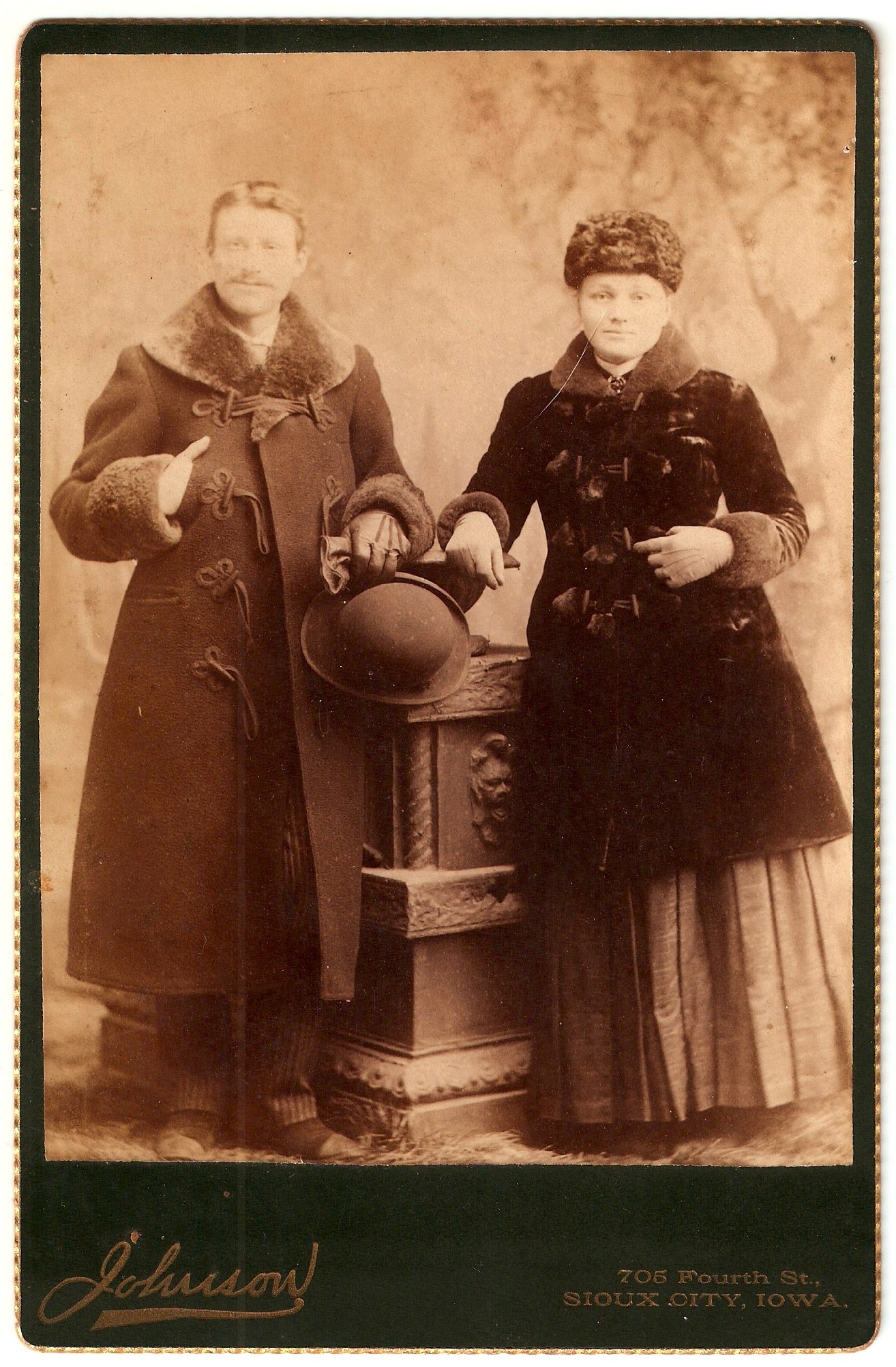
SwedishAlbumSiouxCityCouple1889

Unidentified couple in winter attire, Sioux City, Woodbury County, Iowa, ca. 1889; digital image 2014, privately held by Melanie Frick, 2014.

This Valentine’s Day, perhaps you’re looking forward to a special outing with a loved one. You might dress up, or you might bundle up, depending on the temperature outside. In any case, you likely won’t be decked out in fashionable furs like this couple, who dressed for the winter weather in Sioux City, Woodbury County, Iowa circa 1889. This cabinet card photograph comes from an unidentified antique album featuring a family of Swedish immigrants.1 The photographer – J. E. Johnson of 705 Fourth Street in Sioux City – operated his studio from at least 1887-1891.2

A newspaper column in a nearby community in South Dakota reported in 1888, “It is a lively competition between the comparatively old-fashioned sealskin cloaks and the newer, more picturesque wraps that reach to the ground.”3 The unidentified woman pictured here wears a toggle-fastened coat with a fur collar and cuffs, and she sports a striking fur cap that immediately made me think of one worn by Laura Ingalls Wilder in a photograph taken in the latter half of the 1880s. Her outfit is completed by a pair of fitted gloves, and a pleated skirt extends below the hemline of her coat.

The unidentified man wears a toggle-fastened overcoat of heavy cloth that reaches below the knee, also trimmed with a fur collar and cuffs. He tucks a bare hand into a pocket; the other grasps the spare glove and his bowler hat. Visible beneath his coat are distinctive striped pants. While flipping through Joan Severa’s Dressed for the Photographer, an excellent reference for dating nineteenth century photographs, I spotted an example of another young man wearing striped pants in a photograph dated 1889. In fact, he leaned against what appeared to be the very same pedestal. As it turned out, it was. The photograph of a young man in striped pants featured in Dressed for the Photographer was also taken at the Johnson studio in Sioux City.4 Apparently, striped pants were at their peak in popularity at this time!

The couple pictured here seem relatively young, and perhaps were recently married. If they, like others in this album, were Swedish immigrants, they may have shared copies of this photograph with family members who remained in the old country. Even if they weren’t dressed for a date in the modern sense of the term, they certainly look prepared to take a romantic stroll downtown!

Continue reading

Tombstone Tuesday: Johanne Marie Larsen

Johanne Marie (Larsen) Walsted of Aalborg, Denmark was sixty-three years old when she immigrated to America in the spring of 1900.1 She traveled alone; her husband of thirty-two years had passed away the year before,2 and most of her children had already left Denmark for brighter opportunities in Iowa and Wisconsin. They had paid for her passage aboard the Norge, and she carried fifteen dollars.3

GracelandCemeteryJohannaWalstedGrave

Grave of Johanna M. Walsted, 1836-1914, Graceland Cemetery, Sioux City, Woodbury County, Iowa; image date 2001, privately held by Melanie Frick.

Johanne was christened on 28 September 1836 in Bolle, Nordjylland, Denmark, the daughter of Lars Jensen Bak and Ane Cathrine Christensdatter.4 At the age of thirty, she married Christian Jens Jacobsen Walsted,5 a widower with two young children, Jens Jacob and Lars Marinus Walsted. The couple went on to have seven more children together: Jensine Kathrine, Eskild, Lars Peter, Mandrup, Anna Kathrine, Ellen Eskelline, and Jens Jacob Walsted.6 All but two of the children, the elder Jens Jacob and Eskild, survived to adulthood.7 Christian was a shoemaker, and eventually moved with his family from rural Dronninglund to the city of Aalborg,8 where he died in 1899.9

By the time Johanne made her journey to America, six of her seven surviving children and step-children awaited her arrival. Only her youngest son remained in Denmark; he was to follow two years later.10 In the years to come, Johanne moved between the homes of her children, some of whom she hadn’t seen in more than a decade. She was enumerated in the 1900 U.S. census less than two months after her arrival in the country, at which time she resided with a daughter in Iowa;11 she later joined another daughter in Oklahoma City.12

Johanne’s health may have been poor in her later years; a notation on the ship manifest suggests that she had a deformity of some kind,13 and her death record stated that she suffered from senility.14 Johanne Marie (Larsen) Walsted died at the age of seventy-eight on 3 November 1914 in Sioux City, Woodbury County, Iowa. Services were held at the Danish Lutheran Church, and she was buried at Graceland Cemetery.14

Continue reading