Tag Archives: Iowa

Drunkenness, Death Threats, and a Divorce Petition

On the 5th of February 1902, Sarah Ellen (Hall) Hoffman of Ashton, Osceola County, Iowa, who was then forty-four years old, signed her name to a petition that she sincerely hoped would grant her a divorce. John Hoffman was her second husband; her first husband had died of an accidental gunshot wound, and it was now eighteen years since she had remarried. As detailed in the statement of facts prepared for the court by her attorney, O. J. Clark, this marriage was now in shambles.1

It was established that the plaintiff and the defendant had lived together since the time of their marriage – except recently, as “the defendant has been away from home considerable.”2 It was added, “At times he will work and earn money, but will not use any of his earnings to or for the support of the family, but will stay at home most of the time helping to eat up what the plaintiff and children earn.”3 Then, the chilling details of their marriage spilled forth:

“That the plaintiff has always conducted herself toward the defendant as a loving and dutiful wife, but that the defendant, disregarding his duties towards your petitioner, has always been abusive and ugly towards her, and of late years has become brutally coarse, violent and vulgar towards your petitioner, often calling her the most vile names in the presence of her children and so does without any cause therefore, often striking, kicking and otherwise abusing your petitioner, without cause, often leaving black and blue marks on the person of your petitioner for weeks at a time as the result thereof. That at times the defendant, without cause, threatens to kill your petitioner, threatens to put a hole through your petitioner’s body, threatens to cut her heart out and to kill your petitioner with a knife. That on one occasion said defendant attempted to carry out his threat of killing your petitioner with a butcher knife, and attacked her therewith, when her daughter in attempting to prevent defendant’s harming your petitioner, received the blow with the knife herself on the hand, cutting the cord to one of her fingers off and otherwise injuring her hand, so that she has very little use of said finger, and thus, to that extent has made her a cripple for life. That the threats thus made, the kicking and striking are of very frequent occurrence when he is at home, that he sleeps with his clothes on, and at times in the night will begin his abuse of your petitioner without cause, and threaten to kill her with his knife, and will begin to open and shut his knife so that the plaintiff can hear it click and thus frighten her and worry her all night at a time.”4

OsceolaCountyIowaDivorce1902

Osceola County, Iowa, Circuit Court File 3036, Sarah E. Hoffman v. John Hoffman, for “Petition in Equity,” 20 March 1902; Clerk of District Court, Sibley. The surname Hoffman appeared in this text as Huffman, but in some instances the “u” was overwritten with an “o.” Thus, I have transcribed the name as Hoffman.

In recent years, the defendant had become “addicted to the use of intoxicating liquors, and is an habitual drunkard, which habit he has acquired since their said marriage.”5 The statement continued, “That the plaintiff’s health has become undermined and broken, and if this treatment continues her health will give out entirely and she fears she will die there from – if the defendant does not in fact kill her outright.”6 It’s truly appalling to think what my third great-grandmother must have endured, and it’s to her credit that she had the strength to initiate a divorce at this time.

It would be interesting to learn what grounds for divorce were required in Iowa in 1902; apparently, in this case, habitual drunkenness, horrific abuse, and failure to provide support were sufficient. The divorce was granted in March of that year, at which time Sarah received custody of the couple’s teenage son, possession of the kitchen and household furniture, a return to her former name, and, most importantly, a chance for a better life.7

Continue reading

A Witness to the Ruff Disaster of 1918

RuffFireSiouxCity1918

Ruff Building Collapse and Fire, Sioux City, Iowa, 1918; digital image 2010, privately held by Melanie Frick, 2014.

This photograph of the Ruff Disaster of 1918 in Sioux City, Woodbury County, Iowa comes from my family’s collection. Saturday, 29 June 1918 was a typical afternoon in downtown Sioux City; although the Oscar Ruff Drug Company at Fourth and Douglas was being remodeled, everyone continued to go about their business there and at the adjoining shops, including the Chain Grocery. Then, abruptly, at 1:30 pm, the building collapsed. It was later determined that the building was much too deteriorated to have been subjected to these renovations, which involved lowering the first floor to ground level. It was only a matter of minutes before a fire broke out, and rescue workers struggled to attend to those trapped in the rubble. In the end, thirty-nine people perished.1

Although from this photograph it appears that the fire had gone on for some time – the first images show bystanders kept at bay while the firemen hose the building – the chaos is still evident.2 Debris litters the ground, crowds mill about, and someone even moved out of the frame of the photograph so quickly that only his leg appears. What looks like a firetruck can be seen in the rear, in front of the clouds of smoke.

I don’t know how my family came to have a copy of this photograph, but it looks as though it could have been a print of one that might have originally appeared in a newspaper. Circled at right is a person identified as my second great grandfather, Henry Adam. However, I’m not convinced that this was actually Henry, and not his son. As of September 1918, I know that Henry was employed as a carpenter in the Norfolk Navy Yard of Portsmouth, Virginia; as a result, he may or may not have been home in Sioux City in June of that year.3

Although Henry was of short stature, the person circled also appears quite young. He wears a casual newsboy cap as opposed to the hats donned by the men around him. I’m inclined to believe that he may actually be Gerald “Jerry” Adam of Sioux City, Woodbury County, Iowa, who would have been ten years old at the time.4 Jerry lived just half a mile from the scene of the Ruff Disaster, so it certainly seems plausible that he may have wandered down to the scene to catch a glimpse of the disaster firsthand.5

Did any of your ancestors fall victim to or witness a disaster? If family lore and local histories don’t provide you with enough information, check out historic newspapers or GenDisasters, a website that shares information about the floods, fires, tornadoes, and other unfortunate events that may have impacted your ancestors’ lives.

Continue reading

The Twenties by Day

LeotaAlphaBellFenton

Leota (Fenton) Thoma, Alpha (Fenton) Gibson, and Belle (Fenton) Hoffman, ca. 1920s; digital image 2013, privately held by Melanie Frick, 2014.

As seen in this photograph, the trends of the Roaring Twenties were not just for flappers – although daytime fashions were significantly less flashy than what one tends to associate with the era. Here, sisters Leota, Alpha, and Belle, from left to right, pose together sporting bobs and simple patterned dresses. Although the sisters were likely in their late forties or early fifties when this photograph was taken, they clearly made an effort to keep up with the times.

Alpha Doretta, Minnie Belle, and Anna Leota Fenton were born in Saline County, Kansas, the daughters of George W. and Sarah Ellen (Hall) Fenton.1 After their father’s death, their mother remarried, and eventually, the family relocated to northwestern Iowa.2 At the time that this photograph was taken, Alpha, the wife of Clare Gibson, lived in Colorado,3 whereas Belle, the wife of Joseph Hoffman, and Leota, the wife of George Thoma, lived in different counties in Iowa.4 It was likely a rare occasion that the sisters were able to be together.

Leota, Alpha, and Belle wear popular styles of what would have been considered day dresses or house dresses in this decade, as seen on Vintage Dancer: 1920s Day / House Dresses and Aprons. Likely made of cotton, their dresses feature lively prints and straight, comfortable cuts. Both Belle, right, and Alpha, center, wear dresses made of fabric printed with spirals or swirls. Both have sleeves cuffed above the elbow, and have belted, dropped waists. Leota wears a standard long apron with patch pockets over her dress, but it can be seen that her floral-patterned dress hits, appropriately, just below the knee. Her dress has contrasting fabric sewn at the hem and the cuffs, and she clutches a striped cloche hat in her hand.

This look was quite a change from the romantic, Gibson Girl-esque styles of just a quarter century before, as seen in an earlier photograph of Leota. However, it looks like these ladies might have had quite a bit of fun with their makeovers during this decade, before more conservative styles returned with the Great Depression.

Continue reading

Economical Fashions and the Civil War

Scanned Image 25

Unidentified photograph of a young woman, Mount Pleasant, Iowa, ca. 1863-1865; digital image 2012, privately held by Melanie Frick, 2014.

This lovely carte de visite offers several indications as to its date, from both the name of the photographer, and the unique style of dress. Unfortunately, although the photograph comes from an album linked to the family of Jesse M. Smith of Mount Pleasant, Henry County, Iowa, it remains unidentified.1

If your ancestors lived in Henry County, Iowa, in the early 1860s, take note – could this young woman, born circa 1850, be in your family tree?

The slim young woman in the photograph, perhaps fifteen years of age, wears her dark hair with a center part, likely pulled back into a snood. With one hand on the back of an ornate chair, the other holds a straw hat. She is outfitted in a style distinctive to the Civil War era. Her full-sleeved Garibaldi shirtwaist is of plain muslin, accented by a wide Swiss belt. It is tucked into a skirt fashioned from an old dress, something seen often at this time when there was a need to be economical.2

Scanned Image 25 back

Stamped on the back of the photograph is the identification, “Leisenring Bros., Photographers, Mount Pleasant, Iowa.” Although the Leisenring family operated a studio in Mount Pleasant for many years, the Leisenring brothers managed it together for only a short period of time, from 1863-1867. The name was changed to reflect this joint ownership.3

After putting these clues together, this carte de visite can be dated to a narrow time frame of approximately 1863-1865. Perhaps a local soldier carried a copy with him throughout the war, or maybe the young woman simply wished to have her photograph taken in a new outfit that she had likely sewn herself. Regardless, it provides a unique study of the ways in which the economy may have impacted the fashion choices of southeastern Iowans during the Civil War.

For more unidentified photographs from this album, click here and here.

Continue reading

An Ancestor with an Alias

When I learned that George Hiram Thoma of Garnavillo, Clayton County, Iowa used an alias as a young man, it took me by surprise. He was born to Fred and Matilda (Hammond) Thoma in 1880,1 and the state census indicates that he remained in his home county in northeastern Iowa at least until 1895.2 At some point thereafter, according to family lore, George left home and bicycled across Iowa. Whether he went by bicycle or not, it was said that his move may have been spurred on by his poor relationship with his father.3

GeorgeHiramThoma

George Hiram Thoma, seated left, with an unidentified young man, ca. 1900; digital image 2013, privately held by Melanie Frick, 2014.

Records place George across the state in northwestern Iowa on 23 March 1902, at which time, using the name George A. Neilson, he married Anna Leota Fenton in Ashton, Osceola County, Iowa.4 This was no trick of penmanship or recorder’s error; three affidavits, written by George, his mother, and his younger brother, were attached to the marriage document decades later, each attesting to the fact that George A. Neilson and George Hiram Thoma were one and the same person.5 It is worth noting that George still named his correct place of birth and even the correct names of his parents on the original marriage document, with the exception, of course, of assigning the Neilson surname to them as well.6 Evidently, he was not prepared or had no reason to invent an elaborate backstory regarding his origins.

None of the affidavits, however, explained why George had married under an assumed name.7 One has to wonder whether his wife even knew what she was getting into! Prior to his marriage, I suspect that he might be found in the 1900 U.S. census as George Thoma, a clerk in Belden, Cedar County, Nebraska. Notably, he boarded with a family by the name of Nelson, and a Nielsen also resided in the household.8 Although this may or may not be the correct George Thoma, we do know that within weeks of his marriage, he moved to Center, Knox County, Nebraska, where he was an employee of the Edwards and Bradford Lumber Company.9

Within a few years of his marriage, George relocated with his family to Sioux City, Woodbury County, Iowa. There, his daughter’s birth was recorded with the surname Neilson,10 and according to the city directories, George continued to use his assumed name at least until 1909.11 I have been unable to locate the family in the 1910 U.S. census – they had likely left Sioux City by that time to return to Nebraska, where they moved from place to place for the next decade. However, they had certainly reverted to the use of the Thoma surname no later than World War I.12

Was this alias purely symbolic, in order to emphasize George’s separation from his father, or, perhaps, the ties that he forged with another family? Or was it part of an effort to hide, whether from his father, from love, or from the law? This is one family mystery that I would love to solve!

Continue reading

A New Year’s Eve Party?

HenryMelanieAdamParty_2

Henry and Melanie (Lutz) Adam, ca. 1910, Sioux City, Woodbury County, Iowa; digital image 2010, privately held by Melanie Frick, 2014.

Happy New Year! …or at least, I think that’s what might have been said when this photograph was taken about a century ago. Featured are Henry and Melanie (Lutz) Adam of Sioux City, Woodbury County, Iowa, with Henry seated at lower right and Melanie in white above his raised hand.

Could this photograph have been taken at a New Year’s Eve party? The curtains are drawn in the living room or parlor where the photograph was taken, which suggests to me that it could be after dark. Furthermore, it’s clear that the alcohol is flowing. One man can be seen taking a drink, while several others clutch glasses and bottles. (Alas, I can’t make out the labels.) Nearly everyone wears some sort of silly hat made of cloth or paper, and only three older children are present in the photograph – no little ones.

Note that three of the men in front, including Henry, make a gesture with their thumbs to the sides of their noses and their fingers extended flat, pressed together. They aren’t quite thumbing their noses in the way that I have seen, so I wonder what this gesture might have meant.

Of the nineteen people gathered here, only Henry seems to be ready for the camera. Most, including Melanie, look to the side, perhaps at another photographer, or are caught in the midst of conversation. Whether this gathering was for New Year’s Eve or not, one can easily imagine the chaotic scene as an attempt was made to corral this lively group of friends for a memorable photograph. Cheers!

The Traveling Photographer’s Ram

LeonAdam

Leon Francis Adam, ca. 1916, Sioux City, Woodbury County, Iowa; digital image 2010, privately held by Melanie Frick, 2013.

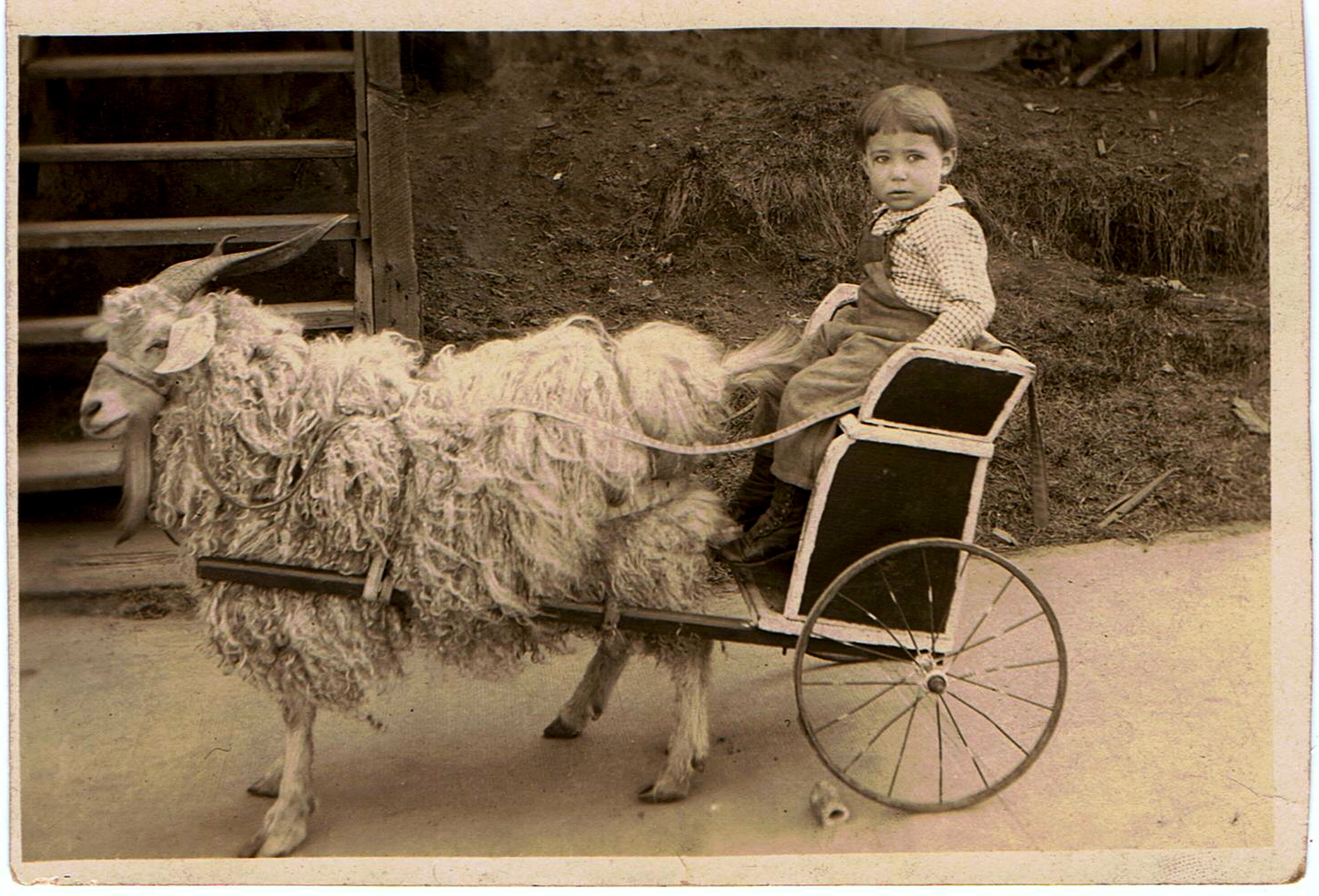
Only a handful of photographs exist of little Leon. He was barely five years old when he tumbled into a bonfire and died from his burns.1 This photograph, however, taken when he was perhaps three years old, gives a glimpse into his brief but surely happy childhood.

Leon Francis Adam was born in Sioux City, Woodbury County, Iowa, on 23 August 1913.2 He was the second and youngest son of Henry Joseph and Melanie Veronica (Lutz) Adam.3 It wasn’t uncommon at this time for photographers to travel through towns with some sort of enticing animal in tow – often a pony,4 or, in this case, a wooly ram pulling a two-wheeled cart. Mothers must have smiled to see their children flock to the attraction, making their parting with a few pennies for a photograph that much easier. This particular photograph is a picture postcard, a format that reached its peak circa 1905-1920.5

Leon is wearing simple play clothes – tiny overalls, a check shirt, and black, button-up shoes. His expression is cautious, and he appears to look not at the photographer but at someone off to the side, likely his mother, offering encouragement. Note the bone placed in front of the wheel of the cart, perhaps necessary to avoid a situation of a runaway ram!

Did your young ancestors ever pose with a pony, ram, or other barnyard animal?


SOURCES
1 “Plays in a Fire; Lad Dies of Burns,” unidentified newspaper from Sioux City, Iowa, September 1918.
2 Grave of Leon Adam, 1913-1918, Calvary Cemetery, Sioux City, Woodbury County, Iowa; image date unknown, privately held by Melanie Frick, 2013.
3 “Plays in Fire; Lad Dies of Burns,” 1918.
4 “Wayback Wednesday: Remembering the Pony Photographer” The Family Curator, 14 August 2013 (http://www.thefamilycurator.com/home/2013/8/14/wayback-wednesday-remembering-the-pony-photographer.html : accessed 13 December 2013).
5 Maureen A. Taylor, Family Photo Detective (Cincinnati: Family Tree Books, 2013), 65.

Tombstone Tuesday: Paulus and Elisabeth (Schmidt) Thoma

July 009

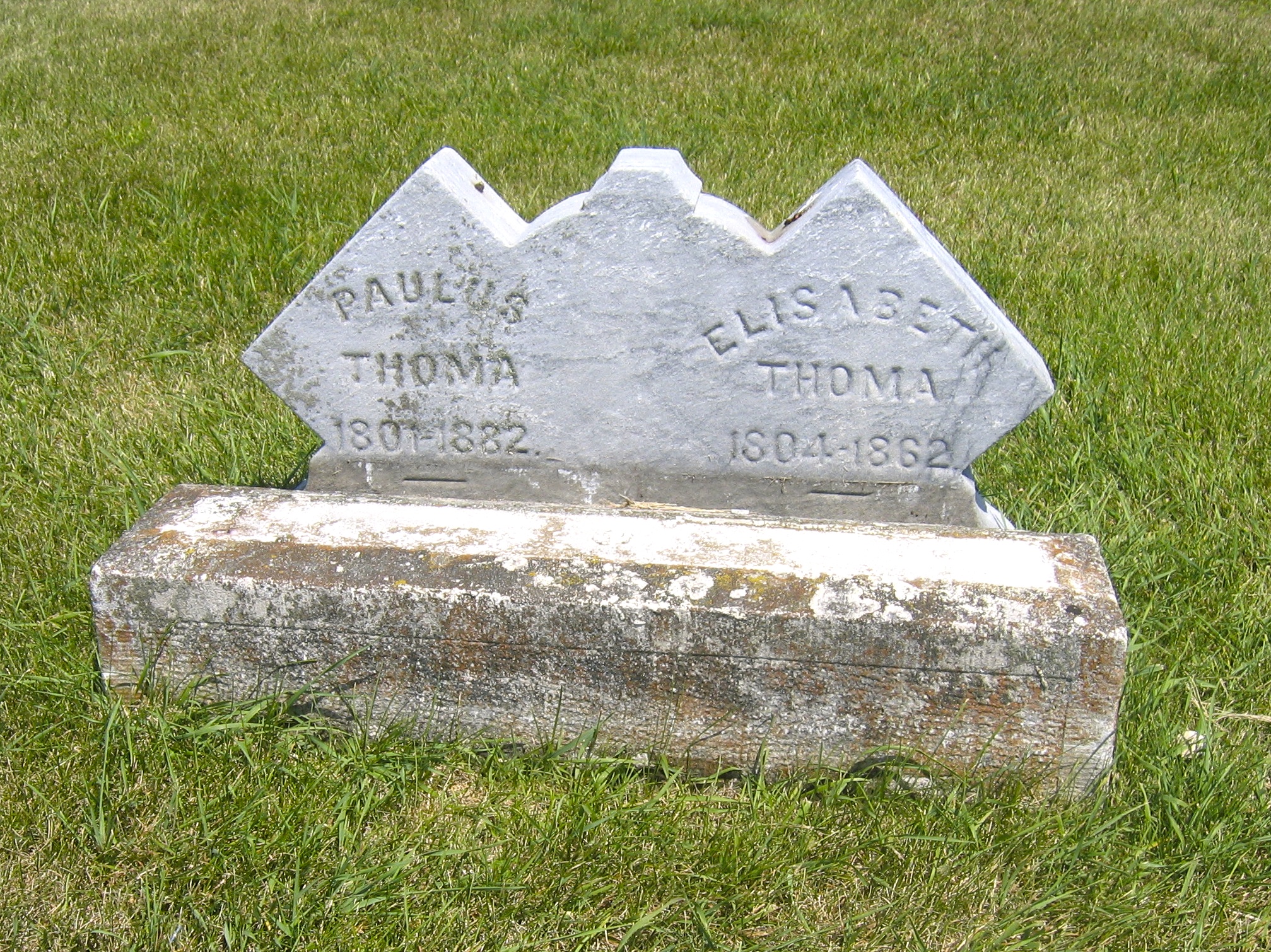
Grave of Paulus Thoma (1801-1882) and Elisabeth Thoma (1804-1862), Garnavillo City Cemetery, Garnavillo, Clayton County, Iowa; digital image 2007, privately held by Melanie Frick, 2013.

The mid-nineteenth century saw what could be considered a virtual exodus of families who left their home village in Bavaria for the farmland of northeastern Iowa. Paulus and Elisabeth (Schmidt) Thoma of Weißenstadt, Wunsiedel, Bavaria, Germany were among them. Paulus was a weaver by trade,1 and together, he and Elisabeth raised eight children: John Conrad, William Henry, Anna Rosina, Frederick, Anna Sabina, Maria Magdalena, Ursula Pauline, and Anna Margaretha.

In 1852, Paulus and Elisabeth traveled with seven of their children from Bremen to New Orleans, undoubtedly an exhausting journey. They were accompanied on the Uhland by ten others from Weißenstadt, a small sampling of the immigrant families who had likely been linked for generations and chose to resettle together in America.2 Upon arrival in New Orleans, the Thoma family traveled by way of the Mississippi River to reach their destination of northeastern Iowa.3 Several years later, Paulus and Elisabeth were joined by their eldest son and his family.4

Once settled, Paulus apparently put his weaving aside for a farmer’s life in Garnavillo, Clayton County, Iowa. I thought perhaps he would have raised sheep for wool, but, at least as of 1860, crops of wheat, Indian corn, and oats seem to have been his primary focus. At this time, he farmed over two hundred acres of improved land.5

Elisabeth (Schmidt) Thoma passed away in 1862, after only ten years in Iowa.6 Five years after her death, Paulus, now well into his sixties, remarried to Maria Krueger.7 By 1870, Paulus was declared on the census to be an “invalid” due to “old age.”8 He survived for more than a decade longer, however, although his “old age” was noted again on the 1880 U.S. census.9 Ultimately, he survived his first wife by twenty years; Paulus passed away in 1882, and he and Elisabeth share a headstone at the Garnavillo City Cemetery in Garnavillo, Clayton County, Iowa.10


SOURCES
1 “New Orleans, Passenger Lists, 1813-1945” digital images, Ancestry.com (http://www.ancestry.com : accessed 1 November 2013), manifest, Uhland, Bremen, Germany to New Orleans, arriving 18 June 1852, Paulus Thoma; citing National Archives microfilm M259, roll 36.
2 “New Orleans, Passenger Lists, 1813-1945” digital images, Ancestry.com, manifest, Uhland, Bremen, Germany to New Orleans, arriving 18 June 1852, Paulus Thoma.
3Diane Haddad, “Riverboat Migration Records,” Family Tree Magazine (http://www.familytreemagazine.com/article/Whatever-Floats-Your-Riverboat : accessed 1 November 2013).
4 “New York, Passenger Lists, 1820-1957” digital images, Ancestry.com (http://www.ancestry.com : accessed 30 October 2013), manifest, Anna Delano, Bremen, Germany to New York, arriving 23 June 1855, J.C. Thoma; citing National Archives microfilm M237, roll 153.
5 1860 U.S. census, Clayton County, Iowa, agriculture schedule, Garnavillo, p. 5 (penned), line 11, Paul Thoma; digital image, Ancestry.com (http://www.ancestry.com : accessed 23 October 2013), citing “Selected U.S. Federal Census Non-Population Schedules, 1850-1880.”
6 Grave of Elisabeth [Schmidt] Thoma, 1804-1862, Garnavillo City Cemetery, Garnavillo, Clayton County, Iowa; digital image 2007, privately held by Melanie Frick, 2013.
7 “Iowa, County Marriages, 1838-1934,” index, FamilySearch (https://familysearch.org : accessed 01 Nov 2013), Paulus Thoma and Mary Krueger, 1867.
8 1870 U.S. census, Clayton County, Iowa, population schedule, Garnavillo, p. 17 (penned), dwelling 116, family 114, Paul Toma; digital image, Ancestry.com (http://www.ancestry.com : accessed 23 October 2013), citing National Archives microfilm M593, roll 383.
9 1880 U.S. census, Clayton County, Iowa, population schedule, Garnavillo, Enumeration District (ED) 133, p. 362 (stamped), dwelling 207, family 218, Paul Thoma; digital image, Ancestry.com (http://www.ancestry.com : accessed 23 October 2013), citing National Archives microfilm T9, roll 333.
10 Grave of Paulus Thoma, 1801-1882, Garnavillo City Cemetery, Garnavillo, Clayton County, Iowa; digital image 2007, privately held by Melanie Frick, 2013.

Finding Your Danish Immigrant Ancestors

KathrineChristensen03

Kathrine Christensen at the Christensen family home photograph, 1905, Vestervig, Thisted, Denmark; digital image 2013, privately held by [personal information withheld].

When searching for Danish immigrant ancestors, you might feel as though they have been lost in a sea of Scandinavians. Nielsens, Larsens, and Hansens abound. Given names might be different than those used in American records. Family members might not have traveled together. All of these factors, on top of the typical transcription errors that make life exciting for genealogists, can make Danish immigrants difficult to track down.

I met a challenge of this nature when attempting to locate the siblings of my mother’s grandmother, who carried the woefully common Christensen surname. As it turned out, between approximately 1889 and 1906, at least six of the nine surviving children of Laust and Ane (Nielsen) Christensen of Vestervig, Thisted, Denmark1 left the thatched roof of the only home they had ever known for America, traveling one or two at a time over a period of seventeen years. All came, at least temporarily, to Newell, Buena Vista, Iowa.

Else Marie Christensen was the first to arrive in northwestern Iowa. It was there that she married Anton Mikkelsen in the summer of 1889, when she was seventeen.2 Fully ten years later, in 1899, Niels H. Christensen and Ane Petrine “Anine” Christensen journeyed together to join their older sister in Newell.3 Niels settled there, where he married Kathrine “Katie” Larson;4 Anine moved west to the urban center of Sioux City, Woodbury, Iowa, where she married John P. Hansen.5

In 1900, their brother Laurits Anton “Louis” Christensen arrived.6 He too settled in Newell, and married Anna Marie Godfredson.7 Kristine “Christina” Christensen came to America in 1905, along with her husband, Jens C. Pedersen, and her young niece,8 the daughter of her widowed brother Christen Christensen, who had remained in Denmark.9 They settled first in Newell, before moving to Sioux City.10

The following year, in the summer of 1906, Kathrine Christensen, my great-grandmother, was the last to leave home,11 leaving only her aforementioned brother and sisters Johanne Christensen and Ane Marie Christensen in Denmark.12 Kathrine, twenty, also joined her siblings in Newell before moving on to Sioux City. It is there that she married Jens “James” Jacob Walsted in 1909.13

Where can you find Danish immigration records? If you’ve been over- (or under-) whelmed with your search results on databases such as Ancestry.com or Ellis Island’s Passenger Search, I recommend visiting the Dansk Demografisk Database. By selecting “Emigrants,” you will be able to access an index of Danes who traveled via Copenhagen or Hamburg. The search options are flexible; try searching for everyone of a particular surname who originated in the same parish, or search for anyone bound for the same destination. It goes without saying to be creative with spellings, although, in my experience, this index remains truer to the original Danish spellings than others. With the information you find here, you might just have luck turning up a passenger list with your ancestor’s name!


SOURCES
1 “Denmark, Marriages, 1635-1916,” index, FamilySearch (http://www.familysearch.org : accessed 30 October 2013), entry for Laust Christensen and Ane Nielsen, 1868.
2 “Iowa, County Marriages, 1838-1934,” index, FamilySearch (https://familysearch.org : accessed 30 Oct 2013), Anton Mikkelson and Elsa Marie Kristensen, 1889.
3 “New York, Passenger Lists, 1820-1957” digital images, Ancestry.com (http://www.ancestry.com : accessed 30 October 2013), manifest, S.S. Paris, Liverpool, England to New York, arriving 13 February 1899, Niels Christensen and Anine P. Christensen; citing National Archives microfilm T715, roll 47.
4 “Iowa, County Marriages, 1838-1934,” index, FamilySearch (https://familysearch.org : accessed 30 Oct 2013), Niels Christensen and Kathrine Larson, 1901.
5 1920 U.S. census, Woodbury County, Iowa, population schedule, Sioux City, Enumeration District (ED) 232, p. 4857 (penned), sheet 6-B, dwelling 129, family 129, Anine Hanson; digital image, Ancestry.com (http://www.ancestry.com : accessed 30 October 2013), citing National Archives microfilm T625, roll 521.
6 “Border Crossings: From Canada to U.S., 1895-1956” digital images, Ancestry.com (http://www.ancestry.com : accessed 30 October 2013), manifest, S.S. Parisian, Liverpool, England to Quebec, arriving 9 June 1900, Laurids Christensen; citing National Archives microfilm M1464, roll 6.
7 “Iowa, County Births, 1880-1935,” index, FamilySearch (https://familysearch.org : accessed 30 Oct 2013), Lewis A. Christensen and Anna Marie Godfredsen in entry for Ludvig Arnold Christensen, 1907.
8 “New York, Passenger Lists, 1820-1957” digital images, Ancestry.com (http://www.ancestry.com : accessed 30 October 2013), manifest, S.S. Helig Olav, Liverpool, England to New York, arriving 24 July 1905, Karoline M. Pederson; citing National Archives microfilm T715, roll 602.
9 [personal information withheld], to Melanie Frick, Ancestry.com message, 7 August 2013, “Cecelia,” Christensen Family File; privately held by Melanie Frick.
10 1920 U.S. census, Woodbury County, Iowa, population schedule, Sioux City, Enumeration District (ED) 234, p. 5951 (penned), sheet 5-A, dwelling 90, family 97, Christina Peterson; digital image, Ancestry.com (http://www.ancestry.com : accessed 30 October 2013), citing National Archives microfilm T625, roll 521.
11 “New York, Passenger Lists, 1820-1957” digital images, Ancestry.com (http://www.ancestry.com : accessed 30 October 2013), manifest, S.S. Cedric, Liverpool, England to New York, arriving 22 July 1906, Kathrine Kristensen; citing National Archives microfilm T715, roll 744.
12 “Public Member Trees,” database, Ancestry.com (http://www.ancestry.com : accessed 30 October 2013), “Christensen Twete,” entries for Christen Christensen (b. 1869), Johanne Christensen (b. 1876), and Ane Marie Christensen (b. 1879); submitted by [personal information withheld], citing Vestervig Church Book.
13 Sioux City, Iowa, Marriage Register, Book E: 1906-1910, James Walsted and Kathin Christinsen, 1909.

A Wedding Party

Not everyone had a wedding portrait made. In my experience, it was even less common for a wedding portrait to include the wedding attendants or witnesses. However, when Henry Joseph Adam and Melanie Veronica Lutz married on 24 October 1905, they posed for a formal photograph with four attendants.

HenryAdamMelanieLutzWedding1905

Henry and Melanie (Lutz) Adam wedding photograph, 1905, Sioux City, Iowa; digital image 2010, privately held by Melanie Frick, 2013.

Melanie, the bride, appears to wear her brown hair loose behind her shoulders, unless this is an illusion created by a shadow. The dark material of her dress, featuring a pleated bodice and v-neck, contrasts with a high white collar. A decorative watch is pinned at her bodice, and a small brooch is at her throat. To the right, her attendant, Permelia Adam, wears a white pleated bodice with full sleeves and a large bow off-center at the collar. Blanche Adam also wears a white bodice, although it features decorative buttons and lace detail. An elegant string of pearls rests at her throat, above the high collar. Like Permelia, Blanche wears a large bow in her hair.

Henry, the groom, wears a dark suit with a crisp white collar and white bow tie. His suit fastens higher than those of his attendants; Theodore Adam wears a polka dot tie, and Herman Adam sports a vest and bow tie. The men have all combed their dark hair with side parts and fashionable waves.

Carnations were apparently in vogue in 1905, or perhaps they were a favorite of the bride. Melanie wears two long-stemmed white carnations, facing downward, pinned to her bodice. Henry wears one as well, although the stem is hidden by his lapel. Although Permelia seems to wear a carnation, the stem is so long that the blossom itself cannot be seen, and the male attendants wear darker flowers that are indistinct against their suits. Only Blanche goes without a flower.

The Adam-Lutz wedding was held at St. Jean the Baptiste Catholic Church in Sioux City, Woodbury, Iowa on a Tuesday morning. Forty guests attended, the majority of whom were relatives.1 As Melanie had no family in the area, it is understandable that only her husband’s relations would have made up their wedding party; Permelia and Theodore were Henry’s brother and sister, while Blanche and Herman were his cousins. After the ceremony, an informal wedding breakfast was served at the home of Henry’s parents, which was decorated, unsurprisingly, with flowers.2


SOURCES
1“Adam-Lutze,” Sioux City (Iowa) Tribune, 28 October 1905.
2“Adam-Lutze,” Sioux City (Iowa) Tribune, 28 October 1905.