Tag Archives: Iowa

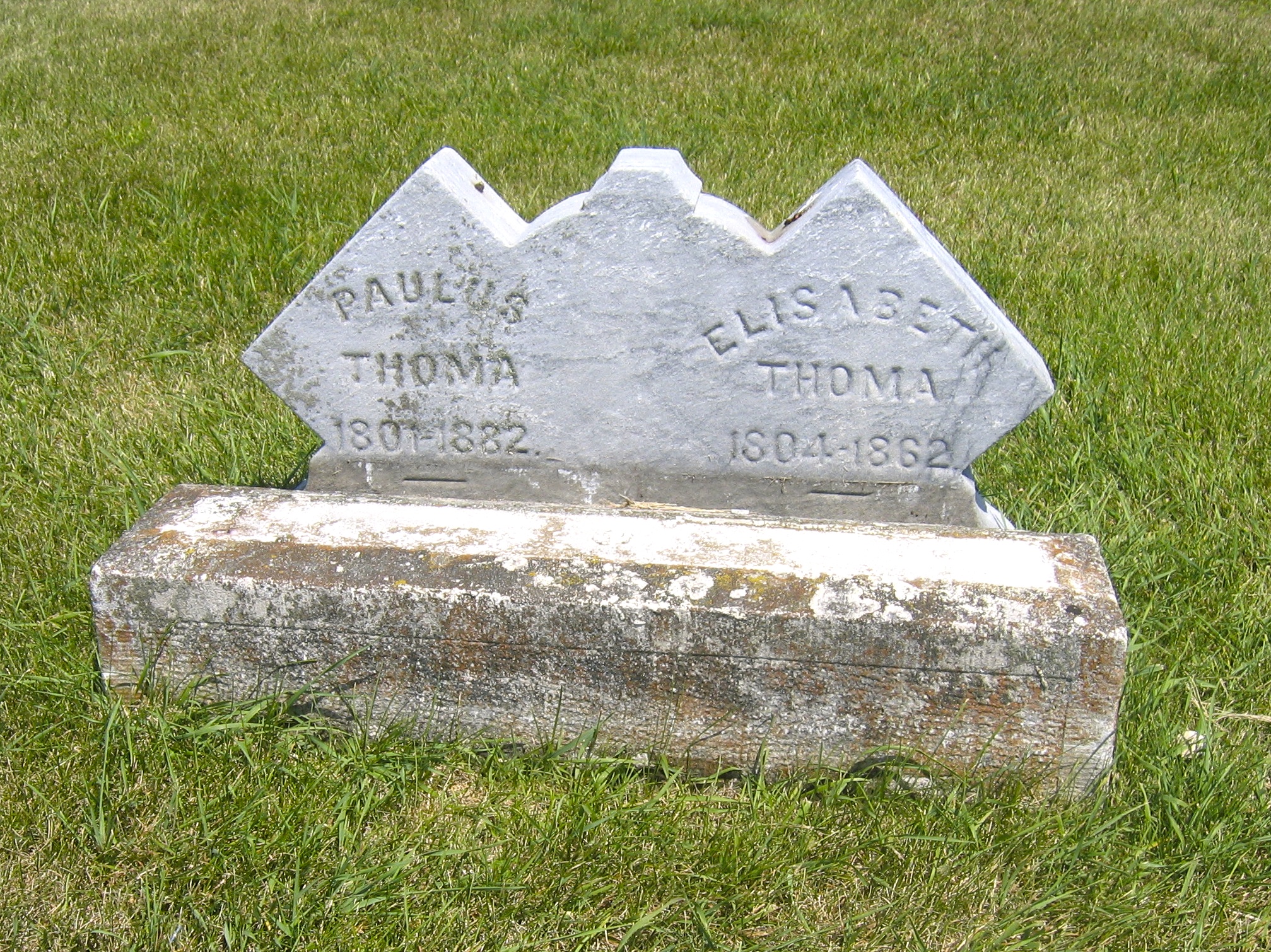
Tombstone Tuesday: Paulus and Elisabeth (Schmidt) Thoma

July 009

Grave of Paulus Thoma (1801-1882) and Elisabeth Thoma (1804-1862), Garnavillo City Cemetery, Garnavillo, Clayton County, Iowa; digital image 2007, privately held by Melanie Frick, 2013.

The mid-nineteenth century saw what could be considered a virtual exodus of families who left their home village in Bavaria for the farmland of northeastern Iowa. Paulus and Elisabeth (Schmidt) Thoma of Weißenstadt, Wunsiedel, Bavaria, Germany were among them. Paulus was a weaver by trade,1 and together, he and Elisabeth raised eight children: John Conrad, William Henry, Anna Rosina, Frederick, Anna Sabina, Maria Magdalena, Ursula Pauline, and Anna Margaretha.

In 1852, Paulus and Elisabeth traveled with seven of their children from Bremen to New Orleans, undoubtedly an exhausting journey. They were accompanied on the Uhland by ten others from Weißenstadt, a small sampling of the immigrant families who had likely been linked for generations and chose to resettle together in America.2 Upon arrival in New Orleans, the Thoma family traveled by way of the Mississippi River to reach their destination of northeastern Iowa.3 Several years later, Paulus and Elisabeth were joined by their eldest son and his family.4

Once settled, Paulus apparently put his weaving aside for a farmer’s life in Garnavillo, Clayton County, Iowa. I thought perhaps he would have raised sheep for wool, but, at least as of 1860, crops of wheat, Indian corn, and oats seem to have been his primary focus. At this time, he farmed over two hundred acres of improved land.5

Elisabeth (Schmidt) Thoma passed away in 1862, after only ten years in Iowa.6 Five years after her death, Paulus, now well into his sixties, remarried to Maria Krueger.7 By 1870, Paulus was declared on the census to be an “invalid” due to “old age.”8 He survived for more than a decade longer, however, although his “old age” was noted again on the 1880 U.S. census.9 Ultimately, he survived his first wife by twenty years; Paulus passed away in 1882, and he and Elisabeth share a headstone at the Garnavillo City Cemetery in Garnavillo, Clayton County, Iowa.10


SOURCES
1 “New Orleans, Passenger Lists, 1813-1945” digital images, Ancestry.com (http://www.ancestry.com : accessed 1 November 2013), manifest, Uhland, Bremen, Germany to New Orleans, arriving 18 June 1852, Paulus Thoma; citing National Archives microfilm M259, roll 36.
2 “New Orleans, Passenger Lists, 1813-1945” digital images, Ancestry.com, manifest, Uhland, Bremen, Germany to New Orleans, arriving 18 June 1852, Paulus Thoma.
3Diane Haddad, “Riverboat Migration Records,” Family Tree Magazine (http://www.familytreemagazine.com/article/Whatever-Floats-Your-Riverboat : accessed 1 November 2013).
4 “New York, Passenger Lists, 1820-1957” digital images, Ancestry.com (http://www.ancestry.com : accessed 30 October 2013), manifest, Anna Delano, Bremen, Germany to New York, arriving 23 June 1855, J.C. Thoma; citing National Archives microfilm M237, roll 153.
5 1860 U.S. census, Clayton County, Iowa, agriculture schedule, Garnavillo, p. 5 (penned), line 11, Paul Thoma; digital image, Ancestry.com (http://www.ancestry.com : accessed 23 October 2013), citing “Selected U.S. Federal Census Non-Population Schedules, 1850-1880.”
6 Grave of Elisabeth [Schmidt] Thoma, 1804-1862, Garnavillo City Cemetery, Garnavillo, Clayton County, Iowa; digital image 2007, privately held by Melanie Frick, 2013.
7 “Iowa, County Marriages, 1838-1934,” index, FamilySearch (https://familysearch.org : accessed 01 Nov 2013), Paulus Thoma and Mary Krueger, 1867.
8 1870 U.S. census, Clayton County, Iowa, population schedule, Garnavillo, p. 17 (penned), dwelling 116, family 114, Paul Toma; digital image, Ancestry.com (http://www.ancestry.com : accessed 23 October 2013), citing National Archives microfilm M593, roll 383.
9 1880 U.S. census, Clayton County, Iowa, population schedule, Garnavillo, Enumeration District (ED) 133, p. 362 (stamped), dwelling 207, family 218, Paul Thoma; digital image, Ancestry.com (http://www.ancestry.com : accessed 23 October 2013), citing National Archives microfilm T9, roll 333.
10 Grave of Paulus Thoma, 1801-1882, Garnavillo City Cemetery, Garnavillo, Clayton County, Iowa; digital image 2007, privately held by Melanie Frick, 2013.

Finding Your Danish Immigrant Ancestors

KathrineChristensen03

Kathrine Christensen at the Christensen family home photograph, 1905, Vestervig, Thisted, Denmark; digital image 2013, privately held by [personal information withheld].

When searching for Danish immigrant ancestors, you might feel as though they have been lost in a sea of Scandinavians. Nielsens, Larsens, and Hansens abound. Given names might be different than those used in American records. Family members might not have traveled together. All of these factors, on top of the typical transcription errors that make life exciting for genealogists, can make Danish immigrants difficult to track down.

I met a challenge of this nature when attempting to locate the siblings of my mother’s grandmother, who carried the woefully common Christensen surname. As it turned out, between approximately 1889 and 1906, at least six of the nine surviving children of Laust and Ane (Nielsen) Christensen of Vestervig, Thisted, Denmark1 left the thatched roof of the only home they had ever known for America, traveling one or two at a time over a period of seventeen years. All came, at least temporarily, to Newell, Buena Vista, Iowa.

Else Marie Christensen was the first to arrive in northwestern Iowa. It was there that she married Anton Mikkelsen in the summer of 1889, when she was seventeen.2 Fully ten years later, in 1899, Niels H. Christensen and Ane Petrine “Anine” Christensen journeyed together to join their older sister in Newell.3 Niels settled there, where he married Kathrine “Katie” Larson;4 Anine moved west to the urban center of Sioux City, Woodbury, Iowa, where she married John P. Hansen.5

In 1900, their brother Laurits Anton “Louis” Christensen arrived.6 He too settled in Newell, and married Anna Marie Godfredson.7 Kristine “Christina” Christensen came to America in 1905, along with her husband, Jens C. Pedersen, and her young niece,8 the daughter of her widowed brother Christen Christensen, who had remained in Denmark.9 They settled first in Newell, before moving to Sioux City.10

The following year, in the summer of 1906, Kathrine Christensen, my great-grandmother, was the last to leave home,11 leaving only her aforementioned brother and sisters Johanne Christensen and Ane Marie Christensen in Denmark.12 Kathrine, twenty, also joined her siblings in Newell before moving on to Sioux City. It is there that she married Jens “James” Jacob Walsted in 1909.13

Where can you find Danish immigration records? If you’ve been over- (or under-) whelmed with your search results on databases such as Ancestry.com or Ellis Island’s Passenger Search, I recommend visiting the Dansk Demografisk Database. By selecting “Emigrants,” you will be able to access an index of Danes who traveled via Copenhagen or Hamburg. The search options are flexible; try searching for everyone of a particular surname who originated in the same parish, or search for anyone bound for the same destination. It goes without saying to be creative with spellings, although, in my experience, this index remains truer to the original Danish spellings than others. With the information you find here, you might just have luck turning up a passenger list with your ancestor’s name!


SOURCES
1 “Denmark, Marriages, 1635-1916,” index, FamilySearch (http://www.familysearch.org : accessed 30 October 2013), entry for Laust Christensen and Ane Nielsen, 1868.
2 “Iowa, County Marriages, 1838-1934,” index, FamilySearch (https://familysearch.org : accessed 30 Oct 2013), Anton Mikkelson and Elsa Marie Kristensen, 1889.
3 “New York, Passenger Lists, 1820-1957” digital images, Ancestry.com (http://www.ancestry.com : accessed 30 October 2013), manifest, S.S. Paris, Liverpool, England to New York, arriving 13 February 1899, Niels Christensen and Anine P. Christensen; citing National Archives microfilm T715, roll 47.
4 “Iowa, County Marriages, 1838-1934,” index, FamilySearch (https://familysearch.org : accessed 30 Oct 2013), Niels Christensen and Kathrine Larson, 1901.
5 1920 U.S. census, Woodbury County, Iowa, population schedule, Sioux City, Enumeration District (ED) 232, p. 4857 (penned), sheet 6-B, dwelling 129, family 129, Anine Hanson; digital image, Ancestry.com (http://www.ancestry.com : accessed 30 October 2013), citing National Archives microfilm T625, roll 521.
6 “Border Crossings: From Canada to U.S., 1895-1956” digital images, Ancestry.com (http://www.ancestry.com : accessed 30 October 2013), manifest, S.S. Parisian, Liverpool, England to Quebec, arriving 9 June 1900, Laurids Christensen; citing National Archives microfilm M1464, roll 6.
7 “Iowa, County Births, 1880-1935,” index, FamilySearch (https://familysearch.org : accessed 30 Oct 2013), Lewis A. Christensen and Anna Marie Godfredsen in entry for Ludvig Arnold Christensen, 1907.
8 “New York, Passenger Lists, 1820-1957” digital images, Ancestry.com (http://www.ancestry.com : accessed 30 October 2013), manifest, S.S. Helig Olav, Liverpool, England to New York, arriving 24 July 1905, Karoline M. Pederson; citing National Archives microfilm T715, roll 602.
9 [personal information withheld], to Melanie Frick, Ancestry.com message, 7 August 2013, “Cecelia,” Christensen Family File; privately held by Melanie Frick.
10 1920 U.S. census, Woodbury County, Iowa, population schedule, Sioux City, Enumeration District (ED) 234, p. 5951 (penned), sheet 5-A, dwelling 90, family 97, Christina Peterson; digital image, Ancestry.com (http://www.ancestry.com : accessed 30 October 2013), citing National Archives microfilm T625, roll 521.
11 “New York, Passenger Lists, 1820-1957” digital images, Ancestry.com (http://www.ancestry.com : accessed 30 October 2013), manifest, S.S. Cedric, Liverpool, England to New York, arriving 22 July 1906, Kathrine Kristensen; citing National Archives microfilm T715, roll 744.
12 “Public Member Trees,” database, Ancestry.com (http://www.ancestry.com : accessed 30 October 2013), “Christensen Twete,” entries for Christen Christensen (b. 1869), Johanne Christensen (b. 1876), and Ane Marie Christensen (b. 1879); submitted by [personal information withheld], citing Vestervig Church Book.
13 Sioux City, Iowa, Marriage Register, Book E: 1906-1910, James Walsted and Kathin Christinsen, 1909.

A Wedding Party

Not everyone had a wedding portrait made. In my experience, it was even less common for a wedding portrait to include the wedding attendants or witnesses. However, when Henry Joseph Adam and Melanie Veronica Lutz married on 24 October 1905, they posed for a formal photograph with four attendants.

HenryAdamMelanieLutzWedding1905

Henry and Melanie (Lutz) Adam wedding photograph, 1905, Sioux City, Iowa; digital image 2010, privately held by Melanie Frick, 2013.

Melanie, the bride, appears to wear her brown hair loose behind her shoulders, unless this is an illusion created by a shadow. The dark material of her dress, featuring a pleated bodice and v-neck, contrasts with a high white collar. A decorative watch is pinned at her bodice, and a small brooch is at her throat. To the right, her attendant, Permelia Adam, wears a white pleated bodice with full sleeves and a large bow off-center at the collar. Blanche Adam also wears a white bodice, although it features decorative buttons and lace detail. An elegant string of pearls rests at her throat, above the high collar. Like Permelia, Blanche wears a large bow in her hair.

Henry, the groom, wears a dark suit with a crisp white collar and white bow tie. His suit fastens higher than those of his attendants; Theodore Adam wears a polka dot tie, and Herman Adam sports a vest and bow tie. The men have all combed their dark hair with side parts and fashionable waves.

Carnations were apparently in vogue in 1905, or perhaps they were a favorite of the bride. Melanie wears two long-stemmed white carnations, facing downward, pinned to her bodice. Henry wears one as well, although the stem is hidden by his lapel. Although Permelia seems to wear a carnation, the stem is so long that the blossom itself cannot be seen, and the male attendants wear darker flowers that are indistinct against their suits. Only Blanche goes without a flower.

The Adam-Lutz wedding was held at St. Jean the Baptiste Catholic Church in Sioux City, Woodbury, Iowa on a Tuesday morning. Forty guests attended, the majority of whom were relatives.1 As Melanie had no family in the area, it is understandable that only her husband’s relations would have made up their wedding party; Permelia and Theodore were Henry’s brother and sister, while Blanche and Herman were his cousins. After the ceremony, an informal wedding breakfast was served at the home of Henry’s parents, which was decorated, unsurprisingly, with flowers.2


SOURCES
1“Adam-Lutze,” Sioux City (Iowa) Tribune, 28 October 1905.
2“Adam-Lutze,” Sioux City (Iowa) Tribune, 28 October 1905.

An Iowa Farmer: Clues from the Agricultural Schedule

When Hiram H. Hammond of Postville, Allamakee, Iowa died in 1896 at the age of eighty-three, the local newspaper stated, “By constant application to his farm and frugal habits, Mr. Hammond acquired a comfortable competency.”1 Although it is believed that he was born in Belmont County, Ohio, little is known about Hiram Hammond before his debut as a farmer in northeastern Iowa.2 It is there that the paper trail begins, and agricultural schedules, an underutilized resource, offer fantastic detail about his experience.

HiramHammondAgriculture1850

1850 U.S. census, Jackson County, Iowa, agriculture schedule, Jackson, p. 299 (penned), line 29, Hyram Hammons; digital image, Ancestry.com (http://www.ancestry.com : accessed 23 October 2013), citing “Selected U.S. Federal Census Non-Population Schedules, 1850-1880.”

An 1848 land transaction placed Hiram Hammond in Jackson County, Iowa, which is located along the Mississippi River.3 In 1850, Hiram, 37, was recorded as a laborer in another household.4 He did not own any land, but he had five horses and one milch cow, together valued at $260. His farm machinery and implements were valued at $20. Hiram had harvested 100 bushels of wheat, 60 bushels of Indian corn, 75 bushels of oats, 10 bushels of peas and beans, and 6 tons of hay. He had also produced 100 pounds of butter, and the value of his animals slaughtered came to $20.5

By 1854, Hiram had moved on to nearby Clayton County, Iowa, where he married a German immigrant, Eva Margaret Stöhr, and started a family. In the years to come, Hiram saw success as a farmer,6 and, although seemingly absent in 1860, he appeared in the 1870 and 1880 U.S census and agricultural schedules.

In 1870, Hiram, 57, lived with his wife and five children under the age of twelve.7 His farm was valued at $2500 and his livestock at $1400; he possessed 180 acres of land, the majority of which was woodland. Hiram also owned fourteen sheep, eight horses, seven swine, seven cattle, and six milch cows. He produced 300 pounds of butter, and 75 pounds of honey.8 In 1880, his farm was valued at $3240; although his acreage was smaller than in 1870, more land was in use. The value of his farm productions of the past year came to $1461.9 All told, this was a far cry from Hiram’s first appearance in the agricultural schedule.

Hiram continued to farm throughout his seventies. Eventually, he and his family moved to nearby Fayette County, before, as Hiram neared eighty, he and his wife retired to town.10 In 1893, he advertised the sale of his farm, “comprising 200 acres, situated two and a quarter miles from Postville on the Clermont road.”11

How can you learn more about your ancestor’s farm? Agricultural Schedules were recorded from 1850-1880, and provide a wealth of information about the land, livestock, crops, and other farm productions, from butter and cheese to maple syrup and honey, of your ancestor. Search for your ancestor through “Selected U.S. Federal Census Non-Population Schedules, 1850-1880” on Ancestry.com. Be aware that the agricultural schedules may span two pages, and consider comparing your ancestor’s farming operation to those of their neighbors. How did they measure up?


SOURCES
1 “Gone to Their Rest,” The Graphic (Postville, Iowa), 27 August 1896, p. 1, col. 3; digital images, Newspaper Archive (http://www.newspaperarchive.com : accessed 23 October 2013).
2 “Gone to Their Rest,” The Graphic (Postville, Iowa), 27 August 1896, p. 1, col. 3.
3 U.S. Bureau of Land Management, “Patent Search,” database, General Land Office Records (http://www.glorecords.blm.gov : accessed 23 October 2013), entry for Hiram Hammond, Dubuque land office, doc. no. 4358.
4 1850 U.S. census, Jackson County, Iowa, population schedule, Jackson, sheet 294-B, dwelling 187, family 187, Hiram Hammons; digital image, Ancestry.com (http://www.ancestry.com : accessed 23 October 2013), citing National Archives microfilm M432, roll 124.
5 1850 U.S. census, Jackson County, Iowa, agriculture schedule, Jackson, p. 299 (penned), line 29, Hyram Hammons; digital image, Ancestry.com (http://www.ancestry.com : accessed 23 October 2013), citing “Selected U.S. Federal Census Non-Population Schedules, 1850-1880.”
6 “Gone to Their Rest,” The Graphic (Postville, Iowa), 27 August 1896, p. 1, col. 3.
7 1870 U.S. census, Clayton County, Iowa, population schedule, Volga, p. 6 (penned), dwelling 39, family 40, Hiram Hammond; digital image, Ancestry.com (http://www.ancestry.com : accessed 23 October 2013), citing National Archives microfilm M593, roll 383.
8 1870 U.S. census, Clayton County, Iowa, agriculture schedule, Volga, line 28, Hiram Hammond; digital image, Ancestry.com (http://www.ancestry.com : accessed 23 October 2013), citing “Selected U.S. Federal Census Non-Population Schedules, 1850-1880.”
9 1880 U.S. census, Clayton County, Iowa, agriculture schedule, Garnavillo, p. 7 (penned), line 7, Hiram Hammond; digital image, Ancestry.com (http://www.ancestry.com : accessed 23 October 2013), citing “Selected U.S. Federal Census Non-Population Schedules, 1850-1880.”
10 “Gone to Their Rest,” The Graphic (Postville, Iowa), 27 August 1896, p. 1, col. 3.
11 “Farm for Sale,” The Graphic (Postville, Iowa), 29 June 1893; digital images, Newspaper Archive (http://www.newspaperarchive.com : accessed 23 October 2013).

A Hand-Colored Photograph

My great-grandmother kept this hand-colored photograph of her mother in a small, red velvet frame on her writing desk. Anna Leota Fenton of Ashton, Osceola County, Iowa married in the spring of 1902 when she was twenty-two years old.1 She may have had her photograph taken at the time of her marriage.

AnnaLeotaFenton

Anna Leota (Fenton) Thoma photograph, ca. 1902, Ashton, Iowa; digital image 2001, privately held by Melanie Frick, 2013.

Anna Leota Fenton, who typically went by her middle name or the nickname “Ota,” poses demurely in this photograph. The hand-colored copy comes with no suggestions as to the photographer or the original medium, but it seems to have been a typical portrait of the day. Did Leota request that the photograph be colored, or was this arranged later by her daughter?

The photograph has been colored in a way that looks quite natural.2 Leota’s eyes are blue-green, and her hair a light brown. Her dress has been colored a deep mauve or soft burgundy, perhaps the original color of the dress, perhaps not, and she wears a matching ribbon in her hair. There is a small gold-colored brooch at the side of her throat.

Leota’s hairstyle is one that was popular at the turn of the twentieth century. It is full and soft around her face, with a tendril or two escaping, and it is fastened in a high bun in the back. Although few details of her dress can be seen in this head-and-shoulders pose, her dress does have a high collar to the chin and full sleeves. The bodice appears to be “pouched” with soft vertical pleats.3

How do you feel about colorized photographs? This week, I read here about the Subreddit page History in Color, which features historical photographs colorized by both amateurs and professionals. Some of them are really beautiful, making scenes from the Civil War or the Great Depression look like they took place yesterday. These photographs could be great for engagement in the classroom – some students might relate more to history if all of the pictures weren’t in black and white!


SOURCES
1 “News of Osceola County,” Sibley (Iowa) Gazette, 27 March 1902, p. 8, col. 1.
2 Maureen A. Taylor, Family Photo Detective (Cincinnati: Family Tree Books, 2013), 62.
3 Taylor, Family Photo Detective, 112.

Wedding Wednesday: “A Very Pretty Wedding”

On 17 January 1934, Roy Lewis Christian Walsted and Frances Marie Noehl were married in Sioux City, Woodbury County, Iowa.1 Roy was Lutheran, the son of Danish immigrants; Frances was Catholic, the daughter of German immigrants. While Roy was raised in the city, Frances had grown up on a farm. Both had settled in Sioux City apart from their families, seeking employment. Roy worked as a clerk at the Sioux City Gas and Electric Company,2 and Frances was employed in the household of Richard Mullins.3 She provided companionship to his teenage daughter, who was confined to a wheelchair.4 One can’t be sure how Roy and Frances met, but their modest wedding ceremony was described in detail in a local newspaper:

Miss Frances Noehl is Married at Sioux City, Iowa, Recently

Is a Daughter of Mr. and Mrs. Matt Noehl of South of New Hampton.

Bride of Mr. Roy Walsted of Sioux City.

FrancesNoehl

Frances Marie (Noehl) Walsted photograph, ca. 1934, Sioux City, Iowa; digital image ca. 2001, privately held by Melanie Frick, 2013.

A very pretty wedding was solemnized at the Church of the Blessed Sacrament at Sioux City, Iowa, Wednesday morning, January 17, 1934, when Miss Frances Noehl, daughter of Mr. and Mrs. Matt Noehl of New Hampton, became the bride of Roy Walsted, Sioux City, son of Mr. and Mrs. James Walsted of Chicago. They were married at 7 a.m. by Reverend Leo Berger. The couple was attended by Mr. and Mrs. Harold McDonald, friends of the couple.

They entered the church and advanced to the alter to the strains of Lohengrin’s wedding march played by Mrs. R. J. Mullins.  Mr. R. J. Mullins sang a solo accompanied by Mrs. Mullins at the piano and Dr. Meis playing the violin.

The bride wore an ankle-length gown of light green crepe, with accessories to match. She carried a beautiful bouquet of American Beauty roses. The bridesmaid wore a dress of black chiffon velvet with accessories to match.

Both the bridegroom and best man wore dark gray suits.

After the ceremony they motored to the home of Mr. and Mrs. John P. Hansen at Morningside, an uncle and aunt of the bridegroom, where a lovely three course breakfast was served to the bridal party and immediate relatives of the couple. After breakfast the newlyweds left on a brief wedding trip to Omaha after which they will make their home at Morningside. Mr. Walsted is employed at the Sioux City Gas and Electric Company.

Mr. and Mrs. Leo Buscher and children, Lillian and Richard, of LeMars, Iowa, were present at the wedding ceremony. Mrs. Buscher is a sister of the bride.

The bride is well and favorably known here, and her many friends in this community join us in congratulating her and extending wishes to her and her husband for a happy future filled with success and contentment.5

What did your grandparents wear when they married? Did they take a honeymoon? And, most importantly, did they marry at 7:00 in the morning?


SOURCES
1 “Miss Frances Noehl is Married at Sioux City, Iowa, Recently,” undated clipping, ca. January 1934, from unidentified newspaper; Adam Family, privately held [personal information withheld].
2 “U.S, City Directories, 1821-1989,” database, Ancestry.com (http://www.ancestry.com : accessed 9 October 2013), entry for Roy Walsted; citing “Polk’s Sioux City Directory, 1933 (R.L. Polk & Co., 1932),” 332.
3 “U.S, City Directories, 1821-1989,” database, Ancestry.com (http://www.ancestry.com : accessed 9 October 2013), entry for Frances Noehl; citing “Polk’s Sioux City Directory, 1933 (R.L. Polk & Co., 1932),” 248.
4 Kay (Walsted) Adam, conversations with the author, 2003; notes in author’s files.
5 “Miss Frances Noehl is Married at Sioux City, Iowa, Recently,” undated clipping, ca. January 1934, from unidentified newspaper.

Edwardian Children’s Fashions

Gerald Joseph Adam photograph, ca. 1910-1911, Sioux City, Iowa; digital image 2010, privately held by Melanie Frick, 2013.

Gerald Joseph Adam photograph, ca. 1910-1911, Sioux City, Iowa; digital image 2010, privately held by Melanie Frick, 2013.

Gerald “Jerry” Adam of Sioux City, Woodbury, Iowa, is pictured here at left with his cousin, Alvin Joseph Bauer, and Alvin’s cousin, Helen Ann Thomas. The three toddlers stand on a sidewalk and hold hands, supporting the youngest in the middle. Jerry speaks to someone who has caught his attention outside of the frame, while Alvin gazes directly at the camera, wide eyed and solemn. Little Helen has a sweet smile for the photographer.

All of the children wear dark shoes and thick stockings. Jerry’s dress is the most elaborate, made of a light-colored plaid or gingham fabric with matching knickerbockers. It features two rows of white buttons, a bow at the throat, and a drop waist with a dark belt. His hair is curled in chin-length ringlets. The other, younger children are dressed more simply. Alvin wears a shapeless, light-colored gown without adornment. His hair is short, slickly parted on the side. Helen wears a similarly loose gown, though it appears to have a light calico pattern. Her dress has a collar, over which hangs a slim necklace and pendant. Her hair is also short, though wavy in texture.

In the Edwardian era, it continued to be common for young children, regardless of gender, to wear comfortable gowns. While it undoubtedly made changing soiled clothing a quicker task, dresses also allowed for easier movement. Pants – and haircuts – for little boys were often reserved for the time at which they would start school. In 1907, The Ladies’ Home Journal made a comparison of practical and impractical children’s clothing, writing:

“The first boy is in for a good time, and yet he looks the thorough little man with his bloomer trousers underneath his one-piece suit. Then look at his ‘nice’ but unhappy little companion who is made a ridiculous caricature of a man in his wee trousers so out of place on little legs.”1

When was this picture taken? Jerry was born in June 1908,2 Helen was born in August 1908,3 and Alvin was in August 1909,4. It should be noted that Alvin, the youngest, was already walking when this picture was taken, dating the picture no earlier than the late summer of 1910. Several additional clues date the photograph slightly later. The children do not wear coats, but appear to be dressed in layers. Furthermore, the trees in the background are completely bare. It seems most likely that this photograph was taken in the late fall of 1910 or the early spring of 1911.

Could the photograph have been taken on a holiday, perhaps Thanksgiving or Easter, when the families might have gotten together? Or was this simply a play date of a century ago? Regardless, I’m sure that my great grandfather would have had something to say about this photograph of him wearing long curls and a dress!

Have you found that your grandfathers wore dresses as children?


SOURCES
1 “Edwardian Clothing: Good Taste and Bad Taste in Dressing Children,” Victorian Magazine, (http://www.victoriana.com/edwardianfashions/edwardianchildren.php : accessed 20 September 2013).
2 “Iowa, Births and Christenings Index, 1857-1947,” database, Ancestry.com (http://www.ancestry.com : accessed 20 September 2013), entry for Herald [Gerald] Joseph Adam, 19 June 1908, Sioux City.
3 “Iowa, Births and Christenings Index, 1857-1947,” database, Ancestry.com (http://www.ancestry.com : accessed 20 September 2013), entry for Helen Ann Thomas, 22 August 1908, Sioux City.
4 “Iowa, Births and Christenings Index, 1857-1947,” database, Ancestry.com (http://www.ancestry.com : accessed 20 September 2013), entry for Alvin Joseph Bauer, 7 August 1909, Sioux City.