Tag Archives: Poesch

Tombstone Tuesday: Anna Barbara (Ruckdäschel) Poesch (1811-1887)

Anna Barbara (Ruckdäschel) Poesch was forty-two years old before she saw something of the world. Born on 14 November 1811 in the village of Schönlind near what is now Weißenstadt, Bavaria, Germany, she was said to have been the daughter of Johann Georg Ruckdäschel and Eva Margaretha Brodmerkel. Nothing is known of her early years, but Barbara, as she was known, married shoemaker Wolfgang Poesch on 22 April 1833 when she was twenty-one years old. Five known children would be born to the couple in the years to come, the first that same year: Johann (1833), Catharina (1835), Anna Margaretha (1838), Lorenz (1847), and Paulus (1850).

In 1852, Barbara bade farewell to her eldest son when he departed in the company of another local family, that of Paulus and Elisabeth (Schmidt) Thoma, to seek a better life in America. Young Johann, nineteen at the time of his passage, must have sent a favorable report to his parents of his new home in northeastern Iowa; in 1854, Barbara, Wolfgang, and their four remaining children packed a trunk and left the village of Weißenstadt behind forever.

After making the trek to Bremen and then stepping aboard the Heinrich Von Gagern, the family was at sea for what may have been as long as two months. Barbara must have struggled to keep her family clean and fed in cramped conditions, but surely took solace in the companionship of others from their home village who traveled with them. Her eldest daughters, Catharina, eighteen, and Anna Margaretha, fifteen, would have been a great help to her in caring for the two little boys, Lorenz, seven, and Paulus, just four.

Barbara and her family disembarked in New Orleans on 27 Apr 1854. They may have been wary of lingering long in this bustling port; a devastating yellow fever epidemic had swept through the city the previous summer, and as April turned to May, the weather would likely have become increasingly hot, humid, and inhospitable. A steamboat would have provided the family relatively quick and reliable passage north, at the very least to St. Louis if not all the way to Iowa.

After an arduous journey across the Atlantic and through the Gulf of Mexico, then up the Mississippi River, Barbara was no doubt thrilled to finally be reunited with her eldest son upon their arrival in Clayton County, Iowa; in fact, numerous familiar faces from their home village would have greeted the Poesch family.

However, tragedy would soon strike—if indeed it hadn’t already. Four-year-old Paulus, listed as the youngest member of the family on the 1854 ship manifest, was not present at the time the family was recorded in the 1856 Iowa State Census, which suggests that he had died at some point in the intervening years, either in Iowa or en route there. Then, most likely within a year of that same census, Wolfgang succumbed to sunstroke. In his early fifties at the time, the physical demands of farming in the heat of an Iowa summer were apparently too much for him.

Although Wolfgang did not live to commemorate his silver wedding anniversary with Barbara, the couple was able to celebrate the marriages of their two eldest children: son Johann to fellow immigrant Catharina Weiss, and, in 1855, daughter Catharina to Friederich Thoma. Then, in 1857, Anna Margaretha married Wilhelm Heinrich Thoma. The Poesch sisters had, in fact, married two brothers, members of the same family with whom their brother Johann had emigrated from Weißenstadt in 1852. This made their children—nineteen between them—double first cousins.
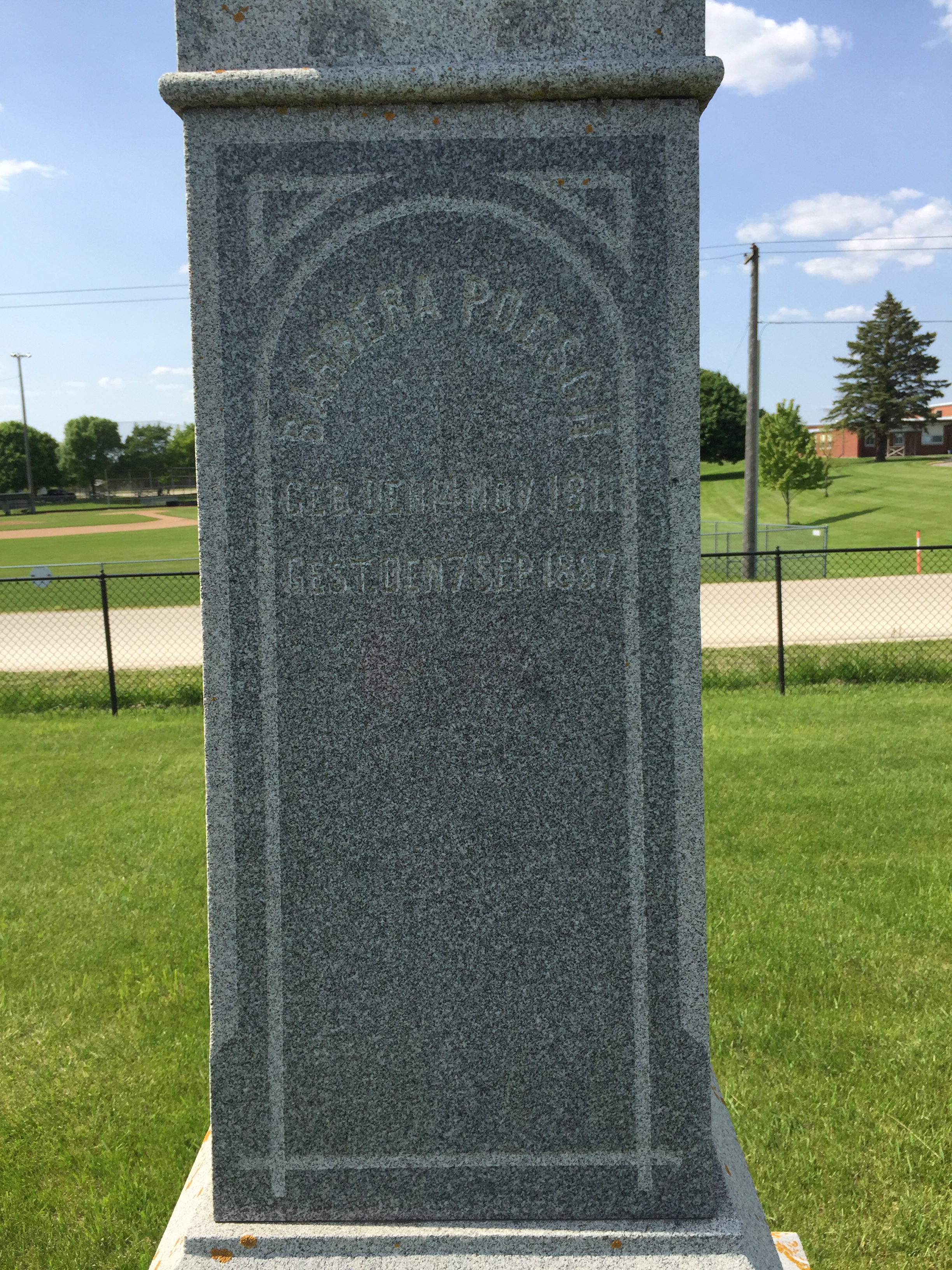
Find A Grave, Inc., Find A Grave, digital image (www.findagrave.com : accessed 25 March 2024), photograph, Barbera Poesch (1811-1887), Memorial No. 148724753, Garnavillo Community Cemetery, Garnavillo, Clayton County, Iowa; photograph by Ken Johnson, 2016.

Barbara survived Wolfgang by approximately twenty years. The year 1860 found her living with the family of her daughter Catharina; a few years later, her son Lorenz would serve with the 12th Iowa Infantry in the Civil War, surely an anxious time for Barbara. Lorenz survived the war and married Wilhelmina Best in 1868. In 1870, Barbara lived with the family of her son Johann, and was perhaps still a member of his household during a bitter cold snap in early March of 1873 when her fourteen-year-old granddaughter, her namesake, sadly perished. Young Barbara, who had been ill, had entered an unheated room one night where she fell and lay undetected until morning, by which time her arms and legs were said to have frozen and she was too weakened to recover.

By 1885, Barbara resided in the town of Garnavillo with her daughter Anna Margaretha, who was by that point also widowed. Barbara’s occupation was recorded as “Old Mother.” Having raised four children of her own to adulthood, and having likely had a hand in raising a total of twenty-five grandchildren as well, Barbara certainly earned her title.

Anna Barbara (Ruckdäschel) Poesch died at the home of her daughter in Garnavillo, Clayton County, Iowa, on 07 September 1887, when she was seventy-five years old. Her obituary, printed in a local newspaper, stated, “Her remains were conveyed to their last resting place on Saturday, followed by a large concourse of sorrowing relatives and friends. Rev. F. Sommerlad conducted the ceremony in his usual impressive manner.”

Copyright © 2024 Melanie Frick. All Rights Reserved.

Continue reading

Tombstone Tuesday: Fred and Matilda (Hammond) Thoma

Fred and Matilda (Hammond) Thoma, or Fritz and Tillie as they were known in their community, spent their childhoods and the entirety of their married lives in the same rural county in northeastern Iowa. Fred Thoma was born to Bavarians Wilhelm Heinrich and Anna Margaretha (Poesch) Thoma on 4 December 1857 in Garnavillo, Clayton County, Iowa.1 Matilda Hammond was born to Hiram H. and Eva Margaret (Stoehr) Hammond on 4 May 1859 in Volga, Clayton County, Iowa.2 While Matilda’s father was a native of Ohio and an early settler in Iowa, her mother hailed from the same Bavarian village of Weißenstadt as Matilda’s in-laws.3

SCAN0126

Grave of Matilda Thoma (1857-1947) and Fred Thoma (1857-1924), Garnavillo Community Cemetery, Garnavillo, Clayton County, Iowa; image date unknown, privately held by Melanie Frick, 2015.

It seems likely that the couple crossed paths as children, although they lived in separate communities; the Weißenstadt immigrants were surely a close-knit bunch. Fred and Matilda married on 29 December 1879 at the Zion Evangelical Lutheran Church in Clayton Center.4 The next year found them living in Garnavillo, where Fred was a clerk in his late father’s country store.5 That autumn, the couple became parents to the first of their eventual five children: George Hiram, Leonard Christopher Julius, Ludelia Maria, Roselyn Anna, and Norma Evaline.6 All but Norma survived to adulthood; sadly, she died in a diphtheria outbreak when she was ten years old.7

What few details are known of Fred and Matilda’s lives come from recollections of their granddaughters.8 The first thirty years of their marriage were spent in the town of Garnavillo, where Fred later had a restaurant and then worked as a laborer.9 Matilda was said to have been a midwife who delivered many children in Clayton County, although such skills were not recorded in the census. Fred allegedly had a fondness for drink, so when Matilda received an inheritance, she bought a farm away from town – and the saloons.10 The empty nesters enjoyed life in the countryside for the next fifteen years until Fred’s death in Clayton on 10 January 1925.11

As a widow, Matilda spent time in the homes of her daughter and granddaughter. In 1930, she experienced a different climate in Houston, Texas; by 1940, she had returned to the Midwest and resided in Wisconsin.12 It was there in Bridgeport, Crawford County, Wisconsin that she died on 21 August 1947 when she was approaching ninety years of age. She is buried beside her husband at the Garnavillo Community Cemetery.13

Copyright © 2015 Melanie Frick. All Rights Reserved.

Continue reading

A Fatal Scratch: The Death of a Pioneer Woman

Anna_Margaretha_Poesch_Thoma_Obituary“After almost a week of extreme suffering, caused from blood poisoning, Mrs. Margaretha Thoma, one of Garnavillo’s oldest residents, passed away at 4:00 o’clock last Saturday afternoon. About two weeks ago the lady accidentally scratched the back of one of her hands with a pin. The scratch at the time was a mere trifle and was given no further thought by her until a few days after when the hand began to swell and cause more or less pain. A physician was called and found it necessary to lance the hand, but desired results did not follow and twice later the lance was employed, and still no relief came to her sufferings, but instead the wound continued to grow worse and the swelling commenced extending into the arm. Everything possible was done to allay the pain and comfort her in her unendurable suffering, but nothing could be administered that would combat with the situation and the result was death came as a relief after nearly a week of incessant torture.”1

Anna Margaretha (Poesch) Thoma was born in Weißenstadt, Wunsiedel, Bavaria, the daughter of Wolfgang and Barbara Poesch.2 She came to Iowa with her family at a young age, and was later deemed “one of the venerable and loved pioneer women of Clayton County.”3 Margaretha married William Henry Thoma, a local merchant, in 1857, when she was still in her teens.4 They had eleven children before his death in 1876; Margaretha never remarried, and in fact continued to operate his mercantile in the years following his death.5 Perhaps it was this role in her community that brought her the recognition to be remembered so fondly in the years following her death from blood poisoning on 9 November 1907.6

Margaretha’s unfortunate plight might remind some of Caroline Ingalls’ encounter with a rusty nail in a particularly drama-filled episode of Little House on the Prairie. Indeed, albeit tragically, little could have been done to relieve Margaretha’s suffering at this time and place. Her age, estimated at near seventy, might also have contributed to her susceptibility to infection, whether she in fact suffered from sepsis or tetanus. Although not soon enough for Margaretha, it would be just a matter of time before the use of penicillin – and the tetanus vaccine – would become widespread. 

Copyright © 2015 Melanie Frick. All Rights Reserved.

Continue reading

The Country Store: Family Groceries, the Best of Brandy, and Excellent Beer

The Bavarian William Henry Thoma of Garnavillo, Clayton County, Iowa, was a businessman by the age of thirty.1 In 1859, the Clayton County Journal reported:

“William Thoma, Grocer, Main Street, Garnavillo, Iowa, keeps constantly on hand all kinds of family groceries, such as Coffee, Sugar, Tea, Milasses, ice, &c. The best of Brandy and excellent Beer is also always to be found at this establishment.”2

William must have found success as a grocer and purveyor of alcoholic beverages, as his business was apparently in operation for at least two decades. He was named a merchant in the 1860 census,3 and in the 1870 census it was noted that he was the keeper of a “country store.”4 This must have allowed him to provide a comfortable lifestyle for his wife and eleven children; in 1870, he owned real estate valued at $12,000 and personal estate valued at $3,000.5

William_Thoma_1870

1870 U.S. census, Clayton County, Iowa, population schedule, Garnavillo, p. 13 (penned), dwelling 87, family 86, Wm Toma; digital image, Ancestry.com (http://www.ancestry.com : accessed 16 April 2014), citing National Archives microfilm M593, roll 383.

After William’s death in the summer of 1876,6 his widow, Anna Margaretha (Poesch) Thoma, with a handful of young children still at home, took over as merchant. She maintained the business for a number of years, while her eldest son assisted as a clerk in the store.7

I like to wonder whether William’s store was anything like that featured at Iowa’s Living History Farms, which boasts the fictional 1875 Town of Walnut Hill. Images of the picturesque Greteman Brothers General Store can be seen here. It’s well worth a visit if you find yourself in central Iowa and have ever wondered what life was like for your Midwestern ancestors in the years following the Civil War. The impact of the Industrial Revolution on rural communities is visible, although, according to the Living History Farms, “The railroad will always be a few years away for Walnut Hill.”8

Of course, I also have to wonder whether William and Anna Margaretha (Poesch) Thoma were anything like Nels and Harriet Oleson of Little House on the Prairie. Let’s just hope that their children weren’t as spoiled as the infamous Nellie and Willie!

Continue reading