Tag Archives: Sioux City

Wedding Wednesday: A Question of Nationality

I’m not sure if it was meant as a joke, or if newlyweds Gerald and Fern (Thoma) Adam of Sioux City, Woodbury County, Iowa were genuinely confused. When asked to state their nationalities at the time of their marriage, their answers should have been simple; they were the American-born children of American-born parents, after all, so there was really no question that they were American themselves. Jerry, however, stated that he was of French nationality, while Fern declared that she was German-English.1

GeraldAdam1929

Gerald Joseph Adam, Sioux City, Iowa, ca. 1929; digital image 2012, privately held by Melanie Frick, 2014.

FernThomaAdam1929

Fern Lavonne Thoma, Sioux City, Iowa, ca. 1929; digital image 2012, privately held by Melanie Frick, 2014.

From a genealogical perspective, I love it. How often does one have the chance to learn what their forebears knew of their own ancestry? However, if I didn’t already know so much about this couple and their heritage, I might have been thrown off. Jerry’s ancestry was indeed French – and French Canadian, and Polish. Fern’s ancestors, many of whom were likely early arrivals on American soil, can thus far be traced to Germany and the British Isles.

I don’t know when exactly the couple met while on their way downtown to the movie theater, but Jerry and Fern married in their hometown on 8 June 1929 – eighty-five years ago this week.2 Fern was twenty-one, and although Jerry would not celebrate his twenty-first birthday for eleven more days,3 he claimed to be the same age as Fern.4 Their wedding attendants were close friends Merle Montgomery and Dorothy Thompson,5 and, following their ceremony, led by Reverend R. M. LeCair of St. Jean Baptiste Church, the couple took a “motor trip” to the Black Hills of South Dakota.6

Gerald_Adam_Fern_Thoma_Marriage_1929

“Iowa, Marriage Records, 1923-1937,” digital images, Ancestry.com (http://www.ancestry.com : accessed 10 June 2014), Gerald Adam and Fern Thoma, 8 June 1929, Sioux City; citing “Iowa Marriage Records, 1923–37,” microfilm, State Historical Society of Iowa, Des Moines.

If your ancestors married in Iowa between 1923 and 1937, be sure to visit Ancestry.com’s digital image collection, “Iowa, Marriage Records, 1923-1937,” new this year. This database has plenty of detail to offer, as marriage records included such information as age, place of residence, occupation, place of birth, father’s name, mother’s maiden name, number of marriages, and the names of the officiant and witnesses. It’s also an opportunity to see the signatures of the couple – likely the last time the bride would sign her maiden name. Have you found any surprises in this record set?

Continue reading

A Little French Boy

An American by birth, Henry Joseph Adam spoke French until he started school.1 He was born in Indian Orchard, Hampden County, Massachusetts, on 5 August 1881, the son of Timothy and Odile (Millette) Adam, both of French Canadian heritage.2 His father had been born in Quebec, while his mother had been born in upstate New York.3 Regardless of their nationality, their roots ran deep, and the French language likely remained more familiar to them than English.

Henry_Joseph_Adam_1886

Henry Joseph Adam, Sioux City, Woodbury County, Iowa, ca. 1886-87; digital image 2013, privately held by Melanie Frick, 2014.

Pictured here circa 1886-87, when he was about five years old, Henry is simply but neatly dressed. He wears breeches with high patterned stockings, and a white or light-colored shirt with a contrasting bow-tie. His boots, perhaps hand-me-downs from an older brother, have been polished till they shine. He may hold a cap in his left hand, although it is indistinct due to the quality of this tintype. Despite the fact that cabinet cards grew in popularity during this decade, tintypes were still certainly not unusual. The faintest blush of pink is visible on Henry’s cheeks from a painted accent.

The studio setup is interesting and not particularly professional. Henry stands upon a small stool, and leans against a piece of furniture covered with heavy fabric. The painted backdrop behind him depicts a scene of a house, fields, and a tree, which doesn’t tie in well with the wood floor in the foreground. I suspect that this photograph may have been taken in Sioux City, Woodbury County, Iowa; the Adam family moved here sometime in the mid-1880s, perhaps because of its proximity to the large French Canadian community in nearby Jefferson, Union County, South Dakota.4 Thus, this little French boy remained in good company; he may have learned English at school, but he would not have forgotten his French!

Continue reading

Friendship Clubs and Funny Quotes: Finding Family in Yearbooks

Several years before they would meet and marry, teenagers Fern and Jerry were unsuspecting students at Central High School in Sioux City, Woodbury County, Iowa.1 They were not in the same grade, and this was a large school; Fern moved to Sioux City only in time for her senior year, and as Jerry graduated two years later, it’s possible that they never crossed paths during their brief overlap as students at the imposing sandstone building dubbed “The Castle on the Hill.”2

Fern_Thoma_Yearbook_1925

The Maroon and White, Vol. XXI (Sioux City, Iowa: Central High School, 1925), 67; digital image, Ancestry.com (http://www.ancestry.com : accessed 24 March 2014).

Fern Lavonne Thoma graduated from Central High School in 1925. In her yearbook photo, she wore a long necklace and, true to the times, styled her hair in a fashionable, chin-length bob. The only club that Fern had joined was the “Friendship Club,” which, apparently, was mandatory for all female students.3 From what I remember her telling me, she enjoyed her time at this school, especially a banquet for the upperclassmen during which the school gymnasium was decorated like a boat. She thought this event was “just wonderful!”4

Gerald_Adam_Yearbook_1927

The Maroon and White, Vol. XXIII (Sioux City, Iowa: Central High School, 1927), 34; digital image, Ancestry.com (http://www.ancestry.com : accessed 24 March 2014).

Gerald “Jerry” Joseph Adam graduated from Central High School in 1927. According to the yearbook, he was in the general course of study and had been involved in Civics, no surprise given his penchant for writing to politicians later in his life, as well as the Spanish Club. His handsome photo was paired with the quote, “Who shows you your place when you go to the Princess?”5 As a teenager, Jerry earned money as an usher at the Princess Theatre in downtown Sioux City, surely a popular place among his movie-going peers.6

In fact, Fern and Jerry reportedly met while on their way to the movies. Fern and her friend Florence were walking downtown when two young men, who were known to Florence, drove up in their rental car and offered the girls a ride. Fern approached the front to sit next to the driver, when Jerry suggested that she sit in the back with him. Fern later claimed that Florence had set her up, while Jerry liked to say that when he first laid eyes on Fern, he proclaimed, “That’s the girl I’m going to marry!”7

If you would like to find yearbook photos of your ancestors (or even yourself), check out the yearbook collections on Ancestry.com. In my experience, yearbooks don’t always appear as strong “shaky leaf” matches, so I have found it helpful to search specifically within the category “Schools, Directories & Church Histories” in order to bring all relevant results to the top.

Also consider searching the yearbooks individually as your ancestor’s full name may not have been given for every appearance, particularly if he or she was an underclassman or appeared in additional club or athletic photographs. As a bonus, see if you can find his or her autograph scrawled in the back of the book. You never know what you might learn about the glory days of your ancestor’s youth!

Continue reading

Fashionable Winter Wear

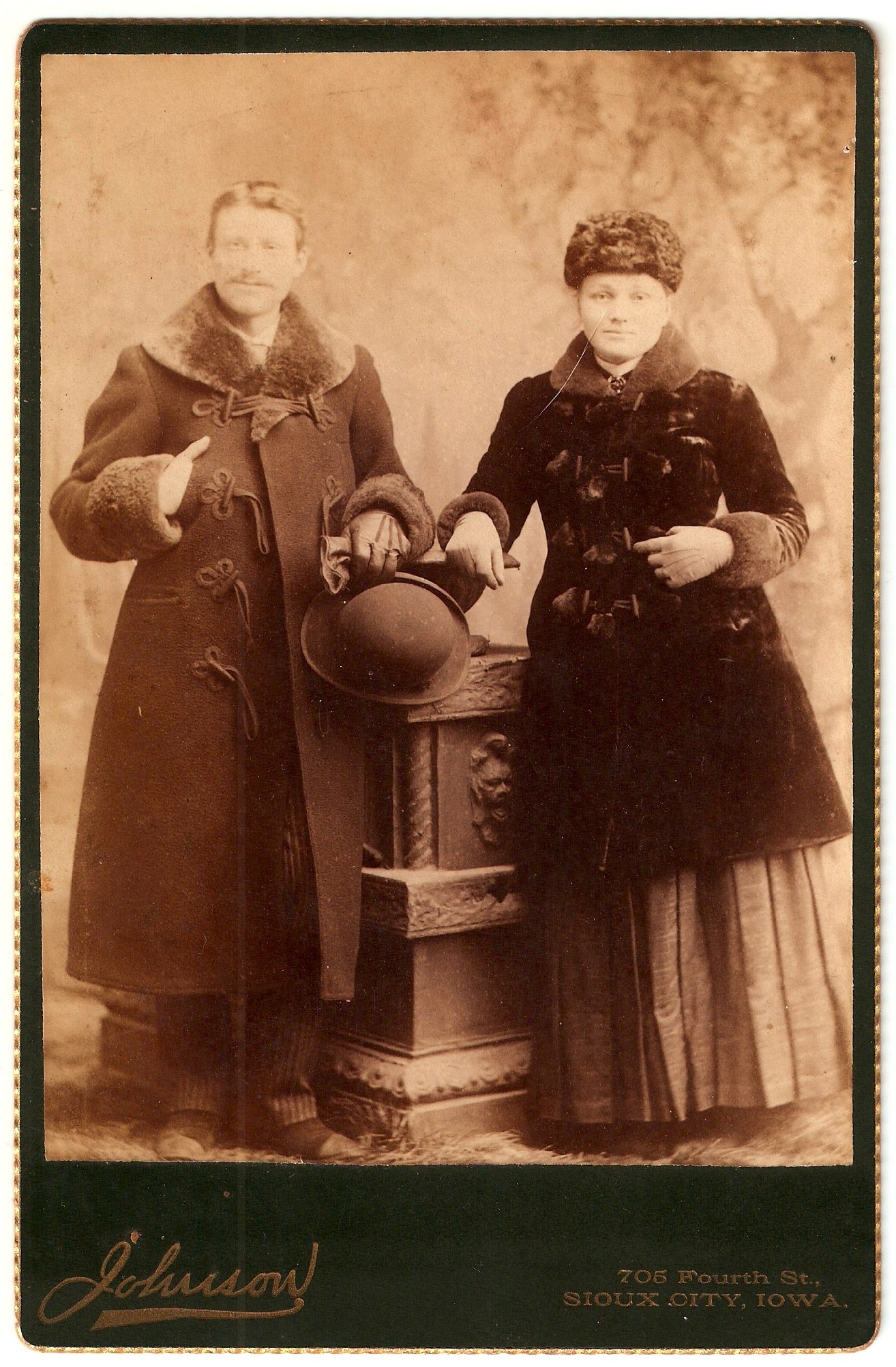
SwedishAlbumSiouxCityCouple1889

Unidentified couple in winter attire, Sioux City, Woodbury County, Iowa, ca. 1889; digital image 2014, privately held by Melanie Frick, 2014.

This Valentine’s Day, perhaps you’re looking forward to a special outing with a loved one. You might dress up, or you might bundle up, depending on the temperature outside. In any case, you likely won’t be decked out in fashionable furs like this couple, who dressed for the winter weather in Sioux City, Woodbury County, Iowa circa 1889. This cabinet card photograph comes from an unidentified antique album featuring a family of Swedish immigrants.1 The photographer – J. E. Johnson of 705 Fourth Street in Sioux City – operated his studio from at least 1887-1891.2

A newspaper column in a nearby community in South Dakota reported in 1888, “It is a lively competition between the comparatively old-fashioned sealskin cloaks and the newer, more picturesque wraps that reach to the ground.”3 The unidentified woman pictured here wears a toggle-fastened coat with a fur collar and cuffs, and she sports a striking fur cap that immediately made me think of one worn by Laura Ingalls Wilder in a photograph taken in the latter half of the 1880s. Her outfit is completed by a pair of fitted gloves, and a pleated skirt extends below the hemline of her coat.

The unidentified man wears a toggle-fastened overcoat of heavy cloth that reaches below the knee, also trimmed with a fur collar and cuffs. He tucks a bare hand into a pocket; the other grasps the spare glove and his bowler hat. Visible beneath his coat are distinctive striped pants. While flipping through Joan Severa’s Dressed for the Photographer, an excellent reference for dating nineteenth century photographs, I spotted an example of another young man wearing striped pants in a photograph dated 1889. In fact, he leaned against what appeared to be the very same pedestal. As it turned out, it was. The photograph of a young man in striped pants featured in Dressed for the Photographer was also taken at the Johnson studio in Sioux City.4 Apparently, striped pants were at their peak in popularity at this time!

The couple pictured here seem relatively young, and perhaps were recently married. If they, like others in this album, were Swedish immigrants, they may have shared copies of this photograph with family members who remained in the old country. Even if they weren’t dressed for a date in the modern sense of the term, they certainly look prepared to take a romantic stroll downtown!

Continue reading

Tombstone Tuesday: Johanne Marie Larsen

Johanne Marie (Larsen) Walsted of Aalborg, Denmark was sixty-three years old when she immigrated to America in the spring of 1900.1 She traveled alone; her husband of thirty-two years had passed away the year before,2 and most of her children had already left Denmark for brighter opportunities in Iowa and Wisconsin. They had paid for her passage aboard the Norge, and she carried fifteen dollars.3

GracelandCemeteryJohannaWalstedGrave

Grave of Johanna M. Walsted, 1836-1914, Graceland Cemetery, Sioux City, Woodbury County, Iowa; image date 2001, privately held by Melanie Frick.

Johanne was christened on 28 September 1836 in Bolle, Nordjylland, Denmark, the daughter of Lars Jensen Bak and Ane Cathrine Christensdatter.4 At the age of thirty, she married Christian Jens Jacobsen Walsted,5 a widower with two young children, Jens Jacob and Lars Marinus Walsted. The couple went on to have seven more children together: Jensine Kathrine, Eskild, Lars Peter, Mandrup, Anna Kathrine, Ellen Eskelline, and Jens Jacob Walsted.6 All but two of the children, the elder Jens Jacob and Eskild, survived to adulthood.7 Christian was a shoemaker, and eventually moved with his family from rural Dronninglund to the city of Aalborg,8 where he died in 1899.9

By the time Johanne made her journey to America, six of her seven surviving children and step-children awaited her arrival. Only her youngest son remained in Denmark; he was to follow two years later.10 In the years to come, Johanne moved between the homes of her children, some of whom she hadn’t seen in more than a decade. She was enumerated in the 1900 U.S. census less than two months after her arrival in the country, at which time she resided with a daughter in Iowa;11 she later joined another daughter in Oklahoma City.12

Johanne’s health may have been poor in her later years; a notation on the ship manifest suggests that she had a deformity of some kind,13 and her death record stated that she suffered from senility.14 Johanne Marie (Larsen) Walsted died at the age of seventy-eight on 3 November 1914 in Sioux City, Woodbury County, Iowa. Services were held at the Danish Lutheran Church, and she was buried at Graceland Cemetery.14

Continue reading

A Witness to the Ruff Disaster of 1918

RuffFireSiouxCity1918

Ruff Building Collapse and Fire, Sioux City, Iowa, 1918; digital image 2010, privately held by Melanie Frick, 2014.

This photograph of the Ruff Disaster of 1918 in Sioux City, Woodbury County, Iowa comes from my family’s collection. Saturday, 29 June 1918 was a typical afternoon in downtown Sioux City; although the Oscar Ruff Drug Company at Fourth and Douglas was being remodeled, everyone continued to go about their business there and at the adjoining shops, including the Chain Grocery. Then, abruptly, at 1:30 pm, the building collapsed. It was later determined that the building was much too deteriorated to have been subjected to these renovations, which involved lowering the first floor to ground level. It was only a matter of minutes before a fire broke out, and rescue workers struggled to attend to those trapped in the rubble. In the end, thirty-nine people perished.1

Although from this photograph it appears that the fire had gone on for some time – the first images show bystanders kept at bay while the firemen hose the building – the chaos is still evident.2 Debris litters the ground, crowds mill about, and someone even moved out of the frame of the photograph so quickly that only his leg appears. What looks like a firetruck can be seen in the rear, in front of the clouds of smoke.

I don’t know how my family came to have a copy of this photograph, but it looks as though it could have been a print of one that might have originally appeared in a newspaper. Circled at right is a person identified as my second great grandfather, Henry Adam. However, I’m not convinced that this was actually Henry, and not his son. As of September 1918, I know that Henry was employed as a carpenter in the Norfolk Navy Yard of Portsmouth, Virginia; as a result, he may or may not have been home in Sioux City in June of that year.3

Although Henry was of short stature, the person circled also appears quite young. He wears a casual newsboy cap as opposed to the hats donned by the men around him. I’m inclined to believe that he may actually be Gerald “Jerry” Adam of Sioux City, Woodbury County, Iowa, who would have been ten years old at the time.4 Jerry lived just half a mile from the scene of the Ruff Disaster, so it certainly seems plausible that he may have wandered down to the scene to catch a glimpse of the disaster firsthand.5

Did any of your ancestors fall victim to or witness a disaster? If family lore and local histories don’t provide you with enough information, check out historic newspapers or GenDisasters, a website that shares information about the floods, fires, tornadoes, and other unfortunate events that may have impacted your ancestors’ lives.

Continue reading

An Ancestor with an Alias

When I learned that George Hiram Thoma of Garnavillo, Clayton County, Iowa used an alias as a young man, it took me by surprise. He was born to Fred and Matilda (Hammond) Thoma in 1880,1 and the state census indicates that he remained in his home county in northeastern Iowa at least until 1895.2 At some point thereafter, according to family lore, George left home and bicycled across Iowa. Whether he went by bicycle or not, it was said that his move may have been spurred on by his poor relationship with his father.3

GeorgeHiramThoma

George Hiram Thoma, seated left, with an unidentified young man, ca. 1900; digital image 2013, privately held by Melanie Frick, 2014.

Records place George across the state in northwestern Iowa on 23 March 1902, at which time, using the name George A. Neilson, he married Anna Leota Fenton in Ashton, Osceola County, Iowa.4 This was no trick of penmanship or recorder’s error; three affidavits, written by George, his mother, and his younger brother, were attached to the marriage document decades later, each attesting to the fact that George A. Neilson and George Hiram Thoma were one and the same person.5 It is worth noting that George still named his correct place of birth and even the correct names of his parents on the original marriage document, with the exception, of course, of assigning the Neilson surname to them as well.6 Evidently, he was not prepared or had no reason to invent an elaborate backstory regarding his origins.

None of the affidavits, however, explained why George had married under an assumed name.7 One has to wonder whether his wife even knew what she was getting into! Prior to his marriage, I suspect that he might be found in the 1900 U.S. census as George Thoma, a clerk in Belden, Cedar County, Nebraska. Notably, he boarded with a family by the name of Nelson, and a Nielsen also resided in the household.8 Although this may or may not be the correct George Thoma, we do know that within weeks of his marriage, he moved to Center, Knox County, Nebraska, where he was an employee of the Edwards and Bradford Lumber Company.9

Within a few years of his marriage, George relocated with his family to Sioux City, Woodbury County, Iowa. There, his daughter’s birth was recorded with the surname Neilson,10 and according to the city directories, George continued to use his assumed name at least until 1909.11 I have been unable to locate the family in the 1910 U.S. census – they had likely left Sioux City by that time to return to Nebraska, where they moved from place to place for the next decade. However, they had certainly reverted to the use of the Thoma surname no later than World War I.12

Was this alias purely symbolic, in order to emphasize George’s separation from his father, or, perhaps, the ties that he forged with another family? Or was it part of an effort to hide, whether from his father, from love, or from the law? This is one family mystery that I would love to solve!

Continue reading

A New Year’s Eve Party?

HenryMelanieAdamParty_2

Henry and Melanie (Lutz) Adam, ca. 1910, Sioux City, Woodbury County, Iowa; digital image 2010, privately held by Melanie Frick, 2014.

Happy New Year! …or at least, I think that’s what might have been said when this photograph was taken about a century ago. Featured are Henry and Melanie (Lutz) Adam of Sioux City, Woodbury County, Iowa, with Henry seated at lower right and Melanie in white above his raised hand.

Could this photograph have been taken at a New Year’s Eve party? The curtains are drawn in the living room or parlor where the photograph was taken, which suggests to me that it could be after dark. Furthermore, it’s clear that the alcohol is flowing. One man can be seen taking a drink, while several others clutch glasses and bottles. (Alas, I can’t make out the labels.) Nearly everyone wears some sort of silly hat made of cloth or paper, and only three older children are present in the photograph – no little ones.

Note that three of the men in front, including Henry, make a gesture with their thumbs to the sides of their noses and their fingers extended flat, pressed together. They aren’t quite thumbing their noses in the way that I have seen, so I wonder what this gesture might have meant.

Of the nineteen people gathered here, only Henry seems to be ready for the camera. Most, including Melanie, look to the side, perhaps at another photographer, or are caught in the midst of conversation. Whether this gathering was for New Year’s Eve or not, one can easily imagine the chaotic scene as an attempt was made to corral this lively group of friends for a memorable photograph. Cheers!

The Traveling Photographer’s Ram

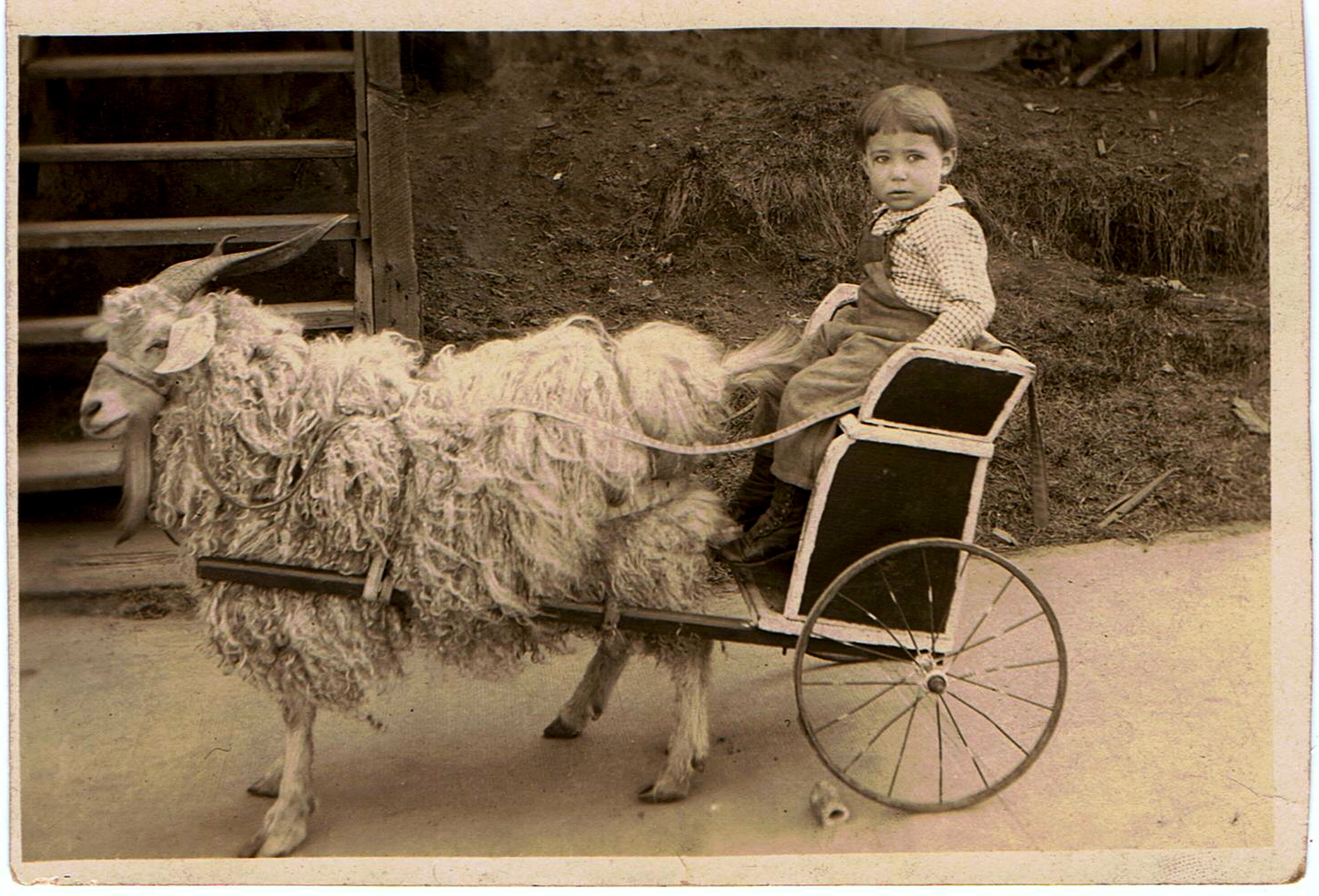
LeonAdam

Leon Francis Adam, ca. 1916, Sioux City, Woodbury County, Iowa; digital image 2010, privately held by Melanie Frick, 2013.

Only a handful of photographs exist of little Leon. He was barely five years old when he tumbled into a bonfire and died from his burns.1 This photograph, however, taken when he was perhaps three years old, gives a glimpse into his brief but surely happy childhood.

Leon Francis Adam was born in Sioux City, Woodbury County, Iowa, on 23 August 1913.2 He was the second and youngest son of Henry Joseph and Melanie Veronica (Lutz) Adam.3 It wasn’t uncommon at this time for photographers to travel through towns with some sort of enticing animal in tow – often a pony,4 or, in this case, a wooly ram pulling a two-wheeled cart. Mothers must have smiled to see their children flock to the attraction, making their parting with a few pennies for a photograph that much easier. This particular photograph is a picture postcard, a format that reached its peak circa 1905-1920.5

Leon is wearing simple play clothes – tiny overalls, a check shirt, and black, button-up shoes. His expression is cautious, and he appears to look not at the photographer but at someone off to the side, likely his mother, offering encouragement. Note the bone placed in front of the wheel of the cart, perhaps necessary to avoid a situation of a runaway ram!

Did your young ancestors ever pose with a pony, ram, or other barnyard animal?


SOURCES
1 “Plays in a Fire; Lad Dies of Burns,” unidentified newspaper from Sioux City, Iowa, September 1918.
2 Grave of Leon Adam, 1913-1918, Calvary Cemetery, Sioux City, Woodbury County, Iowa; image date unknown, privately held by Melanie Frick, 2013.
3 “Plays in Fire; Lad Dies of Burns,” 1918.
4 “Wayback Wednesday: Remembering the Pony Photographer” The Family Curator, 14 August 2013 (http://www.thefamilycurator.com/home/2013/8/14/wayback-wednesday-remembering-the-pony-photographer.html : accessed 13 December 2013).
5 Maureen A. Taylor, Family Photo Detective (Cincinnati: Family Tree Books, 2013), 65.

A Wedding Party

Not everyone had a wedding portrait made. In my experience, it was even less common for a wedding portrait to include the wedding attendants or witnesses. However, when Henry Joseph Adam and Melanie Veronica Lutz married on 24 October 1905, they posed for a formal photograph with four attendants.

HenryAdamMelanieLutzWedding1905

Henry and Melanie (Lutz) Adam wedding photograph, 1905, Sioux City, Iowa; digital image 2010, privately held by Melanie Frick, 2013.

Melanie, the bride, appears to wear her brown hair loose behind her shoulders, unless this is an illusion created by a shadow. The dark material of her dress, featuring a pleated bodice and v-neck, contrasts with a high white collar. A decorative watch is pinned at her bodice, and a small brooch is at her throat. To the right, her attendant, Permelia Adam, wears a white pleated bodice with full sleeves and a large bow off-center at the collar. Blanche Adam also wears a white bodice, although it features decorative buttons and lace detail. An elegant string of pearls rests at her throat, above the high collar. Like Permelia, Blanche wears a large bow in her hair.

Henry, the groom, wears a dark suit with a crisp white collar and white bow tie. His suit fastens higher than those of his attendants; Theodore Adam wears a polka dot tie, and Herman Adam sports a vest and bow tie. The men have all combed their dark hair with side parts and fashionable waves.

Carnations were apparently in vogue in 1905, or perhaps they were a favorite of the bride. Melanie wears two long-stemmed white carnations, facing downward, pinned to her bodice. Henry wears one as well, although the stem is hidden by his lapel. Although Permelia seems to wear a carnation, the stem is so long that the blossom itself cannot be seen, and the male attendants wear darker flowers that are indistinct against their suits. Only Blanche goes without a flower.

The Adam-Lutz wedding was held at St. Jean the Baptiste Catholic Church in Sioux City, Woodbury, Iowa on a Tuesday morning. Forty guests attended, the majority of whom were relatives.1 As Melanie had no family in the area, it is understandable that only her husband’s relations would have made up their wedding party; Permelia and Theodore were Henry’s brother and sister, while Blanche and Herman were his cousins. After the ceremony, an informal wedding breakfast was served at the home of Henry’s parents, which was decorated, unsurprisingly, with flowers.2


SOURCES
1“Adam-Lutze,” Sioux City (Iowa) Tribune, 28 October 1905.
2“Adam-Lutze,” Sioux City (Iowa) Tribune, 28 October 1905.