Tag Archives: Thoma

The Thoma Store: Scribner’s Favorite Trading Place

George Hiram Thoma was not the first in his family to open a general store. Decades before, his grandfather, a Bavarian immigrant, had operated a country store in northeastern Iowa, and perhaps it was stories of his success that inspired George to pursue this livelihood. In any case, George first entered the trade when he was about thirty years old, at which time he lived with his wife and children in Decatur, Burt County, Nebraska.1 This small community with a population under seven hundred was located near the border of the Omaha Reservation. It was likely here that George picked up the Omaha-Ponca language as well as Plains Indian Sign Language, with which he communicated with members of the local tribe.2

(Yet another interesting aside to the story of this ancestor with an alias!)

In 1922, after more than a decade in Decatur, George moved with his family some forty miles southwest to the town of Scribner, Dodge County, Nebraska.3 Scribner boasted a population of just over one thousand—several hundred more than in Decatur, perhaps making it a more promising location for a general store despite, or because, of its remote location. The local newspaper, The Rustler, announced the family’s impending arrival in February of 1922:

“George H. Thoma of Decatur, this state, was in Scribner this week and has leased the building which has been occupied by the People’s Co-Operative Store. He will open up about March 1 with a complete line of general merchandise. Mr. Thoma comes well recommended as an up-to-date merchant with a record of twelve years of successful business at Decatur and twenty in the mercantile business. He has a very pleasing personality and we learn he has always been a booster for his home town. He has an interesting family that will be a welcome addition to our church and school circles; a young daughter in high school and one son who assists his father in their business, who is a band man and a football player, who will find congenial associates here. Mr. and Mrs. Thoma and family will find a hearty welcome awaiting them in our little city.”4
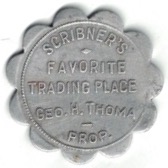
“Scribner’s Favorite Trading Place” token, Scribner, Nebraska, 1922-24; privately held by Melanie Frick, 2017.

It did indeed appear that the people of Scribner welcomed the Thoma family into their fold without hesitation. Regular updates were printed in the local newspaper regarding the opening of the store and the enrollment of daughters Fern, Norma, and later Betty in school. George wasted little time in becoming an active member the community, taking on leadership positions in a new Business Men’s Club as well as the Boy Scouts and the American Red Cross,5 while his wife, Leota, made friends among the Royal Neighbors and the Ladies Aid Society at the local Congregational church.6 Their son, Fenton, was named in the newspaper numerous times as he took part in social and athletic activities; he eventually spent a period of time away from his family in Scribner as he traveled for a summer with the Redpath-Horner Chautauqua and then attended Dakota Wesleyan University, where he served as president of the freshman class.7 Fern, too, received frequent mentions in the newspaper as she engaged in high school activities and gathered with friends, and mentions were even made of young Norma and Betty as they took part in events with their elementary school classmates.8

It seems, however, that the Thoma store did not take off as well as the family’s social life, and although the family embraced life in Scribner, it must also have been a stressful time for them. Less than a year after opening shop, a full-page advertisement appeared in the local newspaper, declaring that “Scribner’s Favorite Trading Place” was being “FORCED BY CREDITORS” to “raise $10,000 cash at once or close up business.”9 The Northwestern Selling System was to be in charge of this cash-raising sale of the store’s stock of $25,000 of “clean seasonable merchandise, only a few months old, consisting of dry goods, notions, women’s and children’s shoes, hosiery, underwear, fancy goods, men’s and boys’ sheep-lined clothing, hats, caps, furnishings, groceries, and queensware.”10 All purchases were to be made in cash or, interestingly, produce.11

“Scribner’s Favorite Trading Place” token, Scribner, Nebraska, 1922-24; privately held by Melanie Frick, 2017.

Apparently, this sale merely bought time. Another cash-raising sale was held that August,12 and in February of 1924, just two years after The Rustler had announced the opening of Thoma’s Store, a two-page spread appeared, announcing, “We’ve Decided to Quit Business in Scribner,” adding, in all-caps, “THOMA’S $20,000 STOCK JUST GOTTA GO!”13 A personal note from the proprietor himself was central to the advertisement:

“Here Are The Cold-Blooded Facts: You’ve heard and read about merchandise sales and bargains until your faith in them has been shattered, but your idea and our idea of a sale and a bargain are the same: It has been the custom of some stores in announcing a sale to give it some fancy decoy name and attempt to justify it by some plausible excuse. We are BLUNT about it – the reason for this sale is that we are sick and tired of business, physically and mentally and we’re just a going to get out and do it quick, and if low prices were ever an inducement this stock will be sold in a jiffy. Please understand, WE ARE CLOSING OUT! THIS MEANS IT ALL GOES! Signed GEO. H. THOMA”14

In May of 1924, The Rustler reported:

“George H. Thoma last Saturday moved his family and household effects to Sioux City, where they will make their future home. Their daughter, Miss Fern, remained here to finish her school year. Mr. and Mrs. Thoma have made many warm friends during their residence here, who regret to see them leave this city, and wish them all the good luck in the world at their new location. Mr. Thoma is now on the road selling electrical appliances. Friday afternoon the ladies’ aid of the Congregational church held a farewell reception in honor of Mrs. Thoma in the church basement. The manner in which the ladies dressed and made-up for the affair caused much merriment and an enjoyable afternoon is reported.”15

Sioux City proved to be a more promising destination for the Thoma family, and despite the close friendships they left behind in Scribner, they thrived in this city of nearly eighty thousand. George put his experience as a merchant to good use and found success as a wholesale fruit salesman for the Haley-Neeley Company and, for many years, the Palmer Fruit Company. He remained in Sioux City for the rest of his life, never again returning to the general merchandise business.16

Copyright © 2017 Melanie Frick. All Rights Reserved.
Continue reading
An Ancestor with an Alias Revisited

In the past, I’ve touched upon the mystery surrounding George Hiram Thoma, who used an alias for a number of years before reverting back to the use of his original name. Born on 29 September 1880 in Clayton County, Iowa to Fred and Matilda (Hammond) Thoma, census records indicate that George remained in his home county at least until 1895.1 Family lore states that he left home as a teenager due to a poor relationship with his father;2 he was said to have bicycled from northeast to northwest Iowa where the next definitive record of his existence shows him marrying Anna Leota Fenton in the spring of 1902.3 However, he married under the assumed name of George A. Neilson, and later affidavits attest that this was one and the same person.4 George continued to use this assumed name for a number of years before finally reverting to the Thoma surname.

Now, a century has passed, and none of his living descendants, including his youngest daughter, seem to have even heard of the Neilson alias! In an effort to learn more about the potential cause of George’s name-change, a closer look was taken at his movements during his late teens and early twenties:

Did George leave home as a teenager? It was said that George had a poor relationship with his father, and recently uncovered evidence shows that he did, in fact, leave home as a teenager. However, at least at first, he didn’t go far. At the time of the 1895 Iowa State Census, George was fourteen and lived at home in the community of Garnavillo.5 Two years later, sixteen-year-old George attended high school in Postville, a town about twenty-five miles away.6 As George’s maternal grandmother also resided there, it’s certainly possible that he may have lived with her while completing his education.

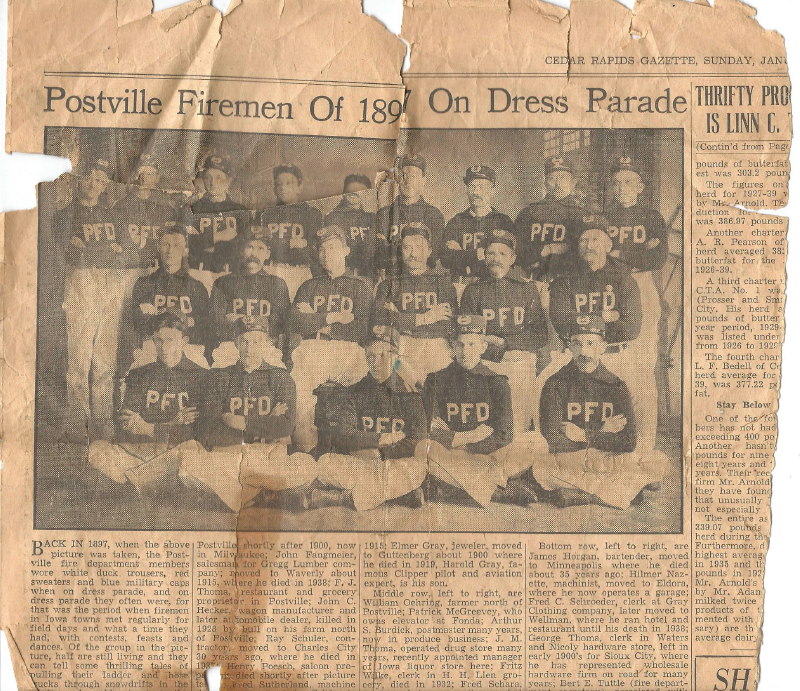
“Postville Firemen Of 1897 On Dress Parade,” 28 January 1940, Cedar Rapids (Iowa) Gazette; clipping privately held by David Adam, 2016. George Thoma is seated second from right; text reads, “George Thoma, clerk in Waters and Nicol[a]y hardware store, left in early 1900’s for Sioux City where he has represented wholesale hardware firm on road for many years.”

Also in 1897, George served with the Postville Fire Department.As reported in a local newspaper decades later, “Back in 1897 […] the Postville fire department members wore white duck trousers, red sweaters and blue military caps when on dress parade, and on dress parade they often were, for that was the period when firemen in Iowa towns met regularly for field days and what a time they had, with contests, feasts, and dances.”8 George, slim and clean-shaven, sits cross-legged in the front row of the group of twenty men, among whom he may have counted both former classmates and kin. At this time, after having dabbled previously with the idea of becoming a tinner,9 he was a clerk at a local hardware store.10

Did George really ride a bicycle across Iowa? Although family lore states that George left home as a teenager and bicycled across Iowa, I’ve always questioned whether this particular tale was entirely true or, indeed, even possible. As it turns out, George did, in fact, have access to a bicycle, and according to a blurb in the Postville Review in the summer of 1898, he “took an overland trip by bicycle to Farmersburg last Saturday, returning on Sunday.”11 From Postville to Farmersburg was a distance of more than fifteen miles—more than thirty miles roundtrip—which, with an eye to both the quality of bicycles of the era as well as the condition of the roads, frankly impressed me. Maybe he did bicycle across Iowa, or at least part of it, but from this clipping we are able to learn that he did not make the journey before he was eighteen; he remained close to home and was known as George Hiram Thoma at least until 1899. In January of that year, the Postville Review shared that he had spent several days visiting his parents in Garnavillo.12

How long did George use an alias? Thanks to the record of his daughter’s birth as well as the discovery of the record of his relinquished homestead, a fairly concrete date can be determined for the conclusion of George’s alias. His eldest daughter was born Fern Neilson in September of 1907;13 George A. Neilson appeared in a city directory printed in late 1908;14 and in February 1909, George H. Thoma made application for a homestead in western Nebraska.15 Perhaps the need to sign a record at the federal level inspired George to embrace his true identity once again! As for when George first used his alias, however, I have as of yet discovered no definitive records of his life between February of 1899, when he was known locally as George Thoma, and March of 1902, when he was married as George A. Neilson.16

What could have happened in those three years to give George reason to change his name? His experiences between the ages of eighteen and twenty-one remain a mystery to me. While I don’t yet know why George Hiram Thoma used an alias throughout a seven to ten year period of his early adulthood, however, I do have a more complete picture of his life during his late teens: he was a high school student, clerk, and fireman who lived apart from his immediate family but maintained a relationship with them, and he was apparently known well enough in his community to be mentioned routinely in the local newspapers.

Further complicating matters, however, is the fact that, in December 1905, during the midst of his documented use of an alias, a newspaper in his home county noted that “George Thoma, from Nebraska, is visiting with home folks since Friday.” This suggests both a continued relationship with his parents as well as the fact that his alias was either unknown or unacknowledged by those in northeastern Iowa. In any case, further information gleaned from historic newspapers could ultimately narrow the search for answers as to why, exactly, George Hiram Thoma was known as George A. Neilson.

Copyright © 2016 Melanie Frick. All Rights Reserved.
Continue reading
The Relinquished Homestead

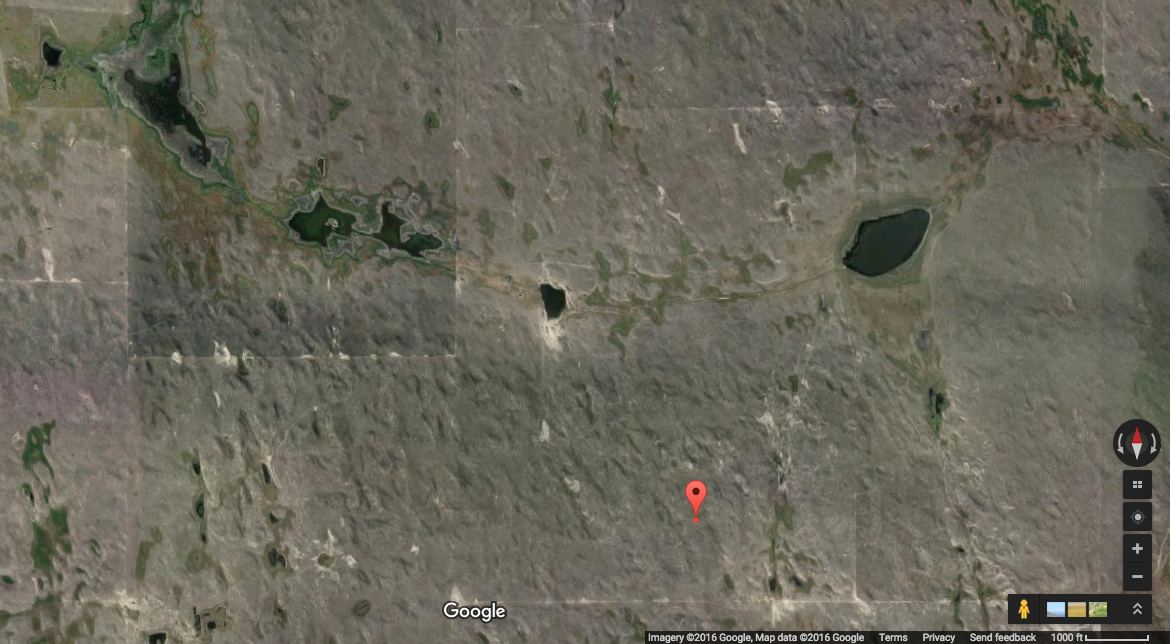
Not all homesteaders made it. As far as I know, George Hiram Thoma was the last of my direct ancestors to stake a claim, which he did in western Nebraska on a February day in 1909. George and his brother-in-law Clare Eugene Gibson arrived together at the land office in Valentine in order to pay their respective filing fees; each was granted about six hundred acres of land on adjoining claims in the desolate Sandhills of nearby Rock County, Nebraska.1 While earlier claims under the Homestead Act of 1862 allowed each individual only one hundred and sixty acres, later amendments granted settlers more land in certain areas where, for example, the soil and climate might be less conducive to raising crops. The Kincaid Act of 1904 applied specifically to thirty-seven counties in northwestern Nebraska that contained non-irrigable land.2

Screen Shot 2016-02-29 at 1.12.48 PM

Google Earth certainly doesn’t make this part of the country look particularly inviting, and life there may have been even more difficult than expected. The homesteads were located more than twenty miles from the nearest town of Bassett, and the families had likely never experienced such isolation. However, Clare Gibson, along with his wife, Alpha, and their four children, Bernice, Pauline, James, and Florence, stuck it out; his homestead was patented in February 1913,3 and the Gibson family remained there for years to come.4

George Thoma and his wife Leota, on the other hand, lasted only a little more than a year. On 4 May 1910, George relinquished his homestead,5 acknowledging defeat and, apparently, accommodating his wife’s wishes to leave an area that his daughter later described as “all sand, horrible, no trees.”6 To make matters worse, there were rattlesnakes, and with a rambunctious six-year-old son, Fenton, and a two-year-old daughter, Fern, to keep safe, this was perhaps more than the couple had bargained for. They cut their losses, bade farewell to Clare and Alpha—sisters Alpha and Leota would never again have the opportunity to live as neighbors—and moved to town.7

Thoma_George_Homestead_01

George H. Thoma (Rock County) homestead file, case no. 1383, Valentine, Nebraska, Land Office; Serialized Land Entry Case Files That Were Canceled, Relinquished, or Rejected, ca. 1909-ca. 1918; Records of the Bureau of Land Management, Record Group 49; National Archives at Kansas City.

I may never have come across this record had I not attended the course “Advanced Research Tools: Land Records” at the Salt Lake Institute of Genealogy. [Read about my experience HERE.] It was there that I learned about tract books, bound volumes maintained by the Bureau of Land Management that faithfully recorded the filing of all land transactions—including claims that were later canceled, relinquished, or rejected. These claims cannot be found indexed at the Bureau of Land Management, typically my go-to resource for locating land records. Fortunately, however, the United States Bureau of Land Management Tract Books are available online at FamilySearch, and a handy Tract Books Coverage Table makes it possible to navigate the unindexed record images.

While I knew my great-grandmother had said that her father had homesteaded near Bassett, Nebraska, when no final patent could be found on the Bureau of Land Management’s database, I initially came to the conclusion that he must not have actually homesteaded there. Perhaps the family had lived with relatives or rented a farm during their brief time in Bassett, I thought. After all, my grandmother was only a toddler at the time, so her recollections might well have been dim. Well, as it turns out, George Hiram Thoma did indeed have his very own homestead, albeit briefly, and as a bit of a research bonus, the federal records that this homestead created mark the conclusion of his mysterious use of an alias.

Copyright © 2016 Melanie Frick. All Rights Reserved.
Continue reading

The Proud Owners of a New Piano

You never know what might have made the news a century ago. In Iowa, for example, news might have been made when someone acquired a piano. Although mail-order catalogues like Sears, Roebuck & Company made owning a piano more affordable than ever thanks to convenient financing options,1 such a substantial purchase was still of great interest to those in rural communities and small towns across America.

These were the years before Victrolas became widespread.2 Pianos were a ready source of music and entertainment, and people of all ages might have enjoyed gathering at the home of a friend or family member with a piano for an evening of playing and singing.

pianoloc

“A Pleasant Evening at Home,” Prints & Photographs Online Catalog, Prints & Photographs Reading Room, Library of Congress, Washington, D.C. (http://www.loc.gov/pictures/item/90709337 : accessed 5 August 2015).

In the northwestern corner of Iowa, The Sibley Gazette reported on 24 May 1900:

John Hoffman and family are the proud owners of a new piano.3

And in the northeastern corner of the state, The Guttenberg Press reported on 25 June 1909:

Miss Roselyn Thoma is the happy and proud possessor of a new piano.4

John Hoffman was the second husband of Sarah Ellen Hall; married since 1883, they would undergo a tumultuous divorce in 1902. At the turn of the century, however, they were still married with a twenty-year-old daughter and a sixteen-year-old son at home.5 Their acquisition of a piano adds a bit of brightness to what was painted in their divorce proceedings as a rather dim time. Although Sarah led a difficult life, her granddaughter remembered that she had loved fine things; this piano was likely a prized possession.6 As she was said to be a religious woman, perhaps she enjoyed hymns played on the piano either by herself or her children.

Roselyn Thoma was the daughter of Fred and Matilda (Hammond) Thoma and was seventeen years of age in 1909.7 She was the last of four surviving children still at home, her younger sister having been lost to a diphtheria outbreak three years prior.8 Perhaps it was with a newfound appreciation to seize the moment that her parents supported such an extravagance for their daughter, or perhaps the same inheritance that had recently spurred them to purchase a farm made the purchase of a piano possible as well.9 Roselyn would marry two years later, and one can imagine that her piano might have accompanied her to her new home.10

Whether the Hoffman and Thoma families enjoyed idyllic moments crowded around their pianos à la Little Women or not, it is clear that the addition of a piano to a household in their humble Midwestern communities was worthy of note – and pride. However, even in these rural areas, it would be only a matter of time before new forms of entertainment overtook the novelty of owning a piano.

Copyright © 2015 Melanie Frick. All Rights Reserved.

Continue reading

Tombstone Tuesday: Fred and Matilda (Hammond) Thoma

Fred and Matilda (Hammond) Thoma, or Fritz and Tillie as they were known in their community, spent their childhoods and the entirety of their married lives in the same rural county in northeastern Iowa. Fred Thoma was born to Bavarians Wilhelm Heinrich and Anna Margaretha (Poesch) Thoma on 4 December 1857 in Garnavillo, Clayton County, Iowa.1 Matilda Hammond was born to Hiram H. and Eva Margaret (Stoehr) Hammond on 4 May 1859 in Volga, Clayton County, Iowa.2 While Matilda’s father was a native of Ohio and an early settler in Iowa, her mother hailed from the same Bavarian village of Weißenstadt as Matilda’s in-laws.3

SCAN0126

Grave of Matilda Thoma (1857-1947) and Fred Thoma (1857-1924), Garnavillo Community Cemetery, Garnavillo, Clayton County, Iowa; image date unknown, privately held by Melanie Frick, 2015.

It seems likely that the couple crossed paths as children, although they lived in separate communities; the Weißenstadt immigrants were surely a close-knit bunch. Fred and Matilda married on 29 December 1879 at the Zion Evangelical Lutheran Church in Clayton Center.4 The next year found them living in Garnavillo, where Fred was a clerk in his late father’s country store.5 That autumn, the couple became parents to the first of their eventual five children: George Hiram, Leonard Christopher Julius, Ludelia Maria, Roselyn Anna, and Norma Evaline.6 All but Norma survived to adulthood; sadly, she died in a diphtheria outbreak when she was ten years old.7

What few details are known of Fred and Matilda’s lives come from recollections of their granddaughters.8 The first thirty years of their marriage were spent in the town of Garnavillo, where Fred later had a restaurant and then worked as a laborer.9 Matilda was said to have been a midwife who delivered many children in Clayton County, although such skills were not recorded in the census. Fred allegedly had a fondness for drink, so when Matilda received an inheritance, she bought a farm away from town – and the saloons.10 The empty nesters enjoyed life in the countryside for the next fifteen years until Fred’s death in Clayton on 10 January 1925.11

As a widow, Matilda spent time in the homes of her daughter and granddaughter. In 1930, she experienced a different climate in Houston, Texas; by 1940, she had returned to the Midwest and resided in Wisconsin.12 It was there in Bridgeport, Crawford County, Wisconsin that she died on 21 August 1947 when she was approaching ninety years of age. She is buried beside her husband at the Garnavillo Community Cemetery.13

Copyright © 2015 Melanie Frick. All Rights Reserved.

Continue reading

A Fatal Scratch: The Death of a Pioneer Woman

Anna_Margaretha_Poesch_Thoma_Obituary“After almost a week of extreme suffering, caused from blood poisoning, Mrs. Margaretha Thoma, one of Garnavillo’s oldest residents, passed away at 4:00 o’clock last Saturday afternoon. About two weeks ago the lady accidentally scratched the back of one of her hands with a pin. The scratch at the time was a mere trifle and was given no further thought by her until a few days after when the hand began to swell and cause more or less pain. A physician was called and found it necessary to lance the hand, but desired results did not follow and twice later the lance was employed, and still no relief came to her sufferings, but instead the wound continued to grow worse and the swelling commenced extending into the arm. Everything possible was done to allay the pain and comfort her in her unendurable suffering, but nothing could be administered that would combat with the situation and the result was death came as a relief after nearly a week of incessant torture.”1

Anna Margaretha (Poesch) Thoma was born in Weißenstadt, Wunsiedel, Bavaria, the daughter of Wolfgang and Barbara Poesch.2 She came to Iowa with her family at a young age, and was later deemed “one of the venerable and loved pioneer women of Clayton County.”3 Margaretha married William Henry Thoma, a local merchant, in 1857, when she was still in her teens.4 They had eleven children before his death in 1876; Margaretha never remarried, and in fact continued to operate his mercantile in the years following his death.5 Perhaps it was this role in her community that brought her the recognition to be remembered so fondly in the years following her death from blood poisoning on 9 November 1907.6

Margaretha’s unfortunate plight might remind some of Caroline Ingalls’ encounter with a rusty nail in a particularly drama-filled episode of Little House on the Prairie. Indeed, albeit tragically, little could have been done to relieve Margaretha’s suffering at this time and place. Her age, estimated at near seventy, might also have contributed to her susceptibility to infection, whether she in fact suffered from sepsis or tetanus. Although not soon enough for Margaretha, it would be just a matter of time before the use of penicillin – and the tetanus vaccine – would become widespread. 

Copyright © 2015 Melanie Frick. All Rights Reserved.

Continue reading

…and a Happy New Year!

George Fenton Thoma, the son of George Hiram and Anna Leota (Fenton) Thoma, was eight years old when he scrawled these holiday greetings to his cousin, Glen Hoffman.1 Glen, the son of Joseph and Minnie Bell (Fenton) Hoffman, was one year Fenton’s senior.2 Whether the boys – Fenton in Nebraska, Glen in Iowa – had actually met or were merely pen pals at their mothers’ urging is unknown, as the sentiments expressed on the postcard are not of a particularly personal nature:

SCAN0133

George Fenton Thoma school postcard, Decatur, Nebraska, 1911; digital image 2014, privately held by Melanie Frick, 2014. Collection courtesy of David Adam.

This postcard is another piece of the puzzle of the Thoma family. A decade prior, Fenton’s father, George Hiram Thoma, had married under the alias of George A. Neilson, and he proceeded to use the Neilson surname along with his wife and children at least until 1909. The family moved frequently throughout Iowa and Nebraska; according to the postmark here, they may have resided in or near Decatur, Burt, Nebraska, as of late 1911. It is also possible that they were guests in the home of Leota’s mother during the holiday season and in fact lived elsewhere.3 Unfortunately, Fenton did not sign his full name – so it is up for debate whether he was a Neilson or a Thoma at the time!

SCAN0132

George Fenton Thoma school postcard, Decatur, Nebraska, 1911; digital image 2014, privately held by Melanie Frick, 2014. Collection courtesy of David Adam.

The reverse of this postcard shows a school photograph. Fenton can be spotted in the first row of students, third from left, in a collared striped shirt and dark trousers. The gathering of students is casual – there are untucked shirts, fidgeting hands, smiles and scowls. Fenton, his expression eager, has his eyes directly on the camera and seems to edge forward as his head partially obscures that of the boy behind him.

While I have in my collection many postcard-style photographs, this may be the only one that was actually addressed and mailed as a postcard. At some point thereafter, it was apparently returned to the Thoma family, as it was found in the collection of Fenton’s younger sister. Perhaps it was returned after Fenton’s unexpected death at the age of forty-four, as it is likely one of only a few photographs of him as a child.4 The cost of the one cent postage was likely well worth it to Fenton in exchange for the chance to show off his class picture and his painstaking penmanship as he wrote to his cousin, “I wish you a Merry Xmas and happy new years.”

Continue reading

Photographing an Edwardian Toddler

These charming studio portraits are the nearest thing to baby pictures that exist for Fern Lavonne Thoma, whose birth was celebrated one hundred and seven years ago today. Born to George Hiram and Anna Leota (Fenton) Thoma on 30 September 1907 in Sioux City, Woodbury, Iowa, she was named Fern Neilson in her birth record;1 for reasons yet unknown, her father used an alias for a period of time. By the time these photographs were taken, however, Fern was about two years old, and may well have had no recollection of ever being named anything but Fern Thoma.

Fern Thoma 01

Fern Thoma, Iowa or Nebraska, circa 1909; digital image 2013, privately held by Melanie Frick, 2014.

In the first photograph, Fern poses with a rustic iron piece that looks like a rather uncomfortable type of corner chair. Her head barely reaches the top of the frame as she stands beside it, and she clutches something small in her hand, perhaps a treat to entice her to stand still. The second child and first daughter born to her parents, Fern is dressed beautifully in an immaculate white dress complete with ruffles and eyelet trim. Whites and creams in soft fabrics were popular choices for small girls at the tail end of the Edwardian era.2 Fern’s dress falls above the knees, revealing  black stockings and shiny black shoes. The golden curls about her face evidently took some care, and she peers at the camera with an impish grin and bright blue eyes.

Fern Thoma 02

Fern Thoma, Iowa or Nebraska, circa 1909; digital image 2013, privately held by Melanie Frick, 2014.

Fern’s expression is more demure in the second photograph, in which she is perched atop the iron chair and gazes away from the camera. She has evidently tried her best to keep her small hands still in her lap, as a gold bracelet, clamped around one chubby forearm, is more visible in this photograph. So, too, is the lovely floral eyelet trim of her dress. This photograph has a softer focus, likely unintentional but rather caused by Fern’s motion.

A photographer by the name of Phelps penciled his name below these photographs on their original cream-colored mats. An inscription by Fern’s mother on the back of one suggests that the family was living in Basset, Rock, Nebraska, at this time, although it’s also possible that the photographs were taken in Sioux City before the family moved west.

These are darling portraits of an Edwardian toddler, and provide evidence that even an average Midwestern family would have known how to fashionably style a little girl for a photograph. However, one can easily imagine the off-screen coaxing by both photographer and mother that certainly must have taken place in order to convince this active toddler to be still!

Continue reading

Wedding Wednesday: A Question of Nationality

I’m not sure if it was meant as a joke, or if newlyweds Gerald and Fern (Thoma) Adam of Sioux City, Woodbury County, Iowa were genuinely confused. When asked to state their nationalities at the time of their marriage, their answers should have been simple; they were the American-born children of American-born parents, after all, so there was really no question that they were American themselves. Jerry, however, stated that he was of French nationality, while Fern declared that she was German-English.1

GeraldAdam1929

Gerald Joseph Adam, Sioux City, Iowa, ca. 1929; digital image 2012, privately held by Melanie Frick, 2014.

FernThomaAdam1929

Fern Lavonne Thoma, Sioux City, Iowa, ca. 1929; digital image 2012, privately held by Melanie Frick, 2014.

From a genealogical perspective, I love it. How often does one have the chance to learn what their forebears knew of their own ancestry? However, if I didn’t already know so much about this couple and their heritage, I might have been thrown off. Jerry’s ancestry was indeed French – and French Canadian, and Polish. Fern’s ancestors, many of whom were likely early arrivals on American soil, can thus far be traced to Germany and the British Isles.

I don’t know when exactly the couple met while on their way downtown to the movie theater, but Jerry and Fern married in their hometown on 8 June 1929 – eighty-five years ago this week.2 Fern was twenty-one, and although Jerry would not celebrate his twenty-first birthday for eleven more days,3 he claimed to be the same age as Fern.4 Their wedding attendants were close friends Merle Montgomery and Dorothy Thompson,5 and, following their ceremony, led by Reverend R. M. LeCair of St. Jean Baptiste Church, the couple took a “motor trip” to the Black Hills of South Dakota.6

Gerald_Adam_Fern_Thoma_Marriage_1929

“Iowa, Marriage Records, 1923-1937,” digital images, Ancestry.com (http://www.ancestry.com : accessed 10 June 2014), Gerald Adam and Fern Thoma, 8 June 1929, Sioux City; citing “Iowa Marriage Records, 1923–37,” microfilm, State Historical Society of Iowa, Des Moines.

If your ancestors married in Iowa between 1923 and 1937, be sure to visit Ancestry.com’s digital image collection, “Iowa, Marriage Records, 1923-1937,” new this year. This database has plenty of detail to offer, as marriage records included such information as age, place of residence, occupation, place of birth, father’s name, mother’s maiden name, number of marriages, and the names of the officiant and witnesses. It’s also an opportunity to see the signatures of the couple – likely the last time the bride would sign her maiden name. Have you found any surprises in this record set?

Continue reading

All Aboard Mr. Laughlin’s Palace Photo Car

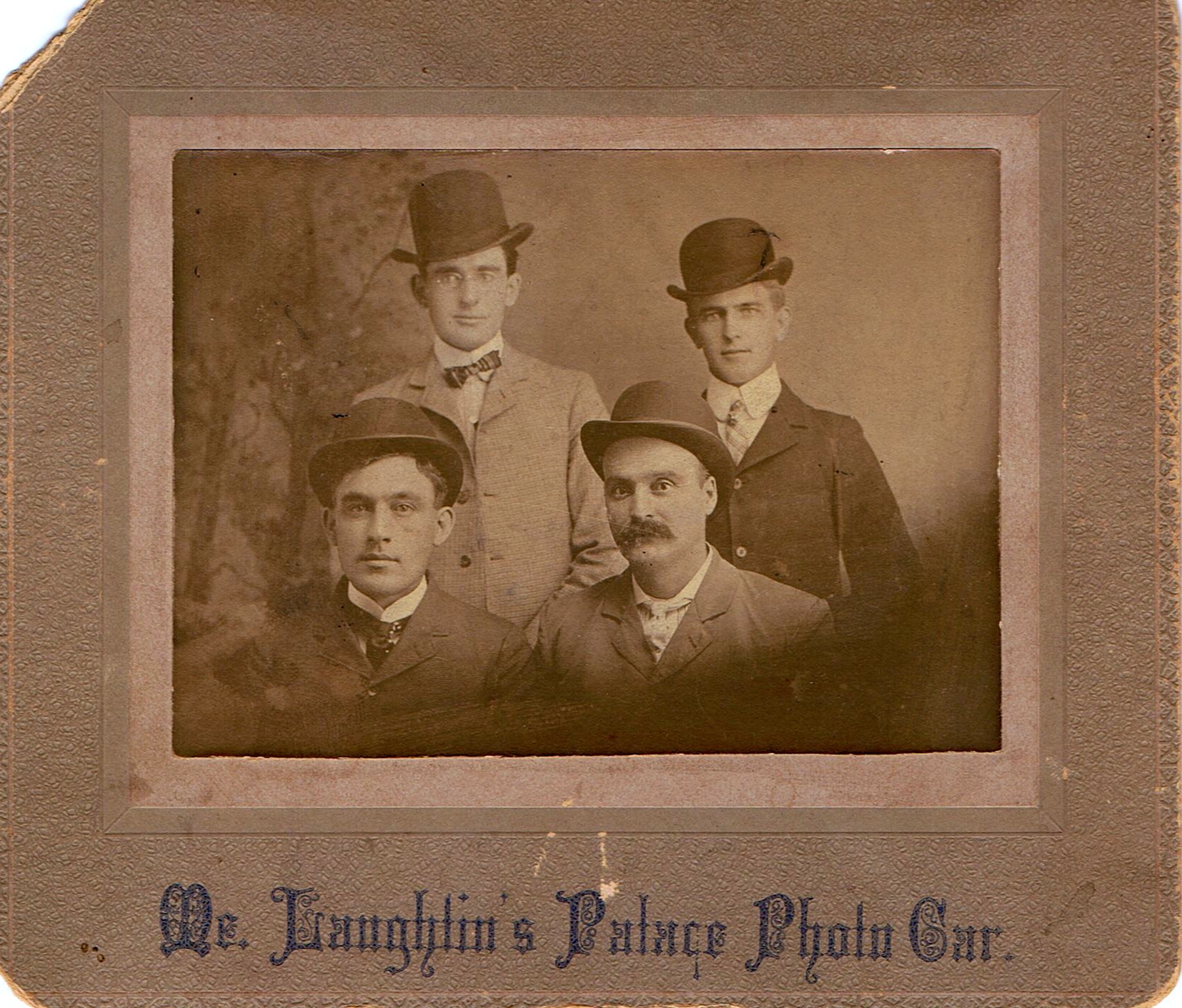
Not all photograph studios were stationary. Your ancestors may have had their photographs taken aboard a boat or even a specially outfitted railroad car, as did this group of gentlemen around the turn of the last century.

GeorgeHiramThoma

George Hiram Thoma a.k.a. George A. Neilson, top right, Iowa or Nebraska, ca. 1900; digital image 2010, privately held by Melanie Frick, 2014.

George Hiram Thoma, also known as George A. Neilson, is the slim, fair-haired young man pictured at top right in this photograph taken aboard Mr. Laughlin’s Palace Photo Car.1 George, born in 1880,2 was raised in Clayton County, Iowa,3 but his exact whereabouts during his late teenage years and early manhood are up for debate. He may have spent some time in Cedar County, Nebraska,6 before winding up in Osceola County, Iowa, where he married in 1902.5 This photograph was likely taken at a train station somewhere in northwestern Iowa or northeastern Nebraska circa 1900.

The men all wear dapper hats, jackets, and ties. The man next to George seems to be the trendsetter of the group with a check or plaid jacket, striped bow tie, eyeglasses, and his soft felt bowler or derby hat at a jaunty angle. The man at front right is the only one who is not clean shaven; he also appears to be somewhat older than the others.

Who were these men, and what were their relationships to one another? None bear a remarkable resemblance to George, with the exception, perhaps, of the man next to him. Perhaps the men were friends or business associates, although thanks to George’s elusive lifestyle prior to his marriage and his use of an alias, much is left to the imagination as to with whom, exactly, he may have associated.

Perhaps somewhere there exists another copy – or three – of this very photograph, taken long ago aboard Mr. Laughlin’s Palace Photo Car.

Continue reading