Tag Archives: World War I

A Yankton County Girl at the 1918 South Dakota State Fair

As the summer of 1918 drew to close, seventeen-year-old Helena Nelson of Yankton County, South Dakota prepared to compete at the South Dakota State Fair as a participant in a local 4-H club.

YANKTON TO SEND CONTESTANTS TO FAIR

Yankton, S.D., Sept. 2.—After a series of contests here, Wilma Gilreath, Elsie Frick, Helena Nelson and Albena Sailer, will represent this county in the state contest at the state fair at Huron in September in the Liberty Food Club. In addition Wilma Gilreath, winner in the food contest, will also be in the canning contest, and will be associated with Lois and Dorothy Gross to make up the team in the canning contest.

Tabor Independent, 05 September 1918

In 1918, Helena was a student at the Southern State Normal School in Springfield, South Dakota. This was not terribly far from her family’s farm in Tabor, west of Yankton, where she had likely spent the summer before the fall semester began. In addition to pitching in on the farm that summer, Helena was also involved with the activities of the Liberty Food Club.

Helena’s older sister, Andrea, wrote in her diary that on the morning of Sunday, 08 September, “About five Jim took Helena on to town, as she was to start by car with Kecks at six for the fair at Huron. The rest of us had a late breakfast.” Helena and her siblings had attended a barn dance hosted in honor of a local soldier on furlough the night before, but that didn’t stop her from hitching a ride from her brother-in-law that morning after only a few hours of sleep! It was time to make her way to the state fair, one hundred and twenty miles to the north.
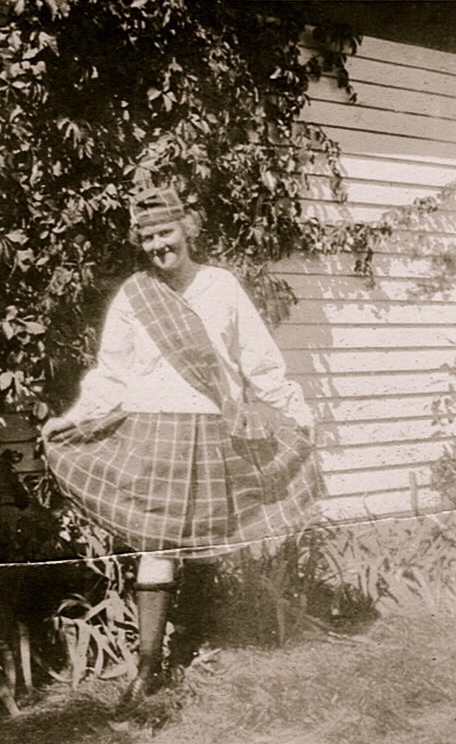
Helena Margaret Nelson photograph, circa 1918, Yankton County, South Dakota; digital image 2010, privately held by Melanie Frick, 2023. Based on family recollections, it is possible, but unconfirmed, that Helena is pictured here wearing a “uniform” of the Liberty Food Club.

The South Dakota State Fair, which dates to 1885, first introduced activities for youth in 1915 when a Boys State Fair Camp was held. Delegates were judged on their agricultural skills in regards to crops and livestock. The first Girls State Fair Camp took place in 1918, and included both food canning demonstrations and Liberty Food Clubs.

Liberty Food Clubs were a wartime invention and encouraged participants to assist with the war effort. An official bulletin of the United States government stated, “In order to become a member of this club each boy and girl enrolled in club work must sign a card pledging himself or herself, through food production and food conservation, to help win the war and world peace.”

While it is not known exactly what their exhibit or presentation may have entailed, the Yankton County girls did walk away as the winners of their event at the South Dakota State Fair. The Daily Argus-Leader of Sioux Falls reported, “Nearly a hundred valuable prizes were won by members of South Dakota boys’ and girls’ clubs in the final contests of the year at the state fair.” The different competition classes, aside from Liberty Food, included Pig Club, Baby Beef, Sheep, Stock Judging, Canning, and Sewing. Of Liberty Food, it was noted, “First, Yankton, State banner. Team Wilma Gilreath, Elsie Frick and Helena Nelson, all of Yankton. Second, Hughes county team, Alma Swanson Harrold, Ina Putnam Oahe, and Janice Lantz, Pierre.” One source suggests that twenty-four Liberty Food teams had competed in all.

Members of the Liberty Food Club who had successfully completed the work of the club for the entire year were to be given a diploma of achievement, but it is unknown whether Helena received such an honor. Not long after the South Dakota State Fair, Spanish Influenza struck her community and within a few short months she ultimately lost both her father and her sister Andrea. This was a tumultuous time for the Nelson family, especially as Helena’s older brother Ole was still away at war, and it seems very likely that any extracurricular endeavors would have fallen by the wayside.

The following year, the Boys State Fair Camp and Girls State Fair Camp became more formally known as 4-H clubs under the oversight of the State College Extension Service. World War I had come to a close, and Helena herself had completed her studies and become a country school teacher.

Copyright © 2023 Melanie Frick. All Rights Reserved.

Continue reading
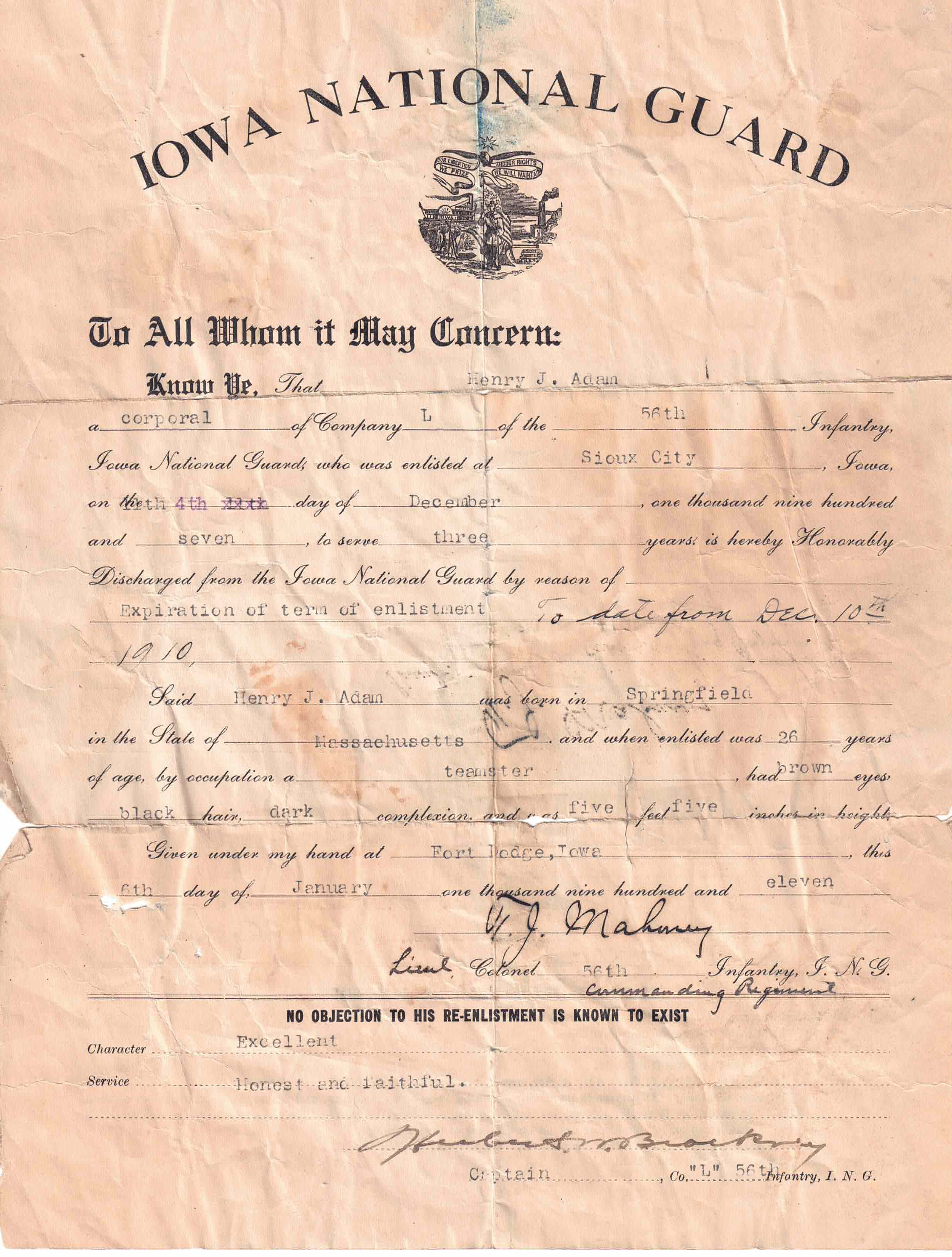
An Iowa National Guardsman

Henry Joseph Adam of Sioux City, Woodbury County, Iowa, was twenty-six years old when he enlisted in the Iowa National Guard in December 1907. He enlisted for a term of three years with Company L of the 56th Infantry, and received an honorable discharge when his term was complete. His character was noted to be “excellent” and his service “honest and faithful.”

Iowa National Guard Certificate for Henry Joseph Adam, Sioux City, Iowa, 1911; digital image 2021, privately held by Melanie Frick, 2021.

In December 1917, ten years after he had first enlisted with the Iowa National Guard, Henry enlisted once again, this time with Company D of the 4th Infantry. The United States had entered the “Great War” in April of that year, and by June the first draft registration was underway. Henry, now thirty-six, was not included in this first draft (which was limited to men between the ages of twenty-one and thirty-one), but perhaps he saw the writing on the wall and considered that service with the National Guard might put him in a better position than if he were to wait to be eventually drafted. In July 1918, he was appointed corporal, but soon thereafter his trajectory was altered.

Henry Joseph Adam, Sioux City, Iowa, ca. 1918; digital image 2010, privately held by Melanie Frick, 2021.

Henry, a carpenter, relocated to Portsmouth, Virginia, where he became an employee of the George Leary Construction Company at the Norfolk Navy Yard. He commenced work on 01 September 1918, and on 12 September, when the third draft registration, for men between the ages of eighteen and forty-five, was initiated, he dutifully completed his registration. He was called home to Iowa in late September when, tragically, his five-year-old son succumbed to extensive burns received when he fell into a fire. It could not have been easy for Henry to bid farewell to his wife and surviving son, who was ten years old, to return to the shipyards once again.

In late October, Henry became an employee of the United States government, assisting in the construction of a power plant at the Norfolk Navy Yard. It was on these grounds, as a skilled laborer in a necessary industrial occupation, that he completed a questionnaire claiming deferred classification of military duties. His work entailed building concrete forms; he stated that he had four years of specific experience, and six years of additional general experience. His daily wages amounted to eight dollars and twenty-five cents, and he was the sole supporter of his wife and child.

The questionnaire was signed and dated on 05 November 1918—less than one week before armistice would occur, marking the conclusion of the war on the eleventh hour of the eleventh day of the eleventh month. Perhaps Henry’s questionnaire was never even submitted, or was returned to him in short order, which might explain how it ended up among other assorted family papers and survived for more than a century.

I have no record of when Henry’s employment at the Norfolk Navy Yard nor his service with the Iowa National Guard formally concluded. However, Henry would continue to apply his carpentry skills in the service of the government periodically throughout the rest of his life. During the Great Depression, he found employment with the Works Progress Administration, and during World War II, he was employed at a United States Air Force base near Sioux City before temporarily relocating to Portland, Oregon, where he once again became an essential worker in the shipyards.


Copyright © 2021 Melanie Frick. All Rights Reserved.


SOURCES

Iowa National Guard Certificate, Henry Joseph Adam, Sioux City, Iowa, 06 January 1911; Adam Family; privately held by Melanie Frick, 2021.

Military Deferment Questionnaire, Form 1001, Office of the Provost Marshall General, for Henry Joseph Adam, Portsmouth, Virginia, 05 November 1918; Adam Family; privately held by Melanie Frick, 2021.

“World War I Draft Registration Cards, 1917-1918,” digital images, Ancestry.com (http://www.ancestry.com : accessed 25 April 2021), card for Henry Joseph Adam, Sioux City, Woodbury County, Iowa; citing World War I Selective Service System Draft Registration Cards, 1917-1918, National Archives microfilm publication M1509; imaged from Family History Library film roll 1,643,352.

“Henry J. Adam” in Lasher, Louis G., Report of the Adjutant General of Iowa: For the Biennial Period Ended June 30, 1920 (Des Moines: The State of Iowa, 1920), 125; from “U.S., Adjutant General Military Records, 1631-1976,” Ancestry.com (http://www.ancestry.com : accessed 25 April 2021).