Author Archives: Melanie Frick

Unknown's avatar

About Melanie Frick

Melanie Frick, MLS, holds a Certificate in Genealogical Research and has been researching her family history for two decades. An Iowa native with Midwestern roots, she lives in the Pacific Northwest.

Military Monday: “Although he was on his Dieing Bed”

Compiled service record, John Fenton, Pvt. Co. M, 3 Illinois Inf.; Carded Records, Volunteer Organizations, Civil War; Records of the Adjutant General’s Office, 1780s-1917, Record Group 94; National Archives, Washington, D.C. Color edited for clarity.

Compiled service record, John Fenton, Pvt. Co. M, 3 Illinois Inf.; Carded Records, Volunteer Organizations, Civil War; Records of the Adjutant General’s Office, 1780s-1917, Record Group 94; National Archives, Washington, D.C. Image color edited for clarity.

As spring turned to summer in the year 1862, John Fenton of Company M of the 3rd Illinois U.S. Cavalry lay dying in a hospital bed in Lebanon, Laclede County, Missouri. He had enlisted the previous autumn, eager to do his part for the Union, but in April, following the Battle of Pea Ridge in Arkansas, he was hospitalized with typhoid pneumonia.1

At the time of his enlistment, John, a native of Bole, Nottinghamshire, England, was a widower with four children at home in Pana, Christian County, Illinois.2 After his death on 7 June 1862, A. W. Bingham, a hospital steward, penned a sympathetic but hurried letter to John’s eldest daughter, Sarah Alice Fenton, informing her of her father’s passing:3

“Lebanon, MO
June 7th 1862

Miss Fenton

You will be of course Serprised in Receiving a letter from one that never beheld your face or eaven had the honor of knowing your nam but through one that is or has been Dear to you your Father, he was admitted in this Hospital on the 22d day of April Sinse then he has been leaberin under Tyford Pneumonia which at last terminated in his death, which was at 7 Oclock this evening June the 7th he was a long time dieing and told me he wished me to write to you and all for him to put your confidence in christ and he hoped to meet you in the world to come he talked of and would of liked very much to see you but when god comes there is no alternative but to resign our will so he done so and diese in piece, you must not take it hard for we as soldiers have no limited time for our lives and when we enlist in our Countrys call we make up our mind to meet death when god thinks proper to call us away, your Father requests me to tell you also to collect what money was due him and put it to as good use as you thought people he wished you to see to the small children and bring them up in his fear and love of God which no doubt you will and he felt satisfyed you would do so, remembering he was your Father although he was on his dieing bed.

Continue reading

An Iowa Homestead

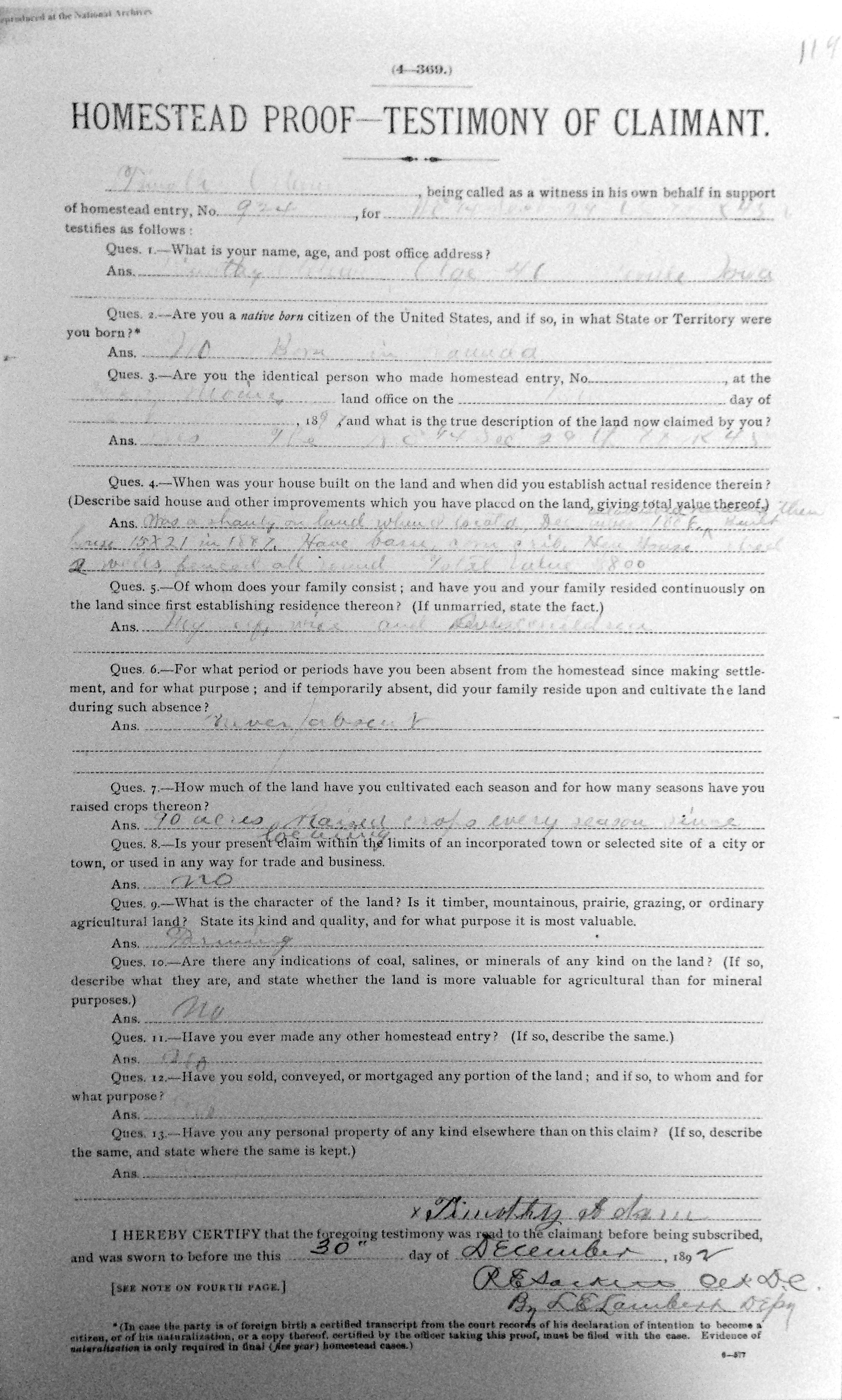
Winter was well on its way when Timothy Adam claimed a homestead near Moville, Woodbury County, Iowa, in December 1886. At that time, only a claim shanty existed on the property.1 I have to wonder if Timothy weathered the winter alone, with his wife and children situated somewhere in town, or if they joined him in what certainly must have been far from ideal living conditions. In any case, the next year, Timothy built a house that measured fifteen by twenty-one feet – three hundred and fifteen square feet for a family of six.2

IMG_3179

Timothy Adam (Woodbury County) homestead file, final certificate no. 2560, Fort Des Moines, Iowa, Land Office; Land Entry Papers, 1800-1908; Records of the Bureau of Land Management, Record Group 49; National Archives, Washington, D.C.

The Homestead Act was signed by President Abraham Lincoln on 20 May 1862.3 My first ancestor who took advantage of the one hundred and sixty acres offered to qualified applicants who lived on the land for five years and made specified improvements was Jens Madsen Schmidt, a Danish immigrant who settled in South Dakota in 1870.4 I had assumed that any ancestors who claimed homesteads in the years to follow would have had to journey even further west to find available land, but as it turns out, this was not necessarily the case. It would be sixteen years before Timothy would claim his homestead to the east, in northwestern Iowa.

The new yet modest house must have seemed positively roomy in comparison to the original shanty, and perhaps it was an improvement over what may have been an even more crowded situation back in Massachusetts. Timothy had been born and raised in St. Pie, Quebec, but by the time he was twenty, he had settled in Indian Orchard, Hampden County, Massachusetts, with his wife, Odile Millette.4 For nearly two decades, they relied on the cotton mills to earn a living, although Timothy was a carpenter by trade.5 Life in Massachusetts was likely difficult; Odile reportedly gave birth to ten children, of whom only five survived to adulthood.6 At least one succumbed to scarlet fever.7

Life in Iowa proved to be a fresh start for the family. Within a few years, the homestead boasted a barn, corn crib, hen house, shed, two wells, and fencing, valued altogether at eight hundred dollars. Timothy had cultivated ninety acres, and had raised crops every season. In addition, he had become a naturalized citizen. Finally, in 1893, at the age of forty-five, Timothy Adam became the proud owner of the NE 1/4 of Section 29, Township 88N, Range 45W in Woodbury County, Iowa.8

Continue reading

A Slumber Party at “The Bee Hive”

SCAN0854

    The Bee Hive, Yankton County, South Dakota, ca. 1918; digital image 2014, privately held by [personal information withheld].

The Bee Hive, Yankton County, South Dakota, ca. 1918; digital image 2014, privately held by [personal information withheld].

Slumber parties, as it turns out, have a long history among teenage girls. The caption, “They look happy don’t they? No wonder for they are just going home from a slumber party at ‘The Bee Hive,'” is penned on the back of this South Dakota snapshot, dated circa 1918.

In the photograph, a gaggle of girls crowds together on the porch of a clapboard building, located in or near Yankton County, South Dakota. All are dressed informally in simple cotton dresses. Several wear sailor-style neckerchiefs, a nod to the ongoing war abroad, and one dons a cap. Their short sleeves suggest warm weather; in southeastern South Dakota, this may have been anytime from May through September. Two squirming kittens can be spotted on the girls’ laps as they all lean together, their eyes on the camera.

From left to right sit Helena Nelson, Marguerite Miller, Andrea Nelson, Louise Nelson, Edith Nelson, and Mary Nelson. Helena, Andrea, Louise, and Mary were sisters; Edith was their cousin, and Marguerite was a close friend and neighbor in Township 93, near present-day Tabor. At some point, all attended the Southern State Normal School in nearby Springfield, where they gained the credentials needed to teach at the local country schools.1

What, exactly, was the Bee Hive? In September 1918, Andrea Nelson wrote in her diary that, following a barn dance held in honor of a local soldier home on furlough, “Jim, Anne, little ones, Helena, Mary, and I stayed at the Beehive from three till morning.” Although Andrea’s guest list indicated that all present in the photograph were guests at this particular dance, it must not have been the same occasion, as, “About five Jim took Helena on to town, as she was to start by car with Kecks at six for the fair at Huron. The rest of us had a late breakfast. Then went to church.”2

She made one more mention of the Bee Hive in her diary when, several weeks later, she wrote, “Julia called up from Yankton after school. She said that a lady would be at the Beehive tomorrow night to demonstrate the preparation of sugar beets. She wanted us to come up.”3 This suggests to me that the Bee Hive may not merely have been a clever nickname for a friend’s home, but may actually have been a sort of social club or church-based organization – a place where one might stay the night but also take part in educational programs. I wonder if any locals still recall the name.

This photograph most likely dates to the summer of 1918. Mary, the youngest of the girls, pictured at far right, was fourteen that summer,4 and although her skirts still seem a tad shorter than those of the others, her hair is in the same style of twist as that of her seventeen-year-old sister, Helena.5 Andrea, the eldest at twenty-one, died unexpectedly late that year.6 This photograph was likely tucked away as a memento of a happy time when all were together for a lighthearted slumber party.

Continue reading

2014 NGS Family History Conference

IMG_3043My lack of recent updates can be explained by the fact that the 2014 NGS Family History Conference was held last week in Richmond, Virginia. This was my second time attending a conference sponsored by the National Genealogical Society, and it was just as much fun as the first! I stayed at the historic Linden Row Inn in downtown Richmond, within walking distance of the conference center, the Library of Virginia, and the Richmond Public Library, and I made it to more than a dozen lectures, spent some quality time in the exhibit hall, attended a celebration of fifty years of genealogical credentialing, and met with old friends and new. I even Tweeted a bit!

IMG_3031Some highlights included lectures by Elizabeth Shown Mills, who always provides inspiration for creative ways to look at records in order to break through perceived “brick walls,” and Tom Jones, who had everyone in the audience laughing at his anecdote about tracking down county court records in a small Midwestern town. I also attended several helpful sessions on specific research topics, including tax records, slave claims, and German genealogy. Warren Bittner did the impossible by making the Meyers Gazetteer seem (almost) easy to decipher, which instigated a mad dash to the exhibit hall to purchase the guidebook that he recommended. The exhibit hall is also where I was able to peruse a sample application portfolio to the Board for Certification of Genealogists, following a helpful lecture about the intensive, but worthwhile, application process.

IMG_3027I made sure to catch a lecture by Maureen Taylor, “The Photo Detective.” Anyone who follows my blog will know how much I love analyzing antique photographs, so it was interesting to hear her speak about “Photo Identification 101” and to see some of the more outlandish fashions of the mid-nineteenth century. Maureen authored the book The Last Muster: Images of the Revolutionary War Generation, and she and contributor David Allen Lambert were kind enough to autograph my copy.

NGGN_Richmond_2014Good times were also had with the other conference attendees, whether making new friends at mealtimes and in the lecture halls, catching up with a former grad school classmate, or meeting with several of my fellow board members and supporters of the NextGen Genealogy Network. All in all, it was a jam-packed week of genealogy fun, learning, and connecting – well worth the jet lag!

‘Round the Maypole

Helen Nelson was a student at the rural Southern State Normal School in Springfield, Bon Homme County, South Dakota, or perhaps a recent graduate, when she pasted this series of photographs in her scrapbook.1 A group of young girls dance ’round a Maypole twined with ribbons, certainly in celebration of the first of May. They were likely students at a local one-room schoolhouse, perhaps from a teaching assignment near Helen’s home in Yankton County, South Dakota, or from the “practice school” near Springfield.2

Raising a Maypole for a May Day celebration seems just the type of thing that an enthusiastic young teacher would have arranged to brighten a typical school day. Andrea Nelson, Helen’s elder sister, wrote in her diary of spontaneous recess games such as “Pump Pump Pull Away,” as well as moving class outdoors in good weather.3 This Maypole must have been a planned affair; the ten or so girls, ranging in age from perhaps six to twelve, seem to be dressed in their best summer dresses, with most in white or pastels. Several wear bows in their hair as well as sashes at their waists. In the final photograph, they bow to each other as their dance concludes.

Although this celebration took place near 1920, Maypoles were certainly nothing new. The American Girls Handy Book, originally published in 1887, mentions the ancient origins of the day and gives the following instructions for a Maypole dance:

“An even number of persons are required for this dance; half the number take the end of a ribbon in the right hand and half in the left; they then stand facing alternately right and left. When the dance commences, each dancer facing the right passes under the ribbon held by the one opposite facing the left; she then allows the next person going to the left to pass under her ribbon, and so, tripping in and out, under and over, the ribbons are woven around the pole.”4

The dance goes on, including variations to weave the ribbons together, and all the while, according to the Handybook, “An appropriate song, with words set to a dancing air, should be sung by those taking part in the May-pole dance.”5

Continue reading

A Prayer Book from Home

Before Joseph Lutz left his home village, he carefully inscribed his name inside a leather-bound prayer book, small enough to be tucked inside a coat pocket. “This book belongs to me, Joseph Lutz of Sondersdorf,” he penned in French. The book, however, was printed in German; Joseph spoke both languages, having grown up in an area that was the subject of dispute between France and Germany.1

Joseph_Lutz_Prayer_Book_01

Joseph Lutz prayer book, Adam Family Collection; privately held by Brian Adam (personal information withheld), 2014.

Joseph Lutz of Sondersdorf, Haut Rhin, Alsace, France, the son of François Joseph and Marguerite (Meister) Lutz, was baptized on 31 May 1844.2 He left his homeland following  the Franco-Prussian War of 1870-1871. It was said that he had been injured during his time of service, which may have limited his opportunities for occupation, and, furthermore, he did not wish to live under Prussian rule.3 Thus, like many of his relatives, he set his sights on Minnesota.

Once settled, Joseph may have read from his prayer book with his wife, a Polish immigrant who also spoke German, as they began their life together.4 Perhaps it inspired his generosity during his career as a butcher, when he was said to have provided gifts of meat to struggling immigrants. When he later became a saloon keeper, it may have given him the strength to avoid the temptation of alcohol, a quality appreciated by his wife.5 Perhaps the prayer book brought him peace as he suffered from tuberculosis, an illness that claimed his life on 3 May 1887 when he was forty-two years old.6

Joseph_Lutz

Joseph Lutz prayer book, Adam Family Collection; privately held by Brian Adam (personal information withheld), 2014.

Joseph was said to have been buried in Danville, Blue Earth County, Minnesota, and though a wooden cross once marked his grave, it is no more.7 His well-worn prayer book was passed down to his daughters, who kept his tintype – his only known photograph – tucked inside to ensure its safety. These items may have been their sole mementos of their father, a slim man with a handlebar mustache, a Catholic, a veteran, and a businessman who hailed from the border of France and Switzerland.

Continue reading

The Country Store: Family Groceries, the Best of Brandy, and Excellent Beer

The Bavarian William Henry Thoma of Garnavillo, Clayton County, Iowa, was a businessman by the age of thirty.1 In 1859, the Clayton County Journal reported:

“William Thoma, Grocer, Main Street, Garnavillo, Iowa, keeps constantly on hand all kinds of family groceries, such as Coffee, Sugar, Tea, Milasses, ice, &c. The best of Brandy and excellent Beer is also always to be found at this establishment.”2

William must have found success as a grocer and purveyor of alcoholic beverages, as his business was apparently in operation for at least two decades. He was named a merchant in the 1860 census,3 and in the 1870 census it was noted that he was the keeper of a “country store.”4 This must have allowed him to provide a comfortable lifestyle for his wife and eleven children; in 1870, he owned real estate valued at $12,000 and personal estate valued at $3,000.5

William_Thoma_1870

1870 U.S. census, Clayton County, Iowa, population schedule, Garnavillo, p. 13 (penned), dwelling 87, family 86, Wm Toma; digital image, Ancestry.com (http://www.ancestry.com : accessed 16 April 2014), citing National Archives microfilm M593, roll 383.

After William’s death in the summer of 1876,6 his widow, Anna Margaretha (Poesch) Thoma, with a handful of young children still at home, took over as merchant. She maintained the business for a number of years, while her eldest son assisted as a clerk in the store.7

I like to wonder whether William’s store was anything like that featured at Iowa’s Living History Farms, which boasts the fictional 1875 Town of Walnut Hill. Images of the picturesque Greteman Brothers General Store can be seen here. It’s well worth a visit if you find yourself in central Iowa and have ever wondered what life was like for your Midwestern ancestors in the years following the Civil War. The impact of the Industrial Revolution on rural communities is visible, although, according to the Living History Farms, “The railroad will always be a few years away for Walnut Hill.”8

Of course, I also have to wonder whether William and Anna Margaretha (Poesch) Thoma were anything like Nels and Harriet Oleson of Little House on the Prairie. Let’s just hope that their children weren’t as spoiled as the infamous Nellie and Willie!

Continue reading

A Little French Boy

An American by birth, Henry Joseph Adam spoke French until he started school.1 He was born in Indian Orchard, Hampden County, Massachusetts, on 5 August 1881, the son of Timothy and Odile (Millette) Adam, both of French Canadian heritage.2 His father had been born in Quebec, while his mother had been born in upstate New York.3 Regardless of their nationality, their roots ran deep, and the French language likely remained more familiar to them than English.

Henry_Joseph_Adam_1886

Henry Joseph Adam, Sioux City, Woodbury County, Iowa, ca. 1886-87; digital image 2013, privately held by Melanie Frick, 2014.

Pictured here circa 1886-87, when he was about five years old, Henry is simply but neatly dressed. He wears breeches with high patterned stockings, and a white or light-colored shirt with a contrasting bow-tie. His boots, perhaps hand-me-downs from an older brother, have been polished till they shine. He may hold a cap in his left hand, although it is indistinct due to the quality of this tintype. Despite the fact that cabinet cards grew in popularity during this decade, tintypes were still certainly not unusual. The faintest blush of pink is visible on Henry’s cheeks from a painted accent.

The studio setup is interesting and not particularly professional. Henry stands upon a small stool, and leans against a piece of furniture covered with heavy fabric. The painted backdrop behind him depicts a scene of a house, fields, and a tree, which doesn’t tie in well with the wood floor in the foreground. I suspect that this photograph may have been taken in Sioux City, Woodbury County, Iowa; the Adam family moved here sometime in the mid-1880s, perhaps because of its proximity to the large French Canadian community in nearby Jefferson, Union County, South Dakota.4 Thus, this little French boy remained in good company; he may have learned English at school, but he would not have forgotten his French!

Continue reading

An Iowa Teacher’s Report to Parents, 1925

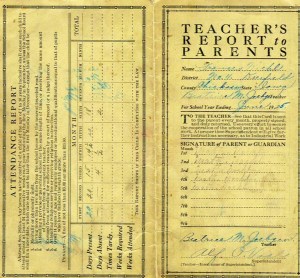
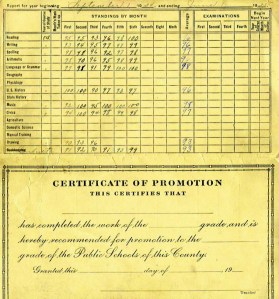
The first of June 1925 was an important day for Frances Marie Noehl of Deerfield, Chickasaw County, Iowa. She completed the eighth grade in District No. 11 with flying colors, even rallying over the course of the year to bring up her lagging grade in conduct.1 However, although she was a successful student, with high average marks equivalent to straight A’s, she would not go on to graduate from high school.2

ReportCard1

Frances Noehl, Teacher’s Report to Parents, 1925, Deerfield, Iowa; digital image 2003, privately held by V. P. [personal information withheld], 2014.

Frances was the eighth of nine children born to Matthias and Elizabeth (Hoffman) Noehl, German immigrants who farmed in northeastern Iowa.3 Once her schooling was completed, Frances was needed at home, although her father did prize education. In his memoirs, he wrote of his schooldays in Germany, “I entered into the arena, and took it up not only with the alphabet, but with all my classmates. As at that time there was no special talent in our school of eighty-four pupils, I succeeded in taking the first place among all the boys.”4 His education concluded at the age of fourteen, but he was pleased to be allowed to keep his books, writing tablet, slate, and pencil.5 Perhaps he had once dreamed that his children would be fortunate enough to further their educations, but, at least in the case of his youngest daughter, that dream was unfulfilled.

During the course of her eighth grade year, Frances was instructed by Miss Beatrice Joebgen, a local teacher who was still a teenager herself.6 Frances was graded in Reading, Writing, Spelling, Arithmetic, Grammar, U.S. History, Music, Civics, Drawing, and Conduct, with all of her marks falling between 90 and 100 and her averages between 93 and 98. Her father’s signature was recorded on her report card at the end of each term.7

ReportCard2

Frances Noehl, Teacher’s Report to Parents, 1925, Deerfield, Iowa; digital image 2003, privately held by V. P. [personal information withheld], 2014.

Attendance rules for the time indicate that Frances would not have been required to complete additional schooling, as she had fulfilled the educational qualifications of an eighth grade pupil. Other reasons for exemption from public schooling included being mentally or physically unfit, living more than two miles from the school house by the nearest traveled road, or attending a private or parochial school, receiving instruction from a competent teacher, court order, religious instruction, or regular employment for one over the age of fourteen.8

Although Frances may have liked very much to have had the opportunity to graduate from high school, duty to her family, it seems, kept her at home.

Continue reading

The Three Amigos

Fred_Nelson_Seven_Falls_01

Peter Jorgensen, Fred Nelson, and Chris Callesen, Seven Falls, South Cheyenne Canon, Colorado; digital image 2014, privately held by [personal information withheld], 2014.

This souvenir photograph features three mustachioed men in sombreros posing astride burros in front of a rugged western landscape. In 1911, Peter Jorgensen, Fred Nelson, and Chris Callesen of Yankton County, South Dakota, pictured here from left to right, ventured west to Seven Falls in the South Cheyenne Canon near Colorado Springs, El Paso County, Colorado. I can’t know for sure what brought them west; I do know that, decades earlier, brothers-in-law Fred and Chris had traveled at least as far as the Black Hills to sell eggs to the miners.1 It’s possible that this trip to Colorado, however, was purely an opportunity for sightseeing and adventure, rather than business.

Fred_Nelson_Seven_Falls_02The reverse side of the photograph, mounted on heavy card stock, provides printed detail about the South Cheyenne Canon, famed for its natural beauty and sites of historical interest. The Seven Falls Photo & Curio Co. was responsible for this photograph, which was “taken at the foot of the famous Seven Falls.” It was possible to order duplicates by referencing the number shown on the photograph. (The number on the mat came only recently.) Given the number 716, it seems that plenty of these souvenir photographs must exist; I spotted several on eBay and on The Henry Ford Online Collection.

Did the men ride to the Falls on the burros? As of 1911, there was, in fact, a Cheyenne Burro & Carriage Co. in operation,2 so if they weren’t part of the package when the men paid for their photograph, they may have opted to rent the burros independently to ease their exploration of the area – or just for fun. The same may go for their sombreros!

Continue reading