Author Archives: Melanie Frick

Unknown's avatar

About Melanie Frick

Melanie Frick, MLS, holds a Certificate in Genealogical Research and has been researching her family history for two decades. An Iowa native with Midwestern roots, she lives in the Pacific Northwest.

Fashionable Winter Wear

SwedishAlbumSiouxCityCouple1889

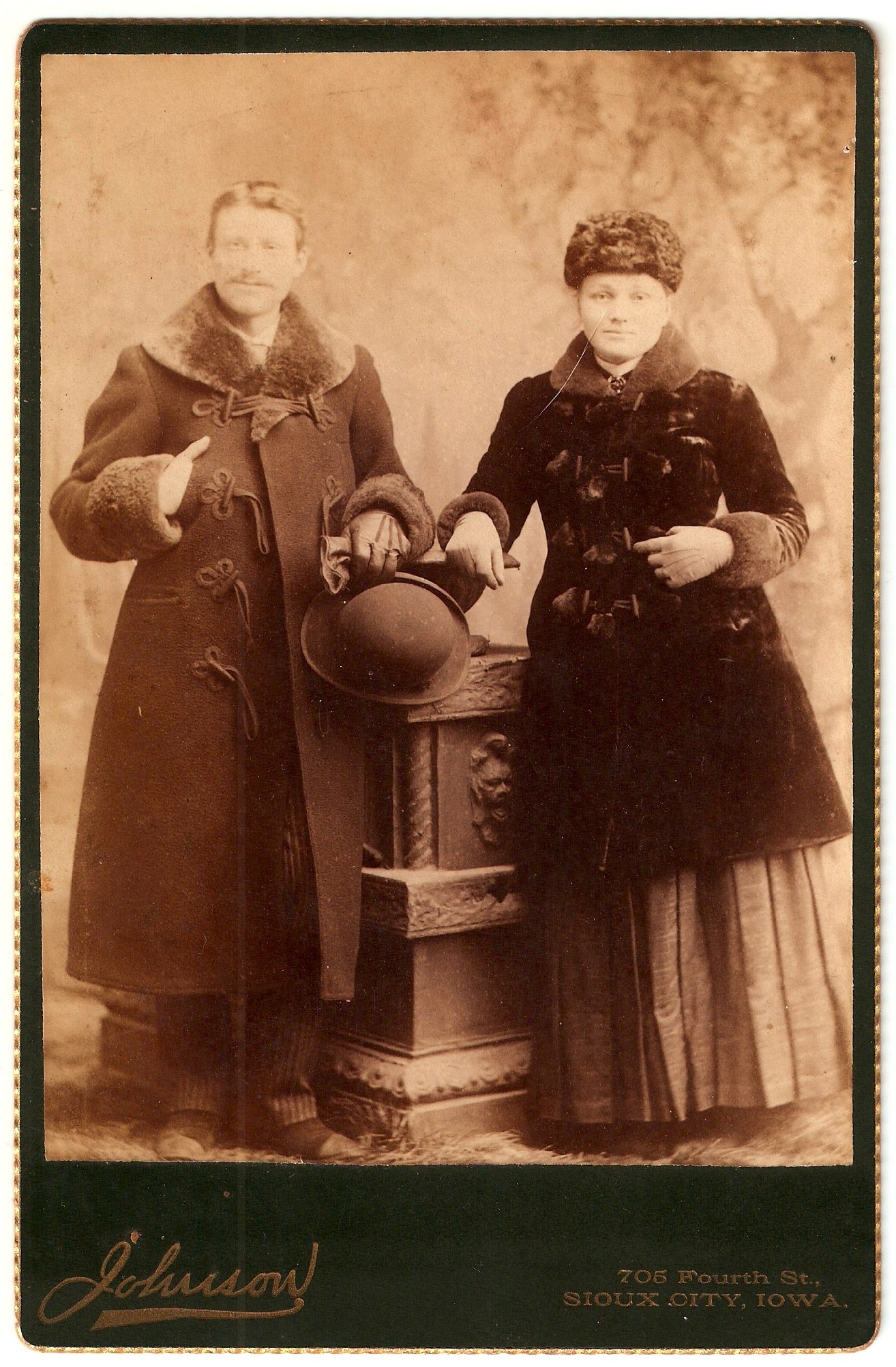
Unidentified couple in winter attire, Sioux City, Woodbury County, Iowa, ca. 1889; digital image 2014, privately held by Melanie Frick, 2014.

This Valentine’s Day, perhaps you’re looking forward to a special outing with a loved one. You might dress up, or you might bundle up, depending on the temperature outside. In any case, you likely won’t be decked out in fashionable furs like this couple, who dressed for the winter weather in Sioux City, Woodbury County, Iowa circa 1889. This cabinet card photograph comes from an unidentified antique album featuring a family of Swedish immigrants.1 The photographer – J. E. Johnson of 705 Fourth Street in Sioux City – operated his studio from at least 1887-1891.2

A newspaper column in a nearby community in South Dakota reported in 1888, “It is a lively competition between the comparatively old-fashioned sealskin cloaks and the newer, more picturesque wraps that reach to the ground.”3 The unidentified woman pictured here wears a toggle-fastened coat with a fur collar and cuffs, and she sports a striking fur cap that immediately made me think of one worn by Laura Ingalls Wilder in a photograph taken in the latter half of the 1880s. Her outfit is completed by a pair of fitted gloves, and a pleated skirt extends below the hemline of her coat.

The unidentified man wears a toggle-fastened overcoat of heavy cloth that reaches below the knee, also trimmed with a fur collar and cuffs. He tucks a bare hand into a pocket; the other grasps the spare glove and his bowler hat. Visible beneath his coat are distinctive striped pants. While flipping through Joan Severa’s Dressed for the Photographer, an excellent reference for dating nineteenth century photographs, I spotted an example of another young man wearing striped pants in a photograph dated 1889. In fact, he leaned against what appeared to be the very same pedestal. As it turned out, it was. The photograph of a young man in striped pants featured in Dressed for the Photographer was also taken at the Johnson studio in Sioux City.4 Apparently, striped pants were at their peak in popularity at this time!

The couple pictured here seem relatively young, and perhaps were recently married. If they, like others in this album, were Swedish immigrants, they may have shared copies of this photograph with family members who remained in the old country. Even if they weren’t dressed for a date in the modern sense of the term, they certainly look prepared to take a romantic stroll downtown!

Continue reading

Tombstone Tuesday: Johanne Marie Larsen

Johanne Marie (Larsen) Walsted of Aalborg, Denmark was sixty-three years old when she immigrated to America in the spring of 1900.1 She traveled alone; her husband of thirty-two years had passed away the year before,2 and most of her children had already left Denmark for brighter opportunities in Iowa and Wisconsin. They had paid for her passage aboard the Norge, and she carried fifteen dollars.3

GracelandCemeteryJohannaWalstedGrave

Grave of Johanna M. Walsted, 1836-1914, Graceland Cemetery, Sioux City, Woodbury County, Iowa; image date 2001, privately held by Melanie Frick.

Johanne was christened on 28 September 1836 in Bolle, Nordjylland, Denmark, the daughter of Lars Jensen Bak and Ane Cathrine Christensdatter.4 At the age of thirty, she married Christian Jens Jacobsen Walsted,5 a widower with two young children, Jens Jacob and Lars Marinus Walsted. The couple went on to have seven more children together: Jensine Kathrine, Eskild, Lars Peter, Mandrup, Anna Kathrine, Ellen Eskelline, and Jens Jacob Walsted.6 All but two of the children, the elder Jens Jacob and Eskild, survived to adulthood.7 Christian was a shoemaker, and eventually moved with his family from rural Dronninglund to the city of Aalborg,8 where he died in 1899.9

By the time Johanne made her journey to America, six of her seven surviving children and step-children awaited her arrival. Only her youngest son remained in Denmark; he was to follow two years later.10 In the years to come, Johanne moved between the homes of her children, some of whom she hadn’t seen in more than a decade. She was enumerated in the 1900 U.S. census less than two months after her arrival in the country, at which time she resided with a daughter in Iowa;11 she later joined another daughter in Oklahoma City.12

Johanne’s health may have been poor in her later years; a notation on the ship manifest suggests that she had a deformity of some kind,13 and her death record stated that she suffered from senility.14 Johanne Marie (Larsen) Walsted died at the age of seventy-eight on 3 November 1914 in Sioux City, Woodbury County, Iowa. Services were held at the Danish Lutheran Church, and she was buried at Graceland Cemetery.14

Continue reading

A Chicago Couple

FredWieseEmmaStube

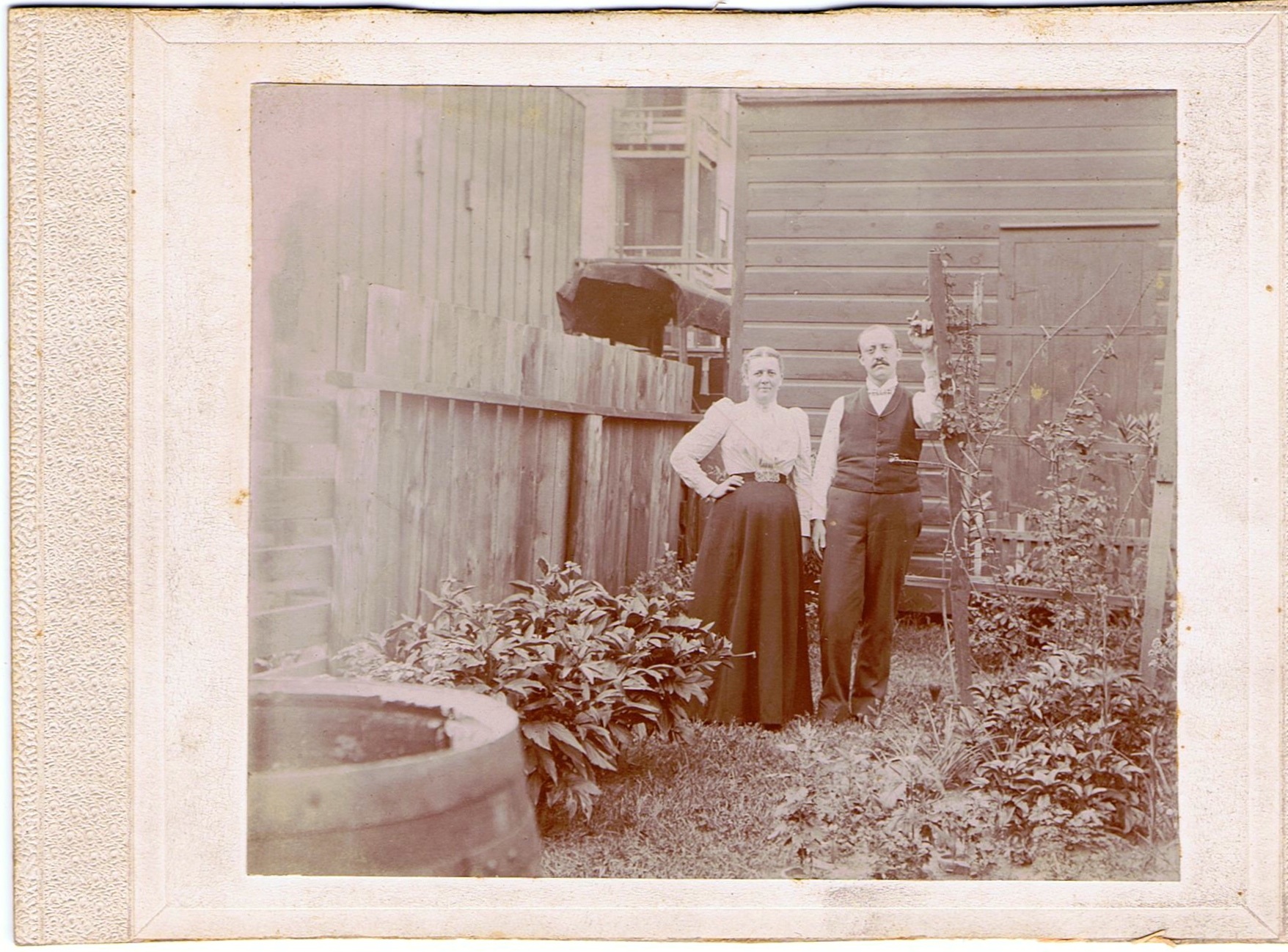
Fred and Emma (Stube) Wiese, ca. 1900; digital image 2010, privately held by Melanie Frick, 2014.

This glimpse into a backyard garden at the turn of the twentieth century features Fred and Emma (Stube) Wiese of Chicago, Cook County, Illinois. Fred rests his hand on a trellis while Emma stands close by his side, her hand on her hip. Their arms barely brush together as they gaze directly at the camera.

Emma wears everyday attire in the form of a simple dark skirt and a collared shirtwaist. Her skirt is belted high, with an adornment of some kind at the center of the waistband. It looks to me like she could have been pregnant at the time that this photograph was taken, which seems entirely possible as she was pregnant no less than five times between 1887 and 1900.1

However, Emma’s sleeves are not nearly as full as those seen during much of the 1890s, nor are they as tight as those of the decade prior. Perhaps this suggests that the photograph dates closer to 1900,2 which is when her youngest child was born.3 She and her husband were both in their early thirties at this time, and I don’t feel that they could have been significantly younger in this photograph.4

Fred wears somewhat loose trousers and a collared shirt, set off by a buttoned vest and a checked bow tie. Most notably, he sports a full mustache, and what hair he has is cut short. With the exception of his pants, which typically would be more fitted, this, too, fits the time period.5

The photograph, pasted on an embossed white card, is clear and of good quality, despite the fact that it is a seemingly casual shot. Might it have been taken by a traveling photographer who passed through the neighborhood, offering his services? Fred and Emma are not dressed in their best, although their simple attire was certainly presentable enough for a photograph. Perhaps their urban garden was a source of pride, making it an ideal spot for the couple to pose together.

Continue reading

Drunkenness, Death Threats, and a Divorce Petition

On the 5th of February 1902, Sarah Ellen (Hall) Hoffman of Ashton, Osceola County, Iowa, who was then forty-four years old, signed her name to a petition that she sincerely hoped would grant her a divorce. John Hoffman was her second husband; her first husband had died of an accidental gunshot wound, and it was now eighteen years since she had remarried. As detailed in the statement of facts prepared for the court by her attorney, O. J. Clark, this marriage was now in shambles.1

It was established that the plaintiff and the defendant had lived together since the time of their marriage – except recently, as “the defendant has been away from home considerable.”2 It was added, “At times he will work and earn money, but will not use any of his earnings to or for the support of the family, but will stay at home most of the time helping to eat up what the plaintiff and children earn.”3 Then, the chilling details of their marriage spilled forth:

“That the plaintiff has always conducted herself toward the defendant as a loving and dutiful wife, but that the defendant, disregarding his duties towards your petitioner, has always been abusive and ugly towards her, and of late years has become brutally coarse, violent and vulgar towards your petitioner, often calling her the most vile names in the presence of her children and so does without any cause therefore, often striking, kicking and otherwise abusing your petitioner, without cause, often leaving black and blue marks on the person of your petitioner for weeks at a time as the result thereof. That at times the defendant, without cause, threatens to kill your petitioner, threatens to put a hole through your petitioner’s body, threatens to cut her heart out and to kill your petitioner with a knife. That on one occasion said defendant attempted to carry out his threat of killing your petitioner with a butcher knife, and attacked her therewith, when her daughter in attempting to prevent defendant’s harming your petitioner, received the blow with the knife herself on the hand, cutting the cord to one of her fingers off and otherwise injuring her hand, so that she has very little use of said finger, and thus, to that extent has made her a cripple for life. That the threats thus made, the kicking and striking are of very frequent occurrence when he is at home, that he sleeps with his clothes on, and at times in the night will begin his abuse of your petitioner without cause, and threaten to kill her with his knife, and will begin to open and shut his knife so that the plaintiff can hear it click and thus frighten her and worry her all night at a time.”4

OsceolaCountyIowaDivorce1902

Osceola County, Iowa, Circuit Court File 3036, Sarah E. Hoffman v. John Hoffman, for “Petition in Equity,” 20 March 1902; Clerk of District Court, Sibley. The surname Hoffman appeared in this text as Huffman, but in some instances the “u” was overwritten with an “o.” Thus, I have transcribed the name as Hoffman.

In recent years, the defendant had become “addicted to the use of intoxicating liquors, and is an habitual drunkard, which habit he has acquired since their said marriage.”5 The statement continued, “That the plaintiff’s health has become undermined and broken, and if this treatment continues her health will give out entirely and she fears she will die there from – if the defendant does not in fact kill her outright.”6 It’s truly appalling to think what my third great-grandmother must have endured, and it’s to her credit that she had the strength to initiate a divorce at this time.

It would be interesting to learn what grounds for divorce were required in Iowa in 1902; apparently, in this case, habitual drunkenness, horrific abuse, and failure to provide support were sufficient. The divorce was granted in March of that year, at which time Sarah received custody of the couple’s teenage son, possession of the kitchen and household furniture, a return to her former name, and, most importantly, a chance for a better life.7

Continue reading

A Witness to the Ruff Disaster of 1918

RuffFireSiouxCity1918

Ruff Building Collapse and Fire, Sioux City, Iowa, 1918; digital image 2010, privately held by Melanie Frick, 2014.

This photograph of the Ruff Disaster of 1918 in Sioux City, Woodbury County, Iowa comes from my family’s collection. Saturday, 29 June 1918 was a typical afternoon in downtown Sioux City; although the Oscar Ruff Drug Company at Fourth and Douglas was being remodeled, everyone continued to go about their business there and at the adjoining shops, including the Chain Grocery. Then, abruptly, at 1:30 pm, the building collapsed. It was later determined that the building was much too deteriorated to have been subjected to these renovations, which involved lowering the first floor to ground level. It was only a matter of minutes before a fire broke out, and rescue workers struggled to attend to those trapped in the rubble. In the end, thirty-nine people perished.1

Although from this photograph it appears that the fire had gone on for some time – the first images show bystanders kept at bay while the firemen hose the building – the chaos is still evident.2 Debris litters the ground, crowds mill about, and someone even moved out of the frame of the photograph so quickly that only his leg appears. What looks like a firetruck can be seen in the rear, in front of the clouds of smoke.

I don’t know how my family came to have a copy of this photograph, but it looks as though it could have been a print of one that might have originally appeared in a newspaper. Circled at right is a person identified as my second great grandfather, Henry Adam. However, I’m not convinced that this was actually Henry, and not his son. As of September 1918, I know that Henry was employed as a carpenter in the Norfolk Navy Yard of Portsmouth, Virginia; as a result, he may or may not have been home in Sioux City in June of that year.3

Although Henry was of short stature, the person circled also appears quite young. He wears a casual newsboy cap as opposed to the hats donned by the men around him. I’m inclined to believe that he may actually be Gerald “Jerry” Adam of Sioux City, Woodbury County, Iowa, who would have been ten years old at the time.4 Jerry lived just half a mile from the scene of the Ruff Disaster, so it certainly seems plausible that he may have wandered down to the scene to catch a glimpse of the disaster firsthand.5

Did any of your ancestors fall victim to or witness a disaster? If family lore and local histories don’t provide you with enough information, check out historic newspapers or GenDisasters, a website that shares information about the floods, fires, tornadoes, and other unfortunate events that may have impacted your ancestors’ lives.

Continue reading

Yearbooks of the Old Settlers Association of Yankton County, South Dakota

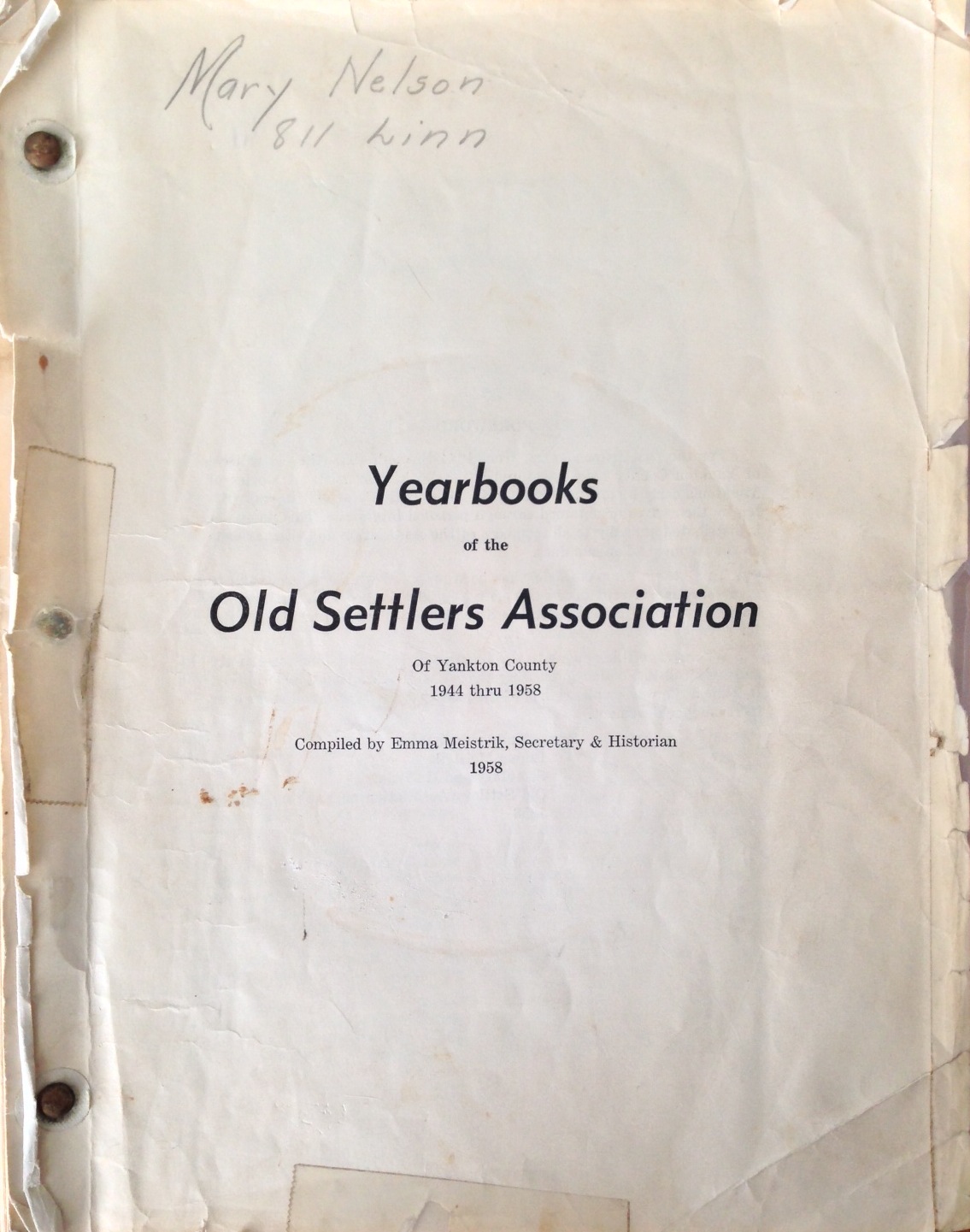
For fifteen years, from 1944 through 1958, the old settlers of Yankton County, South Dakota sponsored a yearbook that compiled their own fascinating stories of life in southeastern South Dakota in the late nineteenth and early twentieth centuries. These yearbooks were later bound and filed with the local library and the state historical society. As written by Emma Meistrik, Secretary and Historian of the Old Settlers Association of Yankton County, “We dedicate this volume to the future old settlers of Yankton County and may call it Volume I, trusting that it will be continued indefinitely. It is upon the worthwhile things of the past that the future builds for ever increasing achievement.”1

OldSettlersAssociationYanktonCounty

Yearbooks of the Old Settlers Association of Yankton County, 1944-1958 (Yankton, South Dakota: Old Settlers Association of Yankton County, 1958); private collection of Melanie Frick.

My copy, once in the possession of an aunt, was not bound professionally, and I’m unsure whether all of the yearbooks are included. However, the stories within are rich with detail. Many of the settlers recount their experiences as immigrants, the establishment of their homesteads, and their survival of the deadly blizzard of 1888, as did Christine (Schmidt) Nelson of Yankton County, South Dakota.

She shared her recollections with her daughter, who wrote, “As an old settler of Yankton county she has many memories of the early years in her community. She recalls the old Indian trail which brought Indian traders to the home of her parents, Mr. and Mrs. Jens Smith, early settlers of Bon Homme county. On the old stage trail between Springfield, Fort Randall and Sioux City, the Smith farm was used as a place to change horses for the carrying of the mail.”2

Of the aforementioned blizzard, it was said, “Mrs. Nelson attended the Breezy Hill school and recalls the blizzard of 1888 when her only brother, Mads Smith, spent the night in the schoolhouse. The next morning after the storm, the sun was shining brightly and the family were overjoyed to see the young boy walking over the sparkling hard drifts after his night’s vigil.”3

The brief autobiography concludes, in part, “Mrs. Nelson is well-known by her many friends and relatives as a person who always has a warm welcome hand extended to all those who call at her home. Even today, at the age of 85, she is active with her household duties and retains an active interest in what is going on about her. She is cordial and sympathetic with the many young people who come her way. She is truly one of Dakota’s pioneer mothers who still looks ahead and enjoys her home and family.”4

As with A Yearbook from the Southern State Normal School, Springfield, South Dakota, 1916, copies of the compiled Yearbooks of the Old Settlers Association of Yankton County, 1944-1958 are likely not widely available to most researchers. Although my copy may not be complete, the individuals named below are included as featured settlers:

Continue reading

The Twenties by Day

LeotaAlphaBellFenton

Leota (Fenton) Thoma, Alpha (Fenton) Gibson, and Belle (Fenton) Hoffman, ca. 1920s; digital image 2013, privately held by Melanie Frick, 2014.

As seen in this photograph, the trends of the Roaring Twenties were not just for flappers – although daytime fashions were significantly less flashy than what one tends to associate with the era. Here, sisters Leota, Alpha, and Belle, from left to right, pose together sporting bobs and simple patterned dresses. Although the sisters were likely in their late forties or early fifties when this photograph was taken, they clearly made an effort to keep up with the times.

Alpha Doretta, Minnie Belle, and Anna Leota Fenton were born in Saline County, Kansas, the daughters of George W. and Sarah Ellen (Hall) Fenton.1 After their father’s death, their mother remarried, and eventually, the family relocated to northwestern Iowa.2 At the time that this photograph was taken, Alpha, the wife of Clare Gibson, lived in Colorado,3 whereas Belle, the wife of Joseph Hoffman, and Leota, the wife of George Thoma, lived in different counties in Iowa.4 It was likely a rare occasion that the sisters were able to be together.

Leota, Alpha, and Belle wear popular styles of what would have been considered day dresses or house dresses in this decade, as seen on Vintage Dancer: 1920s Day / House Dresses and Aprons. Likely made of cotton, their dresses feature lively prints and straight, comfortable cuts. Both Belle, right, and Alpha, center, wear dresses made of fabric printed with spirals or swirls. Both have sleeves cuffed above the elbow, and have belted, dropped waists. Leota wears a standard long apron with patch pockets over her dress, but it can be seen that her floral-patterned dress hits, appropriately, just below the knee. Her dress has contrasting fabric sewn at the hem and the cuffs, and she clutches a striped cloche hat in her hand.

This look was quite a change from the romantic, Gibson Girl-esque styles of just a quarter century before, as seen in an earlier photograph of Leota. However, it looks like these ladies might have had quite a bit of fun with their makeovers during this decade, before more conservative styles returned with the Great Depression.

Continue reading

Tombstone Tuesday: Marguerite Chicoine

Whenever I hear that someone is a Chicoine, I assume that we’re related. From what I’ve been able to learn, most, if not all of those who bear the Chicoine surname – in the United States, at least – can trace their ancestry to the early settlers of Quebec. In the latter half of the nineteenth century, many of these French Canadian Chicoines immigrated to New England, and from there, many moved on to settle in southeastern South Dakota. The Ancestry.com surname map reflects this migration pattern.

SaintAloysiusCemeteryMargueriteChicoine

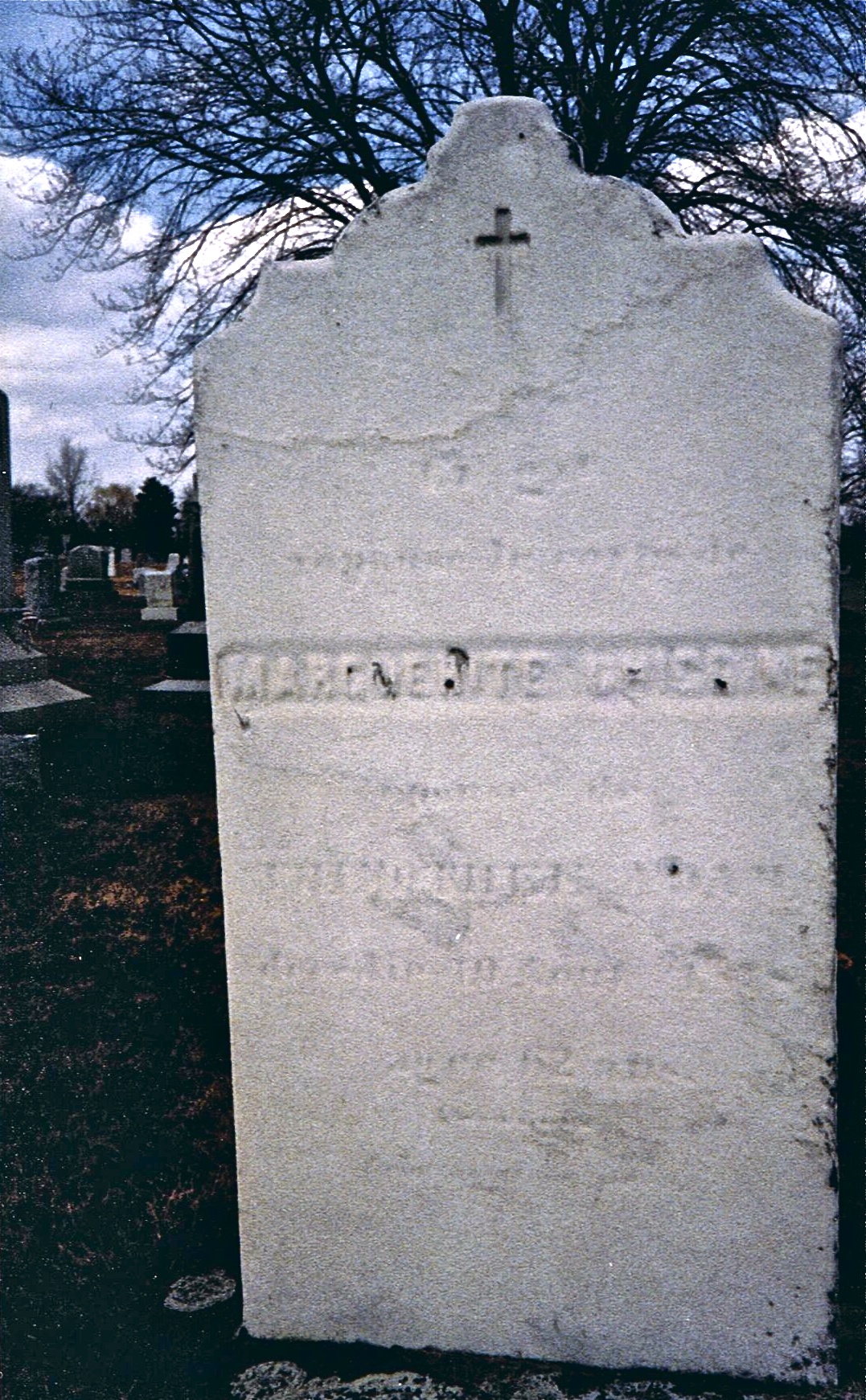
Grave of Marguerite (Chicoine) Adam, 1816-1878, Saint Aloysius Cemetery, Indian Orchard, Hampden, Massachusetts; image date 1987, privately held by Brian Adam [personal information withheld].

The last of my ancestors to carry the Chicoine surname was Marguerite Chicoine of Indian Orchard, Hampden County, Massachusetts.1 Marguerite was baptized on 31 August 1816 in Saint-Antoine-sur-Richelieu, Quebec, the daughter of Leon Chicoine, a forgeron, or blacksmith, and Marie Varie.2 According to family lore, which has not been verified, Marguerite was of Native American (First Nation) descent through her mother.3

Marguerite married Timothée Adam on 23 October 1837 in Saint-Marc-sur-Richelieu, Quebec.4 They farmed in Saint-Hyacinthe County,5 and together, they had at least sixteen children, fourteen of whom survived to adulthood: Timothee (I), Marguerite, Marie, Julienne, Timothee (II), Louis, Joseph, Marie Vitaline, Pierre Pie, Joseph Magloire, Euclide, Marie Elisa, Marie Arcelia, Elzear Henry, Prosper Phillip Adam, and an anonymous infant who did not live longer than two days.

By 1865, Marguerite had relocated with her family to Massachusetts, to a community where many, including her husband, sought work in the cotton mills.6 However, her time there was short-lived; Marguerite succumbed to consumption on 12 September 1878, days after she turned sixty-two.7 She is buried at the Saint Aloysius Cemetery in Indian Orchard, Hampden County, Massachusetts.8

Note: This blog post was updated on 27 May 2020 to include the name of an additional child of Marguerite Chicoine.

Continue reading

Economical Fashions and the Civil War

Scanned Image 25

Unidentified photograph of a young woman, Mount Pleasant, Iowa, ca. 1863-1865; digital image 2012, privately held by Melanie Frick, 2014.

This lovely carte de visite offers several indications as to its date, from both the name of the photographer, and the unique style of dress. Unfortunately, although the photograph comes from an album linked to the family of Jesse M. Smith of Mount Pleasant, Henry County, Iowa, it remains unidentified.1

If your ancestors lived in Henry County, Iowa, in the early 1860s, take note – could this young woman, born circa 1850, be in your family tree?

The slim young woman in the photograph, perhaps fifteen years of age, wears her dark hair with a center part, likely pulled back into a snood. With one hand on the back of an ornate chair, the other holds a straw hat. She is outfitted in a style distinctive to the Civil War era. Her full-sleeved Garibaldi shirtwaist is of plain muslin, accented by a wide Swiss belt. It is tucked into a skirt fashioned from an old dress, something seen often at this time when there was a need to be economical.2

Scanned Image 25 back

Stamped on the back of the photograph is the identification, “Leisenring Bros., Photographers, Mount Pleasant, Iowa.” Although the Leisenring family operated a studio in Mount Pleasant for many years, the Leisenring brothers managed it together for only a short period of time, from 1863-1867. The name was changed to reflect this joint ownership.3

After putting these clues together, this carte de visite can be dated to a narrow time frame of approximately 1863-1865. Perhaps a local soldier carried a copy with him throughout the war, or maybe the young woman simply wished to have her photograph taken in a new outfit that she had likely sewn herself. Regardless, it provides a unique study of the ways in which the economy may have impacted the fashion choices of southeastern Iowans during the Civil War.

For more unidentified photographs from this album, click here and here.

Continue reading

Wedding Wednesday: Swell Times in Chicago

HelenLeonardWedding

Leonard and Helen (Nelson) Wiese, Chicago, Cook, Illinois, 1924; digital image 2010, privately held by Melanie Frick, 2014.

On the evening of 5 January 1924, Leonard John Christian Wiese and Helen Margaret Nelson were married in Chicago, Cook County, Illinois.1 Leonard had been raised in Chicago, the son of German immigrants,2 whereas Helen had been raised in rural Yankton County, South Dakota, the daughter of Danish immigrants.3 The couple met when Leonard sought work in South Dakota, and he and Helen bonded over a shared love of music.4 Leonard and his bride-to-be then moved to Chicago, where they were wed in the home of Leonard’s widowed mother.5 Since Helen’s family was not able to be with them, she wrote a detailed letter home describing their wedding day:

My dear folks,

Now I think that this letter will have to be passed around so I won’t have to repeat all the details of the past few days. We are married! Yes. Now then I will endeavor to tell you the points which I think will be of interest to you.

My dress was very plain but everyone liked it. Dark brown brocaded silk with short sleeves and sort of a drape on the skirt. I have a new coat and hat and new satin shoes.

Well, there were eighteen grown people here. We were married at 9:30. Stanley Smith played the wedding march and Irene and I came from upstairs and met the other two in the room. After the ceremony, a shower of rice descended upon us and the best man and several of the others took advantage of the privilege of kissing the bride. So it was on the order of some of the weddings you read about!!!

Then we had dinner. Turkey, chicken, mashed potatoes, peas, corn relish, cranberries, dressing, Jello, coffee, etc. A huge wedding cake adorned the center of the table. This cake was made to order. You people are going to have some of it. I baked two angel food cakes and a sponge cake. That’s all I did in helping preparations.

I spent some time at the hairdresser’s! Oh, I looked real swell!!!

After supper we had music and some of the men played cards. Then after awhile we started the Victrola and we all danced.

Continue reading