Category Archives: Photograph Analysis

Economical Fashions and the Civil War

Scanned Image 25

Unidentified photograph of a young woman, Mount Pleasant, Iowa, ca. 1863-1865; digital image 2012, privately held by Melanie Frick, 2014.

This lovely carte de visite offers several indications as to its date, from both the name of the photographer, and the unique style of dress. Unfortunately, although the photograph comes from an album linked to the family of Jesse M. Smith of Mount Pleasant, Henry County, Iowa, it remains unidentified.1

If your ancestors lived in Henry County, Iowa, in the early 1860s, take note – could this young woman, born circa 1850, be in your family tree?

The slim young woman in the photograph, perhaps fifteen years of age, wears her dark hair with a center part, likely pulled back into a snood. With one hand on the back of an ornate chair, the other holds a straw hat. She is outfitted in a style distinctive to the Civil War era. Her full-sleeved Garibaldi shirtwaist is of plain muslin, accented by a wide Swiss belt. It is tucked into a skirt fashioned from an old dress, something seen often at this time when there was a need to be economical.2

Scanned Image 25 back

Stamped on the back of the photograph is the identification, “Leisenring Bros., Photographers, Mount Pleasant, Iowa.” Although the Leisenring family operated a studio in Mount Pleasant for many years, the Leisenring brothers managed it together for only a short period of time, from 1863-1867. The name was changed to reflect this joint ownership.3

After putting these clues together, this carte de visite can be dated to a narrow time frame of approximately 1863-1865. Perhaps a local soldier carried a copy with him throughout the war, or maybe the young woman simply wished to have her photograph taken in a new outfit that she had likely sewn herself. Regardless, it provides a unique study of the ways in which the economy may have impacted the fashion choices of southeastern Iowans during the Civil War.

For more unidentified photographs from this album, click here and here.

Continue reading

A New Year’s Eve Party?

HenryMelanieAdamParty_2

Henry and Melanie (Lutz) Adam, ca. 1910, Sioux City, Woodbury County, Iowa; digital image 2010, privately held by Melanie Frick, 2014.

Happy New Year! …or at least, I think that’s what might have been said when this photograph was taken about a century ago. Featured are Henry and Melanie (Lutz) Adam of Sioux City, Woodbury County, Iowa, with Henry seated at lower right and Melanie in white above his raised hand.

Could this photograph have been taken at a New Year’s Eve party? The curtains are drawn in the living room or parlor where the photograph was taken, which suggests to me that it could be after dark. Furthermore, it’s clear that the alcohol is flowing. One man can be seen taking a drink, while several others clutch glasses and bottles. (Alas, I can’t make out the labels.) Nearly everyone wears some sort of silly hat made of cloth or paper, and only three older children are present in the photograph – no little ones.

Note that three of the men in front, including Henry, make a gesture with their thumbs to the sides of their noses and their fingers extended flat, pressed together. They aren’t quite thumbing their noses in the way that I have seen, so I wonder what this gesture might have meant.

Of the nineteen people gathered here, only Henry seems to be ready for the camera. Most, including Melanie, look to the side, perhaps at another photographer, or are caught in the midst of conversation. Whether this gathering was for New Year’s Eve or not, one can easily imagine the chaotic scene as an attempt was made to corral this lively group of friends for a memorable photograph. Cheers!

Warm Winter Furs

NormaThomaFernThoma1917

Norma Arlene Thoma and Fern Lavonne Thoma, ca. 1917-1918, Decatur, Burt County, Nebraska; digital image 2013, privately held by Melanie Frick, 2013.

Although I remember when my great grandmother first showed me this photograph, years ago, I wish I could remember more of what she had to say about it. I believe that the furs that she and her younger sister wore may have been a special gift. From left to right are sisters Norma and Fern Thoma of Decatur, Burt County, Nebraska, most likely photographed during the winter of 1917-1918. At this time, Fern would have been ten years old,1 and Norma would have been a few months shy of her third birthday.2 They lived in town, a community of eight hundred, as their father was a grocer.3

The girls seem to have been posed specifically to show off their matching fur hats, collars, and muffs. Have you ever felt a fur muff? They really are very warm, perfect to shelter little fingers from the biting cold of a Nebraska winter. Norma and Fern are also bundled into long wool coats, and Fern wears what seem to be stylish gaiters or “spats” over her shoes, such as those seen at The Quintessential Clothes Pen: An Exploration of Historic Costume.

With the holidays approaching, I can’t help but wonder if these furs might have been a Christmas gift, or if the girls may have worn them in honor of the day. In that spirit, I would like to take this opportunity to wish very happy holidays to all of my readers, as well as to offer a big thank you for following The Homestead!


SOURCES
1 Iowa State Department of Health, birth certificate no. 419687 (1907, issued 1942), Fern L. Thoma; Division of Vital Statistics, Des Moines.
2 Nebraska State Department of Health, birth certificate no. 2-84091 (1915, issued 1943), Norma A. Thoma; Division of Vital Statistics, Lincoln.
3 Bill Weaver, “Nebraska State Gazetteer and Business Directory – 1917 – Decatur,” NE GenWeb Project: Burt County, Nebraska On-Line Resources (http://www.rootsweb.ancestry.com/~neburt/olres/gazbus17.html : accessed 15 December 2013), entry for Geo. H. Thomas [Thoma].

The Traveling Photographer’s Ram

LeonAdam

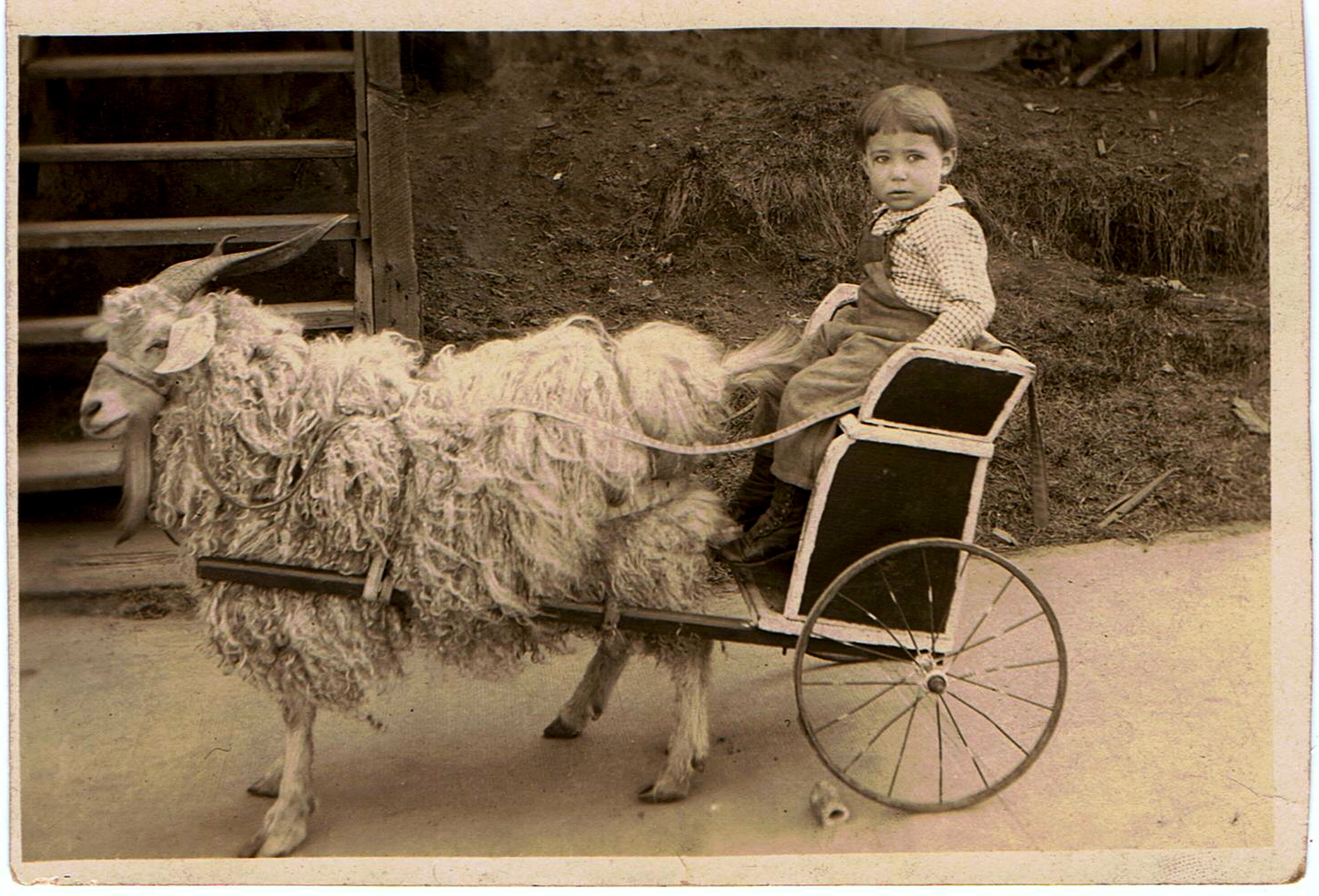
Leon Francis Adam, ca. 1916, Sioux City, Woodbury County, Iowa; digital image 2010, privately held by Melanie Frick, 2013.

Only a handful of photographs exist of little Leon. He was barely five years old when he tumbled into a bonfire and died from his burns.1 This photograph, however, taken when he was perhaps three years old, gives a glimpse into his brief but surely happy childhood.

Leon Francis Adam was born in Sioux City, Woodbury County, Iowa, on 23 August 1913.2 He was the second and youngest son of Henry Joseph and Melanie Veronica (Lutz) Adam.3 It wasn’t uncommon at this time for photographers to travel through towns with some sort of enticing animal in tow – often a pony,4 or, in this case, a wooly ram pulling a two-wheeled cart. Mothers must have smiled to see their children flock to the attraction, making their parting with a few pennies for a photograph that much easier. This particular photograph is a picture postcard, a format that reached its peak circa 1905-1920.5

Leon is wearing simple play clothes – tiny overalls, a check shirt, and black, button-up shoes. His expression is cautious, and he appears to look not at the photographer but at someone off to the side, likely his mother, offering encouragement. Note the bone placed in front of the wheel of the cart, perhaps necessary to avoid a situation of a runaway ram!

Did your young ancestors ever pose with a pony, ram, or other barnyard animal?


SOURCES
1 “Plays in a Fire; Lad Dies of Burns,” unidentified newspaper from Sioux City, Iowa, September 1918.
2 Grave of Leon Adam, 1913-1918, Calvary Cemetery, Sioux City, Woodbury County, Iowa; image date unknown, privately held by Melanie Frick, 2013.
3 “Plays in Fire; Lad Dies of Burns,” 1918.
4 “Wayback Wednesday: Remembering the Pony Photographer” The Family Curator, 14 August 2013 (http://www.thefamilycurator.com/home/2013/8/14/wayback-wednesday-remembering-the-pony-photographer.html : accessed 13 December 2013).
5 Maureen A. Taylor, Family Photo Detective (Cincinnati: Family Tree Books, 2013), 65.

A Mystery Solved: Identifying a Family Photograph

Last year, my cousin’s wife and I embarked on a combined research effort to track down the descendants of Christian Jens Jacobsen Walsted (1833-1899) of Aalborg, Denmark. Christian, a shoemaker,1 married twice, first to Mariane Jensen,2 and later to Johanne Marie Larsen.3 In all, seven of his children survived to adulthood, and all eventually immigrated to America. In 1900, less than a year after Christian’s death, Johanne joined several of their children in western Iowa.4

This unidentified photograph was shared with my cousin’s wife by one of the many helpful descendants with whom we made contact.5 In all of our hours of research, we had never thought that we might come up with a photograph of our central subjects! Given that this photograph was taken in Aalborg, we immediately felt that it could be Christian and his second wife, Johanne. A librarian at the Museum of Danish America thoughtfully suggested that it might have been taken to commemorate their twenty-fifth wedding anniversary. This would date it to 1892.6

ChristianWalstedJohanneLarsdatter1892

Christian Jens Jacobsen and Johanne Marie (Larsen) Walsted, ca. 1892, Aalborg, Denmark; privately held by L.V. [personal information withheld], 2013.

At the time of their anniversary, Christian would have been fifty-eight years old,7 and Johanne would have been fifty-five.8 These seem to be plausible ages for the couple in the photograph, particularly given the gray in the man’s beard. The woman wears a flattering black dress and a headpiece over her hair. Her sleeves are puffed, but not in an exaggerated fashion.9 The man wears a three-piece suit and what appears to be a watch chain. He sits in a finely carved chair at a studio, which, according to the photograph, was located at Slotsgade 15 in Aalborg. A photographer allegedly operated at this location from 1891-1910.10

Later, I would hear from another descendant who possessed an identified copy of this same photograph,11 verifying our suspicion that it was, indeed, a photograph of Christian and Johanne (Larsen) Walsted. Success!

If you have a mystery photograph, be sure to find out if any of your relatives also have a copy. If you are able to locate a copy that is identified, and if the identification matches the clues in the photograph, you’re in luck. However, even if you come across a copy that is not identified, you may be able to narrow down who is in the photograph based on the branch of the family that held it, or who initially passed it down.


SOURCES
1 Abbey of Our Lady Parish (Aalborg, Denmark), Christian Jens Jacobsen Valsted (1899).
2 Dronninglund Parish (Dronninglund, Denmark), Christian Jens Jacobsen Valsted and Mariane Jensen (1863).
3 Dronninglund Parish (Dronninglund, Denmark), Christian Jens Jacobsen Valsted and Johanne Larsen (1867).
4 “New York, Passenger Lists, 1820-1957” digital images, Ancestry.com (http://www.ancestry.com : accessed 6 December 2013), manifest, S.S. Norge, Copenhagen to New York, arriving 1 May 1900, Johanne Walsted; citing National Archives microfilm T715, roll 119.
5 J.W. [personal information withheld], to Melanie Frick, e-mail, 27 May 2012, “Photo,” Personal Correspondence, Walsted Family, Frick Research Files; privately held by Frick.
6 M.M. [personal information withheld], The Danish Immigrant Museum [now Museum of Danish America], to Melanie Frick, e-mail, 30 May 2012, “Danish Wedding Photograph,” Personal Correspondence, Walsted Family, Frick Research Files; privately held by Frick.
7 Dronninglund Parish (Dronninglund, Denmark), Christian Jens Jacobsen Valsted and Johanne Larsen (1867).
8 Dronninglund Parish (Dronninglund, Denmark), Christian Jens Jacobsen Valsted and Johanne Larsen (1867).
9 Joan Severa, Dressed for the Photographer: Ordinary Americans and Fashion, 1840-1900 (Kent, Ohio: Kent State University Press, 1995), 458.
10 “Fotografer,” Aalborg Leksikon (http://aalborgleksikon.dk/Fotografer.htm : accessed 6 December 2013).
11 D.A. [personal information withheld], to Melanie Frick, e-mail, 1 June 2012, “Walsted Photo,” Personal Correspondence, Walsted Family, Frick Research Files; privately held by Frick.

Choose Your Own Backdrop

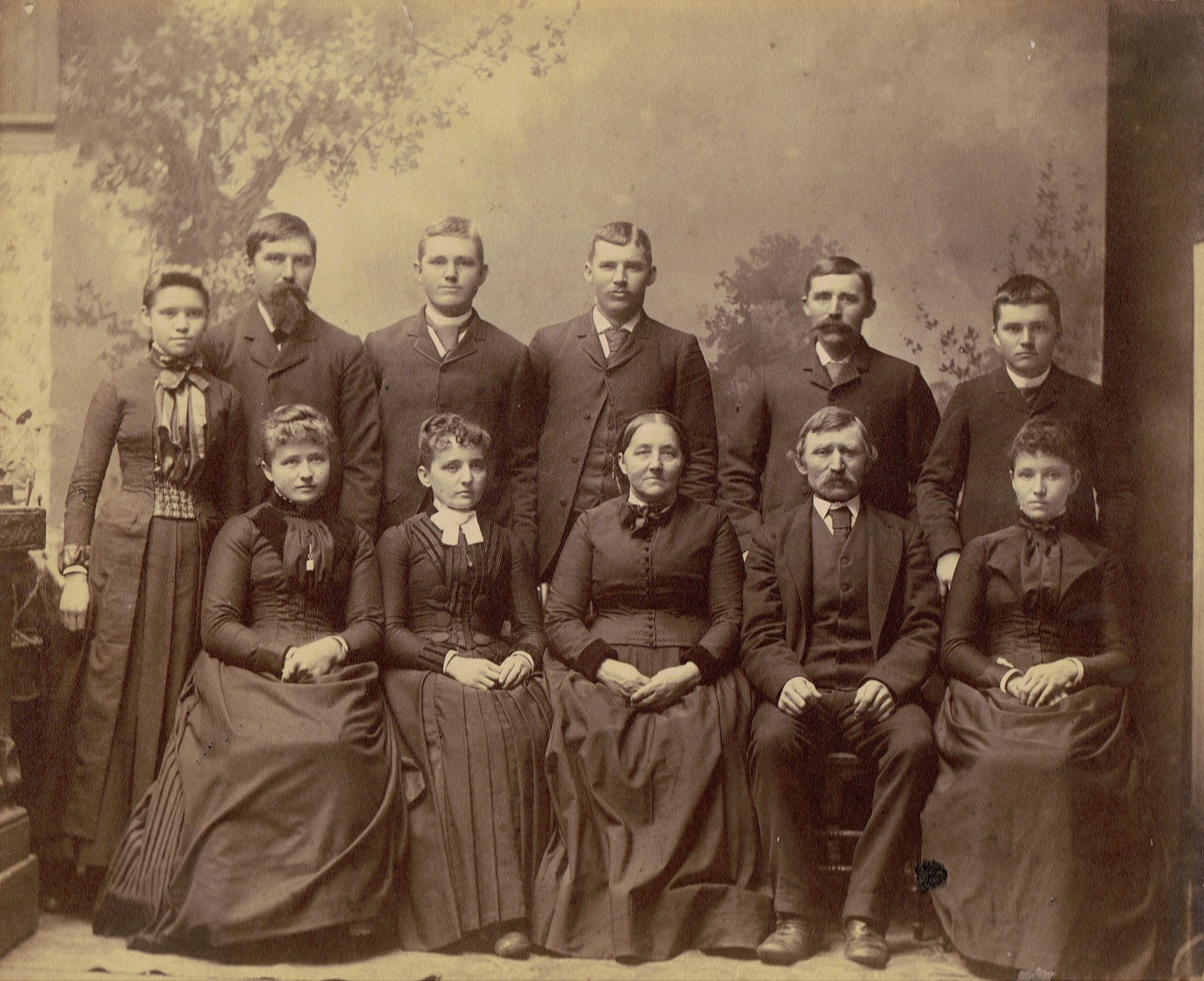
When they posed with their children for this photograph in 1893, Niels and Juliane Sophie (Hennike) Olsen of Yankton County, South Dakota had been married for just over forty years. They had raised nine children to adulthood, eight of whom were born in their native Denmark.1

nielsolsenfamily1893

Family of Niels and Juliane (Hennike) Olsen, 1893, Yankton County, South Dakota; privately held by Melanie Frick, 2013.

Niels and Juliane had purchased a farm upon their arrival in America, but in their later years, they moved to a more comfortable life in town. The couple would go on to celebrate fifty years of marriage in 1902,2 although their youngest son, Andrew, would be missing from that gathering. He drowned in 1897 while hunting ducks on the nearby Swan Lake.3

The photograph is a large print, roughly 8×10 inches, pasted onto cardboard with the date marked on the back. Do you notice anything strange about the backdrop? The family poses in front of a backdrop of painted trees that is slightly too small for a group of that size. To one side, the edge of the backdrop of a wallpapered room is visible, and the backdrop cuts off altogether on the other. All seem to be dressed in their best, the men in dark suits and the women in good black dresses. In 1896, Godey’s wrote, “All of us who are wise, possess a black gown.”4

The women’s dresses are distinct, although the two sisters seated on opposite ends, Stena and Cecilie, could easily have made their dresses from the same pattern. Their sisters’ dresses also bear similarities, though all have their own touches – pleats, contrasting material, or, in Dora’s case, large decorative buttons. Their mother’s dress, however, has no unnecessary frills. Notably, all of the women’s sleeves are of the fitted fashion of the previous decade; as the 1890s went on, puffed sleeves gained popularity. Perhaps this fashion had not yet become popular in Yankton County, or maybe these women simply didn’t care for the new style enough to want to rework dresses that were still perfectly serviceable.

Standing, left to right, are Helena (Neilsen) Larsen, John Neilsen, Andrew Neilsen, Fred Neilsen, Ole Neilsen, and Chris Neilsen. Seated, left to right, are Stena (Neilsen) Callesen, Dora (Neilsen) Nissen, Juliane Sophie (Hennike) Olsen, Niels Olsen, and Cecilie (Neilsen) Boysen. Variations of the surname, including Nelson, were also used by some members of the family.


SOURCES
1 Harold W. Jorgensen, “Olsen, Niels,” in Ben Van Osdel and Don Binder, editors, History of Yankton County, South Dakota (Yankton, South Dakota: Curtis Media Corporation and the Yankton County Historical Society, 1987), 53.
2 Jorgensen, “Olsen, Niels,” 53.
3 Jorgensen, “Olsen, Niels,” 53.
2 Jorgensen, “Olsen, Niels,” 53.
4 Joan Severa, Dressed for the Photographer: Ordinary Americans and Fashion, 1840-1900 (Kent, Ohio: Kent State University Press), 460.

Across Generations: The Power of a Snapshot

If you will be spending the holidays with family this year, consider snapping a few two, three, or even four generation photographs, should you have the opportunity.

JackieRoselynMatildaHammondThoma

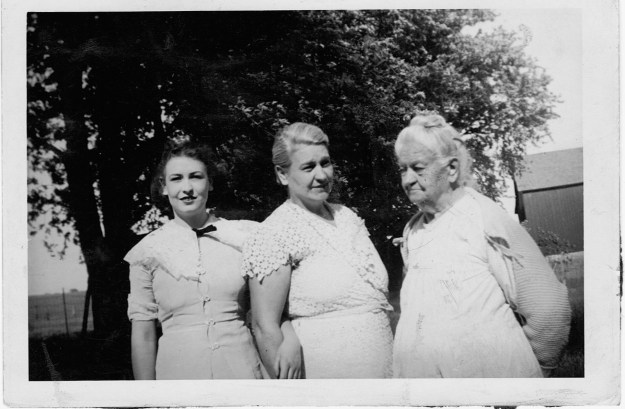
Jacqueline (Cuzins) Hedeman, Roselyn (Thoma) Friend Cuzins Chaney Bohringer, and Matilda (Hammond) Thoma, ca. 1938-1947; digital image 2010, privately held by Melanie Frick, 2013.

Why? This is one of only two photographs that I have of my third great grandmother, Matilda (Hammond) Thoma of Clayton County, Iowa. Matilda was born in 1859, and spent most of her life in the same county. She married and raised five children, four of whom survived to adulthood.1

Matilda is pictured here with her daughter, Roselyn, center, and her granddaughter, Jacqueline, left, who links arms with her mother. The occasion may not have seemed important at the time – only Jacqueline is facing the camera, and Roselyn and Matilda seem to have been caught unaware – but not only is this a rare photograph of Matilda, it’s also the only picture that I have of her with her daughter and granddaughter. This priceless three-generation photograph seems to have been a casual snapshot, likely taken by a family member.

After her husband’s death, Matilda lived with Roselyn in Texas,2 and later with Jacqueline in Wisconsin,3 suggesting that she had a close relationship with both women. This photograph was probably taken at some point after 1940, when Jacqueline would have turned twenty, or perhaps shortly before.4 Both Roselyn and Matilda passed away in 1947, Roselyn at age fifty-four,5 and Matilda at age eighty-eight.6

Seeing Matilda here with her daughter and granddaughter gives a glimpse into what she may have been like as a younger woman. Matilda wears a comfortable pinafore over a striped dress, her white hair fixed in a bun high on her head. Roselyn looks very much like her mother, right down to her nose and ears. She wears a short-sleeved eyelet dress. Jacqueline wears the bright lipstick of the era and a smart buttoned dress. Her sleeves are rolled up; it must have been a warm day. Jacqueline, too, resembles her mother, and, in turn, her grandmother.

I, for one, am very happy that someone just so happened to take this photograph. I’m even happier that this relatively flimsy print managed to survive seventy years. Even a snapshot can become a treasured family photograph.


SOURCES
1 1910 U.S. census, Clayton County, Iowa, population schedule, Guttenberg, enumeration district (ED) 209, sheet 4-B, p. 25 (penned), dwelling 76, family 77, Mathilda Thoma; digital image, Ancestry.com (http://www.ancestry.com : accessed 20 November 2013), citing National Archives microfilm publication T624, roll 397.
2 1930 U.S. census, Harris County, Texas, population schedule, Houston, enumeration district (ED) 209, sheet 5-B, p. 7201 (penned), dwelling 82, family 107, Mathilda Thoma; digital image, Ancestry.com (http://www.ancestry.com : accessed 20 November 2013), citing National Archives microfilm publication T626, roll 2349.
3 1940 U.S. census, Grant County, Wisconsin, population schedule, Wyalusing, enumeration district (ED) 22-56, sheet 1-A, p. 7201 (penned), dwelling 82, family 107, Matilda Thomas; digital image, Ancestry.com (http://www.ancestry.com : accessed 20 November 2013), citing National Archives microfilm publication T627, roll 4481.
4 “Iowa, County Births, 1880-1935,” index, FamilySearch (https://familysearch.org : accessed 20 November 2013), Jacquelin Thoma Cuzins, 1920.
5 “Texas, Deaths, 1890-1976,” index and images, FamilySearch (https://familysearch.org : accessed 20 November 2013), Roselyn Bohringer, 19 May 1947; citing certificate number 19651, State Registrar Office, Austin; FHL microfilm 2218598.
6 Wisconsin State Board of Health, death certificate, Matilda H. Thoma (1947), Vital Records Office, Madison.

The Lutz Sisters

HattieJuliaAnnaMelanieLutz

Sisters Hedwig, Julia, Anna, and Melanie Lutz, ca. 1900, Minnesota; digital image 2010, privately held by Melanie Frick, 2013.

Julia, Anna Marie, Hedwig “Hattie” Eulalie, and Melanie Veronica Lutz were the daughters of French and Polish immigrants, respectively Joseph and Hedwig (Cichos) Lutz of Minnesota Lake, Faribault County, Minnesota.1 By the time that this photograph was taken, circa 1900, Joseph had passed away, and Hedwig had remarried and given birth to five additional children.2 Her eldest daughters must have been close, however, as they chose to have a photograph taken of just the four of them.

Standing with her arms protectively behind her seated sisters is Hattie, who would have turned nineteen in the year 1900.3 Although her position suggests that she was the eldest, she was not; it’s possible that she may have been the tallest, however, if the photographer were to have posed the sisters based on height. She is also the only sister wearing a dress with a white collar, offering contrast; the other sisters seem to be wearing their good black dresses. None of the dresses, however, are alike, each having unique decorative pleats, panels, and/or bows. The collars are extremely high, perhaps an example of what would have been known as “officer’s” collars.4

Julia is seated at right, her dark eyes serious. She would have turned twenty-four in 1900, and was the eldest of the sisters.5 Seated at the center is Anna, who would have turned twenty-two that year.6 Melanie, the youngest, is at left; she would have celebrated her sixteenth birthday in 1900.7

At this time, all four sisters had left their mother’s household.8 Julia was married with two young children at home; she and her husband kept a hotel,9 and Anna was employed as a servant there.10 Hattie lived with her elderly maternal grandparents.11 As Melanie cannot be located in the 1900 U.S. census, she may have been away at school, where she trained to become a teacher. Later in life, Julia, Anna, Hattie, and Melanie made their homes in four different communities across three different states, but their sisterly bond is apparent in this photograph of them as young women.


SOURCES
1 “Minnesota, Marriages, 1849-1950,” index, FamilySearch (https://familysearch.org : accessed 15 Nov 2013), Joseph Lutz and Hedwig Joice, 19 April 1875. Cichos was likely transcribed incorrectly as Joice.
2 1900 U.S. census, Faribault County, Minnesota, population schedule, Minnesota Lake, enumeration district (ED) 92, sheet 10-B, p. 4834 (penned), dwelling 178, family 178, Hattie Rendfleisch; digital image, Ancestry.com (http://www.ancestry.com : accessed 15 November 2013), citing National Archives microfilm publication T623, roll 763. Rendfleisch was a variation of Rindfleisch.
3 “Minnesota, Births and Christenings, 1840-1980,” index, FamilySearch (https://familysearch.org : accessed 15 Nov 2013), Hedwig Lutz, 06 September 1881.
4 Joan Severa, Dressed for the Photographer: Ordinary Americans and Fashion, 1840-1900 (Kent, Ohio: Kent State University Press, 1995), 526.
5 “Minnesota, Births and Christenings, 1840-1980,” index, FamilySearch (https://familysearch.org : accessed 15 Nov 2013), Julia Lutz, 13 December 1876.
6 “Minnesota, Births and Christenings, 1840-1980,” index, FamilySearch (https://familysearch.org : accessed 15 Nov 2013), Anna Lutz, 12 May 1878.
7 “Minnesota, Births and Christenings, 1840-1980,” index, FamilySearch (https://familysearch.org : accessed 15 Nov 2013), Melanie Veronica Lutz, 28 May 1884.
8 1900 U.S. census, Faribault Co., Minn., pop. sch., Minnesota Lake, ED 92, sheet 10-B, p. 4834, dwell. 178, fam. 178, Hattie Rendfleisch.
9 1900 U.S. census, Nobles County, Minnesota, population schedule, Adrian, enumeration district (ED) 209, sheet 2-B, p. 43 (penned), dwelling 29, family 29, Julia McColm; digital image, Ancestry.com (http://www.ancestry.com : accessed 15 November 2013), citing National Archives microfilm publication T623, roll 778.
10 1900 U.S. census, Nobles County, Minnesota, population schedule, Adrian, enumeration district (ED) 209, sheet 2-B, p. 43 (penned), dwelling 29, family 29, Anna M. Lutz; digital image, Ancestry.com (http://www.ancestry.com : accessed 15 November 2013), citing National Archives microfilm publication T623, roll 778.
11 1900 U.S. census, Faribault County, Minnesota, population schedule, Minnesota Lake, enumeration district (ED) 92, sheet 5-A, p. 4719 (penned), dwelling 73, family 73, Hattie Lutz; digital image, Ancestry.com (http://www.ancestry.com : accessed 15 November 2013), citing National Archives microfilm publication T623, roll 763.

The Nelson Family

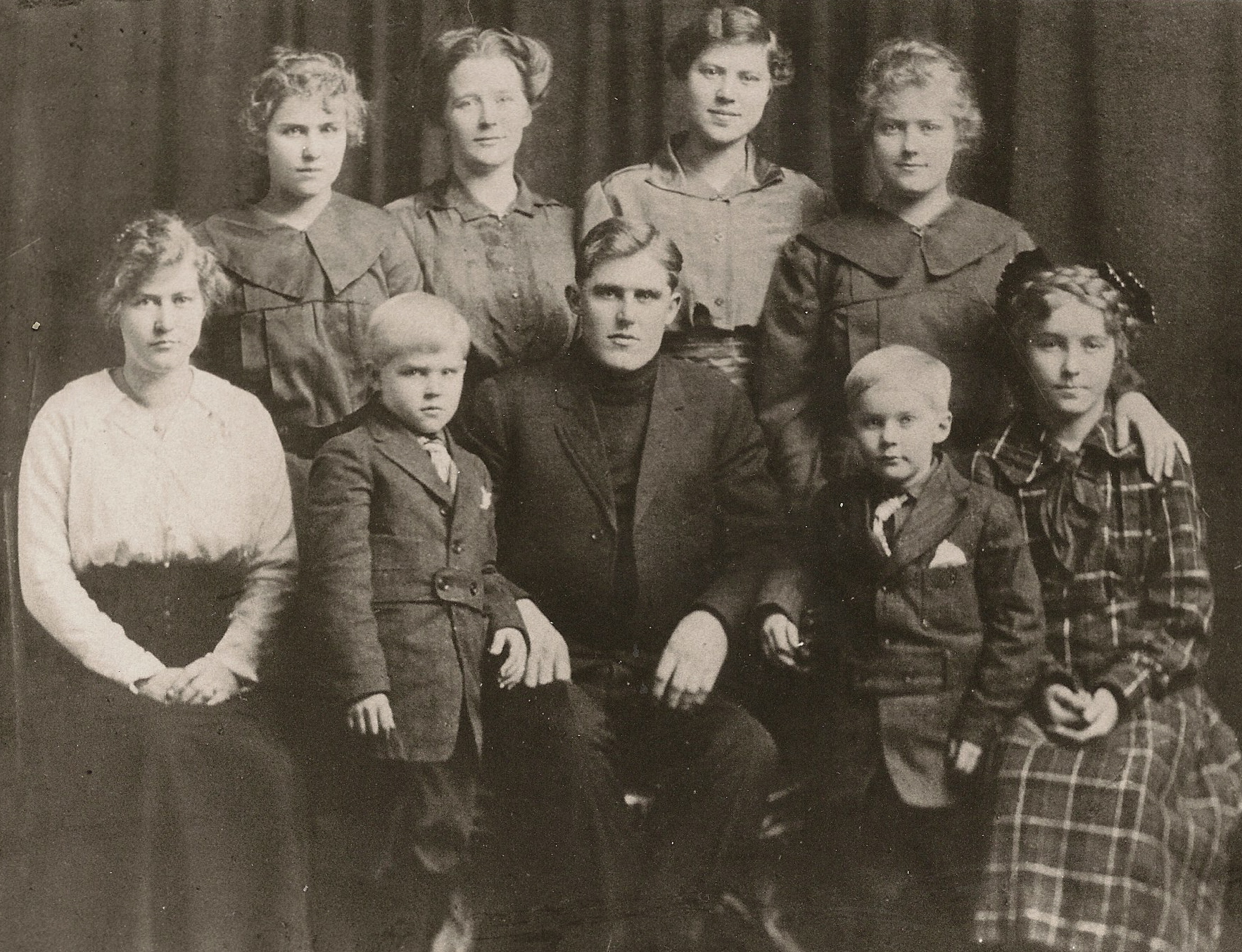
The nine children of Fred and Christine (Schmidt) Nelson of Tabor, Yankton County, South Dakota pose together here circa 1915. These six sisters and three brothers span nineteen years in age; from eldest to youngest, they are Anna, Julia, Ole, Andrea, Louise, Helena, Mary, Fred, and Myron Nelson. [Update: Since writing this piece, I have located another copy of this photograph with a date of December 1917 handwritten on the back.]

FredNelsonChildren1915

Family of Fred and Christina (Schmidt) Nelson, ca. 1915, Yankton County, South Dakota; digital image 2010, privately held by [personal information withheld], 2013.

A strong family resemblance can be seen in the nine Nelson siblings. Anna and Julia stand at center; they are wearing plain buttoned blouses and skirts, as is Andrea, seated left. Louise and Helena, standing at left and right, wear almost identical dresses with wide collars, pleated bodices, and belted waists. Their dresses were almost certainly sewn by hand from the same pattern.

Mary, the youngest sister, seated at right, is dressed in the most striking manner in a plaid dress with a ring of beautiful braids coiled atop her head. As the story goes, while they were growing up, the Nelson sisters would line up each morning to braid the hair of the sister standing before them.1 Someone clearly spent extra time on Mary’s hair on the morning that this photograph was taken!

The brothers, regardless of age, wear sturdy wool jackets. Ole’s jacket is open over a dark shirt or sweater that seems to be in the style of a turtleneck, while young (and very blond) Fred and Myron wear their jackets buttoned over shirts and ties. They lean towards Ole, their arms propped beside his on the arms of his chair.

In 1915, not all of the Nelson children remained at home, although all continued to live in the area. Anna, the eldest, was married, and had started a family.2 Julia was a schoolteacher,3 the profession pursued by her younger sisters, Andrea and Louise, who were students at the nearby Springfield Normal School.4 They would soon be followed by Helena and Mary, who at this point likely still attended the local school with Fred and Myron. Ole, the eldest brother, was a carpenter, and worked on the family farm.5

Was there an occasion for this photograph? In March of 1915, Fred and Christina (Schmidt) Nelson would have celebrated their twenty-fifth wedding anniversary.6 Perhaps a photograph of their progeny was in order, either by their request or as a gift from their children. Regardless, this is the last known photograph of all of the Nelson children together, and it’s a lovely one.


SOURCES
1 Phyllis (Wiese) Adam, conversations with the author, 2012; notes in author’s files.
2 1920 U.S. census, Yankton County, South Dakota, population schedule, Mission Hill, Enumeration District (ED) 251, p. 6151 (penned), sheet 1-B, dwelling 10, family 10, Anna Jorgensen; digital image, Ancestry.com (http://www.ancestry.com : accessed 4 November 2013), citing National Archives microfilm T625, roll 1726.
3 “South Dakota, State Census, 1915,” index and images, FamilySearch (https://familysearch.org : accessed 04 Nov 2013), Julia Nelson, Tabor, Yankton, South Dakota, United States.
4 The Echo, Vol. 1 (Springfield, South Dakota: Springfield Normal School, 1916); private collection of Brian Adam [personal information withheld].
5“South Dakota, State Census, 1915,” index and images, FamilySearch (https://familysearch.org : accessed 04 Nov 2013), Ole Nelson, Tabor, Yankton, South Dakota, United States.
6“In Memoriam: Christine M. Nelson,” undated clipping, ca. January 1961, from unidentified newspaper.

A Dashing Young Man

Scanned Image 27

Unidentified photograph of a young man, ca. 1860-1866; digital image 2012, privately held by Melanie Frick, 2013.

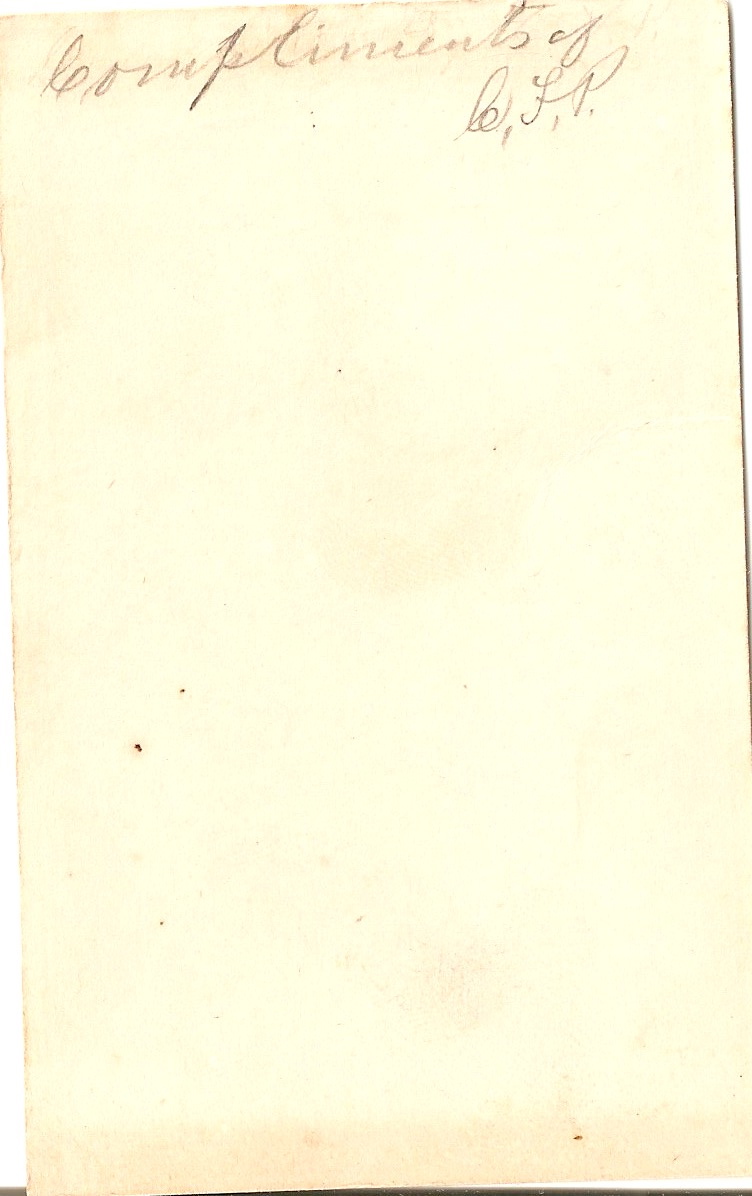
“Compliments of C.F.P.” is inscribed in pencil on the back of this unidentified photograph of a young man. He has a high forehead and wavy hair; there is a firm set to his jaw and his dark eyes hold a steady gaze. His jacket is buttoned to the top, revealing a high collar and a snippet of a checked necktie underneath.

This photograph is an example of what was known as a carte de visite, or CDV, most popular between 1860 and 1866.
Cartes de visite were paper photographs mounted on cardboard, affordable and easy to transport. They fell out of favor when larger cabinet card photographs became available.1

The young man’s hairstyle, longish and brushed back from his forehead, reflects this era.2 His knotted necktie may be fastened with a stickpin and reveals a bit of checked fabric just above the collar of his coat. His coat does not seem particularly fine; it is loose-fitting and looks to be made of wool.

Scanned Image 27 backAlthough unidentified, this carte de visite comes from an album that traces to the family of Jesse M. Smith of Henry County, Iowa, although other families may be included. This particular photograph offers no clues as to where it was taken, although many of the photographs in the album are from Iowa with a few from Kansas and Missouri.3 It’s anyone’s guess as to who C.F.P. might have been.

My estimate for the age of the young man is perhaps between twenty-five and thirty; his high hairline suggests to me that he is probably not much younger. His apparent age suggests a date of birth between approximately 1830 and 1840, depending on the year that the photograph was taken. Perhaps he was unmarried when he inscribed this photograph and presented it to a young lady he admired; of course, it could also have been given to a family member or friend. Did C.F.P. serve in the Civil War? Although he is not in uniform in this photograph, that doesn’t mean that it might not have been taken as a memento for his loved ones before he left home.

What are your thoughts about the elusive C.F.P.?


SOURCES
1 Georgen Gilliam Charnes, “Cartes-de-Visite: The First Pocket Photographs,” Nantucket Historical Association, 2004 (http://www.nha.org/history/keepinghistory/KHcdv.htm : accessed 1 November 2013).
2 Maureen Taylor, Fashionable Folks: Hairstyles 1840-1900 (United States: Picture Perfect Press, 2009), 53.
3 Jesse M. and Elizabeth Jane (Baker) Smith Album, ca. 1860-1920; privately held by Melanie Frick, 2013.