Category Archives: Uncategorized

A Prayer Book from Home

Before Joseph Lutz left his home village, he carefully inscribed his name inside a leather-bound prayer book, small enough to be tucked inside a coat pocket. “This book belongs to me, Joseph Lutz of Sondersdorf,” he penned in French. The book, however, was printed in German; Joseph spoke both languages, having grown up in an area that was the subject of dispute between France and Germany.1

Joseph_Lutz_Prayer_Book_01

Joseph Lutz prayer book, Adam Family Collection; privately held by Brian Adam (personal information withheld), 2014.

Joseph Lutz of Sondersdorf, Haut Rhin, Alsace, France, the son of François Joseph and Marguerite (Meister) Lutz, was baptized on 31 May 1844.2 He left his homeland following  the Franco-Prussian War of 1870-1871. It was said that he had been injured during his time of service, which may have limited his opportunities for occupation, and, furthermore, he did not wish to live under Prussian rule.3 Thus, like many of his relatives, he set his sights on Minnesota.

Once settled, Joseph may have read from his prayer book with his wife, a Polish immigrant who also spoke German, as they began their life together.4 Perhaps it inspired his generosity during his career as a butcher, when he was said to have provided gifts of meat to struggling immigrants. When he later became a saloon keeper, it may have given him the strength to avoid the temptation of alcohol, a quality appreciated by his wife.5 Perhaps the prayer book brought him peace as he suffered from tuberculosis, an illness that claimed his life on 3 May 1887 when he was forty-two years old.6

Joseph_Lutz

Joseph Lutz prayer book, Adam Family Collection; privately held by Brian Adam (personal information withheld), 2014.

Joseph was said to have been buried in Danville, Blue Earth County, Minnesota, and though a wooden cross once marked his grave, it is no more.7 His well-worn prayer book was passed down to his daughters, who kept his tintype – his only known photograph – tucked inside to ensure its safety. These items may have been their sole mementos of their father, a slim man with a handlebar mustache, a Catholic, a veteran, and a businessman who hailed from the border of France and Switzerland.

Continue reading

The Country Store: Family Groceries, the Best of Brandy, and Excellent Beer

The Bavarian William Henry Thoma of Garnavillo, Clayton County, Iowa, was a businessman by the age of thirty.1 In 1859, the Clayton County Journal reported:

“William Thoma, Grocer, Main Street, Garnavillo, Iowa, keeps constantly on hand all kinds of family groceries, such as Coffee, Sugar, Tea, Milasses, ice, &c. The best of Brandy and excellent Beer is also always to be found at this establishment.”2

William must have found success as a grocer and purveyor of alcoholic beverages, as his business was apparently in operation for at least two decades. He was named a merchant in the 1860 census,3 and in the 1870 census it was noted that he was the keeper of a “country store.”4 This must have allowed him to provide a comfortable lifestyle for his wife and eleven children; in 1870, he owned real estate valued at $12,000 and personal estate valued at $3,000.5

William_Thoma_1870

1870 U.S. census, Clayton County, Iowa, population schedule, Garnavillo, p. 13 (penned), dwelling 87, family 86, Wm Toma; digital image, Ancestry.com (http://www.ancestry.com : accessed 16 April 2014), citing National Archives microfilm M593, roll 383.

After William’s death in the summer of 1876,6 his widow, Anna Margaretha (Poesch) Thoma, with a handful of young children still at home, took over as merchant. She maintained the business for a number of years, while her eldest son assisted as a clerk in the store.7

I like to wonder whether William’s store was anything like that featured at Iowa’s Living History Farms, which boasts the fictional 1875 Town of Walnut Hill. Images of the picturesque Greteman Brothers General Store can be seen here. It’s well worth a visit if you find yourself in central Iowa and have ever wondered what life was like for your Midwestern ancestors in the years following the Civil War. The impact of the Industrial Revolution on rural communities is visible, although, according to the Living History Farms, “The railroad will always be a few years away for Walnut Hill.”8

Of course, I also have to wonder whether William and Anna Margaretha (Poesch) Thoma were anything like Nels and Harriet Oleson of Little House on the Prairie. Let’s just hope that their children weren’t as spoiled as the infamous Nellie and Willie!

Continue reading

An Iowa Teacher’s Report to Parents, 1925

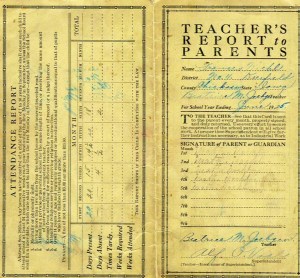
The first of June 1925 was an important day for Frances Marie Noehl of Deerfield, Chickasaw County, Iowa. She completed the eighth grade in District No. 11 with flying colors, even rallying over the course of the year to bring up her lagging grade in conduct.1 However, although she was a successful student, with high average marks equivalent to straight A’s, she would not go on to graduate from high school.2

ReportCard1

Frances Noehl, Teacher’s Report to Parents, 1925, Deerfield, Iowa; digital image 2003, privately held by V. P. [personal information withheld], 2014.

Frances was the eighth of nine children born to Matthias and Elizabeth (Hoffman) Noehl, German immigrants who farmed in northeastern Iowa.3 Once her schooling was completed, Frances was needed at home, although her father did prize education. In his memoirs, he wrote of his schooldays in Germany, “I entered into the arena, and took it up not only with the alphabet, but with all my classmates. As at that time there was no special talent in our school of eighty-four pupils, I succeeded in taking the first place among all the boys.”4 His education concluded at the age of fourteen, but he was pleased to be allowed to keep his books, writing tablet, slate, and pencil.5 Perhaps he had once dreamed that his children would be fortunate enough to further their educations, but, at least in the case of his youngest daughter, that dream was unfulfilled.

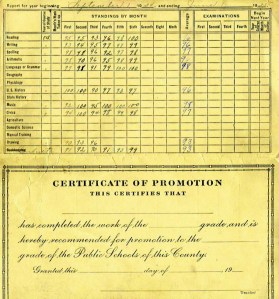
During the course of her eighth grade year, Frances was instructed by Miss Beatrice Joebgen, a local teacher who was still a teenager herself.6 Frances was graded in Reading, Writing, Spelling, Arithmetic, Grammar, U.S. History, Music, Civics, Drawing, and Conduct, with all of her marks falling between 90 and 100 and her averages between 93 and 98. Her father’s signature was recorded on her report card at the end of each term.7

ReportCard2

Frances Noehl, Teacher’s Report to Parents, 1925, Deerfield, Iowa; digital image 2003, privately held by V. P. [personal information withheld], 2014.

Attendance rules for the time indicate that Frances would not have been required to complete additional schooling, as she had fulfilled the educational qualifications of an eighth grade pupil. Other reasons for exemption from public schooling included being mentally or physically unfit, living more than two miles from the school house by the nearest traveled road, or attending a private or parochial school, receiving instruction from a competent teacher, court order, religious instruction, or regular employment for one over the age of fourteen.8

Although Frances may have liked very much to have had the opportunity to graduate from high school, duty to her family, it seems, kept her at home.

Continue reading

Friendship Clubs and Funny Quotes: Finding Family in Yearbooks

Several years before they would meet and marry, teenagers Fern and Jerry were unsuspecting students at Central High School in Sioux City, Woodbury County, Iowa.1 They were not in the same grade, and this was a large school; Fern moved to Sioux City only in time for her senior year, and as Jerry graduated two years later, it’s possible that they never crossed paths during their brief overlap as students at the imposing sandstone building dubbed “The Castle on the Hill.”2

Fern_Thoma_Yearbook_1925

The Maroon and White, Vol. XXI (Sioux City, Iowa: Central High School, 1925), 67; digital image, Ancestry.com (http://www.ancestry.com : accessed 24 March 2014).

Fern Lavonne Thoma graduated from Central High School in 1925. In her yearbook photo, she wore a long necklace and, true to the times, styled her hair in a fashionable, chin-length bob. The only club that Fern had joined was the “Friendship Club,” which, apparently, was mandatory for all female students.3 From what I remember her telling me, she enjoyed her time at this school, especially a banquet for the upperclassmen during which the school gymnasium was decorated like a boat. She thought this event was “just wonderful!”4

Gerald_Adam_Yearbook_1927

The Maroon and White, Vol. XXIII (Sioux City, Iowa: Central High School, 1927), 34; digital image, Ancestry.com (http://www.ancestry.com : accessed 24 March 2014).

Gerald “Jerry” Joseph Adam graduated from Central High School in 1927. According to the yearbook, he was in the general course of study and had been involved in Civics, no surprise given his penchant for writing to politicians later in his life, as well as the Spanish Club. His handsome photo was paired with the quote, “Who shows you your place when you go to the Princess?”5 As a teenager, Jerry earned money as an usher at the Princess Theatre in downtown Sioux City, surely a popular place among his movie-going peers.6

In fact, Fern and Jerry reportedly met while on their way to the movies. Fern and her friend Florence were walking downtown when two young men, who were known to Florence, drove up in their rental car and offered the girls a ride. Fern approached the front to sit next to the driver, when Jerry suggested that she sit in the back with him. Fern later claimed that Florence had set her up, while Jerry liked to say that when he first laid eyes on Fern, he proclaimed, “That’s the girl I’m going to marry!”7

If you would like to find yearbook photos of your ancestors (or even yourself), check out the yearbook collections on Ancestry.com. In my experience, yearbooks don’t always appear as strong “shaky leaf” matches, so I have found it helpful to search specifically within the category “Schools, Directories & Church Histories” in order to bring all relevant results to the top.

Also consider searching the yearbooks individually as your ancestor’s full name may not have been given for every appearance, particularly if he or she was an underclassman or appeared in additional club or athletic photographs. As a bonus, see if you can find his or her autograph scrawled in the back of the book. You never know what you might learn about the glory days of your ancestor’s youth!

Continue reading

How to Research at the Los Angeles County Archives

It’s been a year since my husband and I moved to Southern California, and, slowly but surely, I’m becoming familiar with the various record repositories in the area. This isn’t without effort, as Los Angeles County, with an area of 4,752 square miles and a population of 10 million, is so overwhelming that it can be hard to know where to begin! When I needed to hunt down some probate records, however, I knew that I would have to visit the Los Angeles County Archives and Records Center.

In preparation, I referred to a blog post by The SoCal Genie. I found it so helpful that I thought I would share an updated version for anyone who might be planning to visit this facility, as the official website isn’t terribly informative. The Los Angeles County Archives and Records Center is the go-to place for probate, divorce, and civil court cases more than five years old. 

First, I would recommend accessing the facility via Metro, as it’s located immediately off the Civic Center/Grand Park Station on the Red Line. I would also recommend that you resign yourself to spending some quality time at the facility, which, to be honest, is not a particularly nice place to spend the day. It’s essentially an underground warehouse – think concrete floors and fluorescent lighting – in need of more than a little TLC. That said, the employees were as nice as can be, so I imagine they’re doing the best they can under the circumstances. Not all archives are created equal!

IMG_2134It can be difficult to find the entrance to the Archives. As you face the Civic Center from the sidewalk, look to the left until you spot the outdoor elevator structure. This will take you underground to the Archives. At the second lower level, follow the signs through the hallway, which, at least when I was there, was piled with boxes and wooden pallets and looked like a place that would be off-limits to the public. However, further down the hall, a line had formed in front of the information desk.

Continue reading

The FAN Principle: Finding Family in Southern Illinois

Isaac_Hall_Probate01

Washington County, Illinois, Isaac Hall probate file, Box 22, County Court; Illinois State Archives, Springfield.

Of course, it would have been too easy if Isaac Hall of Washington County, Illinois had named all of his surviving children in his last will and testament. Although probate records can be excellent resources for genealogists, they don’t always provide all of the details that one would hope. When Isaac dictated his wishes to two witnesses in January of 1852, he stated only that his “eldest son,” Jonathan Hall, was to receive all of his lands, goods, and chattels.1 He named this same son as the sole executor of his estate. Isaac made his mark, and went on to live less than two months more; his will was filed on 15 March 1852.2

Fortunately, there are other resources that provide clues as to who at least some of the other children of Isaac Hall may have been. Among them is the 1850 U.S. census for District 20, Washington County, Illinois, which counts three Hall households in a row. In the first lived Elathan Hall, thirty-seven, a farmer from Tennessee.3 In the second lived Isaac Hall, forty-five, also a farmer from Tennessee.4 In the third lived Jonathan Hall, fifty, a farmer who was a native of North Carolina,5 as was the only other adult male resident of the household, Isaac Hall, seventy-four.6 Although relationships between members of a household were not recorded in the 1850 census, based on the information provided, it seems logical to assume that the senior Isaac was Jonathan’s father, and that they were, in fact, the same Isaac and Jonathan of the aforementioned probate record. Their living arrangement suggests why Isaac may have felt so indebted to his eldest son when it came time to pen his will. Perhaps he had spent many years in the care of his son’s family.

And what of the younger Isaac Hall and Elathan Hall who lived next door, or, rather, on neighboring farms? No, they had not been born in North Carolina – but Tennessee falls between North Carolina and southern Illinois, making it a likely stop for a family that may have gradually migrated west. The thirteen-year age span between Jonathan, the younger Isaac, and Elithan suggests a possible sibling relationship. An exploration of additional records indicates that these families were closely linked for decades.

This is a perfect example of the importance of Cluster Research, also called the FAN Principle – an awareness of an ancestor’s Friends, Associates, and Neighbors – explored by Elizabeth Shown Mills.7 I should note that my dad stressed the importance of this principle to me in my research long before we knew that it had a name! How have you used the FAN Principle in your research?

Continue reading

A Dastardly Act: Making the News in 1893

Mrs. Hiram Hammond barely had a chance to settle in to her retirement in the town of Postville, Allamakee County, Iowa, before an unfortunate event warranted her a mention in the local newspaper.1

PostvilleReview29May1893Hammond.jpg

“Local Review,” The Postville (Iowa) Weekly Review, 29 May 1893, p. 1, col. 4; digital images, Newspaper Archive (http://www.newspaperarchive.com : accessed 18 February 2014).

As reported in The Postville Weekly Review on 29 May 1893, “Some miserable sneak thief stole some potted house plants from the residence of Mrs. Hiram Hammond, on Tuesday night. The most contemptible part of it was that those not carried off were mashed and destroyed. They were left out of doors without thought of danger. A man that would do such a dastardly act is not a safe member of society in any respect.”2

Well then! I can only imagine that poor Mrs. Hiram Hammond – born Eva Margaret Stoehr – must have been most distressed at this unexpected turn of events. She had likely only recently moved to town, while her husband prepared to put their farm up for sale.3 Hiram had turned eighty that year, while his wife was over sixty.4 After years of labor on their farm, they must have looked forward to a quiet life in town.

Postville was certainly not a large community, yet apparently large enough that a man (or, perhaps much more likely, a teenage boy) could get away with a destructive prank. However, if this was the worst that Postville had to report, it seems that things really may not have been all that bad! One can only hope that in the years to come, Mrs. Hiram Hammond was able to enjoy her potted house plants without further incident.

What is one of your favorite stories about an ancestor that you’ve found in a historic newspaper database? There are several excellent databases out there; so far, I’ve had positive experiences with Chronicling America (free) and NewspaperArchive (subscription). Be aware that different databases may offer access to different areas and periods of coverage. Also be sure to find out whether your local library provides free access to any useful newspaper databases, which can often be accessed from home.

Continue reading

Drunkenness, Death Threats, and a Divorce Petition

On the 5th of February 1902, Sarah Ellen (Hall) Hoffman of Ashton, Osceola County, Iowa, who was then forty-four years old, signed her name to a petition that she sincerely hoped would grant her a divorce. John Hoffman was her second husband; her first husband had died of an accidental gunshot wound, and it was now eighteen years since she had remarried. As detailed in the statement of facts prepared for the court by her attorney, O. J. Clark, this marriage was now in shambles.1

It was established that the plaintiff and the defendant had lived together since the time of their marriage – except recently, as “the defendant has been away from home considerable.”2 It was added, “At times he will work and earn money, but will not use any of his earnings to or for the support of the family, but will stay at home most of the time helping to eat up what the plaintiff and children earn.”3 Then, the chilling details of their marriage spilled forth:

“That the plaintiff has always conducted herself toward the defendant as a loving and dutiful wife, but that the defendant, disregarding his duties towards your petitioner, has always been abusive and ugly towards her, and of late years has become brutally coarse, violent and vulgar towards your petitioner, often calling her the most vile names in the presence of her children and so does without any cause therefore, often striking, kicking and otherwise abusing your petitioner, without cause, often leaving black and blue marks on the person of your petitioner for weeks at a time as the result thereof. That at times the defendant, without cause, threatens to kill your petitioner, threatens to put a hole through your petitioner’s body, threatens to cut her heart out and to kill your petitioner with a knife. That on one occasion said defendant attempted to carry out his threat of killing your petitioner with a butcher knife, and attacked her therewith, when her daughter in attempting to prevent defendant’s harming your petitioner, received the blow with the knife herself on the hand, cutting the cord to one of her fingers off and otherwise injuring her hand, so that she has very little use of said finger, and thus, to that extent has made her a cripple for life. That the threats thus made, the kicking and striking are of very frequent occurrence when he is at home, that he sleeps with his clothes on, and at times in the night will begin his abuse of your petitioner without cause, and threaten to kill her with his knife, and will begin to open and shut his knife so that the plaintiff can hear it click and thus frighten her and worry her all night at a time.”4

OsceolaCountyIowaDivorce1902

Osceola County, Iowa, Circuit Court File 3036, Sarah E. Hoffman v. John Hoffman, for “Petition in Equity,” 20 March 1902; Clerk of District Court, Sibley. The surname Hoffman appeared in this text as Huffman, but in some instances the “u” was overwritten with an “o.” Thus, I have transcribed the name as Hoffman.

In recent years, the defendant had become “addicted to the use of intoxicating liquors, and is an habitual drunkard, which habit he has acquired since their said marriage.”5 The statement continued, “That the plaintiff’s health has become undermined and broken, and if this treatment continues her health will give out entirely and she fears she will die there from – if the defendant does not in fact kill her outright.”6 It’s truly appalling to think what my third great-grandmother must have endured, and it’s to her credit that she had the strength to initiate a divorce at this time.

It would be interesting to learn what grounds for divorce were required in Iowa in 1902; apparently, in this case, habitual drunkenness, horrific abuse, and failure to provide support were sufficient. The divorce was granted in March of that year, at which time Sarah received custody of the couple’s teenage son, possession of the kitchen and household furniture, a return to her former name, and, most importantly, a chance for a better life.7

Continue reading

Yearbooks of the Old Settlers Association of Yankton County, South Dakota

For fifteen years, from 1944 through 1958, the old settlers of Yankton County, South Dakota sponsored a yearbook that compiled their own fascinating stories of life in southeastern South Dakota in the late nineteenth and early twentieth centuries. These yearbooks were later bound and filed with the local library and the state historical society. As written by Emma Meistrik, Secretary and Historian of the Old Settlers Association of Yankton County, “We dedicate this volume to the future old settlers of Yankton County and may call it Volume I, trusting that it will be continued indefinitely. It is upon the worthwhile things of the past that the future builds for ever increasing achievement.”1

OldSettlersAssociationYanktonCounty

Yearbooks of the Old Settlers Association of Yankton County, 1944-1958 (Yankton, South Dakota: Old Settlers Association of Yankton County, 1958); private collection of Melanie Frick.

My copy, once in the possession of an aunt, was not bound professionally, and I’m unsure whether all of the yearbooks are included. However, the stories within are rich with detail. Many of the settlers recount their experiences as immigrants, the establishment of their homesteads, and their survival of the deadly blizzard of 1888, as did Christine (Schmidt) Nelson of Yankton County, South Dakota.

She shared her recollections with her daughter, who wrote, “As an old settler of Yankton county she has many memories of the early years in her community. She recalls the old Indian trail which brought Indian traders to the home of her parents, Mr. and Mrs. Jens Smith, early settlers of Bon Homme county. On the old stage trail between Springfield, Fort Randall and Sioux City, the Smith farm was used as a place to change horses for the carrying of the mail.”2

Of the aforementioned blizzard, it was said, “Mrs. Nelson attended the Breezy Hill school and recalls the blizzard of 1888 when her only brother, Mads Smith, spent the night in the schoolhouse. The next morning after the storm, the sun was shining brightly and the family were overjoyed to see the young boy walking over the sparkling hard drifts after his night’s vigil.”3

The brief autobiography concludes, in part, “Mrs. Nelson is well-known by her many friends and relatives as a person who always has a warm welcome hand extended to all those who call at her home. Even today, at the age of 85, she is active with her household duties and retains an active interest in what is going on about her. She is cordial and sympathetic with the many young people who come her way. She is truly one of Dakota’s pioneer mothers who still looks ahead and enjoys her home and family.”4

As with A Yearbook from the Southern State Normal School, Springfield, South Dakota, 1916, copies of the compiled Yearbooks of the Old Settlers Association of Yankton County, 1944-1958 are likely not widely available to most researchers. Although my copy may not be complete, the individuals named below are included as featured settlers:

Continue reading

A Glimpse Inside the Family History Library

During my time in Salt Lake City last week for the APG Professional Management Conference, I was able to spend a day at the Family History Library. This was, at the same time, both very exciting, and very overwhelming!

FHLBefore going, I had reviewed these tips for research at the Family History Library, and the volunteers were so helpful that I was able to get to work within minutes. I had come prepared with a list of microfilms that I hoped to look at, and I checked up on the originals of many documents that I’d found indexed elsewhere – usually verifying the information in the index, but, in at least one example, finding an important error. I also spent hours poring through a single microfilm for the name of one of my most elusive ancestors, who, according to the microfilm index, should have been in there twice. Finally, bleary eyed and hungry, I had to admit that I’d come up empty, and decided that that is one microfilm that I will be ordering to view again at my local Family History Center, this time with fresh eyes.

So, with some successes and some frustrations, it was in many ways a typical day of research – but for once, every microfilm I could possibly want was at my fingertips!