Tag Archives: genealogy

To Acadie: A Family History Inspired Vacation

I’m all about incorporating family history with family vacations (my husband, surely, is grateful). This month marks ten years since I embarked on one such vacation. After becoming fascinated with our ancestors who settled in what is now Nova Scotia, my dad and I spent several memorable days exploring what was once Acadie on a quest to learn more about their experiences prior to the Acadian Deportation of 1755-1763.

In the seventeenth and eighteenth centuries, Nova Scotia was a French colony called Acadia, or, in French, Acadie. The residents were peasants who farmed land reclaimed from the sea and developed peaceful relationships with the natives. After the colony was transferred to British control, the Acadians proclaimed their neutrality. However, during the French and Indian War, the British colonial officers became suspicious that the Acadians might be providing aid to the French. With the support of New England legislators and militia, approximately 11,500 Acadians were forcibly deported from Nova Scotia and the surrounding maritime provinces. As the Acadian men, women and children were ordered aboard ships, their lands were confiscated and their homes were burned to discourage their return.

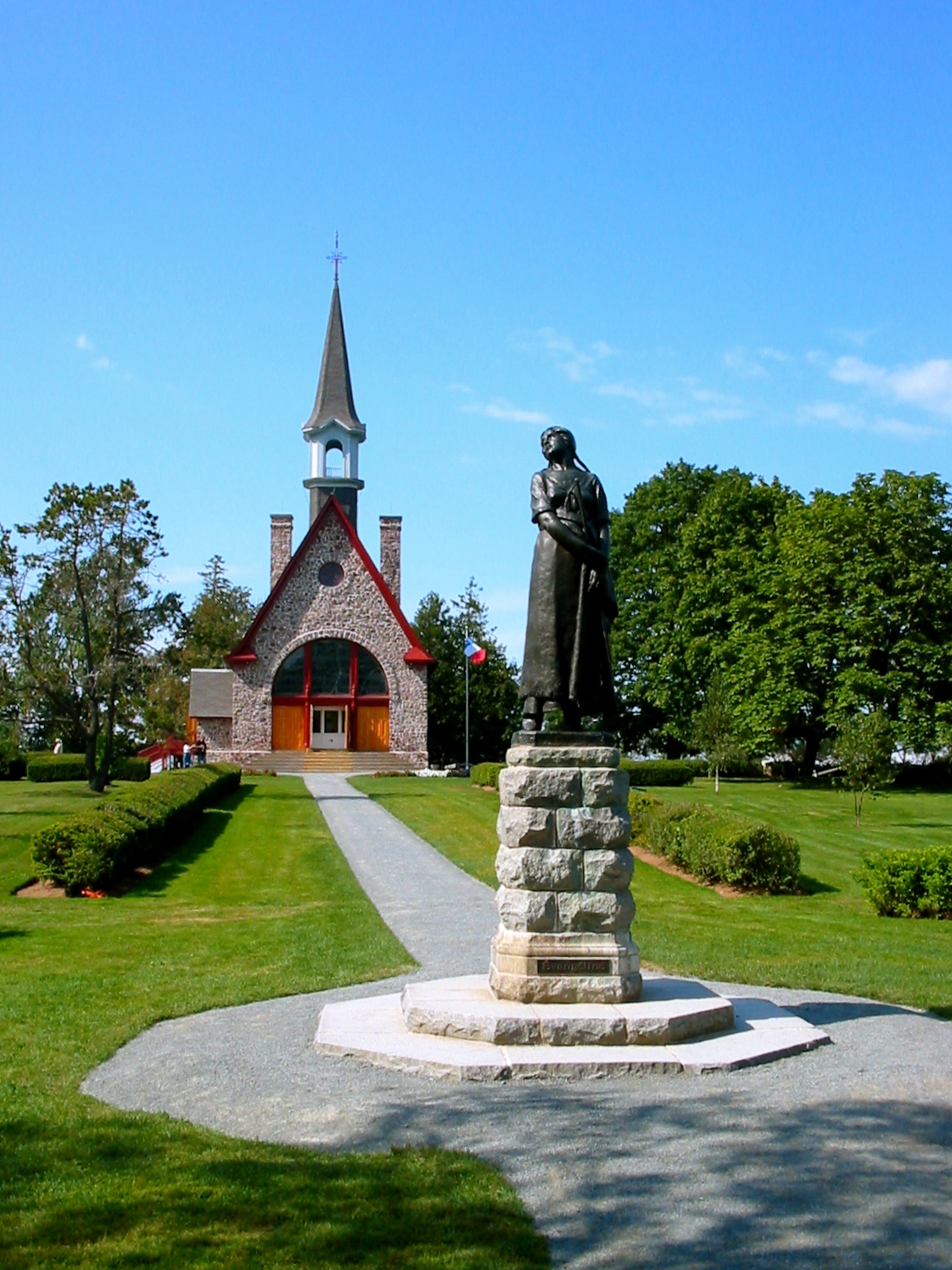
IMG_2167After reaching Nova Scotia, my dad and I made our way from Halifax to the Grand-Pré National Historic Site. Here, a church stands to commemorate the site where Colonel John Winslow rounded up the local men and boys to declare the terms of the deportation. A statue of Evangeline, Longfellow’s fictional Acadian heroine who became separated from her lover, stands here as well. We were fortunate to visit Nova Scotia in 2004, the 400th anniversary of French settlement in North America, as we were able to see a musical performance of Evangeline in Pointe-de-l’Église.

IMG_2193We also paid a visit to the Port-Royal National Historic Site, located at the site of the original 1605 habitation that was France’s first successful settlement on North American soil. Port Royal held a wealth of information about this hardy settlement, and it was interesting to explore. We were particularly amused to find an artist’s rendition of one of our more illustrious ancestors, Louis Hebert, within the habitation; he served as an apothecary there before venturing on to New France.

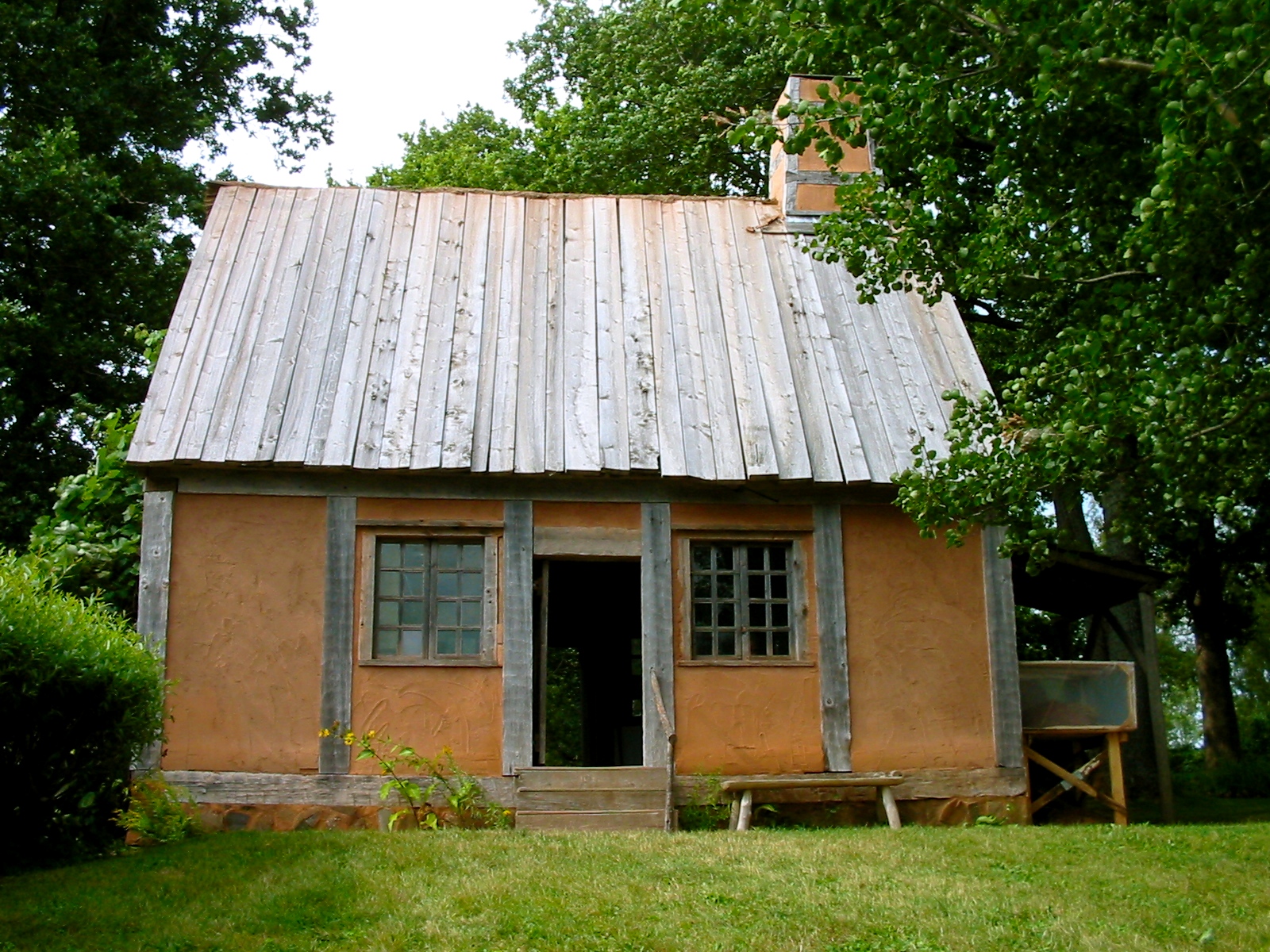
IMG_2249We spent another afternoon strolling through the beautiful Annapolis Royal Historic Gardens, where we were able to explore a reconstruction of a typical 1671 Acadian home. The comfortable cottage featured a thatched roof and beds that each had their own cozy cupboard doors. It was fun to see how the Acadians lived as well as what they ate, as we did when we stopped by the charming farmhouse restaurant Chez Christophe for some excellent seafood and rappie pie, an Acadian specialty.

IMG_2236The Fort Anne National Historic Site overlooks the Annapolis Basin, which is from where at least one of our ancestors, Joseph Michel, was deported. Fort Anne saw conflict in the French and Indian War, the American Revolution, and the War of 1812, and it was another well-kept and informative site. We were a bit thrown off when we thought we recognized the historical interpreter as having also been at Port Royal, but as it turned out, the two men were twin brothers, and apparently used to double takes!

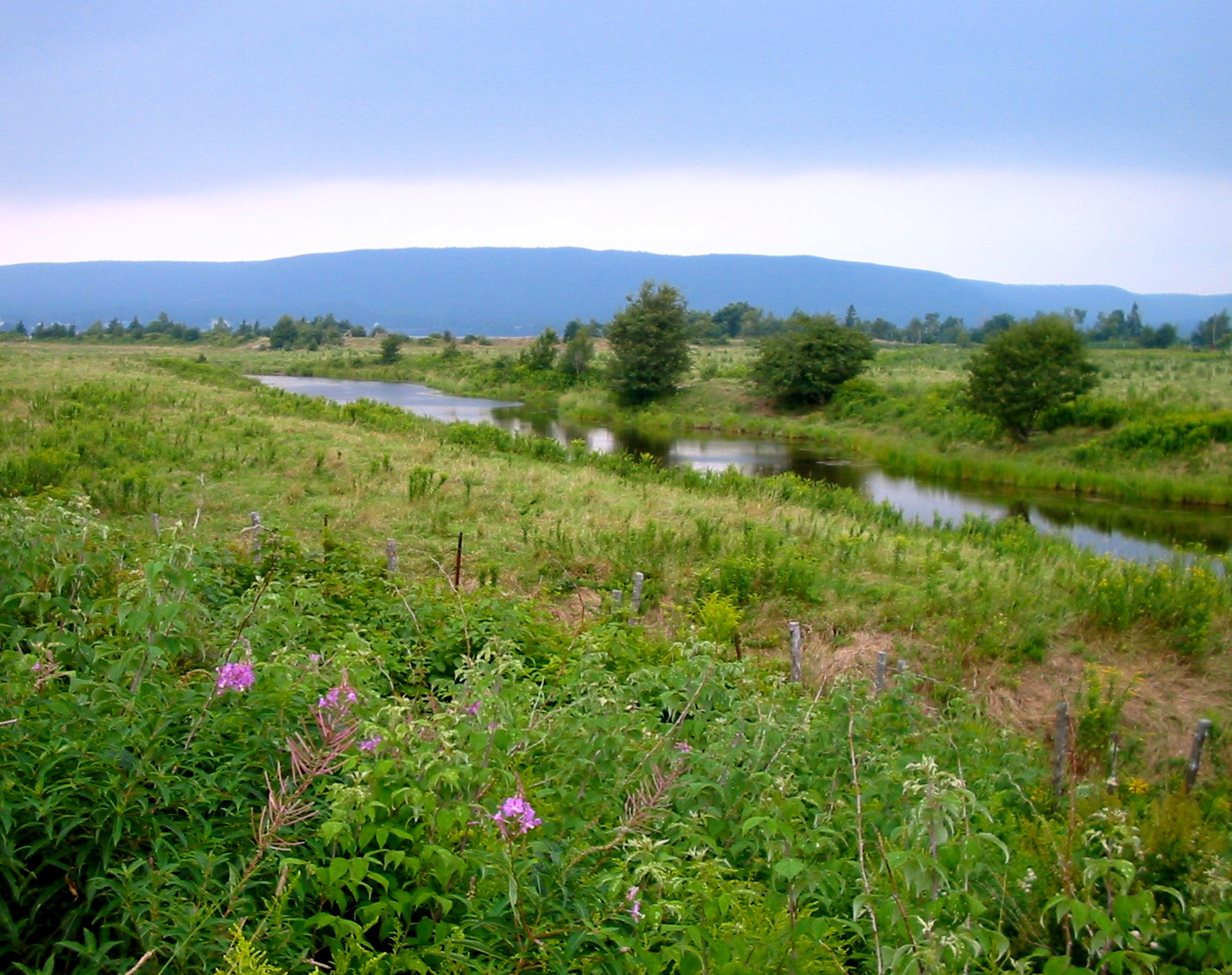
IMG_2272Last but not least, we made a point of walking on some of the land where our ancestors had farmed centuries before. Nova Scotia, as it turns out, is well prepared for this type of tourism, with maps at the ready – both paper and of the trail side marker variety – indicating where the properties affiliated with different Acadian surnames were once located. Nova Scotia remains quite rural, and it was wonderful to be able to picture our ancestors’ lives so clearly with much of the land still undeveloped.

After seeing a few more sites in Nova Scotia, my dad and I returned home laden with pictures, maps, brochures, books, recipes, and Acadian and Cajun music, as well as an Acadian flag and the occasional unintentional burst of an Acadian accent. Of course, it was also all too easy to see why our ancestors would not have wanted to leave their homeland, and why some Acadians underwent great hardship in order to return.

Although our direct ancestors, who were deported to Massachusetts, ultimately settled in Quebec, it is certainly telling that they named their new home l’Acadie.

Wedding Wednesday: The Parish Church

    "St. Peter's Church, Gamston," 2007, Gamston, Nottinghamshire, England; Wikimedia Commons, copyright Richard Croft.

“St. Peter’s Church, Gamston,” 2007, Gamston, Nottinghamshire, England; Wikimedia Commons, copyright Richard Croft.

It would have come as no surprise to the congregation of the parish church of Gamston, Nottinghamshire, England when a shoemaker’s son and a cottager’s daughter married on 14 April 1840.1 For three consecutive Sundays, the banns had been read by the church rector, and as no impediments arose in response to his announcement of the couple’s intentions,2 they were married on the Tuesday before Easter.3

John Fenton and Ann Bowskill (also spelled Bouskill), a bachelor and spinster “of full age,” had their union solemnized in the parish church of Gamston, also known as St. Peter’s Church.4 Just a few years earlier, it had been described in a local gazetteer as a historic but perhaps somewhat dilapidated structure: “The Church dedicated to St. Peter, ‘has once been antique,’ but its brasses have been all destroyed or stolen, and its sculptured ornaments are hid behind many coats of whitewash.”5 St. Peter’s Church dates to the thirteenth century, and received what was apparently a much needed restoration in 1855.6

Gamston, located near the community of Retford, was described as “a good village on the east bank of the Idle, where there is a corn mill and a candlewick manufactory.”7 John and Ann did not remain here in Ann’s hometown following their marriage, however, nor did they return to Bole, where John’s father was the village shoemaker.8 In fact, they seemed intent on pursuing opportunities of their own, as within a year of their marriage, they settled in Worksop, about ten miles northwest of Gamston.9

It would have taken the couple several hours on foot to reach Worksop from Gamston, but a pleasant view would have awaited them upon their arrival:

“On the approach from the east, the appearance of the town, lying in a valley, overtopped by the magnificent towers of the church, and baked by swelling hills finely clothed with wood, is extremely picturesque. Its situation is indeed delightful, and both nature and art have contributed to its beauty, for the houses are in general well built; the two principle streets spacious and well paved, and the inns clean and comfortable […]”10

Worksop was deemed a “clean and pleasant market town,” and if John, described as a laborer in the 1841 census, was not already trained in another profession, he may have found employment in agriculture, at a malt kiln, or at one of the many corn mills.11 It was in Worksop that the couple’s eldest children were born, before, within a decade, they immigrated to America.12

Continue reading

Military Monday: A Duty to His Family

Today marks the World War I centenary, although it would be a few more years before Ole James Nelson, a young farmer from rural Yankton County, South Dakota, would make his way overseas as a mechanic with the U.S. Navy Aviation Section.

Ole enlisted on 3 May 1917 at the age of twenty-two, within a month of the United States entering the war.1 According to a county history, he served in Eastleigh, Hampshire, England.2 His journey to Eastleigh, however, may have been a roundabout one; in fact, he may not have left American soil for at least a year after his enlistment. One photograph suggests that he completed his training in Buffalo, New York;3 another photograph was sent to his family from Charleston, South Carolina, in May of 1918.4 That October, his sister wrote to him, commenting, “Wonder if you are still at Quebec.”5

SCAN0858

Ole Nelson, Charleston, South Carolina, 1918; digital image 2013, privately held by Melanie Frick, 2014.

Ole’s time in Eastleigh was likely brief. The United States Navy established a naval air station in Eastleigh in July of 1918 to assemble and repair aircraft, including Caproni Ca.5 and Airco DH.4 and DH.9 bombers.6 This, almost certainly, is how Ole made use of his time as a mechanic. The base was in operation, however, for only a matter of months, as it closed following the armistice later that year.7

As it turned out, Ole’s days in the service were numbered, although not because the “war to end all wars” was winding down. After receiving notification of his father’s unexpected death, which had taken place a matter of days before the armistice,8 Ole applied for an honorable discharge, which was granted on 29 January 1919.9 As the eldest son, Ole was to return home to manage his family’s farm and to care for his mother and younger siblings; what he did not learn until his return, however, was that one of his sisters had also passed away in his absence, having succumbed to what was said to be a combination of Spanish Influenza and shock at the death of her father.10

A return to the farm, following what must have been an exciting time in this young man’s life, was perhaps not what Ole had initially had in mind for his future, but after duty to his country, he had a duty to his family.

Continue reading

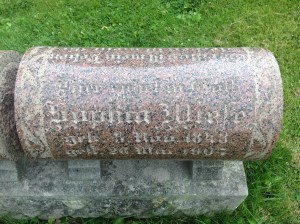
Tombstone Tuesday: Joachim and Sophia (Cammin) Wiese

It can often feel like a lost cause to submit Find A Grave Photo Requests for graves that are situated in enormous, urban cemeteries, but as I learned last week, when an anonymous contributor answered my plea for two photographs from Concordia Cemetery in Cook County, Illinois, it is possible to get lucky.

Joachim Wiese Grave

Find A Grave, Inc., Find A Grave, digital image (http://www.findagrave.com : accessed 13 July 2014), photograph, Joachim Wiese (1841-1915), Memorial No. 123360232, Concordia Cemetery, Forest Park, Cook, Illinois; photograph by Anonymous, 2014. Note: The German script reads, “Hier ruhet in Gott” [Here rests in God].

Joachim and Sophia (Cammin) Wiese were Pomeranian immigrants who spent most of their adult lives in Chicago, Cook County, Illinois. On 1 November 1868, accompanied by their young son, Frederick “Fritz” Wiese, and a host of other relatives, they boarded the Electric in the great port of Hamburg.1 Their voyage lasted nearly two months; they arrived in New York the day after Christmas, 1868.2

Apparently without further ado, the family made their way to the Midwest. 1870 found them living in the urban center of Chicago, where Joachim was employed as a day laborer.3 The Chicago Fire of 1871 must have had an impact on their early years in the city; the family belonged to the predominantly German First Bethlehem Lutheran Church,4 established in an area that was developed in the years following the fire.5 By 1880, Joachim Wiese was employed as a tailor,6 a trade he continued at least for the next two decades.7 Perhaps Sophia was able to assist her husband with his work, in addition to raising their children.

Sophia Wiese Grave

Find A Grave, Inc., Find A Grave, digital image (http://www.findagrave.com : accessed 13 July 2014), photograph, Sophia Wiese (1843-1907), Memorial No. 123360289, Concordia Cemetery, Forest Park, Cook, Illinois; photograph by Anonymous, 2014. Note: The German script reads, “Hier ruhet in Gott” [Here rests in God].

In all, six children were born to the Wiese family: Frederick (1866-1914),8 Mary (1870),9 John C. (1873-1943),10 Minna (1876-1945),11 William (1879-1882),12 and Arthur Louis (1886-1932).13 Five children survived to adulthood; sadly, William died of diphtheria at the age of two.14

Sophia (Cammin) Wiese died of pneumonia at their home on Marion Place on 26 May 1907, at which time she was said to be sixty-four years of age.15 Joachim Wiese died at home on 2 June 1915 at seventy-four years of age.16 Their funeral services were held at the First Bethlehem Lutheran Church, and they are buried beside their son at Concordia Cemetery in Forest Park, Cook County, Illinois.

Continue reading

A Golden Anniversary Celebration

One warm afternoon during the summer of 1902, a crowd gathered at the home of local pioneers Niels and Juliane Sophie (Hennike) Olsen. The couple, who had retired from farm life several years before, was celebrating fifty years of marriage, and all of their children and grandchildren were invited to their home located near the center of town at 605 Broadway in Yankton, South Dakota.1 The event was surely a memorable affair, and the local newspaper gave a glowing report of the afternoon’s activities:

Mr. and Mrs. Nels Olson celebrated their golden wedding yesterday afternoon at their home on Broadway. All their children, eight in number, were present with their families. Their names are as follows; Ole Nelson, Mission Hill; John Nelson, Viborg; Christ Nelson, Lakeport; Fred Nelson, Lakeport; Mrs. J. Nissen, Yankton; Mrs. C. Calleson, Yankton; and Miss Helena Nelson, Yankton. Rev. C.K. Solberg spoke a few words appropriate to the occasion and presented to the venerable couple two fine presents from the children, a gold headed cane to “father” and pair of gold glasses to “mother.” The “old folks” came from Denmark in 1874 and made their first home in America near Lakeport, S.D. Eight years ago they moved to Yankton, their present home. They are in fairly good health and enjoy comfort and happiness surrounded by kind children.2

Niels Olsen and Juliane Sophie Hennecke had married in Haraldsted, Soro, Denmark, on 30 July 1852.3 For the first twenty-two years of their married life, they resided in Denmark; their twenty-second anniversary, however, was spent aboard ship as they ventured to America.4 Their years since had been spent in southeastern South Dakota, where they claimed a homestead and where Niels had recently served a term as a rural postmaster. All eight of their surviving children remained in the area, and to commemorate their fiftieth anniversary, an informal group photograph was arranged on the porch of their home beneath the shade of several large trees.

Olsen Golden Anniversary

Olsen Golden Anniversary, Yankton, South Dakota, July 1902; digital image 2010, privately held by Melanie Frick, 2014.

The couple of honor is seated near the center, surrounded by those in attendance. Niels wears a wool three-piece suit and tie, as do most of the men, while Juliane wears a patterned shirtwaist with a bow at the neckline. Patterned, striped, or light-colored cotton fabrics seem to be popular choices among the women for their summertime wear. The adults, including the couple’s children, sit or stand in two rows, and three infants are perched on laps. Nine young grandchildren – including four sisters in matching dresses – cram together in the front, sitting cross-legged on the wooden plank floorboards. The group is relaxed; there are a few smiles, several women cross their arms comfortably, and a few maternal faces are turned away from the camera, intent on minding the couple’s many grandchildren.

I have to hope that this well-dressed crowd had the opportunity to partake in some refreshing lemonade in honor of the occasion!

In the back row, from left to right, are Reverend Solberg, Mrs. Solberg, Harry Nissen, Fred Nelson, Ole Nielsen, Harry Nielsen, John Nielsen, Eric Boysen, unknown, and Chris Callesen. In the middle row, from left to right, are unknown, Dora Nissen, Cleora Nielsen, Hannah Nielsen, Stena Callesen, Cecilia Boysen, J. Chris Nelson, Niels Olsen, Juliana Olsen, Helena Olsen, Jennie Nelson, Edith Nelson (child), Christine Nelson, and Helen Nelson (child). In the front row, from left to right, are Robert Nelson, Anna Nelson, Louise Nelson, Andrea Nelson, Julia Nelson, Bessie Nelson, Ole Nelson, Alvin Nielsen, and George Boysen.5

Continue reading

Back to the Land: Finding an Ancestor’s Iowa Homestead

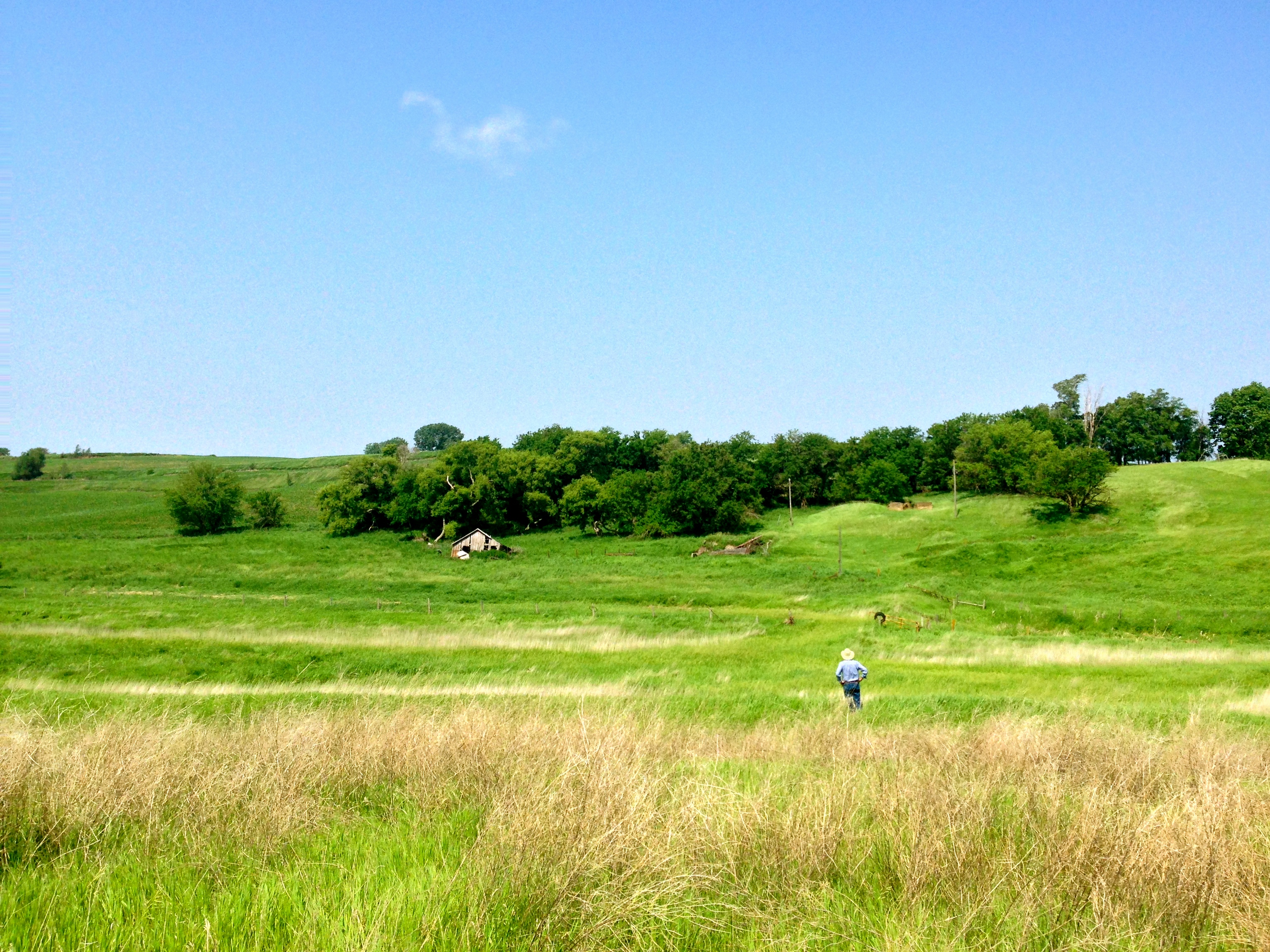
While tracking down the exact location of your ancestor’s land may seem daunting, last month, I learned that it’s entirely possible to get from this: Timothy Adam BLM…to this:

IMG_3409

Timothy Adam Homestead Site, Moville Township, Woodbury County, Iowa; digital image 2014, privately held by Melanie Frick, 2014.

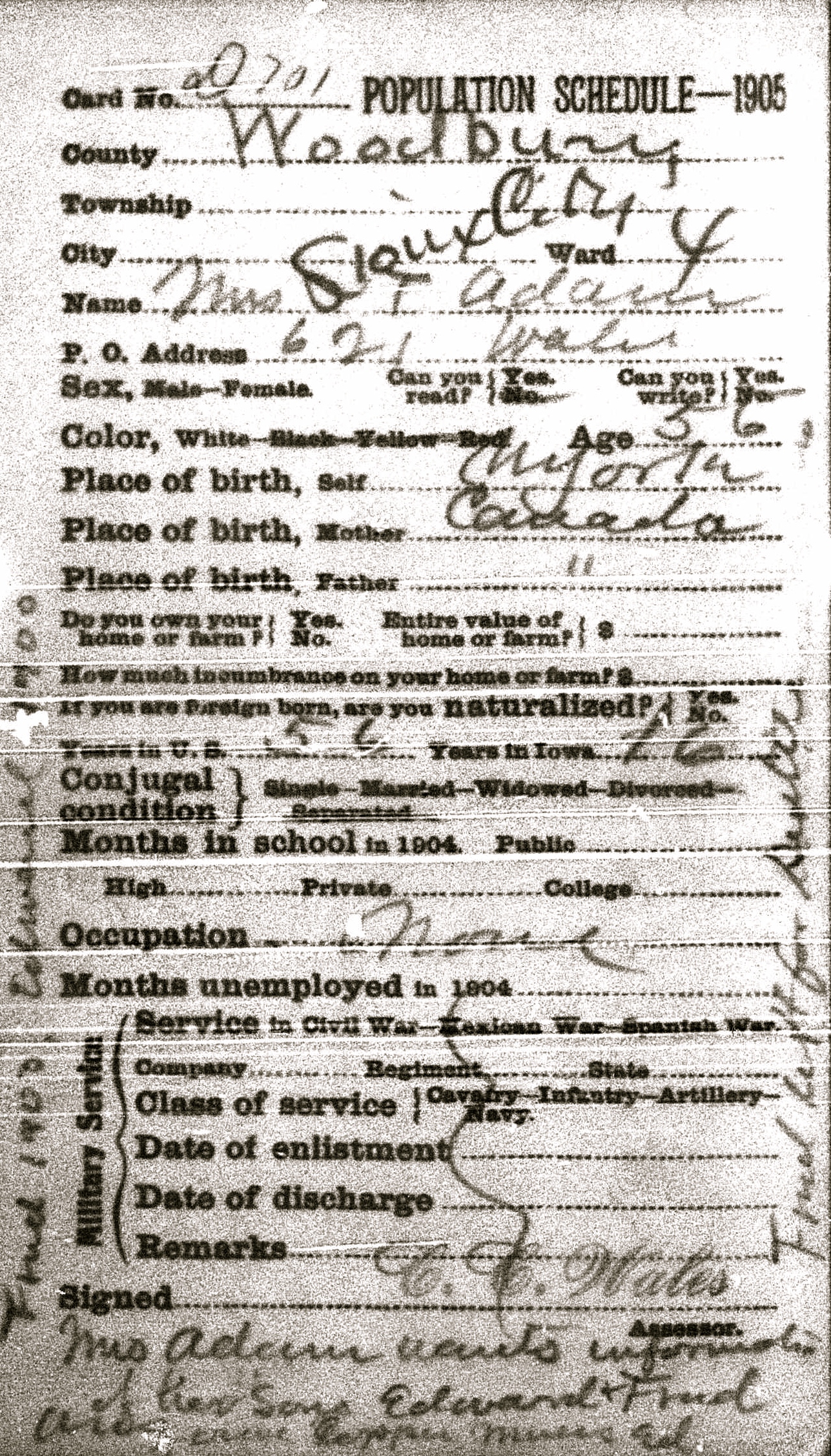
It wasn’t until recently that I learned that my ancestor Timothy Adam homesteaded in Woodbury County, Iowa.1 I was excited to find that his homestead was just a short hop from the Woodbury County Fairgrounds in rural Moville Township, making it an area that, thanks to my years in 4-H, is familiar to me. I thought how funny it would be if I would happen to know who lived on his land today.

That thought remained in the back of my mind as I prepared to plot the location of the NE ¼ of Section 29, information obtained online from the Bureau of Land Management General Land Office Records and verified in record copies from the National Archives. Armed with the legal land description, I turned to the Plat Book of Woodbury County, Iowa, available online through the Iowa Digital Library.

After locating the quarter section where the Adam family spent the latter part of the nineteenth century, I took note of any landmarks – including nearby towns, roads, and waterways – that would help pinpoint the homestead site on a modern map. As Moville Township is still comprised of farmland broken into the orderly squares that make up the Midwest’s patchwork landscape, it was easy enough to identify the right quarter section via satellite image on Google Maps.

Timothy Adam Google MapsAfter zooming in on a grove of trees on the appropriate quarter, it was even possible to see that there was an old home site located there. Thank you, Google Maps!

Timothy Adam Home Site Google MapsThe next step, of course, was to visit the land where Timothy and Odile (Millette) Adam, pictured here, once lived. My parents and I embarked on an expedition to the back roads southeast of Moville, where we stopped at a neighboring farm to ask if we might have permission to trek to the home site. There, we discovered that the owners were, indeed, a family that we knew from 4-H! Despite the shock of us showing up on her doorstep for perhaps the most unexpected reason imaginable, our friend kindly gave us permission to take a shortcut across the pasture with our truck.

According to a local newspaper, a tornado that hit the area in 1928 was said to have caused significant damage to what remained of the homestead: “Southwest of Moville on the old Timothy Adam farm now owned by W. H. Rawson trees in the orchard were uprooted, corn crib, machine shed, barn, hog house and chicken house were swept away. The house is the only building left standing.”2 Today, not even a house remains, but it was fascinating to explore the old foundations and to imagine just how little, perhaps, the view from the homestead had changed.

IMG_3431

Timothy Adam Homestead Site, Moville Township, Woodbury County, Iowa; digital image 2014, privately held by Melanie Frick, 2014.

Continue reading

Dressing Well in Dakota Territory

SCAN0009

Christine Marie [Schmidt] Nelson,  Yankton County, Dakota Territory, ca. 1886-1888; digital image 2013, privately held by Melanie Frick, 2014.

Christine Marie Schmidt, spelled “Christiane” on the back of this photograph and called “Dana” by her close friends, would not have remembered Denmark, as she was still an infant when she accompanied her parents to America in June of 1870.1 Her father homesteaded in Dakota Territory later that year, and Christine grew up a hardworking farm girl on the prairie near what is now Tabor, Bon Homme County, South Dakota.2

This photograph may have been taken in Yankton, the onetime capital of Dakota Territory located a dozen or so miles east of the family’s homestead. Christine’s hair is styled in true 1880s fashion with frizzled bangs – which could not have been easy to achieve – and a smooth high bun.3 She wears what looks to be a heavy pleated dress with velvet panels adorning the bodice vertically from shoulder to waist.4 The same velvet trims the collar and cuffs, where a white under-layer peeks out. No fewer than twelve large buttons adorn her dress, and a horizontal pin is affixed to the stylish high collar. Christine is clearly corseted to enhance her hourglass figure.5

Christine married in the spring of 1890 at the age of twenty-one; her wedding portrait suggests that she was a bit younger when this photograph was taken.6 My guess is that she was about eighteen, give or take a year, dating this photograph circa 1886-1888. Although green cardstock, as seen on this cabinet card, technically peaked in popularity several years earlier,7 another photograph from my personal collection with cardstock of the same dark green color dates to approximately 1889. Its popularity may well have been ongoing, at least in the Midwest.

Christine almost certainly sewed her dress herself, likely in the company of her mother and older sister, and she stands so as to display it to its best advantage. A subtle painted backdrop nearly touches the floor behind her as she rests her left hand on the back of an upholstered chair, gazing into the distance. In spite of her rural upbringing, Christine strikes an elegant pose, demonstrating that the latest fashions had found a place even in Dakota Territory.

Continue reading

Wedding Wednesday: A Question of Nationality

I’m not sure if it was meant as a joke, or if newlyweds Gerald and Fern (Thoma) Adam of Sioux City, Woodbury County, Iowa were genuinely confused. When asked to state their nationalities at the time of their marriage, their answers should have been simple; they were the American-born children of American-born parents, after all, so there was really no question that they were American themselves. Jerry, however, stated that he was of French nationality, while Fern declared that she was German-English.1

GeraldAdam1929

Gerald Joseph Adam, Sioux City, Iowa, ca. 1929; digital image 2012, privately held by Melanie Frick, 2014.

FernThomaAdam1929

Fern Lavonne Thoma, Sioux City, Iowa, ca. 1929; digital image 2012, privately held by Melanie Frick, 2014.

From a genealogical perspective, I love it. How often does one have the chance to learn what their forebears knew of their own ancestry? However, if I didn’t already know so much about this couple and their heritage, I might have been thrown off. Jerry’s ancestry was indeed French – and French Canadian, and Polish. Fern’s ancestors, many of whom were likely early arrivals on American soil, can thus far be traced to Germany and the British Isles.

I don’t know when exactly the couple met while on their way downtown to the movie theater, but Jerry and Fern married in their hometown on 8 June 1929 – eighty-five years ago this week.2 Fern was twenty-one, and although Jerry would not celebrate his twenty-first birthday for eleven more days,3 he claimed to be the same age as Fern.4 Their wedding attendants were close friends Merle Montgomery and Dorothy Thompson,5 and, following their ceremony, led by Reverend R. M. LeCair of St. Jean Baptiste Church, the couple took a “motor trip” to the Black Hills of South Dakota.6

Gerald_Adam_Fern_Thoma_Marriage_1929

“Iowa, Marriage Records, 1923-1937,” digital images, Ancestry.com (http://www.ancestry.com : accessed 10 June 2014), Gerald Adam and Fern Thoma, 8 June 1929, Sioux City; citing “Iowa Marriage Records, 1923–37,” microfilm, State Historical Society of Iowa, Des Moines.

If your ancestors married in Iowa between 1923 and 1937, be sure to visit Ancestry.com’s digital image collection, “Iowa, Marriage Records, 1923-1937,” new this year. This database has plenty of detail to offer, as marriage records included such information as age, place of residence, occupation, place of birth, father’s name, mother’s maiden name, number of marriages, and the names of the officiant and witnesses. It’s also an opportunity to see the signatures of the couple – likely the last time the bride would sign her maiden name. Have you found any surprises in this record set?

Continue reading

All Aboard Mr. Laughlin’s Palace Photo Car

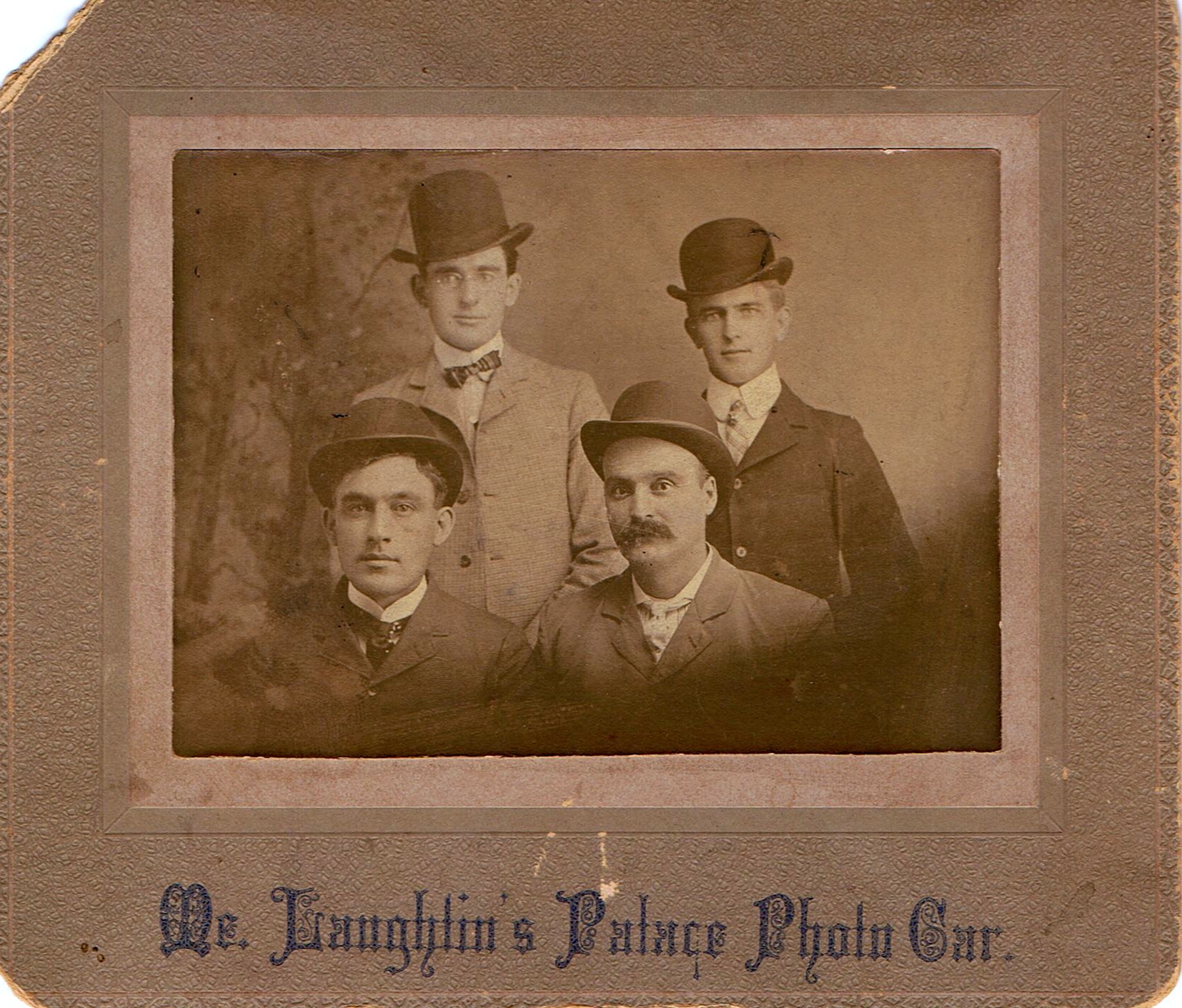
Not all photograph studios were stationary. Your ancestors may have had their photographs taken aboard a boat or even a specially outfitted railroad car, as did this group of gentlemen around the turn of the last century.

GeorgeHiramThoma

George Hiram Thoma a.k.a. George A. Neilson, top right, Iowa or Nebraska, ca. 1900; digital image 2010, privately held by Melanie Frick, 2014.

George Hiram Thoma, also known as George A. Neilson, is the slim, fair-haired young man pictured at top right in this photograph taken aboard Mr. Laughlin’s Palace Photo Car.1 George, born in 1880,2 was raised in Clayton County, Iowa,3 but his exact whereabouts during his late teenage years and early manhood are up for debate. He may have spent some time in Cedar County, Nebraska,6 before winding up in Osceola County, Iowa, where he married in 1902.5 This photograph was likely taken at a train station somewhere in northwestern Iowa or northeastern Nebraska circa 1900.

The men all wear dapper hats, jackets, and ties. The man next to George seems to be the trendsetter of the group with a check or plaid jacket, striped bow tie, eyeglasses, and his soft felt bowler or derby hat at a jaunty angle. The man at front right is the only one who is not clean shaven; he also appears to be somewhat older than the others.

Who were these men, and what were their relationships to one another? None bear a remarkable resemblance to George, with the exception, perhaps, of the man next to him. Perhaps the men were friends or business associates, although thanks to George’s elusive lifestyle prior to his marriage and his use of an alias, much is left to the imagination as to with whom, exactly, he may have associated.

Perhaps somewhere there exists another copy – or three – of this very photograph, taken long ago aboard Mr. Laughlin’s Palace Photo Car.

Continue reading

Military Monday: “Although he was on his Dieing Bed”

Compiled service record, John Fenton, Pvt. Co. M, 3 Illinois Inf.; Carded Records, Volunteer Organizations, Civil War; Records of the Adjutant General’s Office, 1780s-1917, Record Group 94; National Archives, Washington, D.C. Color edited for clarity.

Compiled service record, John Fenton, Pvt. Co. M, 3 Illinois Inf.; Carded Records, Volunteer Organizations, Civil War; Records of the Adjutant General’s Office, 1780s-1917, Record Group 94; National Archives, Washington, D.C. Image color edited for clarity.

As spring turned to summer in the year 1862, John Fenton of Company M of the 3rd Illinois U.S. Cavalry lay dying in a hospital bed in Lebanon, Laclede County, Missouri. He had enlisted the previous autumn, eager to do his part for the Union, but in April, following the Battle of Pea Ridge in Arkansas, he was hospitalized with typhoid pneumonia.1

At the time of his enlistment, John, a native of Bole, Nottinghamshire, England, was a widower with four children at home in Pana, Christian County, Illinois.2 After his death on 7 June 1862, A. W. Bingham, a hospital steward, penned a sympathetic but hurried letter to John’s eldest daughter, Sarah Alice Fenton, informing her of her father’s passing:3

“Lebanon, MO
June 7th 1862

Miss Fenton

You will be of course Serprised in Receiving a letter from one that never beheld your face or eaven had the honor of knowing your nam but through one that is or has been Dear to you your Father, he was admitted in this Hospital on the 22d day of April Sinse then he has been leaberin under Tyford Pneumonia which at last terminated in his death, which was at 7 Oclock this evening June the 7th he was a long time dieing and told me he wished me to write to you and all for him to put your confidence in christ and he hoped to meet you in the world to come he talked of and would of liked very much to see you but when god comes there is no alternative but to resign our will so he done so and diese in piece, you must not take it hard for we as soldiers have no limited time for our lives and when we enlist in our Countrys call we make up our mind to meet death when god thinks proper to call us away, your Father requests me to tell you also to collect what money was due him and put it to as good use as you thought people he wished you to see to the small children and bring them up in his fear and love of God which no doubt you will and he felt satisfyed you would do so, remembering he was your Father although he was on his dieing bed.

Continue reading