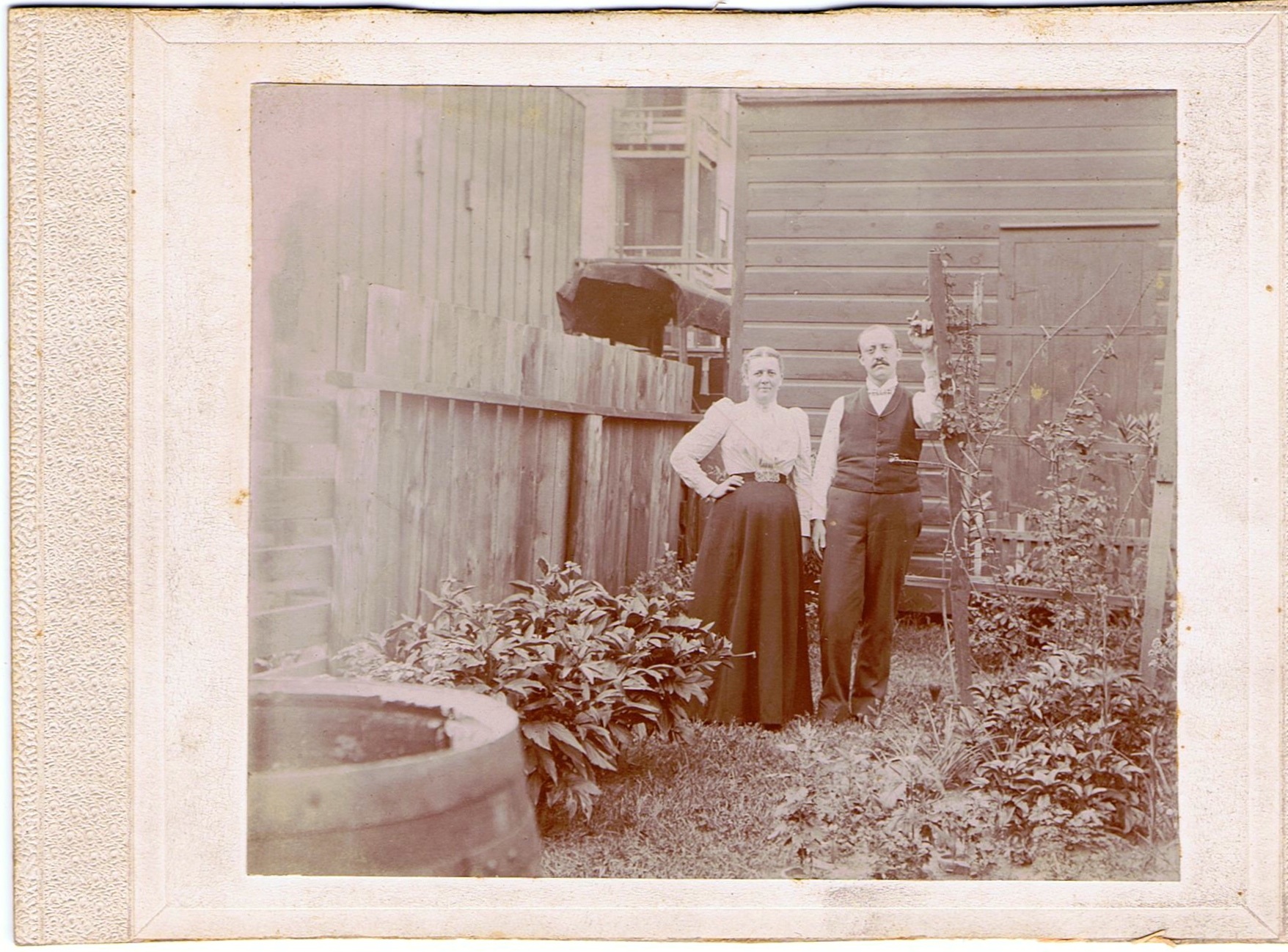
Fred and Emma (Stube) Wiese, ca. 1900; digital image 2010, privately held by Melanie Frick, 2014.
This glimpse into a backyard garden at the turn of the twentieth century features Fred and Emma (Stube) Wiese of Chicago, Cook County, Illinois. Fred rests his hand on a trellis while Emma stands close by his side, her hand on her hip. Their arms barely brush together as they gaze directly at the camera.
Emma wears everyday attire in the form of a simple dark skirt and a collared shirtwaist. Her skirt is belted high, with an adornment of some kind at the center of the waistband. It looks to me like she could have been pregnant at the time that this photograph was taken, which seems entirely possible as she was pregnant no less than five times between 1887 and 1900.1
However, Emma’s sleeves are not nearly as full as those seen during much of the 1890s, nor are they as tight as those of the decade prior. Perhaps this suggests that the photograph dates closer to 1900,2 which is when her youngest child was born.3 She and her husband were both in their early thirties at this time, and I don’t feel that they could have been significantly younger in this photograph.4
Fred wears somewhat loose trousers and a collared shirt, set off by a buttoned vest and a checked bow tie. Most notably, he sports a full mustache, and what hair he has is cut short. With the exception of his pants, which typically would be more fitted, this, too, fits the time period.5
The photograph, pasted on an embossed white card, is clear and of good quality, despite the fact that it is a seemingly casual shot. Might it have been taken by a traveling photographer who passed through the neighborhood, offering his services? Fred and Emma are not dressed in their best, although their simple attire was certainly presentable enough for a photograph. Perhaps their urban garden was a source of pride, making it an ideal spot for the couple to pose together.





 The conference opened yesterday after lunch with an introduction from Kimberly Powell, APG President, and a lecture from D. Joshua Taylor, who recently appeared in Genealogy Roadshow, “New Industries, New Worlds: Working for Entertainment and Corporate Clients.” As an audience member pointed out, much of his advice would also be applicable to everyday client research. For the remainder of the afternoon, I enjoyed Harold Henderson’s workshop, “The Story of Jethro’s Story: The Making of a NGSQ Article.” Writing for the National Genealogical Society Quarterly is definitely one of my long-term goals, and it was extremely helpful to have the process of crafting a research article broken down in a frank discussion.
 Homestead Genealogy