Tag Archives: Hammond

Fred the Farmer

Frederick Thoma might never have had any intention of becoming a farmer. Born on 04 December 1857 in Garnavillo, Clayton County, Iowa, Fred was the eldest of eleven children born to Bavarian immigrants Wilhelm Heinrich Thoma and Anna Margaretha Poesch. His father, a respected community leader, owned and operated a general store in the town of Garnavillo, which is where Fred and his siblings were raised. In 1876, when Fred was eighteen, his father died; three years later, on 29 December 1879, he married Matilda J. Hammond, the daughter of a prosperous local farmer.

Fred and Matilda, who were known familiarly as Fritz and Tillie, had five children: George Hiram (born 1880), Leonard Christopher (born 1885), Ludelia Maria (born 1887), Roselyn Anna (born 1892), and Norma Evaline (born 1895). All lived to adulthood with the exception of Norma, who died in a diphtheria outbreak at the age of ten. This was not the first time that Fred had lost a loved one to communicable disease: two of his brothers had died of consumption, both when they were twenty-four, in 1886 and 1890. One can imagine that each of these losses would have had a profound impact on Fred.

As a young married man, Fred was a store clerk in Garnavillo; according to local news clippings, he then, over the course of several years, opened an agricultural warehouse, carrying “a full line of cultivators, reapers, etc.,” and next operated a saloon or billiard hall, dealing in “pure Wines and Liquors, choice Cigars, etc.,” before briefly entering the “fruit and fancy grocery business.” By 1895, however, when he was thirty-seven, the census recorded that he was a laborer, and his occupation remained the same in both 1900 and 1905. It seems that his business endeavors were ultimately unsuccessful, and family lore gives a clue as to why.

Decades later, Fred’s granddaughter recalled that his vice was alcohol, noting that his eldest son had left home as a teenager for this reason, and also that Fred’s wife, upon receiving an inheritance from the estate of her parents, bought a farm in order to remove Fred from town and from the temptation of the saloon. Indeed, in March of 1910, a local newspaper reported that Matilda Thoma had purchased 80 acres from William D. Harnack and his wife for $4800, and by the time of the U.S. census that April, the couple resided on their farm in rural Clayton.

The move northeast from Garnavillo into rural Clayton Township was a distance of about five miles, and it brought Fred and Matilda closer to the family of their eldest daughter and son-in-law who also farmed there. Newspaper clippings make mention of Fred and his son-in-law engaging in farm work, participating in a barn raising, and hauling sand across the Mississippi River at Clayton.

A newly uncovered photograph of Fred Thoma—in fact, the only photograph of him known to exist—shows him as a mustachioed farmer in overalls and a brimmed hat, standing beside a team of horses in front of a two-story farmhouse. It’s a beautifully kept home, featuring, at the time this photograph was taken circa 1910-1924, an inviting front porch complete with a wicker rocker, potted plants, and vines growing on a trellis. The front porch shelters two front doors, and curtains can be seen at the windows. A screened-in back porch is also visible around the side of the house, and leafy tree branches frame the shot. Fred, photographed, perhaps, after a brief rest in the Windsor chair behind him, appears relaxed and has an amiable expression.

Frederick Thoma (1857-1925), Clayton, Clayton County, Iowa, circa 1910-1924; digital image 2024, privately held by Julie Jentz, 2024.


Fred and Matilda farmed in rural Clayton between 1910 and 1924, when Fred’s poor health necessitated their return to town. In the summer of 1924, Fred had spent some weeks at the Prairie du Chien Sanitarium, where, weakened from a bout of influenza and suffering from dropsy, he had sought medical attention; his health not improved, that fall he auctioned off his livestock and numerous farming implements in a public sale. Late in the year, he and Matilda resettled in the town of Clayton; they lived there for only two months, during which time they would have celebrated forty-five years of marriage, before Fred’s death at the age of sixty-seven on 10 January 1925. The funeral was held at St. Paul Lutheran Church in Garnavillo, with members of the Garnavillo Turnverein, a German-American social club of which he was a member, in attendance.

Fred’s career as a farmer may have made up less than a decade and a half of his adult life, but one can hope that these were at the least peaceful, pleasant years for him and his family—years during which Matilda was able to put to use her skills and knowledge from a childhood spent on a farm, and Fred was able to face fewer temptations, connect with his adult children and young grandchildren, and engage in fulfilling work. The farmhouse where he and Matilda spent these quiet years still stands today on Great River Road between Garnavillo and Clayton.

Copyright © 2025 Melanie Frick. All Rights Reserved.

Continue reading

Matilda the Midwife

“Matilda was a midwife,” so goes the family story, “and delivered a lot of babies in the county.” Despite a lack of definitive documentation, and almost certain lack of opportunity for any formal training, this nevertheless seems plausible. Matilda J. (Hammond) Thoma (1859-1947) of Clayton County, Iowa birthed five children of her own, and it does not seem unlikely that she might have assisted at the births of others in her close-knit community. She had numerous nieces and nephews whose births she might have supported, and she may even have served as midwife at the births of some of her own grandchildren. Indeed, it was her granddaughter Ina Fischer, born in 1907, who recalled nearly eighty years later that Matilda had been a midwife, and a 1920 newspaper announcement indicated that another granddaughter, Jacqueline Chaney, was in fact born at Matilda’s home.

Matilda (Hammond) Thoma and Franque (Friend) Curtis photograph, circa 1922, Clayton County, Iowa; digital image 2023, privately held by Melanie Frick, 2023.

Here, in one of only two photographs known to exist of Matilda, she poses with granddaughter Franque Friend. Matilda would have been in her early sixties at the time that this photograph was taken circa 1922; her hair, loosely coiled into a bun atop her head, seems to have gone mostly white. She wears a somewhat rumpled striped dress with buttons up the front and a wide collar in a contrasting fabric; this was not a studio portrait, but a casual snapshot apparently taken at home. Matilda appears to sit on a sofa near a window, a potted plant beside her, and striped wallpaper is visible in the background. She offers a small smile to the camera. Young Franque, perhaps ten years old here, stands next to her grandmother, grinning beneath the broad brim of a straw hat with a fringe of dark hair just peeking out. She wears a white dress with scalloped cuffs, a bow at the collar, and a leather belt.

Matilda, the daughter of Hiram H. Hammond (1813-1896) and Eva Margaret Stoehr (1831-1906), spent more than sixty-five years in Clayton County, Iowa, where she was born and later married Frederick Thoma (1857-1925). Four of their five children lived to adulthood; the youngest sadly died in a diphtheria outbreak at the age of ten. Following her husband’s death, Matilda eventually relocated, first to Texas with her daughter Roselyn and then to Wisconsin where she lived with her granddaughter Jacqueline. Few other details are known of her life, but what little is known suggests that she was a kind, competent, and maternal individual—just the sort to lend a hand as a midwife.

Copyright © 2023 Melanie Frick. All Rights Reserved.

Continue reading
An Iowa Ancestor Without a Church

Churches can be excellent sources of ancestral records, but determining an ancestor’s religious affiliation is not always straightforward—and, in some cases, an ancestor may not have been affiliated with a church all.

In the 1895 Iowa census, it was recorded that Hiram Hammond, an eighty-two year old retired farmer residing in Allamakee County, had no “religious belief.” This initially surprised me—wouldn’t it have been terribly unusual, even shameful, to openly declare a lack of religious belief at this time, particularly in a small Midwestern town? A quick scan of the neighbors recorded on the same page of the census, however, suggests that this may not have been the case. Out of thirty-one individuals recorded on a single page of this particular census, four others were noted to have no religious belief while one other was left blank. Those who did claim religious belief were either Lutheran, Methodist Episcopalian, or Congregational.

Hiram’s wife Eva Margaretha (née Stoehr) was recorded in the same census as being affiliated with the Lutheran church. As she was a German immigrant, this was not unexpected; decades earlier, she and Hiram had been married by a Lutheran minister. However, three of the couple’s four surviving adult children also appeared in the 1895 Iowa census, in separate households, and their affiliations differed from one another: their eldest son John was, like his father, recorded with no religious belief, while their daughter Mathilda was Lutheran and their daughter Louisa was Congregational. All three of their children’s spouses were Lutheran.

Marriage of Hiram Hammend [Hammond] and Margaretha Stoehr, 02 December 1854, St. Paul Lutheran Church, Garnavillo, Clayton County, Iowa; digitized photocopy courtesy of Ken Johnson, 2018.

Twenty years later—nineteen years after Hiram’s death, and nine years after Eva Margaretha’s—the same three adult children appeared in the 1915 Iowa census. This time, the space for John’s church affiliation was left blank, Mathilda was recorded as having no church affiliation, and Louisa was now Lutheran. It seems that Hiram’s apparent lack of interest in religion may have been shared by at least two of his children, if not three; son George lived out of state and was again not included in the Iowa census, so his affiliation is unknown.

Much of Hiram’s early life remains a mystery, and it is unknown whether he may have been affiliated with a church during the first thirty-odd years of his life before he wound up in Iowa Territory in 1845. After his death in 1896, the local newspaper printed an obituary that made no mention of any church affiliation, past or present, nor even a passing reference to Christianity in general. It did note positively Hiram’s success as a farmer and called him “a kindly neighbor and friend,” which leads me to believe that he was well-regarded in his community in any case. Hiram spent more than fifty years in northeastern Iowa, and his life as a farmer and father seems to have been a quiet one. It is believed that he was illiterate—his will was signed with a mark—and his name did not appear in local politics nor in a contemporary collection of local biographies.

Hiram’s funeral service, held at home, was led by Reverend Bargelt of the Methodist Episcopalian Church of Postville; this was the small town in which Hiram had retired several years prior. Perhaps Hiram did attend services at this church prior to his death—or what was perhaps more likely was that the reverend was a family friend simply performing a favor and following local custom. In contrast, his wife’s funeral services in 1906 were led by Reverend Puhl of the St. Paul Lutheran Church of Postville; Eva Margaretha’s affiliation with the Lutheran church had apparently remained constant throughout her adult life. If Hiram had not, perhaps, remained loyal to a hypothetical church of his boyhood, which lacked a presence in northeastern Iowa, then it seems plausible that he truly was a nineteenth-century “religious none.”

Copyright © 2021 Melanie Frick. All Rights Reserved.

Continue reading

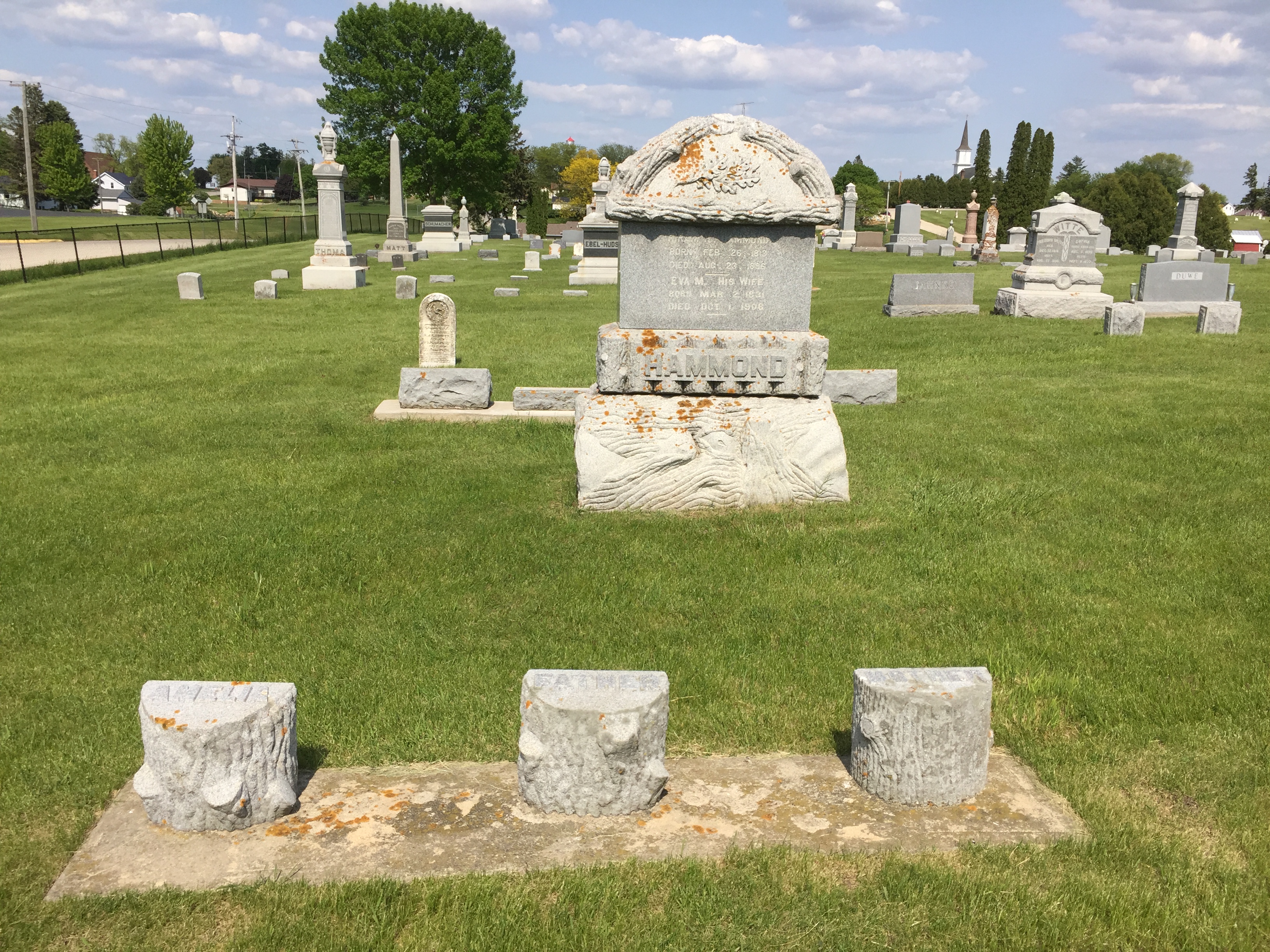
Tombstone Tuesday: Hiram and Eva Margaret (Stoehr) Hammond

Hiram and Eva Margaret (Stoehr) Hammond were a couple who, at the surface, appeared to have little in common.

Hiram, who was said to have been born on 26 February 1813 in Ohio, first appeared in public record when he purchased land in Jackson County, Iowa Territory in the spring of 1845.1 Presumed to be in his early thirties at this time, Hiram spent the next nine years honing his skills as a farmer before purchasing one hundred and sixty acres of land near Volga, Clayton County, Iowa.2 Although there are speculative connections potentially linking Hiram to the family of War of 1812 veteran Jonathan Hammond and his wife Lovisa Herrington, no connections have yet been verified.

Eva Margaret Stoehr, on the other hand, settled in Clayton County, Iowa alongside her parents and siblings.3 She was said to have been born on 02 March 1831 in Weißenstadt, Wunsiedel, Bavaria, the daughter of Lorenz Stoehr, a master tailor who was a veteran of the Napoleonic wars, and his wife Barbara Feicht.4 She immigrated to America aboard the Solon, arriving in New York in 1853, and settled alongside many from her home village in northeastern Iowa.5

Find A Grave, Inc., Find A Grave, digital image (http://www.findagrave.com : accessed 13 July 2014), photograph, Hiram H. Hammond (1813-1896), Memorial No. 84463650, and Eva M. (Stoehr) Hammond (1831-1906), Memorial No. 84463738, Garnavillo Community Cemetery, Garnavillo, Clayton County, Iowa; photograph by Ken Johnson, 2016. Note: The third headstone belongs to daughter Amelia Hammond (1857-1872).

When the couple married in Garnavillo, Clayton County, Iowa on 02 December 1854, Eva was likely just twenty-three years old while Hiram was forty-one.6 Although they were married by a German Lutheran minister, Hiram, unlike Eva, was neither German nor Lutheran.7 Eva was literate and came from a family of skilled craftsmen; Hiram was a farmer and could not write his own name.8 The couple went on to have the following known children: Amelia (1857-1872), Matilda J. (1859-1947), Louisa Barbara (1861-1936), John William (1865-1931), and George H. Hammond (1867-1934).9 In addition to losing their daughter Amelia when she was fourteen years old, it is believed that the couple lost two additional children at young ages.10

The Hammond family farmed near the community of Volga in Clayton County for thirty years, eventually moving to Henderson Prairie near Clermont, Fayette County, Iowa in early 1885.11 They saw success as farmers, and by 1893, as Hiram entered his eighties, he and Eva decided to retire to the nearby town of Postville, Allamakee County, Iowa.12

Despite their vast difference in age, language, and culture, these Iowa pioneers celebrated more than forty years of marriage together. Hiram H. Hammond died on 23 August 1896 in Postville, Allamakee County, Iowa, and Eva Margaret (Stoehr) Hammond died there a decade later on 01 October 1906, both having suffered cerebral hemorrhages.13 They are buried side by side in the Garnavillo Community Cemetery in Garnavillo, Clayton County, Iowa.14

Copyright © 2018 Melanie Frick. All Rights Reserved.
Continue reading

The Search for Y-DNA for Hiram H. Hammond

For years, about all I’ve known about the parents of Hiram H. Hammond has boiled down to the origins that were reported in four census records over a span of twenty-five years:

SOURCE FATHER MOTHER
1870 U.S. Federal Census1 Foreign Foreign
1880 U.S. Federal Census2 England Scotland
1885 Iowa State Census3 Native Native
1895 Iowa State Census4 Native Native

While Hiram, an Iowa farmer, was consistent in declaring that he was born circa 1813 in Ohio, he was apparently less certain about the origins of his parents. Or was he? Hiram may not have spoken for himself when the census enumerator came to the door; responses could have been given by his wife or another member of his household if he was not available. It’s also possible that some information might have been added by the enumerator after the fact, based on memory alone. Given that Hiram lived among many immigrants, his wife included, his parentage may have been presumed to be foreign as well.

In any case, this lack of consistency leaves me with questions today. Who am I looking for? Were Hiram’s father and mother born in England and Scotland, respectively? Or were they native-born with English and Scottish ancestral origins? If that’s the case, it would not be the first time that one of my ancestors took the question of nationality a little too far.

Now, however, I’m a bit closer to solving the mystery of Hiram’s parentage, thanks to a little something called Y-DNA. The Y chromosome, as explained by Family Tree DNA, “is passed almost unchanged from father to son,” so it can be useful in determining the origins of a surname and to make connections with cousins who share the same chromosome.5 In Hiram’s case, I hoped this would prove to be very useful.

Hiram is my fourth great grandfather; as I am descended from his daughter, thus immediately breaking the chain of father-to-son Y-DNA, I began tracing the descendants of his son with the hope of finding a living male relative who would be eligible to take a Y-DNA test. After reaching out to a distant Hammond-by-marriage in Iowa and an apparent game of hot potato with my letter of inquiry, I finally made contact with a Hammond-by-blood in Arkansas. Bingo! It was time to pull out the genetic guns, so to speak, and test this (wonderful! willing!) cousin’s Y-DNA.

There’s not much to be too excited about right now – as of yet, there are no matches on the 67-marker test – but there is always the chance that someone who shares Hiram’s Y-DNA will choose to test with Family Tree DNA in the future and in doing so establish a long-lost genetic connection. I’m prepared to monitor this account – and the Hammond DNA Project – for years, if that’s what it takes! A more pro-active approach, however, would be to find a living male descendant of another Hammond line that I suspect could be connected to Hiram.

“Old Log Cabin,” Jackson County, Iowa, 2010; digital image courtesy of user dadmw1, Panoramio, Google Maps. This cabin is situated approximately one mile south of the land purchased by Hiram H. Hammond in 1848.

My earliest records of Hiram H. Hammond come from his years in Jackson County, Iowa, where he acquired land in 1848. According to an 1852 Iowa census, Hiram was neighbor to an Andrew Hammond,6 and although Hiram moved away shortly thereafter,7 in 1854, Andrew remained in Jackson County with a new neighbor, Philow Hammond.8 I suspect that these Hammond men may have been sons of War of 1812 veteran Jonathan Hammond, who lived in Ohio, Hiram’s stated place of birth, during the appropriate period of time. Several of Jonathan’s other known sons include Orin Hammond, Reuben Hammond, and Lemuel Brooks Hammond, and intriguingly, a nephew also bears the somewhat distinctive name Hiram H. Hammond.9 However, more research is necessary to prove the relationships among the members of this particular Hammond family and to determine whether Hiram himself could feasibly be a relative.

If such a connection still seems plausible, or if another potential connection is found elsewhere on the paper trail, well, then it will be time to trace another line of male descendants for a willing Y-DNA test participant! 

Copyright © 2016 Melanie Frick. All Rights Reserved.

Continue reading

Tombstone Tuesday: Fred and Matilda (Hammond) Thoma

Fred and Matilda (Hammond) Thoma, or Fritz and Tillie as they were known in their community, spent their childhoods and the entirety of their married lives in the same rural county in northeastern Iowa. Fred Thoma was born to Bavarians Wilhelm Heinrich and Anna Margaretha (Poesch) Thoma on 4 December 1857 in Garnavillo, Clayton County, Iowa.1 Matilda Hammond was born to Hiram H. and Eva Margaret (Stoehr) Hammond on 4 May 1859 in Volga, Clayton County, Iowa.2 While Matilda’s father was a native of Ohio and an early settler in Iowa, her mother hailed from the same Bavarian village of Weißenstadt as Matilda’s in-laws.3

SCAN0126

Grave of Matilda Thoma (1857-1947) and Fred Thoma (1857-1924), Garnavillo Community Cemetery, Garnavillo, Clayton County, Iowa; image date unknown, privately held by Melanie Frick, 2015.

It seems likely that the couple crossed paths as children, although they lived in separate communities; the Weißenstadt immigrants were surely a close-knit bunch. Fred and Matilda married on 29 December 1879 at the Zion Evangelical Lutheran Church in Clayton Center.4 The next year found them living in Garnavillo, where Fred was a clerk in his late father’s country store.5 That autumn, the couple became parents to the first of their eventual five children: George Hiram, Leonard Christopher Julius, Ludelia Maria, Roselyn Anna, and Norma Evaline.6 All but Norma survived to adulthood; sadly, she died in a diphtheria outbreak when she was ten years old.7

What few details are known of Fred and Matilda’s lives come from recollections of their granddaughters.8 The first thirty years of their marriage were spent in the town of Garnavillo, where Fred later had a restaurant and then worked as a laborer.9 Matilda was said to have been a midwife who delivered many children in Clayton County, although such skills were not recorded in the census. Fred allegedly had a fondness for drink, so when Matilda received an inheritance, she bought a farm away from town – and the saloons.10 The empty nesters enjoyed life in the countryside for the next fifteen years until Fred’s death in Clayton on 10 January 1925.11

As a widow, Matilda spent time in the homes of her daughter and granddaughter. In 1930, she experienced a different climate in Houston, Texas; by 1940, she had returned to the Midwest and resided in Wisconsin.12 It was there in Bridgeport, Crawford County, Wisconsin that she died on 21 August 1947 when she was approaching ninety years of age. She is buried beside her husband at the Garnavillo Community Cemetery.13

Copyright © 2015 Melanie Frick. All Rights Reserved.

Continue reading

A Dastardly Act: Making the News in 1893

Mrs. Hiram Hammond barely had a chance to settle in to her retirement in the town of Postville, Allamakee County, Iowa, before an unfortunate event warranted her a mention in the local newspaper.1

PostvilleReview29May1893Hammond.jpg

“Local Review,” The Postville (Iowa) Weekly Review, 29 May 1893, p. 1, col. 4; digital images, Newspaper Archive (http://www.newspaperarchive.com : accessed 18 February 2014).

As reported in The Postville Weekly Review on 29 May 1893, “Some miserable sneak thief stole some potted house plants from the residence of Mrs. Hiram Hammond, on Tuesday night. The most contemptible part of it was that those not carried off were mashed and destroyed. They were left out of doors without thought of danger. A man that would do such a dastardly act is not a safe member of society in any respect.”2

Well then! I can only imagine that poor Mrs. Hiram Hammond – born Eva Margaret Stoehr – must have been most distressed at this unexpected turn of events. She had likely only recently moved to town, while her husband prepared to put their farm up for sale.3 Hiram had turned eighty that year, while his wife was over sixty.4 After years of labor on their farm, they must have looked forward to a quiet life in town.

Postville was certainly not a large community, yet apparently large enough that a man (or, perhaps much more likely, a teenage boy) could get away with a destructive prank. However, if this was the worst that Postville had to report, it seems that things really may not have been all that bad! One can only hope that in the years to come, Mrs. Hiram Hammond was able to enjoy her potted house plants without further incident.

What is one of your favorite stories about an ancestor that you’ve found in a historic newspaper database? There are several excellent databases out there; so far, I’ve had positive experiences with Chronicling America (free) and NewspaperArchive (subscription). Be aware that different databases may offer access to different areas and periods of coverage. Also be sure to find out whether your local library provides free access to any useful newspaper databases, which can often be accessed from home.

Continue reading

An Ancestor with an Alias

When I learned that George Hiram Thoma of Garnavillo, Clayton County, Iowa used an alias as a young man, it took me by surprise. He was born to Fred and Matilda (Hammond) Thoma in 1880,1 and the state census indicates that he remained in his home county in northeastern Iowa at least until 1895.2 At some point thereafter, according to family lore, George left home and bicycled across Iowa. Whether he went by bicycle or not, it was said that his move may have been spurred on by his poor relationship with his father.3

GeorgeHiramThoma

George Hiram Thoma, seated left, with an unidentified young man, ca. 1900; digital image 2013, privately held by Melanie Frick, 2014.

Records place George across the state in northwestern Iowa on 23 March 1902, at which time, using the name George A. Neilson, he married Anna Leota Fenton in Ashton, Osceola County, Iowa.4 This was no trick of penmanship or recorder’s error; three affidavits, written by George, his mother, and his younger brother, were attached to the marriage document decades later, each attesting to the fact that George A. Neilson and George Hiram Thoma were one and the same person.5 It is worth noting that George still named his correct place of birth and even the correct names of his parents on the original marriage document, with the exception, of course, of assigning the Neilson surname to them as well.6 Evidently, he was not prepared or had no reason to invent an elaborate backstory regarding his origins.

None of the affidavits, however, explained why George had married under an assumed name.7 One has to wonder whether his wife even knew what she was getting into! Prior to his marriage, I suspect that he might be found in the 1900 U.S. census as George Thoma, a clerk in Belden, Cedar County, Nebraska. Notably, he boarded with a family by the name of Nelson, and a Nielsen also resided in the household.8 Although this may or may not be the correct George Thoma, we do know that within weeks of his marriage, he moved to Center, Knox County, Nebraska, where he was an employee of the Edwards and Bradford Lumber Company.9

Within a few years of his marriage, George relocated with his family to Sioux City, Woodbury County, Iowa. There, his daughter’s birth was recorded with the surname Neilson,10 and according to the city directories, George continued to use his assumed name at least until 1909.11 I have been unable to locate the family in the 1910 U.S. census – they had likely left Sioux City by that time to return to Nebraska, where they moved from place to place for the next decade. However, they had certainly reverted to the use of the Thoma surname no later than World War I.12

Was this alias purely symbolic, in order to emphasize George’s separation from his father, or, perhaps, the ties that he forged with another family? Or was it part of an effort to hide, whether from his father, from love, or from the law? This is one family mystery that I would love to solve!

Continue reading

Across Generations: The Power of a Snapshot

If you will be spending the holidays with family this year, consider snapping a few two, three, or even four generation photographs, should you have the opportunity.

JackieRoselynMatildaHammondThoma

Jacqueline (Cuzins) Hedeman, Roselyn (Thoma) Friend Cuzins Chaney Bohringer, and Matilda (Hammond) Thoma, ca. 1938-1947; digital image 2010, privately held by Melanie Frick, 2013.

Why? This is one of only two photographs that I have of my third great grandmother, Matilda (Hammond) Thoma of Clayton County, Iowa. Matilda was born in 1859, and spent most of her life in the same county. She married and raised five children, four of whom survived to adulthood.1

Matilda is pictured here with her daughter, Roselyn, center, and her granddaughter, Jacqueline, left, who links arms with her mother. The occasion may not have seemed important at the time – only Jacqueline is facing the camera, and Roselyn and Matilda seem to have been caught unaware – but not only is this a rare photograph of Matilda, it’s also the only picture that I have of her with her daughter and granddaughter. This priceless three-generation photograph seems to have been a casual snapshot, likely taken by a family member.

After her husband’s death, Matilda lived with Roselyn in Texas,2 and later with Jacqueline in Wisconsin,3 suggesting that she had a close relationship with both women. This photograph was probably taken at some point after 1940, when Jacqueline would have turned twenty, or perhaps shortly before.4 Both Roselyn and Matilda passed away in 1947, Roselyn at age fifty-four,5 and Matilda at age eighty-eight.6

Seeing Matilda here with her daughter and granddaughter gives a glimpse into what she may have been like as a younger woman. Matilda wears a comfortable pinafore over a striped dress, her white hair fixed in a bun high on her head. Roselyn looks very much like her mother, right down to her nose and ears. She wears a short-sleeved eyelet dress. Jacqueline wears the bright lipstick of the era and a smart buttoned dress. Her sleeves are rolled up; it must have been a warm day. Jacqueline, too, resembles her mother, and, in turn, her grandmother.

I, for one, am very happy that someone just so happened to take this photograph. I’m even happier that this relatively flimsy print managed to survive seventy years. Even a snapshot can become a treasured family photograph.


SOURCES
1 1910 U.S. census, Clayton County, Iowa, population schedule, Guttenberg, enumeration district (ED) 209, sheet 4-B, p. 25 (penned), dwelling 76, family 77, Mathilda Thoma; digital image, Ancestry.com (http://www.ancestry.com : accessed 20 November 2013), citing National Archives microfilm publication T624, roll 397.
2 1930 U.S. census, Harris County, Texas, population schedule, Houston, enumeration district (ED) 209, sheet 5-B, p. 7201 (penned), dwelling 82, family 107, Mathilda Thoma; digital image, Ancestry.com (http://www.ancestry.com : accessed 20 November 2013), citing National Archives microfilm publication T626, roll 2349.
3 1940 U.S. census, Grant County, Wisconsin, population schedule, Wyalusing, enumeration district (ED) 22-56, sheet 1-A, p. 7201 (penned), dwelling 82, family 107, Matilda Thomas; digital image, Ancestry.com (http://www.ancestry.com : accessed 20 November 2013), citing National Archives microfilm publication T627, roll 4481.
4 “Iowa, County Births, 1880-1935,” index, FamilySearch (https://familysearch.org : accessed 20 November 2013), Jacquelin Thoma Cuzins, 1920.
5 “Texas, Deaths, 1890-1976,” index and images, FamilySearch (https://familysearch.org : accessed 20 November 2013), Roselyn Bohringer, 19 May 1947; citing certificate number 19651, State Registrar Office, Austin; FHL microfilm 2218598.
6 Wisconsin State Board of Health, death certificate, Matilda H. Thoma (1947), Vital Records Office, Madison.

An Iowa Farmer: Clues from the Agricultural Schedule

When Hiram H. Hammond of Postville, Allamakee, Iowa died in 1896 at the age of eighty-three, the local newspaper stated, “By constant application to his farm and frugal habits, Mr. Hammond acquired a comfortable competency.”1 Although it is believed that he was born in Belmont County, Ohio, little is known about Hiram Hammond before his debut as a farmer in northeastern Iowa.2 It is there that the paper trail begins, and agricultural schedules, an underutilized resource, offer fantastic detail about his experience.

HiramHammondAgriculture1850

1850 U.S. census, Jackson County, Iowa, agriculture schedule, Jackson, p. 299 (penned), line 29, Hyram Hammons; digital image, Ancestry.com (http://www.ancestry.com : accessed 23 October 2013), citing “Selected U.S. Federal Census Non-Population Schedules, 1850-1880.”

An 1848 land transaction placed Hiram Hammond in Jackson County, Iowa, which is located along the Mississippi River.3 In 1850, Hiram, 37, was recorded as a laborer in another household.4 He did not own any land, but he had five horses and one milch cow, together valued at $260. His farm machinery and implements were valued at $20. Hiram had harvested 100 bushels of wheat, 60 bushels of Indian corn, 75 bushels of oats, 10 bushels of peas and beans, and 6 tons of hay. He had also produced 100 pounds of butter, and the value of his animals slaughtered came to $20.5

By 1854, Hiram had moved on to nearby Clayton County, Iowa, where he married a German immigrant, Eva Margaret Stöhr, and started a family. In the years to come, Hiram saw success as a farmer,6 and, although seemingly absent in 1860, he appeared in the 1870 and 1880 U.S census and agricultural schedules.

In 1870, Hiram, 57, lived with his wife and five children under the age of twelve.7 His farm was valued at $2500 and his livestock at $1400; he possessed 180 acres of land, the majority of which was woodland. Hiram also owned fourteen sheep, eight horses, seven swine, seven cattle, and six milch cows. He produced 300 pounds of butter, and 75 pounds of honey.8 In 1880, his farm was valued at $3240; although his acreage was smaller than in 1870, more land was in use. The value of his farm productions of the past year came to $1461.9 All told, this was a far cry from Hiram’s first appearance in the agricultural schedule.

Hiram continued to farm throughout his seventies. Eventually, he and his family moved to nearby Fayette County, before, as Hiram neared eighty, he and his wife retired to town.10 In 1893, he advertised the sale of his farm, “comprising 200 acres, situated two and a quarter miles from Postville on the Clermont road.”11

How can you learn more about your ancestor’s farm? Agricultural Schedules were recorded from 1850-1880, and provide a wealth of information about the land, livestock, crops, and other farm productions, from butter and cheese to maple syrup and honey, of your ancestor. Search for your ancestor through “Selected U.S. Federal Census Non-Population Schedules, 1850-1880” on Ancestry.com. Be aware that the agricultural schedules may span two pages, and consider comparing your ancestor’s farming operation to those of their neighbors. How did they measure up?


SOURCES
1 “Gone to Their Rest,” The Graphic (Postville, Iowa), 27 August 1896, p. 1, col. 3; digital images, Newspaper Archive (http://www.newspaperarchive.com : accessed 23 October 2013).
2 “Gone to Their Rest,” The Graphic (Postville, Iowa), 27 August 1896, p. 1, col. 3.
3 U.S. Bureau of Land Management, “Patent Search,” database, General Land Office Records (http://www.glorecords.blm.gov : accessed 23 October 2013), entry for Hiram Hammond, Dubuque land office, doc. no. 4358.
4 1850 U.S. census, Jackson County, Iowa, population schedule, Jackson, sheet 294-B, dwelling 187, family 187, Hiram Hammons; digital image, Ancestry.com (http://www.ancestry.com : accessed 23 October 2013), citing National Archives microfilm M432, roll 124.
5 1850 U.S. census, Jackson County, Iowa, agriculture schedule, Jackson, p. 299 (penned), line 29, Hyram Hammons; digital image, Ancestry.com (http://www.ancestry.com : accessed 23 October 2013), citing “Selected U.S. Federal Census Non-Population Schedules, 1850-1880.”
6 “Gone to Their Rest,” The Graphic (Postville, Iowa), 27 August 1896, p. 1, col. 3.
7 1870 U.S. census, Clayton County, Iowa, population schedule, Volga, p. 6 (penned), dwelling 39, family 40, Hiram Hammond; digital image, Ancestry.com (http://www.ancestry.com : accessed 23 October 2013), citing National Archives microfilm M593, roll 383.
8 1870 U.S. census, Clayton County, Iowa, agriculture schedule, Volga, line 28, Hiram Hammond; digital image, Ancestry.com (http://www.ancestry.com : accessed 23 October 2013), citing “Selected U.S. Federal Census Non-Population Schedules, 1850-1880.”
9 1880 U.S. census, Clayton County, Iowa, agriculture schedule, Garnavillo, p. 7 (penned), line 7, Hiram Hammond; digital image, Ancestry.com (http://www.ancestry.com : accessed 23 October 2013), citing “Selected U.S. Federal Census Non-Population Schedules, 1850-1880.”
10 “Gone to Their Rest,” The Graphic (Postville, Iowa), 27 August 1896, p. 1, col. 3.
11 “Farm for Sale,” The Graphic (Postville, Iowa), 29 June 1893; digital images, Newspaper Archive (http://www.newspaperarchive.com : accessed 23 October 2013).