Tag Archives: Larsen

A July 4th Celebration

On 04 July 1910, a group of twenty people—plus one dog—came together for a photograph somewhere in Yankton County, South Dakota. Presumably, they had gathered to celebrate Independence Day, and several chairs were brought outside for their assemblage before a backdrop of trees. All present appear to be well if not formally dressed for the day. The men wear no jackets and several go without vests or ties, suggesting that the weather was quite warm, and several of the women and girls, most of whom wear light-colored, summer dresses, have their sleeves pushed to their elbows. At least one woman wears an apron. A man’s straw boater hat is cast to the side, and a dog rests, alert, at a girls’ feet. However, despite the fact that this was a warm summer day and that even the men have shed some layers, the children all seem to have been required to wear stockings and shoes as there are no comfortably bare feet in sight.
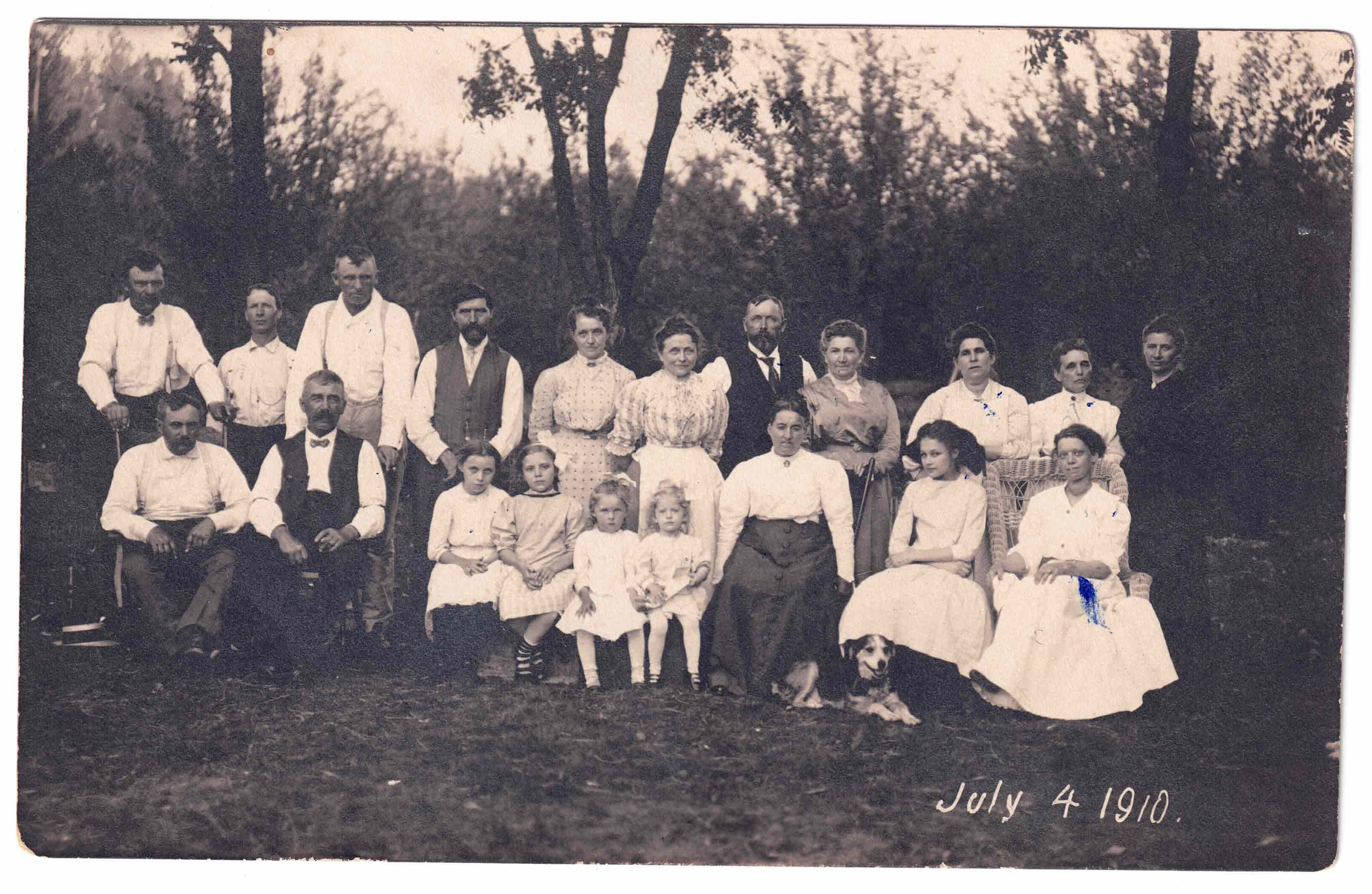
Independence Day celebration featuring descendants of Niels and Juliane (Hennike) Olsen and friends, Yankton County, South Dakota, 1910; digital image 2025, privately held by Greg Smith. Back, left to right: Jens Christian Nielsen?, Marius Larsen, Henry Schaller, John Nielsen, Cecilia (Nielsen) Boysen, Stena (Nielsen) Callesen, Jacob Nissen, Elizabeth Bruhn, Mrs. Schaller, Dorothea (Neilsen) Nissen, and Mary (Jacobsen) Nielsen. Front, left to right: Chris Callesen?, Erick Boysen, Herta Scheel Callesen, Cleora Nielsen, Grace Nielsen?, Violet Larsen, Jennie (Burton) Nielsen?, Henrietta Bruhn, and Helena (Nielsen) Larsen.

Thanks to a loose handwritten note that accompanied this photograph, as well as comparisons made with a 1902 group photograph that included many of the same individuals, most people have been identified with reasonable certainty. Present were at least five if not six of the eight adult children of the late Niels and Juliane (Hennicke) Olsen, Danish immigrants who had settled in Yankton County, Dakota Territory, in the early 1870s: John, Cecilia, Christina (Stena), Dorothea, and Helena Nielsen (also spelled Nielson or Nelson), along with their spouses. Their brother Jens Christian and his wife may have been there as well. Also present were several friends, who, according to the handwritten note, were members of the Henry Schaller and Henry Bruhn families.

The woman in the apron near the center of the photograph, who, given her attire, may have been the hostess of the event, is Christina “Stena” (Nielsen) Callesen (1860-1951). In 1910, Stena and her husband Christian “Chris” Callesen were living in Utica, Yankton County, South Dakota with their nine-year-old foster daughter Herta. Chris, whose name appears twice in the handwritten list of identifications, is likely seated at far left, while the child at left is Herta. Herta Scheel Callesen had been living with the Callesens since she was four years old and lost her father. Her mother, left with seven young children to feed, had made what must have been a difficult decision to allow her youngest daughter to be separated from the family—including from her twin brother—and raised by the Callesens. Stena was known to have had only one child of her own, a daughter who died in infancy. Herta, however, was one of as many as six children that the Callesens fostered or adopted over the years, some for only a short while and some, like Herta, to adulthood.

Seated to the right of Herta Scheel Callesen is her cousin Cleora Nielsen, the youngest daughter of John and Mary (Jacobsen) Nielsen. Cleora, eight years old, had been born in South Dakota but now lived in Santa Clara County, California. She and her parents had most likely returned to South Dakota for a summer visit with relatives; it is possible that her older siblings, the youngest already sixteen, remained in California, as they are not pictured here.

Next to Herta and Cleora are two young girls, between, perhaps, the ages of two and four. Only one was identified in the handwritten note, although it is not immediately clear which one: two-year-old Violet Larsen, the only child of Marius and Helena (Nielsen) Larsen. Tragically, Violet would live only to the age of four, and I have no other photographs of her. Although it was not indicated which girl is Violet, because the child on the right appears to me to be closer to the age of two—she fidgets with her skirt and her feet don’t quite reach the ground from the bench on which she appears to be sitting—that is my guess. There also seems to be a space left between the names of Cleora and Violet in the handwritten note.

Could the bigger of the two littlest girls be, perhaps, Grace Nielsen, four-year-old daughter of Jens Christian and Jennie (Burton) Nielsen? Jens, known familiarly as J. C. or Chris, was not named in the handwritten note accompanying the photograph, nor was his wife, but he bears some resemblance to the man at back left and his wife to the unidentified woman seated in the front row to the right of the children. The Nielsens, like the Callesens, lived in the small farming community of Utica, so it is reasonable to consider that they might have been present to spend the holiday with kin.

Jens Christian Nielsen, known as J.C. or Chris, is pictured at left in 1902. Could he be the man at right in 1910?

JaneJennie” (Burton) Nielsen is pictured at left in 1902. Could she be the woman at right in 1910?

The fact that this photograph was taken during a census year is particularly helpful in confirming the identities of the children, as it is possible to see exactly who resided in which household just a few months prior. It can be determined that the Bruhn and Schaller families, for example, did not have any young daughters who might have been seated beside little Violet Larsen. Unexpectedly, the census provided another important clue about this photograph: the identity of the photographer. It had seemed curious that family friend Henry Bruhn was not pictured alongside his wife, Elizabeth, and fourteen-year-old daughter, Henrietta, but according to the 1910 United States census, Henry Bruhn was, in fact, a photographer, and therefore may very well have been the person behind the camera.

Census records are of course less helpful when attempting to determine the identities of adults who are close in age, particularly considering the similarities in appearance among those with both shared heritages and lifestyles. Perhaps this is why whoever created the handwritten note accompanying the photograph named Chris Callesen twice! Cross-referencing with other more confidently identified photographs is key, and fortunately, in Chris’s case, there are two other known photographs that can be used as points of comparison and provide some degree of confidence.

Christian “Chris” Callesen is pictured at upper left in 1902 and at lower left in 1911. It is believed that he is the man at right in 1910.

Large group photographs like this are particular treasures in a family archive as they provide insight not only into the bonds of family and friendship, but also the occasions that brought people together. As they are less formal than studio portraits, they can also offer greater glimpses into personality and personal style, as well as the surroundings in which people lived. For a number of the Olsen descendants and their friends, 04 July 1910 looked to be a pleasant day spent in the fresh air, perhaps with a bountiful noon meal to share.

Copyright © 2025 Melanie Frick. All Rights Reserved.

Continue reading

Tombstone Tuesday: Johanne Marie Larsen

Johanne Marie (Larsen) Walsted of Aalborg, Denmark was sixty-three years old when she immigrated to America in the spring of 1900.1 She traveled alone; her husband of thirty-two years had passed away the year before,2 and most of her children had already left Denmark for brighter opportunities in Iowa and Wisconsin. They had paid for her passage aboard the Norge, and she carried fifteen dollars.3

GracelandCemeteryJohannaWalstedGrave

Grave of Johanna M. Walsted, 1836-1914, Graceland Cemetery, Sioux City, Woodbury County, Iowa; image date 2001, privately held by Melanie Frick.

Johanne was christened on 28 September 1836 in Bolle, Nordjylland, Denmark, the daughter of Lars Jensen Bak and Ane Cathrine Christensdatter.4 At the age of thirty, she married Christian Jens Jacobsen Walsted,5 a widower with two young children, Jens Jacob and Lars Marinus Walsted. The couple went on to have seven more children together: Jensine Kathrine, Eskild, Lars Peter, Mandrup, Anna Kathrine, Ellen Eskelline, and Jens Jacob Walsted.6 All but two of the children, the elder Jens Jacob and Eskild, survived to adulthood.7 Christian was a shoemaker, and eventually moved with his family from rural Dronninglund to the city of Aalborg,8 where he died in 1899.9

By the time Johanne made her journey to America, six of her seven surviving children and step-children awaited her arrival. Only her youngest son remained in Denmark; he was to follow two years later.10 In the years to come, Johanne moved between the homes of her children, some of whom she hadn’t seen in more than a decade. She was enumerated in the 1900 U.S. census less than two months after her arrival in the country, at which time she resided with a daughter in Iowa;11 she later joined another daughter in Oklahoma City.12

Johanne’s health may have been poor in her later years; a notation on the ship manifest suggests that she had a deformity of some kind,13 and her death record stated that she suffered from senility.14 Johanne Marie (Larsen) Walsted died at the age of seventy-eight on 3 November 1914 in Sioux City, Woodbury County, Iowa. Services were held at the Danish Lutheran Church, and she was buried at Graceland Cemetery.14

Continue reading

A Mystery Solved: Identifying a Family Photograph

Last year, my cousin’s wife and I embarked on a combined research effort to track down the descendants of Christian Jens Jacobsen Walsted (1833-1899) of Aalborg, Denmark. Christian, a shoemaker,1 married twice, first to Mariane Jensen,2 and later to Johanne Marie Larsen.3 In all, seven of his children survived to adulthood, and all eventually immigrated to America. In 1900, less than a year after Christian’s death, Johanne joined several of their children in western Iowa.4

This unidentified photograph was shared with my cousin’s wife by one of the many helpful descendants with whom we made contact.5 In all of our hours of research, we had never thought that we might come up with a photograph of our central subjects! Given that this photograph was taken in Aalborg, we immediately felt that it could be Christian and his second wife, Johanne. A librarian at the Museum of Danish America thoughtfully suggested that it might have been taken to commemorate their twenty-fifth wedding anniversary. This would date it to 1892.6

ChristianWalstedJohanneLarsdatter1892

Christian Jens Jacobsen and Johanne Marie (Larsen) Walsted, ca. 1892, Aalborg, Denmark; privately held by L.V. [personal information withheld], 2013.

At the time of their anniversary, Christian would have been fifty-eight years old,7 and Johanne would have been fifty-five.8 These seem to be plausible ages for the couple in the photograph, particularly given the gray in the man’s beard. The woman wears a flattering black dress and a headpiece over her hair. Her sleeves are puffed, but not in an exaggerated fashion.9 The man wears a three-piece suit and what appears to be a watch chain. He sits in a finely carved chair at a studio, which, according to the photograph, was located at Slotsgade 15 in Aalborg. A photographer allegedly operated at this location from 1891-1910.10

Later, I would hear from another descendant who possessed an identified copy of this same photograph,11 verifying our suspicion that it was, indeed, a photograph of Christian and Johanne (Larsen) Walsted. Success!

If you have a mystery photograph, be sure to find out if any of your relatives also have a copy. If you are able to locate a copy that is identified, and if the identification matches the clues in the photograph, you’re in luck. However, even if you come across a copy that is not identified, you may be able to narrow down who is in the photograph based on the branch of the family that held it, or who initially passed it down.


SOURCES
1 Abbey of Our Lady Parish (Aalborg, Denmark), Christian Jens Jacobsen Valsted (1899).
2 Dronninglund Parish (Dronninglund, Denmark), Christian Jens Jacobsen Valsted and Mariane Jensen (1863).
3 Dronninglund Parish (Dronninglund, Denmark), Christian Jens Jacobsen Valsted and Johanne Larsen (1867).
4 “New York, Passenger Lists, 1820-1957” digital images, Ancestry.com (http://www.ancestry.com : accessed 6 December 2013), manifest, S.S. Norge, Copenhagen to New York, arriving 1 May 1900, Johanne Walsted; citing National Archives microfilm T715, roll 119.
5 J.W. [personal information withheld], to Melanie Frick, e-mail, 27 May 2012, “Photo,” Personal Correspondence, Walsted Family, Frick Research Files; privately held by Frick.
6 M.M. [personal information withheld], The Danish Immigrant Museum [now Museum of Danish America], to Melanie Frick, e-mail, 30 May 2012, “Danish Wedding Photograph,” Personal Correspondence, Walsted Family, Frick Research Files; privately held by Frick.
7 Dronninglund Parish (Dronninglund, Denmark), Christian Jens Jacobsen Valsted and Johanne Larsen (1867).
8 Dronninglund Parish (Dronninglund, Denmark), Christian Jens Jacobsen Valsted and Johanne Larsen (1867).
9 Joan Severa, Dressed for the Photographer: Ordinary Americans and Fashion, 1840-1900 (Kent, Ohio: Kent State University Press, 1995), 458.
10 “Fotografer,” Aalborg Leksikon (http://aalborgleksikon.dk/Fotografer.htm : accessed 6 December 2013).
11 D.A. [personal information withheld], to Melanie Frick, e-mail, 1 June 2012, “Walsted Photo,” Personal Correspondence, Walsted Family, Frick Research Files; privately held by Frick.