Author Archives: Melanie Frick

Unknown's avatar

About Melanie Frick

Melanie Frick, MLS, holds a Certificate in Genealogical Research and has been researching her family history for two decades. An Iowa native with Midwestern roots, she lives in the Pacific Northwest.

Ten Tips for NGS Family History Conference Attendees

Registration has opened for the NGS 2014 Family History Conference, 7-10 May 2014 in Richmond, Virginia! NGS 2013 in Las Vegas was my first conference, and I can’t wait for round two of four days of genealogical bliss. As a bonus, although I spent nearly three years living in Virginia, I never made it to Richmond. Are you going?

The National Genealogical Society offers a list of very helpful Tips for First Time Conference Attendees. I recommend that any attendee look them over – there are great reminders even for those who have attended a conference before. After NGS 2013, however, I came up with a few practical tips of my own:

Ten Tips for NGS Family History Conference Attendees

1. Be prepared! Before taking off, review the conference schedule and download the NGS app to your smartphone to keep you organized. Make note of which lectures you want most to attend, and think seriously about what you want to learn. Whether you’re a complete novice or an experienced professional, there are lecture topics and tracks geared towards you. A plan of action is important when preparing to tackle several full days of lectures and activities, including luncheons, evening programs, and other special events – but be willing to be flexible, too. Discovering a new favorite speaker may sway you into attending a lecture that you had previously ruled out, or a new friend might invite you along to a networking event that you hadn’t heard about.

2. Broaden your horizons! A lecture might catch your eye if it covers a specific topic in genealogy that you love and have read everything about – but realize that if that’s the case, you might not learn much new in a lecture geared towards beginners in that subject area. If you take a look at the syllabus, you might find that you can get the gist of a lecture from the summary provided there, and decide, in its place, to attend a lecture about something completely new to you. I almost missed what ended up being one of my favorite lectures on a topic that I knew nothing about to attend a lecture on a topic that I already knew well.

3. Check out the Exhibit Hall! Plan on spending some quality time here, even if that means skipping out on a lecture at some point during the course of the conference. Right between lectures, the Exhibit Hall can be packed, so I found it worthwhile to go at an off time, particularly when I wanted to buy mass quantities of books and peruse the binders of application materials at the booth for the Board for the Certification of Genealogists. (If you’ve ever so much as thought about certification, do this!)

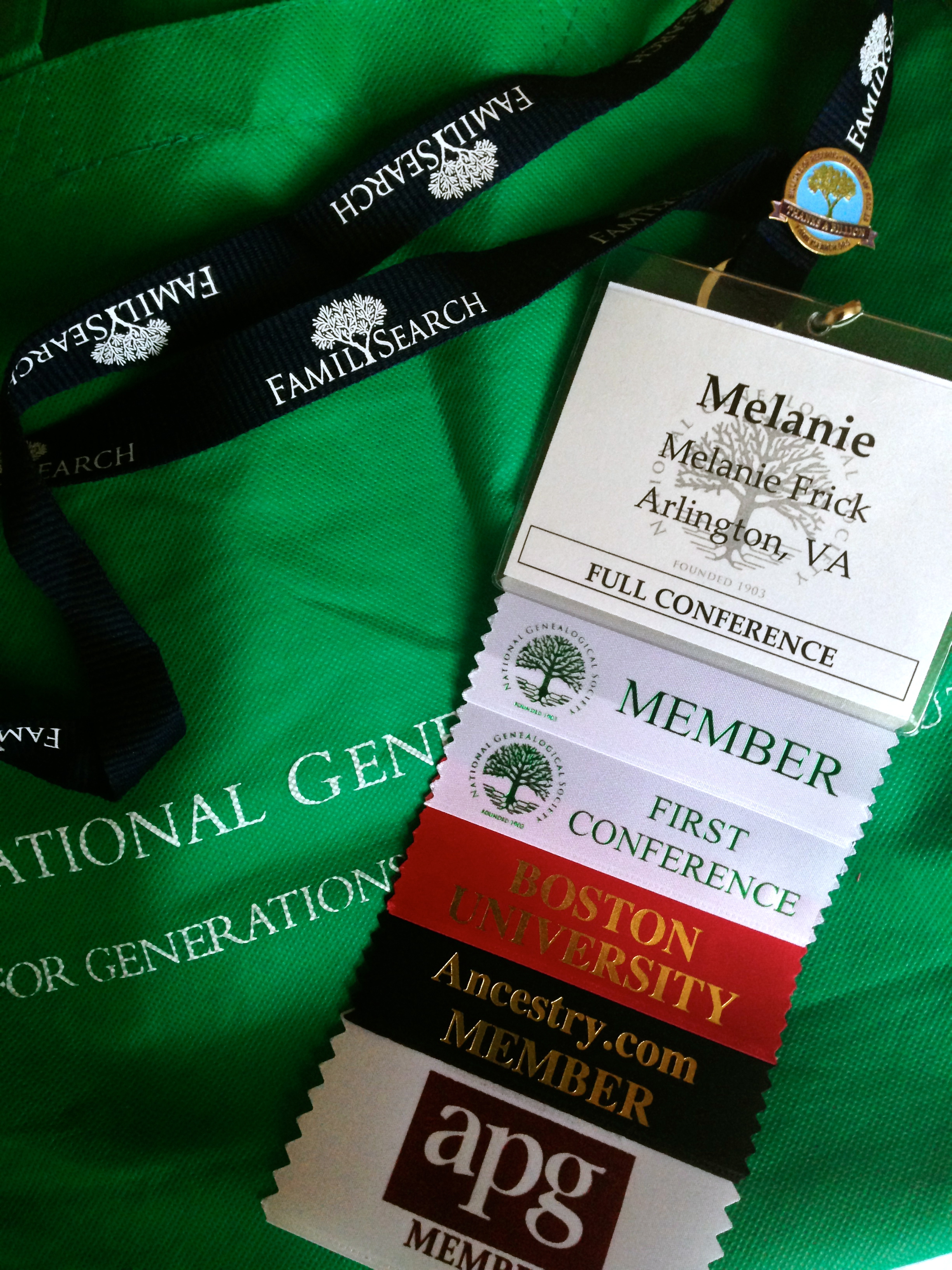
IMG_03314. Get colorful! Before attending NGS 2013, I had not been aware that ribbons that attached to one’s name tag even existed. Well, as it turns out, they do, and they’re popular at genealogy conferences. As you explore the Exhibit Hall, you will have the opportunity to collect ribbons from genealogical organizations that you support. Some people are selective with their ribbons, while others make a point to collect as many as possible. However you go about it, be sure to add some color to your name tag!

5. Dress to impress! Maybe it’s just me, but I’ve found that the term “business casual” can be vague, and I like specifics. At NGS 2013, most attendees wore trousers or slacks with a nice shirt or blouse, though by all means, one should wear whatever makes him or her feel the most comfortable and confident. On the final day of the conference, many attendees dressed more casually, particularly if they were leaving directly for a flight home.

6. Layer! I appreciate air-conditioning, but it can be unpredictable in large conference facilities. There were a couple of occasions last year when I would have turned into an icicle if I hadn’t brought along my trusty cardigan. NGS already offers this advice, but I’ll say it again – a sweater or light jacket is a necessity!

7. Stay hydrated! At NGS 2013, there were water stations at the back of every lecture hall. I don’t know if this will be the case every year, but I appreciated being able to fill my own water bottle before lectures. Hydration will be just important at future conferences as it was in the Nevada desert, so pack a water bottle and plan on using it.

8. Bring snacks! For those times when you’re too exhausted (in a good way, of course) to seek out lunch or dinner, or when you don’t have enough of an appetite to warrant purchasing a big meal, bring along some snacks. I made a few meals of peanut butter, crackers, and fruit, which really wasn’t as tragic as it sounds. If your room comes with a refrigerator or microwave, you’ll have even more options for low-key, low-cost meals.

9. Get connected! Although some may prefer to rely on a smartphone for Internet access during the conference, I would recommend bringing your tablet or laptop as well. I didn’t carry my laptop to the lectures with me (although you should have something to take notes), but I found that I was eager to put my new skills to use immediately (!) and liked being able to access my files easily once I was back in my room. Be aware of Internet options at your hotel – in 2013, NGS provided a hotspot for conference attendees as the attached hotel did not provide complimentary Internet access.

10. Talk to your neighbor!  In my experience, the vast majority of conference attendees are as friendly as can be and are very open to chatting with their neighbors in the moments before a lecture begins. The very least anyone should do is to smile and say hello. You all have something in common, and if there’s one thing that genealogists love to talk about, it’s genealogy!

What are your tips for NGS Family History Conference attendees?

Choose Your Own Backdrop

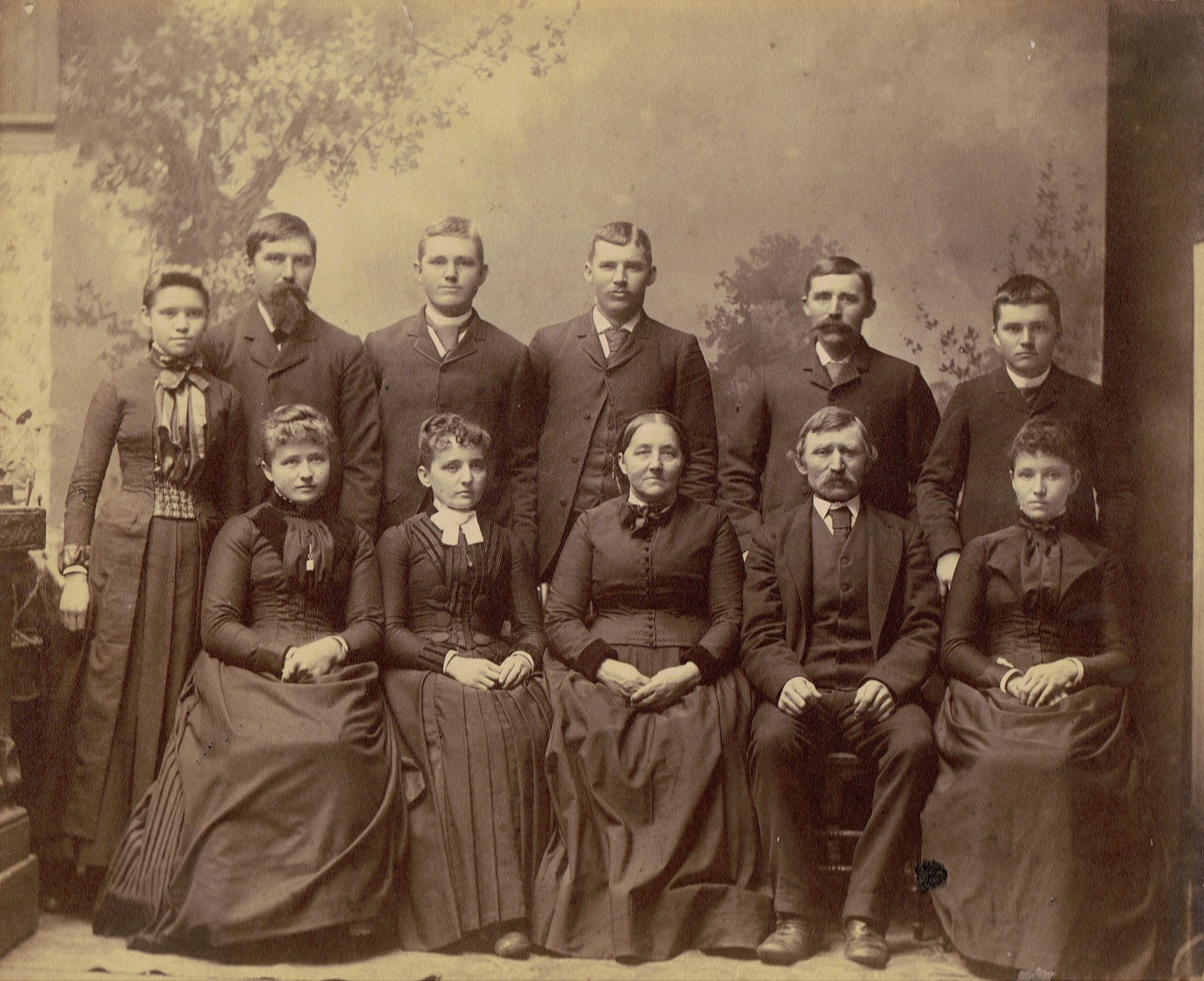
When they posed with their children for this photograph in 1893, Niels and Juliane Sophie (Hennike) Olsen of Yankton County, South Dakota had been married for just over forty years. They had raised nine children to adulthood, eight of whom were born in their native Denmark.1

nielsolsenfamily1893

Family of Niels and Juliane (Hennike) Olsen, 1893, Yankton County, South Dakota; privately held by Melanie Frick, 2013.

Niels and Juliane had purchased a farm upon their arrival in America, but in their later years, they moved to a more comfortable life in town. The couple would go on to celebrate fifty years of marriage in 1902,2 although their youngest son, Andrew, would be missing from that gathering. He drowned in 1897 while hunting ducks on the nearby Swan Lake.3

The photograph is a large print, roughly 8×10 inches, pasted onto cardboard with the date marked on the back. Do you notice anything strange about the backdrop? The family poses in front of a backdrop of painted trees that is slightly too small for a group of that size. To one side, the edge of the backdrop of a wallpapered room is visible, and the backdrop cuts off altogether on the other. All seem to be dressed in their best, the men in dark suits and the women in good black dresses. In 1896, Godey’s wrote, “All of us who are wise, possess a black gown.”4

The women’s dresses are distinct, although the two sisters seated on opposite ends, Stena and Cecilie, could easily have made their dresses from the same pattern. Their sisters’ dresses also bear similarities, though all have their own touches – pleats, contrasting material, or, in Dora’s case, large decorative buttons. Their mother’s dress, however, has no unnecessary frills. Notably, all of the women’s sleeves are of the fitted fashion of the previous decade; as the 1890s went on, puffed sleeves gained popularity. Perhaps this fashion had not yet become popular in Yankton County, or maybe these women simply didn’t care for the new style enough to want to rework dresses that were still perfectly serviceable.

Standing, left to right, are Helena (Neilsen) Larsen, John Neilsen, Andrew Neilsen, Fred Neilsen, Ole Neilsen, and Chris Neilsen. Seated, left to right, are Stena (Neilsen) Callesen, Dora (Neilsen) Nissen, Juliane Sophie (Hennike) Olsen, Niels Olsen, and Cecilie (Neilsen) Boysen. Variations of the surname, including Nelson, were also used by some members of the family.


SOURCES
1 Harold W. Jorgensen, “Olsen, Niels,” in Ben Van Osdel and Don Binder, editors, History of Yankton County, South Dakota (Yankton, South Dakota: Curtis Media Corporation and the Yankton County Historical Society, 1987), 53.
2 Jorgensen, “Olsen, Niels,” 53.
3 Jorgensen, “Olsen, Niels,” 53.
2 Jorgensen, “Olsen, Niels,” 53.
4 Joan Severa, Dressed for the Photographer: Ordinary Americans and Fashion, 1840-1900 (Kent, Ohio: Kent State University Press), 460.

A South Dakota Thanksgiving

How did your ancestors celebrate Thanksgiving? As the cooking commences, I can’t help but wonder when Thanksgiving truly became a tradition among the different branches of my family tree, and how the celebrations might have varied.

NelsonFamilyFarm

Fred and Christine (Schmidt) Nelson Family Farm, Yankton County, South Dakota, ca. 1911-1917; digital image 2013, privately held by [personal information withheld].

I do know that the family of Fred and Christine (Schmidt) Nelson of Tabor, Yankton County, South Dakota celebrated the holiday more than a century ago. In 1908, their daughter Anna, seventeen, wrote in her diary, “Nov. 26, Thanksgiving day. Uncle Andrew, Aunt Mary and little cousins, also John S[ch]neider came down and had dinner with us and spent the day. It was cloudy most of the day and a rather cold wind.”1

Her guest list indicates that they had quite a crowd for dinner. By 1908, the Nelson family numbered ten,2 so with the addition of John Schneider and Andrew and Inger Marie “Mary” (Schmidt) Schmidt, who came with their three young children,3 the number at the table was brought to sixteen.

TurkeyValleySchool

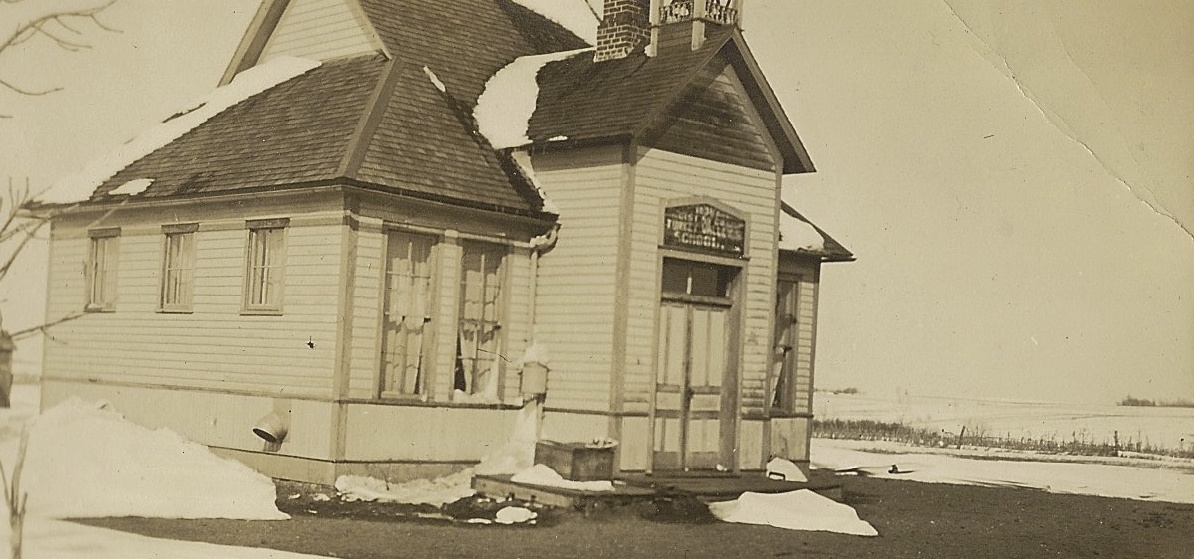
Turkey Valley School, date unknown, Turkey Valley, Yankton County, South Dakota; digital image 2010, privately held by [personal information withheld].

As the Nelson children grew and completed school, several of the six daughters scattered about the county on teaching assignments. In the fall of 1916, Andrea, age nineteen, boarded with the Skov family in Turkey Valley. Andrea was in the midst of her first term as a schoolteacher, having recently graduated from the Springfield Normal School.4

On 18 November 1916, Andrea wrote to her parents, explaining that she had spoken to the members of the local school board to ask if she could take off the day after Thanksgiving:

“Mr. Hinseth said that for his part he didn’t care how many we took off as he had no kids to send and Mr. Mikkleson said sure we could take the day then could see later about making it up. […] I haven’t asked Mr. Andreason about the day but it won’t do him much good to kick as it’s three against one.”5

Andrea was pleased, as this meant that she could return home for Thanksgiving and the three days following. No doubt she was eager to show off her new overshoes, purchased the previous afternoon in Irene. Although she reported woefully that they had made a dent in her monthly “warrant,” she continued, “Mr. Skov gave his ‘womenfolks’ a scolding because we hadn’t gotten overshoes a week ago Sat. when we were in town so I thot [sic] I had better get me a pair yesterday or I’d be scolded again, ha!”6

With these overshoes, Andrea would have been prepared for the blustery winter days on the eastern South Dakota prairie, and she would have stayed warm for the duration of the forty-mile journey home for the holidays. Now, if only we knew what was served for dinner!


SOURCES
1 Nelson, Anna. “Diary.” MS. Yankton County, South Dakota, 1908. Privately held by [personal information withheld].
2 1910 U.S. census, Yankton County, South Dakota, population schedule, Township 93 Range 57, enumeration district (ED) 447, sheet 2-A, p. 186 (stamped), dwelling 24, family 24, Fred Nelson; digital image, Ancestry.com (http://www.ancestry.com : accessed 26 November 2013), citing National Archives microfilm publication T624, roll 1489.
3 1910 U.S. census, Yankton County, South Dakota, population schedule, Township 93 Range 57, enumeration district (ED) 447, sheet 3-A, p. 187 (stamped), dwelling 46, family 48, Andrew Schmidt; digital image, Ancestry.com (http://www.ancestry.com : accessed 26 November 2013), citing National Archives microfilm publication T624, roll 1489.
4 The Echo, Vol. 1, “Andrea Nelson,” Springfield, South Dakota, 1916; privately held by [personal information withheld].
5 Andrea Nelson to Fred and Christine (Schimdt) Nelson, letter, detailing Thanksgiving plans, 18 November 1916; privately held by [personal information withheld].
6 Andrea Nelson to Fred and Christine (Schmidt) Nelson, letter.

Across Generations: The Power of a Snapshot

If you will be spending the holidays with family this year, consider snapping a few two, three, or even four generation photographs, should you have the opportunity.

JackieRoselynMatildaHammondThoma

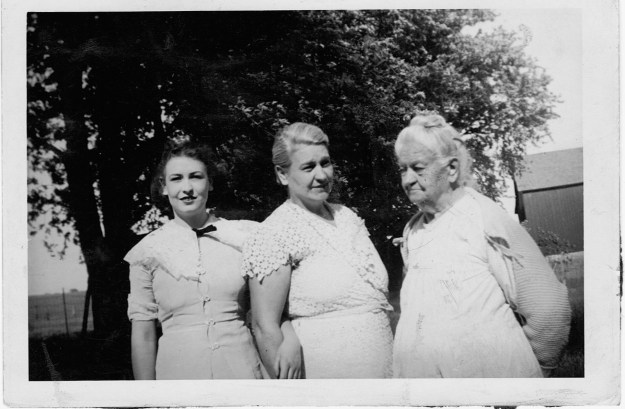
Jacqueline (Cuzins) Hedeman, Roselyn (Thoma) Friend Cuzins Chaney Bohringer, and Matilda (Hammond) Thoma, ca. 1938-1947; digital image 2010, privately held by Melanie Frick, 2013.

Why? This is one of only two photographs that I have of my third great grandmother, Matilda (Hammond) Thoma of Clayton County, Iowa. Matilda was born in 1859, and spent most of her life in the same county. She married and raised five children, four of whom survived to adulthood.1

Matilda is pictured here with her daughter, Roselyn, center, and her granddaughter, Jacqueline, left, who links arms with her mother. The occasion may not have seemed important at the time – only Jacqueline is facing the camera, and Roselyn and Matilda seem to have been caught unaware – but not only is this a rare photograph of Matilda, it’s also the only picture that I have of her with her daughter and granddaughter. This priceless three-generation photograph seems to have been a casual snapshot, likely taken by a family member.

After her husband’s death, Matilda lived with Roselyn in Texas,2 and later with Jacqueline in Wisconsin,3 suggesting that she had a close relationship with both women. This photograph was probably taken at some point after 1940, when Jacqueline would have turned twenty, or perhaps shortly before.4 Both Roselyn and Matilda passed away in 1947, Roselyn at age fifty-four,5 and Matilda at age eighty-eight.6

Seeing Matilda here with her daughter and granddaughter gives a glimpse into what she may have been like as a younger woman. Matilda wears a comfortable pinafore over a striped dress, her white hair fixed in a bun high on her head. Roselyn looks very much like her mother, right down to her nose and ears. She wears a short-sleeved eyelet dress. Jacqueline wears the bright lipstick of the era and a smart buttoned dress. Her sleeves are rolled up; it must have been a warm day. Jacqueline, too, resembles her mother, and, in turn, her grandmother.

I, for one, am very happy that someone just so happened to take this photograph. I’m even happier that this relatively flimsy print managed to survive seventy years. Even a snapshot can become a treasured family photograph.


SOURCES
1 1910 U.S. census, Clayton County, Iowa, population schedule, Guttenberg, enumeration district (ED) 209, sheet 4-B, p. 25 (penned), dwelling 76, family 77, Mathilda Thoma; digital image, Ancestry.com (http://www.ancestry.com : accessed 20 November 2013), citing National Archives microfilm publication T624, roll 397.
2 1930 U.S. census, Harris County, Texas, population schedule, Houston, enumeration district (ED) 209, sheet 5-B, p. 7201 (penned), dwelling 82, family 107, Mathilda Thoma; digital image, Ancestry.com (http://www.ancestry.com : accessed 20 November 2013), citing National Archives microfilm publication T626, roll 2349.
3 1940 U.S. census, Grant County, Wisconsin, population schedule, Wyalusing, enumeration district (ED) 22-56, sheet 1-A, p. 7201 (penned), dwelling 82, family 107, Matilda Thomas; digital image, Ancestry.com (http://www.ancestry.com : accessed 20 November 2013), citing National Archives microfilm publication T627, roll 4481.
4 “Iowa, County Births, 1880-1935,” index, FamilySearch (https://familysearch.org : accessed 20 November 2013), Jacquelin Thoma Cuzins, 1920.
5 “Texas, Deaths, 1890-1976,” index and images, FamilySearch (https://familysearch.org : accessed 20 November 2013), Roselyn Bohringer, 19 May 1947; citing certificate number 19651, State Registrar Office, Austin; FHL microfilm 2218598.
6 Wisconsin State Board of Health, death certificate, Matilda H. Thoma (1947), Vital Records Office, Madison.

His Last Trip to Germany, Part II

Read “His Last Trip to Germany, Part I” here.

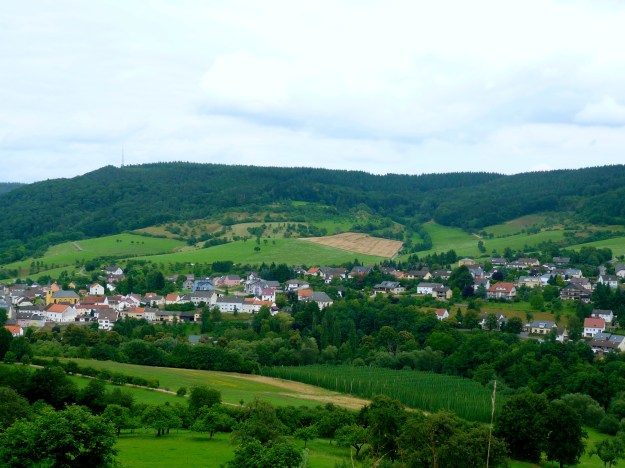
In the summer of 1938, Mathias Noehl of Holsthum, Rheinland-Pfalz, Germany, who had immigrated to America as a young man in 1886,1 returned for a final visit to the place that he considered to be the paradise of his youth. He wrote of his experiences in his memoirs, excerpted here.2
P1000417

Holsthum, Rheinland-Pfalz, Germany photograph, 2009; privately held by Melanie Frick, 2013.

When Mathias reached the town of Trier, near his home village, he exclaimed, “Oh joy without end! Is it a reality, or only a dream? After forty-four years, back to Trier.” Mathias entered a restaurant, and wrote, “I was served a good meal by a girl from the Mosel, who looks very much like my wife, when fifty years ago she offered her garden products for sale in the market place of Trier. The drinks were also good, but when I made known to her that I came from America, the friendly features of her face froze up and all my hopes to be treated kindly vanished.”3

Although his spirits were dampened by the encounter, Mathias continued, “As I was desirous to reach as quickly as possible my native village, which was five miles distant to the west, I went to an auto-livery. They brought me over the hills of the forefront of the Eifel, to Holsthum.” He reunited with his relatives, and was disheartened to note the absence of those who were lost in the World War:

“The sadness written on their faces gave me to understand how much they had suffered from the shortness of provisions after the World War. Our creator will judge severely those nations who let mountains of foodstuff spoil rather than to help their fellow man, especially the children.”4

Mathias’ return to Holsthum was wrought with emotion. He wrote, “God has helped me to find the way to my old home, but the hour of meeting my relatives again was full of sorrow. Reaching hands, shaking hands, tears of joy running to the earth, I asked myself, ‘Has God spared me no suffering?’ Oh, if only I had remained hidden in my exile in North America.”5

He continued, “Through the lines of the living I hurried to the cemetery, more than one thousand years old, to the kingdom of the dead, to the graves of my parents and brothers. In our house at home, I found all the pieces of furniture […]. There was the old kitchen range in its old place, on which my mother had prepared so many good meals for her seven boys, and shed also many a drop of sweat, and wept tears for her children who were scattered now in all parts of the world.”6 Mathias also visited the Shankweiler Klause, a church located in the forest, for a religious holiday:

“It was very beautiful, especially the singing, which could be heard from the heights of the rock, in all the adjoining valleys. It was so good that I had the privilege to sing with my comrades for the last time in that memorable church. May the echo of our singing be heard from that rocky height for many generations, till the end of time.”7

However, Mathias noted, “The mood of the people was not as joyful among the visitors as in my childhood days. The many baskets of cherries, which on that occasion were formerly sold there, were not there. A late frost had killed all the fruit blossoms, a hard blow for all the Rhineland. Of the many tents, where formerly toys were sold, there was only one left. But the thirst was well taken care of; there was plenty of beer to be had. Though the fruit harvest was a failure, the wheat crop was so much better due to the artificial fertilizer, which was not known formerly in my younger days. They now produced a double crop.”8

Mathias wrote of his time in Holsthum with a sense of wistful melancholy, stating, “I knew well that my stay could not be of long duration, so I made use of every hour to view once more the paradise of my youth, with all the objects of interest that had remained.” He described the two rivers, the beautiful forests, and the fruit trees which he had helped to plant decades before. At one point, Mathias settled down for a nap beneath those trees, admiring the fields before him.9

He wrote, “Awaking from sleep, I did not remember right away where I was […]. The river, flowing close by, threw off its disguise, and proved to be the Enz, and a shout addressed to me from the hill, ‘Heil Hitler,’ recalled me from my condition of drowsiness, into normal consciousness.” Mathias revived himself with coffee, and, “After that, being out of tobacco, I went to the store to buy the much-coveted tobacco, but tobacco is so loaded with taxes that it has to go up in smoke mixed with many herbs and leaves.10

P1000444.JPG

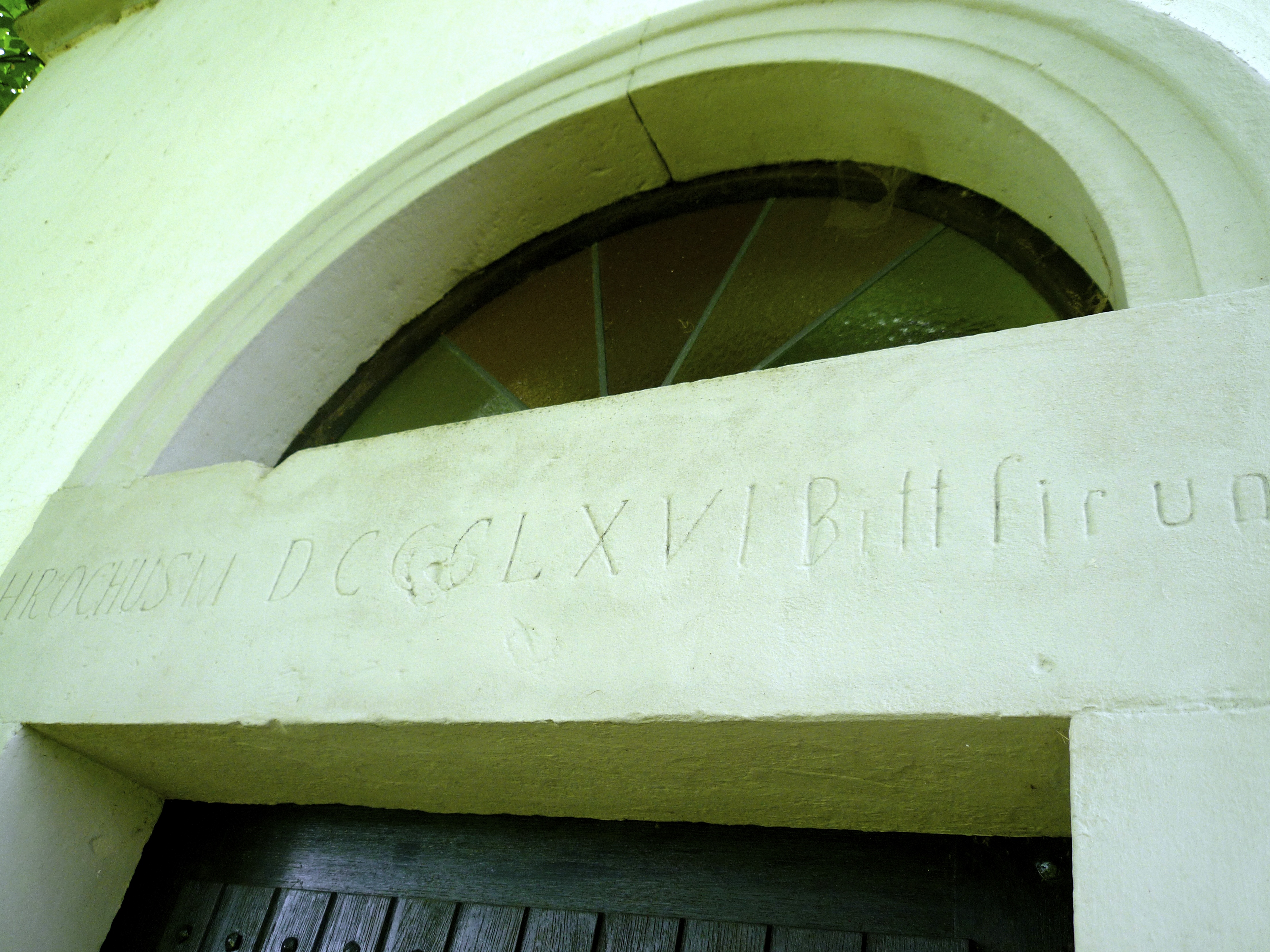
St. Rochus, Holsthum, Rheinland-Pfalz, Germany photograph, 2009; privately held by Melanie Frick, 2013.

“Next day I paid a visit to the chapel of St. Rochus. It was clean, in good repair in spite of its age of 500 years; Christ’s chapel built on a lovely road. May yet many pilgrims enter into thy roof to seek and find consolation. Then I visited the fields which were once the property of my parents and grandparents, and were now divided among brothers and cousins.”

“At last I came to the most beautiful valley of our district. To hear once more the echo, I sang, I called, I shouted, all in vain. The inhabitants of the mountain opposite remained silent, and Theresa Miller, the dairymaid of the same age as myself, whom I saw sixty years ago tending the cows, was not to be seen. Only an eagle flying over a high rock pierced the quiet landscape with its pitiful cries, as though complaining to the misfortune of the Fatherland.”11

Mathias paused to reminisce at a mighty walnut tree under which he recalled his elderly grandfather would enjoy his afternoon naps. Then, “Saying farewell to the paradise of my grandfather, I turned towards the village and suddenly found myself face to face with my old dairymaid, Theresa.” This was a bittersweet reunion, as they exchanged news of long-lost friends.12

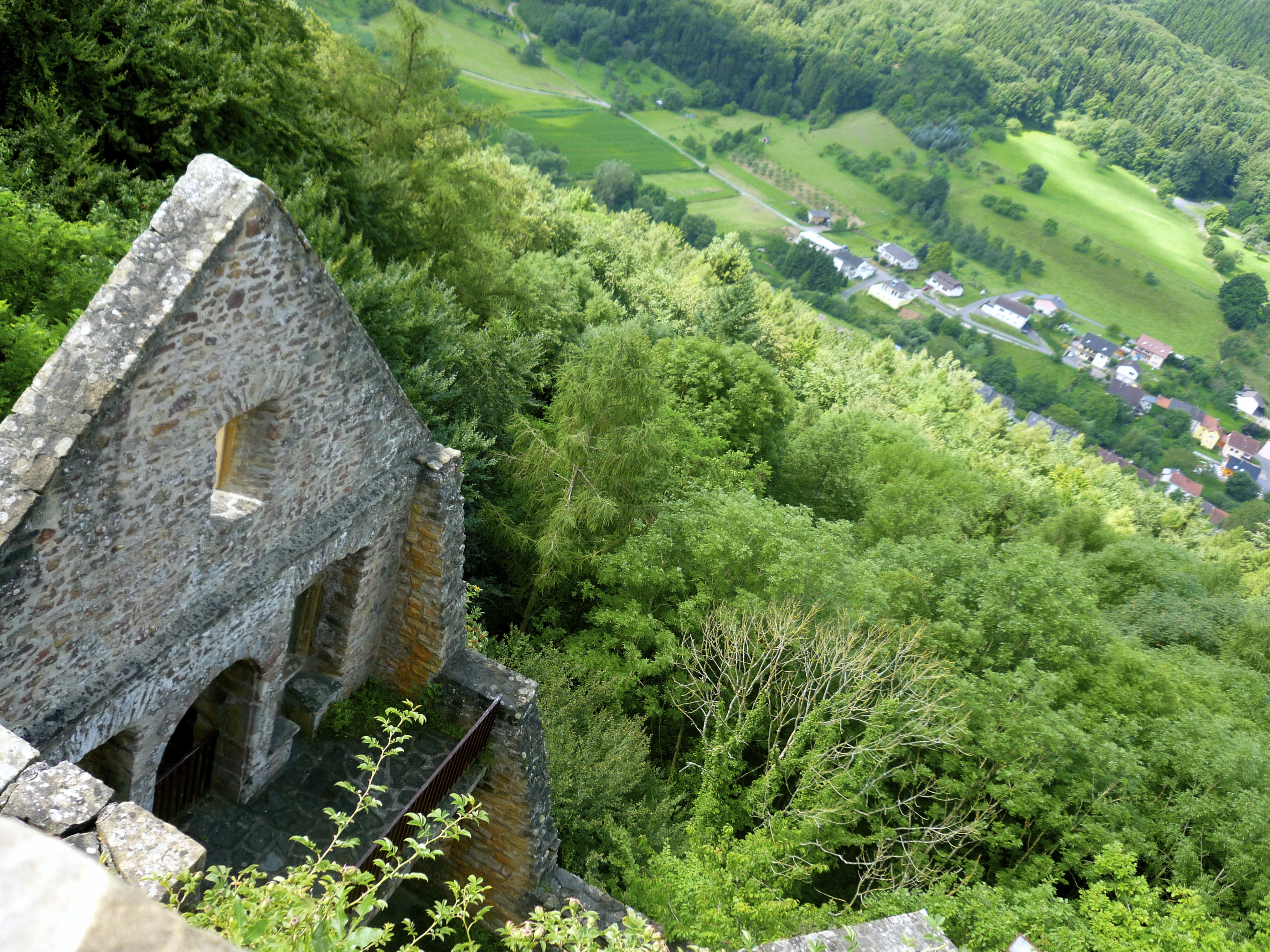
Mathias attempted to visit his godmother in Allsdorf, a village four miles away, but he faced difficulties: “The road to this place had been changed during my absence […], and so I lost my way in the beautiful forest. For three hours I ran over roads that were prohibited […] on account of army maneuvers, trying to find my way out.” Mathias happened upon the ruins of the Castle Prümzurlay, where, in the eighteenth century, his grandfather had conducted an orchestra to entertain the noble inhabitants.13

Pruemzurlay.JPG

Prümerburg and Prümzurlay, Rheinland-Pfalz, Germany photograph, 2009; privately held by Melanie Frick, 2013.

The next day, Mathias was able to find his way to Allsdorf, and he was pleased to find his relatives well. However, upon his return, he had to avoid the army maneuvers that were taking place in the river valley by cutting through the forest:

“I saw trees freshly cut, to widen the road lying over the way, without seeing any woodcutters. I also saw a red and white flag, diagonal across the road, which frightened me more than any object I had seen in the forests of America or the plains of Canada. Halting for a few moments, I dared to cross the road, and ran as fast as I could towards the valley below.”14

It is evident that although Mathias was deeply sympathetic to the plight of his homeland following the World War, he looked upon Germany’s new direction with suspicion. Indeed, despite his feelings of goodwill towards his kin, he faced intense scrutiny as an American in a land that he could no longer call his own. However, Mathias was determined to make the most of his time there, and although his relatives warned him against it, he made up his mind that he would cross the border into Luxembourg:

“I came at the border of Echternacherbrück into the dreaded crossfire of the German customs official. I showed my traveling papers as well as the sum of money I carried with me, which, according to the customs regulations, was too large to be taken across the border. As a consequence, I was bombarded with questions as never before, since our field watchman had caught me sitting in our neighbor’s apple tree!

“All the money I carried with me, except ten marks, I had to leave behind in the hotel. Then I received permission to cross the frontier. In Echternach, Luxembourg, I found the people very much depressed, on account of the prohibition of the people on the German side to do any trading in their border city of some six thousand inhabitants. In the beautiful marketplace, I thought I saw grass growing between the pavement stones.”15

Finally, Mathias was able to visit his relatives in the village of Bastendorf, with whom he had an emotional reunion. Before Mass with his relatives the following morning, he strolled through the village to collect his thoughts:

“My parents, brothers, and other relatives had promised me everything that was necessary to establish myself as an independent man. But no, as though driven by an invisible power, I stumbled along the steep street as if I was going to a funeral. And now, on the 12th day of July, 1938, I am standing once more at the same crossroad and feel compelled to leave once more the beautiful woods and meadows to return to the land of the dollar.”16

After parting, Mathias wrote that he felt, “Lost in my dream, half this side and half the other side of the Atlantic.” At the border, he gave his remaining 4 Francs to the Luxembourg customs official, in order to ease his crossing, and reported, “I was fairly well treated by the custodians of the law.” He retrieved his money from the hotel and treated five laborers to beer and cigars, “for which they thanked, but they did not enter into any conversation.” Finally, Mathias wrote, “After I had worked myself through all the red tape at Echternacherbrück and received a moral lesson out of the proceedings, I took the stagecoach and arrived at Holsthum.”17

Mathias’ memoirs ended abruptly as he described visiting an abandoned Franciscan hermitage the following day. We know that he returned to northeastern Iowa, where he and his wife had raised nine children. He surely shuddered as he followed the news of World War II in the years to follow, and likely realized how fortunate he had been to return to his childhood home while he still had the chance. However, his memoirs were left incomplete. Mathias passed away on 31 January 1950 at the age of eighty-one.18

Continue reading

The Lutz Sisters

HattieJuliaAnnaMelanieLutz

Sisters Hedwig, Julia, Anna, and Melanie Lutz, ca. 1900, Minnesota; digital image 2010, privately held by Melanie Frick, 2013.

Julia, Anna Marie, Hedwig “Hattie” Eulalie, and Melanie Veronica Lutz were the daughters of French and Polish immigrants, respectively Joseph and Hedwig (Cichos) Lutz of Minnesota Lake, Faribault County, Minnesota.1 By the time that this photograph was taken, circa 1900, Joseph had passed away, and Hedwig had remarried and given birth to five additional children.2 Her eldest daughters must have been close, however, as they chose to have a photograph taken of just the four of them.

Standing with her arms protectively behind her seated sisters is Hattie, who would have turned nineteen in the year 1900.3 Although her position suggests that she was the eldest, she was not; it’s possible that she may have been the tallest, however, if the photographer were to have posed the sisters based on height. She is also the only sister wearing a dress with a white collar, offering contrast; the other sisters seem to be wearing their good black dresses. None of the dresses, however, are alike, each having unique decorative pleats, panels, and/or bows. The collars are extremely high, perhaps an example of what would have been known as “officer’s” collars.4

Julia is seated at right, her dark eyes serious. She would have turned twenty-four in 1900, and was the eldest of the sisters.5 Seated at the center is Anna, who would have turned twenty-two that year.6 Melanie, the youngest, is at left; she would have celebrated her sixteenth birthday in 1900.7

At this time, all four sisters had left their mother’s household.8 Julia was married with two young children at home; she and her husband kept a hotel,9 and Anna was employed as a servant there.10 Hattie lived with her elderly maternal grandparents.11 As Melanie cannot be located in the 1900 U.S. census, she may have been away at school, where she trained to become a teacher. Later in life, Julia, Anna, Hattie, and Melanie made their homes in four different communities across three different states, but their sisterly bond is apparent in this photograph of them as young women.


SOURCES
1 “Minnesota, Marriages, 1849-1950,” index, FamilySearch (https://familysearch.org : accessed 15 Nov 2013), Joseph Lutz and Hedwig Joice, 19 April 1875. Cichos was likely transcribed incorrectly as Joice.
2 1900 U.S. census, Faribault County, Minnesota, population schedule, Minnesota Lake, enumeration district (ED) 92, sheet 10-B, p. 4834 (penned), dwelling 178, family 178, Hattie Rendfleisch; digital image, Ancestry.com (http://www.ancestry.com : accessed 15 November 2013), citing National Archives microfilm publication T623, roll 763. Rendfleisch was a variation of Rindfleisch.
3 “Minnesota, Births and Christenings, 1840-1980,” index, FamilySearch (https://familysearch.org : accessed 15 Nov 2013), Hedwig Lutz, 06 September 1881.
4 Joan Severa, Dressed for the Photographer: Ordinary Americans and Fashion, 1840-1900 (Kent, Ohio: Kent State University Press, 1995), 526.
5 “Minnesota, Births and Christenings, 1840-1980,” index, FamilySearch (https://familysearch.org : accessed 15 Nov 2013), Julia Lutz, 13 December 1876.
6 “Minnesota, Births and Christenings, 1840-1980,” index, FamilySearch (https://familysearch.org : accessed 15 Nov 2013), Anna Lutz, 12 May 1878.
7 “Minnesota, Births and Christenings, 1840-1980,” index, FamilySearch (https://familysearch.org : accessed 15 Nov 2013), Melanie Veronica Lutz, 28 May 1884.
8 1900 U.S. census, Faribault Co., Minn., pop. sch., Minnesota Lake, ED 92, sheet 10-B, p. 4834, dwell. 178, fam. 178, Hattie Rendfleisch.
9 1900 U.S. census, Nobles County, Minnesota, population schedule, Adrian, enumeration district (ED) 209, sheet 2-B, p. 43 (penned), dwelling 29, family 29, Julia McColm; digital image, Ancestry.com (http://www.ancestry.com : accessed 15 November 2013), citing National Archives microfilm publication T623, roll 778.
10 1900 U.S. census, Nobles County, Minnesota, population schedule, Adrian, enumeration district (ED) 209, sheet 2-B, p. 43 (penned), dwelling 29, family 29, Anna M. Lutz; digital image, Ancestry.com (http://www.ancestry.com : accessed 15 November 2013), citing National Archives microfilm publication T623, roll 778.
11 1900 U.S. census, Faribault County, Minnesota, population schedule, Minnesota Lake, enumeration district (ED) 92, sheet 5-A, p. 4719 (penned), dwelling 73, family 73, Hattie Lutz; digital image, Ancestry.com (http://www.ancestry.com : accessed 15 November 2013), citing National Archives microfilm publication T623, roll 763.

Military Monday: A Civil War Compiled Service Record

In honor of Veteran’s Day, I thought I would share the Compiled Military Service Record (CMSR) of my one and only direct ancestor who served in the Civil War, namely John Fenton of Company M of the 3rd Illinois U.S. Cavalry.1

John Fenton, of Bole, Nottinghamshire, England,2 came to America with his wife and children before 1850.3 They settled first in Summit County, Ohio,4 and later lived in Montgomery County, Illinois. By the time the Civil War rolled around, John was a widower with four children between the ages of nine and eighteen: Sarah Alice, Harriet, John, and George W. Fenton.5

This slideshow requires JavaScript.

On 14 September 1861, John enlisted as a Private in Company M of the 3rd Illinois U.S. Cavalry in Pana, Christian, Illinois, for a term of three years. He was now forty-six years old – no longer a young man, he would have been nearly fifty before his term of service was complete. John stood at 5 feet 9 inches tall, and had a dark complexion, black hair, and hazel eyes.6

As of 1860, John had made his living as a farm laborer, boarding with three of his children in the household of another family.7 One of his daughters boarded with a family in the next county.8 Perhaps, being that John was apparently a horseman, a three-year stint in the cavalry seemed to be as good of an option as any in terms of bringing in steady pay. John’s daughters were old enough to look after their younger brothers, and perhaps – hopefully – there were friends or relatives willing to take them in while he served. The pension file submitted by his minor son, decades later, may answer some of these lingering questions.9

John’s service was relatively short lived. Soon after his enlistment, the Regiment made its way to Missouri; John spent time on prisoners’ guard in Rolla, and may have seen action at the Battle of Pea Ridge in Arkansas. In late April of 1862, John left the site of Pea Ridge with the train of wounded, arriving in the hospital in Lebanon, Laclede, Missouri. After a lingering illness, it was there that he died of typhoid fever on 7 July 1862 at the age of forty-seven.10 Although John was initially buried at Lebanon, his grave was likely unmarked and his body may since have been exhumed and reburied the National Cemetery in Springfield, Missouri.11

How can you obtain your ancestor’s Compiled Military Service Record (CMSR)? I acquired John Fenton’s CMSR in person at the National Archives in 2011, when I still lived near Washington, D.C. It was a definitely an experience to be able to view and photograph the original document at my leisure; although the National Archives can seem intimidating, I was able to place my request without any problems and there were plenty of staff members and volunteers willing to point me in the right direction as needed. If you don’t find yourself there anytime soon, and if the CMSR that you seek isn’t available online or on microfilm at a local branch of the National Archives, you can still request a copy for a fee, using information located in indexes online. The online ordering system is easy to use – just be prepared to wait for your record to arrive in the mail!


SOURCES
1 Compiled service record, John Fenton, Pvt. Co. M, 3 Illinois Inf.; Carded Records, Volunteer Organizations, Civil War; Records of the Adjutant General’s Office, 1780s-1917, Record Group 94; National Archives, Washington, D.C.
2 Compiled military service record, John Fenton, Pvt. Co. M, 3 Ill. Inf., Civil War, RG 94, NA-Washington.
3 1850 U.S. census, Summit County, Ohio, population schedule, Stow, p. 931 (penned), dwelling 33, family 52, John Fenton; digital image, Ancestry.com (http://www.ancestry.com : accessed 11 November 2013), citing National Archives microfilm M432, roll 732.
4 1850 U.S. census, Summit Co., Oh., pop. sch., Stow, p. 931 (penned), dwell. 33, fam. 52, John Fenton.
5 1860 U.S. census, Montgomery County, Illinois, population schedule, Audubon Post Office, p. 319 (penned), dwelling 2284, family 2287, John Fenton; digital image, Ancestry.com (http://www.ancestry.com : accessed 11 November 2013), citing National Archives microfilm M653, roll 214.
6 Compiled military service record, John Fenton, Pvt. Co. M, 3 Ill. Inf., Civil War, RG 94, NA-Washington.
7 1860 U.S. census, Montgomery Co., Ill., pop. sch., Audubon P.O., p. 319 (penned), dwell. 2284, fam. 2287, John Fenton.
8 1860 U.S. census, Christian County, Illinois, population schedule, Pana, p. 319 (penned), dwelling 574, family 5114, Harriet Fenton; digital image, Ancestry.com (http://www.ancestry.com : accessed 11 November 2013), citing National Archives microfilm M653, roll 161.
9 “U.S., Civil War Pension Index: General Index to Pension Files, 1861-1934,” digital images, Ancestry.com (http://www.ancestry.com : accessed 11 November 2013); John Fenton (Co. M, 3rd Ill. Inf.) index card; imaged from General Index to Pension Files, 1861-1934, T288 (Washington, D.C.: National Archives [n.d.]), roll 150.
10 Compiled military service record, John Fenton, Pvt. Co. M, 3 Ill. Inf., Civil War, RG 94, NA-Washington.
11 “Union Soldiers Buried at Lebanon, Missouri 1862-1865,” Judy’s Stuff (http://freepages.genealogy.rootsweb.ancestry.com/~judysstuff/burials/Lebanon.htm : accessed 11 November 2013).

The Nelson Family

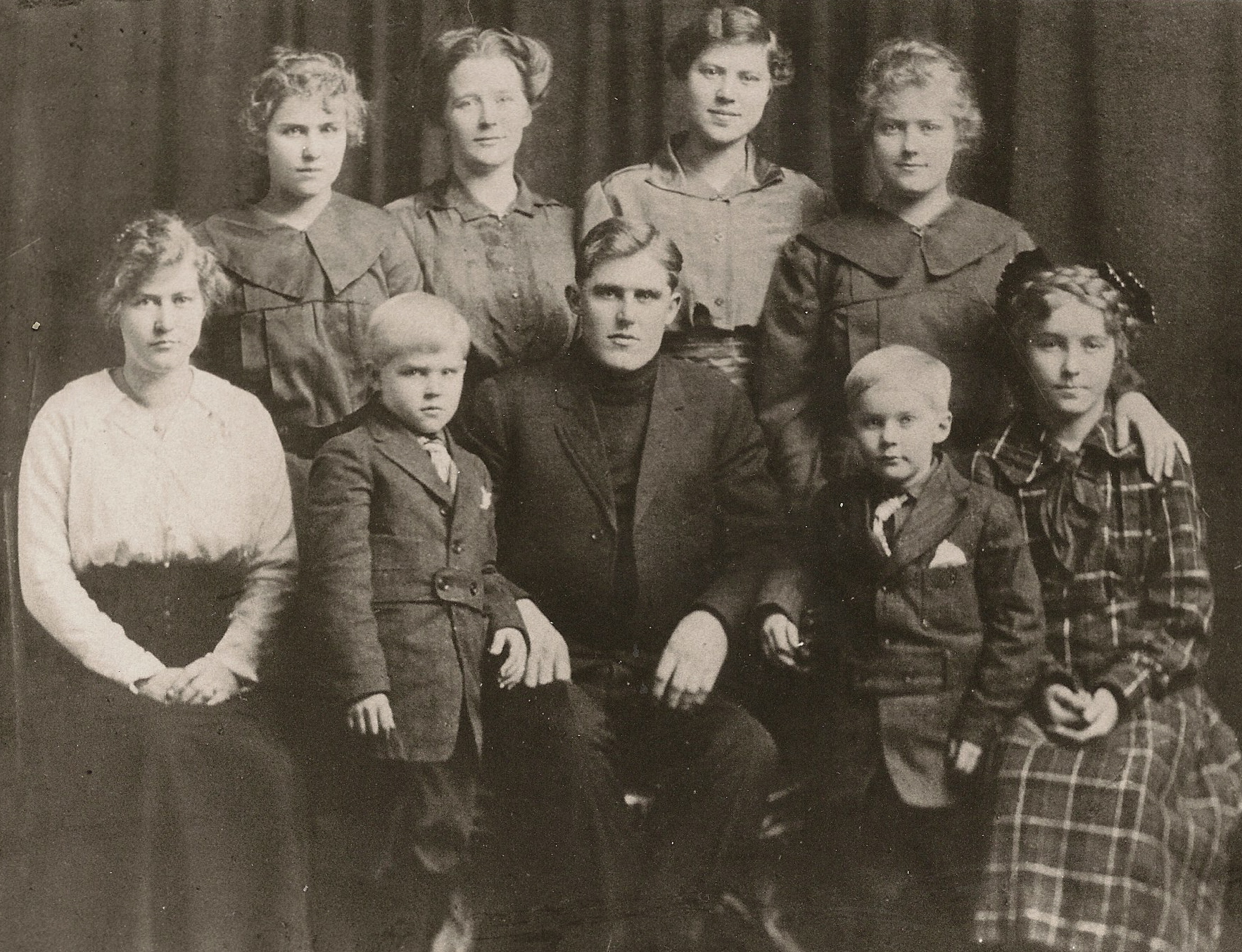
The nine children of Fred and Christine (Schmidt) Nelson of Tabor, Yankton County, South Dakota pose together here circa 1915. These six sisters and three brothers span nineteen years in age; from eldest to youngest, they are Anna, Julia, Ole, Andrea, Louise, Helena, Mary, Fred, and Myron Nelson. [Update: Since writing this piece, I have located another copy of this photograph with a date of December 1917 handwritten on the back.]

FredNelsonChildren1915

Family of Fred and Christina (Schmidt) Nelson, ca. 1915, Yankton County, South Dakota; digital image 2010, privately held by [personal information withheld], 2013.

A strong family resemblance can be seen in the nine Nelson siblings. Anna and Julia stand at center; they are wearing plain buttoned blouses and skirts, as is Andrea, seated left. Louise and Helena, standing at left and right, wear almost identical dresses with wide collars, pleated bodices, and belted waists. Their dresses were almost certainly sewn by hand from the same pattern.

Mary, the youngest sister, seated at right, is dressed in the most striking manner in a plaid dress with a ring of beautiful braids coiled atop her head. As the story goes, while they were growing up, the Nelson sisters would line up each morning to braid the hair of the sister standing before them.1 Someone clearly spent extra time on Mary’s hair on the morning that this photograph was taken!

The brothers, regardless of age, wear sturdy wool jackets. Ole’s jacket is open over a dark shirt or sweater that seems to be in the style of a turtleneck, while young (and very blond) Fred and Myron wear their jackets buttoned over shirts and ties. They lean towards Ole, their arms propped beside his on the arms of his chair.

In 1915, not all of the Nelson children remained at home, although all continued to live in the area. Anna, the eldest, was married, and had started a family.2 Julia was a schoolteacher,3 the profession pursued by her younger sisters, Andrea and Louise, who were students at the nearby Springfield Normal School.4 They would soon be followed by Helena and Mary, who at this point likely still attended the local school with Fred and Myron. Ole, the eldest brother, was a carpenter, and worked on the family farm.5

Was there an occasion for this photograph? In March of 1915, Fred and Christina (Schmidt) Nelson would have celebrated their twenty-fifth wedding anniversary.6 Perhaps a photograph of their progeny was in order, either by their request or as a gift from their children. Regardless, this is the last known photograph of all of the Nelson children together, and it’s a lovely one.


SOURCES
1 Phyllis (Wiese) Adam, conversations with the author, 2012; notes in author’s files.
2 1920 U.S. census, Yankton County, South Dakota, population schedule, Mission Hill, Enumeration District (ED) 251, p. 6151 (penned), sheet 1-B, dwelling 10, family 10, Anna Jorgensen; digital image, Ancestry.com (http://www.ancestry.com : accessed 4 November 2013), citing National Archives microfilm T625, roll 1726.
3 “South Dakota, State Census, 1915,” index and images, FamilySearch (https://familysearch.org : accessed 04 Nov 2013), Julia Nelson, Tabor, Yankton, South Dakota, United States.
4 The Echo, Vol. 1 (Springfield, South Dakota: Springfield Normal School, 1916); private collection of Brian Adam [personal information withheld].
5“South Dakota, State Census, 1915,” index and images, FamilySearch (https://familysearch.org : accessed 04 Nov 2013), Ole Nelson, Tabor, Yankton, South Dakota, United States.
6“In Memoriam: Christine M. Nelson,” undated clipping, ca. January 1961, from unidentified newspaper.

Tombstone Tuesday: Paulus and Elisabeth (Schmidt) Thoma

July 009

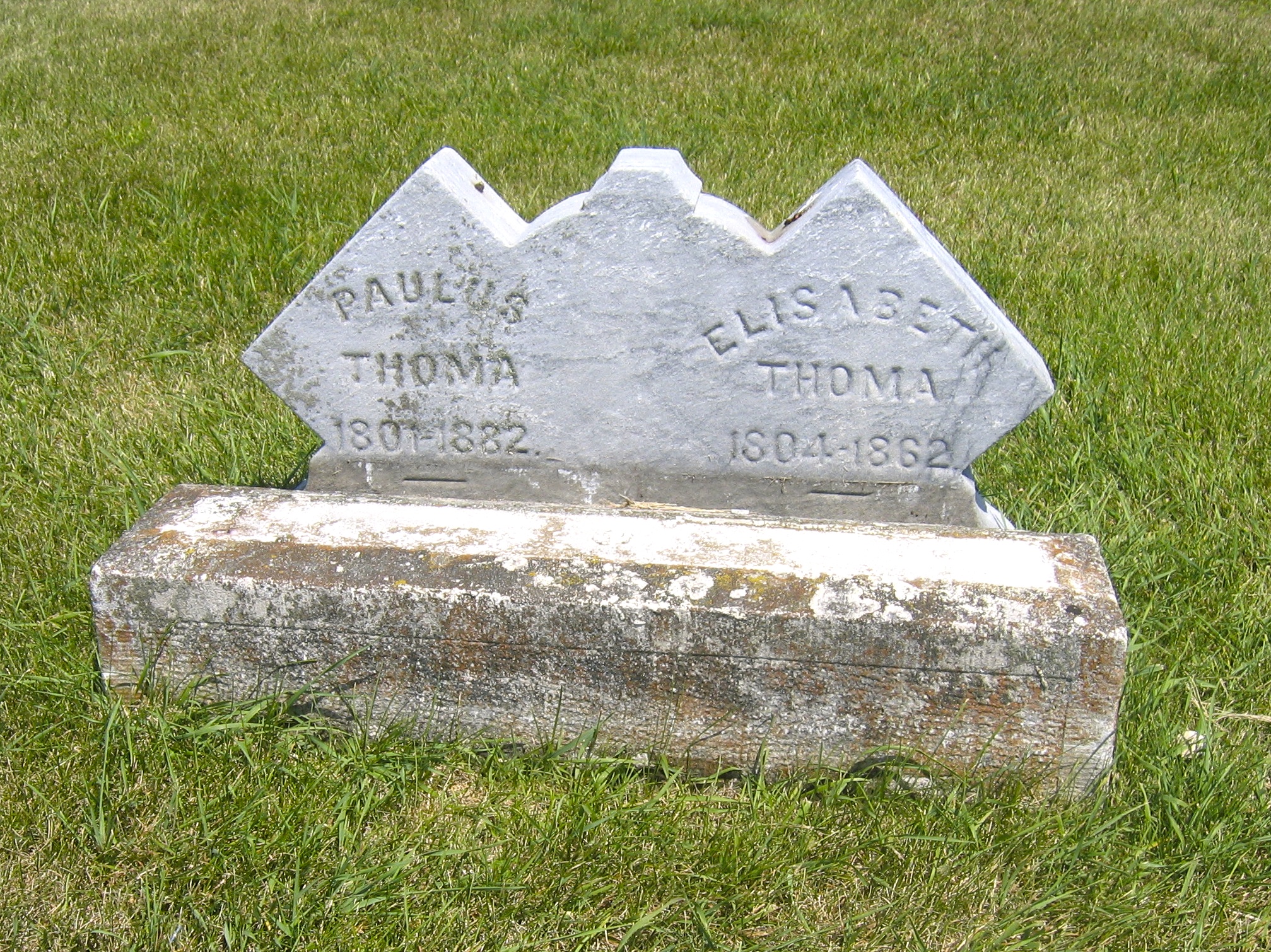
Grave of Paulus Thoma (1801-1882) and Elisabeth Thoma (1804-1862), Garnavillo City Cemetery, Garnavillo, Clayton County, Iowa; digital image 2007, privately held by Melanie Frick, 2013.

The mid-nineteenth century saw what could be considered a virtual exodus of families who left their home village in Bavaria for the farmland of northeastern Iowa. Paulus and Elisabeth (Schmidt) Thoma of Weißenstadt, Wunsiedel, Bavaria, Germany were among them. Paulus was a weaver by trade,1 and together, he and Elisabeth raised eight children: John Conrad, William Henry, Anna Rosina, Frederick, Anna Sabina, Maria Magdalena, Ursula Pauline, and Anna Margaretha.

In 1852, Paulus and Elisabeth traveled with seven of their children from Bremen to New Orleans, undoubtedly an exhausting journey. They were accompanied on the Uhland by ten others from Weißenstadt, a small sampling of the immigrant families who had likely been linked for generations and chose to resettle together in America.2 Upon arrival in New Orleans, the Thoma family traveled by way of the Mississippi River to reach their destination of northeastern Iowa.3 Several years later, Paulus and Elisabeth were joined by their eldest son and his family.4

Once settled, Paulus apparently put his weaving aside for a farmer’s life in Garnavillo, Clayton County, Iowa. I thought perhaps he would have raised sheep for wool, but, at least as of 1860, crops of wheat, Indian corn, and oats seem to have been his primary focus. At this time, he farmed over two hundred acres of improved land.5

Elisabeth (Schmidt) Thoma passed away in 1862, after only ten years in Iowa.6 Five years after her death, Paulus, now well into his sixties, remarried to Maria Krueger.7 By 1870, Paulus was declared on the census to be an “invalid” due to “old age.”8 He survived for more than a decade longer, however, although his “old age” was noted again on the 1880 U.S. census.9 Ultimately, he survived his first wife by twenty years; Paulus passed away in 1882, and he and Elisabeth share a headstone at the Garnavillo City Cemetery in Garnavillo, Clayton County, Iowa.10


SOURCES
1 “New Orleans, Passenger Lists, 1813-1945” digital images, Ancestry.com (http://www.ancestry.com : accessed 1 November 2013), manifest, Uhland, Bremen, Germany to New Orleans, arriving 18 June 1852, Paulus Thoma; citing National Archives microfilm M259, roll 36.
2 “New Orleans, Passenger Lists, 1813-1945” digital images, Ancestry.com, manifest, Uhland, Bremen, Germany to New Orleans, arriving 18 June 1852, Paulus Thoma.
3Diane Haddad, “Riverboat Migration Records,” Family Tree Magazine (http://www.familytreemagazine.com/article/Whatever-Floats-Your-Riverboat : accessed 1 November 2013).
4 “New York, Passenger Lists, 1820-1957” digital images, Ancestry.com (http://www.ancestry.com : accessed 30 October 2013), manifest, Anna Delano, Bremen, Germany to New York, arriving 23 June 1855, J.C. Thoma; citing National Archives microfilm M237, roll 153.
5 1860 U.S. census, Clayton County, Iowa, agriculture schedule, Garnavillo, p. 5 (penned), line 11, Paul Thoma; digital image, Ancestry.com (http://www.ancestry.com : accessed 23 October 2013), citing “Selected U.S. Federal Census Non-Population Schedules, 1850-1880.”
6 Grave of Elisabeth [Schmidt] Thoma, 1804-1862, Garnavillo City Cemetery, Garnavillo, Clayton County, Iowa; digital image 2007, privately held by Melanie Frick, 2013.
7 “Iowa, County Marriages, 1838-1934,” index, FamilySearch (https://familysearch.org : accessed 01 Nov 2013), Paulus Thoma and Mary Krueger, 1867.
8 1870 U.S. census, Clayton County, Iowa, population schedule, Garnavillo, p. 17 (penned), dwelling 116, family 114, Paul Toma; digital image, Ancestry.com (http://www.ancestry.com : accessed 23 October 2013), citing National Archives microfilm M593, roll 383.
9 1880 U.S. census, Clayton County, Iowa, population schedule, Garnavillo, Enumeration District (ED) 133, p. 362 (stamped), dwelling 207, family 218, Paul Thoma; digital image, Ancestry.com (http://www.ancestry.com : accessed 23 October 2013), citing National Archives microfilm T9, roll 333.
10 Grave of Paulus Thoma, 1801-1882, Garnavillo City Cemetery, Garnavillo, Clayton County, Iowa; digital image 2007, privately held by Melanie Frick, 2013.

A Dashing Young Man

Scanned Image 27

Unidentified photograph of a young man, ca. 1860-1866; digital image 2012, privately held by Melanie Frick, 2013.

“Compliments of C.F.P.” is inscribed in pencil on the back of this unidentified photograph of a young man. He has a high forehead and wavy hair; there is a firm set to his jaw and his dark eyes hold a steady gaze. His jacket is buttoned to the top, revealing a high collar and a snippet of a checked necktie underneath.

This photograph is an example of what was known as a carte de visite, or CDV, most popular between 1860 and 1866.
Cartes de visite were paper photographs mounted on cardboard, affordable and easy to transport. They fell out of favor when larger cabinet card photographs became available.1

The young man’s hairstyle, longish and brushed back from his forehead, reflects this era.2 His knotted necktie may be fastened with a stickpin and reveals a bit of checked fabric just above the collar of his coat. His coat does not seem particularly fine; it is loose-fitting and looks to be made of wool.

Scanned Image 27 backAlthough unidentified, this carte de visite comes from an album that traces to the family of Jesse M. Smith of Henry County, Iowa, although other families may be included. This particular photograph offers no clues as to where it was taken, although many of the photographs in the album are from Iowa with a few from Kansas and Missouri.3 It’s anyone’s guess as to who C.F.P. might have been.

My estimate for the age of the young man is perhaps between twenty-five and thirty; his high hairline suggests to me that he is probably not much younger. His apparent age suggests a date of birth between approximately 1830 and 1840, depending on the year that the photograph was taken. Perhaps he was unmarried when he inscribed this photograph and presented it to a young lady he admired; of course, it could also have been given to a family member or friend. Did C.F.P. serve in the Civil War? Although he is not in uniform in this photograph, that doesn’t mean that it might not have been taken as a memento for his loved ones before he left home.

What are your thoughts about the elusive C.F.P.?


SOURCES
1 Georgen Gilliam Charnes, “Cartes-de-Visite: The First Pocket Photographs,” Nantucket Historical Association, 2004 (http://www.nha.org/history/keepinghistory/KHcdv.htm : accessed 1 November 2013).
2 Maureen Taylor, Fashionable Folks: Hairstyles 1840-1900 (United States: Picture Perfect Press, 2009), 53.
3 Jesse M. and Elizabeth Jane (Baker) Smith Album, ca. 1860-1920; privately held by Melanie Frick, 2013.