Author Archives: Melanie Frick

Unknown's avatar

About Melanie Frick

Melanie Frick, MLS, holds a Certificate in Genealogical Research and has been researching her family history for two decades. An Iowa native with Midwestern roots, she lives in the Pacific Northwest.

A Sad Accident: The Death of George W. Fenton

George W. Fenton of Saline County, Kansas, was a young father of three when he was accidentally shot and killed by his brother-in-law on 9 October 1880.1

MarriageRecordGeorgeFentonSarahHall

Saline County, Kansas, “Marriage Affidavits, 1873-1879,” p. 43-44, George W. Fenton and Sarah Hall marriage, 11 June 1873; digital images, FamilySearch, “Kansas, County Marriages, 1855-1911,” (https://www.familysearch.org : accessed 18 September 2013).

George, the American-born son of English immigrants, was raised in Ohio and Illinois and was orphaned around the age of ten. He ventured to Kansas as a young man, no doubt seeking opportunity and adventure on this new frontier. In 1873, at the age of twenty-two, George married Sarah Ellen Hall, who was barely sixteen, though she claimed to be a year older.2 They settled near her mother and siblings by Gypsum Creek in Saline County, Kansas, and it was there that they raised three daughters: Minnie Bell, Alpha Doretta, and Anna Leota Fenton.3

The tenth of October 1880 was a Saturday. Farm chores were put aside for the afternoon, as George, Sarah, and their young daughters gathered at Sarah’s mother’s home with a crowd of neighbors and kin. Perhaps they were celebrating a successful harvest, or perhaps it was simply a good time to enjoy the early autumn weather, to catch up, and to let the children play.

Also in attendance that afternoon was Sarah’s elder brother, Elithan Davis “Bud” Hall, who fell between Sarah and George in age, and no doubt thought well of George as he, as Sarah’s oldest living male relative, had granted permission for their marriage seven years before.4 He and George were talking of hunting when he reached for the double-barreled shotgun behind the door, teasing his nieces Bell, six, and Alpha, four, that he was going to shoot their dog. His niece Leota, at seven months old, was still too young to play along, as was Bud’s own daughter, Gracie, just over a year.5 As Bud raised his shotgun in jest, however, presuming it to be unloaded, it discharged – sending a bullet straight above George’s heart.6

George was mortally wounded, and lived only an hour more on that fateful October afternoon. His death was ruled purely accidental at the inquest held two days later, when five witnesses testified in front of a jury. The Salina Herald headlined the incident as a “Sad Accident,” and added, “The thing to be condemned [is] the careless handling of firearms.”6 The Journal (Salina), detailed, “Hall is nearly distracted over the result of his carelessness. The brothers-in-law were the best of friends – no trouble ever having occurred between them.” The frequency of such accidents was noted with sorrow, and it was questioned, “Will people never learn better?”7

George W. Fenton was buried at McQuary’s Graveyard on Gypsum Creek.8


SOURCES
1 Saline County, Kansas, Coroner’s Records, “Fenton, George,” filed 10 October 1880; database, Smoky Valley Genealogical Society, “Saline County, Kansas Coroner’s Records” (http://www.rootsweb.ancestry.com/~kssvgs/ : accessed 18 September 2013).
2 Saline County, Kansas, “Marriage Affidavits, 1873-1879,” p. 43-44, George W. Fenton and Sarah Hall marriage, 11 June 1873; digital images, FamilySearch, “Kansas, County Marriages, 1855-1911,” (https://www.familysearch.org : accessed 18 September 2013).
3 1880 U.S. census, Saline County, Kansas, population schedule, Eureka Township, enumeration district (ED) 300, p. 204 (stamped), dwelling 102, family 110, George W. Fenton; digital image, Ancestry.com (http://www.ancestry.com : accessed 18 September 2013), citing National Archives microfilm publication T9, roll 396.
4 Saline County, Kansas, “Marriage Affidavits, 1873-1879,” p. 43-44, George W. Fenton and Sarah Hall marriage (1873).
5 1880 U.S. census, Saline County, Kansas, population schedule, Gypsum Township, enumeration district (ED) 300, p. 12 (handwritten), dwelling 82, family 90, Elithan D. Hall; digital image, Ancestry.com (http://www.ancestry.com : accessed 18 September 2013), citing National Archives microfilm publication T9, roll 396.
6 “Sad Accident,” The Salina Herald (Salina, Kansas), 16 October 1880, copy of newspaper clipping privately held by Melanie Frick, 2013.
7 “A Sad Accident, The Journal (Salina, Kansas), 14 October 1880, copy of newspaper clipping privately held by Melanie Frick, 2013.
8 “Sad Accident,” The Salina Herald (Salina, Kansas), 16 October 1880.

Identifying Photographs of the Civil War Era

Antique photographs can come with unique distinctions that suggest that they were made during the Civil War era. Neither of these photographs has been identified, but both come from a photograph album, purchased at an antique shop, with ties to the family of Jesse M. and Elizabeth Jane (Baker) Smith of Mount Pleasant, Henry County, Iowa.1 Both provide excellent examples of the ways in which Civil War era photographs might be marked or otherwise adorned.

Unidentified tintype of woman and child, ca. 1865; digital image 2012, privately held by Melanie Frick, 2013.

Unidentified tintype of woman and child, ca. 1865; digital image 2012, privately held by Melanie Frick, 2013.

The first image in the album, which features a woman and, presumably, her young daughter, is set inside an embossed white paper mat with a patriotic pattern of stars. An embossed notation on the side of this mat states that it was patented 7 March 1865, suggesting that the tintype was made shortly thereafter.2 The woman has crimped her hair at the temples in a manner that was popular in the latter half of the decade,3 and the young girl, perhaps six years old, wears her hair long and loosely curled. While the mother is corseted and in a fine gown supported by a hoop skirt, the daughter is dressed in a much looser – and more comfortable – style, though she also wears jewelry as well as what appears to be flowers or decorative combs in her hair.

The name “Laura” is handwritten in pencil near the top of the mat. Unfortunately, the only Laura that I could find directly related to the couple associated with this album was not born until 1867.4 Perhaps there was another Laura in the extended family, or perhaps it was labeled as such simply because it came from “Laura’s side of the family,” as opposed to, for example, the family of her spouse. Regardless, the relationship between the mother and daughter pictured here, dressed in their best during a tumultuous period in American history, can still be appreciated today.

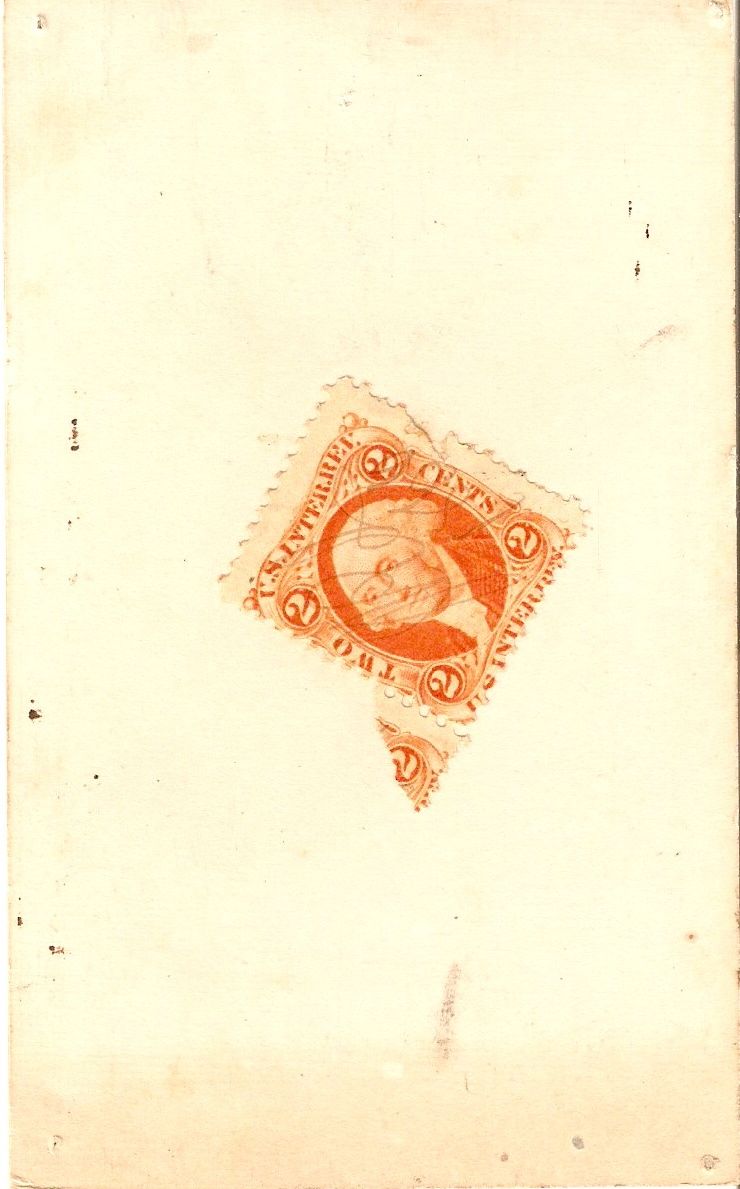
Tax revenue stamp of unidentified photograph of couple, 1866; digital image 2012, privately held by Melanie Frick, 2013.

Tax revenue stamp of unidentified photograph of couple, 1866; digital image 2012, privately held by Melanie Frick, 2013.

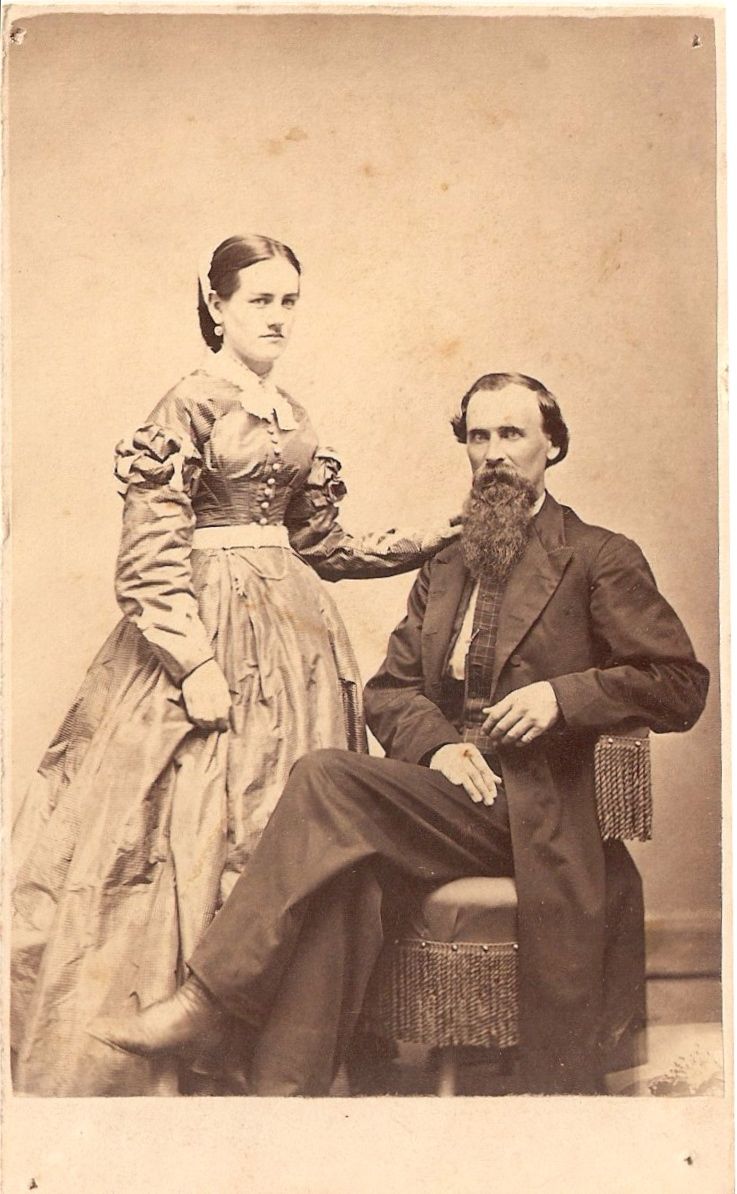
Unidentified photograph of couple, 1866; digital image 2012, privately held by Melanie Frick, 2013.

Unidentified photograph of couple, 1866; digital image 2012, privately held by Melanie Frick, 2013.

Another photograph with a distinct Civil War flavor comes with a helpful clue.  The couple in the photograph above appears impeccably dressed. The bearded man wears a typically roomy sack-cut coat,5 accented with a dark plaid vest, and the woman, whose hair is held back with combs in a style that was common at the time,6 wears a solid-colored gown with elegant puffed sleeves and buttons adorning the bodice. Affixed to the back of this carte de visite is an orange two-cent stamp. This stamp, which features George Washington, was a tax revenue stamp. It is canceled with the photographer’s initials, along with the date: 1866. As it turns out, this photograph was taxed near the tail end of the period during which photographs were subject to a tax; the period of taxation lasted only from 1 September 1864 to 1 August 1866.7

This photograph has tack holes in each of its four corners, suggesting that it was put on display at one time, tacked up perhaps on the wall of a home or on a writing desk. Evidently, in the years before it made its way into an album and was subsequently forgotten, this photograph was important enough to someone that he or she wished to look upon it every day. Today, we are left to wonder what became of the couple pictured within, and why they chose to have their photograph taken on this day in 1866, not long after the conclusion of the Civil War.

What signs of the Civil War era have you spotted in a photograph?


SOURCES
1 Jesse M. and Elizabeth Jane (Baker) Smith Album, ca. 1860-1920; privately held by Melanie Frick, 2013.
2 “What Do You Know About Tintypes?,” Ohio Historical Society Collections Blog, 5 August 2011 (http://ohiohistory.wordpress.com/2011/08/05/what-do-you-know-about-tintypes/ : accessed 13 September 2013).
3 Joan Severa, Dressed for the Photographer: Ordinary Americans and Fashion, 1840-1900 (Kent, Ohio: Kent State University Press), 206.
4 1870 U.S. census, Henry County, Iowa, population schedule, Center, p. 14, dwelling 109, family 109, Laura B. Smith; NARA microfilm publication M593, roll 395.
5 Severa, Dressed for the Photographer, 209.
6 Severa, Dressed for the Photographer, 206.
7 Maureen A. Taylor, Family Photo Detective (Cincinnati: Family Tree Books, 2013), 54-55.

His Last Trip to Germany, Part I

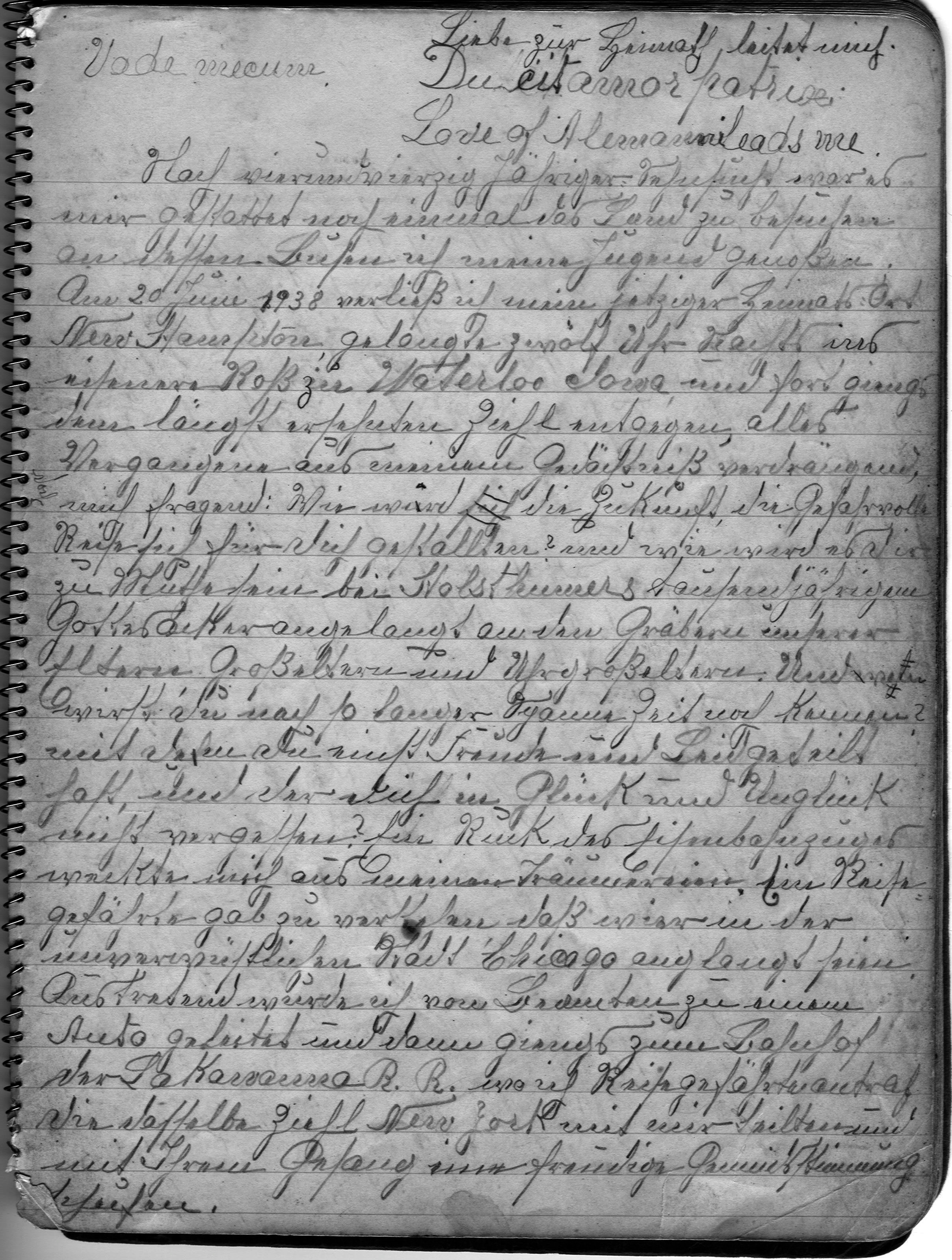
Very few of my immigrant ancestors ever had the opportunity to revisit the countries they left behind, but Mathias Noehl of Holsthum, Rheinland-Pfalz, Germany did so on two occasions. Mathias came to America as a young man in the spring of 1886, eventually settling in northeastern Iowa.1 Late in life, he began to write a reflective memoir; its tone was frequently melancholy, hinting at tragedies and disappointments, and it was left unfinished. Mathias wrote warmly, however, of the rural village where he had grown up. His first return trip to Germany was in 1894, to visit his aging parents.2 His second and final return trip was decades later, in 1938, when he himself was an old man.3 Mathias was a keen observer and thoughtful writer, and his memoirs offer insight into the emotions of an immigrant now a stranger in his homeland.

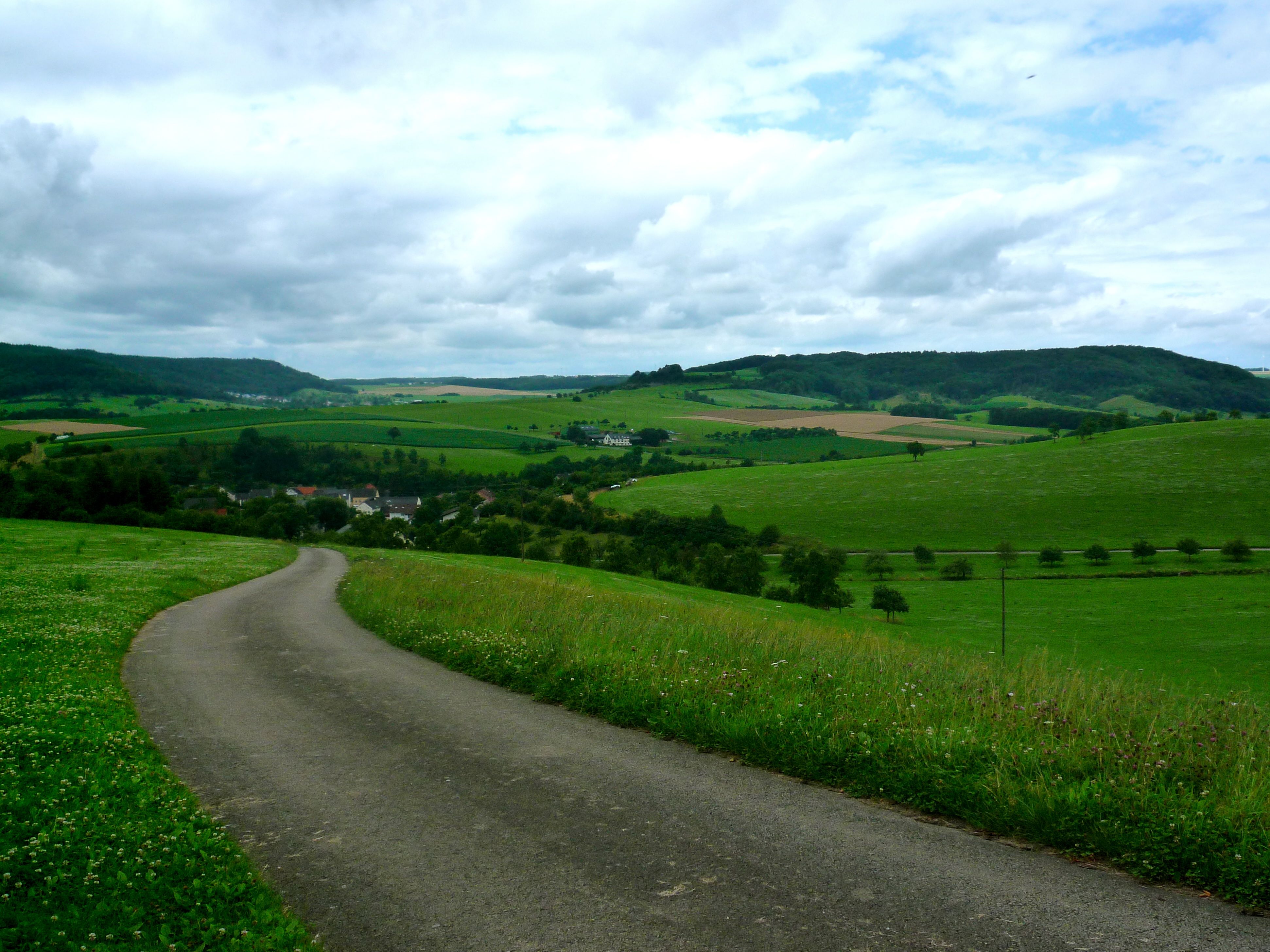
Holsthum, Rheinland-Pfalz, Germany photograph, 2009; privately held by Melanie Frick, 2013.

Holsthum, Rheinland-Pfalz, Germany photograph, 2009; privately held by Melanie Frick, 2013.

As his memoirs are lengthy, today I want to share an excerpt concerning his journey from Iowa to Germany in the summer of 1938. Mathias began, “After having longed for forty-four years to see my old home again, and to visit the land, at the bosom of which I had enjoyed my youth, I was permitted to carry out my desire.” He traveled by train from New Hampton, Chickasaw County, Iowa, to “the indestructible city of Chicago,” before transferring to another train. He wrote, “I met companions who were bound for the same goal, New York, and who created with their singing a joyful frame of mind. The number of homesick travelers increased, from station to station, and the words of the song ‘at last the long desired hour has arrived,’ sounded louder and louder […]. There was an excitement as if we were going to a wedding. We saw roses on every thorn, and when we returned, only the thorns were left.”4

Once arrived in New York, Mathias prepared to board the ship Hamburg:

“A Frenchman advised us not to entrust ourselves on the ocean on such a small boat like the Hamburg (22,000 tons). An Englishman spoke of the short time it would take their steamer to cross the Atlantic. A German warned us of both. And on the streets of New York, a Greek offered us his food wares, and praised the Germans, which was no disadvantage to his business.”5

The chaotic scene at the docks made a lasting impression on Mathias. He wrote, “A dense crowd of human beings, who were tired of America, hustled over the landing bridge with the slogan ‘England or Death!’ Away from the ‘Fortune Wheel’ of America, where they had drawn only blanks. […] They hoped for better things, because no American misfortune could force them out of the ranks of those who struggled for survival. They were followed by young girls from Scotland who were homesick, or who had found bad luck in love. Whichever the motive, they longed to return to the laps of their mothers in Edinburgh. Then came women carrying weeping children, while boys were being dragged along on the coattails of their fathers. Then I saw young married women embracing their husbands with tears in their eyes. Men saying farewell to their wives, tearing themselves away from their embraces, to disappear into the lower part of the boat. Perhaps they had not the means to make the trip jointly. Then came the last reserve of the Knights of Fortune of America. Carrying their small possessions on bent shoulders, with their knees tottering, plunging into the belly of the ship, and blessing the wheel-of-fortune of America with a curse. Queen Mary, Queen of all the boats, sailed on, laden with joy and grief.”6

Noehl, Mathias. “Memoirs.” MS. New Hampton, Iowa, ca. 1938-1950. Privately held by Melanie Frick. Note: Excerpts from an unpaginated German to English translation. Information about the translator and date of translation to come at a future date.

Noehl, Mathias. “Memoirs.” MS. New Hampton, Iowa, ca. 1938-1950. Privately held by Melanie Frick. Note: Excerpts from an unpaginated German to English translation.

He continued, “The sight of the steamer Isle de France was different. When the happy-go-lucky Frenchmen marched down the planks into the rooms of the ship, here you could view and examine all the modern fashions of others, and not so modern, from the latest Parisian costumes to the costume of Adam. […] Fare-thee-well you gay Frenchmen. We once fought with you at our side. […] If all goes well, we may still join hands across the Atlantic, and not as hereditary enemies.”7

“At last we had to go where the German steamer [Hamburg] was anchored. At both entrances there were double guards, looking downcast, which I could not understand. Neither could I understand the police force of twenty-four men marching up and down the landing place. […] After a short while, we one thousand passengers were ordered on board the ship. Tired as we were, we sought our berths […]. It was a nerve-wracking job for our stewards to tell each one the room assigned for him, but as always, we found everywhere the friendliest service. Kindness, goodness, and the friendly, ‘Oh pray, please,’ of the North German were heard in all corners of our steamer, and then I could not help noticing everywhere the German love for order, punctuality, neatness, cleanliness, and kindness. No cross words or unclean talk. All ready to obey. All ready to serve. We had left all our cares behind us in America.”8

The passage was not without a scare, however: “On June 26, we left the Gulf Stream behind us and came into cool water. On the northeastern sky, we noticed a copper coloring, which indicated storm. […] Fishes jumped out of the sea, and our steamer began to heave ominously, and to sink again. Waves high as a house descended upon one another, and plunged into the awful abyss […]. Women made desperate attempts while vomiting to maintain their equilibrium on the boat, heaving to and fro. Seasickness on board, tables were knocked to the floor, someone broke a leg on the deck. I myself, in order not to be thrown over, grasped several chairs and rolled over against the iron wall, while the thunder was rolling. A speech to be made by the captain was cancelled. Seamen loaded with life belts rocked to the high fore deck where we had to assemble, in case the worst would come. I had picked an Englishwoman with whom I should share a life belt, in order to become a solitary food for the big fish, in case I should not be spared the jump into eternity. But, as on Lake Genesareth long ago, the storm abated […].”9

Mathias also wrote of the friendships forged with the other passengers – English, Irish, French, Swiss – throughout the ocean crossing. At each stop, more passengers disembarked:

“Thus reducing more, our family of one thousand passengers, without hope of seeing each other again. Although we had faced each other as enemies in the World War, we had become fast friends during our brief sojourn on the boat. And, many left us with tears in their eyes. Unbelievable, for those who have never seen such a scene. The anchors are lifted, the band plays ‘Farewell,’ whistles sound as signals, handkerchiefs are waved.”10

At last, Mathias’ voyage came to an end: “Land in sight: the Fatherland! The new Germany dressed in its best summer clothes, June 30, 1938, and now we began nervously to pack our clothes, to present our passports, to receive our railway tickets, to give tips to our stewards, to thank for congratulations, etc. At the command of the Captain, our steamer jerked into its landing place, where a thousand years before, St. Bernard had preached; where Rembrandt had painted his pictures; where the poets had sung their songs.”11

Of course, as it turns out, Mathias Noehl had impeccable timing when planning this last trip to Germany, just months before Kristallnacht and a year before the invasion of Poland. I will share the next chapter of his memoir another day, which details his experiences revisiting his beloved Holsthum, and his dismay at the inevitable changes that were brought upon his home district of Bitburg-Prüm.

Read “His Last Trip to Germany, Part II” here.

Continue reading

Vintage Swimwear

This is a fun photograph that I thought I would share before the summer completely slips away. This snapshot was labeled on the back, and, years ago, I was also able to hear its story from my late great-grandmother, Fern Lavonne (Thoma) Adam of Sioux City, Woodbury County, Iowa. Well, more than its story, I remember her laughing about her bathing suit! The photograph was taken in 1924, at the river near Scribner, Dodge County, Nebraska.

Fern Lavonne (Thoma) Adam photograph, 1924; digital image 2010, privately held by Melanie Frick, 2013.

Fern Lavonne (Thoma) Adam photograph, 1924, Scribner, Nebraska; digital image 2010, privately held by Melanie Frick, 2013.

Fern lived in Scribner, where her father opened a grocery store, for a few years in the early 1920s. She remembered attending dances there, as well as learning to drive. Her father gave her a lesson immediately when she remarked that she would like to learn, and the next day, when she asked for another lesson, he told her to go ahead on her own!1 Apparently, Fern also enjoyed taking advantage of the opportunity to swim in the Elkhorn River during her short time in Scribner. She is pictured here at center; at left is Lucille Romberg, and at right is Helen Kellner. These young ladies must have been good friends in the summer of 1924, when Fern would have been sixteen years old.

In order to learn more about vintage bathing suits, I turned to Threaded, the Smithsonian’s blog about fashion history. From there I learned that a company by the name of Jantzen devised a “swimming suit” made of wool in 1915, and that by 1921, the name had stuck.2 My great-grandmother and her friends appear to be wearing typical knitted wool swimsuits of the era, comprised of long, sleeveless, v-necked tunics, fitted shorts, and, in my great-grandmother’s case, knee high stockings, rolled at the top. The girls wear their hair inside knit swimming caps, the one on the left being slightly more elaborate with a small brim. They all squint in the sun and lean together for the photograph, happy and relaxed on a summer’s day.

Have you come across any photographs featuring early styles of swimwear?


SOURCES
1 Fern Lavonne (Thoma) Adam, conversations with the author, 2001.
2 “The Swimsuit Series, Part 1: A History of Women’s Suits,” Threaded, 22 June 2012 (http://blogs.smithsonianmag.com/threaded/2012/06/the-swimsuit-series-part-1-a-history-of-womens-suits/ : accessed 6 September 2013).

When Did He Die? Clues From a Probate File

This year was the first that I attended the NGS Family History Conference, and I never could have imagined how much I would learn from each and every lecture that I attended there. I was always left with the urge to rush back to my hotel room to open up my laptop and try out a new research trick, or to look at a record in a different way. One of the many inspiring lectures that gave me some food for thought was the Helen F. M. Leary Distinguished Lecture, “Trousers, Beds, Black Domestic, Tacks, and Housekeeping Bills: ‘Trivial Details’ Can Solve Research Problems,” by Elizabeth Shown Mills.1

This lecture stressed attention to detail, in particular the information and significant dates that could be gleaned from probate records and household bills. For example, a doctor clearly wouldn’t continue to attend and bill a patient after they had died, and the purchase of items needed for a burial, including a coffin or, less obviously, a new suit of clothes, could also suggest a date of death.2 When contemplating this, I immediately thought of my ancestor Elithan Hall of Washington County, Illinois; details of his life are few and far between, but I did possess a copy of his probate file.

Within the probate file for Elithan Hall was a petition that stated that he had died on an unspecified date in March of 1859. This petition was not created until 1866, but seemed to be the most reliable document referencing the date of his death.3 After attending Elizabeth Shown Mills’ lecture, however, I recalled that the probate file had included quite a few miscellaneous bills. I wondered if one might suggest a more specific date of death, and I could hardly wait to reexamine the contents of the file to see whether I had overlooked any details before.

Washington County, Illinois, Ellerton Hall probate file, Box 34, County Court; Illinois State Archives, Springfield.

Washington County, Illinois, Ellerton Hall probate file, Box 34, County Court; Illinois State Archives, Springfield.

As it turns out, I most certainly had. To be honest, the facts became almost embarrassingly obvious! Within the probate file was a doctor bill, which stated, “1860: From April 26th to May 5th for Medical Attendance during his last sickness.”4 There was another bill as well, signed by a different man: “From January 27th 1860, To May 9th 1860, To Sundries including burial expenses.”5

Last sickness? Burial expenses? From these seemingly minor details, I realized that Elithan Hall had likely lived more than a year longer than the date on the petition, which I had blindly accepted although it was created more than five years after the fact. In reality, Elithan Hall likely died in Washington County, Illinois, on 5-6 May 1860, and was buried no later than 9 May 1860.

What surprising clues have you found in a probate file?


SOURCES
1 Elizabeth Shown Mills, “Trousers, Beds, Black Domestic, Tacks, and Housekeeping Bills: ‘Trivial Details’ Can Solve Research Problems,” National Genealogical Society Family History Conference: Las Vegas, 2013.
2 Elizabeth Shown Mills, “Trousers, Beds, Black Domestic, Tacks, and Housekeeping Bills.”
3 Washington County, Illinois, Ellerton Hall probate file, Box 34, County Court; Illinois State Archives, Springfield. Ellerton was a variation of the name Elithan.
4 Washington Co., Ill., Ellerton Hall probate file.
5 Washington Co., Ill., Ellerton Hall probate file.


A Tintype Wedding Portrait

One of my favorite aspects of genealogical research is photograph analysis. I can never take just one glance at an old photograph, as I love to detect clues about the eras, lifestyles, and relationships depicted within. I hope to share a photograph and analysis on a weekly or monthly basis, including both photographs from my family’s collection, as well as photographs, unidentified or not, that I’ve come across in antique stores.

Timothy Adam and Odile Millette photograph, 1867, Springfield, Massachusetts; digital image 2013, privately held by Melanie Frick, 2013.

Timothy Adam and Odile Millette photograph, 1867, Springfield, Massachusetts; digital image 2013, privately held by Melanie Frick, 2013.

This is a scan of a tintype of my third great grandparents, Timothy Adam and Odile Millette of Springfield, Hampden, Massachusetts, who were married on 22 September 1867.1 At the time of their marriage, Timothy and Odile, both of French Canadian heritage, were twenty years old. Timothy worked as a dresser at a cotton mill; prior to their marriage, it seems likely that Odile would have worked at a mill as well.

This tintype has several features worth noting. Smaller than my hand, the original has hand painted pink accents on the cheeks of the couple. The corner of the tintype has been bent, but the overall quality of the image is good.

Was this tintype made at the time of the couple’s marriage? First of all, we know that tintypes were in use from 1856-1930. They gained popularity in the 1860s as they were inexpensive to produce – Timothy and Odile may have paid only a few cents for this image at a local studio.2

In the image, Odile stands at Timothy’s side while he sits in a chair. His feet are planted firmly on the ground, and Odile rests her hand on his shoulder. Timothy’s gaze focuses directly on the camera, while Odile gazes slightly above. Their expressions are serious, but not unpleasant.

Timothy wears a three-piece suit for the occasion. He appears to be a slight young man, and his dark suit is somewhat loose fitting – perhaps it was not brand new, as closer fitted, ready-made styles became popular in this decade.3 There is trim at the borders and cuffs of his suit, which he wears with a white collar, a cravat, appropriate for a formal occasion, and what may be a pocket watch at the lapel.4 Timothy’s hair is parted on the side, and he sports a faint mustache.

Odile wears a skirt and waist style of dress, the simple waist accented by jet buttons. Over this, she wears a Spanish jacket in a contrasting color with a bold trim.5 Her otherwise plain skirt features a belt or sash and a wide hoop, which is compressed slightly by her position against her husband’s chair. Her dark hair has a center part and is pulled back into a plain snood, or hair net, in an everyday style. She wears earrings, and a brooch adorns her high collar.

Odile’s style of dress reflects a fashion seen in the 1860s. In May 1863, Peterson’s printed the following:

“[…] All the thin summer goods are very much risen in price, so that the present fashion of wearing old skirts, with Spanish and Zouave jackets, is a most convenient one […] pretty jackets in velvet, silk, and cloth […] very useful for wearing with old skirts, the bodices of which are worn out.”6

Furthermore, in June 1866, Godey’s noted “a charming assortment of fancy jackets” worn by women.7 Though the high prices of fabric reported in 1863 were most likely a result of the Civil War, which concluded two years prior to Odile’s wedding day, as she was a young millworker of limited means, it does not seem unreasonable to assume that she might have remade an old dress in an economical fashion for the occasion. With her dark complexion, a Spanish jacket proved an attractive choice.

The clothing and hairstyles worn by the couple indicates that the image was made in the 1860s, and the apparent age of the couple suggests that it was made in the latter half of the decade. It therefore seems likely that this was indeed a wedding portrait of Timothy Adam and Odile Millette, who would have had their picture made on or around 22 September 1867 in Springfield, Hampden, Massachusetts. It provides a unique glimpse into an important day in the lives of two young people of French Canadian heritage, who sought opportunity in the textile mills of New England in the years following the Civil War.

Do you have any tintypes in your family collection?


SOURCES
1 “Massachusetts, Marriages, 1841-1915,” digital image, FamilySearch (https://familysearch.org : accessed 30 Aug 2013), Timothy Adams and Julia Mellett, 22 September 1867, Springfield. Odile Millette used the name Julia early in her life.
2 Maureen A. Taylor, Family Photo Detective (Cincinnati: Family Tree Books, 2013), 37.
3 Joan Severa, Dressed for the Photographer: Ordinary Americans & Fashion, 1840-1900 (Kent, Ohio: Kent State University Press, 1995), 259.
4 Severa, Dressed for the Photographer, 209.
5 Severa, Dressed for the Photographer, 277.
6 Severa, Dressed for the Photographer, 241.
7 Severa, Dressed for the Photographer, 277.

Welcome!

Hello, and welcome to The Homestead! My name is Melanie Frick, and while I’m new to the world of genealogy blogging, genealogy has been an important part of my life for over a decade. I’m sure any genealogist can relate to the most frequent questions I receive when someone learns what I do: Where did your ancestors come from? How far back does your family tree go? I always struggle to give a brief answer to these questions, because I realize that to answer the questions completely would be more than one would bargain for when making polite conversation.

My ancestors were Danish immigrants who homesteaded in southeastern South Dakota, and frontiersmen who made the trek from coastal North Carolina to southern Illinois at the dawn of the nineteenth century. They were Acadians who were forcibly exiled to Massachusetts in the midst of the French and Indian Wars, and German farmers who found their paradise in the peaceful rural communities of northeast Iowa. They were immigrants who made their homes in the hustle and bustle of Chicago, and pioneers who made their lives on the plains of Kansas. They were French fur traders in the harsh landscape of seventeenth century Quebec, and English immigrants who supported their new nation in the Civil War. They were husbands and fathers, wives and mothers, farmers, soldiers, businessmen, teachers, midwives, millworkers.

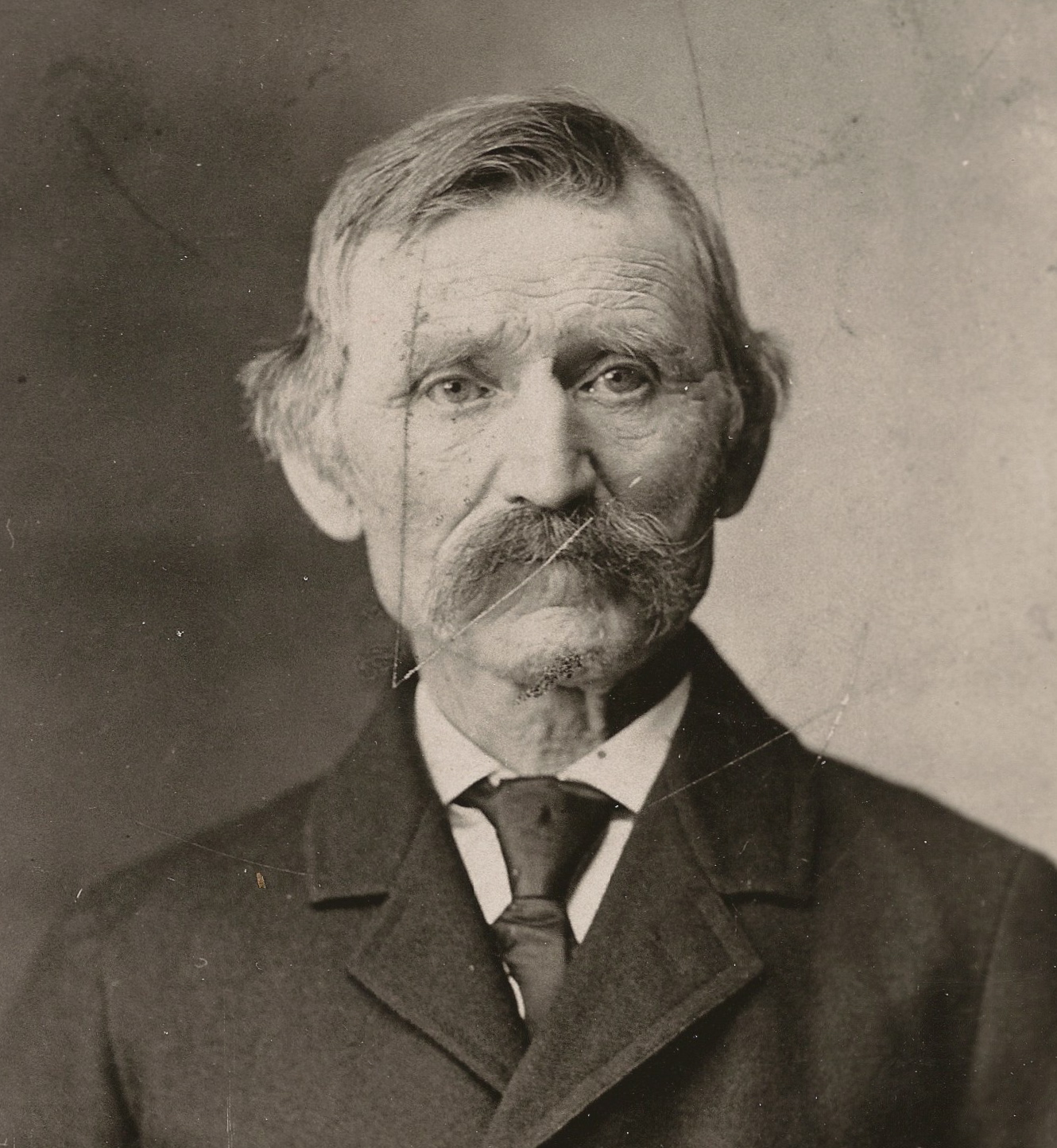
Inger Marie (Hansen) Bramsen photograph, ca. 1870; digital image ca. 2001, privately held by Melanie Frick, 2013. The location, condition, and characteristics of the original are unknown.

Inger Marie (Hansen) Bramsen photograph, ca. 1870; digital image ca. 2001, privately held by Melanie Frick, 2013. The location, condition, and characteristics of the original are unknown.

They were raised in dank sod houses, in cabins, in sturdy farmhouses and village homes, in crowded tenements. They were taught to read and write at home, in convents, in one-room schoolhouses. They were never taught to read or write. They married one, two, three, four times. They raised a dozen children. They buried baby after baby. They buried their spouses. They divorced. They celebrated their golden anniversaries. They saw their farms and businesses fail. They saw their farms and businesses succeed. They mourned homelands that they would never see again. They returned to their homelands to find their loved ones gone, their homes abandoned, their communities changed. They stayed in the same village for all of their days. They crossed oceans, continents, always in search of a better life. They died of gunshot wounds, consumption, influenza, drowning, alcoholism, buggy accidents, airplane crashes, cholera, typhoid, diphtheria, tetanus, suicide, senility, heart failure, pneumonia, old age. Their graves are marked by towering headstones. Their graves were never marked. No one remembers their names.

These are the stories I love to tell.

What will happen on The Homestead? For now, I plan to explore what I find most enjoyable to write, and what others find most enjoyable to read. I will write about my own genealogical research and historical events that impacted our ancestors, as well as tips and tricks for identifying old photographs, archiving genealogical material, and breaking down brick walls. I may even include the occasional book or product review.

I hope that you will enjoy following along with my experiences as a young professional in the field of genealogy, and I look forward to hearing from my readers. Thanks for stopping by!