The Last Canadian

In honor of Canada Day, I introduce my last ancestor to live and die a Canadian: Leon Chicoine, who was baptized Joseph Leon Chicoine on 12 April 1785 at St-Charles-sur-Richelieu, Quebec, the son of Francois Chicoine and Marie Elizabeth Tetreault.1

St-Charles-sur-Richelieu

“View of St-Charles-sur-Richelieu from St-Marc-sur-Richelieu,” 2014, Saint-Charles-sur-Richelieu, Montérégie, Québec, Canada; Wikimedia Commons, copyright Tango7174.

Little is known of Leon’s early years. By the time he was twenty-five, he had made his way to Longueuil, located on the south shore of Montreal. It was there that he married Longueuil native Marie Varry on 17 September 1810.2 Their marriage took place at the impressive Cathédrale St-Antoine-de-Padoue in a ceremony led by Father Augustin Chaboillez, who, according to contemporary accounts, managed his parishioners with a firm hand. In fact, earlier that same year, he had a parishioner jailed for daring to interrupt his sermon!3

Leon and Marie did not remain there for long; they soon settled in St-Marc-sur-Richelieu, a rural community just across the Richelieu River from where Leon himself had been born. They remained in this area for the rest of their lives.4 Family lore states that Leon served in the military during the War of 1812.5 Then, twenty-five years later, war came to St-Marc when British troops defeated a number of Canadian rebels there during what is known as the Patriot War.6 Leon was in his fifties at this time; might he have participated in the futile attack? We may never know for sure.

Attack-on-Saint-Charles

“Attack on Saint-Charles 25th Novr. 1837,” 1840, Lord Charles Beauclerk (1813-1842); McCord Museum, Montreal, Quebec.

In any case, the majority of Leon’s life was likely spent in a more peaceful manner as a forgeron, or blacksmith.7 He fathered at least thirteen children, including my ancestor Marguerite Chicoine, although not all survived to adulthood. Sadly, Leon’s wife, Marie, passed away before she was forty; Leon remarried to Francoise Desautels in 1829.8

Leon Chicoine would live to the age of ninety two. When his granddaughter recorded his death in January 1877, she noted that he was by that time the grandfather of fifty-six grandchildren.9 His burial occurred at his birth parish of St-Charles-sur-Richelieu, likely in the churchyard of the striking eighteenth-century stone church located on the banks of the Richelieu River.10

Copyright © 2015 Melanie Frick. All Rights Reserved.

Continue reading

A Letter From the Shipyards

Although Henry Joseph Adam was sixty years old when the United States entered World War II, he made the decision to apply his skills as a carpenter more than fifteen hundred miles from home at the Kaiser Shipyards in Portland, Oregon.1 This was one of several emergency shipyards established during wartime that oversaw the construction of numerous Liberty and Victory ships.2

Henry_Adam_Carpenter

Henry Adam (seated at center) at work, Sioux City, Iowa, ca. 1930-40; digital image 2010, privately held by Melanie Frick, 2015.

Henry ventured to Oregon in 1942, although he was not there continuously; his wife of thirty-seven years, Melanie, remained at their home in Iowa.3 However, we know that Henry was in Portland in June of 1943 when he mailed the following letter:

6-4-43
Dear Mealane
red your letter last night and it seam funey to me to here of so many people dying sent i left. i just got back from supper i was out to cool and here it is quarty to eight so will send you my first check rent i got sick and it leave me purty short you ask me what i am doing well i send you the slip of the copany witch i am with and i is house prog work and i am in side setting up book case and kitchen cabinet and thresh hold and it is a snap so far. and the Boos pick me up right at the door so that make it fine i leave here at half past 7 and we get back about 5.75 and by the time i get to cool it is 6.00. well Mealane i will send you my driver licin so you get me a new one and i wish you would send me the last MWAR so i can go and play cribag with the man that live in the back room that old lady say you aught to be out here now to see the purty flowrs and so many it rain every day a little bit and the night are fine so i guest that about all i think of so good By and good luck
Henry xxxxxxxxxxxxX

This slideshow requires JavaScript.

I don’t have the impression that Henry had occasion to write many letters in his lifetime. His spelling errors are numerous, and at times humorous – for one, his wife actually spelled her name Melanie, not Mealane! However, his apparent lack of practice in spelling and grammar is understandable for a hardworking tradesman of the era. After spending his early years in Massachusetts surrounded by so many relatives of French Canadian descent that he had no reason to speak English until he entered school, Henry moved to Iowa where he spent the remainder of his childhood on his father’s homestead. He did not attend school beyond eighth grade, at which point he likely entered the workforce.3 By the time he was thirty, he had settled on carpentry as a profession.4

A carpenter Henry remained until his death. On 28 March 1944, Henry suffered a fatal heart attack in Long Beach, California, where he had been a resident for less than a week.5 He had likely pursued work at the US Naval Dry Docks, later the Long Beach Naval Shipyard, as the United States was still in the throes of World War II. His letter, written less than a year prior to his death, documents this final chapter of his life.

Copyright © 2015 Melanie Frick. All Rights Reserved.

Continue reading

2015 SCGS Jamboree

It seems there has hardly been a chance to catch my breath since I was in Missouri for the NGS Family History Conference last month – and I suppose with good reason. My husband and I managed to fit a road trip with visits to ten states in ten days (not to mention three national parks in twenty-four hours) in between! This past weekend, then, only added to the blur as it was time to attend my second conference of year: the Southern California Genealogical Society’s Jamboree in nearby Burbank, California.

There were several memorable sessions and I made a point to Tweet some of the many highlights. I started off learning how to create a “Genealogy Disaster Plan” with Denise Levenick and picked up some great tips about how to handle an abundance of genealogy materials, including a recommendation for a fireproof safe for irreplaceable items and guidelines for backing up digital files. Levenick even shared a “Genealogy Preparedness” checklist, available for download at The Family Curator. I also enjoyed a case study on tracing common surnames (the “Jones Jinx”) from Tom Jones, insight into the records of poor ancestors from Paula Stuart-Warren, thoughts on immersion genealogy and family history travel from Lisa Alzo, and songs and stories of farming ancestors from Jean Wilcox Hibben.

Another informative session was “Genetic Genealogy and the Next Generation” led by Blaine Bettinger and Paul Woodbury. As a big fan of genetic genealogy (my grandparents have submitted to multiple DNA tests for me at this point!), I agreed with their suggestions that DNA offers a tangible opportunity for education and engagement among youth within the realms of both genetics and family history. What was especially interesting to me was a discussion of the correlation between an interest in genealogy and the number of generations of displacement from one’s cultural roots.

NextGen Genealogy Network Meetup, 2015 SCGS Jamboree

Of course, the Jamboree provided a great opportunity to socialize with several friends and fellow genealogy bloggers. This included Deborah Sweeney, who kindly provided me with a copy of her beautiful new book about the lives of her grandparents during World War II, Dear Mother, Love Daddy. I also hosted an informal meetup of the NextGen Genealogy Network and was glad to see nearly twenty attendees stop by our table, whether fellow “young genealogists” or our staunch supporters. It was a great way to conclude my last day in Burbank, as I chose to attend the conference virtually on Sunday. After so much of the past month spent away from home, it was nice to be able to catch up some things around the house while listening in on the free live stream of selected sessions – including one by sixteen-year-old genealogist Matthew Hovorka! The next generation of genealogy is here indeed.

Read about the 2014 SCGS Jamboree here.

Copyright © 2015 Melanie Frick. All Rights Reserved.

2015 NGS Family History Conference

Last week was spent at the National Genealogical Society’s 2015 Family History Conference in St. Charles, Missouri. This was my third NGS conference in as many years, and as always, it was a fantastic time of education, inspiration, and connecting with colleagues and friends.

IMG_0792Despite missing the first morning and final afternoon of the conference, I managed to pack in fourteen sessions in addition to the NGS luncheon and a lovely breakfast hosted by Findmypast. (No, I didn’t get much sleep.) From legal lingo with Judy Russell to tracing kinships through indirect evidence with Elizabeth Shown Mills, I came away with plenty of new ideas for tracking down some of my more elusive ancestors. Other sessions ranged from Federal Military Pensions to Scandinavians in the Midwest, and I also enjoyed learning about Illinois resources, pre-statehood and beyond, as a number of my ancestors entered Illinois Territory more than two hundred years ago.

One standout session was Baerbel Johnson’s “So You Think You Want to Get Married: German Marriage Records, Laws, and Customs.” Let’s just say that all of the obstacles in the way of marriage during different points in German history – including age restrictions (brides had to be twenty-two and grooms had to be twenty-five!), parental permission, proof of means of support, and taxes galore – go a long way in explaining just why so many German children may have been born out of wedlock.

My favorite discovery from a session? That would have to be HistoryGeo.com, a resource that maps “First Landowners” and can pinpoint the exact site of your ancestor’s land on Google Maps in just a few clicks. This eliminates the need to painstakingly cross-reference historic plat maps with modern road maps as I did last summer when identifying the location of the homestead of one of my ancestors. If you have any first landowners in your family tree, this is a resource you won’t want to miss.

This slideshow requires JavaScript.

At this year’s conference, I especially enjoyed getting to spend time with two fellow members of the Leadership Team of the NextGen Genealogy Network. We hosted an informal meetup event for other young genealogists in their twenties, thirties, and forties – and those who lend their support, including a friend of mine from graduate school. A handful of us stuck around to swap our best family stories into the night, and from black sheep to DNA discoveries, we covered it all. It was the perfect way to pause and unwind halfway into the conference!

All in all, I was impressed with the stellar organization of this year’s conference by the National Genealogical Society, the St. Louis Genealogical Society, and conference center staff, as well as the tireless speakers, volunteers, and exhibit hall vendors. The conference center was a short walk from my hotel, and there was a Cracker Barrel in between – what more could one want? Oh, food trucks, of course. Lots of fun details of the conference were captured on Twitter under #NGS2015GEN.

I didn’t have the chance on this trip to explore what historic St. Charles and St. Louis have to offer, but I will definitely need to return at some point for a research venture – after all, my southern Illinois ancestors settled just a couple of hours away. Now I know how to find their land!

Read about the 2014 NGS Family History Conference (Richmond) here.
Read Ten Tips for NGS Family History Conference Attendees here.

Copyright © 2015 Melanie Frick. All Rights Reserved.

A Glimpse of Hyde County

Three years ago, my husband and I were in our final year of graduate school and in search of something to do over spring break. We lived in Northern Virginia at the time, so my husband suggested exploring the Outer Banks – about a five hour drive south. As soon as I determined that the Outer Banks were only a stone’s throw from mainland Hyde County, North Carolina, I was on board.

Why the fuss about Hyde County? I knew that this was the place from which my Stilley ancestors – who settled on the Illinois frontier in the early nineteenth century – had likely hailed. And for me, the ideal vacation includes at least some genealogical or historical element, paired, of course, with beautiful scenery, good local food, plenty of photo ops, and a travel companion willing to humor me.

P1050418

My direct ancestor Nancy Stilley, born in 1819 in Franklin County, Illinois, can almost certainly be linked to the other Stilleys scattered throughout southern Illinois who had roots in Hyde County, North Carolina. Nancy is believed to have been a granddaughter of the Hezekiah Stilley who was a resident of Hyde County as late as 1800 and whose numerous children – later residents of southern Illinois – are named in a family Bible.1 In the interests of full disclosure (I’m looking at you, Ben Affleck), I will add that Hezekiah Stilley likely married the daughter of Hyde County landowner and enslaver William Davis, who died there circa 1803.2 His will named eight enslaved individuals, Jemima, Gabrel, Joseph, Moses, Kesiah, Cate, Judith, and Silard, all of who were to remain with his wife and selected children after his death.3

P1050417

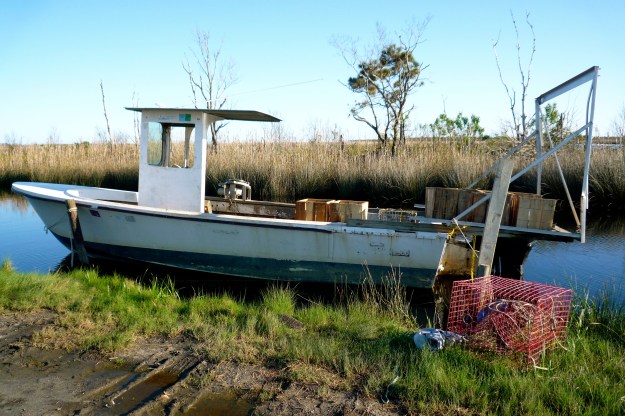
We had only a couple of hours to spend driving through the Inner Banks of Hyde County, but while this was not an in-depth research venture, it was still incredible to get a feel for the landscape that would have been familiar to my ancestors. I was glad to find that the county is still very rural; according to the 2010 census, the population is under six thousand people, comparable to its size two centuries ago. I believe we drove for an hour through the swamps and marshes without seeing another human being, and the only signs of civilization for much of our drive were an untended boat and an abandoned but well-kept ghost town.

P1050422

Hyde County, North Carolina also encompasses Ocracoke Island, a popular tourist destination on the Outer Banks that we visited via ferry. The island boasts quaint shops, stunning herds of wild horses, and locals who speak a distinct Ocracoke brogue that traces back to the dialect of the early colonists. It’s a must-see along the Outer Banks. The Inner Banks, in sharp contrast, are on the road less traveled – but one I would most definitely like to travel again.

Copyright © 2015 Melanie Frick. All Rights Reserved.

Continue reading

The Trailblazers

Jensine Kathrine and Lars Marinus Walsted were the first of their siblings to leave Denmark for America. Sine (also spelled Sena) was eighteen and Lars Marinus twenty when they arrived in Boston on 19 April 1886 aboard the Catalonia and made their way to Council Bluffs, Pottawattamie County, Iowa.1 It would be seven years before they would see another member of their family, although eventually, all of their surviving siblings would make their way to America.

Marinus_Walsted_Jensine_Walsted_1887

Lars Marinus “Charles” Walsted, 21, and Jensine Kathrine “Sine” Walsted, 19, half-siblings, Council Bluffs, Iowa, 1887; digital image 2014, privately held by Dianne Anderson, 2015.

This 1887 cabinet card photograph was likely taken outside in the summertime, as real grass appears in front of the outdoorsy backdrop. In addition, Sine poses with a parasol, certainly a warm-weather accessory. Both are smartly dressed, Lars Marinus in a light-colored three-piece suit and Sine in a plaid dress with a straight skirt and snug sleeves that, as was typical of the time, do not quite reach her wrists.2 A flower is pinned at her throat. Their hats – Sine’s quite elaborate – rest at their feet. Lars Marinus parted and combed his hair neatly, while Sine’s hair is pulled back tightly and does not seem to be styled in any special way. Iowa summers can be hot and humid, rather unforgiving to the curled fringe often worn by young women of the era!

At nineteen and twenty-one, these fair-complexioned half-siblings had their lives ahead of them. Having become established among a community of Danes in the Council Bluffs area, Sine and Lars Marinus may have wanted to have their picture made so that their parents could see how well they were doing after a year away from home. As the eldest children and trailblazers for life in America, they may also have hoped to encourage their five siblings to join them when they were able. While this photograph remained in Sine’s possession until she gifted it to her daughter in 1932, it’s easy to imagine that another copy may very well have accompanied a letter home to Denmark.

Copyright © 2015 Melanie Frick. All Rights Reserved.

Continue reading

Crestleaf.com’s Guess My Family Heritage Blogathon Contest Entry

I love any incentive to digitize and share old photographs, so today I am taking part in a blog contest hosted by Crestleaf.com, a collaborative genealogy website.

Participants have been asked to share a family photograph and to invite their blog readers to guess their heritage (or, for those of us with rather diverse backgrounds, the heritage of those pictured). If you would like to take part in the contest, details are available on their blog.

Crestleaf_Contest

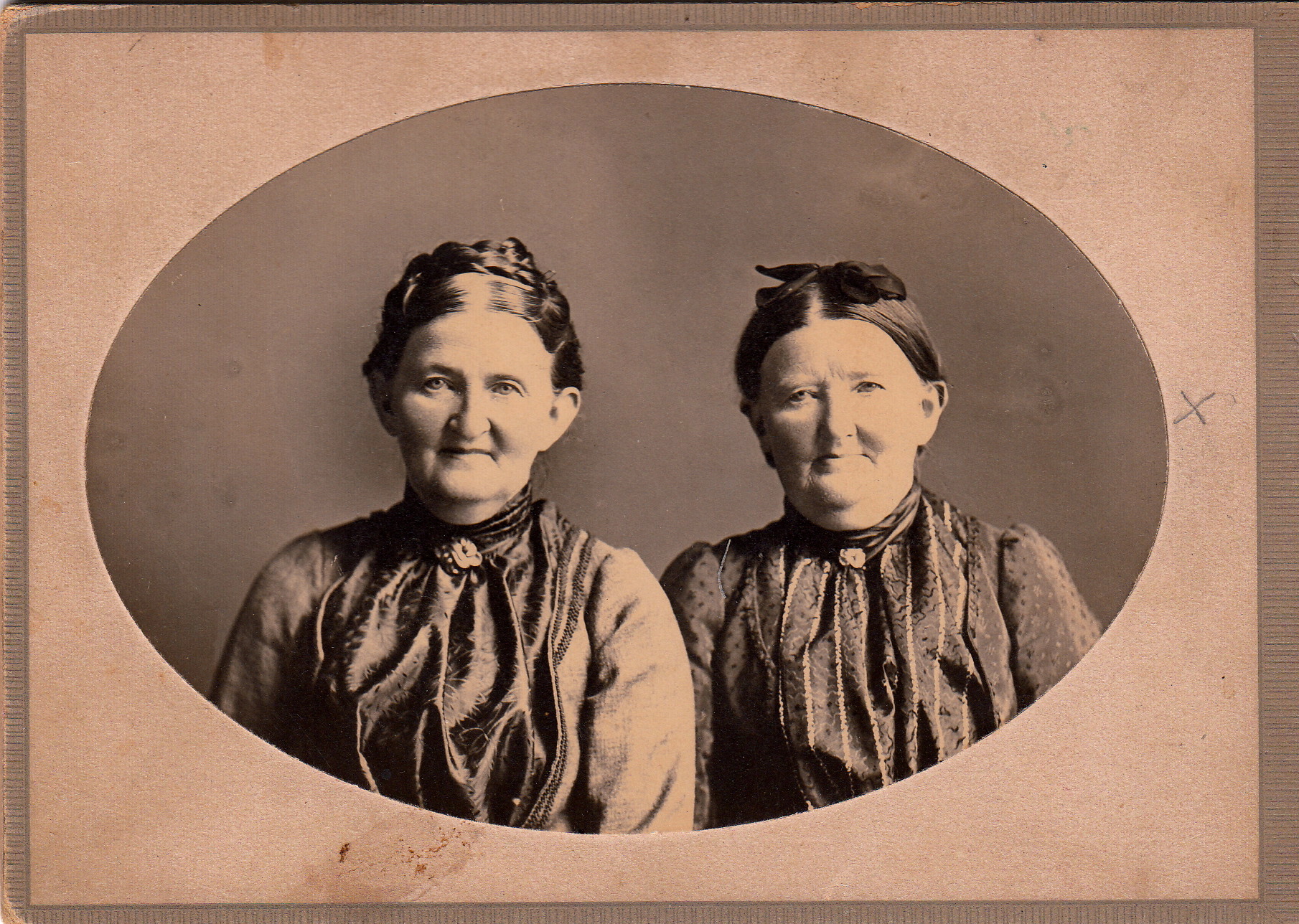
This cabinet card photograph depicts one of my ancestors, at right, with her sister. Can you guess their heritage? You are welcome to leave a comment! There is no prize for a correct answer, but I look forward to reading any responses. Check back after April 20th for the story of these sisters.

Update 4/22: Sisters Matilda Bramsen, left, and Anna Bramsen, daughters of Eric and Inger Marie (Hansen) Bramsen, were born in Denmark and later settled in South Dakota.

Thank you to Crestleaf.com for promoting the preservation of family memories through the Guess My Family Heritage Blogathon Contest!

Copyright © 2015 Melanie Frick. All Rights Reserved.

Tombstone Tuesday: Fred and Matilda (Hammond) Thoma

Fred and Matilda (Hammond) Thoma, or Fritz and Tillie as they were known in their community, spent their childhoods and the entirety of their married lives in the same rural county in northeastern Iowa. Fred Thoma was born to Bavarians Wilhelm Heinrich and Anna Margaretha (Poesch) Thoma on 4 December 1857 in Garnavillo, Clayton County, Iowa.1 Matilda Hammond was born to Hiram H. and Eva Margaret (Stoehr) Hammond on 4 May 1859 in Volga, Clayton County, Iowa.2 While Matilda’s father was a native of Ohio and an early settler in Iowa, her mother hailed from the same Bavarian village of Weißenstadt as Matilda’s in-laws.3

SCAN0126

Grave of Matilda Thoma (1857-1947) and Fred Thoma (1857-1924), Garnavillo Community Cemetery, Garnavillo, Clayton County, Iowa; image date unknown, privately held by Melanie Frick, 2015.

It seems likely that the couple crossed paths as children, although they lived in separate communities; the Weißenstadt immigrants were surely a close-knit bunch. Fred and Matilda married on 29 December 1879 at the Zion Evangelical Lutheran Church in Clayton Center.4 The next year found them living in Garnavillo, where Fred was a clerk in his late father’s country store.5 That autumn, the couple became parents to the first of their eventual five children: George Hiram, Leonard Christopher Julius, Ludelia Maria, Roselyn Anna, and Norma Evaline.6 All but Norma survived to adulthood; sadly, she died in a diphtheria outbreak when she was ten years old.7

What few details are known of Fred and Matilda’s lives come from recollections of their granddaughters.8 The first thirty years of their marriage were spent in the town of Garnavillo, where Fred later had a restaurant and then worked as a laborer.9 Matilda was said to have been a midwife who delivered many children in Clayton County, although such skills were not recorded in the census. Fred allegedly had a fondness for drink, so when Matilda received an inheritance, she bought a farm away from town – and the saloons.10 The empty nesters enjoyed life in the countryside for the next fifteen years until Fred’s death in Clayton on 10 January 1925.11

As a widow, Matilda spent time in the homes of her daughter and granddaughter. In 1930, she experienced a different climate in Houston, Texas; by 1940, she had returned to the Midwest and resided in Wisconsin.12 It was there in Bridgeport, Crawford County, Wisconsin that she died on 21 August 1947 when she was approaching ninety years of age. She is buried beside her husband at the Garnavillo Community Cemetery.13

Copyright © 2015 Melanie Frick. All Rights Reserved.

Continue reading

Searching for Marguerite

There is both good and bad news about this photograph:

Unidentified_Marguerite_Chicoine_Adam

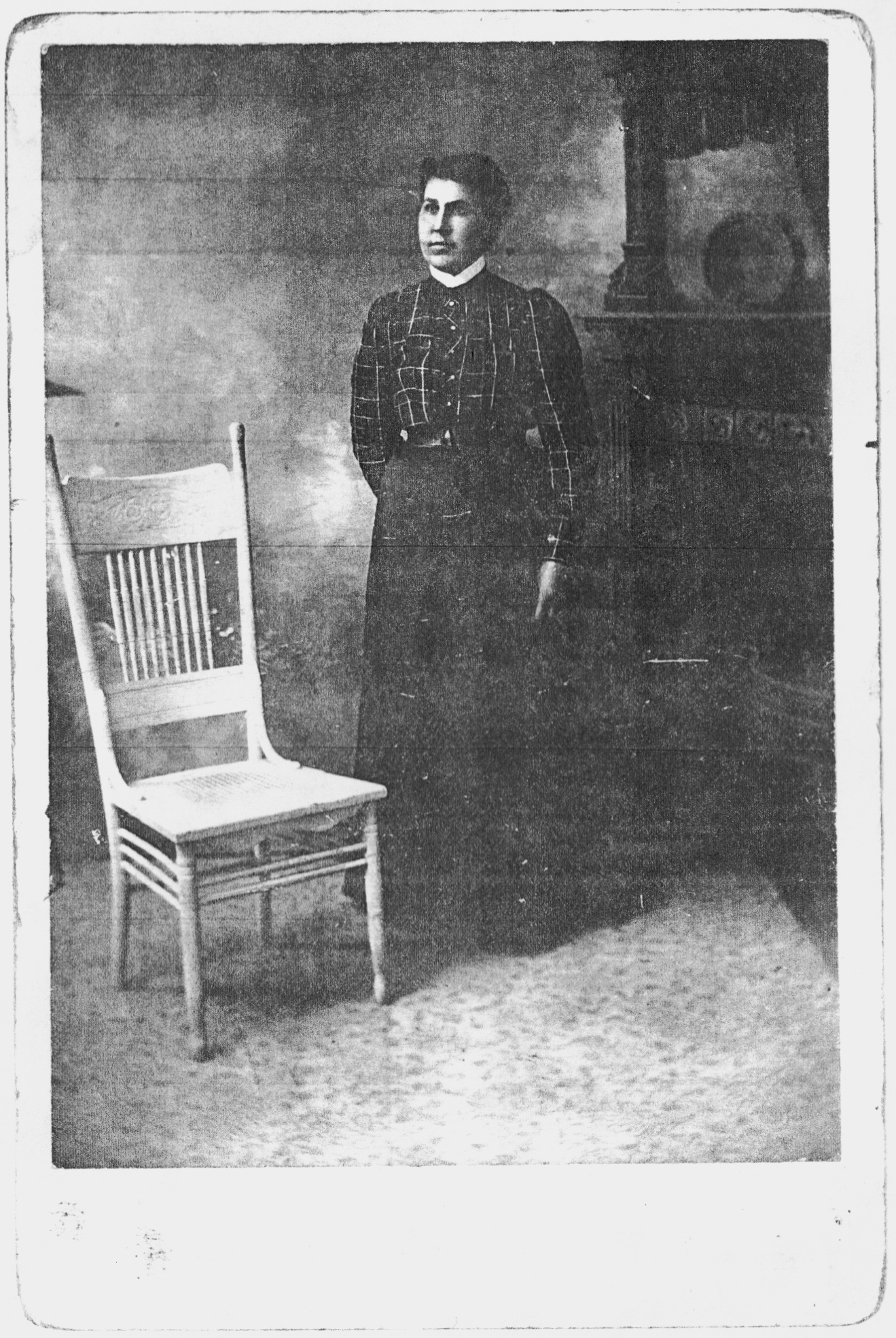
Unidentified photograph, ca. 1860-1866; digital image 2015, privately held by Melanie Frick, 2015. Image courtesy of D.B.

Twenty-seven years ago, my parents traveled to Massachusetts and made a stop in the community of Indian Orchard, where, my father knew, his ancestors had lived for a time in the latter half of the nineteenth century. As it turned out, these French Canadian immigrants had descendants who still lived in the area, and thanks to the staff at Saint Aloysius Parish, he was able to connect with one such descendant. Later, he began corresponding with two more cousins, both of whom were kind enough to share their research about our shared French Canadian and Acadian ancestors. Family lore and even a few photographs were also exchanged – including this photocopied image thought to be a photograph of Marguerite (Chicoine) Adam (1816-1878).1

Marguerite Chicoine is one of the first ancestral names I learned as a child and amateur family historian. I loved hearing that she was said to be Native American – a bit of family lore since (mostly) disproven, but it did work quite effectively to capture my attention at the time. I had always hoped to see the original of this photograph that was sent to us by our late cousin, but learned two years ago that an original may no longer exist. Apparently, when she was moved to a nursing home, her family history materials were thrown out.2 This serves as an important reminder to make an estate plan for the preservation of your own family history materials.

While I can’t rule out that somewhere out there, a cousin might hold another copy of this same photograph – that fortunate scenario has happened before – it’s also possible that this is the only version of this photograph that I will ever see. In any case, let’s take a look. Could this realistically be a photograph of Marguerite Chicoine?

Marguerite died in Massachusetts in 1878 at the age of 62.3 Thus, this photograph would have to predate 1878. As the photocopy indicates that this was a carte de visite – most popular between approximately 1860 and 1866 – that is entirely possible.4 All of Marguerite’s fifteen known children were born before 1862, with the exception of her youngest, who was born five years later. As Marguerite relocated with her family from Quebec to Massachusetts circa 1864-65, it seems plausible that she may have had her picture taken during this time period as a memento to share with relatives at home.5

Marguerite was fifty years old when her youngest child was born at the tail end of the most likely timeframe for this photograph; in order to have had a healthy pregnancy so late, perhaps she had a more youthful appearance than one might otherwise imagine for a mother of fifteen. The woman appears to have dark hair without noticeable graying, and her dark complexion and strong nose make it easy to see how rumors of significant Native American ancestry could have gotten started. However, I find it difficult to get a sense for her age, due in part to the poor quality of the image. Could she be over forty-five, or is this woman in fact decades younger?

Marguerite did have three daughters who would have reached adulthood by the 1860s: Marguerite Adam, Marie Adam, and Julienne Adam.6 While I do have a photograph of Marguerite, who does not appear to be a match, could this photograph show instead either Marie or Julienne as a young woman in her early to mid-twenties?

The woman wears a buttoned shirtwaist with a windowpane pattern, the sleeves neither significantly fitted nor puffed, and a high linen band collar is visible.7 Her belted skirt is of a straightforward design. Notably, it is not worn with a fashionable hoop as one would typically expect in the 1860s; this more unassuming skirt would perhaps have been in line with what a woman in rural Quebec or an immigrant in a New England mill town might wear.8 The backdrop is similarly domestic in style with a practical wooden chair and what looks to be a fireplace.

The good news? This could be a photograph of Marguerite Chicoine. It depicts a dark-complected woman of evidently simple means who was photographed in the 1860s, a physical description, socioeconomic background, and timeline that fit with what is known about Marguerite.

The bad news? We may never know for sure. It seems equally plausible that could be a photograph of one of Marguerite’s daughters or a close relative. Lacking an original for closer examination, it can still be hoped that another copy of this photograph might exist in different branch of the family, and that it may hold additional clues regarding the true identification of the mysterious dark-haired Québécois.

Copyright © 2015 Melanie Frick. All Rights Reserved.

Continue reading

A Fatal Scratch: The Death of a Pioneer Woman

Anna_Margaretha_Poesch_Thoma_Obituary“After almost a week of extreme suffering, caused from blood poisoning, Mrs. Margaretha Thoma, one of Garnavillo’s oldest residents, passed away at 4:00 o’clock last Saturday afternoon. About two weeks ago the lady accidentally scratched the back of one of her hands with a pin. The scratch at the time was a mere trifle and was given no further thought by her until a few days after when the hand began to swell and cause more or less pain. A physician was called and found it necessary to lance the hand, but desired results did not follow and twice later the lance was employed, and still no relief came to her sufferings, but instead the wound continued to grow worse and the swelling commenced extending into the arm. Everything possible was done to allay the pain and comfort her in her unendurable suffering, but nothing could be administered that would combat with the situation and the result was death came as a relief after nearly a week of incessant torture.”1

Anna Margaretha (Poesch) Thoma was born in Weißenstadt, Wunsiedel, Bavaria, the daughter of Wolfgang and Barbara Poesch.2 She came to Iowa with her family at a young age, and was later deemed “one of the venerable and loved pioneer women of Clayton County.”3 Margaretha married William Henry Thoma, a local merchant, in 1857, when she was still in her teens.4 They had eleven children before his death in 1876; Margaretha never remarried, and in fact continued to operate his mercantile in the years following his death.5 Perhaps it was this role in her community that brought her the recognition to be remembered so fondly in the years following her death from blood poisoning on 9 November 1907.6

Margaretha’s unfortunate plight might remind some of Caroline Ingalls’ encounter with a rusty nail in a particularly drama-filled episode of Little House on the Prairie. Indeed, albeit tragically, little could have been done to relieve Margaretha’s suffering at this time and place. Her age, estimated at near seventy, might also have contributed to her susceptibility to infection, whether she in fact suffered from sepsis or tetanus. Although not soon enough for Margaretha, it would be just a matter of time before the use of penicillin – and the tetanus vaccine – would become widespread. 

Copyright © 2015 Melanie Frick. All Rights Reserved.

Continue reading