Tag Archives: 1920s

The Thoma Store: Scribner’s Favorite Trading Place

George Hiram Thoma was not the first in his family to open a general store. Decades before, his grandfather, a Bavarian immigrant, had operated a country store in northeastern Iowa, and perhaps it was stories of his success that inspired George to pursue this livelihood. In any case, George first entered the trade when he was about thirty years old, at which time he lived with his wife and children in Decatur, Burt County, Nebraska.1 This small community with a population under seven hundred was located near the border of the Omaha Reservation. It was likely here that George picked up the Omaha-Ponca language as well as Plains Indian Sign Language, with which he communicated with members of the local tribe.2

(Yet another interesting aside to the story of this ancestor with an alias!)

In 1922, after more than a decade in Decatur, George moved with his family some forty miles southwest to the town of Scribner, Dodge County, Nebraska.3 Scribner boasted a population of just over one thousand—several hundred more than in Decatur, perhaps making it a more promising location for a general store despite, or because, of its remote location. The local newspaper, The Rustler, announced the family’s impending arrival in February of 1922:

“George H. Thoma of Decatur, this state, was in Scribner this week and has leased the building which has been occupied by the People’s Co-Operative Store. He will open up about March 1 with a complete line of general merchandise. Mr. Thoma comes well recommended as an up-to-date merchant with a record of twelve years of successful business at Decatur and twenty in the mercantile business. He has a very pleasing personality and we learn he has always been a booster for his home town. He has an interesting family that will be a welcome addition to our church and school circles; a young daughter in high school and one son who assists his father in their business, who is a band man and a football player, who will find congenial associates here. Mr. and Mrs. Thoma and family will find a hearty welcome awaiting them in our little city.”4

“Scribner’s Favorite Trading Place” token, Scribner, Nebraska, 1922-24; privately held by Melanie Frick, 2017.

It did indeed appear that the people of Scribner welcomed the Thoma family into their fold without hesitation. Regular updates were printed in the local newspaper regarding the opening of the store and the enrollment of daughters Fern, Norma, and later Betty in school. George wasted little time in becoming an active member the community, taking on leadership positions in a new Business Men’s Club as well as the Boy Scouts and the American Red Cross,5 while his wife, Leota, made friends among the Royal Neighbors and the Ladies Aid Society at the local Congregational church.6 Their son, Fenton, was named in the newspaper numerous times as he took part in social and athletic activities; he eventually spent a period of time away from his family in Scribner as he traveled for a summer with the Redpath-Horner Chautauqua and then attended Dakota Wesleyan University, where he served as president of the freshman class.7 Fern, too, received frequent mentions in the newspaper as she engaged in high school activities and gathered with friends, and mentions were even made of young Norma and Betty as they took part in events with their elementary school classmates.8

It seems, however, that the Thoma store did not take off as well as the family’s social life, and although the family embraced life in Scribner, it must also have been a stressful time for them. Less than a year after opening shop, a full-page advertisement appeared in the local newspaper, declaring that “Scribner’s Favorite Trading Place” was being “FORCED BY CREDITORS” to “raise $10,000 cash at once or close up business.”9 The Northwestern Selling System was to be in charge of this cash-raising sale of the store’s stock of $25,000 of “clean seasonable merchandise, only a few months old, consisting of dry goods, notions, women’s and children’s shoes, hosiery, underwear, fancy goods, men’s and boys’ sheep-lined clothing, hats, caps, furnishings, groceries, and queensware.”10 All purchases were to be made in cash or, interestingly, produce.11

“Scribner’s Favorite Trading Place” token, Scribner, Nebraska, 1922-24; privately held by Melanie Frick, 2017.

Apparently, this sale merely bought time. Another cash-raising sale was held that August,12 and in February of 1924, just two years after The Rustler had announced the opening of Thoma’s Store, a two-page spread appeared, announcing, “We’ve Decided to Quit Business in Scribner,” adding, in all-caps, “THOMA’S $20,000 STOCK JUST GOTTA GO!”13 A personal note from the proprietor himself was central to the advertisement:

“Here Are The Cold-Blooded Facts: You’ve heard and read about merchandise sales and bargains until your faith in them has been shattered, but your idea and our idea of a sale and a bargain are the same: It has been the custom of some stores in announcing a sale to give it some fancy decoy name and attempt to justify it by some plausible excuse. We are BLUNT about it – the reason for this sale is that we are sick and tired of business, physically and mentally and we’re just a going to get out and do it quick, and if low prices were ever an inducement this stock will be sold in a jiffy. Please understand, WE ARE CLOSING OUT! THIS MEANS IT ALL GOES! Signed GEO. H. THOMA”14

In May of 1924, The Rustler reported:

“George H. Thoma last Saturday moved his family and household effects to Sioux City, where they will make their future home. Their daughter, Miss Fern, remained here to finish her school year. Mr. and Mrs. Thoma have made many warm friends during their residence here, who regret to see them leave this city, and wish them all the good luck in the world at their new location. Mr. Thoma is now on the road selling electrical appliances. Friday afternoon the ladies’ aid of the Congregational church held a farewell reception in honor of Mrs. Thoma in the church basement. The manner in which the ladies dressed and made-up for the affair caused much merriment and an enjoyable afternoon is reported.”15

Sioux City proved to be a more promising destination for the Thoma family, and despite the close friendships they left behind in Scribner, they thrived in this city of nearly eighty thousand. George put his experience as a merchant to good use and found success as a wholesale fruit salesman for the Haley-Neeley Company and, for many years, the Palmer Fruit Company. He remained in Sioux City for the rest of his life, never again returning to the general merchandise business.16

Copyright © 2017 Melanie Frick. All Rights Reserved.
Continue reading

Fun on the Farm

Farm kids have long learned to make their own fun, and Frances Marie Noehl of Deerfield, Chickasaw County, Iowa was no exception. Pictured here circa 1920, Frances is grinning as she sits on a wooden cart pulled by her dog, Shep. If his expression can be interpreted, he appears to have been game to take part in the shenanigans of Frances and her siblings: Leo, Helen, Kathryn, Elinor, John, Al, Frank, and Joe. Frances, born in the spring of 1911, fell between Frank and Joe in age as the second-to-youngest of the nine children of German immigrants Mathias and Elizabeth (Hoffman) Noehl.

Noehl_Frances_Shep_c1920_Iowa

Frances Marie Noehl with Shep, Chickasaw County, Iowa, circa 1920; digital image 2015, privately held by Valene Petersen, 2016.

Although the Noehls were not prosperous and bounced around from farm to farm while their children were young, the available recollections of their children indicate that plenty of fun was to be found in the country—after chores, of course. Following brief, unsuccessful stints in Canada and Minnesota around the turn of the century, the Noehls returned to Chickasaw County where they rented a farm near New Hampton.1 As a small child, Frances’s brother John, who was seven years her senior, could apparently often be found in the maple grove, contentedly sipping sweet sap from a tin cup under the watchful eye of another beloved dog, Sultan.2

Next, the family moved to an acreage in the town of North Washington, where the older children attended Catholic school and learned English for the first time.3 After three years there, the man who owned their property offered them a chance to rent out his farm in Deerfield, near the community of Alta Vista.4 John recalled his mother’s happiness as they prepared to resume farm life, teaching him to sing, “For to plow / For to mow / For to reap / For to sow / For to be a farmer’s boy.”5 It was now around 1910, and the family would remain on this farm for years to come. Aside from playtime with the family dog, rumor has it that Frances and her siblings also liked to have spitting contests while perched in the hayloft.6

With her bobbed haircut and loose-fitting, short-sleeved cotton dress, complete with a tie about the neck à la a sailor suit, Frances looks every bit an energetic 1920s tween.7 Her worn leather shoes appear to be barely staying on her feet and she sits relaxed with one bare (or stockinged) leg folded underneath. A massive barn with a stone foundation is visible behind her. This informal snapshot was likely taken by a family member, although since I have seen very few photographs of the Noehl family in general, I wonder if photography may have been only a passing hobby. In any case, it’s a pleasure to have a rare glimpse into a long-ago childhood.

Copyright © 2016 Melanie Frick. All Rights Reserved.
Continue reading
Brotherly Love

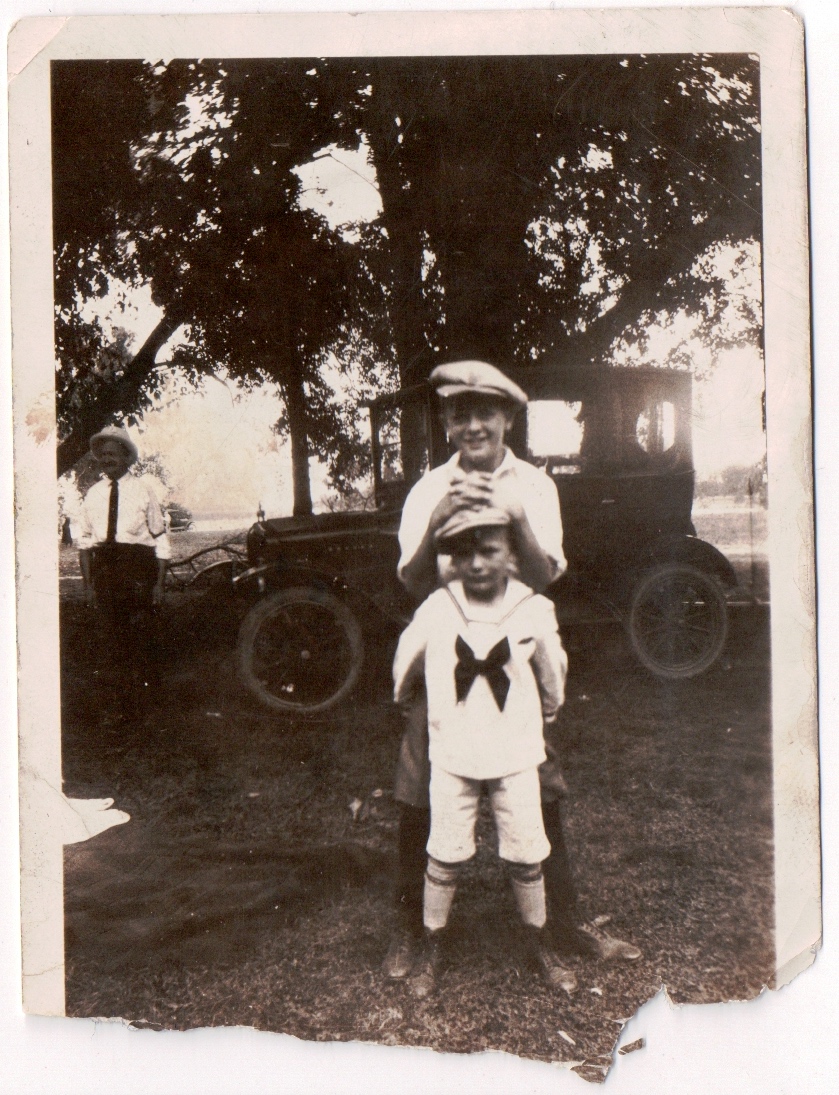
It might have been a late summer’s day when brothers Roy and James Walsted of Sioux City, Woodbury County, Iowa posed for this snapshot circa 1924. Six years apart in age, Roy was perhaps twelve and Jim perhaps six when this photograph was taken some ninety years ago.1 The park-like setting and the blanket at their feet suggest that the occasion may have been a picnic. Classic car aficionados could likely date the vehicle parked behind the boys.

SCAN0323 - Version 2

Roy Louis Christian Walsted (back) and James Herman Walsted (front), Sioux City, Iowa, ca. 1924; digital image 2015, privately held by Valene Petersen, 2015.

Roy suffered from polio as a child, which resulted in a limp as one leg was left shorter than the other. His younger brother was said to have come to his defense when Roy was bullied or was the last to be chosen for a neighborhood baseball team.2 Even in this photograph, it appears that Jim stands guard in front of his brother, his arms protectively curved back around Roy’s legs as Roy clasps his hands atop his brother’s head. Both boys wear short pants and newsboy caps; Jim is in a sailor suit, a style that remained popular for young boys in the post World War I era.3

I have to wonder who the man off to the side of the photograph could be. I have only seen two small snapshots of Roy and Jim’s father, both of which were taken late in his life. (I suppose there is a third if I count a postmortem photograph of him at his own funeral.) From those, I know that he was a man of slight build, but beyond that, I have no way of telling whether this gentleman in a straw boater hat and rolled shirtsleeves is in fact James Jacob Walsted or not. If this picnic was a family affair, perhaps the boys’ mother, Kathrine, was behind the camera.

This charming snapshot is one of a handful of photographs that I have in my digital collection of the Walsted brothers and their parents, both immigrants who came to Iowa from Denmark in the early twentieth century. For more photographs of the family of James Jacob Walsted (1886-1956) and Kathrine Christensen (1886-1971), check out my new Walsted Family Album

Copyright © 2015 Melanie Frick. All Rights Reserved.

Continue reading

Wedding Wednesday: A Question of Nationality

I’m not sure if it was meant as a joke, or if newlyweds Gerald and Fern (Thoma) Adam of Sioux City, Woodbury County, Iowa were genuinely confused. When asked to state their nationalities at the time of their marriage, their answers should have been simple; they were the American-born children of American-born parents, after all, so there was really no question that they were American themselves. Jerry, however, stated that he was of French nationality, while Fern declared that she was German-English.1

GeraldAdam1929

Gerald Joseph Adam, Sioux City, Iowa, ca. 1929; digital image 2012, privately held by Melanie Frick, 2014.

FernThomaAdam1929

Fern Lavonne Thoma, Sioux City, Iowa, ca. 1929; digital image 2012, privately held by Melanie Frick, 2014.

From a genealogical perspective, I love it. How often does one have the chance to learn what their forebears knew of their own ancestry? However, if I didn’t already know so much about this couple and their heritage, I might have been thrown off. Jerry’s ancestry was indeed French – and French Canadian, and Polish. Fern’s ancestors, many of whom were likely early arrivals on American soil, can thus far be traced to Germany and the British Isles.

I don’t know when exactly the couple met while on their way downtown to the movie theater, but Jerry and Fern married in their hometown on 8 June 1929 – eighty-five years ago this week.2 Fern was twenty-one, and although Jerry would not celebrate his twenty-first birthday for eleven more days,3 he claimed to be the same age as Fern.4 Their wedding attendants were close friends Merle Montgomery and Dorothy Thompson,5 and, following their ceremony, led by Reverend R. M. LeCair of St. Jean Baptiste Church, the couple took a “motor trip” to the Black Hills of South Dakota.6

Gerald_Adam_Fern_Thoma_Marriage_1929

“Iowa, Marriage Records, 1923-1937,” digital images, Ancestry.com (http://www.ancestry.com : accessed 10 June 2014), Gerald Adam and Fern Thoma, 8 June 1929, Sioux City; citing “Iowa Marriage Records, 1923–37,” microfilm, State Historical Society of Iowa, Des Moines.

If your ancestors married in Iowa between 1923 and 1937, be sure to visit Ancestry.com’s digital image collection, “Iowa, Marriage Records, 1923-1937,” new this year. This database has plenty of detail to offer, as marriage records included such information as age, place of residence, occupation, place of birth, father’s name, mother’s maiden name, number of marriages, and the names of the officiant and witnesses. It’s also an opportunity to see the signatures of the couple – likely the last time the bride would sign her maiden name. Have you found any surprises in this record set?

Continue reading

‘Round the Maypole

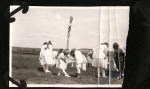
Helen Nelson was a student at the rural Southern State Normal School in Springfield, Bon Homme County, South Dakota, or perhaps a recent graduate, when she pasted this series of photographs in her scrapbook.1 A group of young girls dance ’round a Maypole twined with ribbons, certainly in celebration of the first of May. They were likely students at a local one-room schoolhouse, perhaps from a teaching assignment near Helen’s home in Yankton County, South Dakota, or from the “practice school” near Springfield.2

Raising a Maypole for a May Day celebration seems just the type of thing that an enthusiastic young teacher would have arranged to brighten a typical school day. Andrea Nelson, Helen’s elder sister, wrote in her diary of spontaneous recess games such as “Pump Pump Pull Away,” as well as moving class outdoors in good weather.3 This Maypole must have been a planned affair; the ten or so girls, ranging in age from perhaps six to twelve, seem to be dressed in their best summer dresses, with most in white or pastels. Several wear bows in their hair as well as sashes at their waists. In the final photograph, they bow to each other as their dance concludes.

Although this celebration took place near 1920, Maypoles were certainly nothing new. The American Girls Handy Book, originally published in 1887, mentions the ancient origins of the day and gives the following instructions for a Maypole dance:

“An even number of persons are required for this dance; half the number take the end of a ribbon in the right hand and half in the left; they then stand facing alternately right and left. When the dance commences, each dancer facing the right passes under the ribbon held by the one opposite facing the left; she then allows the next person going to the left to pass under her ribbon, and so, tripping in and out, under and over, the ribbons are woven around the pole.”4

The dance goes on, including variations to weave the ribbons together, and all the while, according to the Handybook, “An appropriate song, with words set to a dancing air, should be sung by those taking part in the May-pole dance.”5

Continue reading

An Iowa Teacher’s Report to Parents, 1925

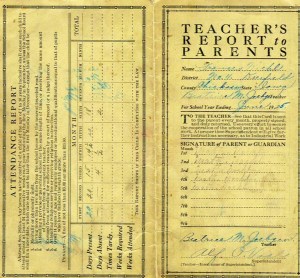
The first of June 1925 was an important day for Frances Marie Noehl of Deerfield, Chickasaw County, Iowa. She completed the eighth grade in District No. 11 with flying colors, even rallying over the course of the year to bring up her lagging grade in conduct.1 However, although she was a successful student, with high average marks equivalent to straight A’s, she would not go on to graduate from high school.2

ReportCard1

Frances Noehl, Teacher’s Report to Parents, 1925, Deerfield, Iowa; digital image 2003, privately held by V. P. [personal information withheld], 2014.

Frances was the eighth of nine children born to Matthias and Elizabeth (Hoffman) Noehl, German immigrants who farmed in northeastern Iowa.3 Once her schooling was completed, Frances was needed at home, although her father did prize education. In his memoirs, he wrote of his schooldays in Germany, “I entered into the arena, and took it up not only with the alphabet, but with all my classmates. As at that time there was no special talent in our school of eighty-four pupils, I succeeded in taking the first place among all the boys.”4 His education concluded at the age of fourteen, but he was pleased to be allowed to keep his books, writing tablet, slate, and pencil.5 Perhaps he had once dreamed that his children would be fortunate enough to further their educations, but, at least in the case of his youngest daughter, that dream was unfulfilled.

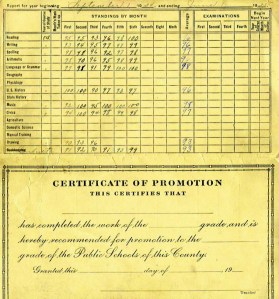
During the course of her eighth grade year, Frances was instructed by Miss Beatrice Joebgen, a local teacher who was still a teenager herself.6 Frances was graded in Reading, Writing, Spelling, Arithmetic, Grammar, U.S. History, Music, Civics, Drawing, and Conduct, with all of her marks falling between 90 and 100 and her averages between 93 and 98. Her father’s signature was recorded on her report card at the end of each term.7

ReportCard2

Frances Noehl, Teacher’s Report to Parents, 1925, Deerfield, Iowa; digital image 2003, privately held by V. P. [personal information withheld], 2014.

Attendance rules for the time indicate that Frances would not have been required to complete additional schooling, as she had fulfilled the educational qualifications of an eighth grade pupil. Other reasons for exemption from public schooling included being mentally or physically unfit, living more than two miles from the school house by the nearest traveled road, or attending a private or parochial school, receiving instruction from a competent teacher, court order, religious instruction, or regular employment for one over the age of fourteen.8

Although Frances may have liked very much to have had the opportunity to graduate from high school, duty to her family, it seems, kept her at home.

Continue reading

Friendship Clubs and Funny Quotes: Finding Family in Yearbooks

Several years before they would meet and marry, teenagers Fern and Jerry were unsuspecting students at Central High School in Sioux City, Woodbury County, Iowa.1 They were not in the same grade, and this was a large school; Fern moved to Sioux City only in time for her senior year, and as Jerry graduated two years later, it’s possible that they never crossed paths during their brief overlap as students at the imposing sandstone building dubbed “The Castle on the Hill.”2

Fern_Thoma_Yearbook_1925

The Maroon and White, Vol. XXI (Sioux City, Iowa: Central High School, 1925), 67; digital image, Ancestry.com (http://www.ancestry.com : accessed 24 March 2014).

Fern Lavonne Thoma graduated from Central High School in 1925. In her yearbook photo, she wore a long necklace and, true to the times, styled her hair in a fashionable, chin-length bob. The only club that Fern had joined was the “Friendship Club,” which, apparently, was mandatory for all female students.3 From what I remember her telling me, she enjoyed her time at this school, especially a banquet for the upperclassmen during which the school gymnasium was decorated like a boat. She thought this event was “just wonderful!”4

Gerald_Adam_Yearbook_1927

The Maroon and White, Vol. XXIII (Sioux City, Iowa: Central High School, 1927), 34; digital image, Ancestry.com (http://www.ancestry.com : accessed 24 March 2014).

Gerald “Jerry” Joseph Adam graduated from Central High School in 1927. According to the yearbook, he was in the general course of study and had been involved in Civics, no surprise given his penchant for writing to politicians later in his life, as well as the Spanish Club. His handsome photo was paired with the quote, “Who shows you your place when you go to the Princess?”5 As a teenager, Jerry earned money as an usher at the Princess Theatre in downtown Sioux City, surely a popular place among his movie-going peers.6

In fact, Fern and Jerry reportedly met while on their way to the movies. Fern and her friend Florence were walking downtown when two young men, who were known to Florence, drove up in their rental car and offered the girls a ride. Fern approached the front to sit next to the driver, when Jerry suggested that she sit in the back with him. Fern later claimed that Florence had set her up, while Jerry liked to say that when he first laid eyes on Fern, he proclaimed, “That’s the girl I’m going to marry!”7

If you would like to find yearbook photos of your ancestors (or even yourself), check out the yearbook collections on Ancestry.com. In my experience, yearbooks don’t always appear as strong “shaky leaf” matches, so I have found it helpful to search specifically within the category “Schools, Directories & Church Histories” in order to bring all relevant results to the top.

Also consider searching the yearbooks individually as your ancestor’s full name may not have been given for every appearance, particularly if he or she was an underclassman or appeared in additional club or athletic photographs. As a bonus, see if you can find his or her autograph scrawled in the back of the book. You never know what you might learn about the glory days of your ancestor’s youth!

Continue reading

The Twenties by Day

LeotaAlphaBellFenton

Leota (Fenton) Thoma, Alpha (Fenton) Gibson, and Belle (Fenton) Hoffman, ca. 1920s; digital image 2013, privately held by Melanie Frick, 2014.

As seen in this photograph, the trends of the Roaring Twenties were not just for flappers – although daytime fashions were significantly less flashy than what one tends to associate with the era. Here, sisters Leota, Alpha, and Belle, from left to right, pose together sporting bobs and simple patterned dresses. Although the sisters were likely in their late forties or early fifties when this photograph was taken, they clearly made an effort to keep up with the times.

Alpha Doretta, Minnie Belle, and Anna Leota Fenton were born in Saline County, Kansas, the daughters of George W. and Sarah Ellen (Hall) Fenton.1 After their father’s death, their mother remarried, and eventually, the family relocated to northwestern Iowa.2 At the time that this photograph was taken, Alpha, the wife of Clare Gibson, lived in Colorado,3 whereas Belle, the wife of Joseph Hoffman, and Leota, the wife of George Thoma, lived in different counties in Iowa.4 It was likely a rare occasion that the sisters were able to be together.

Leota, Alpha, and Belle wear popular styles of what would have been considered day dresses or house dresses in this decade, as seen on Vintage Dancer: 1920s Day / House Dresses and Aprons. Likely made of cotton, their dresses feature lively prints and straight, comfortable cuts. Both Belle, right, and Alpha, center, wear dresses made of fabric printed with spirals or swirls. Both have sleeves cuffed above the elbow, and have belted, dropped waists. Leota wears a standard long apron with patch pockets over her dress, but it can be seen that her floral-patterned dress hits, appropriately, just below the knee. Her dress has contrasting fabric sewn at the hem and the cuffs, and she clutches a striped cloche hat in her hand.

This look was quite a change from the romantic, Gibson Girl-esque styles of just a quarter century before, as seen in an earlier photograph of Leota. However, it looks like these ladies might have had quite a bit of fun with their makeovers during this decade, before more conservative styles returned with the Great Depression.

Continue reading

Wedding Wednesday: Swell Times in Chicago

HelenLeonardWedding

Leonard and Helen (Nelson) Wiese, Chicago, Cook, Illinois, 1924; digital image 2010, privately held by Melanie Frick, 2014.

On the evening of 5 January 1924, Leonard John Christian Wiese and Helen Margaret Nelson were married in Chicago, Cook County, Illinois.1 Leonard had been raised in Chicago, the son of German immigrants,2 whereas Helen had been raised in rural Yankton County, South Dakota, the daughter of Danish immigrants.3 The couple met when Leonard sought work in South Dakota, and he and Helen bonded over a shared love of music.4 Leonard and his bride-to-be then moved to Chicago, where they were wed in the home of Leonard’s widowed mother.5 Since Helen’s family was not able to be with them, she wrote a detailed letter home describing their wedding day:

My dear folks,

Now I think that this letter will have to be passed around so I won’t have to repeat all the details of the past few days. We are married! Yes. Now then I will endeavor to tell you the points which I think will be of interest to you.

My dress was very plain but everyone liked it. Dark brown brocaded silk with short sleeves and sort of a drape on the skirt. I have a new coat and hat and new satin shoes.

Well, there were eighteen grown people here. We were married at 9:30. Stanley Smith played the wedding march and Irene and I came from upstairs and met the other two in the room. After the ceremony, a shower of rice descended upon us and the best man and several of the others took advantage of the privilege of kissing the bride. So it was on the order of some of the weddings you read about!!!

Then we had dinner. Turkey, chicken, mashed potatoes, peas, corn relish, cranberries, dressing, Jello, coffee, etc. A huge wedding cake adorned the center of the table. This cake was made to order. You people are going to have some of it. I baked two angel food cakes and a sponge cake. That’s all I did in helping preparations.

I spent some time at the hairdresser’s! Oh, I looked real swell!!!

After supper we had music and some of the men played cards. Then after awhile we started the Victrola and we all danced.

Continue reading

Vintage Swimwear

This is a fun photograph that I thought I would share before the summer completely slips away. This snapshot was labeled on the back, and, years ago, I was also able to hear its story from my late great-grandmother, Fern Lavonne (Thoma) Adam of Sioux City, Woodbury County, Iowa. Well, more than its story, I remember her laughing about her bathing suit! The photograph was taken in 1924, at the river near Scribner, Dodge County, Nebraska.

Fern Lavonne (Thoma) Adam photograph, 1924; digital image 2010, privately held by Melanie Frick, 2013.

Fern Lavonne (Thoma) Adam photograph, 1924, Scribner, Nebraska; digital image 2010, privately held by Melanie Frick, 2013.

Fern lived in Scribner, where her father opened a grocery store, for a few years in the early 1920s. She remembered attending dances there, as well as learning to drive. Her father gave her a lesson immediately when she remarked that she would like to learn, and the next day, when she asked for another lesson, he told her to go ahead on her own!1 Apparently, Fern also enjoyed taking advantage of the opportunity to swim in the Elkhorn River during her short time in Scribner. She is pictured here at center; at left is Lucille Romberg, and at right is Helen Kellner. These young ladies must have been good friends in the summer of 1924, when Fern would have been sixteen years old.

In order to learn more about vintage bathing suits, I turned to Threaded, the Smithsonian’s blog about fashion history. From there I learned that a company by the name of Jantzen devised a “swimming suit” made of wool in 1915, and that by 1921, the name had stuck.2 My great-grandmother and her friends appear to be wearing typical knitted wool swimsuits of the era, comprised of long, sleeveless, v-necked tunics, fitted shorts, and, in my great-grandmother’s case, knee high stockings, rolled at the top. The girls wear their hair inside knit swimming caps, the one on the left being slightly more elaborate with a small brim. They all squint in the sun and lean together for the photograph, happy and relaxed on a summer’s day.

Have you come across any photographs featuring early styles of swimwear?


SOURCES
1 Fern Lavonne (Thoma) Adam, conversations with the author, 2001.
2 “The Swimsuit Series, Part 1: A History of Women’s Suits,” Threaded, 22 June 2012 (http://blogs.smithsonianmag.com/threaded/2012/06/the-swimsuit-series-part-1-a-history-of-womens-suits/ : accessed 6 September 2013).