Tag Archives: genealogy

Tombstone Tuesday: Fred and Emma (Stübe) Wiese

Fred and Emma (Stübe) Wiese were German immigrants who lived out their adult lives in Chicago, Cook County, Illinois. Although both were born in the late 1860s in Mecklenburg-Vorpommern, an area of present-day Germany located along the Baltic Sea, they left their homeland as infants. Fred – or Fritz – was the son of Joachim and Sophia (Cammin) Wiese and is believed to have been born near Wendisch-Baggendorf;1 Emma was the daughter of Ernst and Friederike (Wagner) Stübe and was born in Friedrichshof in Ritteramt Gnoien.2 These rural communities were not far in terms of distance, but separated by the Trebel River, the Wieses were residents of Pomerania and the Stübes were residents of Mecklenburg.

Both Fred and Emma arrived in America before 1870.3 While the Wiese family settled immediately in Chicago,4 Emma spent her childhood in rural Huntley, McHenry County, Illinois before moving to the city after her father’s death.5 It’s possible that Fred and Emma crossed paths as early as 1880; by that time, Emma’s presumed uncle, Carl Stübe, lived in the same building as Fred’s presumed uncle, Carl Wiese.6 They may also have become acquainted as members of the Missouri Synod First Bethlehem Lutheran Church of Chicago, located in a neighborhood that saw much of its growth in the years following the Great Chicago Fire.7

It was there that the couple married on 19 February 1887.8 They would have five children together, the first born that summer: George Charles Wilhelm Wiese (1887-1975), Lillie Johanna Josephine Wiese (1889-1897), Rosa Minna Emma Bertha Wiese (1892-1918), Oliver William Charles Wiese (1896-1969), and Leonard John Christian Wiese (1900-1947). The early years of their marriage were spent in Chicago’s Fourteenth Ward, near their parish in Wicker Park.9 Tragedy touched their lives when their oldest daughter succumbed to cerebral meningitis at the age of eight;10 a few years prior, weeks before the opening of the Chicago World’s Fair, Emma had tended to her sixteen-year-old sister as she died of the same illness.11

Grave_Wiese_Fred_Elmwood_Cemetery.jpg

Grave of Fred Wiese (1866-1914), Elmwood Cemetery, Chicago, Cook County, Illinois; 2006, privately held by Melanie Frick, 2015. 

In 1902, seeking a fresh start, the family moved west from Wicker Park to a large home in the Montclare neighborhood. Their two-story Victorian home, which still stands today, was located on a corner lot and undoubtedly provided more space for the couple and their four surviving children.12 Fred supported his family as a cigar maker until his death from cirrhosis of the liver on 14 October 1914 when he was forty-eight years old. He was buried at Chicago’s Elmwood Cemetery.13

Grave_Wiese_Emma_Elmwood_Cemetery.jpg

Grave of Emma Wiese (1867-1937), Elmwood Cemetery, Chicago, Cook County, Illinois; 2006, privately held by Melanie Frick, 2015.

Emma remained in their home for more than two decades, crocheting “fancywork” as a modest means of support. She kept chickens, a garden, and was by all accounts a formidable housekeeper who used a rod to smooth the bed coverings to ensure that no wrinkles remained. In her later years, she had a German Shepherd, Sally, and her home was the gathering place for the weekly Saturday meal that she prepared for her children and their families. While her grandchildren considered her to be strict, she was also kind, offering them dimes for the movies and pennies for the organ grinder’s monkey.14 After Emma’s death from a stroke at the age of seventy on 6 November 1937, she, too, was buried at Elmwood Cemetery.15

Copyright © 2015 Melanie Frick. All Rights Reserved.

Continue reading

Suiting Up at the Turn of the Century

I’ll admit I feel rather proud of my namesake for marrying such a debonaire young man. Henry Joseph Adam of Sioux City, Woodbury County, Iowa, pictured at right, married Melanie Veronica Lutz in 1905 at the age of twenty-four, which allows this photograph to be dated to approximately 1900-1905.1

Henry_Adam_1900

Henry Joseph Adam, at right, with an unknown individual, Akron, Iowa, ca. 1900; digital image 2014, privately held by Melanie Frick, 2015. Collection courtesy of David Adam.

Census records confirm that the photographer who made this cabinet card, Gene Frank of Akron, Plymouth County, Iowa, did indeed operate a photography studio in the early twentieth century.2 However, I’m not entirely sure what Henry was doing in Akron himself. He lived in Sioux City, thirty miles south, where there were certainly a number of photographers; however, Akron was a bit closer to the French Canadian communities of southeastern South Dakota where Henry had a number of relatives. It’s also possible that he had hired out to work in the area or that he had simply gone there for a visit – or, as the case may be, for a shopping expedition.

As with all photographs, an important question comes to mind: “What was the occasion?” While I don’t note a strong family resemblance between the other young man and Henry’s male relatives, one possibility is that he could have been a cousin. He could not have been a classmate, as Henry attended school only through eighth grade, but it is possible that he and Henry worked together in some capacity. If nothing else, he was a friend, and I wonder if he and Henry purchased these suits together. The textured suit jackets are nearly identical in terms of cut and fabric, but not quite, while the stiff-collared shirts seem to be the same; the young men expressed their individuality by way of their accessories. The friend, with wet hair slicked in a part, wears a vest with a knotted striped necktie and a watch chain, while Henry omits the vest in favor of a fleur-de-lis-printed necktie tied in a bow. It wouldn’t have been unusual in this era for two young men to have a photograph taken together to document their friendship.

What strikes me about this photograph is that from what I know of Henry, he wasn’t typically quite so refined! He spent his teenage years as a dairy farmer and his adult years as a carpenter, so such dapper attire was in all likelihood limited to his early adulthood and might have been worn to church or while courting. The high detachable collar fully encased his neck, and I particularly like that he wore the fleur-de-lis as an apparent nod to his French Canadian heritage; Henry in fact spoke both French and English.

There are a number of photographs of Henry in my collection, but this may be the most dapper of them all. For more photographs of the family of Henry Joseph Adam (1881-1944) and Melanie Veronica Lutz (1884-1973), stay tuned for the new Adam Family Album. 

Copyright © 2015 Melanie Frick. All Rights Reserved.

Continue reading

Wedding Wednesday: Puffed Sleeves

On a late September day in 1896, Elizabeth Hoffman of North Washington, Chickasaw County, Iowa affixed a gauzy, floor-length veil to her hair. It may have been crowned with flowers, although the faded photograph does not make this clear. Flowers or foliage of some kind – perhaps even autumn leaves? – were indeed attached to the front of her dress, although she wore no white gown. Her best dress was likely black or another dark color and fashionably made with a gathered bodice, narrow waist, and sleeves generously puffed to the elbow. (Anne Shirley would have been envious.)

Elizabeth’s attire is evidence that, at this time, even recent immigrants living in rural areas of the United States were aware of the latest fashion trends. Corsets were not worn by all women in the 1890s, and Elizabeth, already slim, was not dramatically corseted if she was at all.1 The gathered bodice was of a style worn throughout the decade, and while the care of these full leg o’ mutton sleeves was time-consuming, they were at the height of popularity in the middle of the decade.2

MathiasElizabethWedding

Mathias Noehl and Elizabeth Hoffman, wedding, North Washington, Iowa, 1896; digital image 2001, original held by J.H., 2015.

At the age of twenty-seven – her birthday had been just the week before – Elizabeth was to marry a fellow immigrant, Mathias Noehl.3 As it so happened, he hailed from the village of Holsthum, Bitburg-Prum, Rheinland-Pfalz, Germany, which neighbored her own home village of Prümzurlay.4 By all accounts, however, their first meeting took place in northeastern Iowa, where Mathias encountered Elizabeth, whom he called Lizzie, at the Immaculate Conception Church in North Washington. She lived there as the housekeeper of Father Probst and the Sisters of Charity.5 The couple was married there on 22 September 1896 and may have celebrated with Elizabeth’s mother and siblings, who had also made Chickasaw County their home.6

A copy of Mathias and Elizabeth’s wedding portrait was shared with me by a relative; I suspect the original is a cabinet card photograph, popular at the turn of the century. I can’t make out much of the setting (is it grass or a rug at their feet?), but Mathias sits in a wicker chair while Elizabeth stands to the side, her right hand on his shoulder. In her left hand is clutched a small book, perhaps a prayerbook. As was typical of the time, neither of the newlyweds smile, and their faces are so faded in the copy that it’s difficult to see the direction of their gazes. Mathias has short hair; in his memoirs, he wrote that that, upon meeting Elizabeth, his blond hair was “unkempt like dried up flowers of the cemetery,” so a haircut may have been in order!7 He has a tidy mustache and wears a wool suit and white shirt. At twenty-eight, having recovered from an earlier heartbreak during his first years in America, he was prepared to settle down and start a family.8 Mathias and Elizabeth would go on to raise nine children on their farm.

This wedding portrait is one of several photographs that I have in my digital collection of the family of Mathias and Elizabeth (Hoffman) Noehl, both immigrants who came to Iowa from Germany in the late nineteenth century. For more photographs of the family of Mathias Noehl (1868-1950) and Elizabeth Hoffman (1869-1957), check out my new Noehl Family Album

Copyright © 2015 Melanie Frick. All Rights Reserved.

Continue reading

Brotherly Love

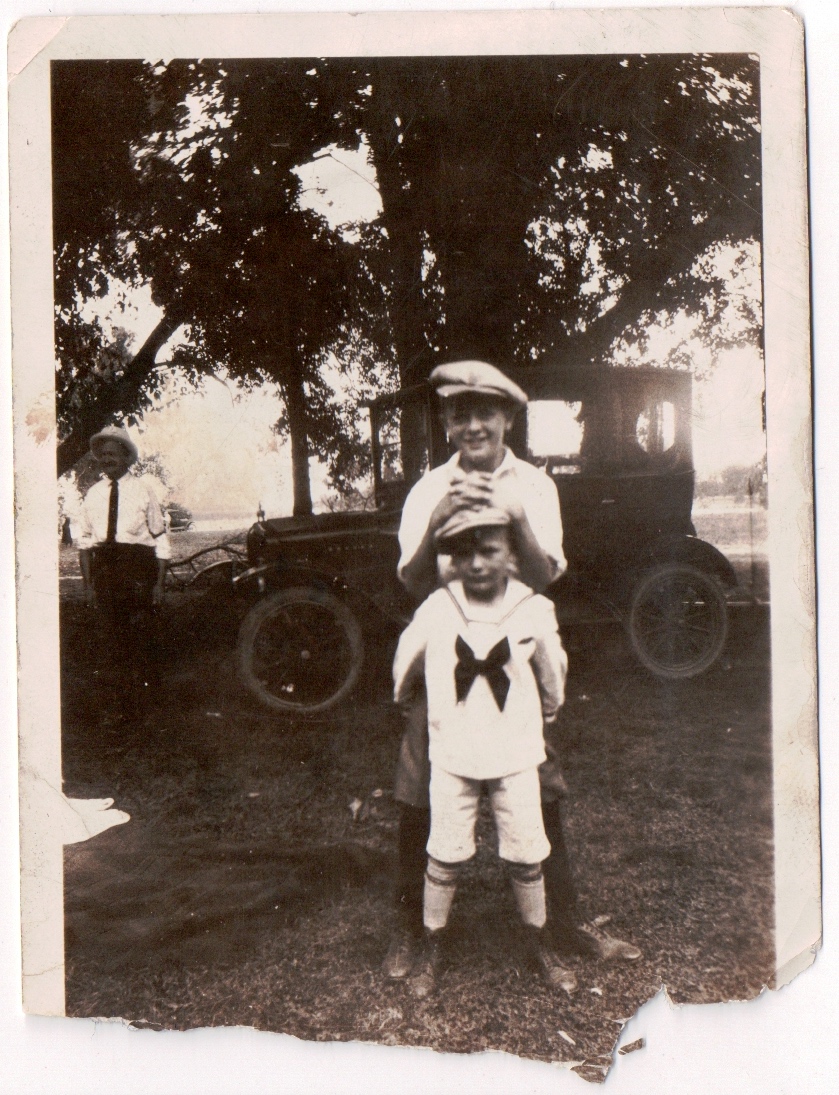
It might have been a late summer’s day when brothers Roy and James Walsted of Sioux City, Woodbury County, Iowa posed for this snapshot circa 1924. Six years apart in age, Roy was perhaps twelve and Jim perhaps six when this photograph was taken some ninety years ago.1 The park-like setting and the blanket at their feet suggest that the occasion may have been a picnic. Classic car aficionados could likely date the vehicle parked behind the boys.

SCAN0323 - Version 2

Roy Louis Christian Walsted (back) and James Herman Walsted (front), Sioux City, Iowa, ca. 1924; digital image 2015, privately held by Valene Petersen, 2015.

Roy suffered from polio as a child, which resulted in a limp as one leg was left shorter than the other. His younger brother was said to have come to his defense when Roy was bullied or was the last to be chosen for a neighborhood baseball team.2 Even in this photograph, it appears that Jim stands guard in front of his brother, his arms protectively curved back around Roy’s legs as Roy clasps his hands atop his brother’s head. Both boys wear short pants and newsboy caps; Jim is in a sailor suit, a style that remained popular for young boys in the post World War I era.3

I have to wonder who the man off to the side of the photograph could be. I have only seen two small snapshots of Roy and Jim’s father, both of which were taken late in his life. (I suppose there is a third if I count a postmortem photograph of him at his own funeral.) From those, I know that he was a man of slight build, but beyond that, I have no way of telling whether this gentleman in a straw boater hat and rolled shirtsleeves is in fact James Jacob Walsted or not. If this picnic was a family affair, perhaps the boys’ mother, Kathrine, was behind the camera.

This charming snapshot is one of a handful of photographs that I have in my digital collection of the Walsted brothers and their parents, both immigrants who came to Iowa from Denmark in the early twentieth century. For more photographs of the family of James Jacob Walsted (1886-1956) and Kathrine Christensen (1886-1971), check out my new Walsted Family Album

Copyright © 2015 Melanie Frick. All Rights Reserved.

Continue reading

The Proud Owners of a New Piano

You never know what might have made the news a century ago. In Iowa, for example, news might have been made when someone acquired a piano. Although mail-order catalogues like Sears, Roebuck & Company made owning a piano more affordable than ever thanks to convenient financing options,1 such a substantial purchase was still of great interest to those in rural communities and small towns across America.

These were the years before Victrolas became widespread.2 Pianos were a ready source of music and entertainment, and people of all ages might have enjoyed gathering at the home of a friend or family member with a piano for an evening of playing and singing.

pianoloc

“A Pleasant Evening at Home,” Prints & Photographs Online Catalog, Prints & Photographs Reading Room, Library of Congress, Washington, D.C. (http://www.loc.gov/pictures/item/90709337 : accessed 5 August 2015).

In the northwestern corner of Iowa, The Sibley Gazette reported on 24 May 1900:

John Hoffman and family are the proud owners of a new piano.3

And in the northeastern corner of the state, The Guttenberg Press reported on 25 June 1909:

Miss Roselyn Thoma is the happy and proud possessor of a new piano.4

John Hoffman was the second husband of Sarah Ellen Hall; married since 1883, they would undergo a tumultuous divorce in 1902. At the turn of the century, however, they were still married with a twenty-year-old daughter and a sixteen-year-old son at home.5 Their acquisition of a piano adds a bit of brightness to what was painted in their divorce proceedings as a rather dim time. Although Sarah led a difficult life, her granddaughter remembered that she had loved fine things; this piano was likely a prized possession.6 As she was said to be a religious woman, perhaps she enjoyed hymns played on the piano either by herself or her children.

Roselyn Thoma was the daughter of Fred and Matilda (Hammond) Thoma and was seventeen years of age in 1909.7 She was the last of four surviving children still at home, her younger sister having been lost to a diphtheria outbreak three years prior.8 Perhaps it was with a newfound appreciation to seize the moment that her parents supported such an extravagance for their daughter, or perhaps the same inheritance that had recently spurred them to purchase a farm made the purchase of a piano possible as well.9 Roselyn would marry two years later, and one can imagine that her piano might have accompanied her to her new home.10

Whether the Hoffman and Thoma families enjoyed idyllic moments crowded around their pianos à la Little Women or not, it is clear that the addition of a piano to a household in their humble Midwestern communities was worthy of note – and pride. However, even in these rural areas, it would be only a matter of time before new forms of entertainment overtook the novelty of owning a piano.

Copyright © 2015 Melanie Frick. All Rights Reserved.

Continue reading
The Last Canadian

In honor of Canada Day, I introduce my last ancestor to live and die a Canadian: Leon Chicoine, who was baptized Joseph Leon Chicoine on 12 April 1785 at St-Charles-sur-Richelieu, Quebec, the son of Francois Chicoine and Marie Elizabeth Tetreault.1

St-Charles-sur-Richelieu

“View of St-Charles-sur-Richelieu from St-Marc-sur-Richelieu,” 2014, Saint-Charles-sur-Richelieu, Montérégie, Québec, Canada; Wikimedia Commons, copyright Tango7174.

Little is known of Leon’s early years. By the time he was twenty-five, he had made his way to Longueuil, located on the south shore of Montreal. It was there that he married Longueuil native Marie Varry on 17 September 1810.2 Their marriage took place at the impressive Cathédrale St-Antoine-de-Padoue in a ceremony led by Father Augustin Chaboillez, who, according to contemporary accounts, managed his parishioners with a firm hand. In fact, earlier that same year, he had a parishioner jailed for daring to interrupt his sermon!3

Leon and Marie did not remain there for long; they soon settled in St-Marc-sur-Richelieu, a rural community just across the Richelieu River from where Leon himself had been born. They remained in this area for the rest of their lives.4 Family lore states that Leon served in the military during the War of 1812.5 Then, twenty-five years later, war came to St-Marc when British troops defeated a number of Canadian rebels there during what is known as the Patriot War.6 Leon was in his fifties at this time; might he have participated in the futile attack? We may never know for sure.

Attack-on-Saint-Charles

“Attack on Saint-Charles 25th Novr. 1837,” 1840, Lord Charles Beauclerk (1813-1842); McCord Museum, Montreal, Quebec.

In any case, the majority of Leon’s life was likely spent in a more peaceful manner as a forgeron, or blacksmith.7 He fathered at least thirteen children, including my ancestor Marguerite Chicoine, although not all survived to adulthood. Sadly, Leon’s wife, Marie, passed away before she was forty; Leon remarried to Francoise Desautels in 1829.8

Leon Chicoine would live to the age of ninety two. When his granddaughter recorded his death in January 1877, she noted that he was by that time the grandfather of fifty-six grandchildren.9 His burial occurred at his birth parish of St-Charles-sur-Richelieu, likely in the churchyard of the striking eighteenth-century stone church located on the banks of the Richelieu River.10

Copyright © 2015 Melanie Frick. All Rights Reserved.

Continue reading

A Letter From the Shipyards

Although Henry Joseph Adam was sixty years old when the United States entered World War II, he made the decision to apply his skills as a carpenter more than fifteen hundred miles from home at the Kaiser Shipyards in Portland, Oregon.1 This was one of several emergency shipyards established during wartime that oversaw the construction of numerous Liberty and Victory ships.2

Henry_Adam_Carpenter

Henry Adam (seated at center) at work, Sioux City, Iowa, ca. 1930-40; digital image 2010, privately held by Melanie Frick, 2015.

Henry ventured to Oregon in 1942, although he was not there continuously; his wife of thirty-seven years, Melanie, remained at their home in Iowa.3 However, we know that Henry was in Portland in June of 1943 when he mailed the following letter:

6-4-43
Dear Mealane
red your letter last night and it seam funey to me to here of so many people dying sent i left. i just got back from supper i was out to cool and here it is quarty to eight so will send you my first check rent i got sick and it leave me purty short you ask me what i am doing well i send you the slip of the copany witch i am with and i is house prog work and i am in side setting up book case and kitchen cabinet and thresh hold and it is a snap so far. and the Boos pick me up right at the door so that make it fine i leave here at half past 7 and we get back about 5.75 and by the time i get to cool it is 6.00. well Mealane i will send you my driver licin so you get me a new one and i wish you would send me the last MWAR so i can go and play cribag with the man that live in the back room that old lady say you aught to be out here now to see the purty flowrs and so many it rain every day a little bit and the night are fine so i guest that about all i think of so good By and good luck
Henry xxxxxxxxxxxxX

This slideshow requires JavaScript.

I don’t have the impression that Henry had occasion to write many letters in his lifetime. His spelling errors are numerous, and at times humorous – for one, his wife actually spelled her name Melanie, not Mealane! However, his apparent lack of practice in spelling and grammar is understandable for a hardworking tradesman of the era. After spending his early years in Massachusetts surrounded by so many relatives of French Canadian descent that he had no reason to speak English until he entered school, Henry moved to Iowa where he spent the remainder of his childhood on his father’s homestead. He did not attend school beyond eighth grade, at which point he likely entered the workforce.3 By the time he was thirty, he had settled on carpentry as a profession.4

A carpenter Henry remained until his death. On 28 March 1944, Henry suffered a fatal heart attack in Long Beach, California, where he had been a resident for less than a week.5 He had likely pursued work at the US Naval Dry Docks, later the Long Beach Naval Shipyard, as the United States was still in the throes of World War II. His letter, written less than a year prior to his death, documents this final chapter of his life.

Copyright © 2015 Melanie Frick. All Rights Reserved.

Continue reading

2015 SCGS Jamboree

It seems there has hardly been a chance to catch my breath since I was in Missouri for the NGS Family History Conference last month – and I suppose with good reason. My husband and I managed to fit a road trip with visits to ten states in ten days (not to mention three national parks in twenty-four hours) in between! This past weekend, then, only added to the blur as it was time to attend my second conference of year: the Southern California Genealogical Society’s Jamboree in nearby Burbank, California.

There were several memorable sessions and I made a point to Tweet some of the many highlights. I started off learning how to create a “Genealogy Disaster Plan” with Denise Levenick and picked up some great tips about how to handle an abundance of genealogy materials, including a recommendation for a fireproof safe for irreplaceable items and guidelines for backing up digital files. Levenick even shared a “Genealogy Preparedness” checklist, available for download at The Family Curator. I also enjoyed a case study on tracing common surnames (the “Jones Jinx”) from Tom Jones, insight into the records of poor ancestors from Paula Stuart-Warren, thoughts on immersion genealogy and family history travel from Lisa Alzo, and songs and stories of farming ancestors from Jean Wilcox Hibben.

Another informative session was “Genetic Genealogy and the Next Generation” led by Blaine Bettinger and Paul Woodbury. As a big fan of genetic genealogy (my grandparents have submitted to multiple DNA tests for me at this point!), I agreed with their suggestions that DNA offers a tangible opportunity for education and engagement among youth within the realms of both genetics and family history. What was especially interesting to me was a discussion of the correlation between an interest in genealogy and the number of generations of displacement from one’s cultural roots.

NextGen Genealogy Network Meetup, 2015 SCGS Jamboree

Of course, the Jamboree provided a great opportunity to socialize with several friends and fellow genealogy bloggers. This included Deborah Sweeney, who kindly provided me with a copy of her beautiful new book about the lives of her grandparents during World War II, Dear Mother, Love Daddy. I also hosted an informal meetup of the NextGen Genealogy Network and was glad to see nearly twenty attendees stop by our table, whether fellow “young genealogists” or our staunch supporters. It was a great way to conclude my last day in Burbank, as I chose to attend the conference virtually on Sunday. After so much of the past month spent away from home, it was nice to be able to catch up some things around the house while listening in on the free live stream of selected sessions – including one by sixteen-year-old genealogist Matthew Hovorka! The next generation of genealogy is here indeed.

Read about the 2014 SCGS Jamboree here.

Copyright © 2015 Melanie Frick. All Rights Reserved.

2015 NGS Family History Conference

Last week was spent at the National Genealogical Society’s 2015 Family History Conference in St. Charles, Missouri. This was my third NGS conference in as many years, and as always, it was a fantastic time of education, inspiration, and connecting with colleagues and friends.

IMG_0792Despite missing the first morning and final afternoon of the conference, I managed to pack in fourteen sessions in addition to the NGS luncheon and a lovely breakfast hosted by Findmypast. (No, I didn’t get much sleep.) From legal lingo with Judy Russell to tracing kinships through indirect evidence with Elizabeth Shown Mills, I came away with plenty of new ideas for tracking down some of my more elusive ancestors. Other sessions ranged from Federal Military Pensions to Scandinavians in the Midwest, and I also enjoyed learning about Illinois resources, pre-statehood and beyond, as a number of my ancestors entered Illinois Territory more than two hundred years ago.

One standout session was Baerbel Johnson’s “So You Think You Want to Get Married: German Marriage Records, Laws, and Customs.” Let’s just say that all of the obstacles in the way of marriage during different points in German history – including age restrictions (brides had to be twenty-two and grooms had to be twenty-five!), parental permission, proof of means of support, and taxes galore – go a long way in explaining just why so many German children may have been born out of wedlock.

My favorite discovery from a session? That would have to be HistoryGeo.com, a resource that maps “First Landowners” and can pinpoint the exact site of your ancestor’s land on Google Maps in just a few clicks. This eliminates the need to painstakingly cross-reference historic plat maps with modern road maps as I did last summer when identifying the location of the homestead of one of my ancestors. If you have any first landowners in your family tree, this is a resource you won’t want to miss.

This slideshow requires JavaScript.

At this year’s conference, I especially enjoyed getting to spend time with two fellow members of the Leadership Team of the NextGen Genealogy Network. We hosted an informal meetup event for other young genealogists in their twenties, thirties, and forties – and those who lend their support, including a friend of mine from graduate school. A handful of us stuck around to swap our best family stories into the night, and from black sheep to DNA discoveries, we covered it all. It was the perfect way to pause and unwind halfway into the conference!

All in all, I was impressed with the stellar organization of this year’s conference by the National Genealogical Society, the St. Louis Genealogical Society, and conference center staff, as well as the tireless speakers, volunteers, and exhibit hall vendors. The conference center was a short walk from my hotel, and there was a Cracker Barrel in between – what more could one want? Oh, food trucks, of course. Lots of fun details of the conference were captured on Twitter under #NGS2015GEN.

I didn’t have the chance on this trip to explore what historic St. Charles and St. Louis have to offer, but I will definitely need to return at some point for a research venture – after all, my southern Illinois ancestors settled just a couple of hours away. Now I know how to find their land!

Read about the 2014 NGS Family History Conference (Richmond) here.
Read Ten Tips for NGS Family History Conference Attendees here.

Copyright © 2015 Melanie Frick. All Rights Reserved.

A Glimpse of Hyde County

Three years ago, my husband and I were in our final year of graduate school and in search of something to do over spring break. We lived in Northern Virginia at the time, so my husband suggested exploring the Outer Banks – about a five hour drive south. As soon as I determined that the Outer Banks were only a stone’s throw from mainland Hyde County, North Carolina, I was on board.

Why the fuss about Hyde County? I knew that this was the place from which my Stilley ancestors – who settled on the Illinois frontier in the early nineteenth century – had likely hailed. And for me, the ideal vacation includes at least some genealogical or historical element, paired, of course, with beautiful scenery, good local food, plenty of photo ops, and a travel companion willing to humor me.

P1050418

My direct ancestor Nancy Stilley, born in 1819 in Franklin County, Illinois, can almost certainly be linked to the other Stilleys scattered throughout southern Illinois who had roots in Hyde County, North Carolina. Nancy is believed to have been a granddaughter of the Hezekiah Stilley who was a resident of Hyde County as late as 1800 and whose numerous children – later residents of southern Illinois – are named in a family Bible.1 In the interests of full disclosure (I’m looking at you, Ben Affleck), I will add that Hezekiah Stilley likely married the daughter of Hyde County landowner and enslaver William Davis, who died there circa 1803.2 His will named eight enslaved individuals, Jemima, Gabrel, Joseph, Moses, Kesiah, Cate, Judith, and Silard, all of who were to remain with his wife and selected children after his death.3

P1050417

We had only a couple of hours to spend driving through the Inner Banks of Hyde County, but while this was not an in-depth research venture, it was still incredible to get a feel for the landscape that would have been familiar to my ancestors. I was glad to find that the county is still very rural; according to the 2010 census, the population is under six thousand people, comparable to its size two centuries ago. I believe we drove for an hour through the swamps and marshes without seeing another human being, and the only signs of civilization for much of our drive were an untended boat and an abandoned but well-kept ghost town.

P1050422

Hyde County, North Carolina also encompasses Ocracoke Island, a popular tourist destination on the Outer Banks that we visited via ferry. The island boasts quaint shops, stunning herds of wild horses, and locals who speak a distinct Ocracoke brogue that traces back to the dialect of the early colonists. It’s a must-see along the Outer Banks. The Inner Banks, in sharp contrast, are on the road less traveled – but one I would most definitely like to travel again.

Copyright © 2015 Melanie Frick. All Rights Reserved.

Continue reading