Tag Archives: Nelson

A July 4th Celebration

On 04 July 1910, a group of twenty people—plus one dog—came together for a photograph somewhere in Yankton County, South Dakota. Presumably, they had gathered to celebrate Independence Day, and several chairs were brought outside for their assemblage before a backdrop of trees. All present appear to be well if not formally dressed for the day. The men wear no jackets and several go without vests or ties, suggesting that the weather was quite warm, and several of the women and girls, most of whom wear light-colored, summer dresses, have their sleeves pushed to their elbows. At least one woman wears an apron. A man’s straw boater hat is cast to the side, and a dog rests, alert, at a girls’ feet. However, despite the fact that this was a warm summer day and that even the men have shed some layers, the children all seem to have been required to wear stockings and shoes as there are no comfortably bare feet in sight.
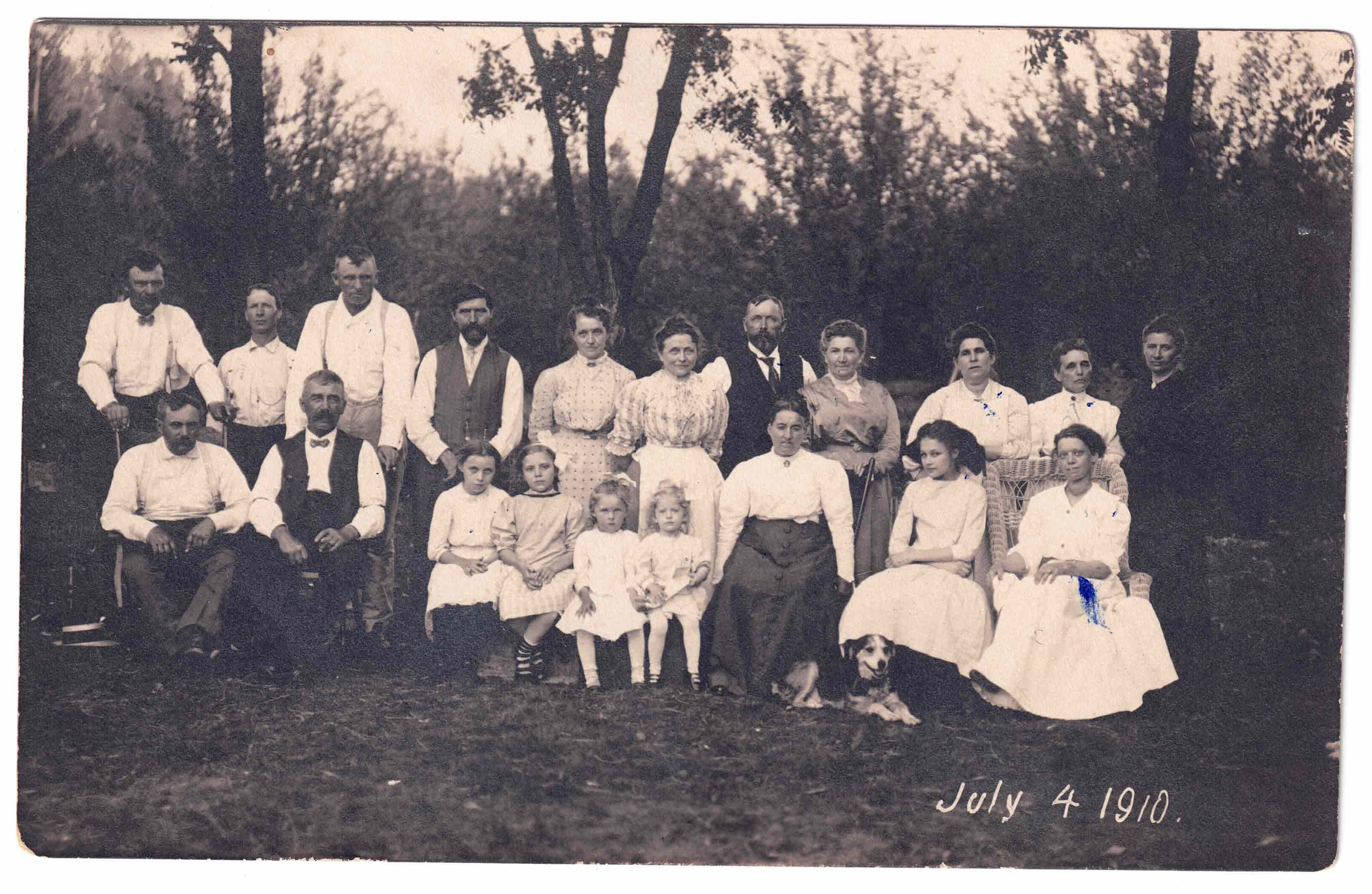
Independence Day celebration featuring descendants of Niels and Juliane (Hennike) Olsen and friends, Yankton County, South Dakota, 1910; digital image 2025, privately held by Greg Smith. Back, left to right: Jens Christian Nielsen?, Marius Larsen, Henry Schaller, John Nielsen, Cecilia (Nielsen) Boysen, Stena (Nielsen) Callesen, Jacob Nissen, Elizabeth Bruhn, Mrs. Schaller, Dorothea (Neilsen) Nissen, and Mary (Jacobsen) Nielsen. Front, left to right: Chris Callesen?, Erick Boysen, Herta Scheel Callesen, Cleora Nielsen, Grace Nielsen?, Violet Larsen, Jennie (Burton) Nielsen?, Henrietta Bruhn, and Helena (Nielsen) Larsen.

Thanks to a loose handwritten note that accompanied this photograph, as well as comparisons made with a 1902 group photograph that included many of the same individuals, most people have been identified with reasonable certainty. Present were at least five if not six of the eight adult children of the late Niels and Juliane (Hennicke) Olsen, Danish immigrants who had settled in Yankton County, Dakota Territory, in the early 1870s: John, Cecilia, Christina (Stena), Dorothea, and Helena Nielsen (also spelled Nielson or Nelson), along with their spouses. Their brother Jens Christian and his wife may have been there as well. Also present were several friends, who, according to the handwritten note, were members of the Henry Schaller and Henry Bruhn families.

The woman in the apron near the center of the photograph, who, given her attire, may have been the hostess of the event, is Christina “Stena” (Nielsen) Callesen (1860-1951). In 1910, Stena and her husband Christian “Chris” Callesen were living in Utica, Yankton County, South Dakota with their nine-year-old foster daughter Herta. Chris, whose name appears twice in the handwritten list of identifications, is likely seated at far left, while the child at left is Herta. Herta Scheel Callesen had been living with the Callesens since she was four years old and lost her father. Her mother, left with seven young children to feed, had made what must have been a difficult decision to allow her youngest daughter to be separated from the family—including from her twin brother—and raised by the Callesens. Stena was known to have had only one child of her own, a daughter who died in infancy. Herta, however, was one of as many as six children that the Callesens fostered or adopted over the years, some for only a short while and some, like Herta, to adulthood.

Seated to the right of Herta Scheel Callesen is her cousin Cleora Nielsen, the youngest daughter of John and Mary (Jacobsen) Nielsen. Cleora, eight years old, had been born in South Dakota but now lived in Santa Clara County, California. She and her parents had most likely returned to South Dakota for a summer visit with relatives; it is possible that her older siblings, the youngest already sixteen, remained in California, as they are not pictured here.

Next to Herta and Cleora are two young girls, between, perhaps, the ages of two and four. Only one was identified in the handwritten note, although it is not immediately clear which one: two-year-old Violet Larsen, the only child of Marius and Helena (Nielsen) Larsen. Tragically, Violet would live only to the age of four, and I have no other photographs of her. Although it was not indicated which girl is Violet, because the child on the right appears to me to be closer to the age of two—she fidgets with her skirt and her feet don’t quite reach the ground from the bench on which she appears to be sitting—that is my guess. There also seems to be a space left between the names of Cleora and Violet in the handwritten note.

Could the bigger of the two littlest girls be, perhaps, Grace Nielsen, four-year-old daughter of Jens Christian and Jennie (Burton) Nielsen? Jens, known familiarly as J. C. or Chris, was not named in the handwritten note accompanying the photograph, nor was his wife, but he bears some resemblance to the man at back left and his wife to the unidentified woman seated in the front row to the right of the children. The Nielsens, like the Callesens, lived in the small farming community of Utica, so it is reasonable to consider that they might have been present to spend the holiday with kin.

Jens Christian Nielsen, known as J.C. or Chris, is pictured at left in 1902. Could he be the man at right in 1910?

JaneJennie” (Burton) Nielsen is pictured at left in 1902. Could she be the woman at right in 1910?

The fact that this photograph was taken during a census year is particularly helpful in confirming the identities of the children, as it is possible to see exactly who resided in which household just a few months prior. It can be determined that the Bruhn and Schaller families, for example, did not have any young daughters who might have been seated beside little Violet Larsen. Unexpectedly, the census provided another important clue about this photograph: the identity of the photographer. It had seemed curious that family friend Henry Bruhn was not pictured alongside his wife, Elizabeth, and fourteen-year-old daughter, Henrietta, but according to the 1910 United States census, Henry Bruhn was, in fact, a photographer, and therefore may very well have been the person behind the camera.

Census records are of course less helpful when attempting to determine the identities of adults who are close in age, particularly considering the similarities in appearance among those with both shared heritages and lifestyles. Perhaps this is why whoever created the handwritten note accompanying the photograph named Chris Callesen twice! Cross-referencing with other more confidently identified photographs is key, and fortunately, in Chris’s case, there are two other known photographs that can be used as points of comparison and provide some degree of confidence.

Christian “Chris” Callesen is pictured at upper left in 1902 and at lower left in 1911. It is believed that he is the man at right in 1910.

Large group photographs like this are particular treasures in a family archive as they provide insight not only into the bonds of family and friendship, but also the occasions that brought people together. As they are less formal than studio portraits, they can also offer greater glimpses into personality and personal style, as well as the surroundings in which people lived. For a number of the Olsen descendants and their friends, 04 July 1910 looked to be a pleasant day spent in the fresh air, perhaps with a bountiful noon meal to share.

Copyright © 2025 Melanie Frick. All Rights Reserved.

Continue reading
A Yankton County Girl at the 1918 South Dakota State Fair

As the summer of 1918 drew to close, seventeen-year-old Helena Nelson of Yankton County, South Dakota prepared to compete at the South Dakota State Fair as a participant in a local 4-H club.

YANKTON TO SEND CONTESTANTS TO FAIR

Yankton, S.D., Sept. 2.—After a series of contests here, Wilma Gilreath, Elsie Frick, Helena Nelson and Albena Sailer, will represent this county in the state contest at the state fair at Huron in September in the Liberty Food Club. In addition Wilma Gilreath, winner in the food contest, will also be in the canning contest, and will be associated with Lois and Dorothy Gross to make up the team in the canning contest.

Tabor Independent, 05 September 1918

In 1918, Helena was a student at the Southern State Normal School in Springfield, South Dakota. This was not terribly far from her family’s farm in Tabor, west of Yankton, where she had likely spent the summer before the fall semester began. In addition to pitching in on the farm that summer, Helena was also involved with the activities of the Liberty Food Club.

Helena’s older sister, Andrea, wrote in her diary that on the morning of Sunday, 08 September, “About five Jim took Helena on to town, as she was to start by car with Kecks at six for the fair at Huron. The rest of us had a late breakfast.” Helena and her siblings had attended a barn dance hosted in honor of a local soldier on furlough the night before, but that didn’t stop her from hitching a ride from her brother-in-law that morning after only a few hours of sleep! It was time to make her way to the state fair, one hundred and twenty miles to the north.

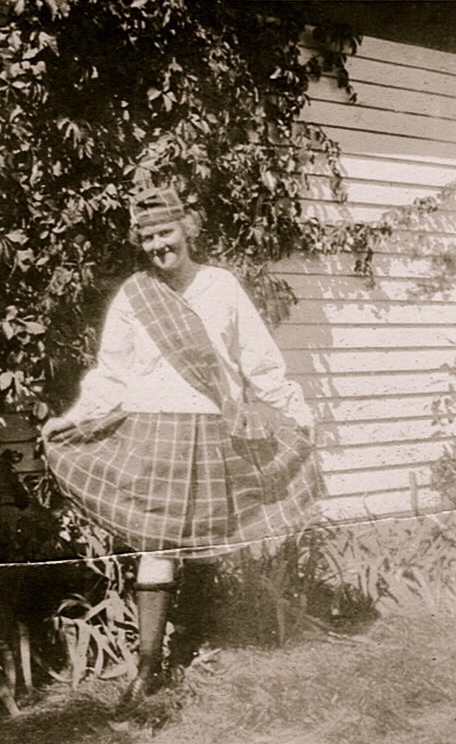
Helena Margaret Nelson photograph, circa 1918, Yankton County, South Dakota; digital image 2010, privately held by Melanie Frick, 2023. Based on family recollections, it is possible, but unconfirmed, that Helena is pictured here wearing a “uniform” of the Liberty Food Club.

The South Dakota State Fair, which dates to 1885, first introduced activities for youth in 1915 when a Boys State Fair Camp was held. Delegates were judged on their agricultural skills in regards to crops and livestock. The first Girls State Fair Camp took place in 1918, and included both food canning demonstrations and Liberty Food Clubs.

Liberty Food Clubs were a wartime invention and encouraged participants to assist with the war effort. An official bulletin of the United States government stated, “In order to become a member of this club each boy and girl enrolled in club work must sign a card pledging himself or herself, through food production and food conservation, to help win the war and world peace.”

While it is not known exactly what their exhibit or presentation may have entailed, the Yankton County girls did walk away as the winners of their event at the South Dakota State Fair. The Daily Argus-Leader of Sioux Falls reported, “Nearly a hundred valuable prizes were won by members of South Dakota boys’ and girls’ clubs in the final contests of the year at the state fair.” The different competition classes, aside from Liberty Food, included Pig Club, Baby Beef, Sheep, Stock Judging, Canning, and Sewing. Of Liberty Food, it was noted, “First, Yankton, State banner. Team Wilma Gilreath, Elsie Frick and Helena Nelson, all of Yankton. Second, Hughes county team, Alma Swanson Harrold, Ina Putnam Oahe, and Janice Lantz, Pierre.” One source suggests that twenty-four Liberty Food teams had competed in all.

Members of the Liberty Food Club who had successfully completed the work of the club for the entire year were to be given a diploma of achievement, but it is unknown whether Helena received such an honor. Not long after the South Dakota State Fair, Spanish Influenza struck her community and within a few short months she ultimately lost both her father and her sister Andrea. This was a tumultuous time for the Nelson family, especially as Helena’s older brother Ole was still away at war, and it seems very likely that any extracurricular endeavors would have fallen by the wayside.

The following year, the Boys State Fair Camp and Girls State Fair Camp became more formally known as 4-H clubs under the oversight of the State College Extension Service. World War I had come to a close, and Helena herself had completed her studies and become a country school teacher.

Copyright © 2023 Melanie Frick. All Rights Reserved.

Continue reading

One of Dakota’s Pioneer Mothers

There can be no question that Christina Marie (Schmidt) Nelson was a strong and capable woman.

Born in Skrydstrup, Gram, Haderslev, Denmark on 11 October 1868, to Jens Madsen Schmidt and Anne Bramsen, Christina immigrated to America with her parents and older sister when she was just twenty months of age. A dugout on a homestead in Dakota Territory was her first home in America; it was from this homestead in Bon Homme County that she spent long hours tending her family’s cattle, experienced devastating prairie fires and blizzards, witnessed interactions with displaced Native Americans, and even once encountered General George Armstrong Custer when he stopped for a drink of water. She was fortunate enough to attend a one-room log schoolhouse through eighth grade, and, in 1889, when she was twenty-one, she married her neighbor and fellow Danish immigrant Frederick Nelson.

Over the course of the next twenty years, Christina gave birth to nine healthy children: Anna Sophie (1891), Julia Marie (1892), Ole James (1894), Andrea Mathilda (1896), Louise Christine (1899), Helena Margaret (1900), Mary Magdalene (1904), Frederick Andrew (1908), and Myron Alvin (1910). Education was of apparent importance to Christina and Fred, as he was known; although their oldest son attended school only through eighth grade, destined to become a farmer like his parents before him, their younger sons and daughters all attended school at least until the age of sixteen. They even saw to it that their four youngest daughters had the opportunity to attend a “normal school” in nearby Springfield, South Dakota, where they received the necessary training to become schoolteachers.

The Fred and Christina Nelson Family, Yankton County, South Dakota, 1912; digital image 2011, privately held by Lori Dickman. Back row, from left: Julia, Anna, Ole, and Andrea Nelson. Front row, from left: Mary, Louise, Christina with Myron, Fred with Fred Jr., and Helena Nelson.

A formal portrait of the Nelson family was taken in July of 1912, likely in Yankton, which was not far from the family’s home in Lakeport; the girls sport bare forearms for the season, their fabric colors light and featuring gingham, stripes, and lace. Christina, while dressed in a dark gown, wears a white collar and whimsical crocheted flowers at her throat. As to the occasion for the photograph, it was not a milestone anniversary year—Christina and Fred would have celebrated their twentieth anniversary the previous spring. However, Christina perhaps realized that, at forty-three, her childbearing years were behind her and now was the time to have a portrait taken of the entire family all together. Furthermore, as her eldest daughter had married in March of 1912, having her first child leave the nest might also have sparked sentimentality and a wish to document the fact that, at least for a short while, all nine Nelson children had been under one roof.

Christina and Fred would go on to celebrate their twenty-fifth anniversary in 1916, but two years later, a matter of weeks after her fiftieth birthday, Christina would be dealt several harsh blows in short succession. First, Spanish Influenza hit the household, and then, in a turn of events that shocked both the family and their wider community, she lost Fred to suicide, and, one month later, daughter Andrea to undetermined medical circumstances.

Christina persevered. She faced another trial when her father died the following spring, but it was a blessing that her eldest son was home from his service in the Great War and able to help manage the family farm while she continued to raise her two youngest sons. She continued to live on the farm with support from her sons well into her old age; even in 1950, when she was eighty-two, the census reported that she was still “keeping house” for her three bachelor sons. It was at this farmhouse that her children and grandchildren frequently gathered to celebrate birthdays and holidays.

Christina died on 23 January 1961 at the age of ninety-two and is buried alongside her husband and three of their nine children at the Elm Grove Cemetery in Yankton County, South Dakota. A brief biography included in a local history book several years prior had noted, “Mrs. Nelson is well-known by her many friends and relatives as a person who always has a warm welcome hand extended to all those who call at her home. Even today, at the age of eighty-five, she is active with her household duties and retains an active interest in what is going on about her. She is cordial and sympathetic with the many young people who come her way. She is truly one of Dakota’s pioneer mothers who still looks ahead and enjoys her home and family.”

Copyright © 2022 Melanie Frick. All Rights Reserved.

Continue reading
Feeding the Black Hills Gold Rush

“In the early 1880 days of the Gold Rush in the Black Hills Fred [Nielsen] and his brother-in-law Christian Callesen bought eggs in the Yankton area, packed them in cases, placed the egg cases in a wagon box surrounded by oats, hauled them to the Hills and sold them at a good price to the hungry miners.” This bit of family lore was recorded by Nielsen descendent Harold Jorgensen and printed in Yankton County History roughly one hundred years after the fact.

The Black Hills Gold Rush began in 1874, the same year that a then ten-year-old Fred Nielsen set sail from Denmark to America with his parents and five siblings, his two oldest brothers having ventured to the Midwest the year prior. The family settled on one hundred and sixty acres of farmland in what is now Yankton County, South Dakota.

Fred turned sixteen in 1880, the same year that Christian “Chris” Callesen, at the age of twenty-five, married Fred’s nineteen-year-old sister Karen Kirstine “Stena” Nielsen. The Black Hills Gold Rush, its epicenter in Deadwood, had peaked in the late 1870s, and the surge of those panning for gold waned considerably by 1880 due in part to a smallpox outbreak and a destructive fire. Apparently, however, there was still enough activity—and “hungry miners,” as the story goes—to make it worthwhile for two young men to drive a wagon nearly 400 miles from Yankton to Deadwood on what may have been more than one occasion.

Charcoal drawing based on photograph of Fred Nielsen (1864-1918), Deadwood, Dakota Territory, ca. 1888-1890, artist unknown, drawing date unknown; digital image 2010, privately held by B.A., 2020.

Indeed, there is evidence that Fred was in Deadwood at least twice, if not more often. He was photographed there on two occasions, the first time circa 1884-86 and the second several years later. Local histories indicate that Christian and his wife homesteaded near St. Onge, a stone’s throw from Deadwood, in 1884. Perhaps Fred spent time in the area with his sister and brother-in-law, as St. Onge hosted a sizable Danish community. In 1889, the Little Dane Church, which still stands today, was built on the southeast corner of Christian’s land.

Were Fred and Christian still making a profit selling eggs and other farm products well into the 1880s, or did Fred find other reasons to make repeated visits to Deadwood? If he was not there on business, Deadwood would at the very least have provided a dramatic change of scenery for a young farmer from a quieter corner of Dakota Territory.

Fred married neighbor Christine Schmidt, a fellow Danish immigrant, in 1890, and it is unknown whether he ever traveled to Deadwood after their marriage. He did travel as far as Colorado with his brother-in-law in 1911, and family lore states that at some point he acquired land near Phillip, South Dakota. Bureau of Land Management records show that a Fred Nielsen purchased one hundred and sixty acres of land in Stanley County, not far from Phillip, in 1910, but further research is necessary to determine whether this was the same Fred Nielsen and, if so, why he might have purchased land there.

Several of Fred’s siblings made return visits to Denmark as adults, but as for Fred, he seems to have been drawn instead to the west.

Copyright © 2020 Melanie Frick. All Rights Reserved.

Continue reading

The Young Musicians

At first, Leonard and Helen might have seemed like an unlikely pairing.

Leonard John Christian Wiese was a city boy through and through, born and raised in Chicago. Helena Margaret Nelson, on the other hand, was a farm girl from rural southeastern South Dakota. Chicago’s population in 1920 numbered over two and half million, while the largest town within the vicinity of Helen’s family’s farm had a population of only five thousand.

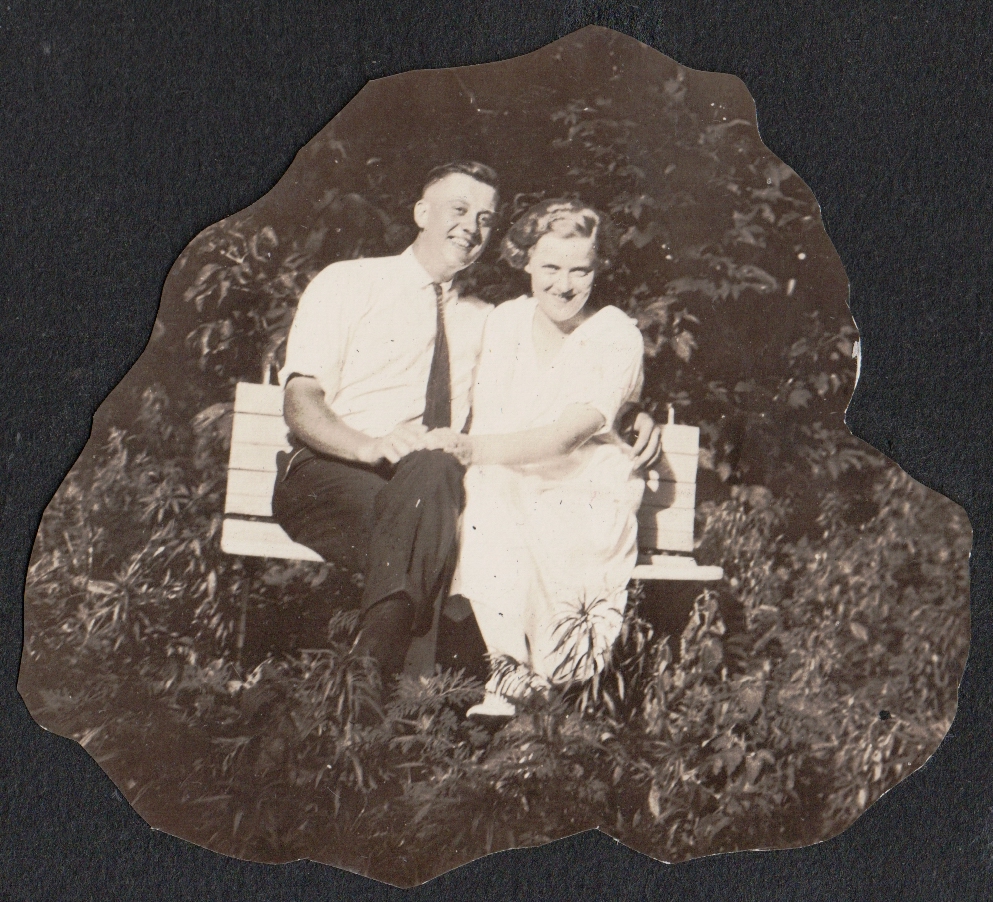
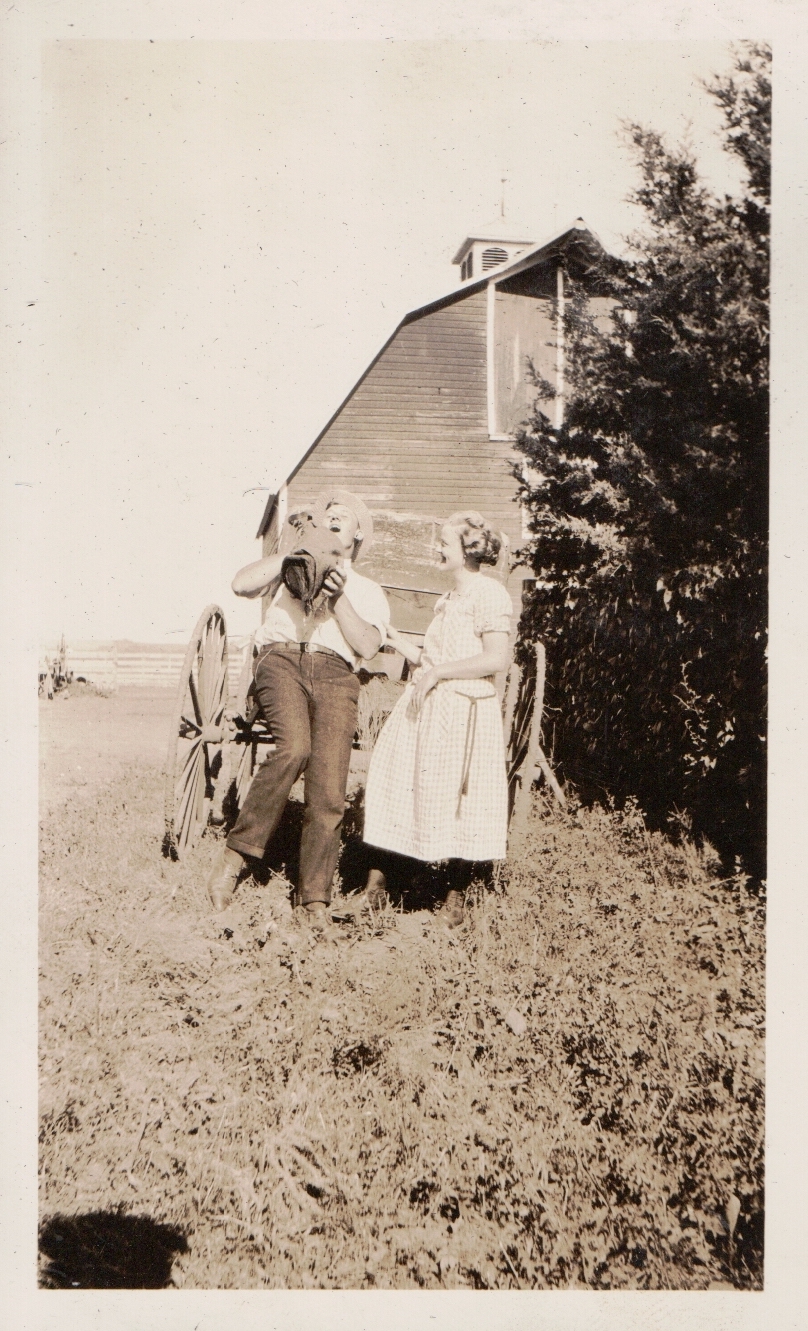
Leonard Wiese and Helen Nelson, South Dakota, circa 1922-23; digital image 2014, privately held by B.S., 2019.

Their heritages also differed. Leonard’s parents had immigrated to America from Germany as children, while Helen’s parents had immigrated to America from Denmark.1 However, despite different familial origins and native languages, Leonard and Helen had a surprising amount in common.

Both were born in the year 1900, and both were younger children in large families—Leonard the last of five, and Helen the sixth of nine.2

Leonard Wiese and Helen Nelson, South Dakota, circa 1922-23; digital image 2014, privately held by B.S., 2019.

Both lost their fathers as teenagers. Leonard’s father, Fred, died when Leonard was thirteen years old, and perhaps because of the need to help support his mother, Leonard entered the workforce after completing the eighth grade.3 Helen’s father, also named Fred, died when she was seventeen; shortly thereafter, she began teaching country school.4

Both saw older brothers serve in the First World War.5

Both lost older sisters to tragic circumstances in the year 1918.6

Both were raised as members of the Lutheran church.7

Perhaps their most significant commonality, however, was their shared love of music. Leonard was a talented violinist, while Helen played the piano, and their talents made them popular entertainers within their respective social circles.8

Leonard Wiese and Helen Nelson, South Dakota, circa 1922-23; digital image 2014, privately held by B.S., 2019.

As the story goes, as a young man, Leonard worked at the docks in Chicago while his older brother Oliver worked for the railroad. Oliver obtained tickets west so that he and Leonard could seek seasonal farm work, and the industrious brothers wound up in Yankton County, South Dakota.9 Leonard, of course, had brought along his violin, and it has been surmised that one way or another, word spread that a young man with musical talent was in the area. Wouldn’t he get along swell with a certain young pianist? Before long, the Wiese brothers had made the acquaintance of the Nelson sisters, among them Helen and her older sister Louise.10 

Oliver and Louise married in Yankton on 01 June 1922, and after a courtship documented in a few surviving snapshots, which offer a glimpse of light-hearted moments shared together, Leonard and Helen married in Chicago on 05 January 1924.11

Happily, music remained a shared passion throughout their twenty-three years of marriage, and it was their delight to engage their two daughters in their very own Wiese Family Band.12

Copyright © 2019 Melanie Frick. All Rights Reserved. Continue reading
Prairie Teacher

“Oh, what a work we teachers have in the molding of the lives of those little ones,” wrote Andrea Nelson in her diary on an autumn evening in 1918.1 At the age of twenty-one, she had just begun her third term as a teacher in southeastern South Dakota.2 She took great delight in her fourteen students, who, she noted, were “in general a bright talkative set.”3 This was her first term at Prairie School District 9, located in Mission Hill, a rural community near the town of Yankton.4

Andrea Mathilda Nelson was born on 31 December 1896, the daughter of Danish immigrants Fred and Christina (Schmidt) Nelson.5 Raised on a farm just west of Yankton, Andrea was the fourth child of nine.6 After completing her grammar school education at a one-room schoolhouse, Andrea, along with her sisters, succeeded in receiving teaching certification from the Southern State Normal School located in nearby Springfield, South Dakota.7 Andrea taught first in Turkey Valley, then at the Dewey School near Lesterville, and finally in Mission Hill, where she was conveniently able to board with her elder sister, Anna, and her husband, Jim.8

With the freedom provided by a small class size and a rural school district, Andrea enjoyed and recorded many memorable moments with her students: she took them on noontime walks to the nearby molasses mill, joined in on games at recess (“Pump Pump Pull Away” and “Ruth and Jacob”), and received invitations to visit them at their homes.9 One evening, she wrote, “Shortly before recess I excused Tim and Royal in order that they might go chase Ficke’s cows out of the nearby cornfield. They came back at recess with two watermelons which Royal brought from home and which we feasted on together.”10

Andrea Nelson at a schoolhouse with her students, Yankton County, South Dakota, ca. 1916-1918; digital image 2012, privately held by Melanie Frick, 2018.

Fond of the outdoors herself, she also recognized its importance to children, even offering an early dismissal one “very fine day.”11 On another occasion, she wrote, “A very beautiful calm autumnal day. But nine at school. We had our drawing lesson outside. At recess the children earnestly requested me to permit them to recite and study outside the remaining hour and fifteen minutes. I consented after which they gleefully clapped their hands. The shade of one tree served as study room while that of another nearby took the place of recitation room. The children did not abuse their privilege. As a result we all fully enjoyed school in the fine October out of doors.”12

The next day, still taking advantage of the autumn weather, she wrote, “After school I hied me to the open. There I helped Jim pick potatoes for about half an hour. He said that I broke a schoolmam’s reputation in taking up such work after a day at school. I replied that he could count on me for doing things out of the ordinary for those in our profession.”13

In late September, Andrea wrote, “Think Spanish Influenza is going about the neighborhood. Only eleven at school.”14 Before long, the number of students in her class dwindled still further as the influenza continued to spread. In early October, just a month into the school year, Andrea recorded in her diary, “Only six at school again. […] I hardly feel that I’m earning my $4.25 per day these days.”15

Tragically, it would be only a matter of time before Andrea was struck with influenza herself, and the final pages of her diary are left blank. Exactly one month after the unexpected death of her father, Andrea died on 28 November 1918 while a patient at St. Bernard’s Hospital in Council Bluffs, Pottawattamie County, Iowa.16 Her younger sister, Helena, a student at Springfield Normal School, took over her teaching position at Prairie School District 9 and completed the sorrow-filled school term with Andrea’s students.17

Copyright © 2018 Melanie Frick. All Rights Reserved.
Continue reading
The Nelson Family at Home

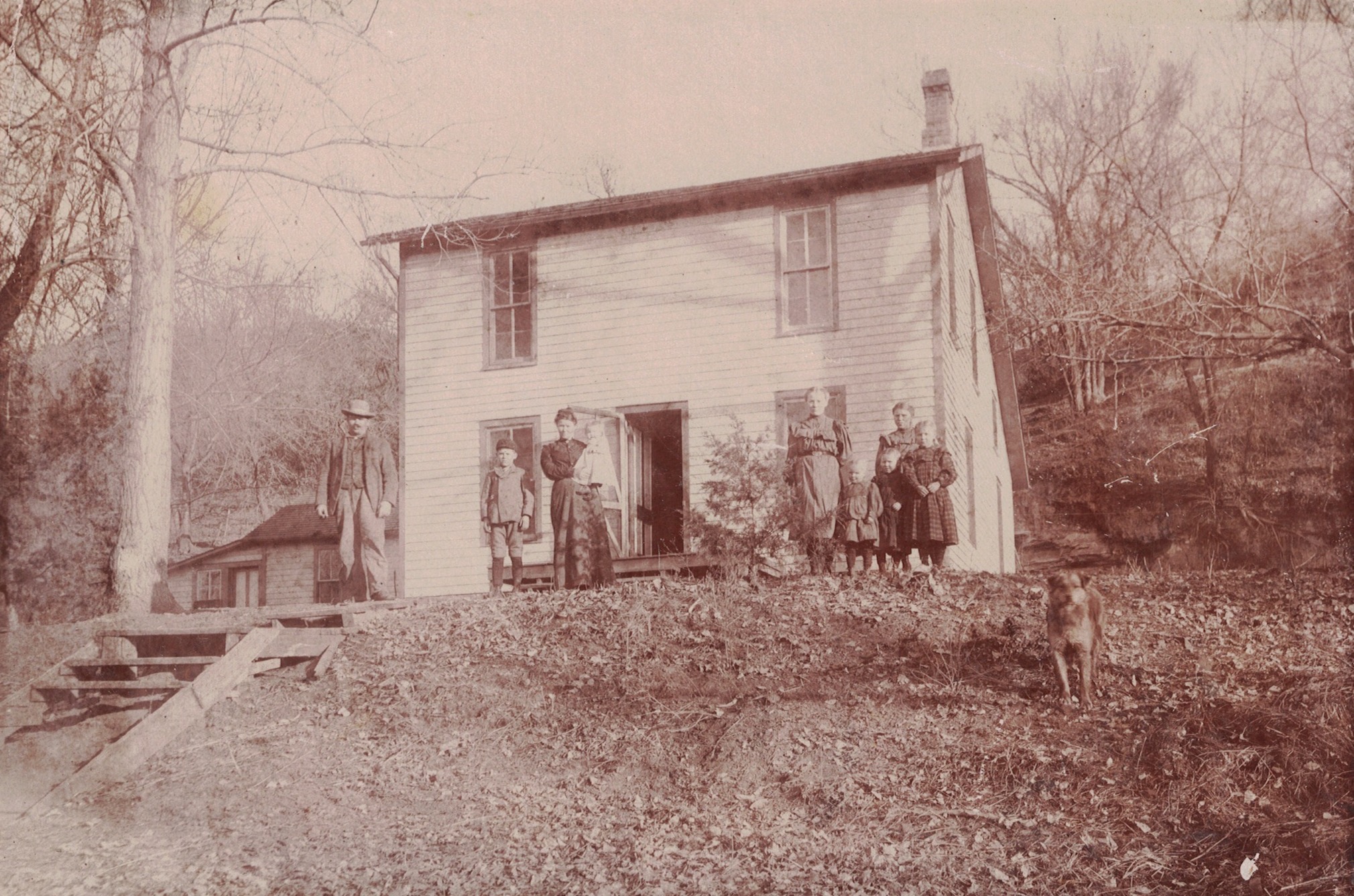
The leaves had already fallen from the trees surrounding the modest two-story farmhouse belonging to Fred and Christina (Schmidt) Nelson when this photograph was taken in late 1904.1 Situated near the scenic bluffs along the Missouri River west of Yankton, Yankton County, South Dakota, the house was said to have had a creek running through the corner of the kitchen as a source of fresh water.2 Its simple, symmetric design featured a center door and four front windows on its clapboard walls, with a chimney appearing above the gable roof on one side. The house was likely painted white with a trim of a different color around the windows and door. Many trees surrounded the house, which was situated on an incline; the remote, wooded landscape seems to lend truth to family lore of the children fearing howling wolves (or coyotes?) as they walked to and from the nearest country school.3

Fred and Christina (Schmidt) Nelson and Family, Yankton County, South Dakota, 1904; digital image 2017, privately held by Melanie Frick, 2017.

Fred and Christina, both of whom immigrated from Denmark as children, married in 1890.4 Fred, at left, was forty years old in late 1904; he wears a loose-fitting sack suit and hat and sports a mustache.5 At center stands son Ole, ten, beside Christina, thirty-five.6 She holds baby Mary, who was born in February of that year.7 While Ole is clearly dressed for the outdoors in a coat and cap, Christina, like her daughters, wears no jacket or shawl. Her simple buttoned bodice and unadorned skirt appear comfortable for a nursing mother as well as household duties.

The open door behind Christina suggests that perhaps she and the girls had just stepped outside for the photograph. In a cluster at right stand Anna, thirteen; Helena, nearly or barely four; Louise, five; Julia, twelve; and Andrea, nearly eight.8 All of the girls wear their hair neatly parted and plaited down the back; it was said that the sisters would line up each morning, oldest to youngest, to braid each other’s hair.9 They wear dresses that, with the exception of the youngest’s, fall below the knees, and all wear dark stockings. Their dresses have high necks and full bishop sleeves; a few additional details can be distinguished, such as the plaid fabric of Andrea’s dress and the belt at Anna’s waist.10

The occasion for this photograph is not known, although perhaps it was taken by an itinerant photographer who made stops at rural homes throughout the Midwest. Unlike formal studio portraits of the era, this photograph is as much about the place as the people, allowing a glimpse into the lives of the Nelson family that would otherwise be missed.

Copyright © 2017 Melanie Frick. All Rights Reserved.
Continue reading
Farm Girls

Sisters Helena, Louise, and Andrea Nelson donned overalls and posed on their family’s farm near Tabor, Yankton County, South Dakota in this candid photograph dated circa 1916. Andrea, nineteen in the summer of 1916, had recently completed her studies at the Southern State Normal School in Springfield.1 Both Helena, fifteen, and Louise, sixteen, would be students there in the fall, while Andrea would go on to her first term as a teacher at a one-room country school.2

Helena, Louise, and Andrea Nelson, Yankton County, South Dakota, ca. 1916-1918; digital image 2017, privately held by Melanie Frick, 2017.

Pitching in to help out on the farm would have been the norm for the Nelson girls, the three middle children in a family of nine. Helena’s daughter later recalled her mother’s stories of working in the fields in the summertime,3 and in a letter dated 1918, in response to a question from her cousin about taking summer courses, Andrea replied, “Oh, how I’d love to, but guess it’s chickens to tend etc. and overalls to wear. Suppose that too will be sport, but after all, is there anything like being a schoolgirl?”4 The Nelson girls would have been especially needed on the farm that summer, as their older brother, Ole, was in the service.

While many decades had yet to pass before women wearing pants would become truly mainstream, I can’t imagine that it would have been unusual at this time for young women to wear the clothing most suitable for farm labor while at home among family. The overalls and loose collared shirts worn by the Nelson girls might have been hand-me-downs from their father and brother (even Levi Strauss & Co. didn’t begin to make jeans especially for women until the 1930s!), and, positioned side-by-side in a field with wide-brimmed straw hats atop their heads, the sisters—or the photographer—clearly recognized that this was a photo op not to be missed.

Copyright © 2017 Melanie Frick. All Rights Reserved.
Continue reading

Military Monday: A Duty to His Family

Today marks the World War I centenary, although it would be a few more years before Ole James Nelson, a young farmer from rural Yankton County, South Dakota, would make his way overseas as a mechanic with the U.S. Navy Aviation Section.

Ole enlisted on 3 May 1917 at the age of twenty-two, within a month of the United States entering the war.1 According to a county history, he served in Eastleigh, Hampshire, England.2 His journey to Eastleigh, however, may have been a roundabout one; in fact, he may not have left American soil for at least a year after his enlistment. One photograph suggests that he completed his training in Buffalo, New York;3 another photograph was sent to his family from Charleston, South Carolina, in May of 1918.4 That October, his sister wrote to him, commenting, “Wonder if you are still at Quebec.”5

SCAN0858

Ole Nelson, Charleston, South Carolina, 1918; digital image 2013, privately held by Melanie Frick, 2014.

Ole’s time in Eastleigh was likely brief. The United States Navy established a naval air station in Eastleigh in July of 1918 to assemble and repair aircraft, including Caproni Ca.5 and Airco DH.4 and DH.9 bombers.6 This, almost certainly, is how Ole made use of his time as a mechanic. The base was in operation, however, for only a matter of months, as it closed following the armistice later that year.7

As it turned out, Ole’s days in the service were numbered, although not because the “war to end all wars” was winding down. After receiving notification of his father’s unexpected death, which had taken place a matter of days before the armistice,8 Ole applied for an honorable discharge, which was granted on 29 January 1919.9 As the eldest son, Ole was to return home to manage his family’s farm and to care for his mother and younger siblings; what he did not learn until his return, however, was that one of his sisters had also passed away in his absence, having succumbed to what was said to be a combination of Spanish Influenza and shock at the death of her father.10

A return to the farm, following what must have been an exciting time in this young man’s life, was perhaps not what Ole had initially had in mind for his future, but after duty to his country, he had a duty to his family.

Continue reading

A Golden Anniversary Celebration

One warm afternoon during the summer of 1902, a crowd gathered at the home of local pioneers Niels and Juliane Sophie (Hennike) Olsen. The couple, who had retired from farm life several years before, was celebrating fifty years of marriage, and all of their children and grandchildren were invited to their home located near the center of town at 605 Broadway in Yankton, South Dakota.1 The event was surely a memorable affair, and the local newspaper gave a glowing report of the afternoon’s activities:

Mr. and Mrs. Nels Olson celebrated their golden wedding yesterday afternoon at their home on Broadway. All their children, eight in number, were present with their families. Their names are as follows; Ole Nelson, Mission Hill; John Nelson, Viborg; Christ Nelson, Lakeport; Fred Nelson, Lakeport; Mrs. J. Nissen, Yankton; Mrs. C. Calleson, Yankton; and Miss Helena Nelson, Yankton. Rev. C.K. Solberg spoke a few words appropriate to the occasion and presented to the venerable couple two fine presents from the children, a gold headed cane to “father” and pair of gold glasses to “mother.” The “old folks” came from Denmark in 1874 and made their first home in America near Lakeport, S.D. Eight years ago they moved to Yankton, their present home. They are in fairly good health and enjoy comfort and happiness surrounded by kind children.2

Niels Olsen and Juliane Sophie Hennecke had married in Haraldsted, Soro, Denmark, on 30 July 1852.3 For the first twenty-two years of their married life, they resided in Denmark; their twenty-second anniversary, however, was spent aboard ship as they ventured to America.4 Their years since had been spent in southeastern South Dakota, where they claimed a homestead and where Niels had recently served a term as a rural postmaster. All eight of their surviving children remained in the area, and to commemorate their fiftieth anniversary, an informal group photograph was arranged on the porch of their home beneath the shade of several large trees.

Olsen Golden Anniversary

Olsen Golden Anniversary, Yankton, South Dakota, July 1902; digital image 2010, privately held by Melanie Frick, 2014.

The couple of honor is seated near the center, surrounded by those in attendance. Niels wears a wool three-piece suit and tie, as do most of the men, while Juliane wears a patterned shirtwaist with a bow at the neckline. Patterned, striped, or light-colored cotton fabrics seem to be popular choices among the women for their summertime wear. The adults, including the couple’s children, sit or stand in two rows, and three infants are perched on laps. Nine young grandchildren – including four sisters in matching dresses – cram together in the front, sitting cross-legged on the wooden plank floorboards. The group is relaxed; there are a few smiles, several women cross their arms comfortably, and a few maternal faces are turned away from the camera, intent on minding the couple’s many grandchildren.

I have to hope that this well-dressed crowd had the opportunity to partake in some refreshing lemonade in honor of the occasion!

In the back row, from left to right, are Reverend Solberg, Mrs. Solberg, Harry Nissen, Fred Nelson, Ole Nielsen, Harry Nielsen, John Nielsen, Eric Boysen, unknown, and Chris Callesen. In the middle row, from left to right, are unknown, Dora Nissen, Cleora Nielsen, Hannah Nielsen, Stena Callesen, Cecilia Boysen, J. Chris Nelson, Niels Olsen, Juliana Olsen, Helena Olsen, Jennie Nelson, Edith Nelson (child), Christine Nelson, and Helen Nelson (child). In the front row, from left to right, are Robert Nelson, Anna Nelson, Louise Nelson, Andrea Nelson, Julia Nelson, Bessie Nelson, Ole Nelson, Alvin Nielsen, and George Boysen.5

Continue reading