Tag Archives: Thoma

Fred the Farmer

Frederick Thoma might never have had any intention of becoming a farmer. Born on 04 December 1857 in Garnavillo, Clayton County, Iowa, Fred was the eldest of eleven children born to Bavarian immigrants Wilhelm Heinrich Thoma and Anna Margaretha Poesch. His father, a respected community leader, owned and operated a general store in the town of Garnavillo, which is where Fred and his siblings were raised. In 1876, when Fred was eighteen, his father died; three years later, on 29 December 1879, he married Matilda J. Hammond, the daughter of a prosperous local farmer.

Fred and Matilda, who were known familiarly as Fritz and Tillie, had five children: George Hiram (born 1880), Leonard Christopher (born 1885), Ludelia Maria (born 1887), Roselyn Anna (born 1892), and Norma Evaline (born 1895). All lived to adulthood with the exception of Norma, who died in a diphtheria outbreak at the age of ten. This was not the first time that Fred had lost a loved one to communicable disease: two of his brothers had died of consumption, both when they were twenty-four, in 1886 and 1890. One can imagine that each of these losses would have had a profound impact on Fred.

As a young married man, Fred was a store clerk in Garnavillo; according to local news clippings, he then, over the course of several years, opened an agricultural warehouse, carrying “a full line of cultivators, reapers, etc.,” and next operated a saloon or billiard hall, dealing in “pure Wines and Liquors, choice Cigars, etc.,” before briefly entering the “fruit and fancy grocery business.” By 1895, however, when he was thirty-seven, the census recorded that he was a laborer, and his occupation remained the same in both 1900 and 1905. It seems that his business endeavors were ultimately unsuccessful, and family lore gives a clue as to why.

Decades later, Fred’s granddaughter recalled that his vice was alcohol, noting that his eldest son had left home as a teenager for this reason, and also that Fred’s wife, upon receiving an inheritance from the estate of her parents, bought a farm in order to remove Fred from town and from the temptation of the saloon. Indeed, in March of 1910, a local newspaper reported that Matilda Thoma had purchased 80 acres from William D. Harnack and his wife for $4800, and by the time of the U.S. census that April, the couple resided on their farm in rural Clayton.

The move northeast from Garnavillo into rural Clayton Township was a distance of about five miles, and it brought Fred and Matilda closer to the family of their eldest daughter and son-in-law who also farmed there. Newspaper clippings make mention of Fred and his son-in-law engaging in farm work, participating in a barn raising, and hauling sand across the Mississippi River at Clayton.

A newly uncovered photograph of Fred Thoma—in fact, the only photograph of him known to exist—shows him as a mustachioed farmer in overalls and a brimmed hat, standing beside a team of horses in front of a two-story farmhouse. It’s a beautifully kept home, featuring, at the time this photograph was taken circa 1910-1924, an inviting front porch complete with a wicker rocker, potted plants, and vines growing on a trellis. The front porch shelters two front doors, and curtains can be seen at the windows. A screened-in back porch is also visible around the side of the house, and leafy tree branches frame the shot. Fred, photographed, perhaps, after a brief rest in the Windsor chair behind him, appears relaxed and has an amiable expression.

Frederick Thoma (1857-1925), Clayton, Clayton County, Iowa, circa 1910-1924; digital image 2024, privately held by Julie Jentz, 2024.


Fred and Matilda farmed in rural Clayton between 1910 and 1924, when Fred’s poor health necessitated their return to town. In the summer of 1924, Fred had spent some weeks at the Prairie du Chien Sanitarium, where, weakened from a bout of influenza and suffering from dropsy, he had sought medical attention; his health not improved, that fall he auctioned off his livestock and numerous farming implements in a public sale. Late in the year, he and Matilda resettled in the town of Clayton; they lived there for only two months, during which time they would have celebrated forty-five years of marriage, before Fred’s death at the age of sixty-seven on 10 January 1925. The funeral was held at St. Paul Lutheran Church in Garnavillo, with members of the Garnavillo Turnverein, a German-American social club of which he was a member, in attendance.

Fred’s career as a farmer may have made up less than a decade and a half of his adult life, but one can hope that these were at the least peaceful, pleasant years for him and his family—years during which Matilda was able to put to use her skills and knowledge from a childhood spent on a farm, and Fred was able to face fewer temptations, connect with his adult children and young grandchildren, and engage in fulfilling work. The farmhouse where he and Matilda spent these quiet years still stands today on Great River Road between Garnavillo and Clayton.

Copyright © 2025 Melanie Frick. All Rights Reserved.

Continue reading
Tombstone Tuesday: Anna Barbara (Ruckdäschel) Poesch (1811-1887)

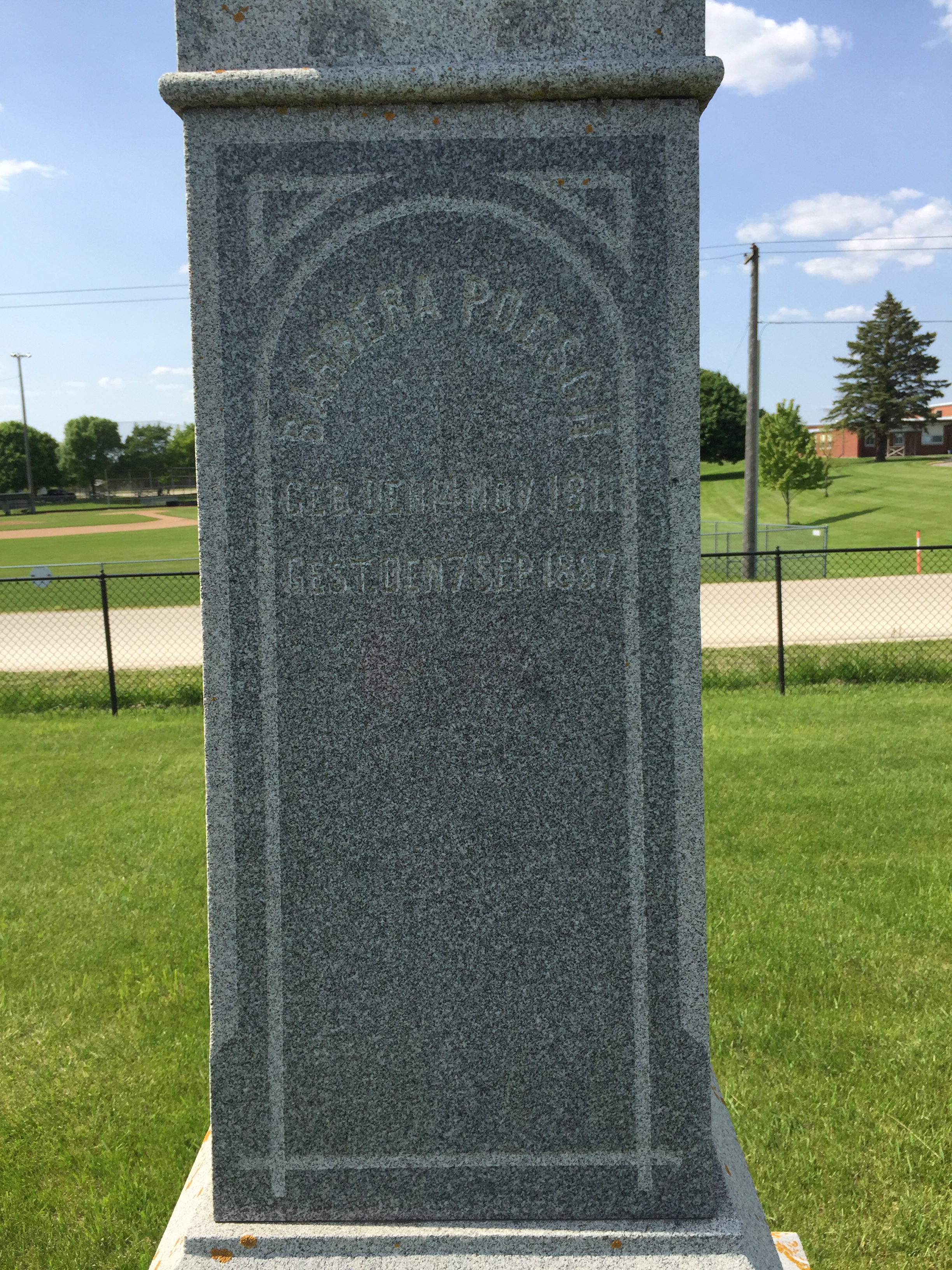
Anna Barbara (Ruckdäschel) Poesch was forty-two years old before she saw something of the world. Born on 14 November 1811 in the village of Schönlind near what is now Weißenstadt, Bavaria, Germany, she was said to have been the daughter of Johann Georg Ruckdäschel and Eva Margaretha Brodmerkel. Nothing is known of her early years, but Barbara, as she was known, married shoemaker Wolfgang Poesch on 22 April 1833 when she was twenty-one years old. Five known children would be born to the couple in the years to come, the first that same year: Johann (1833), Catharina (1835), Anna Margaretha (1838), Lorenz (1847), and Paulus (1850).

In 1852, Barbara bade farewell to her eldest son when he departed in the company of another local family, that of Paulus and Elisabeth (Schmidt) Thoma, to seek a better life in America. Young Johann, nineteen at the time of his passage, must have sent a favorable report to his parents of his new home in northeastern Iowa; in 1854, Barbara, Wolfgang, and their four remaining children packed a trunk and left the village of Weißenstadt behind forever.

After making the trek to Bremen and then stepping aboard the Heinrich Von Gagern, the family was at sea for what may have been as long as two months. Barbara must have struggled to keep her family clean and fed in cramped conditions, but surely took solace in the companionship of others from their home village who traveled with them. Her eldest daughters, Catharina, eighteen, and Anna Margaretha, fifteen, would have been a great help to her in caring for the two little boys, Lorenz, seven, and Paulus, just four.

Barbara and her family disembarked in New Orleans on 27 Apr 1854. They may have been wary of lingering long in this bustling port; a devastating yellow fever epidemic had swept through the city the previous summer, and as April turned to May, the weather would likely have become increasingly hot, humid, and inhospitable. A steamboat would have provided the family relatively quick and reliable passage north, at the very least to St. Louis if not all the way to Iowa.

After an arduous journey across the Atlantic and through the Gulf of Mexico, then up the Mississippi River, Barbara was no doubt thrilled to finally be reunited with her eldest son upon their arrival in Clayton County, Iowa; in fact, numerous familiar faces from their home village would have greeted the Poesch family.

However, tragedy would soon strike—if indeed it hadn’t already. Four-year-old Paulus, listed as the youngest member of the family on the 1854 ship manifest, was not present at the time the family was recorded in the 1856 Iowa State Census, which suggests that he had died at some point in the intervening years, either in Iowa or en route there. Then, most likely within a year of that same census, Wolfgang succumbed to sunstroke. In his early fifties at the time, the physical demands of farming in the heat of an Iowa summer were apparently too much for him.

Although Wolfgang did not live to commemorate his silver wedding anniversary with Barbara, the couple was able to celebrate the marriages of their two eldest children: son Johann to fellow immigrant Catharina Weiss, and, in 1855, daughter Catharina to Friederich Thoma. Then, in 1857, Anna Margaretha married Wilhelm Heinrich Thoma. The Poesch sisters had, in fact, married two brothers, members of the same family with whom their brother Johann had emigrated from Weißenstadt in 1852. This made their children—nineteen between them—double first cousins.

Find A Grave, Inc., Find A Grave, digital image (www.findagrave.com : accessed 25 March 2024), photograph, Barbera Poesch (1811-1887), Memorial No. 148724753, Garnavillo Community Cemetery, Garnavillo, Clayton County, Iowa; photograph by Ken Johnson, 2016.

Barbara survived Wolfgang by approximately twenty years. The year 1860 found her living with the family of her daughter Catharina; a few years later, her son Lorenz would serve with the 12th Iowa Infantry in the Civil War, surely an anxious time for Barbara. Lorenz survived the war and married Wilhelmina Best in 1868. In 1870, Barbara lived with the family of her son Johann, and was perhaps still a member of his household during a bitter cold snap in early March of 1873 when her fourteen-year-old granddaughter, her namesake, sadly perished. Young Barbara, who had been ill, had entered an unheated room one night where she fell and lay undetected until morning, by which time her arms and legs were said to have frozen and she was too weakened to recover.

By 1885, Barbara resided in the town of Garnavillo with her daughter Anna Margaretha, who was by that point also widowed. Barbara’s occupation was recorded as “Old Mother.” Having raised four children of her own to adulthood, and having likely had a hand in raising a total of twenty-five grandchildren as well, Barbara certainly earned her title.

Anna Barbara (Ruckdäschel) Poesch died at the home of her daughter in Garnavillo, Clayton County, Iowa, on 07 September 1887, when she was seventy-five years old. Her obituary, printed in a local newspaper, stated, “Her remains were conveyed to their last resting place on Saturday, followed by a large concourse of sorrowing relatives and friends. Rev. F. Sommerlad conducted the ceremony in his usual impressive manner.”

Copyright © 2024 Melanie Frick. All Rights Reserved.

Continue reading

A Jolly Sleighing Party

It was a chilly January night in 1905 when a group of six young people set out on a sleighing party, traversing the thirteen miles from Center to Bloomfield in northeastern Nebraska. The Bloomfield Monitor reported:

A jolly sleighing party from Center, composed of Mr. and Mrs. Geo. A. Neilson, Mr. and Mrs. C.A. Saunders, Miss Maud Walton and O.A. Danielson took in the “Adventures of Fra Diavolo” at the opera house in Bloomfield last Saturday night. After the play, they, in company with the Misses Neff, Peterson and Lee of the Bloomfield schools, and Miss Dunham, were invited to the hospitable and commodious home of Mr. and Mrs. W. B. Frymire, where they were regaled with oyster stews and entertained with music until the wee sma’ hour when the Center people started for home, all vowing that Bloomfield is not so worse and that Mr. and Mrs. Frymire are the best.

Bloomfield Monitor, Bloomfield, Nebraska, 26 January 1905

George A. Neilson had married Anna Leota Fenton three years prior, and both were twenty-four years old at the time of this particular sleighing party. Their son, Fenton, would celebrate his second birthday just a few days later, on January 26, and he was undoubtedly left in the care of a neighbor or his visiting grandmother while his parents were out, a nighttime outing on the snowy plains not being at all suitable for a toddler! George had managed the Edwards and Bradford Lumber Company in Center ever since his marriage, and as he was known to be an affable and outgoing young man, it is no surprise that he and his wife had a lively circle of friends.

Anna Leota (Fenton) Thoma and George Hiram Thoma, alias George A. Neilson, circa 1900-1905; digital images 2010, privately held by Melanie Frick, 2024. Composite image created by the author.

Notably, however, George A. Neilson was not his real name. Born George Hiram Thoma, son of Fred and Matilda (Hammond) Thoma of Clayton County, Iowa, George is believed to have initiated the use of an assumed name around the year 1900. He is thought to have left his home in northeastern Iowa in 1899, and as of June 1900, he can be found recorded in the U.S. Federal Census of Belden, Cedar County, Nebraska, as George Thoma. Employed as a clerk, he boarded with the family of Charles and Anna Nelson, who were Swedish immigrants, along with a number of other young men between the ages of eighteen and thirty-two: William Reynolds, Morris Nielsen, Thomas Caverhill, William Graham, Arthur Knapp, Albert Brodbrochs, Edgar Stevenson, and Ed Evans. However, a January 1901 news clipping tentatively presumed to refer to him and one of his fellow boarders uses the surname Neilson:

George Neilson and Art Knapp of Belden attended a party in Coleridge Friday evening.

The Coleridge Blade, Coleridge, Nebraska, 24 January 1901

At the time of his marriage in March 1902, which took place in northwestern Iowa, George presented himself officially as George A. Neilson. Decades later, affidavits from George, his mother, and his brother attested that this was an assumed name and that George Hiram Thoma and George A. Neilson were one and the same person. A marriage announcement used the name George Neilson as well and noted an impending move to Nebraska:

George Neilson and Miss Ota Fenton were married Sunday afternoon at the home of the bride’s mother, Mrs. John Hoffman, Rev. Fegtley officiating. Mr. Neilson has been an able assistant in the Edwards & Bradford Lumber Co. for some time past and is a worthy young man. The bride has lived in Ashton for a number of years and needs no introduction. The many friends join in wishing them many happy years of wedded life. Mr. Neilson expects soon to be moved to Nebraska where he will have charge of a lumber yard for the above named firm.

The Sibley Gazette, Sibley, Iowa, 27 March 1902

This move was to Center, where George immediately began placing newspaper advertisements for the Edwards & Bradford Lumber Company under the name George Neilson. He continued to use this alias until at least 1908, through several more moves; by 1909, when he applied for a homestead in western Nebraska, he had reverted to the use of his original name. No reason has yet been uncovered for George’s use of an alias, although it appears to have emerged sometime between June 1900 and January 1901 during his residence in Belden—or perhaps prior, if by chance he had shared his true name with the census enumerator in private.

“Beggar Prince Comic Opera Co. ‘Fra Diavolo,'” Bloomfield Monitor, 12 January 1905; wspapers.com (www.newspapers.com : accessed 25 January 2024).

As he squeezed into a crowded sleigh on the wintry evening of January 21, 1905, however, any secrets that George may have suppressed were likely at the back of his mind. Along with Leota and their group of friends, he enjoyed a play performed at Bloomfield’s opera house by a traveling theater troupe, followed by oyster stew, music, and good company at the home of the owner of a prosperous local hardware store. As night crept on to morning, it was time for the sleighing party to make their return trip to Center, and, just a month or so later, George and Leota—still, at that time, Neilsons—bade their friends a fond farewell as they moved on to the eastern Nebraska town of Newcastle.

Copyright © 2024 Melanie Frick. All Rights Reserved.

Continue reading

Back to School

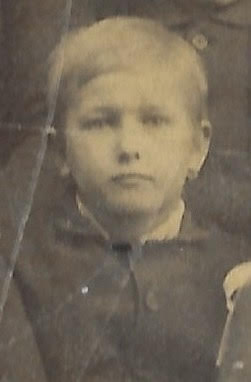
I first glimpsed this photograph behind clouded glass more than fifteen years ago. I was visiting the Garnavillo Historical Society in northeastern Iowa, a short distance from the Mississippi River, and I was thrilled to spy the face of my great-great-grandfather as a little boy in this cabinet card photograph of the Garnavillo School. However, due to its semi-permanent placement inside glass, it wasn’t until more recent efforts by the historical society to refresh their exhibits and digitize their collections that I was, happily, able to obtain a clear copy.

Garnavillo School, circa 1888, Clayton County, Iowa; digital image 2023, privately held by the Garnavillo Historical Society, 2023. Image shared with permission.

George Hiram Thoma, the son of Frederick Thoma and Matilda Hammond, was born in Garnavillo, Clayton County, Iowa on 29 September 1880. His parents were natives of Clayton County, and, right around the time that George would have started school, his father was known to have operated a restaurant in Garnavillo. Pictured here in the second row, fifth from right, fair-haired George, perhaps eight years old, regards the photographer with a still and serious expression, mimicking his teacher more so than some of his wiggly classmates. Thirty-six students were present for “Picture Day” at the Garnavillo School; this photograph, initially believed to have been taken circa 1886, was in fact more likely taken about two years later based on the birth dates of some of the youngest children pictured.

The teacher, Julia Downey, was said to have taught school in Clayton County for thirteen years prior to her 1893 marriage. Her students, with birth year in parentheses if available, are identified below:

Front row, left to right: Sophia Maack (1877), Ora Ahlitz (1879), Emma Harnack (1879), Severa Wirkler (1881), Harvey Maurer (1882), Norma Maurer (1884), Edna Brumm (1883), Adelia Kuhlman (1880).

Second row, left to right: Aerney Tangeman (1881), Alto (Realto) Schumacher (1881), Erwin Wirkler (1880), Billy Gilmore ( ), Will Schumacher (1880), George Thoma (1880), Gretchen Gilmore ( ), Waldemar Krasinsky (1880), Louise Rohde (1881), Elizabeth Siebertz ( ).

Third row, left to right: George Tangeman (1878), George Hill (1882), Paul Rantzow (1879), Miss Julia Downey, Orville Roebken (1879), Gruel ( ), Abner Roebken (1881), Fred Nieter (1880), Fred Stickfort (1879), Emil Schumacher (1879).

Back row, left to right: Irving Maurer (1879), Bruno Tangeman (1879), Ed Breitsprecher (1879), William Blunck (1877), Henry H. Stickfort (1878), Julius H. Rohde (1879), Gruel ( ), Elmer G. Brumm (1878), Arthur (Art) Gruetzmacher (1878).

Courtesy of the Garnavillo Historical Society

Garnavillo boasted a brick, two-story schoolhouse with four rooms; however, this photograph seems to have been taken instead at the studio of the photographer, Mr. Tangeman, as a hanging backdrop is evident. The students pictured here were between the ages of approximately four and eleven, and one can imagine that a field trip to the photographer’s studio would have made for an exciting school day for them.

George Hiram Thoma, detail from Garnavillo School, circa 1888, Clayton County, Iowa; digital image 2023, privately held by the Garnavillo Historical Society, 2023. Image used with permission.

Little is known about young George’s school days, although he was apparently a motivated student as would go on to complete high school. The high school that he attended was not in Garnavillo, however, but in the town of Postville in neighboring Allamakee County. As his grandparents resided there, it is possible that he boarded with them during his high school years. As a teenager, George worked for a time at a local hardware store, volunteered with the fire department, and then, according to family lore, made his way west with his bicycle and changed his name—but that’s another story!

Copyright © 2023 Melanie Frick. All Rights Reserved.

Continue reading
Matilda the Midwife

“Matilda was a midwife,” so goes the family story, “and delivered a lot of babies in the county.” Despite a lack of definitive documentation, and almost certain lack of opportunity for any formal training, this nevertheless seems plausible. Matilda J. (Hammond) Thoma (1859-1947) of Clayton County, Iowa birthed five children of her own, and it does not seem unlikely that she might have assisted at the births of others in her close-knit community. She had numerous nieces and nephews whose births she might have supported, and she may even have served as midwife at the births of some of her own grandchildren. Indeed, it was her granddaughter Ina Fischer, born in 1907, who recalled nearly eighty years later that Matilda had been a midwife, and a 1920 newspaper announcement indicated that another granddaughter, Jacqueline Chaney, was in fact born at Matilda’s home.

Matilda (Hammond) Thoma and Franque (Friend) Curtis photograph, circa 1922, Clayton County, Iowa; digital image 2023, privately held by Melanie Frick, 2023.

Here, in one of only two photographs known to exist of Matilda, she poses with granddaughter Franque Friend. Matilda would have been in her early sixties at the time that this photograph was taken circa 1922; her hair, loosely coiled into a bun atop her head, seems to have gone mostly white. She wears a somewhat rumpled striped dress with buttons up the front and a wide collar in a contrasting fabric; this was not a studio portrait, but a casual snapshot apparently taken at home. Matilda appears to sit on a sofa near a window, a potted plant beside her, and striped wallpaper is visible in the background. She offers a small smile to the camera. Young Franque, perhaps ten years old here, stands next to her grandmother, grinning beneath the broad brim of a straw hat with a fringe of dark hair just peeking out. She wears a white dress with scalloped cuffs, a bow at the collar, and a leather belt.

Matilda, the daughter of Hiram H. Hammond (1813-1896) and Eva Margaret Stoehr (1831-1906), spent more than sixty-five years in Clayton County, Iowa, where she was born and later married Frederick Thoma (1857-1925). Four of their five children lived to adulthood; the youngest sadly died in a diphtheria outbreak at the age of ten. Following her husband’s death, Matilda eventually relocated, first to Texas with her daughter Roselyn and then to Wisconsin where she lived with her granddaughter Jacqueline. Few other details are known of her life, but what little is known suggests that she was a kind, competent, and maternal individual—just the sort to lend a hand as a midwife.

Copyright © 2023 Melanie Frick. All Rights Reserved.

Continue reading

What the Well Dressed Secretary Wore

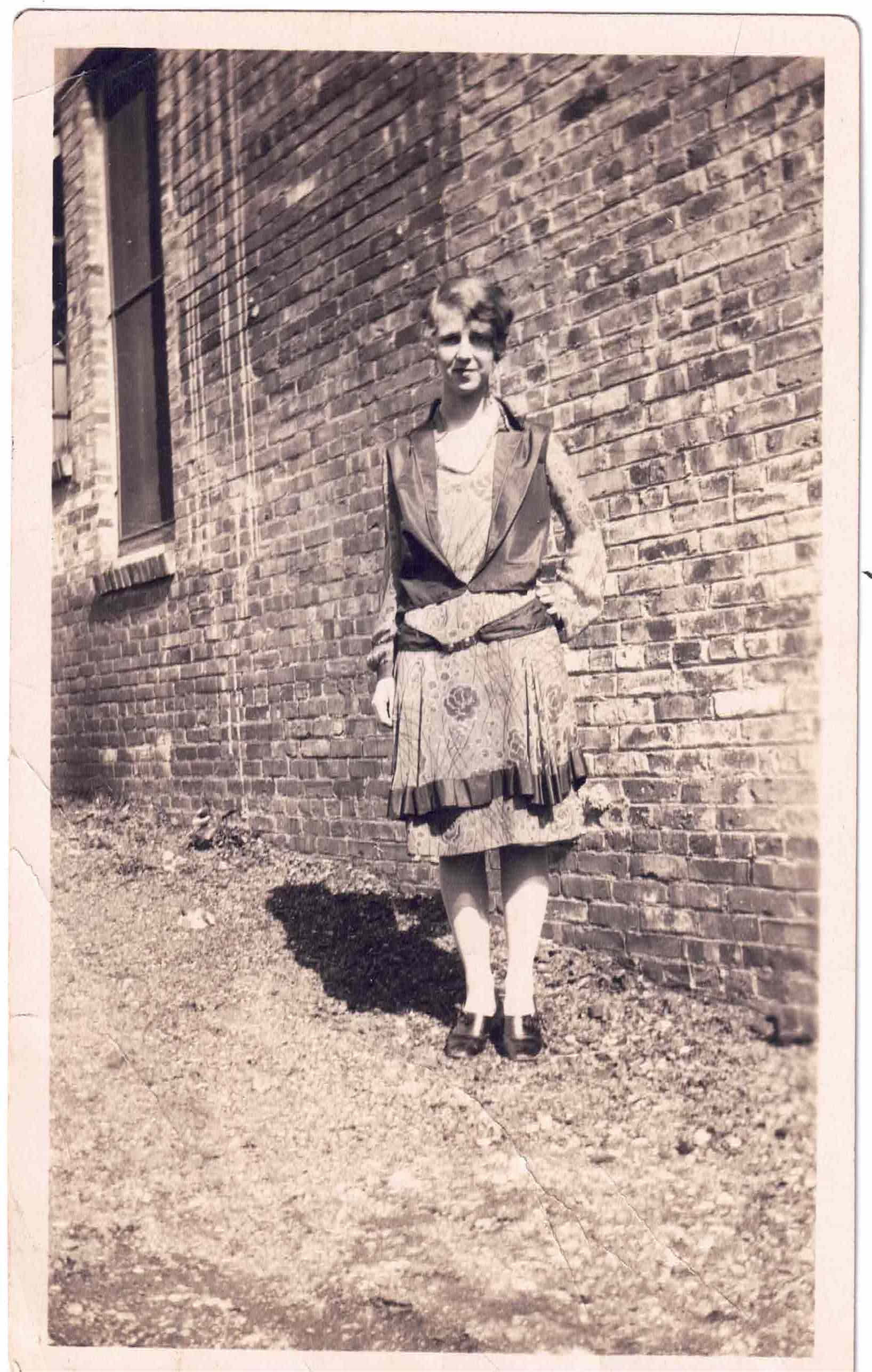
It was 1925 when Fern Thoma graduated from Central High School and entered the workforce in her hometown of Sioux City, Woodbury County, Iowa. Her first known job was as a clerk at S.S. Kresge, a five-and-dime store. Fern did not remain a clerk for long, however; when a likely more lucrative position as a switchboard operator presented itself, she took it. As she recalled years later, however, she immediately found the fast-paced work environment to be much too stressful, and was relieved when her mother told her that she didn’t have to keep the job!

A position as a bookkeeper at the Sioux City Cooperative Dairy Marketing Association, which collaborated with local farmers to market and distribute dairy products, was much more to her liking. Fern had received a certificate of proficiency in typewriting during her final year of high school; perhaps this helped to qualify her for a bookkeeper’s duties. She held this position from 1926 until the summer of 1929, when she married at the age of twenty-one and moved with her husband to Nebraska.

Fern Thoma, Sioux City, Iowa, 1927; digital image 2014, privately held by Melanie Frick, 2022. Collection courtesy of David Adam.

A photograph of Fern, dated 19 May 1927, is labeled in her handwriting, “Yours truly in front of Coop Dairy where I worked until I got married and we moved to Norfolk Nebr. What the well dressed secretary wore.” Fern can be seen wearing a loose-fitting, drop-waisted dress with a pleated, tiered skirt. The fabric is patterned with a rose print, and a collared open vest in a solid color is worn over her dress. Short, waved hair frames her face, and she wears heeled shoes. She stands before the brick exterior wall of a building, the bright midday sun casting her shadow behind her.

The “Coop Dairy,” as Fern called it, was located on Howard Street, near the Floyd River. Fern lived with her parents, and although they moved houses several times in the late 1920s, they remained within a half mile or so of Fern’s workplace. The well dressed secretary would have needed comfortable shoes for the ten-minute walk to and from the dairy!

Copyright © 2022 Melanie Frick. All Rights Reserved.

Continue reading
Old-Fashioned Fun in 1921

On 09 November 1921, a taffy pulling party was held in a small Nebraska town. The Decatur Herald reported, “A number of young folks were present and [a] real jovial evening was spent” at the home of Mr. and Mrs. George Thoma. Hosting this event, I suspect, was their eldest daughter, fourteen-year-old Fern Thoma, who was in ninth grade at the local school. Taffy pulls became popular in the nineteenth century and involved boiling up a sugary mixture that was then pulled, folded, and pulled again by teams of individuals with well-buttered hands, the end result being a quantity of candy to share and eat. As a social event, taffy pulls were particularly popular among mixed groups of young women and young men.

Fern, the daughter of a local merchant, was by all accounts a social girl; the newspaper shared several accounts of her activities as a young teenager before her family left Decatur in March 1922. During her eighth grade year, in February 1921, the Decatur Herald had noted, “Fern Thoma, Ina Lambert, Maxine Choyce, Elizabeth Akins, Gladys Gilson and Eleanor Darling gave a party at the home of Fern Thoma on Friday night. There were 28 boys and girls present, and the evening was spent in games.” Perhaps this party included Fern’s entire class; while only seventeen youth are pictured in her ninth grade class photograph, her eighth grade class may have been larger. As an eighth-grader, as shared in the Decatur Herald, Fern also participated in a Junior Audubon Society with the role of reporter.

Fern Thoma (1907-2006), front center, with ninth grade class, Decatur, Nebraska, October 1921; digital image 2010, privately held by Melanie Frick, 2021.

Outside of school, Fern, along with several of her aforementioned girlfriends, were piano students of local teacher Mrs. E. A. Sears. In April 1919, when Fern was in sixth grade, the Decatur Herald shared: “The younger pupils of Mrs. E. A. Sears will give a program at the home of Mrs. E. A. Hanson’s on Tuesday evening, April 22nd, at 8 o’clock, for the benefit of the organ fund of the Episcopal Church. Everyone cordially invited to attend, and bring a silver offering. Those taking part in the program, are the Misses Maxine Choyce, Rachael Hanson, Ina Lambert, Helen Farrens, Edith Skalovsky, Agnes Busse, Eleanor Darling, Fern Thoma, and Evelyn French; Masters Albert Bysse and Gerald Eagleton. Come and hear the ‘Bell Symphony’ and see the ‘Fairy Queen.'” Later that year, Fern was one of two girls who performed “beautiful solos” at a Decoration Day event.

As a ninth grader, Fern played the Valse-Arabesque by Theodore Lack at a musical program for the “older students” of Mrs. E. A. Sears, which, again, included a number of her girlfriends. It is not known if Fern continued with her musical instruction after her family left Decatur for another small Nebraska town; in any case, while she was not known to be musical as an adult, playing popular songs on the piano would have been a lively way for her to entertain friends as a teenager—when her hands were not covered in sticky taffy, of course!

Copyright © 2021 Melanie Frick. All Rights Reserved.

Continue reading

Tombstone Tuesday: Wilhelm Heinrich Thoma (1827-1876)

Wilhelm Heinrich Thoma was born on 16 December 1827 in the village of Weißenstadt, located in what is now Upper Franconia, Bavaria, Germany, the son of Paulus and Elisabeth (Schmidt) Thoma. At the age of twenty-four, Wilhelm, along with his parents and six siblings, immigrated to America. Traveling aboard the Uhland, the family left Bremen bound for New Orleans, where they arrived in June 1852.

New Orleans was not to be their final destination; the family traveled up the Mississippi River until reaching northeastern Iowa, where they soon settled in the village of Garnavillo in Clayton County. A biography within The History of Clayton County, Iowa notes, “Upon coming to the United States, William Thoma proved himself an ambitious young man whose courage and determination were shown in definite action.”

On 28 May 1857, when Wilhelm, also known as William, was twenty-nine years old, he married eighteen-year-old Anna Margaretha Poesch, a fellow immigrant who also hailed from Weißenstadt. The couple had eleven known children: Frederick (1857-1925), Anna Katharina (1859-1919), John Lorenz (1861-1886), Anna Rosina (1862-1934), Margaretha B. (1864-1902), John Wilhelm (1866-1890), John Paulus (1868-1911), Anna Paulina (1869-1950), Maria Magdelena (1872-1954), John Christopher (1874-1934), and John Charles Thoma (1875-1932).

Find A Grave, Inc., Find A Grave, digital image (www.findagrave.com : accessed 25 July 2020), photograph, Wilhelm H. Thoma (1827-1876), Memorial No. 146616631, Garnavillo Community Cemetery, Garnavillo, Clayton County, Iowa; photograph by Ken Johnson, 2016.

Wilhelm first entered the mercantile business while in his twenties, shortly after arriving in Iowa. In 1859, he established his own general store in Garnavillo, offering groceries and dry goods, which he operated until the time of his death. It was said at that time that “in his personal and business relations with the people he was the ‘soul of honor,’ a good, honest, straight forward man.”

Wilhelm was active in his community throughout his adulthood; his obituary noted, “In public matters Mr. Thoma has taken a lively interest, and exhibited a degree of earnest zeal in the advancement of his fellow countrymen, enjoying their confidence and support. He has held minor offices of trust, discharging the duties thereof satisfactory to the people.” One incident of note is that during the grasshopper plague of 1874, following an appeal from Kossuth County, Iowa, Wilhelm’s name was included among a list of individuals “designated to receive contributions for the grasshopper sufferers.” Furthermore, William was a member of the county Board of Supervisors at the time of his death, an office he was said to have held in “a most excellent and upright” manner.

Wilhelm Heinrich Thoma died in Garnavillo on 27 July 1876; he was forty-eight years old. Lengthy obituaries in multiple local newspapers did not share the cause of his death, but lauded his talents, one noting that he had “been counted among Clayton County’s best and most public spirited citizens,” and that “his own village loses a citizen whom it was equally a pleasure and honor to name as a friend.” Another commented upon his wealth and prominence, and called him “a man universally honored and beloved where known.” Wilhelm was buried at the Garnavillo City Cemetery in Garnavillo, Clayton County, Iowa.

Copyright © 2020 Melanie Frick. All Rights Reserved.

Continue reading

George and Leota

No wedding portrait of George Hiram Thoma and Anna Leota Fenton is known to exist. When they married on 23 March 1902, George was twenty-one years old while Leota had just celebrated her twenty-second birthday.1

And in fact, while photographs of their children abound, the earliest photograph yet uncovered of George and Leota together was taken twenty-six years later.

Leota (Fenton) Thoma and George Thoma, Sioux City, Iowa, 1928; digital image 2014, privately held by Melanie Frick, 2019. Collection courtesy of David Adam.

Another, a sharper yet more serious snapshot, was taken perhaps a decade or more after that.

Leota (Fenton) Thoma and George Thoma, 3500 Block of Nebraska Street, Sioux City, Iowa; digital image 2014, privately held by Melanie Frick, 2019. Collection courtesy of David Adam.

George and Leota had spent their first few years of marriage together not as Mr. and Mrs. Thoma, but as Mr. and Mrs. Neilson, before abruptly discarding this mysterious alias.

They had moved no less than half a dozen times within their first quarter-century together, first as newlyweds from Ashton, Iowa to Center, Nebraska, then to Sioux City, Iowa, then to Bassett, Nebraska, then to Decatur, Nebraska, then to Scribner, Nebraska, and finally back to Sioux City.

They had taken risks and faced failure as aspiring homesteaders and entrepreneurs.

But they had succeeded in raising four children together: Fenton, Fern, Norma, and Betty.

After years of effort to find a place to call home, they settled into a comfortable life together in Sioux City surrounded by their children and grandchildren.

They are remembered as “super grandparents” and as good, kind, fun-loving people who celebrated more than sixty years of marriage together.2

(Just not all of them were spent as Mr. and Mrs. Thoma.)

Copyright © 2019 Melanie Frick. All Rights Reserved. Continue reading

Spring at Grandview Park

Not long before they married on 08 June 1929, Gerald Adam and Fern Thoma posed for a series of snapshots at Grandview Park in Sioux City, Woodbury County, Iowa.1

Gerald, known as Jerry, was twenty years old to Fern’s twenty-one at the time these photographs were likely taken; the prints are stamped with the date 19 March 1929. On what was perhaps the first day warm enough to shed their jackets that year, they clowned around with friends Dorothy Thompson, Irene Tasker, and Clifford Thompson, and snapped a number of photographs documenting their time together. Curly-haired Dorothy and Clifford were siblings; Clifford and Irene would later marry.2

Fern wears heels and stockings, and her on-trend long sleeved, drop-waist dress hits just below the knee. Its geometric pattern is indistinct in the photographs, but it features a sailor-esque tie at the v-neck and two rows of ruffles at the hem.3 Her long wool jacket, worn in all but one of the photographs, has a warm fur collar; her two female friends also wear fur-trimmed jackets. Fern’s bob is neatly concealed by her stylishly adorned cloche hat.4 Jerry is smartly dressed as well, wearing a wool suit with a bow tie and a straw hat, his outfit nearly identical to that of his friend’s. His pants, cuffed at the hems, are so wide and loose that they appear to almost skim the grass; they look much like the ready-made “Oxford Bags” that became popular in the mid-1920s. 

Whether the couple was celebrating something in particular—an engagement?—or simply enjoying the spring weather on an afternoon walk with friends, it is interesting to note that several photographs were taken at a memorial for one Mabel Allison More, a Sioux City resident who had died in 1924.5 Given the lighthearted nature of the photographs, it can be assumed that the young people did not know More, but were rather attracted to the charming tiled wall merely as a backdrop and convenient place to climb. Grandview Park was presented to the city of Sioux City in 1908, and soon became a popular gathering place known especially for its trellised rose garden, the beginnings of which may be visible in the photograph of Fern, Dorothy, and Irene, and later for its bandshell.6

A little less than three months after these photographs were printed, Fern and Jerry would marry, with one of their friends pictured here, Dorothy, serving as an attendant.7 Although no photographs of their wedding day, nor their honeymoon in the Black Hills, are known to exist, these snapshots give a glimpse into the relationship of this happy young couple who leaned comfortably into one another and smiled joyfully for the camera.8

Copyright © 2018 Melanie Frick. All Rights Reserved.
Continue reading