Category Archives: Photograph Analysis

A Little French Boy

An American by birth, Henry Joseph Adam spoke French until he started school.1 He was born in Indian Orchard, Hampden County, Massachusetts, on 5 August 1881, the son of Timothy and Odile (Millette) Adam, both of French Canadian heritage.2 His father had been born in Quebec, while his mother had been born in upstate New York.3 Regardless of their nationality, their roots ran deep, and the French language likely remained more familiar to them than English.

Henry_Joseph_Adam_1886

Henry Joseph Adam, Sioux City, Woodbury County, Iowa, ca. 1886-87; digital image 2013, privately held by Melanie Frick, 2014.

Pictured here circa 1886-87, when he was about five years old, Henry is simply but neatly dressed. He wears breeches with high patterned stockings, and a white or light-colored shirt with a contrasting bow-tie. His boots, perhaps hand-me-downs from an older brother, have been polished till they shine. He may hold a cap in his left hand, although it is indistinct due to the quality of this tintype. Despite the fact that cabinet cards grew in popularity during this decade, tintypes were still certainly not unusual. The faintest blush of pink is visible on Henry’s cheeks from a painted accent.

The studio setup is interesting and not particularly professional. Henry stands upon a small stool, and leans against a piece of furniture covered with heavy fabric. The painted backdrop behind him depicts a scene of a house, fields, and a tree, which doesn’t tie in well with the wood floor in the foreground. I suspect that this photograph may have been taken in Sioux City, Woodbury County, Iowa; the Adam family moved here sometime in the mid-1880s, perhaps because of its proximity to the large French Canadian community in nearby Jefferson, Union County, South Dakota.4 Thus, this little French boy remained in good company; he may have learned English at school, but he would not have forgotten his French!

Continue reading

The Three Amigos

Fred_Nelson_Seven_Falls_01

Peter Jorgensen, Fred Nelson, and Chris Callesen, Seven Falls, South Cheyenne Canon, Colorado; digital image 2014, privately held by [personal information withheld], 2014.

This souvenir photograph features three mustachioed men in sombreros posing astride burros in front of a rugged western landscape. In 1911, Peter Jorgensen, Fred Nelson, and Chris Callesen of Yankton County, South Dakota, pictured here from left to right, ventured west to Seven Falls in the South Cheyenne Canon near Colorado Springs, El Paso County, Colorado. I can’t know for sure what brought them west; I do know that, decades earlier, brothers-in-law Fred and Chris had traveled at least as far as the Black Hills to sell eggs to the miners.1 It’s possible that this trip to Colorado, however, was purely an opportunity for sightseeing and adventure, rather than business.

Fred_Nelson_Seven_Falls_02The reverse side of the photograph, mounted on heavy card stock, provides printed detail about the South Cheyenne Canon, famed for its natural beauty and sites of historical interest. The Seven Falls Photo & Curio Co. was responsible for this photograph, which was “taken at the foot of the famous Seven Falls.” It was possible to order duplicates by referencing the number shown on the photograph. (The number on the mat came only recently.) Given the number 716, it seems that plenty of these souvenir photographs must exist; I spotted several on eBay and on The Henry Ford Online Collection.

Did the men ride to the Falls on the burros? As of 1911, there was, in fact, a Cheyenne Burro & Carriage Co. in operation,2 so if they weren’t part of the package when the men paid for their photograph, they may have opted to rent the burros independently to ease their exploration of the area – or just for fun. The same may go for their sombreros!

Continue reading

A Deadwood Mystery

After years of wondering about an unidentified photograph from Deadwood in my family’s collection, a second photograph of the same couple turned up in the collection of an extended family member. In my mind, while just one might have come from, say, a neighbor who had gone off to the Wild West and wished to be remembered to those back in southeastern South Dakota, where this branch of my family lived, two suggest that this couple may actually have had a closer connection to my family. Were they friends, or were they relatives?

Unidentified_Deadwood_Couple_01

Unidentified couple, Deadwood or Lead City, Dakota Territory, ca. 1884-1890; digital image 2013, privately held by [personal information withheld], 2014.

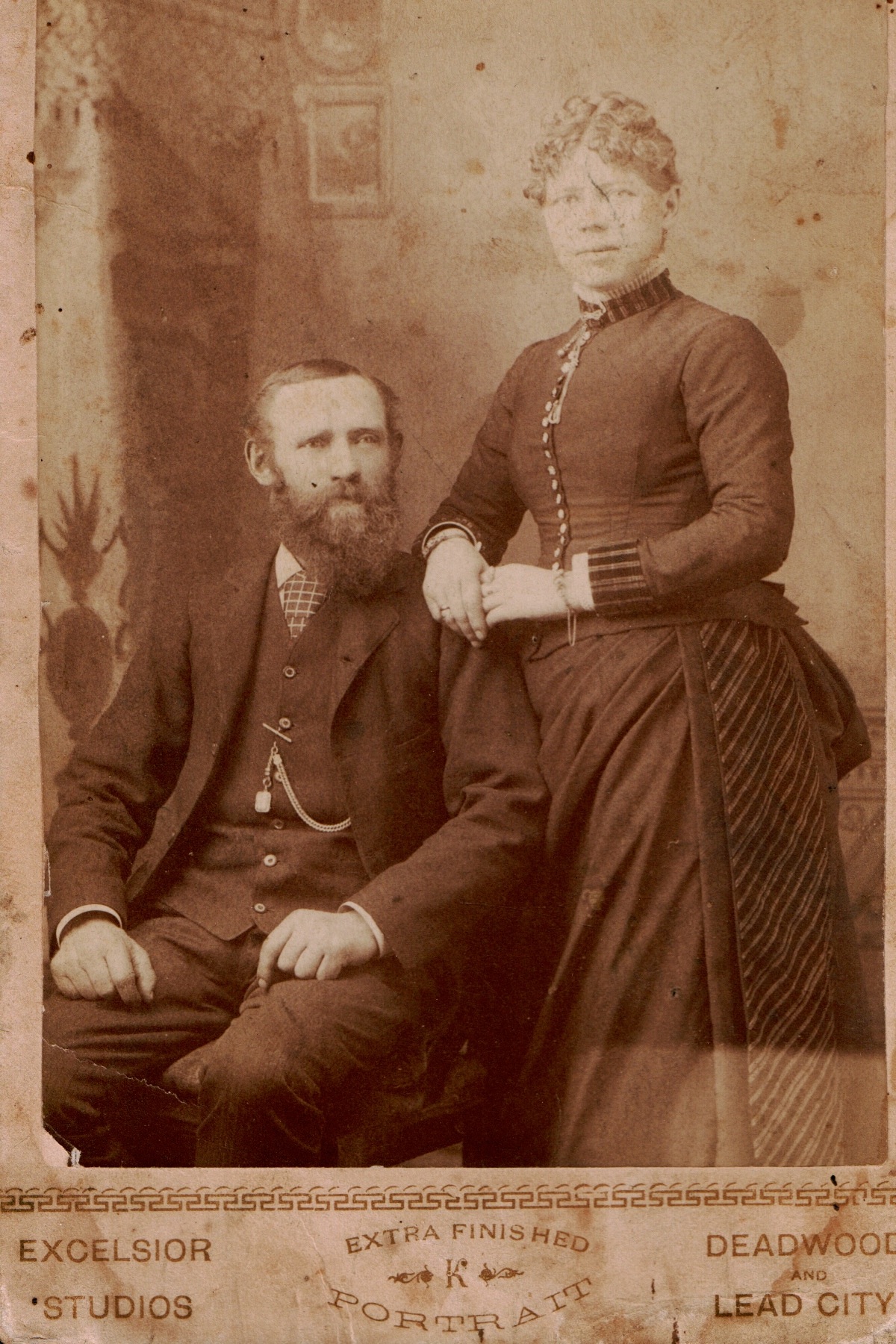
Unidentified_Deadwood_Couple_02In the first photograph, a couple poses for what could be a wedding portrait, as the woman arranges her hands in such a way that a ring is visible along with two bracelets. The man has a distinctive high forehead, large ears, and a long beard. He wears a dark three-piece suit and a plaid tie. The woman has a broad face and light-colored eyes; her hair is curled at the temples and arranged in a looped braid at the back, a style that became popular in the 1870s.1 She is corseted and wears what looks to be a heavy gown, with a high collar and bustle. A single row of buttons adorns her bodice, and matching patterned material is visible at her collar, cuffs, and on a unique side panel of her skirt.

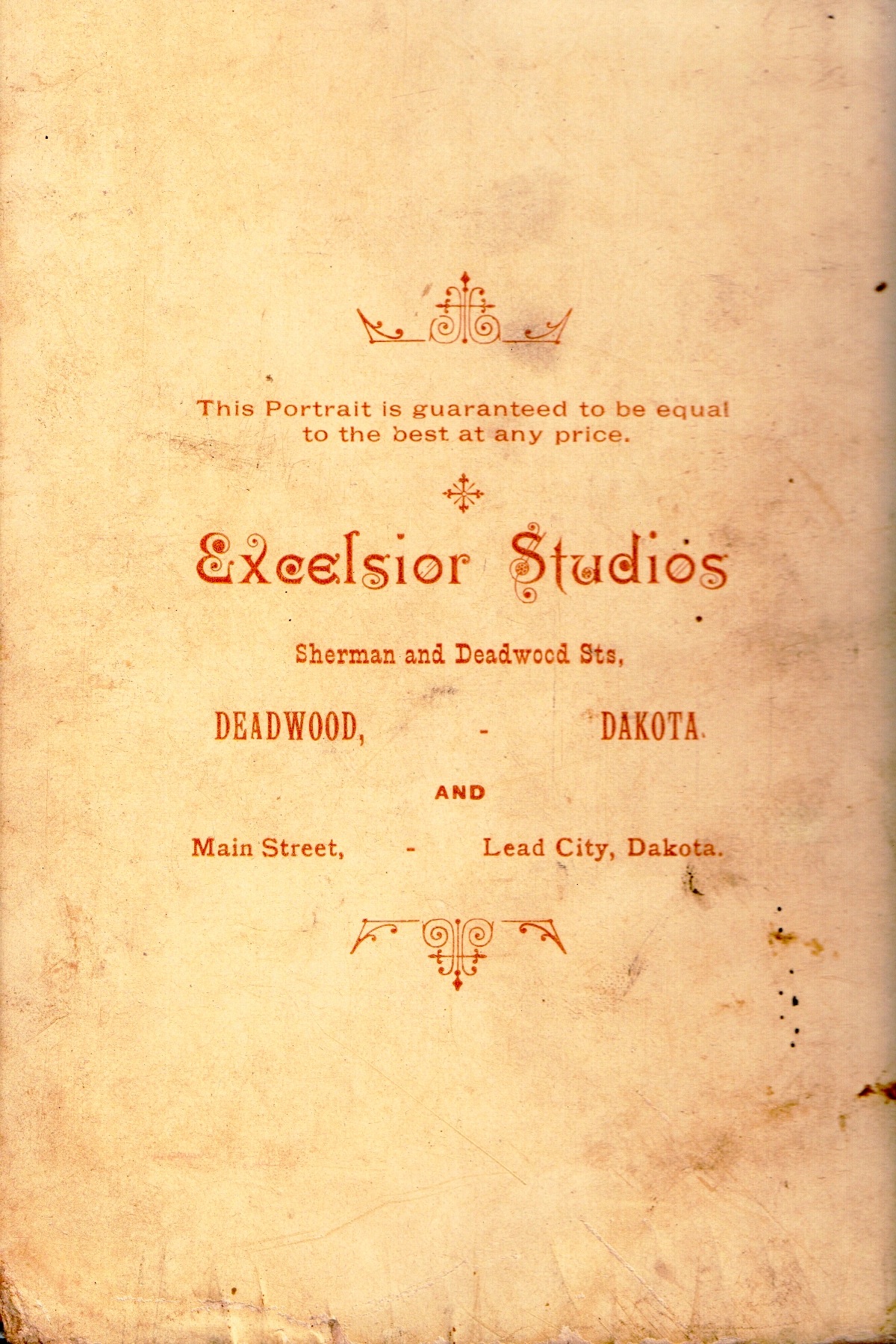
According to the information stamped on this cabinet card, it was made at Excelsior Studios, located either in Deadwood or Lead City, Dakota. Deadwood and Lead were founded in 1876 during the Black Hills Gold Rush, and the place name “Dakota” suggests that the portrait was made before (or immediately after) South Dakota achieved statehood in 1889. Thus, an initial time span for this photograph, as well as the one to follow, can be set at 1876-1890.

I’ve been unable to turn up anything about the Excelsior Studio online, although the small “K” emblem made me wonder whether any early photographers in Deadwood had the last initial “K.” As it turns out, a strikingly similar style of cabinet card can be attributed to Deadwood photographer Charles Kersting; perhaps he operated his business under the name Excelsior for a period of time. Online sources suggest that he may have arrived in Deadwood in 1884, at which time he joined forces with photographer George W. Scott.2
Unidentified_Deadwood_Family

Unidentified family, Deadwood, Dakota Territory, ca. 1883-1887; digital image 2010, privately held by Melanie Frick, 2014.

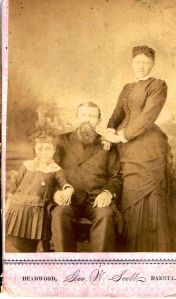
The second photograph seems to feature the same couple, although at a different time; the woman appears more slender and has styled her hair differently, and, of course, she and her husband both wear different clothes. This time, a young girl joins them in the photograph, most certainly their daughter. She looks to be about five or six years old; while standing next to her seated father, she places her hand over her his and leans back against his shoulder. Her dropped waist dress falls to her knees with a pleated skirt, belt, and a fancy collar. Her mother again wears a row of buttons on her bodice, and her draped overskirt over knife pleats was of a style popular in the mid-1880s.3 In many ways, her dress is similar in style to that of the previous photograph.

This cabinet card, printed with a pink pattern, bears the name of the photographer Geo. W. Scott. Biographical information suggests that Scott was in operation in Deadwood for four years, beginning in 1883.4 It was in 1884 that Charles Kersting allegedly took over a branch of his business.5

Initially, I wanted to date the photograph of the couple alone before that of the couple with their child; however, the dates of operation of the Deadwood photography studios suggest that the reverse may also have been true. Perhaps it was not a wedding portrait after all! In any case, for a child of five or six to have been photographed by Scott in Deadwood between the years of 1883 and 1887, a birth date of somewhere between 1877 and 1881 can be assumed. This provides an essential clue.

The next step is to learn whether any of my direct ancestors had kin who lived in or near Deadwood. If a couple had a daughter between roughly 1877 and 1881, who happened to be the only child in their household at some point between 1883 and 1887, then that would make them strong contenders for the individuals featured in these photographs. Whoever they may be, I imagine that they must have had interesting stories to tell about life in Deadwood’s first decade!

Continue reading

A Spectacle in Spectacles

A close look at this photograph reveals something rather unusual: all four women wear pince-nez spectacles.1 In addition, one appears to clutch a writing tablet of sorts, lending a studious air to the scene despite the blur of a moving animal at left. Although these four women have posed for a tintype, which might lead one to believe that it was taken before card photographs exploded in popularity, this image can in fact be dated to the late 1880s.

Unidentified_Spectacle_Tintype.jpg

Four unidentified women wearing spectacles, likely Mount Pleasant, Henry, Iowa, ca. 1885-1890; digital image 2012, privately held by Melanie Frick, 2014.

The bespectacled women are firmly corseted in high-collared dresses. The single and double rows of close-set buttons featured on their bodices were in vogue at this time, as were their high, ruffled collars.2 Pleats at the hems of their skirts can also be attributed to this time period.3

This tintype comes from an album that can be linked to the family of Jesse M. Smith of Mount Pleasant, Henry County, Iowa. The album page in which this tintype rests is labeled in pencil, with the names Exsie and Mollie at the top, and Franc and Laura at the bottom.4 It’s possible, given the date of this photograph and the perceived age of the young woman at lower right, that this Laura could be the daughter of Jesse M. Smith, Laura B. Smith, pictured here when she was, perhaps, eighteen or twenty years old.5

There are other possibilities. As Exsie is an unusual name, I decided to search on Ancestry.com for young women named Exsie who might have resided in Iowa in the 1880s. A stroke of luck revealed just one – Exsie B. Sayles, who was a resident of Mount Pleasant as of 1885.6 A local history page shared that Exsie was a member of the Mount Pleasant High School graduating class of 1886, along with, notably, Franc Pitcher, Laura S. Mitts, Mary Wright, and a handful of others. 7 Mollie can be a nickname for Mary, so could these be other contenders for the women in the photograph? Although Laura B. Smith was not named as a graduate, school records may provide additional clues.

One might assume that these women had the specific goal of appearing scholarly for all to agree to be photographed in their spectacles. It seems likely that they were friends or classmates; perhaps they were celebrating an educational achievement, such as their high school graduation, or were acknowledging their involvement in an intellectual club of some kind, such as a literary society. No matter the occasion, this tintype offers a suggestion of the women’s personalities and interests, as well as a fun look at stylish vintage eyewear.

Continue reading

A Vintage Photo Strip

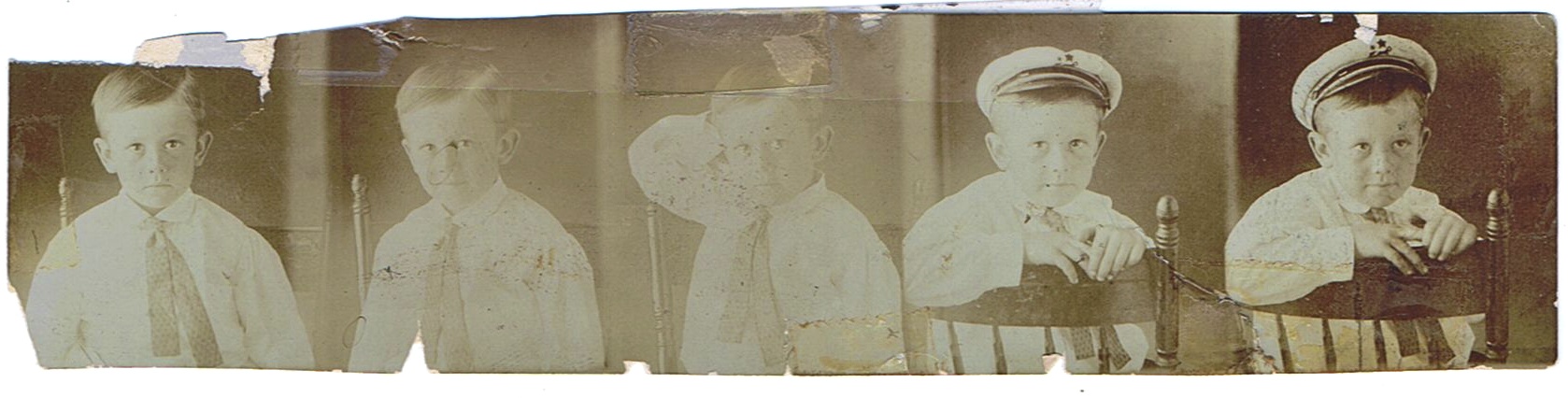
Long before photo booths gained popularity, Leonard Wiese of Chicago, Cook County, Illinois posed for this quaint series of photographs. Printed on a strip of flimsy paper, each individual photograph is about the size of a postage stamp. Leonard, the son of German immigrants Fred and Emma (Stübe) Wiese, was the youngest of five children,1 although an elder sister had died before he was born.2 He likely spent his early years at 46 Thomas Street,3 before his family moved to a new home, a large frame house, at 2502 North Neva Avenue.4 His father earned a living as a cigar maker, and must have done well in order to be able afford this home for his family.5

Leonard_Wiese_Photo_Strip_1905

Leonard Wiese, ca. 1905, Chicago, Cook, Illinois; digital image 2010, privately held by Melanie Frick, 2014.

Leonard looks to be about five years old in these photographs, dating them to approximately 1905. His hair is parted sleekly to the side, and he wears a white collared shirt with a patterned necktie. In the first three photographs, he poses formally while sitting upright in a chair. He has the hint of a smile in one, and artfully places his hand behind his head in another. In the final two photographs, he sports a pint-sized sailor cap while leaning playfully over the back of a wooden chair. His neat hair and dress suggest that these photographs were planned, yet the poses and setting seem more informal than what I would typically expect from a studio.

My first inclination, given the photo strip format, was to think that these photographs came from some sort of early predecessor to a photo booth, as automated photo booths didn’t spring up until 1926. Could there have been some sort of inexpensive arcade studio popular twenty years before? I also wondered if they might have been taken with an early model of a Kodak Brownie camera; another possibility is that they were proofs from which larger prints could be ordered. What do you think? This photo strip could easily have been cut apart and the individual photographs shared with friends or relatives. However, left intact, it allows a glimpse into several moments in Leonard’s boyhood in Chicago more than a century ago.

Continue reading

A Keepsake from Denmark

KathrineChristensen01

Kathrine Christensen, ca. 1905, Thisted, Refs, Denmark; digital image 2013, privately held by Nicole Kilanowski, 2014.

This is a beautiful cabinet card portrait by L. H. Gram of Thisted, Refs, Denmark, whose stamp features a quaint floral pattern. Kathrine Christensen of Vestervig, Thisted, Refs, Denmark, pictured here circa 1905, wears a dress with a high “officer’s” collar, set off by a simple looped chain necklace.1 A fine decorative fabric with crocheted lace trim is draped over her shoulders, something  like a shawl or an open collar. Her seemingly abundant hair is piled elegantly in the style of the time, with a few soft curls at her forehead.

Kathrine gazes just beyond the camera, her expression serious. In the summer of 1906, she would leave Denmark behind – saying farewell forever to her father and three of her siblings – to join five other siblings and their families in Iowa.2 This photograph was previously in the possession of her young niece, who immigrated to America with her parents a year before Kathrine.3 Perhaps Kathrine sent it along as a keepsake to be shared with her older siblings in advance of her own arrival; at least one of her sisters had not seen her since she was a toddler.4 It’s possible that additional copies remained in Denmark with her family and friends.

I have only a few photographs of Kathrine, my mother’s grandmother, and never would have seen this one in particular if it weren’t for my Public Member Tree on Ancestry.com. Several months ago, I heard from a member of the family of Kathrine’s aforementioned niece – a niece I hadn’t known existed until I found her in the records and added her to my tree a few days previously – who had come into possession of a collection of her family photos.5 This treasure was among them.

Continue reading

Fashionable Winter Wear

SwedishAlbumSiouxCityCouple1889

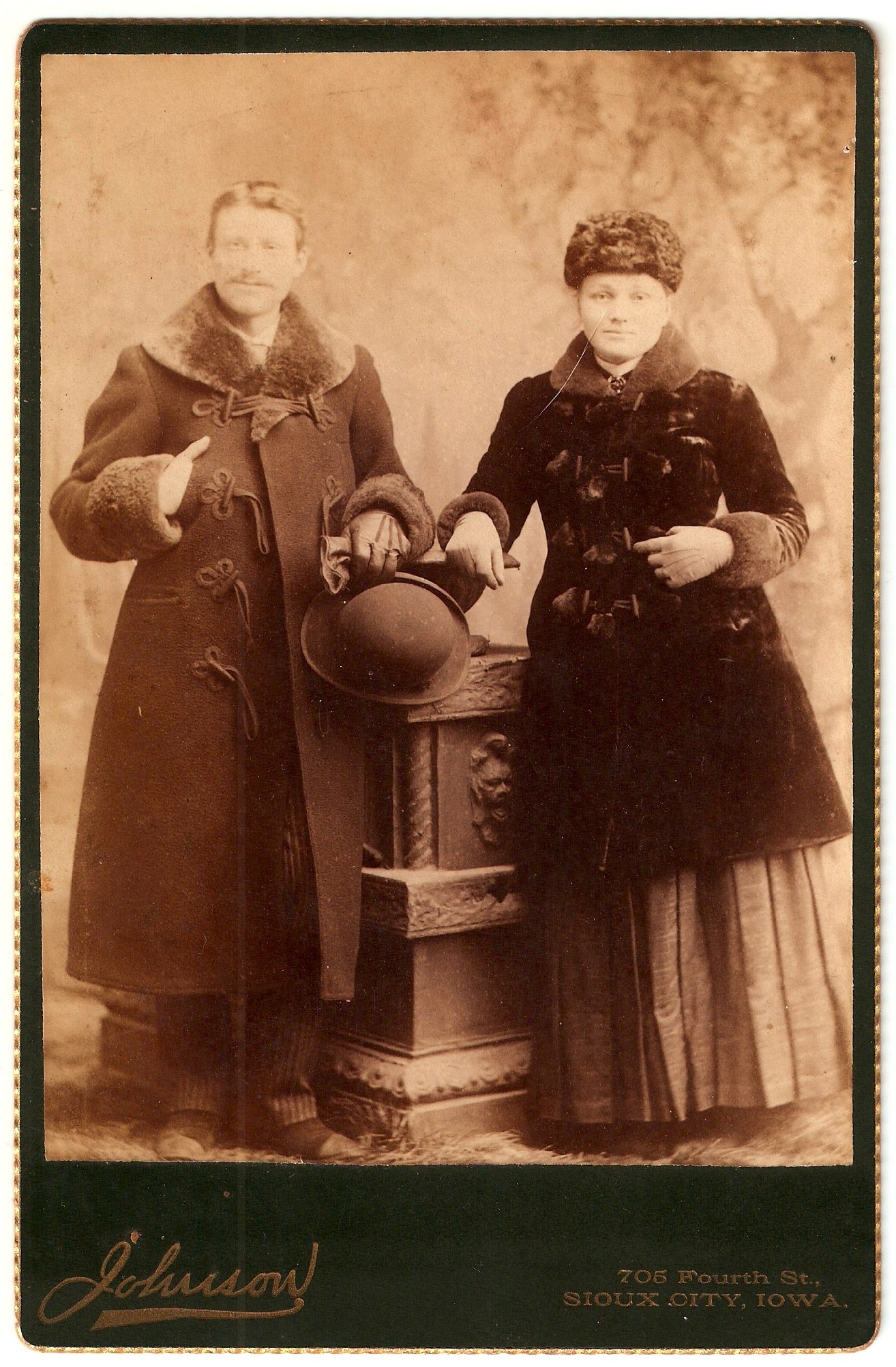
Unidentified couple in winter attire, Sioux City, Woodbury County, Iowa, ca. 1889; digital image 2014, privately held by Melanie Frick, 2014.

This Valentine’s Day, perhaps you’re looking forward to a special outing with a loved one. You might dress up, or you might bundle up, depending on the temperature outside. In any case, you likely won’t be decked out in fashionable furs like this couple, who dressed for the winter weather in Sioux City, Woodbury County, Iowa circa 1889. This cabinet card photograph comes from an unidentified antique album featuring a family of Swedish immigrants.1 The photographer – J. E. Johnson of 705 Fourth Street in Sioux City – operated his studio from at least 1887-1891.2

A newspaper column in a nearby community in South Dakota reported in 1888, “It is a lively competition between the comparatively old-fashioned sealskin cloaks and the newer, more picturesque wraps that reach to the ground.”3 The unidentified woman pictured here wears a toggle-fastened coat with a fur collar and cuffs, and she sports a striking fur cap that immediately made me think of one worn by Laura Ingalls Wilder in a photograph taken in the latter half of the 1880s. Her outfit is completed by a pair of fitted gloves, and a pleated skirt extends below the hemline of her coat.

The unidentified man wears a toggle-fastened overcoat of heavy cloth that reaches below the knee, also trimmed with a fur collar and cuffs. He tucks a bare hand into a pocket; the other grasps the spare glove and his bowler hat. Visible beneath his coat are distinctive striped pants. While flipping through Joan Severa’s Dressed for the Photographer, an excellent reference for dating nineteenth century photographs, I spotted an example of another young man wearing striped pants in a photograph dated 1889. In fact, he leaned against what appeared to be the very same pedestal. As it turned out, it was. The photograph of a young man in striped pants featured in Dressed for the Photographer was also taken at the Johnson studio in Sioux City.4 Apparently, striped pants were at their peak in popularity at this time!

The couple pictured here seem relatively young, and perhaps were recently married. If they, like others in this album, were Swedish immigrants, they may have shared copies of this photograph with family members who remained in the old country. Even if they weren’t dressed for a date in the modern sense of the term, they certainly look prepared to take a romantic stroll downtown!

Continue reading

A Chicago Couple

FredWieseEmmaStube

Fred and Emma (Stube) Wiese, ca. 1900; digital image 2010, privately held by Melanie Frick, 2014.

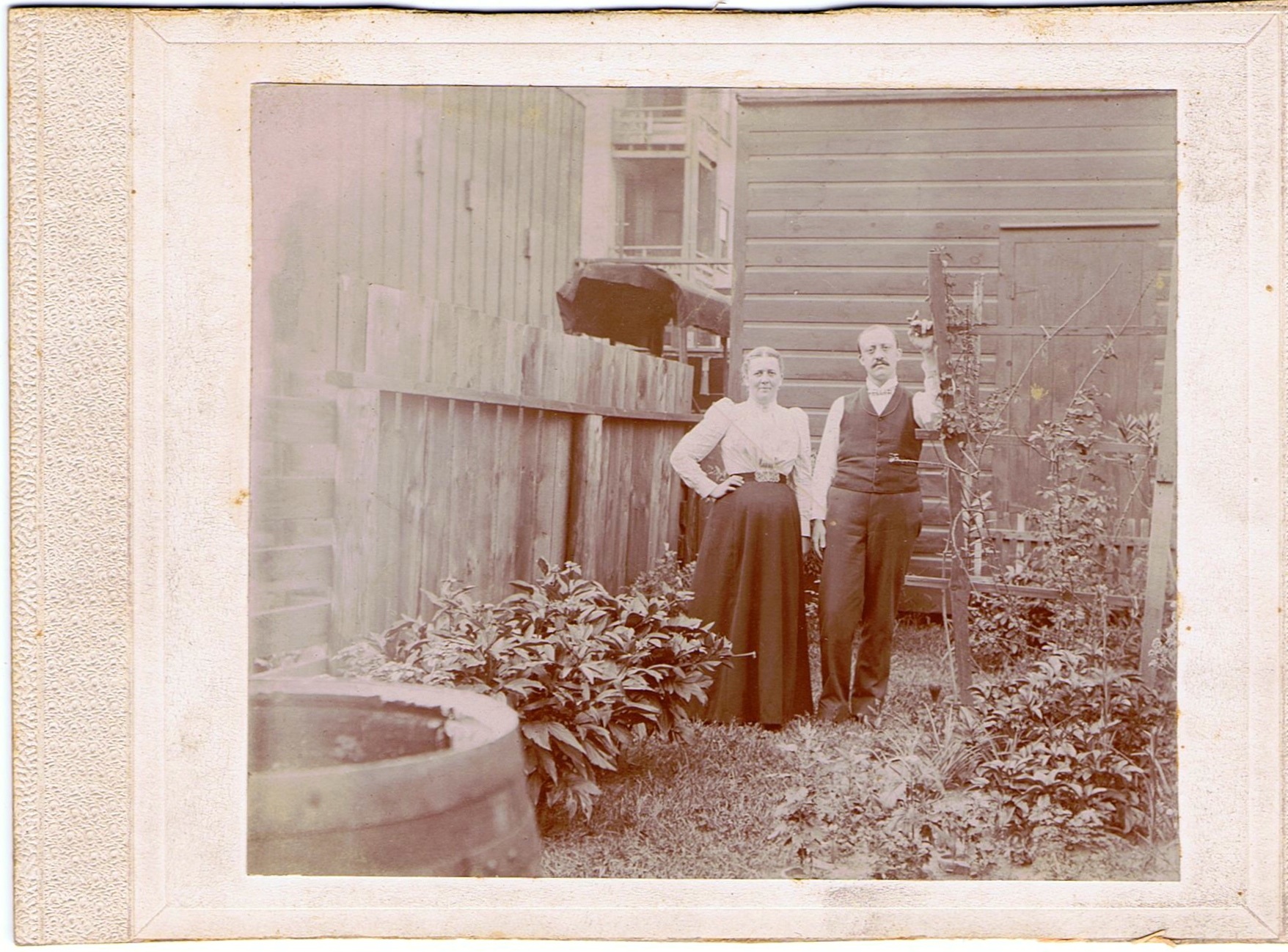
This glimpse into a backyard garden at the turn of the twentieth century features Fred and Emma (Stube) Wiese of Chicago, Cook County, Illinois. Fred rests his hand on a trellis while Emma stands close by his side, her hand on her hip. Their arms barely brush together as they gaze directly at the camera.

Emma wears everyday attire in the form of a simple dark skirt and a collared shirtwaist. Her skirt is belted high, with an adornment of some kind at the center of the waistband. It looks to me like she could have been pregnant at the time that this photograph was taken, which seems entirely possible as she was pregnant no less than five times between 1887 and 1900.1

However, Emma’s sleeves are not nearly as full as those seen during much of the 1890s, nor are they as tight as those of the decade prior. Perhaps this suggests that the photograph dates closer to 1900,2 which is when her youngest child was born.3 She and her husband were both in their early thirties at this time, and I don’t feel that they could have been significantly younger in this photograph.4

Fred wears somewhat loose trousers and a collared shirt, set off by a buttoned vest and a checked bow tie. Most notably, he sports a full mustache, and what hair he has is cut short. With the exception of his pants, which typically would be more fitted, this, too, fits the time period.5

The photograph, pasted on an embossed white card, is clear and of good quality, despite the fact that it is a seemingly casual shot. Might it have been taken by a traveling photographer who passed through the neighborhood, offering his services? Fred and Emma are not dressed in their best, although their simple attire was certainly presentable enough for a photograph. Perhaps their urban garden was a source of pride, making it an ideal spot for the couple to pose together.

Continue reading

A Witness to the Ruff Disaster of 1918

RuffFireSiouxCity1918

Ruff Building Collapse and Fire, Sioux City, Iowa, 1918; digital image 2010, privately held by Melanie Frick, 2014.

This photograph of the Ruff Disaster of 1918 in Sioux City, Woodbury County, Iowa comes from my family’s collection. Saturday, 29 June 1918 was a typical afternoon in downtown Sioux City; although the Oscar Ruff Drug Company at Fourth and Douglas was being remodeled, everyone continued to go about their business there and at the adjoining shops, including the Chain Grocery. Then, abruptly, at 1:30 pm, the building collapsed. It was later determined that the building was much too deteriorated to have been subjected to these renovations, which involved lowering the first floor to ground level. It was only a matter of minutes before a fire broke out, and rescue workers struggled to attend to those trapped in the rubble. In the end, thirty-nine people perished.1

Although from this photograph it appears that the fire had gone on for some time – the first images show bystanders kept at bay while the firemen hose the building – the chaos is still evident.2 Debris litters the ground, crowds mill about, and someone even moved out of the frame of the photograph so quickly that only his leg appears. What looks like a firetruck can be seen in the rear, in front of the clouds of smoke.

I don’t know how my family came to have a copy of this photograph, but it looks as though it could have been a print of one that might have originally appeared in a newspaper. Circled at right is a person identified as my second great grandfather, Henry Adam. However, I’m not convinced that this was actually Henry, and not his son. As of September 1918, I know that Henry was employed as a carpenter in the Norfolk Navy Yard of Portsmouth, Virginia; as a result, he may or may not have been home in Sioux City in June of that year.3

Although Henry was of short stature, the person circled also appears quite young. He wears a casual newsboy cap as opposed to the hats donned by the men around him. I’m inclined to believe that he may actually be Gerald “Jerry” Adam of Sioux City, Woodbury County, Iowa, who would have been ten years old at the time.4 Jerry lived just half a mile from the scene of the Ruff Disaster, so it certainly seems plausible that he may have wandered down to the scene to catch a glimpse of the disaster firsthand.5

Did any of your ancestors fall victim to or witness a disaster? If family lore and local histories don’t provide you with enough information, check out historic newspapers or GenDisasters, a website that shares information about the floods, fires, tornadoes, and other unfortunate events that may have impacted your ancestors’ lives.

Continue reading

The Twenties by Day

LeotaAlphaBellFenton

Leota (Fenton) Thoma, Alpha (Fenton) Gibson, and Belle (Fenton) Hoffman, ca. 1920s; digital image 2013, privately held by Melanie Frick, 2014.

As seen in this photograph, the trends of the Roaring Twenties were not just for flappers – although daytime fashions were significantly less flashy than what one tends to associate with the era. Here, sisters Leota, Alpha, and Belle, from left to right, pose together sporting bobs and simple patterned dresses. Although the sisters were likely in their late forties or early fifties when this photograph was taken, they clearly made an effort to keep up with the times.

Alpha Doretta, Minnie Belle, and Anna Leota Fenton were born in Saline County, Kansas, the daughters of George W. and Sarah Ellen (Hall) Fenton.1 After their father’s death, their mother remarried, and eventually, the family relocated to northwestern Iowa.2 At the time that this photograph was taken, Alpha, the wife of Clare Gibson, lived in Colorado,3 whereas Belle, the wife of Joseph Hoffman, and Leota, the wife of George Thoma, lived in different counties in Iowa.4 It was likely a rare occasion that the sisters were able to be together.

Leota, Alpha, and Belle wear popular styles of what would have been considered day dresses or house dresses in this decade, as seen on Vintage Dancer: 1920s Day / House Dresses and Aprons. Likely made of cotton, their dresses feature lively prints and straight, comfortable cuts. Both Belle, right, and Alpha, center, wear dresses made of fabric printed with spirals or swirls. Both have sleeves cuffed above the elbow, and have belted, dropped waists. Leota wears a standard long apron with patch pockets over her dress, but it can be seen that her floral-patterned dress hits, appropriately, just below the knee. Her dress has contrasting fabric sewn at the hem and the cuffs, and she clutches a striped cloche hat in her hand.

This look was quite a change from the romantic, Gibson Girl-esque styles of just a quarter century before, as seen in an earlier photograph of Leota. However, it looks like these ladies might have had quite a bit of fun with their makeovers during this decade, before more conservative styles returned with the Great Depression.

Continue reading