Tag Archives: 1880s

A Sad Accident: The Death of George W. Fenton, Revisited

Sometimes, there’s more to the story.

Eleven years ago, when I first wrote about the accidental death of Kansas pioneer George W. Fenton, the number of historic newspapers that were readily available to search online was still relatively slim. I was aware that George’s death had made the news—but at that time, I was not yet aware that several differing accounts of the incident had circulated, nor that the news had spread throughout Kansas and beyond.

George W. Fenton—a son of English immigrants who was orphaned at the age of ten when his father perished in the Civil War—had overcome his difficult childhood in Ohio and Illinois and settled down to a farmer’s life near Gypsum Creek in Saline County, Kansas. He had been married for seven years and was the father of three young daughters when, at the age of twenty-eight, he was accidentally shot and killed by his brother-in-law.

As it turned out, George had had another brush with misfortune with a firearm only days before his death. On 02 October 1880, the Salina Herald reported: “Mr. George Fenton had his eyes badly burned by the premature discharge of a gun last week. He is now able to see out of one of them, and hopes they are not seriously injured.”

Perhaps George was still taking things easy on the afternoon of Sunday, 10 October 1880, when he and his family visited at the homestead of his mother-in-law, Nancy (Stilley) Hall. However, that is when tragedy struck. The following Thursday, the Saline County Journal reported:

A Sad Accident. A very painful accident happened last Saturday which resulted in the death of George Fenton, of Gypsum creek. Mr. Fenton with his family was upon a visit to his mother-in-law, who resides about eighteen miles south-east of town, and with whom was residing “Bud” Hall, her son and brother-in-law of Mr. Fenton. During the afternoon while those two persons were engaged in some boyish pranks, Hall playfully presented a shot gun at Fenton (which Hall supposed was unloaded), cocked it and snapped the hammer. A charge of shot was lodged in Fenton’s breast, which proved his death wound. He lived for only an hour after the shot. He leaves a wife and three children. How the charge came in the gun is a mystery, as everybody about the house supposed the gun to be unloaded. Hall is nearly distracted over the result of his carelessness. The brothers-in-law were the best of friends—no trouble ever having occurred between them. The occurrence was so clearly a case of accidental shooting that no coroner’s jury was summoned. Mr. Frank Wilkeson came to town for surgical aid and Dr. Switzer hastened quickly to the scene of the accident, but arrived after Fenton’s death. The moral to be drawn from the careless habit of handling “unloaded guns” is too plain to be commented upon here. Will people never learn better?

The Saline County Journal, 14 October 1880

On the same day that the news was first reported in The Saline County Journal, the McPherson Republican printed the following:

Again we are called upon to listen to the sad results of carelessness with fire-arms. On Sunday, October 10, in the south-eastern part of Saline county, Mr. George Fenton  was accidentally shot by his brother-in-law, Bud Hall. They were both playing with the children, little dreaming of the great calamity that was about to befall one of them. Mr. Hall wishing his gun, reached through the door, and not looking at what he was taking in his hand, took hold of a gun that belonged to a person who was visiting him. Thinking it was his own gun and knowing that it was not loaded, he drew it towards him more carelessly than he would have done had he known it was not his own gun. The hammer of the gun struck against the door side and discharged it; the shot striking Mr. Fenton in the left breast and ranging upward lodged under the shoulder blade. Mr. Andrew Sloop, who had passed a moment before, was called back, and sent post haste to Roxbury for a physician. Doctor Zawadsky hastened at the call, but it was of no avail. The results were fatal, he having expired about one and a half hours after the accident, and before the Doctor arrived. Mr. Fenton leaves a wife and three children to mourn his sad loss. Mr. Hall is almost crazed, and does nothing but rave and call with endearing entreaties to the departed one. All the neighbors sympathize with the distressed family, as they show by their willing assistance. – E. October 11, 1880

McPherson Republican, 14 October 1880

Perhaps Bud had not, in fact, been so cavalier as to actually point a gun at George. The McPherson Republican account eliminates some of the blame he might otherwise have assumed by explaining that the gun—which belonged not to Bud but to an unnamed visitor—discharged accidentally when Bud reached for it behind a door. The account also informs us that medical assistance was sought not only by Frank Wilkeson, who went for Dr. Switzer of Salina, but also by Andrew Sloop, who fetched Dr. Zawadsky of Roxbury. However, both physicians arrived after George’s death, which was said to have occurred either one or one and a half hours after he was shot.

The following day, The Canton Monitor printed the following version of the events:

“We are informed by Mr. Banks, of Roxbury, that an accident occurred about five miles north of that place, by which Mr. George Fenton lost his life. The way it happened was this: Mr. Hall, a brother-in-law of Mr. Fenton, went to see him, Fenton, last Sunday. Mr. Hall was sitting in the door watching the children playing with the dogs, when he told one of them, jokingly, that he would shoot his dog, and at the same time reaching behind the door to get a shotgun, where two were standing. As he was taking one, the hammer of the gun caught some way, causing it to go off, the charge striking Mr. Fenton in the breast, killing him almost instantly. The shooting was entirely accidental, as they were the best of friends. Mr. Hall has went crazy from the accident, thus leaving two families as good as fatherless.

The Canton Monitor, 15 October 1880

This account contradicts the first in that it suggests that Bud was visiting George, when in fact The Saline County Journal was most likely correct that George was at the home of his mother-in-law, which is where Bud also resided with his family. (Frank Wilkeson, who went for the doctor, was a neighbor of the Halls.) This account also states that George died almost instantly, which is unlikely as otherwise there would have been no call to send for a doctor. However, The Canton Monitor does give a very specific and perhaps more believable account of what initiated the chain of events that resulted in George’s death. Like in the McPherson Republican, it is indicated that George and Bud were playing with the children at the time of the accident, but The Canton Monitor goes on to say that Bud was joking with the children that he would shoot his dog. (At a time when “mad dogs” were a more commonplace concern and livestock needed to be protected, this joke may have come across as slightly less alarming than it would to a modern audience!) Furthermore, the account agrees with the McPherson Republican that there was more than one gun standing behind the door, and that the hammer of the gun was caught in a way that caused it to unintentionally fire in George’s direction.

The next day, the Salina Herald printed another account of the events of October 10, more closely following the version published in the McPherson Republican and The Canton Monitor:

Sad Accident. Another sad result from the careless handling of guns occurred on Gypsum last Sunday. It appears that Geo. Fenton, living on the west branch of Gypsum creek went over to visit his mother-in-law, Mrs. Nancy Hall, who lived a short distance from him. While there himself and brother-in-law Bud. Hall were talking of hunting. Their gun was standing behind the door. Bud. Hall reached for it to shoot a dog, when the hammer caught in some way, and discharged the load in Fenton’s breast just above the heart. Mr. Wilkinson being near was informed and immediately came in for a physician, but whose service were too late, as Fenton lived only about an hour. The shooting was purely accidental, the thing to be condemned being the careless handling of firearms. Death often appears to be no warning, and almost daily is recorded sad accidents like this. Geo. Fenton was 27 years old and leaves a wife and three children to mourn his loss. He was buried Monday in McQuary’s graveyard on Gypsum Creek.

Salina Herald, 16 October 1880

The same edition of the Salina Herald also noted the following:

Mr. George Fenton, who was killed on Sunday last by the accidental discharge of a gun, was buried on Tuesday. There was a large attendance at the funeral and much sympathy expressed for the widow and her three children so suddenly bereaved of a husband and father. This adds one more instance of the criminal folly of playing with fire arms under any circumstance. Guns and [sic] playthings, but very serious matter of fact implements that carry death and destruction in their path whether accidentally or intentionally used.

Salina Herald, 16 October 1880

News of George’s death reached the Topeka papers before the end of October, and in November, it was reported in Wichita as well as in the Daily Illinois State Register in Springfield, Illinois: “George Fenton, a former resident of Buckeye Prairie, late of Saline county, Kansas, was accidentally shot and killed last week through the criminal carelessness of a a brother-in-law, who snapped a gun at him, not knowing that it was loaded.”

Elithan Davis “Bud” Hall with grandson Armond Beetch, Enid, Oklahoma Territory, circa 1905; digital image 2019, privately held by Iva Foster, 2024.

Elithan Davis “Bud” Hall did apparently recover from the grief and guilt he experienced at the loss of his brother-in-law and close friend. He went on to raise a family a family of four children and lived out his life on the Hall Homestead in Gypsum. A photograph of him as an older man with a grandchild by his side shows him with a kindly expression, and the laughter lines around his eyes make it easy to imagine him as a good-natured, fun-loving young man whose attempt at a joke went awry.

However, George’s young widow, Sarah, may never have fully recovered from the trauma of the loss of the young man she had married at the age of sixteen. Just twenty-three when she was widowed, she would remarry not once but three more times, with each marriage ending in divorce.

It is interesting that no account makes clear whose gun it was that was left loaded. A final report of the inquest held stated the following:

On Oct. 10, 1880, justice of the peace E.W. Mering was summoned to the home of E.D. Hall “near Frank Welkeson’s farm” to ascertain the circumstances stances of a man’s death. In the event that the county coroner could not attend an investigation (which turned out to be the case), Mering named six citizens to serve as jury: John C. Fahring, John M. Crumrine, Simeon Ellis, Jerome Swisher, D.C. Williams and M.M. Root.

The next day when the inquest was held at the Hall place, Mehring subpoenaed the following witnesses:  W. C. Jackson, Alonzo Gosso, Mrs. William Stahl, Mrs. E.D. Hall, Elisha Davidson and James Gaultney. All appeared to testify except Elisha Davidson, who was sick.

Witnesses revealed that George Fenton was shot in the chest by a double barreled shotgun at two in the afternoon of the previous day. The gun had been in the hands of E.D. Hall, Fenton’s brother-in-law. The shooting was ruled accidental.

Whether the double barreled shotgun in question belonged to Bud, George, or one of the witnesses—other neighbors and close kin—who were present at the Hall home that October afternoon is ultimately unknown, but as the gun was in Bud’s hands, he bore full responsibility for the accident.

Copyright © 2024 Melanie Frick. All Rights Reserved.

Continue reading
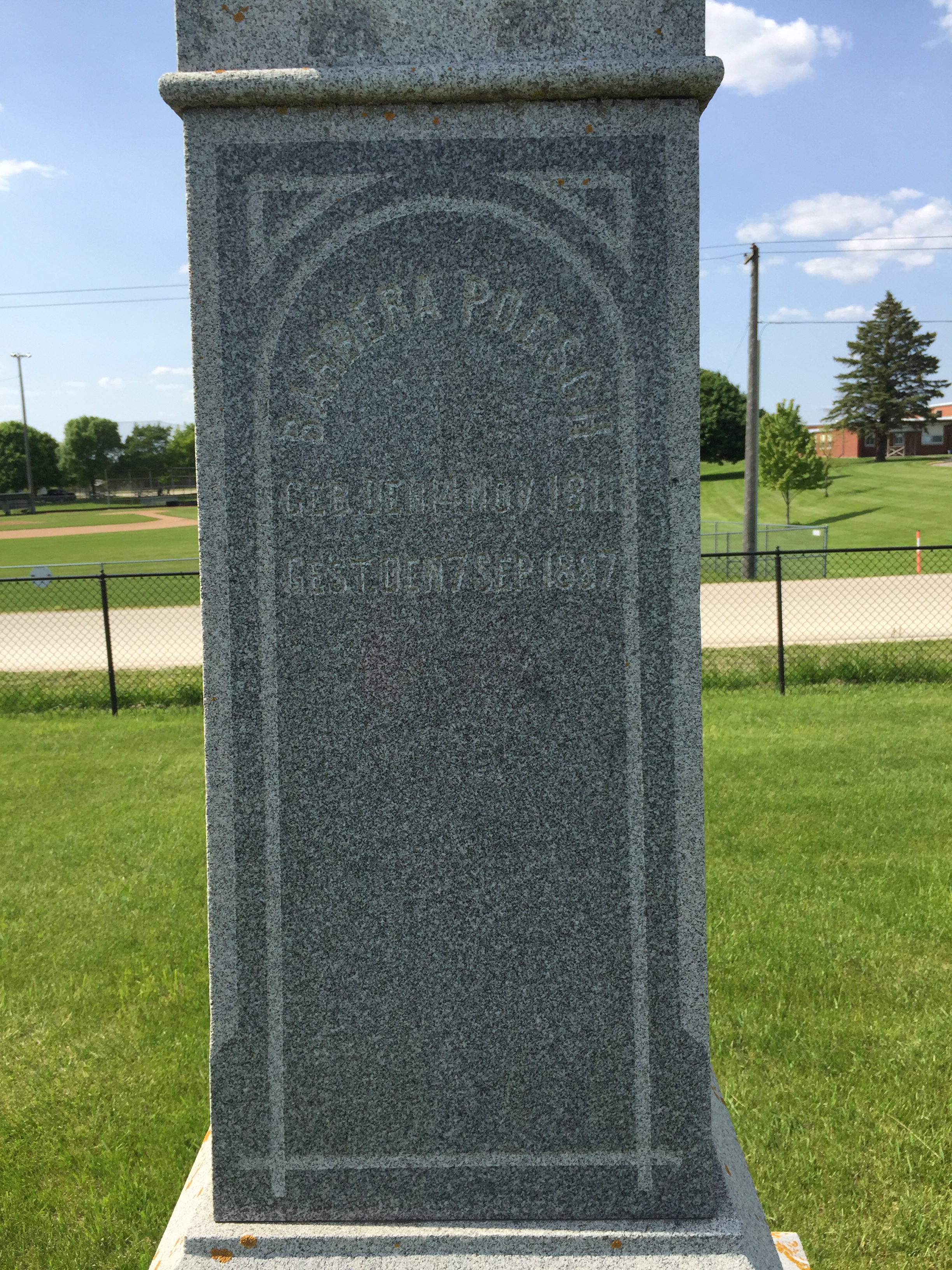
Tombstone Tuesday: Anna Barbara (Ruckdäschel) Poesch (1811-1887)

Anna Barbara (Ruckdäschel) Poesch was forty-two years old before she saw something of the world. Born on 14 November 1811 in the village of Schönlind near what is now Weißenstadt, Bavaria, Germany, she was said to have been the daughter of Johann Georg Ruckdäschel and Eva Margaretha Brodmerkel. Nothing is known of her early years, but Barbara, as she was known, married shoemaker Wolfgang Poesch on 22 April 1833 when she was twenty-one years old. Five known children would be born to the couple in the years to come, the first that same year: Johann (1833), Catharina (1835), Anna Margaretha (1838), Lorenz (1847), and Paulus (1850).

In 1852, Barbara bade farewell to her eldest son when he departed in the company of another local family, that of Paulus and Elisabeth (Schmidt) Thoma, to seek a better life in America. Young Johann, nineteen at the time of his passage, must have sent a favorable report to his parents of his new home in northeastern Iowa; in 1854, Barbara, Wolfgang, and their four remaining children packed a trunk and left the village of Weißenstadt behind forever.

After making the trek to Bremen and then stepping aboard the Heinrich Von Gagern, the family was at sea for what may have been as long as two months. Barbara must have struggled to keep her family clean and fed in cramped conditions, but surely took solace in the companionship of others from their home village who traveled with them. Her eldest daughters, Catharina, eighteen, and Anna Margaretha, fifteen, would have been a great help to her in caring for the two little boys, Lorenz, seven, and Paulus, just four.

Barbara and her family disembarked in New Orleans on 27 Apr 1854. They may have been wary of lingering long in this bustling port; a devastating yellow fever epidemic had swept through the city the previous summer, and as April turned to May, the weather would likely have become increasingly hot, humid, and inhospitable. A steamboat would have provided the family relatively quick and reliable passage north, at the very least to St. Louis if not all the way to Iowa.

After an arduous journey across the Atlantic and through the Gulf of Mexico, then up the Mississippi River, Barbara was no doubt thrilled to finally be reunited with her eldest son upon their arrival in Clayton County, Iowa; in fact, numerous familiar faces from their home village would have greeted the Poesch family.

However, tragedy would soon strike—if indeed it hadn’t already. Four-year-old Paulus, listed as the youngest member of the family on the 1854 ship manifest, was not present at the time the family was recorded in the 1856 Iowa State Census, which suggests that he had died at some point in the intervening years, either in Iowa or en route there. Then, most likely within a year of that same census, Wolfgang succumbed to sunstroke. In his early fifties at the time, the physical demands of farming in the heat of an Iowa summer were apparently too much for him.

Although Wolfgang did not live to commemorate his silver wedding anniversary with Barbara, the couple was able to celebrate the marriages of their two eldest children: son Johann to fellow immigrant Catharina Weiss, and, in 1855, daughter Catharina to Friederich Thoma. Then, in 1857, Anna Margaretha married Wilhelm Heinrich Thoma. The Poesch sisters had, in fact, married two brothers, members of the same family with whom their brother Johann had emigrated from Weißenstadt in 1852. This made their children—nineteen between them—double first cousins.

Find A Grave, Inc., Find A Grave, digital image (www.findagrave.com : accessed 25 March 2024), photograph, Barbera Poesch (1811-1887), Memorial No. 148724753, Garnavillo Community Cemetery, Garnavillo, Clayton County, Iowa; photograph by Ken Johnson, 2016.

Barbara survived Wolfgang by approximately twenty years. The year 1860 found her living with the family of her daughter Catharina; a few years later, her son Lorenz would serve with the 12th Iowa Infantry in the Civil War, surely an anxious time for Barbara. Lorenz survived the war and married Wilhelmina Best in 1868. In 1870, Barbara lived with the family of her son Johann, and was perhaps still a member of his household during a bitter cold snap in early March of 1873 when her fourteen-year-old granddaughter, her namesake, sadly perished. Young Barbara, who had been ill, had entered an unheated room one night where she fell and lay undetected until morning, by which time her arms and legs were said to have frozen and she was too weakened to recover.

By 1885, Barbara resided in the town of Garnavillo with her daughter Anna Margaretha, who was by that point also widowed. Barbara’s occupation was recorded as “Old Mother.” Having raised four children of her own to adulthood, and having likely had a hand in raising a total of twenty-five grandchildren as well, Barbara certainly earned her title.

Anna Barbara (Ruckdäschel) Poesch died at the home of her daughter in Garnavillo, Clayton County, Iowa, on 07 September 1887, when she was seventy-five years old. Her obituary, printed in a local newspaper, stated, “Her remains were conveyed to their last resting place on Saturday, followed by a large concourse of sorrowing relatives and friends. Rev. F. Sommerlad conducted the ceremony in his usual impressive manner.”

Copyright © 2024 Melanie Frick. All Rights Reserved.

Continue reading

Feeding the Black Hills Gold Rush

“In the early 1880 days of the Gold Rush in the Black Hills Fred [Nielsen] and his brother-in-law Christian Callesen bought eggs in the Yankton area, packed them in cases, placed the egg cases in a wagon box surrounded by oats, hauled them to the Hills and sold them at a good price to the hungry miners.” This bit of family lore was recorded by Nielsen descendent Harold Jorgensen and printed in Yankton County History roughly one hundred years after the fact.

The Black Hills Gold Rush began in 1874, the same year that a then ten-year-old Fred Nielsen set sail from Denmark to America with his parents and five siblings, his two oldest brothers having ventured to the Midwest the year prior. The family settled on one hundred and sixty acres of farmland in what is now Yankton County, South Dakota.

Fred turned sixteen in 1880, the same year that Christian “Chris” Callesen, at the age of twenty-five, married Fred’s nineteen-year-old sister Karen Kirstine “Stena” Nielsen. The Black Hills Gold Rush, its epicenter in Deadwood, had peaked in the late 1870s, and the surge of those panning for gold waned considerably by 1880 due in part to a smallpox outbreak and a destructive fire. Apparently, however, there was still enough activity—and “hungry miners,” as the story goes—to make it worthwhile for two young men to drive a wagon nearly 400 miles from Yankton to Deadwood on what may have been more than one occasion.

Charcoal drawing based on photograph of Fred Nielsen (1864-1918), Deadwood, Dakota Territory, ca. 1888-1890, artist unknown, drawing date unknown; digital image 2010, privately held by B.A., 2020.

Indeed, there is evidence that Fred was in Deadwood at least twice, if not more often. He was photographed there on two occasions, the first time circa 1884-86 and the second several years later. Local histories indicate that Christian and his wife homesteaded near St. Onge, a stone’s throw from Deadwood, in 1884. Perhaps Fred spent time in the area with his sister and brother-in-law, as St. Onge hosted a sizable Danish community. In 1889, the Little Dane Church, which still stands today, was built on the southeast corner of Christian’s land.

Were Fred and Christian still making a profit selling eggs and other farm products well into the 1880s, or did Fred find other reasons to make repeated visits to Deadwood? If he was not there on business, Deadwood would at the very least have provided a dramatic change of scenery for a young farmer from a quieter corner of Dakota Territory.

Fred married neighbor Christine Schmidt, a fellow Danish immigrant, in 1890, and it is unknown whether he ever traveled to Deadwood after their marriage. He did travel as far as Colorado with his brother-in-law in 1911, and family lore states that at some point he acquired land near Phillip, South Dakota. Bureau of Land Management records show that a Fred Nielsen purchased one hundred and sixty acres of land in Stanley County, not far from Phillip, in 1910, but further research is necessary to determine whether this was the same Fred Nielsen and, if so, why he might have purchased land there.

Several of Fred’s siblings made return visits to Denmark as adults, but as for Fred, he seems to have been drawn instead to the west.

Copyright © 2020 Melanie Frick. All Rights Reserved.

Continue reading

A Birthday Celebration

Several days after Nancy (Stilley) Hall of Gypsum, Saline County, Kansas celebrated her seventieth birthday on 19 June 1889, a large crowd of family members and friends gathered to honor her.1 A warm account of the affair was printed in the Gypsum Advocate:

A Birthday Social

Last Saturday evening about the time the Sun was taking its good night leave, and later on, a good many persons were seen wending their way toward the west part of the city. The residence of E. D. Hall seemed to be the objective point. After about seventy persons had gathered there, consisting of the aged, the middleaged [sic], youths and children Mrs. Nancy Hall was congratulated on having reached the alloted [sic] years of three score and ten. She is still blessed with reasonably good health and clearness of mind. Mrs. Hall came to this Valley 20 years ago when there were but few settlers in it. She was a widow with 8 children, but two of them boys, aged 9 and 15 years, viz E. D. and John Hall. She located on a quarter section 4 miles south of this city with but one or two settlers in sight. The five daughters that came with her to Kansas, now all married and in good and comfortable circumstances, to wit; Mrs. Wm. Stahl, Mrs. McCance, Mrs. Hoffman, Mrs. Gaultney, and Mrs. Geo. Miller were present and most all of their children. Mrs. H. has 8 children, 33 grandchildren and 4 Great grand children. The other portion of the assembly was composed of members of the baptist church of which Mrs. H. has long been a member, and neighbors and acquaintances. Elder Stitt made an address very appropriate to the time and occasion. Several suitabl [sic] gifts were made Mrs. Hall and presented by Mr. Amos, who alluded to the fact that they came mostly from dutiful and grateful children who knew and appreciated her best. Mrs. Hall very feelingly expressed her thanks and gratitude for the evidence and indications of respect that had been shown her. A bountiful supper was served by the daughters and grand daughters. The baptist chior [sic] furnished good music and singing. The occasion was a pleasant one and will long be remembered, as celebrating the 70th birthday of Mrs. Nancy Hall.2

Pioneer Mother Memorial (Kansas City, Kansas) by Chris Murphy is licensed under CC BY-NC-ND 4.0.

Nancy had indeed ventured from Illinois to Kansas in 1869 as a fifty-year-old widow, and in 1872, she filed for a one hundred and sixty acre homestead nestled against that of the expansive cattle ranch of author and historical figure Frank Wilkeson.3 With the help of her children, she settled into life as a Kansas pioneer at her home near Hobbs Creek, where she farmed crops including wheat, corn, and oats and looked out from her homestead upon a view of the rolling plains.4 She was likely a charter member of the First Baptist Church of Gypsum, the choir of which provided musical entertainment at her birthday celebration.5

Nancy died nine years later due to an accidental fall from a buggy.6 The Gypsum Advocate reported at that time that “Grandma Hall” was “a general favorite with young and old.”7

Copyright © 2019 Melanie Frick. All Rights Reserved. Continue reading

Johann Wiese and a DNA Connection

Johann Wiese of Mecklenburg-Vorpommern, Germany was sixty-five years old and a widower when he boarded the Borussia in Hamburg on 31 October 1868.1 He traveled with Caroline Wiese, twenty, as well as with a young man whom Caroline would marry within months of their arrival in America.2 All named Wendisch Baggendorf, a landed estate located near the town of Grimmen in Mecklenburg-Vorpommern, as their place of origin.3

Interestingly, one day later, several other Wieses departed from Hamburg: Carl Wiese, twenty-three, with his wife, both also of Wendisch Baggendorf, and Joachim Wiese, twenty-seven, with his wife and child.4 They resided in Barkow, an estate located near modern-day Klevenow, which is only a few miles from Wendisch Baggendorf.5 Both Carl and Joachim and their families traveled aboard the Electric, which, like the Borussia, was bound for New York.6

“Kirche in Kirche Baggendorf,” 2009, Kirche Baggendorf (near Wendisch Baggendorf), Mecklenburg-Vorpommern, Germany; Wikimedia Commons, copyright Klugschnacker.

I might not have noted the connection between the Wieses who left Hamburg for New York one day apart if it were not for spotting several interesting member matches within the AncestryDNA results for my grandmother, the great-granddaughter of Joachim Wiese. Each of these matches named Caroline Wiese as a direct ancestor, which led me to the ship manifest that revealed that Caroline had traveled with a Johann Wiese of an appropriate age to be her father; appropriate, too, that a father would accompany his yet-unmarried daughter overseas.

Caroline, as stated, married shortly after her arrival in America; she and Gustav Beth were wed on 10 January 1869 in Dundee, Kane County, Illinois.7 Carl and Joachim Wiese, on the other hand, both settled in Chicago’s 15th Ward with their families.8 While Johann Wiese has not been located in the 1870 or 1880 censuses, and does not appear in the households of Caroline, Carl, or Joachim, it is possible he was simply not counted in the census if, for example, he was en route to the home of another child and was missed by the census enumerator, or if a neighbor provided information about the family to the census enumerator and failed to mention him.

Cook County, Illinois, death certificate no. 28339, John Wiese; Cook County Clerk, Chicago.

Ultimately, it appears Johann Wiese spent the final fifteen years of his life in Illinois, although thus far little is known about how he spent those years.9 Similarly, little is known about his life in Pomerania; records note only that he was a laborer, and as serfdom was abolished in the area in 1820, he was perhaps contracted to work on an estate in Wendisch Baggendorf or the vicinity.10

According to his death record, he died on 02 August 1883 at 144 Newton Street in Chicago at the age of eighty.11 His death was attributed to old age.12 Intriguingly, Carl Wiese resided at this address, further strengthening the potential of a connection beyond their shared Wendisch Baggendorf origins and their emigration one day apart.13 It seems logical to assume that Johann Wiese might have been cared for in his last days by his son.

Johann Wiese is buried in Chicago’s Graceland Cemetery; today, while the location of his grave has been identified, it is unmarked.14

Copyright © 2017 Melanie Frick. All Rights Reserved.
Continue reading

From Germany to Chicago’s Old Town

Clara (Bach) Marbach was born in Luxembourg near the border of the district of Bitburg-Prüm, Rhineland-Pfalz, Germany, the daughter of Johannes and Anna Maria (Thiel) Bach.1 She married Mathias Marbach in June of 1835,2 and the couple had six known children in the decade that followed: Anna,3 Catharina,4 Elisabetha (I),5 Elisabetha (II),6 Adamus,7 and Elisabetha (III).8 The family is believed to have resided in the village of Prümzurlay, known for its castle ruins upon sandstone bluffs that overlook its scenic valley.

Photograph of Prümzurlay, Rheinland-Pfalz, Germany, as viewed from Prümerburg, 2009; privately held by Melanie Frick, 2017.

Following the death of her husband, Clara left Germany for America in the company of two of her daughters, Elisabetha (I) and Elisabetha (III), along with their husbands and children.9 A third daughter, Anna, would emigrate twenty years later.10 Clara traveled aboard the Holland and arrived in New York in June of 1871, thirty-four years after she had married.11 She and her daughters made their way to Chicago where they settled near St. Michael’s Catholic Church, located in what is today the heart of Chicago’s Old Town.

Sadly, within days of their arrival, Clara’s six-month-old grandson succumbed to pneumonia.12 It was a difficult year; the Great Chicago Fire tore through the city in October of 1871, a horrifying disaster that would almost certainly have left Clara and her daughters homeless alongside an estimated 90,000 of the city’s inhabitants,13 and another grandson passed away at twenty-one months the following June amidst a scourge of cholera upon their neighborhood.14 The years to come were difficult as well, as Clara saw numerous grandchildren born and die, including one who succumbed to smallpox in an outbreak that devastated their community.15

The family’s neighborhood was known in the nineteenth century as the “Cabbage Patch” due to the large number of German immigrants who had farmed there in Chicago’s earliest years.16 When Chicago burned, St. Michael’s Catholic Church, the cornerstone of this German American community, was one of only a handful of buildings in the city to survive, although it was badly damaged and had to be reconstructed.17 Perhaps Clara was among the parishioners who attempted to bury some of the church’s valuables in the church yard as the fire approached, and she and her daughters, son-in-laws, and grandchildren may have huddled in an open field or at Lincoln Park on the shores of Lake Michigan as the fire roared through the area.18

At the time of the 1880 U.S. census, nine years after her arrival, Clara lived at the home of her daughter Elisabetha (III), who, at thirty-five, had been twice widowed and once abandoned, a state that earned her the designation of “grass widow” by the census enumerator.19 Elisabetha supported herself and her stepchildren by sewing, while Clara, by then in her mid-seventies, kept house.20 Their neighborhood had been entirely rebuilt following the Great Chicago Fire, thanks to a flood of donations, including building materials, from relief societies.21

Cook County, Illinois, death certificate no. 66546, Clara Marbach; Cook County Clerk, Chicago.

Clara died five years later on 12 July 1885; she was reported to have reached the age of eighty-two and eleven months and her cause of death was attributed to heart failure after having been bedridden for the previous three months.22 Clara (Bach) Marbach was buried at St. Boniface Catholic Cemetery in Chicago’s North Side neighborhood.23 Today, her grave, which rests in the company of those of several of her children and grandchildren, is unmarked.24

Copyright © 2017 Melanie Frick. All Rights Reserved.
Continue reading

A Baby Carriage in Dakota Territory

A new arrival in the family has meant that blogging my research findings has taken a backseat in recent months, but with babies on the mind, here is a peek at a sweet little one posed with his mother in the nineteenth century:

nielson_harry_andresen_hannah_1888

Hannah Marie (Andersen) Nielsen with Harry Niels Nielsen, Yankton, Dakota Territory, 1888-89; digital image 2014, privately held by [personal information withheld].

Pictured is Hannah Marie (Andersen) Nielsen, wife of Ole Nielsen of Yankton, Yankton County, South Dakota, with her infant son Harry Niels Nielsen.1 Harry was to be the couple’s only surviving child; a daughter died in infancy.2 He was born 25 May 1888 in the town of Yankton,3 only a few months after the infamous Children’s Blizzard; his parents, both Danish immigrants, had married in 1880.4 At the time of Harry’s birth, Ole managed a dray line in Yankton, transporting heavy loads in a specially built wagon.5 Later, he would take up farming east of the nearby community of Mission Hill.6

In this photograph, Hannah, forty years of age, wears a dress with a full skirt, fitted sleeves, and a bodice fastened with no less than a dozen buttons.7 A brooch is pinned at her high collar and a flat-brimmed hat atop her head is adorned with feathers, adding an elegant statement to her otherwise relatively simple attire. What appears to be a strip of fabric is wrapped around the palm of her visible hand.

Harry, who looks to be less than a year old, dating this picture to South Dakota’s pre-statehood days of 1888-89, is dressed in a light-colored gown and a snug bonnet. He looks directly at the camera and a belt around his middle secures him to the seat of a baby carriage. The slatted basket is long enough that a smaller baby could lay flat until, like Harry, sitting upright against the fringed backboard would be possible.

I love that a baby carriage is featured here, unlike in any of the other nineteenth century baby photographs in my collection. However, I do have to wonder how practical it would have been at this time and place. While a bustling prairie town in its own right, Yankton was not, by any stretch of the imagination, a particularly urban environment, where a baby carriage might have proven more useful. Was it a prop at the Janousek studio, then, or did it belong to the Nielson familyperhaps a special luxury for a woman who had waited out eight years of marriage for a healthy child?

Whatever the case, this is a charming look at a proud mother and her well-behaved infant striking an elegant pose on the frontier. And, I have to say, the picturesque baby carriages of the nineteenth century were certainly more worthy of studio portraits than those of today!

Copyright © 2017 Melanie Frick. All Rights Reserved.
Continue reading

The Pomeranians: Identifying a Family Photo

If you’d asked me about this photograph a few years ago, I might said that Joachim and Sophia were, in fact, Ernst and Friederike. That is, I might never have identified the couple in this cabinet card photograph if it weren’t for a few subtle clues that pointed me conclusively in the direction of one immigrant couple over another.

My grandmother’s paternal grandparents both came to America as infants, the son and daughter of Pomeranians from the region now known as Mecklenburg-Vorpommern, Germany. The first couple to reach America, Joachim and Sophia (Cammin) Wiese, traveled from Hamburg in 1868.1 The second couple, Ernst and Friederike (Wagner) Stübe, traveled from Hamburg in 1869.2 Both couples settled initially in Chicago, although within a few years, Ernst and Friederike would move to a rural community outside the city. The couples were born within several years of each other, and no other identified photographs of either couple existed in my collection in order to aid in their identification. Based on the provenance of this photograph in a family collection, I knew that it must show one of these two couples.

JoachimWieseSophiaCammin

Joachim and Sophia (Cammin) Wiese, ca. 1885-1890, Chicago, Cook, Illinois; digital image ca. 2000.

The man and woman in this photograph are perhaps in their mid-fifties, give or take a decade. The photograph itself, taken by an unidentified Hansen of Chicago, is a cabinet card, a style that became popular after the Civil War.3 This, of course, fits the time period in which the Wieses and Stübes would have lived in Chicago. However, as both couples were only around thirty years of age in 1870, this photograph was more likely taken at some point between 1880 and 1900.

The woman in the photograph wears her hair parted in the middle and pulled back snugly, a no-nonsense style that is not specific to any era. Her ears are pierced and she wears what appears to be a dark wool suit with a fitted basque jacket featuring a high ruffled collar, a single row of buttons, and cuffed sleeves. Notable is the double row of boxed pleats on her underskirt; this style was popular in the latter half of the 1880s, as was the style of her jacket.4

The man is clean-shaven except for a trimmed neckbeard, and his hair is brushed away from his face. He has light-colored eyes – blue or green – and wears a typical three-piece suit. The age of the couple in this photograph as well as their style of dress suggest that, if this photograph was taken to mark a particular occasion, it may have been to commemorate an event such as their twenty-fifth anniversary.

Joachim and Sophia would have celebrated their twenty-fifth anniversary circa 1890, a date calculated based on their ages and the birthdate of their eldest known child.5 Ernst and Friederike, however, did not reach such a milestone; Ernst died in 1879 at the age of forty.6 As the woman’s clothing in particular is markedly different from the styles of the 1870s, this photograph could not have been taken before 1879, and thus cannot be a photograph of Ernst and Friederike (Wagner) Stübe.

A final clue comes from the notation penned at the bottom of the cabinet card by a descendant: “Fatte + Matte?”7 A letter written by the granddaughter-in-law of Joachim and Sophia noted that his grandsons could not recall their names, but had called them “Fatta” and “Mota.”8 Coincidence? I don’t think so. My hunch is that these are phonetic spellings of perhaps an old dialect-based variation of the German words for father and mother, Vater and Mutter. This is how Joachim and Sophia (Cammin) Wiese were remembered by their children and grandchildren.

Copyright © 2015 Melanie Frick. All Rights Reserved.

Continue reading

The Trailblazers

Jensine Kathrine and Lars Marinus Walsted were the first of their siblings to leave Denmark for America. Sine (also spelled Sena) was eighteen and Lars Marinus twenty when they arrived in Boston on 19 April 1886 aboard the Catalonia and made their way to Council Bluffs, Pottawattamie County, Iowa.1 It would be seven years before they would see another member of their family, although eventually, all of their surviving siblings would make their way to America.

Marinus_Walsted_Jensine_Walsted_1887

Lars Marinus “Charles” Walsted, 21, and Jensine Kathrine “Sine” Walsted, 19, half-siblings, Council Bluffs, Iowa, 1887; digital image 2014, privately held by Dianne Anderson, 2015.

This 1887 cabinet card photograph was likely taken outside in the summertime, as real grass appears in front of the outdoorsy backdrop. In addition, Sine poses with a parasol, certainly a warm-weather accessory. Both are smartly dressed, Lars Marinus in a light-colored three-piece suit and Sine in a plaid dress with a straight skirt and snug sleeves that, as was typical of the time, do not quite reach her wrists.2 A flower is pinned at her throat. Their hats – Sine’s quite elaborate – rest at their feet. Lars Marinus parted and combed his hair neatly, while Sine’s hair is pulled back tightly and does not seem to be styled in any special way. Iowa summers can be hot and humid, rather unforgiving to the curled fringe often worn by young women of the era!

At nineteen and twenty-one, these fair-complexioned half-siblings had their lives ahead of them. Having become established among a community of Danes in the Council Bluffs area, Sine and Lars Marinus may have wanted to have their picture made so that their parents could see how well they were doing after a year away from home. As the eldest children and trailblazers for life in America, they may also have hoped to encourage their five siblings to join them when they were able. While this photograph remained in Sine’s possession until she gifted it to her daughter in 1932, it’s easy to imagine that another copy may very well have accompanied a letter home to Denmark.

Copyright © 2015 Melanie Frick. All Rights Reserved.

Continue reading

Remembering the Children’s Blizzard

Even seventeen Dakota winters could not have prepared the Danish immigrant family of Jens Madsen and Anna (Bramsen) Schmidt for what they faced in 1888.

January 12 dawned bright and clear in southeastern Dakota Territory. The weather was so pleasant that many children set off to school wearing only light jackets and wraps.1 In the Schmidt family, just twelve-year-old Mads was still in school; while he settled in with his classmates, his mother and older sisters, Mary and Christine, tinkered eagerly with the new sewing machine that had been delivered to them just that morning.2

Within a few hours, however, a dark cloud appeared on the horizon, bringing with it a wind so powerful that it roared as it whirled snow and ice into the air. The temperature dropped abruptly, and the snow and ice, said to be as fine as flour, made it impossible to see. Those unfortunate enough to be caught on the open prairie – or even in their barnyards – had little hope of making it to shelter.3

Through the remainder of the day and into the night, the Schmidt family waited in agony, a lantern burning in their window. They had no way of knowing whether Mads had taken shelter at school, or whether he had tried, in vain, to run for home. To search for him would be futile until the storm had ceased.

The next morning, which dawned bright and beautiful, Mads trudged home over the sparkling drifts of snow. The joy and relief that he, his sisters, and his parents must have felt at this reunion can only be imagined. As it turned out, the schoolteacher at the Breezy Hill School had managed to convince all of the children to stay in the shelter of the schoolhouse overnight, which, thankfully, had been sturdy enough to withstand the winds and had had enough fuel to keep them from freezing.4

JensMadsenSchmidtHomestead

Schmidt Family Homestead, near Tabor, Bon Homme County, South Dakota, ca. 1888-1889; digital image 2013, privately held by Melanie Frick, 2015. From left: Inger Marie “Mary,” Mads, Christine, Jens Madsen, and Anna (Bramsen) Schmidt.

Others had not been so lucky. Remembered as the “Children’s Blizzard” for the high number of school-aged victims, the storm tore apart some of the flimsier schoolhouses, forcing the teachers and children to flee into the storm, often in insufficient clothing due to the balmy weather of the morning.5 Others thought that they could beat the worst of it home, but on the open prairie where some children walked miles to reach school, many became disoriented in the storm or were forced by the wind in different directions. It became impossible for them to spot familiar landmarks either because of the fine and blinding snow or because their eyes had frozen shut.6

Later, two sewing machine salesmen, who had made their last stop at the Schmidt family homestead in Bon Homme County, were found huddled in the box of their bobsled just three miles to the west. They had frozen to death; their horses, tied in a grove of trees, survived. For years, locals referred to the area as Dead Man’s Grove.7

The Children’s Blizzard claimed an estimated two hundred fifty to five hundred lives across the Midwestern prairie, with the majority of the casualties in southeastern Dakota Territory.
8 As reported by historian David Laskin, “The pioneers were by and large a taciturn lot, reserved and sober Germans and Scandinavians […]. Even those who never wrote another word about themselves put down on paper everything they could remember about the great blizzard of 1888. Indeed, it was the storm that has preserved these lives from oblivion.”9

Copyright © 2015 Melanie Frick. All Rights Reserved.

Continue reading