Tag Archives: 1900s

Suiting Up at the Turn of the Century

I’ll admit I feel rather proud of my namesake for marrying such a debonaire young man. Henry Joseph Adam of Sioux City, Woodbury County, Iowa, pictured at right, married Melanie Veronica Lutz in 1905 at the age of twenty-four, which allows this photograph to be dated to approximately 1900-1905.1

Henry_Adam_1900

Henry Joseph Adam, at right, with an unknown individual, Akron, Iowa, ca. 1900; digital image 2014, privately held by Melanie Frick, 2015. Collection courtesy of David Adam.

Census records confirm that the photographer who made this cabinet card, Gene Frank of Akron, Plymouth County, Iowa, did indeed operate a photography studio in the early twentieth century.2 However, I’m not entirely sure what Henry was doing in Akron himself. He lived in Sioux City, thirty miles south, where there were certainly a number of photographers; however, Akron was a bit closer to the French Canadian communities of southeastern South Dakota where Henry had a number of relatives. It’s also possible that he had hired out to work in the area or that he had simply gone there for a visit – or, as the case may be, for a shopping expedition.

As with all photographs, an important question comes to mind: “What was the occasion?” While I don’t note a strong family resemblance between the other young man and Henry’s male relatives, one possibility is that he could have been a cousin. He could not have been a classmate, as Henry attended school only through eighth grade, but it is possible that he and Henry worked together in some capacity. If nothing else, he was a friend, and I wonder if he and Henry purchased these suits together. The textured suit jackets are nearly identical in terms of cut and fabric, but not quite, while the stiff-collared shirts seem to be the same; the young men expressed their individuality by way of their accessories. The friend, with wet hair slicked in a part, wears a vest with a knotted striped necktie and a watch chain, while Henry omits the vest in favor of a fleur-de-lis-printed necktie tied in a bow. It wouldn’t have been unusual in this era for two young men to have a photograph taken together to document their friendship.

What strikes me about this photograph is that from what I know of Henry, he wasn’t typically quite so refined! He spent his teenage years as a dairy farmer and his adult years as a carpenter, so such dapper attire was in all likelihood limited to his early adulthood and might have been worn to church or while courting. The high detachable collar fully encased his neck, and I particularly like that he wore the fleur-de-lis as an apparent nod to his French Canadian heritage; Henry in fact spoke both French and English.

There are a number of photographs of Henry in my collection, but this may be the most dapper of them all. For more photographs of the family of Henry Joseph Adam (1881-1944) and Melanie Veronica Lutz (1884-1973), stay tuned for the new Adam Family Album. 

Copyright © 2015 Melanie Frick. All Rights Reserved.

Continue reading

A Goodly Bit of Romance

The newspaper headline must have brought a few chuckles: “OLD FOLKS HAVE ROMANCE.” The story continued, “Romance is not all reserved for young people, as the marriage of Isaac N. Holman, aged 70, of Decatur, Neb., to Mrs. Sarah E. Fenton, aged 51, of Springdale, in Sioux City, will testify. […] This is the third marriage for each of the contracting parties. Both are well along the avenue of life and to them the marriage represents good judgment as well as a goodly bit of romance. They have known each other a long time and the mutual admiration they have entertained has grown gradually until the marriage yesterday placed its happy seal upon their growing affection.” Following their marriage on 24 August 1908 at the home of the Reverend W. H. Montgomery of the Haddock Methodist Episcopal Church in Sioux City, Woodbury County, Iowa, the couple was to visit Omaha. They would settle in Decatur, Burt County, Nebraska, where Holman, “said to be quite well to do,” made his home.1

That evening, their story appeared in another Sioux City newspaper: “LOOKING FOR LAND HE FINDS HELPMATE.” This version of the story was written with a level of flowery detail that, while entertaining, I don’t quite trust:

“I.N. Holman, a wealthy retired farmer of Decatur, Neb., came to Sioux City several months ago on a land deal. At the office of a real estate dealer he met a charming black-eyed widow, Mrs. Sarah E. Fenton, who had chanced in there on business. When they were introduced, he immediately lost all interest in Sioux City property or any property for that matter, and devoted all his time to the widow. Holman is 70 years old, and he pressed his suit with such ardor that before he returned to Decatur he had made a contract for something which he wouldn’t trade for all the farms in Iowa, namely the attractive widow. Today he returned to close the deal, which he says is the best he ever made. A license was issued this afternoon, the bride giving her age as 51. They will be married this evening and after a two weeks’ wedding trip will make their home at Decatur. “Maybe people think we’re foolish,” said the bride, blushing like a school girl, “but we don’t, we’re too happy.”2

This is far from the whole story. First, there are, in fact, two stories presented by these competing news articles. Did the couple meet at the land office, or had they been acquainted for years? This we may never know for sure; it seems unlikely, but not impossible, that the couple had crossed paths before meeting in Sioux City. Second, the “attractive widow” most likely did not have the black eyes of Bess the landlord’s daughter, charming as the description may be.3 And was she even a widow? Well, yes and no. Her first husband, George W. Fenton, died tragically in 1880 when accidentally shot by her brother-in-law.4 Her second husband, however, was still alive and well at the time of her third marriage; Sarah had divorced John Hoffman in 1902 citing his drunkenness and death threats.5 However, it would have been far from unusual for a woman to claim widowhood over divorce.

SarahEHall

Sarah Ellen (Hall) Fenton Hoffman Holman Eklof, Iowa or Nebraska, ca. 1908; digital image 2001, privately held by Melanie Frick, 2015.

Finally, would Isaac and Sarah live happily ever after? Unfortunately not. Isaac was granted a divorce from Sarah in 1914;6 a probate petition filed by his son the previous year, while suggesting that Isaac “indulged in intoxicating liquors to excess” and was “changeable, forgetful, and stubborn,” also stated that “the amount of money demanded from him by his current wife annoyed him considerable.”7 Oh dear. Isaac did not remarry before his death in 1922,8 but Sarah would marry – and divorce – once more.9 She resumed the use of the Holman name and at the time of her death in 1930, she was referenced as the widow of Isaac Newton Holman. Her short-lived marriage to this “wealthy landowner” was, perhaps, her one claim to local fame and financial stability.10

Lesson learned? Never assume. I had assumed that because this was the couple’s third marriage, and because they married in a community with a population greater than thirty thousand, that no mention would be made of their marriage in the local newspaper. In fact, I didn’t bother to check until their names turned up in the Findmypast database featuring a newspaper from across the state, and then learned that more than one version of the story existed. As it turns out, you never know what details of your ancestor’s experience might have made a compelling story deemed worthy of reprint!

Copyright © 2015 Melanie Frick. All Rights Reserved.

Continue reading

The Proud Owners of a New Piano

You never know what might have made the news a century ago. In Iowa, for example, news might have been made when someone acquired a piano. Although mail-order catalogues like Sears, Roebuck & Company made owning a piano more affordable than ever thanks to convenient financing options,1 such a substantial purchase was still of great interest to those in rural communities and small towns across America.

These were the years before Victrolas became widespread.2 Pianos were a ready source of music and entertainment, and people of all ages might have enjoyed gathering at the home of a friend or family member with a piano for an evening of playing and singing.

pianoloc

“A Pleasant Evening at Home,” Prints & Photographs Online Catalog, Prints & Photographs Reading Room, Library of Congress, Washington, D.C. (http://www.loc.gov/pictures/item/90709337 : accessed 5 August 2015).

In the northwestern corner of Iowa, The Sibley Gazette reported on 24 May 1900:

John Hoffman and family are the proud owners of a new piano.3

And in the northeastern corner of the state, The Guttenberg Press reported on 25 June 1909:

Miss Roselyn Thoma is the happy and proud possessor of a new piano.4

John Hoffman was the second husband of Sarah Ellen Hall; married since 1883, they would undergo a tumultuous divorce in 1902. At the turn of the century, however, they were still married with a twenty-year-old daughter and a sixteen-year-old son at home.5 Their acquisition of a piano adds a bit of brightness to what was painted in their divorce proceedings as a rather dim time. Although Sarah led a difficult life, her granddaughter remembered that she had loved fine things; this piano was likely a prized possession.6 As she was said to be a religious woman, perhaps she enjoyed hymns played on the piano either by herself or her children.

Roselyn Thoma was the daughter of Fred and Matilda (Hammond) Thoma and was seventeen years of age in 1909.7 She was the last of four surviving children still at home, her younger sister having been lost to a diphtheria outbreak three years prior.8 Perhaps it was with a newfound appreciation to seize the moment that her parents supported such an extravagance for their daughter, or perhaps the same inheritance that had recently spurred them to purchase a farm made the purchase of a piano possible as well.9 Roselyn would marry two years later, and one can imagine that her piano might have accompanied her to her new home.10

Whether the Hoffman and Thoma families enjoyed idyllic moments crowded around their pianos à la Little Women or not, it is clear that the addition of a piano to a household in their humble Midwestern communities was worthy of note – and pride. However, even in these rural areas, it would be only a matter of time before new forms of entertainment overtook the novelty of owning a piano.

Copyright © 2015 Melanie Frick. All Rights Reserved.

Continue reading

A Fatal Scratch: The Death of a Pioneer Woman

Anna_Margaretha_Poesch_Thoma_Obituary“After almost a week of extreme suffering, caused from blood poisoning, Mrs. Margaretha Thoma, one of Garnavillo’s oldest residents, passed away at 4:00 o’clock last Saturday afternoon. About two weeks ago the lady accidentally scratched the back of one of her hands with a pin. The scratch at the time was a mere trifle and was given no further thought by her until a few days after when the hand began to swell and cause more or less pain. A physician was called and found it necessary to lance the hand, but desired results did not follow and twice later the lance was employed, and still no relief came to her sufferings, but instead the wound continued to grow worse and the swelling commenced extending into the arm. Everything possible was done to allay the pain and comfort her in her unendurable suffering, but nothing could be administered that would combat with the situation and the result was death came as a relief after nearly a week of incessant torture.”1

Anna Margaretha (Poesch) Thoma was born in Weißenstadt, Wunsiedel, Bavaria, the daughter of Wolfgang and Barbara Poesch.2 She came to Iowa with her family at a young age, and was later deemed “one of the venerable and loved pioneer women of Clayton County.”3 Margaretha married William Henry Thoma, a local merchant, in 1857, when she was still in her teens.4 They had eleven children before his death in 1876; Margaretha never remarried, and in fact continued to operate his mercantile in the years following his death.5 Perhaps it was this role in her community that brought her the recognition to be remembered so fondly in the years following her death from blood poisoning on 9 November 1907.6

Margaretha’s unfortunate plight might remind some of Caroline Ingalls’ encounter with a rusty nail in a particularly drama-filled episode of Little House on the Prairie. Indeed, albeit tragically, little could have been done to relieve Margaretha’s suffering at this time and place. Her age, estimated at near seventy, might also have contributed to her susceptibility to infection, whether she in fact suffered from sepsis or tetanus. Although not soon enough for Margaretha, it would be just a matter of time before the use of penicillin – and the tetanus vaccine – would become widespread. 

Copyright © 2015 Melanie Frick. All Rights Reserved.

Continue reading

A Mystery in the Margins

All I can think is that Odile must have been desperate. She hadn’t seen her eldest son, Edward, in five years, and it had been at least two since she’d laid eyes on his younger brother, Fred. The last she’d heard, the two men, both in their thirties, had left the state, and she had no way of contacting them.

OdileMilletteAdam

Odile (Millette) Adam, Sioux City, Iowa, circa 1900; digital image 2004, privately held by Melanie Frick, 2014.

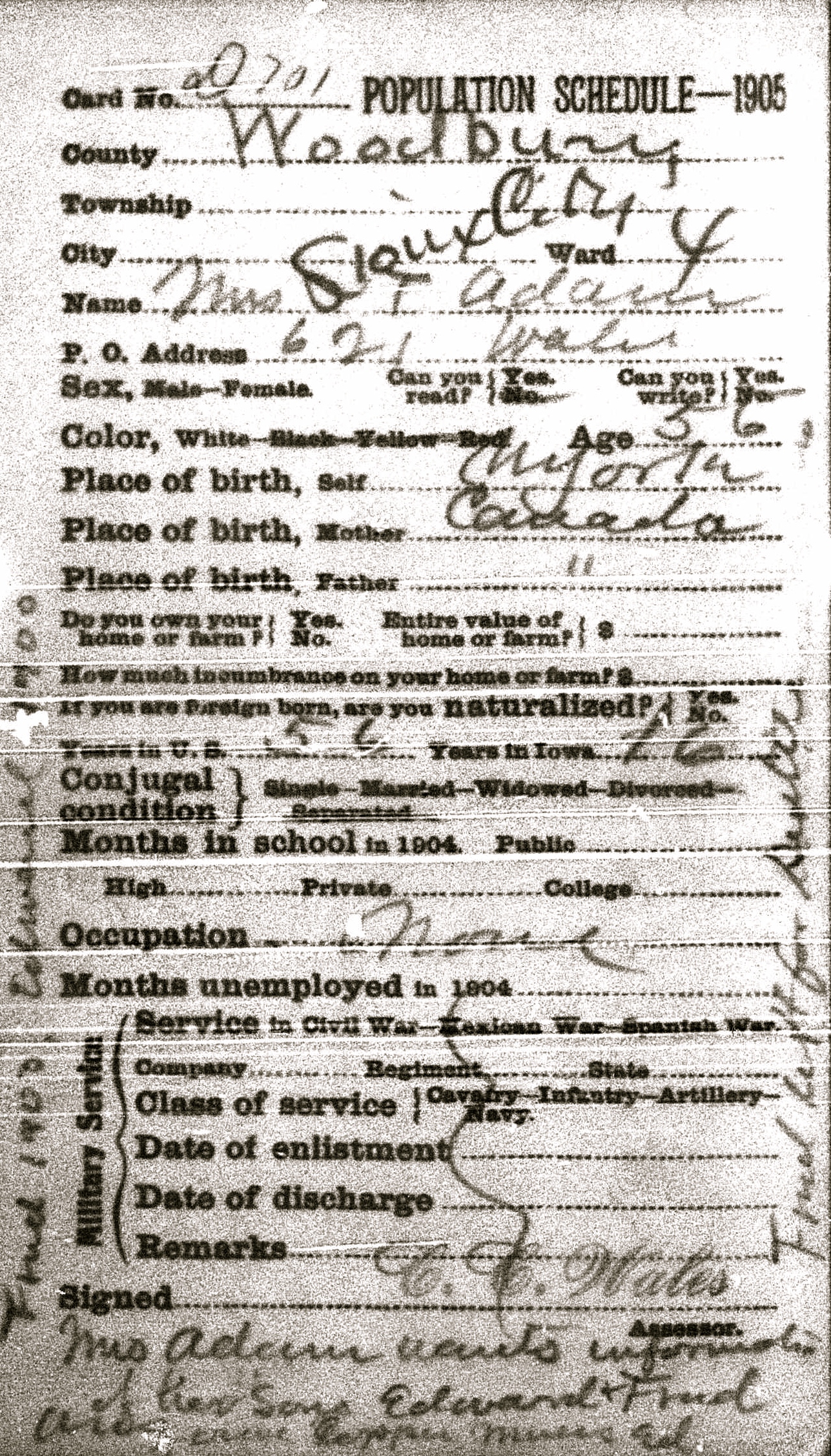
When the census enumerator arrived at the door of her home in Sioux City, Woodbury, Iowa, Odile (Millette) Adam saw in him a reason to hope. Here was someone who surely knew a thing or two about tracking people down. If nothing else, perhaps he could ask around? Had anyone seen her sons, Edward and Fred? The census enumerator strayed from the lines gathering information about Odile’s age, address, and origin, and jotted some hasty notes in the margins:

“Mrs. Adam wants information of her sons Edward and Fred. […] copper mines Ed. Fred left for Seattle. Fred 1903. Edward 1900.”1

Odile Adam 1905

“Iowa, State Census, 1905,” Sioux City, Woodbury County, Iowa, O.T. Adam [Mrs. T. Adam]; digital images, FamilySearch (http://www.familysearch.org : accessed 08 October 2014).

Although some words are indistinct (can anyone make out what it says?), the message is clear: The Adam boys had made their way west, and, whether dead or alive, they had disappeared without a trace. There may not have been much of anything that the census enumerator could have done, save for keeping his eyes and ears open in case the men turned up around town, but at the very least, he appears to have been sympathetic to Odile’s concerns.

Fred, also known as Alfred G. Adam, would eventually return to Sioux City, though perhaps not for a few more years; records suggest he returned to the area around 1909.2 Of Edward Adam, however, there seems to be no paper trail. In the summer of 1900, the Sioux City Journal reported that the then twenty-nine-year-old Edward, who had left home at the age of fourteen, had returned to his family, but his behavior towards them was “abusive, inconsiderate, and contemptuous.”3 His ailing father submitted a petition requesting a restraining order against him in order to protect himself as well as his minor children, and Edward, at least under his given name, is seemingly absent from record thereafter.4

Odile’s apparent distress according to the 1905 Iowa State Census is made more interesting by the fact that her husband of nearly forty years, Timothy Adam, was not recorded as a member of her household.5 Was he away searching for their sons, or was he simply visiting relatives across the state line in South Dakota or in his native Massachusetts? Was he aware that Odile was seeking word of their sons, or had he washed his hands of them? We may never know, just as Odile may never have learned the fate of her two eldest surviving sons before her death late the following year.6

The 1905 Iowa State Census images are available for free on FamilySearch. Even if there aren’t any notes written in the margins, you can learn a great deal about an ancestor from the details that were formally requested, including military status, level of education, and number of years as a resident of the state. If you would like to know who lived in the same household as your ancestor before turning to the individual cards, see the index available in the Iowa State Census Collection on Ancestry.com.

Continue reading

A Golden Anniversary Celebration

One warm afternoon during the summer of 1902, a crowd gathered at the home of local pioneers Niels and Juliane Sophie (Hennike) Olsen. The couple, who had retired from farm life several years before, was celebrating fifty years of marriage, and all of their children and grandchildren were invited to their home located near the center of town at 605 Broadway in Yankton, South Dakota.1 The event was surely a memorable affair, and the local newspaper gave a glowing report of the afternoon’s activities:

Mr. and Mrs. Nels Olson celebrated their golden wedding yesterday afternoon at their home on Broadway. All their children, eight in number, were present with their families. Their names are as follows; Ole Nelson, Mission Hill; John Nelson, Viborg; Christ Nelson, Lakeport; Fred Nelson, Lakeport; Mrs. J. Nissen, Yankton; Mrs. C. Calleson, Yankton; and Miss Helena Nelson, Yankton. Rev. C.K. Solberg spoke a few words appropriate to the occasion and presented to the venerable couple two fine presents from the children, a gold headed cane to “father” and pair of gold glasses to “mother.” The “old folks” came from Denmark in 1874 and made their first home in America near Lakeport, S.D. Eight years ago they moved to Yankton, their present home. They are in fairly good health and enjoy comfort and happiness surrounded by kind children.2

Niels Olsen and Juliane Sophie Hennecke had married in Haraldsted, Soro, Denmark, on 30 July 1852.3 For the first twenty-two years of their married life, they resided in Denmark; their twenty-second anniversary, however, was spent aboard ship as they ventured to America.4 Their years since had been spent in southeastern South Dakota, where they claimed a homestead and where Niels had recently served a term as a rural postmaster. All eight of their surviving children remained in the area, and to commemorate their fiftieth anniversary, an informal group photograph was arranged on the porch of their home beneath the shade of several large trees.

Olsen Golden Anniversary

Olsen Golden Anniversary, Yankton, South Dakota, July 1902; digital image 2010, privately held by Melanie Frick, 2014.

The couple of honor is seated near the center, surrounded by those in attendance. Niels wears a wool three-piece suit and tie, as do most of the men, while Juliane wears a patterned shirtwaist with a bow at the neckline. Patterned, striped, or light-colored cotton fabrics seem to be popular choices among the women for their summertime wear. The adults, including the couple’s children, sit or stand in two rows, and three infants are perched on laps. Nine young grandchildren – including four sisters in matching dresses – cram together in the front, sitting cross-legged on the wooden plank floorboards. The group is relaxed; there are a few smiles, several women cross their arms comfortably, and a few maternal faces are turned away from the camera, intent on minding the couple’s many grandchildren.

I have to hope that this well-dressed crowd had the opportunity to partake in some refreshing lemonade in honor of the occasion!

In the back row, from left to right, are Reverend Solberg, Mrs. Solberg, Harry Nissen, Fred Nelson, Ole Nielsen, Harry Nielsen, John Nielsen, Eric Boysen, unknown, and Chris Callesen. In the middle row, from left to right, are unknown, Dora Nissen, Cleora Nielsen, Hannah Nielsen, Stena Callesen, Cecilia Boysen, J. Chris Nelson, Niels Olsen, Juliana Olsen, Helena Olsen, Jennie Nelson, Edith Nelson (child), Christine Nelson, and Helen Nelson (child). In the front row, from left to right, are Robert Nelson, Anna Nelson, Louise Nelson, Andrea Nelson, Julia Nelson, Bessie Nelson, Ole Nelson, Alvin Nielsen, and George Boysen.5

Continue reading

All Aboard Mr. Laughlin’s Palace Photo Car

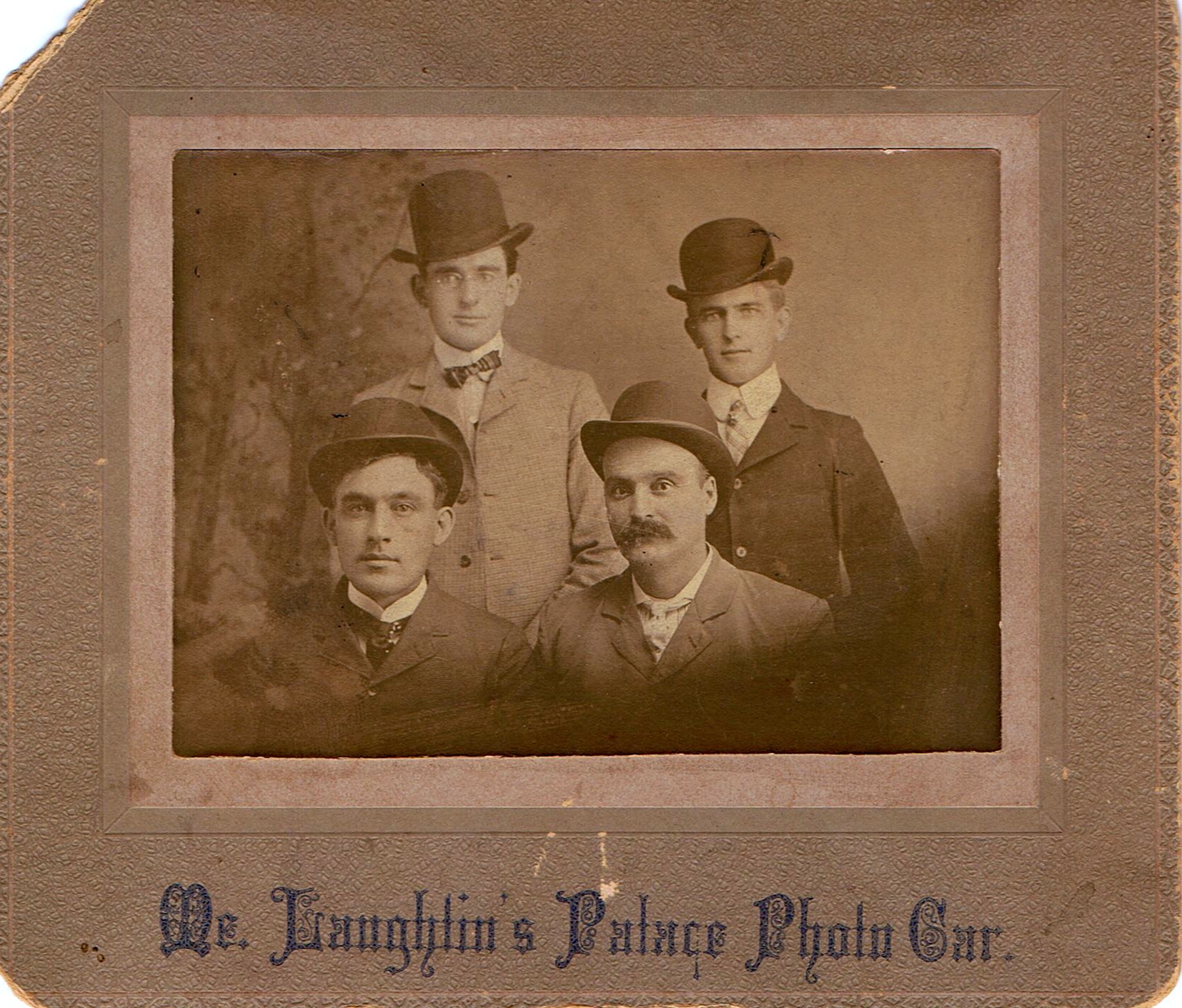
Not all photograph studios were stationary. Your ancestors may have had their photographs taken aboard a boat or even a specially outfitted railroad car, as did this group of gentlemen around the turn of the last century.

GeorgeHiramThoma

George Hiram Thoma a.k.a. George A. Neilson, top right, Iowa or Nebraska, ca. 1900; digital image 2010, privately held by Melanie Frick, 2014.

George Hiram Thoma, also known as George A. Neilson, is the slim, fair-haired young man pictured at top right in this photograph taken aboard Mr. Laughlin’s Palace Photo Car.1 George, born in 1880,2 was raised in Clayton County, Iowa,3 but his exact whereabouts during his late teenage years and early manhood are up for debate. He may have spent some time in Cedar County, Nebraska,6 before winding up in Osceola County, Iowa, where he married in 1902.5 This photograph was likely taken at a train station somewhere in northwestern Iowa or northeastern Nebraska circa 1900.

The men all wear dapper hats, jackets, and ties. The man next to George seems to be the trendsetter of the group with a check or plaid jacket, striped bow tie, eyeglasses, and his soft felt bowler or derby hat at a jaunty angle. The man at front right is the only one who is not clean shaven; he also appears to be somewhat older than the others.

Who were these men, and what were their relationships to one another? None bear a remarkable resemblance to George, with the exception, perhaps, of the man next to him. Perhaps the men were friends or business associates, although thanks to George’s elusive lifestyle prior to his marriage and his use of an alias, much is left to the imagination as to with whom, exactly, he may have associated.

Perhaps somewhere there exists another copy – or three – of this very photograph, taken long ago aboard Mr. Laughlin’s Palace Photo Car.

Continue reading

A Vintage Photo Strip

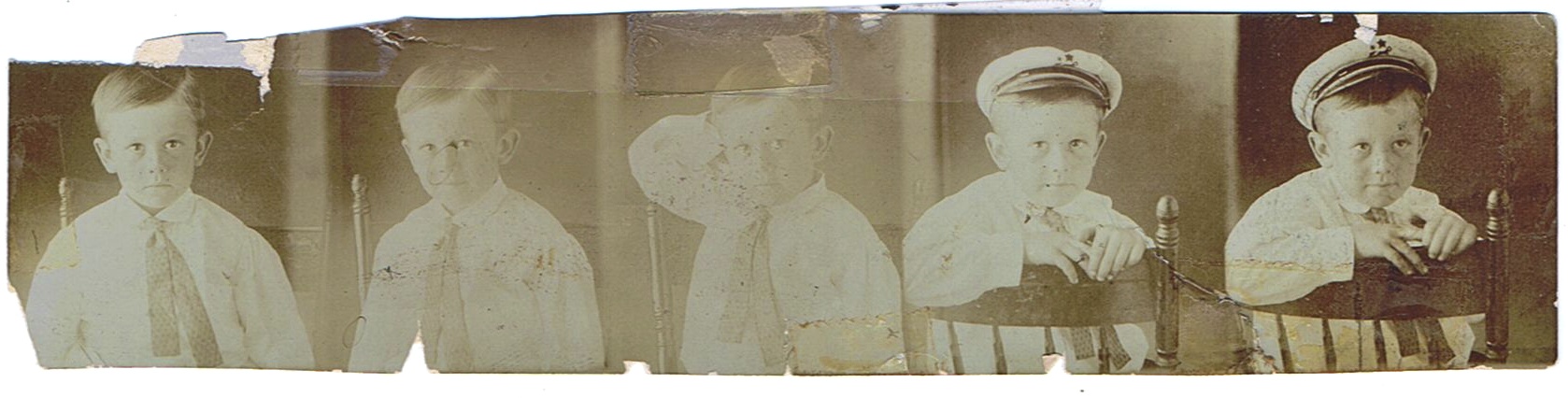
Long before photo booths gained popularity, Leonard Wiese of Chicago, Cook County, Illinois posed for this quaint series of photographs. Printed on a strip of flimsy paper, each individual photograph is about the size of a postage stamp. Leonard, the son of German immigrants Fred and Emma (Stübe) Wiese, was the youngest of five children,1 although an elder sister had died before he was born.2 He likely spent his early years at 46 Thomas Street,3 before his family moved to a new home, a large frame house, at 2502 North Neva Avenue.4 His father earned a living as a cigar maker, and must have done well in order to be able afford this home for his family.5

Leonard_Wiese_Photo_Strip_1905

Leonard Wiese, ca. 1905, Chicago, Cook, Illinois; digital image 2010, privately held by Melanie Frick, 2014.

Leonard looks to be about five years old in these photographs, dating them to approximately 1905. His hair is parted sleekly to the side, and he wears a white collared shirt with a patterned necktie. In the first three photographs, he poses formally while sitting upright in a chair. He has the hint of a smile in one, and artfully places his hand behind his head in another. In the final two photographs, he sports a pint-sized sailor cap while leaning playfully over the back of a wooden chair. His neat hair and dress suggest that these photographs were planned, yet the poses and setting seem more informal than what I would typically expect from a studio.

My first inclination, given the photo strip format, was to think that these photographs came from some sort of early predecessor to a photo booth, as automated photo booths didn’t spring up until 1926. Could there have been some sort of inexpensive arcade studio popular twenty years before? I also wondered if they might have been taken with an early model of a Kodak Brownie camera; another possibility is that they were proofs from which larger prints could be ordered. What do you think? This photo strip could easily have been cut apart and the individual photographs shared with friends or relatives. However, left intact, it allows a glimpse into several moments in Leonard’s boyhood in Chicago more than a century ago.

Continue reading

A Keepsake from Denmark

KathrineChristensen01

Kathrine Christensen, ca. 1905, Thisted, Refs, Denmark; digital image 2013, privately held by Nicole Kilanowski, 2014.

This is a beautiful cabinet card portrait by L. H. Gram of Thisted, Refs, Denmark, whose stamp features a quaint floral pattern. Kathrine Christensen of Vestervig, Thisted, Refs, Denmark, pictured here circa 1905, wears a dress with a high “officer’s” collar, set off by a simple looped chain necklace.1 A fine decorative fabric with crocheted lace trim is draped over her shoulders, something  like a shawl or an open collar. Her seemingly abundant hair is piled elegantly in the style of the time, with a few soft curls at her forehead.

Kathrine gazes just beyond the camera, her expression serious. In the summer of 1906, she would leave Denmark behind – saying farewell forever to her father and three of her siblings – to join five other siblings and their families in Iowa.2 This photograph was previously in the possession of her young niece, who immigrated to America with her parents a year before Kathrine.3 Perhaps Kathrine sent it along as a keepsake to be shared with her older siblings in advance of her own arrival; at least one of her sisters had not seen her since she was a toddler.4 It’s possible that additional copies remained in Denmark with her family and friends.

I have only a few photographs of Kathrine, my mother’s grandmother, and never would have seen this one in particular if it weren’t for my Public Member Tree on Ancestry.com. Several months ago, I heard from a member of the family of Kathrine’s aforementioned niece – a niece I hadn’t known existed until I found her in the records and added her to my tree a few days previously – who had come into possession of a collection of her family photos.5 This treasure was among them.

Continue reading

Tombstone Tuesday: Johanne Marie Larsen

Johanne Marie (Larsen) Walsted of Aalborg, Denmark was sixty-three years old when she immigrated to America in the spring of 1900.1 She traveled alone; her husband of thirty-two years had passed away the year before,2 and most of her children had already left Denmark for brighter opportunities in Iowa and Wisconsin. They had paid for her passage aboard the Norge, and she carried fifteen dollars.3

GracelandCemeteryJohannaWalstedGrave

Grave of Johanna M. Walsted, 1836-1914, Graceland Cemetery, Sioux City, Woodbury County, Iowa; image date 2001, privately held by Melanie Frick.

Johanne was christened on 28 September 1836 in Bolle, Nordjylland, Denmark, the daughter of Lars Jensen Bak and Ane Cathrine Christensdatter.4 At the age of thirty, she married Christian Jens Jacobsen Walsted,5 a widower with two young children, Jens Jacob and Lars Marinus Walsted. The couple went on to have seven more children together: Jensine Kathrine, Eskild, Lars Peter, Mandrup, Anna Kathrine, Ellen Eskelline, and Jens Jacob Walsted.6 All but two of the children, the elder Jens Jacob and Eskild, survived to adulthood.7 Christian was a shoemaker, and eventually moved with his family from rural Dronninglund to the city of Aalborg,8 where he died in 1899.9

By the time Johanne made her journey to America, six of her seven surviving children and step-children awaited her arrival. Only her youngest son remained in Denmark; he was to follow two years later.10 In the years to come, Johanne moved between the homes of her children, some of whom she hadn’t seen in more than a decade. She was enumerated in the 1900 U.S. census less than two months after her arrival in the country, at which time she resided with a daughter in Iowa;11 she later joined another daughter in Oklahoma City.12

Johanne’s health may have been poor in her later years; a notation on the ship manifest suggests that she had a deformity of some kind,13 and her death record stated that she suffered from senility.14 Johanne Marie (Larsen) Walsted died at the age of seventy-eight on 3 November 1914 in Sioux City, Woodbury County, Iowa. Services were held at the Danish Lutheran Church, and she was buried at Graceland Cemetery.14

Continue reading