Tag Archives: Illinois

The Pomeranians: Identifying a Family Photo

If you’d asked me about this photograph a few years ago, I might said that Joachim and Sophia were, in fact, Ernst and Friederike. That is, I might never have identified the couple in this cabinet card photograph if it weren’t for a few subtle clues that pointed me conclusively in the direction of one immigrant couple over another.

My grandmother’s paternal grandparents both came to America as infants, the son and daughter of Pomeranians from the region now known as Mecklenburg-Vorpommern, Germany. The first couple to reach America, Joachim and Sophia (Cammin) Wiese, traveled from Hamburg in 1868.1 The second couple, Ernst and Friederike (Wagner) Stübe, traveled from Hamburg in 1869.2 Both couples settled initially in Chicago, although within a few years, Ernst and Friederike would move to a rural community outside the city. The couples were born within several years of each other, and no other identified photographs of either couple existed in my collection in order to aid in their identification. Based on the provenance of this photograph in a family collection, I knew that it must show one of these two couples.

JoachimWieseSophiaCammin

Joachim and Sophia (Cammin) Wiese, ca. 1885-1890, Chicago, Cook, Illinois; digital image ca. 2000.

The man and woman in this photograph are perhaps in their mid-fifties, give or take a decade. The photograph itself, taken by an unidentified Hansen of Chicago, is a cabinet card, a style that became popular after the Civil War.3 This, of course, fits the time period in which the Wieses and Stübes would have lived in Chicago. However, as both couples were only around thirty years of age in 1870, this photograph was more likely taken at some point between 1880 and 1900.

The woman in the photograph wears her hair parted in the middle and pulled back snugly, a no-nonsense style that is not specific to any era. Her ears are pierced and she wears what appears to be a dark wool suit with a fitted basque jacket featuring a high ruffled collar, a single row of buttons, and cuffed sleeves. Notable is the double row of boxed pleats on her underskirt; this style was popular in the latter half of the 1880s, as was the style of her jacket.4

The man is clean-shaven except for a trimmed neckbeard, and his hair is brushed away from his face. He has light-colored eyes – blue or green – and wears a typical three-piece suit. The age of the couple in this photograph as well as their style of dress suggest that, if this photograph was taken to mark a particular occasion, it may have been to commemorate an event such as their twenty-fifth anniversary.

Joachim and Sophia would have celebrated their twenty-fifth anniversary circa 1890, a date calculated based on their ages and the birthdate of their eldest known child.5 Ernst and Friederike, however, did not reach such a milestone; Ernst died in 1879 at the age of forty.6 As the woman’s clothing in particular is markedly different from the styles of the 1870s, this photograph could not have been taken before 1879, and thus cannot be a photograph of Ernst and Friederike (Wagner) Stübe.

A final clue comes from the notation penned at the bottom of the cabinet card by a descendant: “Fatte + Matte?”7 A letter written by the granddaughter-in-law of Joachim and Sophia noted that his grandsons could not recall their names, but had called them “Fatta” and “Mota.”8 Coincidence? I don’t think so. My hunch is that these are phonetic spellings of perhaps an old dialect-based variation of the German words for father and mother, Vater and Mutter. This is how Joachim and Sophia (Cammin) Wiese were remembered by their children and grandchildren.

Copyright © 2015 Melanie Frick. All Rights Reserved.

Continue reading

A Glimpse of Hyde County

Three years ago, my husband and I were in our final year of graduate school and in search of something to do over spring break. We lived in Northern Virginia at the time, so my husband suggested exploring the Outer Banks – about a five hour drive south. As soon as I determined that the Outer Banks were only a stone’s throw from mainland Hyde County, North Carolina, I was on board.

Why the fuss about Hyde County? I knew that this was the place from which my Stilley ancestors – who settled on the Illinois frontier in the early nineteenth century – had likely hailed. And for me, the ideal vacation includes at least some genealogical or historical element, paired, of course, with beautiful scenery, good local food, plenty of photo ops, and a travel companion willing to humor me.

P1050418

My direct ancestor Nancy Stilley, born in 1819 in Franklin County, Illinois, can almost certainly be linked to the other Stilleys scattered throughout southern Illinois who had roots in Hyde County, North Carolina. Nancy is believed to have been a granddaughter of the Hezekiah Stilley who was a resident of Hyde County as late as 1800 and whose numerous children – later residents of southern Illinois – are named in a family Bible.1 In the interests of full disclosure (I’m looking at you, Ben Affleck), I will add that Hezekiah Stilley likely married the daughter of Hyde County landowner and enslaver William Davis, who died there circa 1803.2 His will named eight enslaved individuals, Jemima, Gabrel, Joseph, Moses, Kesiah, Cate, Judith, and Silard, all of who were to remain with his wife and selected children after his death.3

P1050417

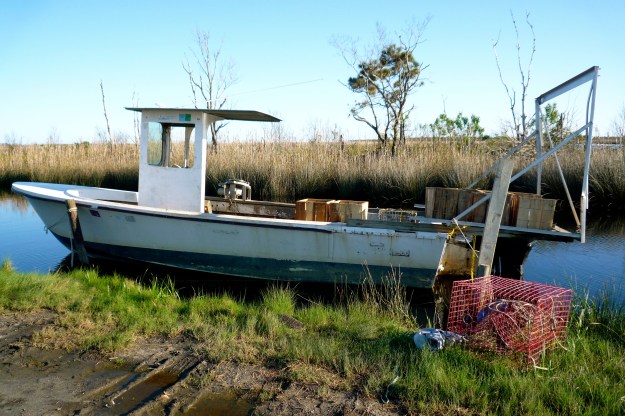
We had only a couple of hours to spend driving through the Inner Banks of Hyde County, but while this was not an in-depth research venture, it was still incredible to get a feel for the landscape that would have been familiar to my ancestors. I was glad to find that the county is still very rural; according to the 2010 census, the population is under six thousand people, comparable to its size two centuries ago. I believe we drove for an hour through the swamps and marshes without seeing another human being, and the only signs of civilization for much of our drive were an untended boat and an abandoned but well-kept ghost town.

P1050422

Hyde County, North Carolina also encompasses Ocracoke Island, a popular tourist destination on the Outer Banks that we visited via ferry. The island boasts quaint shops, stunning herds of wild horses, and locals who speak a distinct Ocracoke brogue that traces back to the dialect of the early colonists. It’s a must-see along the Outer Banks. The Inner Banks, in sharp contrast, are on the road less traveled – but one I would most definitely like to travel again.

Copyright © 2015 Melanie Frick. All Rights Reserved.
Continue reading

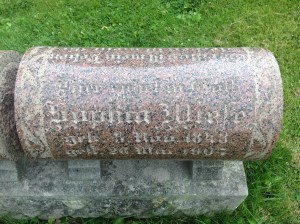
Tombstone Tuesday: Joachim and Sophia (Cammin) Wiese

It can often feel like a lost cause to submit Find A Grave Photo Requests for graves that are situated in enormous, urban cemeteries, but as I learned last week, when an anonymous contributor answered my plea for two photographs from Concordia Cemetery in Cook County, Illinois, it is possible to get lucky.

Joachim Wiese Grave

Find A Grave, Inc., Find A Grave, digital image (http://www.findagrave.com : accessed 13 July 2014), photograph, Joachim Wiese (1841-1915), Memorial No. 123360232, Concordia Cemetery, Forest Park, Cook, Illinois; photograph by Anonymous, 2014. Note: The German script reads, “Hier ruhet in Gott” [Here rests in God].

Joachim and Sophia (Cammin) Wiese were Pomeranian immigrants who spent most of their adult lives in Chicago, Cook County, Illinois. On 1 November 1868, accompanied by their young son, Frederick “Fritz” Wiese, and a host of other relatives, they boarded the Electric in the great port of Hamburg.1 Their voyage lasted nearly two months; they arrived in New York the day after Christmas, 1868.2

Apparently without further ado, the family made their way to the Midwest. 1870 found them living in the urban center of Chicago, where Joachim was employed as a day laborer.3 The Chicago Fire of 1871 must have had an impact on their early years in the city; the family belonged to the predominantly German First Bethlehem Lutheran Church,4 established in an area that was developed in the years following the fire.5 By 1880, Joachim Wiese was employed as a tailor,6 a trade he continued at least for the next two decades.7 Perhaps Sophia was able to assist her husband with his work, in addition to raising their children.

Sophia Wiese Grave

Find A Grave, Inc., Find A Grave, digital image (http://www.findagrave.com : accessed 13 July 2014), photograph, Sophia Wiese (1843-1907), Memorial No. 123360289, Concordia Cemetery, Forest Park, Cook, Illinois; photograph by Anonymous, 2014. Note: The German script reads, “Hier ruhet in Gott” [Here rests in God].

In all, six children were born to the Wiese family: Frederick (1866-1914),8 Mary (1870),9 John C. (1873-1943),10 Minna (1876-1945),11 William (1879-1882),12 and Arthur Louis (1886-1932).13 Five children survived to adulthood; sadly, William died of diphtheria at the age of two.14

Sophia (Cammin) Wiese died of pneumonia at their home on Marion Place on 26 May 1907, at which time she was said to be sixty-four years of age.15 Joachim Wiese died at home on 2 June 1915 at seventy-four years of age.16 Their funeral services were held at the First Bethlehem Lutheran Church, and they are buried beside their son at Concordia Cemetery in Forest Park, Cook County, Illinois.

Continue reading

Military Monday: “Although he was on his Dieing Bed”

Compiled service record, John Fenton, Pvt. Co. M, 3 Illinois Inf.; Carded Records, Volunteer Organizations, Civil War; Records of the Adjutant General’s Office, 1780s-1917, Record Group 94; National Archives, Washington, D.C. Color edited for clarity.

Compiled service record, John Fenton, Pvt. Co. M, 3 Illinois Inf.; Carded Records, Volunteer Organizations, Civil War; Records of the Adjutant General’s Office, 1780s-1917, Record Group 94; National Archives, Washington, D.C. Image color edited for clarity.

As spring turned to summer in the year 1862, John Fenton of Company M of the 3rd Illinois U.S. Cavalry lay dying in a hospital bed in Lebanon, Laclede County, Missouri. He had enlisted the previous autumn, eager to do his part for the Union, but in April, following the Battle of Pea Ridge in Arkansas, he was hospitalized with typhoid pneumonia.1

At the time of his enlistment, John, a native of Bole, Nottinghamshire, England, was a widower with four children at home in Pana, Christian County, Illinois.2 After his death on 7 June 1862, A. W. Bingham, a hospital steward, penned a sympathetic but hurried letter to John’s eldest daughter, Sarah Alice Fenton, informing her of her father’s passing:3

“Lebanon, MO
June 7th 1862

Miss Fenton

You will be of course Serprised in Receiving a letter from one that never beheld your face or eaven had the honor of knowing your nam but through one that is or has been Dear to you your Father, he was admitted in this Hospital on the 22d day of April Sinse then he has been leaberin under Tyford Pneumonia which at last terminated in his death, which was at 7 Oclock this evening June the 7th he was a long time dieing and told me he wished me to write to you and all for him to put your confidence in christ and he hoped to meet you in the world to come he talked of and would of liked very much to see you but when god comes there is no alternative but to resign our will so he done so and diese in piece, you must not take it hard for we as soldiers have no limited time for our lives and when we enlist in our Countrys call we make up our mind to meet death when god thinks proper to call us away, your Father requests me to tell you also to collect what money was due him and put it to as good use as you thought people he wished you to see to the small children and bring them up in his fear and love of God which no doubt you will and he felt satisfyed you would do so, remembering he was your Father although he was on his dieing bed.

Continue reading

Tombstone Tuesday: Nancy Stilley

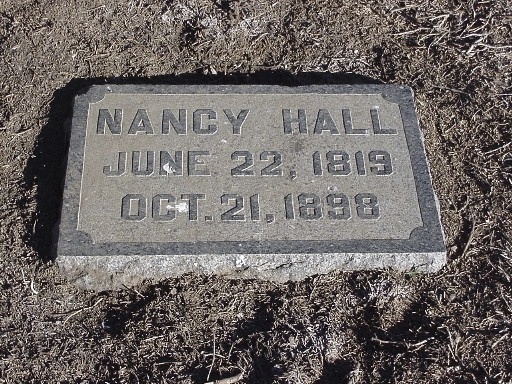
Nancy Stilley was raised on the Illinois frontier, and died a pioneer in Kansas. From what little I know about her life, she’s a perfect example of a “Fearless Female” whose story should be shared in honor of National Women’s History Month.

nancy_stilley_hall

Grave of Nancy (Stilley) Holman Edwards Hall (1819-1898), Gypsum Cemetery, Gypsum, Saline County, Kansas, image date unknown, privately held by V.S.H. [personal information withheld], 2014.

According to her obituary, Nancy Stilley was born 19 June 1819 in Franklin County, Illinois.1 It’s likely that she never attended school,2 although she was said to have joined the Baptist church at the age of thirteen.3 Records suggest that she may have married as many as three times. Her first marriage took place in 1836; she married Thomas Holman of Hamilton County, Illinois.4 Her second marriage took place in 1843; she married Joseph Edwards of Washington County, Illinois.5 Her third and final marriage took place in 1847; she married Elithan Hall of Washington County, Illinois.6 This marriage, too, was short-lived. After her husband’s death in May of 1860,7 Nancy, still just forty years old, was left a widow with nine children at home.8 This time, she did not remarry.

Although it must have been difficult, Nancy seems to have managed her household and farm through the tumultuous years of the Civil War. Following the settlement of her husband’s estate in 1868,9 she relocated to Kansas with her children, including those who now had families of their own.10

By 1870, Nancy had settled in Solomon, Saline County, Kansas, where she held a respectable amount of real estate worth $1100 and personal property worth $600.11 Four children, between the ages of twelve and sixteen, were at home.12 Nancy was to remain in Kansas for the remainder of her life, eventually joining the household of her eldest son.13 She lived to the age of seventy-nine, her death the result of an unfortunate accident during what was likely a routine visit to her children and grandchildren:

“Last Friday morning, October 21, 1898, Mrs. T. G. McCance hitched a team to a buggy for the purpose of driving her mother, Mrs. Nancy Hall, to the residence of her son, E. L. McCance. Just as the ladies started the team suddenly turned the vehicle enough to throw the occupants to the ground. Mrs. Hall struck the ground with sufficient force to tear the flesh from one side of the face, break the cheek bone and inflict internal injuries, from which she died in a few hours.”14

Nancy was buried two days later, her burial attended “by a large number of friends and relatives,” in the Gypsum Cemetery in Gypsum, Saline County, Kansas.15

Continue reading

A Vintage Photo Strip

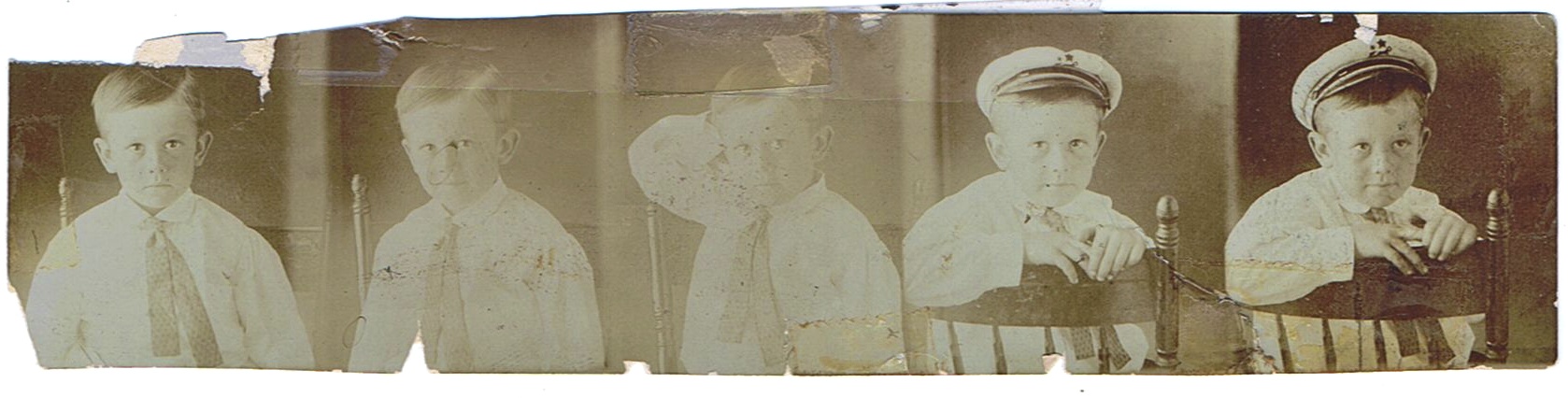
Long before photo booths gained popularity, Leonard Wiese of Chicago, Cook County, Illinois posed for this quaint series of photographs. Printed on a strip of flimsy paper, each individual photograph is about the size of a postage stamp. Leonard, the son of German immigrants Fred and Emma (Stübe) Wiese, was the youngest of five children,1 although an elder sister had died before he was born.2 He likely spent his early years at 46 Thomas Street,3 before his family moved to a new home, a large frame house, at 2502 North Neva Avenue.4 His father earned a living as a cigar maker, and must have done well in order to be able afford this home for his family.5

Leonard_Wiese_Photo_Strip_1905

Leonard Wiese, ca. 1905, Chicago, Cook, Illinois; digital image 2010, privately held by Melanie Frick, 2014.

Leonard looks to be about five years old in these photographs, dating them to approximately 1905. His hair is parted sleekly to the side, and he wears a white collared shirt with a patterned necktie. In the first three photographs, he poses formally while sitting upright in a chair. He has the hint of a smile in one, and artfully places his hand behind his head in another. In the final two photographs, he sports a pint-sized sailor cap while leaning playfully over the back of a wooden chair. His neat hair and dress suggest that these photographs were planned, yet the poses and setting seem more informal than what I would typically expect from a studio.

My first inclination, given the photo strip format, was to think that these photographs came from some sort of early predecessor to a photo booth, as automated photo booths didn’t spring up until 1926. Could there have been some sort of inexpensive arcade studio popular twenty years before? I also wondered if they might have been taken with an early model of a Kodak Brownie camera; another possibility is that they were proofs from which larger prints could be ordered. What do you think? This photo strip could easily have been cut apart and the individual photographs shared with friends or relatives. However, left intact, it allows a glimpse into several moments in Leonard’s boyhood in Chicago more than a century ago.

Continue reading

The FAN Principle: Finding Family in Southern Illinois

Isaac_Hall_Probate01

Washington County, Illinois, Isaac Hall probate file, Box 22, County Court; Illinois State Archives, Springfield.

Of course, it would have been too easy if Isaac Hall of Washington County, Illinois had named all of his surviving children in his last will and testament. Although probate records can be excellent resources for genealogists, they don’t always provide all of the details that one would hope. When Isaac dictated his wishes to two witnesses in January of 1852, he stated only that his “eldest son,” Jonathan Hall, was to receive all of his lands, goods, and chattels.1 He named this same son as the sole executor of his estate. Isaac made his mark, and went on to live less than two months more; his will was filed on 15 March 1852.2

Fortunately, there are other resources that provide clues as to who at least some of the other children of Isaac Hall may have been. Among them is the 1850 U.S. census for District 20, Washington County, Illinois, which counts three Hall households in a row. In the first lived Elathan Hall, thirty-seven, a farmer from Tennessee.3 In the second lived Isaac Hall, forty-five, also a farmer from Tennessee.4 In the third lived Jonathan Hall, fifty, a farmer who was a native of North Carolina,5 as was the only other adult male resident of the household, Isaac Hall, seventy-four.6 Although relationships between members of a household were not recorded in the 1850 census, based on the information provided, it seems logical to assume that the senior Isaac was Jonathan’s father, and that they were, in fact, the same Isaac and Jonathan of the aforementioned probate record. Their living arrangement suggests why Isaac may have felt so indebted to his eldest son when it came time to pen his will. Perhaps he had spent many years in the care of his son’s family.

And what of the younger Isaac Hall and Elathan Hall who lived next door, or, rather, on neighboring farms? No, they had not been born in North Carolina – but Tennessee falls between North Carolina and southern Illinois, making it a likely stop for a family that may have gradually migrated west. The thirteen-year age span between Jonathan, the younger Isaac, and Elithan suggests a possible sibling relationship. An exploration of additional records indicates that these families were closely linked for decades.

This is a perfect example of the importance of Cluster Research, also called the FAN Principle – an awareness of an ancestor’s Friends, Associates, and Neighbors – explored by Elizabeth Shown Mills.7 I should note that my dad stressed the importance of this principle to me in my research long before we knew that it had a name! How have you used the FAN Principle in your research?

Continue reading

A Chicago Couple

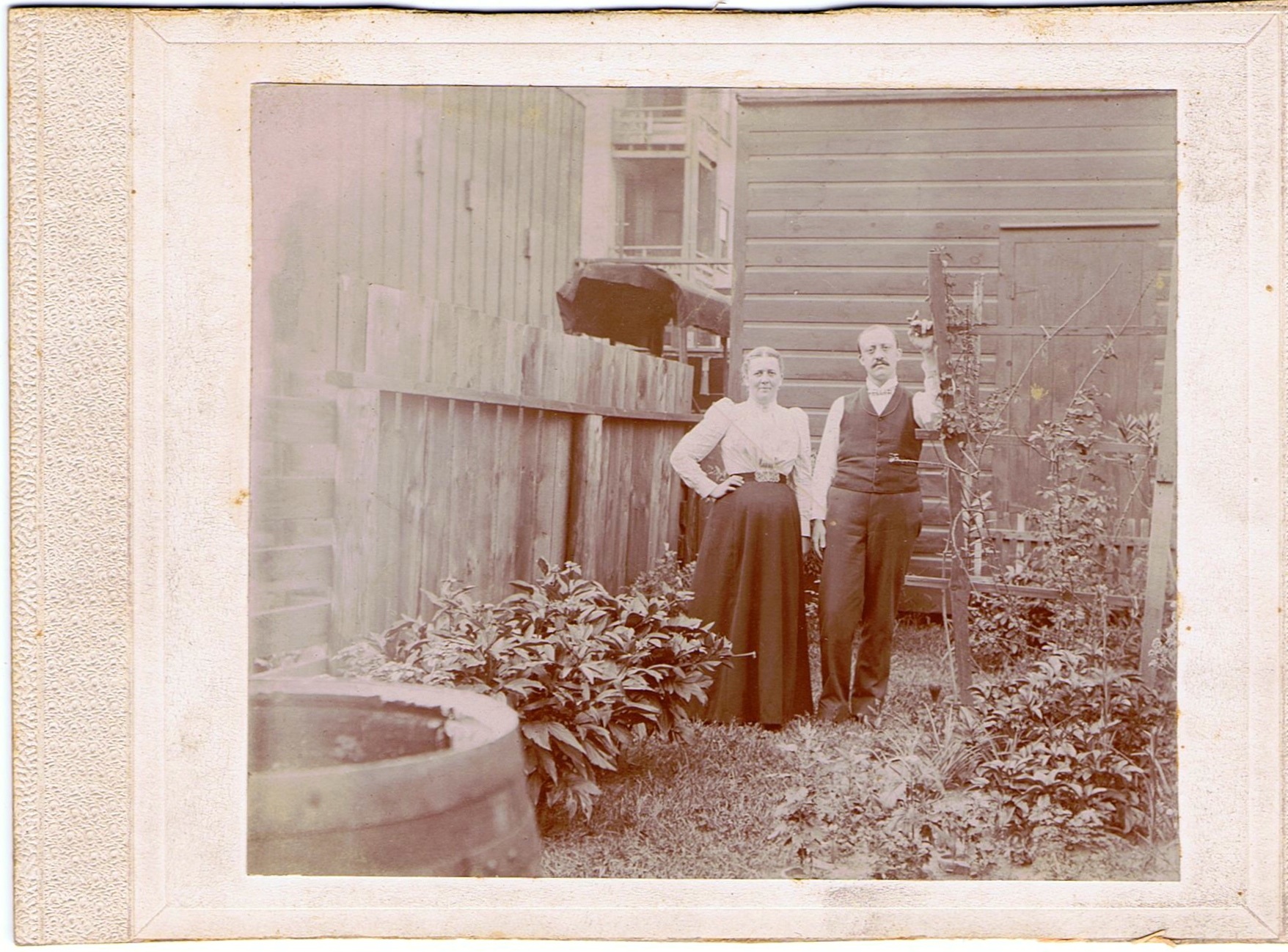
FredWieseEmmaStube

Fred and Emma (Stube) Wiese, ca. 1900; digital image 2010, privately held by Melanie Frick, 2014.

This glimpse into a backyard garden at the turn of the twentieth century features Fred and Emma (Stube) Wiese of Chicago, Cook County, Illinois. Fred rests his hand on a trellis while Emma stands close by his side, her hand on her hip. Their arms barely brush together as they gaze directly at the camera.

Emma wears everyday attire in the form of a simple dark skirt and a collared shirtwaist. Her skirt is belted high, with an adornment of some kind at the center of the waistband. It looks to me like she could have been pregnant at the time that this photograph was taken, which seems entirely possible as she was pregnant no less than five times between 1887 and 1900.1

However, Emma’s sleeves are not nearly as full as those seen during much of the 1890s, nor are they as tight as those of the decade prior. Perhaps this suggests that the photograph dates closer to 1900,2 which is when her youngest child was born.3 She and her husband were both in their early thirties at this time, and I don’t feel that they could have been significantly younger in this photograph.4

Fred wears somewhat loose trousers and a collared shirt, set off by a buttoned vest and a checked bow tie. Most notably, he sports a full mustache, and what hair he has is cut short. With the exception of his pants, which typically would be more fitted, this, too, fits the time period.5

The photograph, pasted on an embossed white card, is clear and of good quality, despite the fact that it is a seemingly casual shot. Might it have been taken by a traveling photographer who passed through the neighborhood, offering his services? Fred and Emma are not dressed in their best, although their simple attire was certainly presentable enough for a photograph. Perhaps their urban garden was a source of pride, making it an ideal spot for the couple to pose together.

Continue reading

Wedding Wednesday: Swell Times in Chicago

HelenLeonardWedding

Leonard and Helen (Nelson) Wiese, Chicago, Cook, Illinois, 1924; digital image 2010, privately held by Melanie Frick, 2014.

On the evening of 5 January 1924, Leonard John Christian Wiese and Helen Margaret Nelson were married in Chicago, Cook County, Illinois.1 Leonard had been raised in Chicago, the son of German immigrants,2 whereas Helen had been raised in rural Yankton County, South Dakota, the daughter of Danish immigrants.3 The couple met when Leonard sought work in South Dakota, and he and Helen bonded over a shared love of music.4 Leonard and his bride-to-be then moved to Chicago, where they were wed in the home of Leonard’s widowed mother.5 Since Helen’s family was not able to be with them, she wrote a detailed letter home describing their wedding day:

My dear folks,

Now I think that this letter will have to be passed around so I won’t have to repeat all the details of the past few days. We are married! Yes. Now then I will endeavor to tell you the points which I think will be of interest to you.

My dress was very plain but everyone liked it. Dark brown brocaded silk with short sleeves and sort of a drape on the skirt. I have a new coat and hat and new satin shoes.

Well, there were eighteen grown people here. We were married at 9:30. Stanley Smith played the wedding march and Irene and I came from upstairs and met the other two in the room. After the ceremony, a shower of rice descended upon us and the best man and several of the others took advantage of the privilege of kissing the bride. So it was on the order of some of the weddings you read about!!!

Then we had dinner. Turkey, chicken, mashed potatoes, peas, corn relish, cranberries, dressing, Jello, coffee, etc. A huge wedding cake adorned the center of the table. This cake was made to order. You people are going to have some of it. I baked two angel food cakes and a sponge cake. That’s all I did in helping preparations.

I spent some time at the hairdresser’s! Oh, I looked real swell!!!

After supper we had music and some of the men played cards. Then after awhile we started the Victrola and we all danced.

Continue reading

The Citizens of the Big Creek Settlement: From Reconstructed Census Records to a Legislative Petition

In September, I attended the Illinois State Genealogical Society’s free webinar, “’To the Honorable, the General Assembly’ – The Treasure Trove in Legislative Petitions,” presented by the always informative Judy G. Russell of The Legal Genealogist.1

Judy’s advice about how and where to find legislative petitions was helpful, as was her point that one won’t often find an indexed list of the names of all of the signers of a given petition (darn!). Instead, she suggested, look specifically for petitions that were created where your ancestor lived, and that concerned a cause that your ancestor was likely to have cared about.2

It was also emphasized how handy petitions can be when they fall between a census year.3 In fact, the names of the signers on some petitions have also been used to reconstruct early census records. I recently noticed an instance of this when searching for my Stilley ancestors of southern Illinois on Ancestry.com. My search brought me to “U.S. Census Reconstructed Records, 1660-1820.”4

In one example, several men with the surname Stilley are listed as having resided at the Big Creek Settlement, Illinois Territory, in 1810. However, a closer look at the entry shows that the men were named on a petition dated 6 December 1812.5 This petition concerned the desire of the “poor Industrious Inhabitants, faithful Citizens of the United States” to acquire land west of the Ohio and Mississippi rivers, and a proposition for the sale of no more than 200 acres of said land to each male citizen over the age of eighteen, or each female head of household, for a cost of twelve and a half cents per acre. Allowing the inhabitants to acquire land, the petitioners continued, would further serve to “prevent Rebellions, remove animosities, Cement an union, and promote happiness” throughout the United States.6

Although, to my knowledge, none of these particular Stilleys were my direct ancestors, the presence of these names on the petition suggests to me that, at the very least, some of the extended family had started to settle in this western territory as early as 1812, perhaps paving the way for other members of the Stilley family to follow.


SOURCES
1 Judy G. Russell, “’To the Honorable, the General Assembly’ – The Treasure Trove in Legislative Petitions,” Illinois State Genealogical Society: ISGS Webinars, 2013.
2 Judy G. Russell, “’To the Honorable, the General Assembly’ – The Treasure Trove in Legislative Petitions.”
3 Judy G. Russell, “’To the Honorable, the General Assembly’ – The Treasure Trove in Legislative Petitions.”
4 “U.S. Census Reconstructed Records, 1660-1820,” database, Ancestry.com (http://www.ancestry.com : accessed 3 December 2013); citing Territorial Papers of the United States, vol. 16, p. 274.
5 “U.S. Census Reconstructed Records, 1660-1820,” database, Ancestry.com (http://www.ancestry.com : accessed 3 December 2013), entries for David Stilley, John Stilley, and Stephen Stilley, 1810, Big Creek Settlement, Illinois Territory; citing Territorial Papers of the United States, vol. 16, p. 274.
6 “To James Madison from the Citizens of the Big Creek Settlement, 6 December 1812 (Abstract),” Founders Online, National Archives (http://founders.archives.gov/documents/Madison/03-05-02-0396 : accessed 3 December 2013); The Papers of James Madison, Presidential Series, vol. 5, 10 July 1812–7 February 1813, ed. J. C. A. Stagg, Martha J. King, Ellen J. Barber, Anne Mandeville Colony, Angela Kreider, and Jewel L. Spangler (Charlottesville: University of Virginia Press, 2004), pp. 485–486.