Tag Archives: 1890s

Tombstone Tuesday: Mathias and Elisabeth (Hoffmann) Noehl

At the tail end of the nineteenth century, two German immigrants made the decision to forge their lives together in America. Mathias Noehl was born to Michael and Magdalena (Hoffmann) Noehl on 22 April 1868 in the village of Holsthum, Germany,1 and Elisabeth Hoffman was born to Mathias and Anna (Marbach) Hoffmann on 16 September 1869 in the neighboring village of Prümzurlay.2 They never met as children, and both made their own ways to America, Mathias in 1886 and Elisabeth in 1890.3

Mathias_Noehl_Grave

Grave of Mathias Noehl (1868-1950) and Elizabeth Noehl (1869-1957), St. Aloysius Cemetery, Calmar, Winneshiek County, Iowa; digital image date unknown, privately held by Melanie Frick, 2014.

Elisabeth soon found a place for herself in North Washington, Chickasaw, Iowa, where she kept house for a local priest, Father Probst. According to her husband’s memoirs, it was during this time that Mathias, who had recently made his way from unfruitful ventures in Minnesota in search for new opportunities in Iowa, happened to pass by Elisabeth’s home. He wrote:

“I was in a neglected condition: My suit of clothes appeared to have seen better days. A hailstorm seemed to have come over my hat. My blond hair lay around my temples unkempt like dried up flowers of the cemetery. When she heard that I had come from her neighborhood village, Holsthum, she said to herself, ‘That is a disgrace to the whole valley of Prüm. He must be hidden from the streets of North Washington, even if I have to marry him.'”4

Marry they did on 22 September 1896, by the same Father Probst who had been Elisabeth’s employer.5 Mathias later wrote of the “joyless” early years of their marriage, during which time the couple struggled to make a living in Alberta and Minnesota before finally returning, poverty stricken, to Iowa. He wrote, “Although children are not always a blessing for parents, they help to lead many a marriage through the inevitable storms between two persons, whose different characters must be adjusted to each other.”6 Whether his statements were sincere or tongue-in-cheek is unknown, but the couple would, indeed, go on to celebrate the births of nine children: Leo, Helen, Kathryn, Elinor, John, Aloysius, Francis “Frank,” Frances, and Joseph Noehl.

Although Mathias once dreamed of relocating with his family to Oregon or Canada, in the end they farmed for many years near New Hampton, Chickasaw, Iowa. In 1946, a year after their retirement from farm life, Mathias and Elisabeth celebrated fifty years of marriage surrounded by their children and grandchildren.7 Mathias died in Calmar, Winneshiek, Iowa, on 31 January 1950; Elisabeth died seven years later on 9 February 1957. Both are buried at St. Aloysius Cemetery in Calmar.8

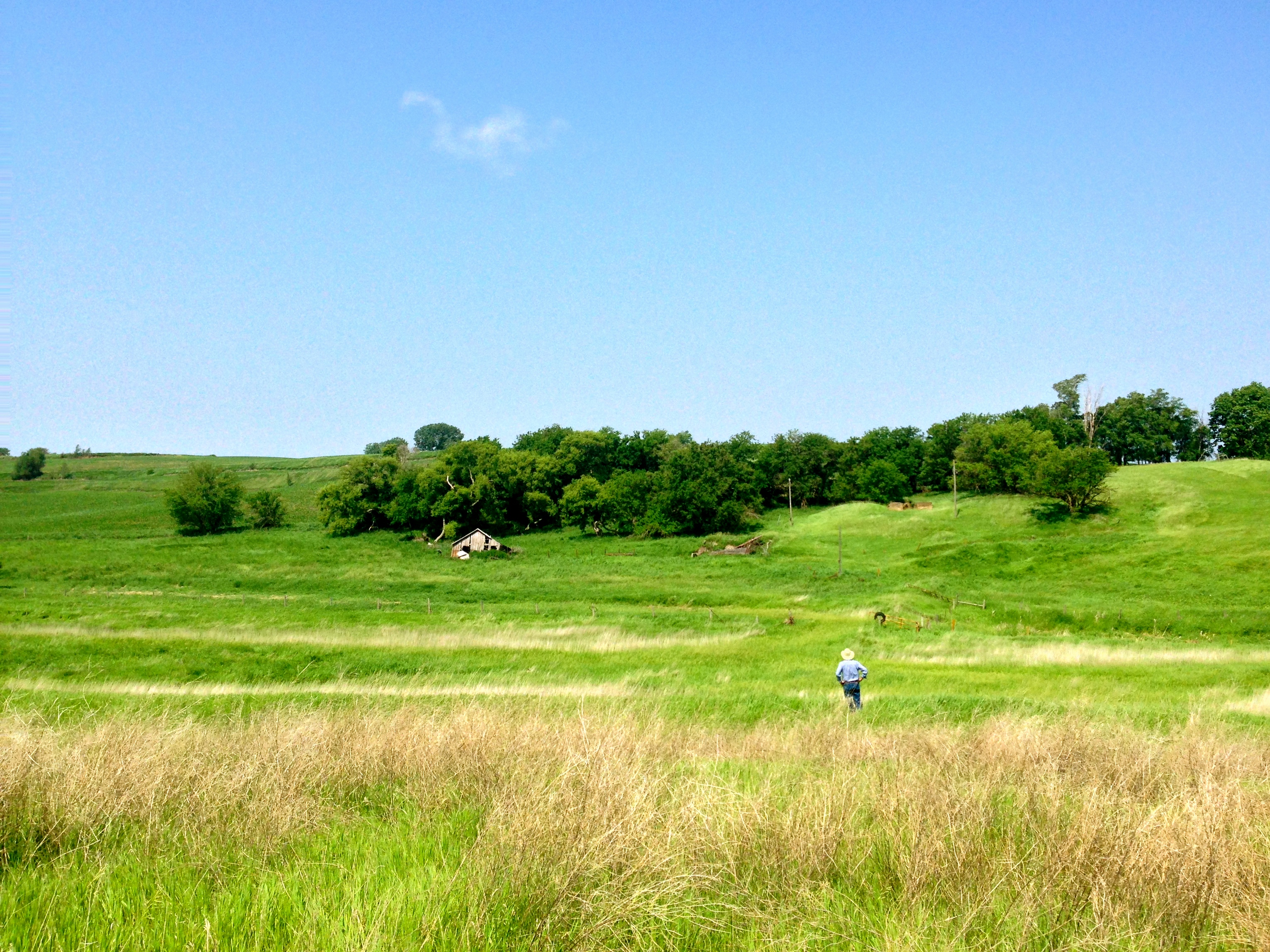
Continue reading

Back to the Land: Finding an Ancestor’s Iowa Homestead

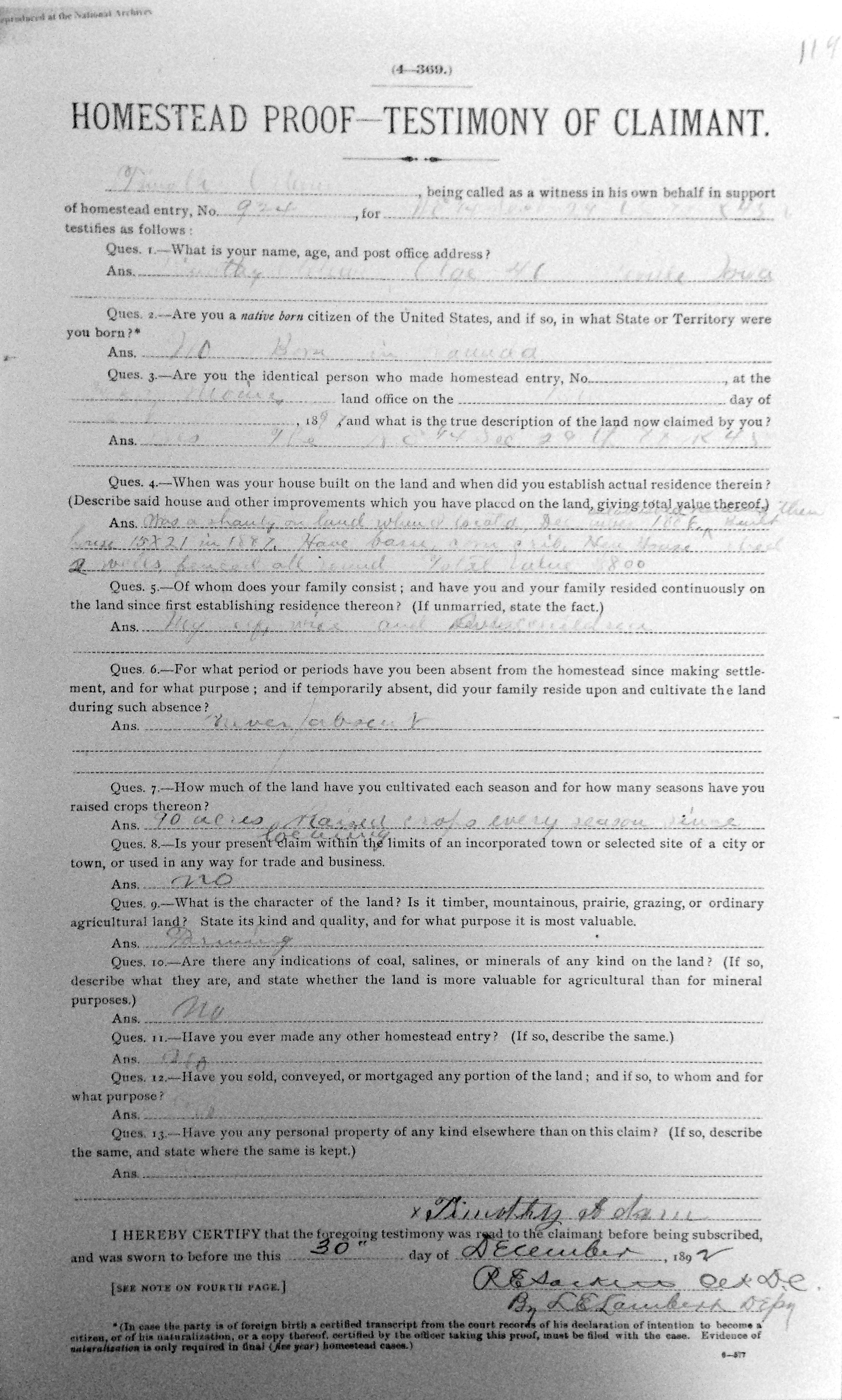
While tracking down the exact location of your ancestor’s land may seem daunting, last month, I learned that it’s entirely possible to get from this: Timothy Adam BLM…to this:

IMG_3409

Timothy Adam Homestead Site, Moville Township, Woodbury County, Iowa; digital image 2014, privately held by Melanie Frick, 2014.

It wasn’t until recently that I learned that my ancestor Timothy Adam homesteaded in Woodbury County, Iowa.1 I was excited to find that his homestead was just a short hop from the Woodbury County Fairgrounds in rural Moville Township, making it an area that, thanks to my years in 4-H, is familiar to me. I thought how funny it would be if I would happen to know who lived on his land today.

That thought remained in the back of my mind as I prepared to plot the location of the NE ¼ of Section 29, information obtained online from the Bureau of Land Management General Land Office Records and verified in record copies from the National Archives. Armed with the legal land description, I turned to the Plat Book of Woodbury County, Iowa, available online through the Iowa Digital Library.

After locating the quarter section where the Adam family spent the latter part of the nineteenth century, I took note of any landmarks – including nearby towns, roads, and waterways – that would help pinpoint the homestead site on a modern map. As Moville Township is still comprised of farmland broken into the orderly squares that make up the Midwest’s patchwork landscape, it was easy enough to identify the right quarter section via satellite image on Google Maps.

Timothy Adam Google MapsAfter zooming in on a grove of trees on the appropriate quarter, it was even possible to see that there was an old home site located there. Thank you, Google Maps!

Timothy Adam Home Site Google MapsThe next step, of course, was to visit the land where Timothy and Odile (Millette) Adam, pictured here, once lived. My parents and I embarked on an expedition to the back roads southeast of Moville, where we stopped at a neighboring farm to ask if we might have permission to trek to the home site. There, we discovered that the owners were, indeed, a family that we knew from 4-H! Despite the shock of us showing up on her doorstep for perhaps the most unexpected reason imaginable, our friend kindly gave us permission to take a shortcut across the pasture with our truck.

According to a local newspaper, a tornado that hit the area in 1928 was said to have caused significant damage to what remained of the homestead: “Southwest of Moville on the old Timothy Adam farm now owned by W. H. Rawson trees in the orchard were uprooted, corn crib, machine shed, barn, hog house and chicken house were swept away. The house is the only building left standing.”2 Today, not even a house remains, but it was fascinating to explore the old foundations and to imagine just how little, perhaps, the view from the homestead had changed.

IMG_3431

Timothy Adam Homestead Site, Moville Township, Woodbury County, Iowa; digital image 2014, privately held by Melanie Frick, 2014.

Continue reading

An Iowa Homestead

Winter was well on its way when Timothy Adam claimed a homestead near Moville, Woodbury County, Iowa, in December 1886. At that time, only a claim shanty existed on the property.1 I have to wonder if Timothy weathered the winter alone, with his wife and children situated somewhere in town, or if they joined him in what certainly must have been far from ideal living conditions. In any case, the next year, Timothy built a house that measured fifteen by twenty-one feet – three hundred and fifteen square feet for a family of six.2

IMG_3179

Timothy Adam (Woodbury County) homestead file, final certificate no. 2560, Fort Des Moines, Iowa, Land Office; Land Entry Papers, 1800-1908; Records of the Bureau of Land Management, Record Group 49; National Archives, Washington, D.C.

The Homestead Act was signed by President Abraham Lincoln on 20 May 1862.3 My first ancestor who took advantage of the one hundred and sixty acres offered to qualified applicants who lived on the land for five years and made specified improvements was Jens Madsen Schmidt, a Danish immigrant who settled in South Dakota in 1870.4 I had assumed that any ancestors who claimed homesteads in the years to follow would have had to journey even further west to find available land, but as it turns out, this was not necessarily the case. It would be sixteen years before Timothy would claim his homestead to the east, in northwestern Iowa.

The new yet modest house must have seemed positively roomy in comparison to the original shanty, and perhaps it was an improvement over what may have been an even more crowded situation back in Massachusetts. Timothy had been born and raised in St. Pie, Quebec, but by the time he was twenty, he had settled in Indian Orchard, Hampden County, Massachusetts, with his wife, Odile Millette.4 For nearly two decades, they relied on the cotton mills to earn a living, although Timothy was a carpenter by trade.5 Life in Massachusetts was likely difficult; Odile reportedly gave birth to ten children, of whom only five survived to adulthood.6 At least one succumbed to scarlet fever.7

Life in Iowa proved to be a fresh start for the family. Within a few years, the homestead boasted a barn, corn crib, hen house, shed, two wells, and fencing, valued altogether at eight hundred dollars. Timothy had cultivated ninety acres, and had raised crops every season. In addition, he had become a naturalized citizen. Finally, in 1893, at the age of forty-five, Timothy Adam became the proud owner of the NE 1/4 of Section 29, Township 88N, Range 45W in Woodbury County, Iowa.8

Continue reading

Tombstone Tuesday: Nancy Stilley

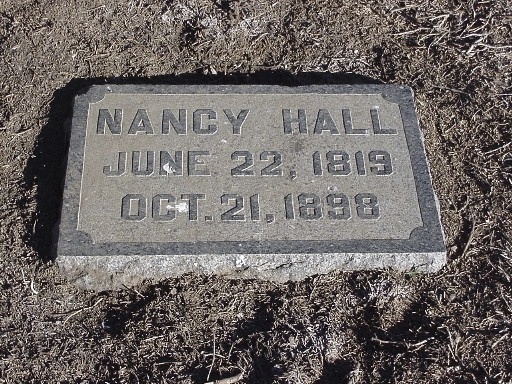
Nancy Stilley was raised on the Illinois frontier, and died a pioneer in Kansas. From what little I know about her life, she’s a perfect example of a “Fearless Female” whose story should be shared in honor of National Women’s History Month.

nancy_stilley_hall

Grave of Nancy (Stilley) Holman Edwards Hall (1819-1898), Gypsum Cemetery, Gypsum, Saline County, Kansas, image date unknown, privately held by V.S.H. [personal information withheld], 2014.

According to her obituary, Nancy Stilley was born 19 June 1819 in Franklin County, Illinois.1 It’s likely that she never attended school,2 although she was said to have joined the Baptist church at the age of thirteen.3 Records suggest that she may have married as many as three times. Her first marriage took place in 1836; she married Thomas Holman of Hamilton County, Illinois.4 Her second marriage took place in 1843; she married Joseph Edwards of Washington County, Illinois.5 Her third and final marriage took place in 1847; she married Elithan Hall of Washington County, Illinois.6 This marriage, too, was short-lived. After her husband’s death in May of 1860,7 Nancy, still just forty years old, was left a widow with nine children at home.8 This time, she did not remarry.

Although it must have been difficult, Nancy seems to have managed her household and farm through the tumultuous years of the Civil War. Following the settlement of her husband’s estate in 1868,9 she relocated to Kansas with her children, including those who now had families of their own.10

By 1870, Nancy had settled in Solomon, Saline County, Kansas, where she held a respectable amount of real estate worth $1100 and personal property worth $600.11 Four children, between the ages of twelve and sixteen, were at home.12 Nancy was to remain in Kansas for the remainder of her life, eventually joining the household of her eldest son.13 She lived to the age of seventy-nine, her death the result of an unfortunate accident during what was likely a routine visit to her children and grandchildren:

“Last Friday morning, October 21, 1898, Mrs. T. G. McCance hitched a team to a buggy for the purpose of driving her mother, Mrs. Nancy Hall, to the residence of her son, E. L. McCance. Just as the ladies started the team suddenly turned the vehicle enough to throw the occupants to the ground. Mrs. Hall struck the ground with sufficient force to tear the flesh from one side of the face, break the cheek bone and inflict internal injuries, from which she died in a few hours.”14

Nancy was buried two days later, her burial attended “by a large number of friends and relatives,” in the Gypsum Cemetery in Gypsum, Saline County, Kansas.15

Continue reading

A Dastardly Act: Making the News in 1893

Mrs. Hiram Hammond barely had a chance to settle in to her retirement in the town of Postville, Allamakee County, Iowa, before an unfortunate event warranted her a mention in the local newspaper.1

PostvilleReview29May1893Hammond.jpg

“Local Review,” The Postville (Iowa) Weekly Review, 29 May 1893, p. 1, col. 4; digital images, Newspaper Archive (http://www.newspaperarchive.com : accessed 18 February 2014).

As reported in The Postville Weekly Review on 29 May 1893, “Some miserable sneak thief stole some potted house plants from the residence of Mrs. Hiram Hammond, on Tuesday night. The most contemptible part of it was that those not carried off were mashed and destroyed. They were left out of doors without thought of danger. A man that would do such a dastardly act is not a safe member of society in any respect.”2

Well then! I can only imagine that poor Mrs. Hiram Hammond – born Eva Margaret Stoehr – must have been most distressed at this unexpected turn of events. She had likely only recently moved to town, while her husband prepared to put their farm up for sale.3 Hiram had turned eighty that year, while his wife was over sixty.4 After years of labor on their farm, they must have looked forward to a quiet life in town.

Postville was certainly not a large community, yet apparently large enough that a man (or, perhaps much more likely, a teenage boy) could get away with a destructive prank. However, if this was the worst that Postville had to report, it seems that things really may not have been all that bad! One can only hope that in the years to come, Mrs. Hiram Hammond was able to enjoy her potted house plants without further incident.

What is one of your favorite stories about an ancestor that you’ve found in a historic newspaper database? There are several excellent databases out there; so far, I’ve had positive experiences with Chronicling America (free) and NewspaperArchive (subscription). Be aware that different databases may offer access to different areas and periods of coverage. Also be sure to find out whether your local library provides free access to any useful newspaper databases, which can often be accessed from home.

Continue reading

A Chicago Couple

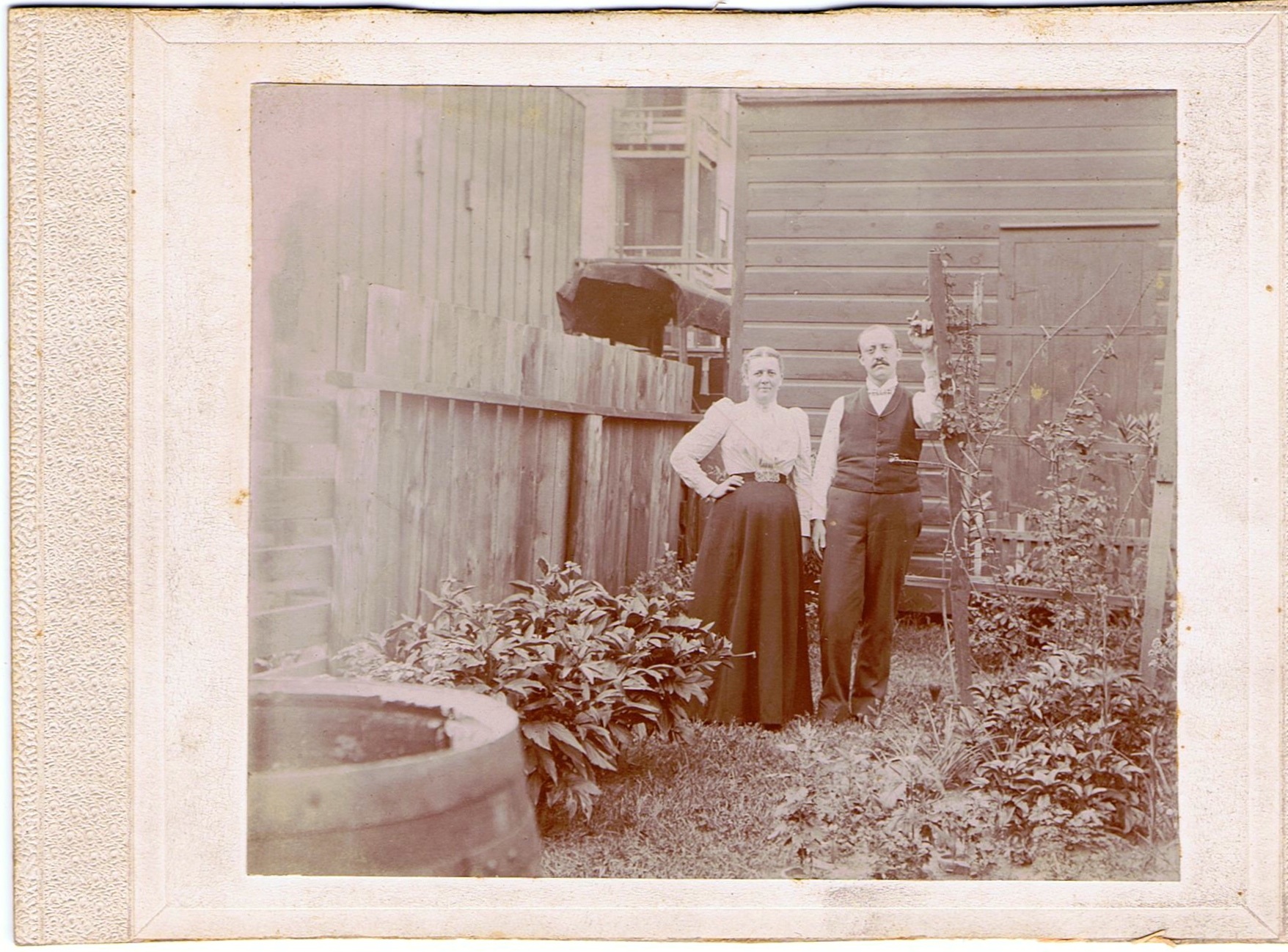
FredWieseEmmaStube

Fred and Emma (Stube) Wiese, ca. 1900; digital image 2010, privately held by Melanie Frick, 2014.

This glimpse into a backyard garden at the turn of the twentieth century features Fred and Emma (Stube) Wiese of Chicago, Cook County, Illinois. Fred rests his hand on a trellis while Emma stands close by his side, her hand on her hip. Their arms barely brush together as they gaze directly at the camera.

Emma wears everyday attire in the form of a simple dark skirt and a collared shirtwaist. Her skirt is belted high, with an adornment of some kind at the center of the waistband. It looks to me like she could have been pregnant at the time that this photograph was taken, which seems entirely possible as she was pregnant no less than five times between 1887 and 1900.1

However, Emma’s sleeves are not nearly as full as those seen during much of the 1890s, nor are they as tight as those of the decade prior. Perhaps this suggests that the photograph dates closer to 1900,2 which is when her youngest child was born.3 She and her husband were both in their early thirties at this time, and I don’t feel that they could have been significantly younger in this photograph.4

Fred wears somewhat loose trousers and a collared shirt, set off by a buttoned vest and a checked bow tie. Most notably, he sports a full mustache, and what hair he has is cut short. With the exception of his pants, which typically would be more fitted, this, too, fits the time period.5

The photograph, pasted on an embossed white card, is clear and of good quality, despite the fact that it is a seemingly casual shot. Might it have been taken by a traveling photographer who passed through the neighborhood, offering his services? Fred and Emma are not dressed in their best, although their simple attire was certainly presentable enough for a photograph. Perhaps their urban garden was a source of pride, making it an ideal spot for the couple to pose together.

Continue reading

A Mystery Solved: Identifying a Family Photograph

Last year, my cousin’s wife and I embarked on a combined research effort to track down the descendants of Christian Jens Jacobsen Walsted (1833-1899) of Aalborg, Denmark. Christian, a shoemaker,1 married twice, first to Mariane Jensen,2 and later to Johanne Marie Larsen.3 In all, seven of his children survived to adulthood, and all eventually immigrated to America. In 1900, less than a year after Christian’s death, Johanne joined several of their children in western Iowa.4

This unidentified photograph was shared with my cousin’s wife by one of the many helpful descendants with whom we made contact.5 In all of our hours of research, we had never thought that we might come up with a photograph of our central subjects! Given that this photograph was taken in Aalborg, we immediately felt that it could be Christian and his second wife, Johanne. A librarian at the Museum of Danish America thoughtfully suggested that it might have been taken to commemorate their twenty-fifth wedding anniversary. This would date it to 1892.6

ChristianWalstedJohanneLarsdatter1892

Christian Jens Jacobsen and Johanne Marie (Larsen) Walsted, ca. 1892, Aalborg, Denmark; privately held by L.V. [personal information withheld], 2013.

At the time of their anniversary, Christian would have been fifty-eight years old,7 and Johanne would have been fifty-five.8 These seem to be plausible ages for the couple in the photograph, particularly given the gray in the man’s beard. The woman wears a flattering black dress and a headpiece over her hair. Her sleeves are puffed, but not in an exaggerated fashion.9 The man wears a three-piece suit and what appears to be a watch chain. He sits in a finely carved chair at a studio, which, according to the photograph, was located at Slotsgade 15 in Aalborg. A photographer allegedly operated at this location from 1891-1910.10

Later, I would hear from another descendant who possessed an identified copy of this same photograph,11 verifying our suspicion that it was, indeed, a photograph of Christian and Johanne (Larsen) Walsted. Success!

If you have a mystery photograph, be sure to find out if any of your relatives also have a copy. If you are able to locate a copy that is identified, and if the identification matches the clues in the photograph, you’re in luck. However, even if you come across a copy that is not identified, you may be able to narrow down who is in the photograph based on the branch of the family that held it, or who initially passed it down.


SOURCES
1 Abbey of Our Lady Parish (Aalborg, Denmark), Christian Jens Jacobsen Valsted (1899).
2 Dronninglund Parish (Dronninglund, Denmark), Christian Jens Jacobsen Valsted and Mariane Jensen (1863).
3 Dronninglund Parish (Dronninglund, Denmark), Christian Jens Jacobsen Valsted and Johanne Larsen (1867).
4 “New York, Passenger Lists, 1820-1957” digital images, Ancestry.com (http://www.ancestry.com : accessed 6 December 2013), manifest, S.S. Norge, Copenhagen to New York, arriving 1 May 1900, Johanne Walsted; citing National Archives microfilm T715, roll 119.
5 J.W. [personal information withheld], to Melanie Frick, e-mail, 27 May 2012, “Photo,” Personal Correspondence, Walsted Family, Frick Research Files; privately held by Frick.
6 M.M. [personal information withheld], The Danish Immigrant Museum [now Museum of Danish America], to Melanie Frick, e-mail, 30 May 2012, “Danish Wedding Photograph,” Personal Correspondence, Walsted Family, Frick Research Files; privately held by Frick.
7 Dronninglund Parish (Dronninglund, Denmark), Christian Jens Jacobsen Valsted and Johanne Larsen (1867).
8 Dronninglund Parish (Dronninglund, Denmark), Christian Jens Jacobsen Valsted and Johanne Larsen (1867).
9 Joan Severa, Dressed for the Photographer: Ordinary Americans and Fashion, 1840-1900 (Kent, Ohio: Kent State University Press, 1995), 458.
10 “Fotografer,” Aalborg Leksikon (http://aalborgleksikon.dk/Fotografer.htm : accessed 6 December 2013).
11 D.A. [personal information withheld], to Melanie Frick, e-mail, 1 June 2012, “Walsted Photo,” Personal Correspondence, Walsted Family, Frick Research Files; privately held by Frick.

Choose Your Own Backdrop

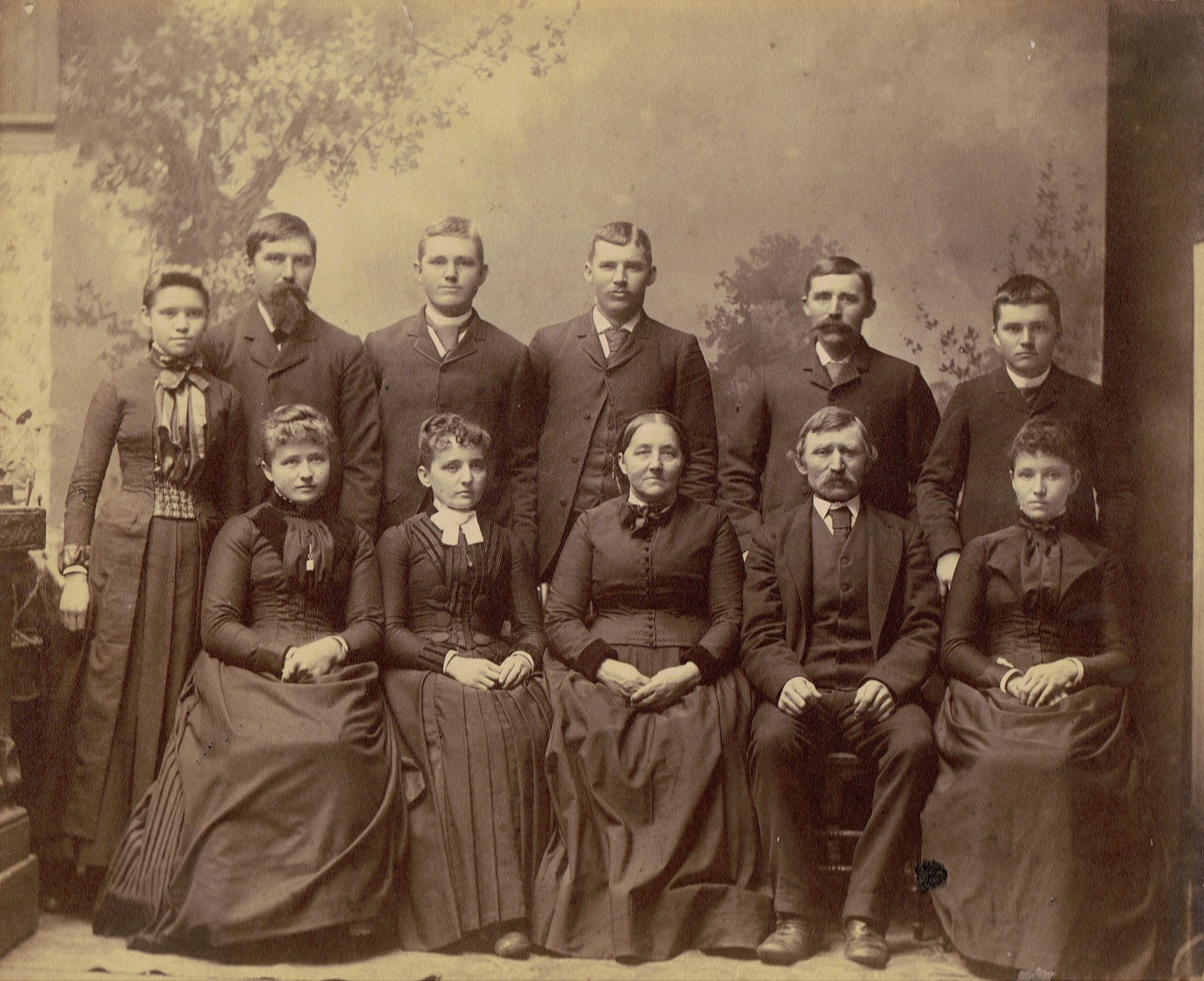
When they posed with their children for this photograph in 1893, Niels and Juliane Sophie (Hennike) Olsen of Yankton County, South Dakota had been married for just over forty years. They had raised nine children to adulthood, eight of whom were born in their native Denmark.1

nielsolsenfamily1893

Family of Niels and Juliane (Hennike) Olsen, 1893, Yankton County, South Dakota; privately held by Melanie Frick, 2013.

Niels and Juliane had purchased a farm upon their arrival in America, but in their later years, they moved to a more comfortable life in town. The couple would go on to celebrate fifty years of marriage in 1902,2 although their youngest son, Andrew, would be missing from that gathering. He drowned in 1897 while hunting ducks on the nearby Swan Lake.3

The photograph is a large print, roughly 8×10 inches, pasted onto cardboard with the date marked on the back. Do you notice anything strange about the backdrop? The family poses in front of a backdrop of painted trees that is slightly too small for a group of that size. To one side, the edge of the backdrop of a wallpapered room is visible, and the backdrop cuts off altogether on the other. All seem to be dressed in their best, the men in dark suits and the women in good black dresses. In 1896, Godey’s wrote, “All of us who are wise, possess a black gown.”4

The women’s dresses are distinct, although the two sisters seated on opposite ends, Stena and Cecilie, could easily have made their dresses from the same pattern. Their sisters’ dresses also bear similarities, though all have their own touches – pleats, contrasting material, or, in Dora’s case, large decorative buttons. Their mother’s dress, however, has no unnecessary frills. Notably, all of the women’s sleeves are of the fitted fashion of the previous decade; as the 1890s went on, puffed sleeves gained popularity. Perhaps this fashion had not yet become popular in Yankton County, or maybe these women simply didn’t care for the new style enough to want to rework dresses that were still perfectly serviceable.

Standing, left to right, are Helena (Neilsen) Larsen, John Neilsen, Andrew Neilsen, Fred Neilsen, Ole Neilsen, and Chris Neilsen. Seated, left to right, are Stena (Neilsen) Callesen, Dora (Neilsen) Nissen, Juliane Sophie (Hennike) Olsen, Niels Olsen, and Cecilie (Neilsen) Boysen. Variations of the surname, including Nelson, were also used by some members of the family.


SOURCES
1 Harold W. Jorgensen, “Olsen, Niels,” in Ben Van Osdel and Don Binder, editors, History of Yankton County, South Dakota (Yankton, South Dakota: Curtis Media Corporation and the Yankton County Historical Society, 1987), 53.
2 Jorgensen, “Olsen, Niels,” 53.
3 Jorgensen, “Olsen, Niels,” 53.
2 Jorgensen, “Olsen, Niels,” 53.
4 Joan Severa, Dressed for the Photographer: Ordinary Americans and Fashion, 1840-1900 (Kent, Ohio: Kent State University Press), 460.

Ada Zingara, Sideshow Performer

Tucked into the slots of an antique album filled with photographs of an unidentified family of Kaukauna, Outagamie County, Wisconsin, are several photographs of sideshow performers.1

Ada Zingara photograph, ca. 1890s, Chicago, Illinois; digital image 2013, privately held by Melanie Frick, 2013.

Ada Zingara photograph, ca. 1890s, Chicago, Illinois; digital image 2013, privately held by Melanie Frick, 2013.

The name Ada Zingara is handwritten on the back of this photograph, which features a woman posing in a rather scandalous fashion. Her dress is short, and she stands with one leg elevated on a bench as she pretends to fasten her pointy-toed shoe. Her stockings feature bold zigzags, and her dress is patterned as well. The bodice is trimmed with lace and loose cap sleeves, and the border of her lace-trimmed petticoat is also visible. She wears earrings, and a large, bejeweled crucifix lies at her throat. What is most striking is her hairstyle: Ada’s hair is teased into an Afro.

A search for Ada Zingara informed me that, in the early 1900s, she was a snake charmer. A 1906 sideshow advertisement specified that she had a den of “Five Big Anacondas.”2 However, I wondered why she was not posing with snakes in this picture, which was surely printed for publicity. And why did she have such a dramatic hairstyle?

Further research informed me that the circus great P.T. Barnum began exhibiting women with this hairstyle in the 1865, calling them Circassian Beauties. According to reports of the time, the women of the mountainous region near the Black Sea were particularly beautiful, and were prized by Turkish sultans who kidnapped them for their harems. Barnum capitalized on this sensational story, seeking first to purchase one of these slave girls abroad, and eventually settling for a local girl with teased hair (which was not an accurate Circassian style) who was merely marketed as a Circassian.3 Eventually, as the popularity of the Circassian Beauties waned, the women adopted other acts, including routines as equally alluring snake charmers.4

A close look at her face reveals that Ada Zingara is not very young. There are lines around her eyes, which gaze warmly at the camera. Her lips part in a faint smile, showing her teeth – and a possible missing tooth. Why did Ada turn to sideshows, and what became of her? What was her real name?

What I find especially interesting is the fact that this photograph occupies the very first page of the album – the page usually reserved for an important family member or the primary subject of the album.4 Of course, it’s possible that the photographs were rearranged in the years that this album made its way from its original home to the antique store. Whatever the case, it should be noted that this is not the only photograph of a circus or sideshow performer located in the album. The family of Kaukauna, Wisconsin must have enjoyed these attractions!

Did your ancestors collect photographs of circus or sideshow performers?


SOURCES
1 Unidentified Album of a Kaukauna, Wisconsin Family, ca. 1870-1900; privately held by Melanie Frick, 2013.
2 “Ada Zingara,” The Billboard, 14 April 1906, digital image, Old Fulton Post Cards (http://www.fultonhistory.com : accessed 27 September 2013).
3 Wikipedia (http://www.wikipedia.org), “Circassian Beauties,” rev. 18:32, 3 July 2013.
4 Katherine H. Adams and Michael L. Keene, Women of the American Circus, 1880-1940 (Jefferson, North Carolina: McFarland and Company, 2012), 142; digital images, Google Books (http://books.google.com : accessed 27 September 2013).
5 “’Reading’ A Family Photo Album,” Photo Detective with Maureen A. Taylor, 22 September 2013 (http://blog.familytreemagazine.com/photodetectiveblog/ : accessed 27 September 2013).


The Little Postmaster on the Prairie

After reading today that the cost of stamps could rise yet again, I was reminded that my third great grandfather, Niels Olsen of Lakeport, Yankton County, South Dakota, once served as a postmaster.

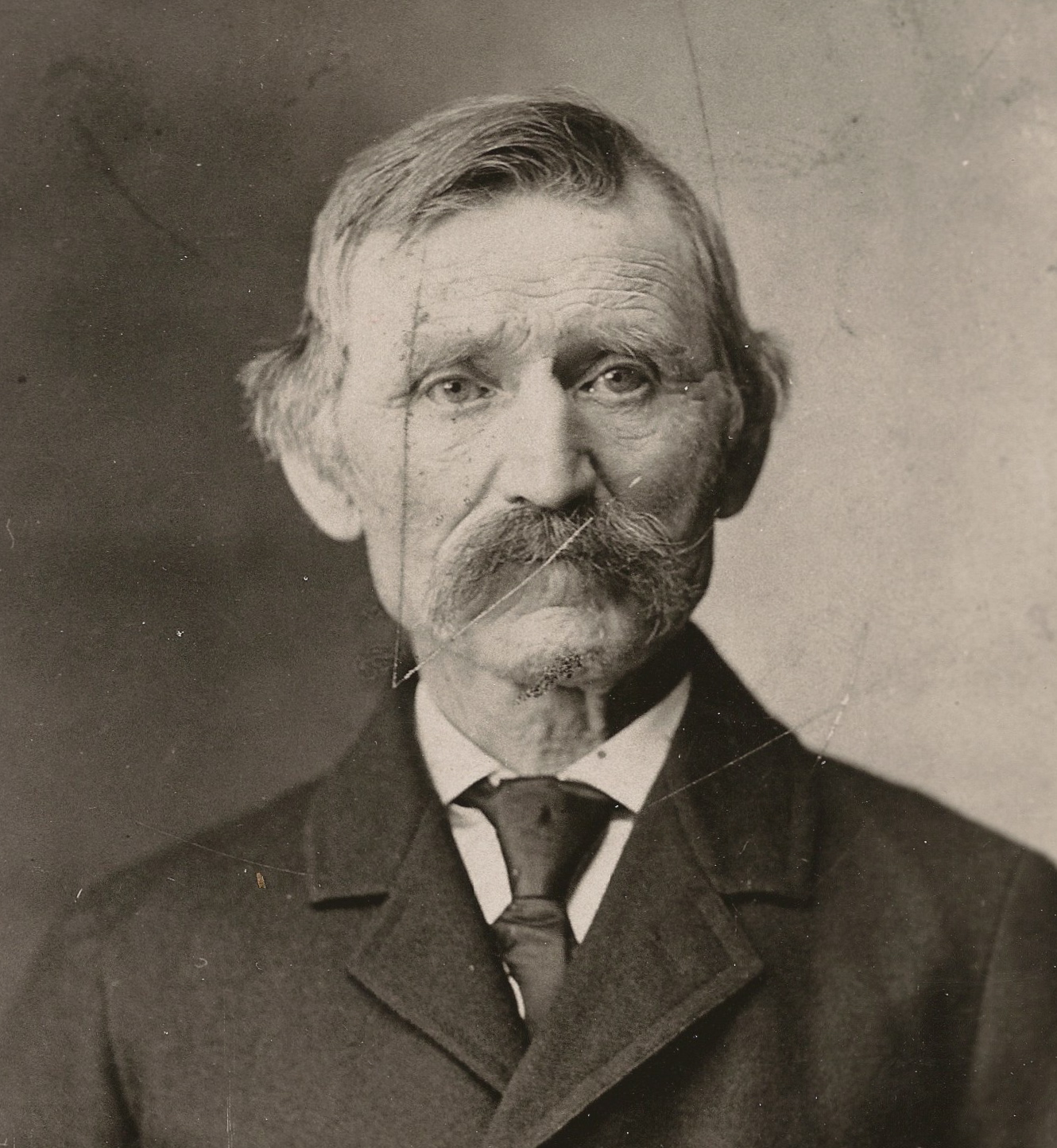
Niels Olsen photograph, 1893, Yankton, South Dakota; digital image 2010, privately held by Melanie Frick, 2013.

Niels Olsen (1827-1908) photograph, 1893, Yankton, South Dakota; digital image 2010, privately held by Melanie Frick, 2013.

Niels Olsen emigrated from his native Denmark in 1874,1 settling on a farm in what is now southeastern South Dakota. His wife and six children accompanied him on the ocean crossing; his two eldest sons had already left Denmark, paving the way, and another daughter was born the following year.2

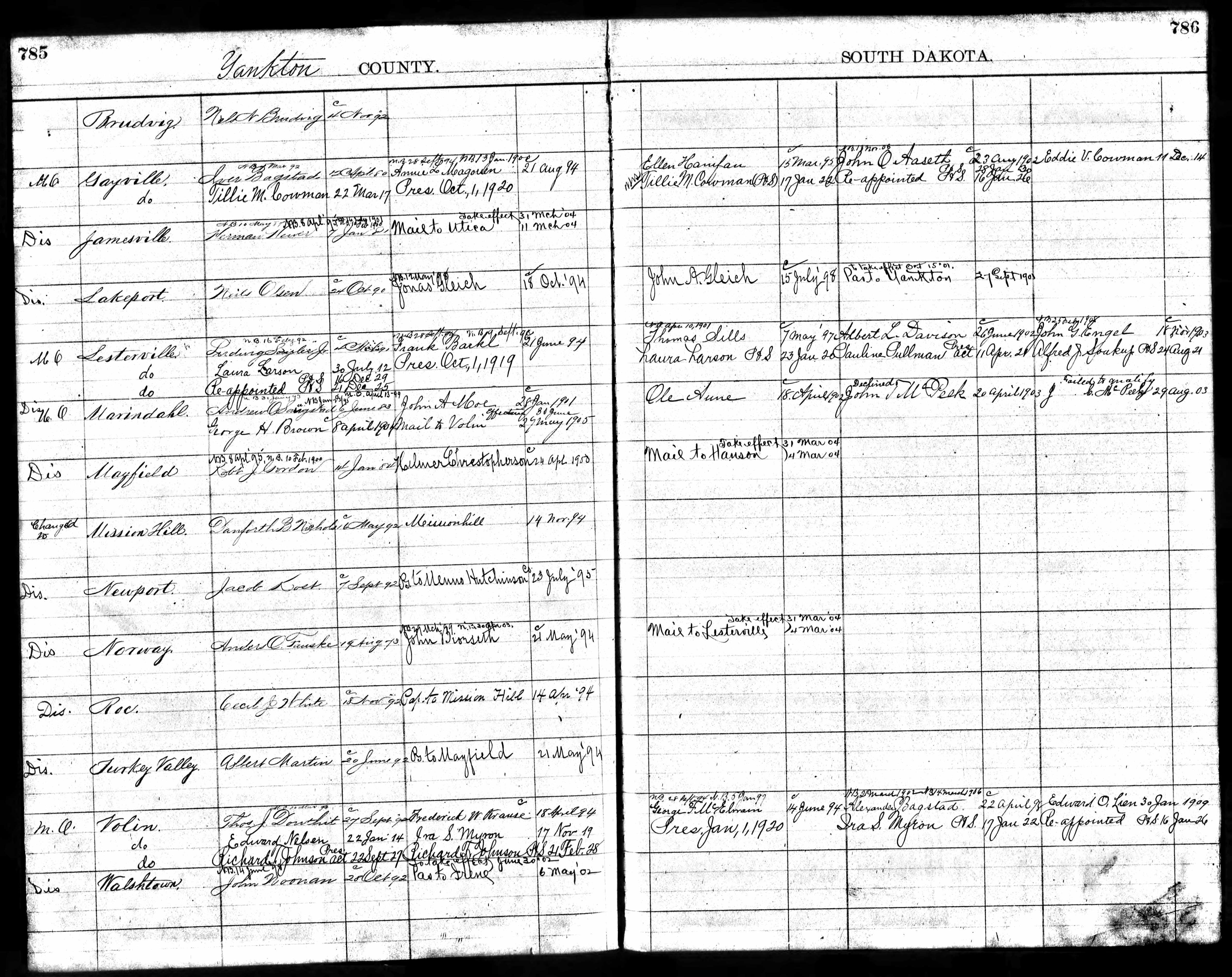
In the fall of 1890, Niels would have been sixty-three. With two grown sons and a daughter still at home to assist him and his wife, Juliane, with the farm, Niels may have found himself with some extra time on his hands. Lakeport, an unincorporated village, was the nearest place to buy supplies and receive mail; it even boasted a hotel for weary stagecoach travelers. While the post office did not seem to have a permanent location, as it reportedly bounced between the hotel, the general store, and a grocery store, regular mail deliveries were undoubtedly a major attraction for the Czech and German settlers of the area.3 On 24 October 1890, Niels Olsen signed on as postmaster of Lakeport, a position he held for four years.4

nielsolsenlakeportpostmaster02

“U.S., Appointments of U.S. Postmasters, 1832-1971,” digital images, Ancestry.com (http://www.ancestry.com : accessed 25 September 2013), entry for Neils Olsen, Lakeport, Yankton, South Dakota; citing National Archives microfilm publication M841, Record of Appointment of Postmasters, 1832-1971.”

Although Lakeport has all but vanished, due to competition from other trade centers and the rerouting of a major highway,5 in the final decade of the nineteenth century, Niels Olsen would have played an integral role in this village as its postmaster. He may have been attracted to the position as an opportunity to earn extra money, or he may have fallen into it if no one else in the community was interested or eligible. At the very least, it tells us that Niels was literate, an American citizen, and that he may have had a sociable personality. I like to think that Niels would have known all of the latest gossip – after all, who else would have had the opportunity to interact with so many members of the community on a regular basis?

How can you find out if one of your ancestors was a postmaster? Ancestry.com makes this easy with the collection, “U.S., Appointments of U.S. Postmasters, 1832-1971.” If you want to locate this collection, you will find it categorized under “Schools, Directories, and Church Histories.” Then, you can search for an ancestor by their name and/or location. Niels Olsen held his position as postmaster until 18 October 1894; it was just a few years later, in 1901, that the Lakeport post office closed its doors for good.6


SOURCES
1 “New York, Passenger Lists, 1820-1957,” digital images, Ancestry.com (http://www.ancestry.com : accessed 25 September 2013), manifest, S.S. Humboldt, Stettin, Germany, to New York, arriving 4 August 1874, Niels Olsen; citing National Archives microfilm publication M237, roll 392, line 149.
2 Harold W. Jorgensen, “Olsen, Niels,” in Ben Van Osdel and Don Binder, editors, History of Yankton County, South Dakota (Yankton, South Dakota: Curtis Media Corporation and the Yankton County Historical Society, 1987), 53.
3 Sister Verena Kaiser, “Lakeport, South Dakota,” in Ben Van Osdel and Don Binder, editors, History of Yankton County, South Dakota (Yankton, South Dakota: Curtis Media Corporation and the Yankton County Historical Society, 1987), 605.
4 “U.S., Appointments of U.S. Postmasters, 1832-1971,” digital images, Ancestry.com (http://www.ancestry.com : accessed 25 September 2013), entry for Neils Olsen, Lakeport, Yankton, South Dakota; citing National Archives microfilm publication M841, “Record of Appointment of Postmasters, 1832-1971.”
5 Kaiser, “Lakeport, South Dakota,” 54.
6 “U.S., Appointments of U.S. Postmasters, 1832-1971,” digital images, Ancestry.com, entry for Neils Olsen, Lakeport, Yankton, South Dakota.