Tag Archives: French Canadian

A Farewell to Canada

Timothée Adam was only a year old when he lost his father. Born to Charles Pierre Adam and Marie Marguerite Saint Michel on 02 April 1816 in Beloeil, Quebec, he was baptized as Joseph Timothée Adam and was the seventh of eight children born to the couple; his younger sister was born just two weeks after their father’s death in August of 1817. Their mother, who had married at sixteen, was now a widow at the age of thirty, and considering how many small mouths she had to feed, it is not at all surprising that she remarried the following summer.

Although little is known about Marie Marguerite’s second husband, Louis Amable Pineau, after several generations had passed an oral tradition remained that the surname Pineau was somehow linked to the Adam line. Marie Marguerite had no children with Louis, who was ten years her junior, but he was the only father that the youngest of her children would have ever known. Her children would also have known her parents, their grandparents Joseph Michel and Marie Josephe Patenaude, as they spent their later years living in the same parish as Marie Marguerite and her family. Perhaps Joseph, who was born in exile in Massachusetts in 1757 following Le Grand Dérangement, the tragic expulsion of the French-speaking Acadians of Nova Scotia by the British, shared stories of his origins and the family’s eventual return to Canada—or perhaps not.

Timothée married Marguerite Chicoine in Saint-Marc-sur-Richelieu, a village just north of Beloeil on the Richelieu River, on 24 October 1837, when he was twenty-one. The couple then moved approximately thirty miles east to the village of Saint-Pie, where Timothée supported his family as a cultivateur, or farmer. The couple’s first ten children (of an eventual sixteen) were born in Saint-Pie, and the family appeared in the census there in 1851. It was noted that they resided in a one-level home made of wood, although interestingly, not all of their children lived within their household. Two of their daughters, who were eight and two, were found with their grandmother in another household in the same community, although perhaps this was only a temporary arrangement.

A decade later, at the time of the 1861 census, Timothée and Marguerite shared their household with all of their minor children, while their two eldest daughters, both married and with children of their own, were enumerated directly before them in the census. All were recorded as residents of Rang Saint-Charles, a rural road that runs southeast of Saint-Pie and south of the Noire River. This was not far from Saint-Paul-d’Abbotsford, where several of their younger children were baptized.

View of Mont Yamaska from Grand Rang Saint-Charles, Saint-Pie, Quebec

By June of 1865, Timothée had relocated with his family to Massachusetts. One has to wonder whether he recognized the irony in returning to the same place where his grandfather had been born in exile—but what drew him and his family to Massachusetts, a little more than a century after Le Grand Dérangement, was almost certainly the cotton mills. Contemporary news accounts referenced, sometimes scathingly, the “hordes of French Canadians” who traveled by rail from the border crossing at St. Alban’s, Vermont, to Massachusetts, where entire families crowded into tenements and worked at the mills. Indeed, the 1865 Massachusetts State Census places Timothée, Marguerite, and their ten unmarried children, who were between the ages of three and twenty-one, in Ward 8 of Springfield, Hampden County, Massachusetts, where Timothée and the five eldest children were all employed at the Indian Orchard mill.

There may have been another driving factor that caused Timothée to uproot his entire family, however, and that was the potential threat of a military draft in Canada and associated unrest that presumably might have affected his eldest sons. A Massachusetts newspaper printed the following in January 1865: “There is quite a little rebellion in Canada now, and all about a militia draft for frontier service. The French Canadians at Quebec resisted the draft made upon them last week and drove away the officers. Four companies of the volunteer militia were immediately called out and the insurrection will be a short lived one.”

By the time of the 1870 U.S. census, Timothée, by then fifty-four and with nine children still in his immediate household, continued to reside in Indian Orchard but was without an occupation. His six eldest unmarried children, who were between the ages of twelve and twenty, were all millworkers, and their earnings no doubt supported the entire family. Incredibly, the grand total of individuals in Timothée and Marguerite’s multigenerational household, which included their married children and their own large families, numbered twenty-eight.

View of Springfield, Massachusetts on the Connecticut River,” ca. 1840-1845, Thomas Chambers (1808-1869); oil on canvas, private collection, photographed while on loan to the Metropolitan Museum of Art, New York, New York; Wikimedia Commons.

Tragedy struck in 1878, when Timothée first lost two grandsons who drowned while fishing in the Chicopee River, and then lost his wife of forty years when Marguerite succumbed to consumption at the age of sixty-two. Timothée did not appear in the 1880 U.S. census, but city directories indicate that he resided at 83 Main in Indian Orchard. His unmarried children, ranging in age from fourteen to thirty, were enumerated together on Main Street; perhaps Timothée’s absence was an accidental omission, or perhaps he was traveling at the time that the census was recorded. It is known that he ventured to Dakota Territory a short time later, as he was documented as a parishioner at St. Peter’s Parish in what is now Jefferson, Union County, South Dakota in 1885, along with two of his adult sons and their families. The recent deaths of several family members, including two of Timothée’s adult children and multiple young grandchildren, may have spurred this move away from crowded tenement life.

Timothée is absent from the Springfield, Massachusetts city directories of 1885-1895. He makes a reappearance in 1896, boarding at 69 Main, Indian Orchard; this was the home of his daughter, Marie, and her husband, Gabriel Noel. Had Timothée spent the intervening years with his children in the Midwest?

On 19 March 1897, a newspaper in Sioux City, Woodbury County, Iowa, printed the following: “T. Adams, father of P.P. Adams of Davidson Bros., died while visiting relatives at Indian Orchard, Mass., at the age of 84 years.” Timothée would have been, in fact, eighty years old at the time, but this was not the only misprint regarding his death.

The death register for the city of Springfield, Massachusetts, which encompassed Indian Orchard, does not have a record of the death of any individual by the name of Timothée Adam at that time—but it does name one “Mathieu A. Adam,” son of Pierre Adam of Canada, who was reportedly eighty years, ten months, and seventeen days at the time of his death on 09 March 1897.

The dates are close enough that they might be considered a mathematical error—Timothée would have reached the age of eighty years, eleven months, and seven days at the time of his death. His father’s middle name had been Pierre, and it’s quite possible that that is how he was more commonly known. But “Mathieu”? One guess is that entries on the death register were recorded based on other handwritten records or notes, and that a scrawled “Timothée” was mis-transcribed as “Mathieu,” another French name with a “th” in the middle. His cause of death was attributed to “Old age: Indigestion,” and Timothée’s grave, presumably near that of his wife at the Saint Aloysius Cemetery in Indian Orchard, is unmarked.

His will, filed in Springfield in March of 1896, a year prior to his death, is succinct in regards to his wishes and suggests that he may have spent extended time in the care of his second-eldest daughter Marie:

“After the payment of my just debts and funeral charges, I bequeath and devise as follows. First: To my daughter Mary Noel wife of Gabriel Noel of said Springfield, all the estate both real and personal of which I shall die seized and possessed and to which I shall be entitled at the time of my decease. I purposely give no bequest or devise in this will to my only living children, or the issue of any deceased child, having provided for them in my lifetime and I exclude them and their issue from any claim upon my estate of every nature and description. Second: I direct that my executrix hereinafter named expend the sum of Fifteen dollars for a high mass over my remains.”

Hampden County, Massachusetts Probate Records

So little is known of who Timothée Adam was as a person. He was a French Canadian by birth and an immigrant who may have faced contempt and discrimination in the United States due to his language, faith, and culture. He was a farmer and a millworker—but as his eldest surviving son was a carpenter, one can speculate that Timothée may also have possessed these skills. Two of his younger sons played the fiddle, and another sang; was Timothée musical as well? He was a lifelong Catholic, and desired that a portion of his (presumably not large) estate be set aside in order for him to receive a high mass upon his death. He was the father of sixteen known children, fourteen of whom survived to adulthood, and the names of his eldest sons suggest strong familial bonds: Timothée, Louis (like his stepfather), Joseph (like his maternal grandfather), Pierre (like his father and paternal grandfather). Notable too is the name of his youngest son, the only one of his children born outside of Canada: Prosper, named perhaps in recognition of Timothée’s hopes for his family to flourish in a new home.

Copyright © 2024 Melanie Frick. All Rights Reserved.

Continue reading

A Full House in a Mill Town

By the time of the 1870 U.S. census, French Canadians Timothée and Marguerite (Chicoine) Adam, both fifty-four years old, had lived in America for approximately five years. Along with their children, who ranged in age from toddlerhood to young adulthood, they had settled among fellow French-speaking immigrants in Springfield, Hampden County, Massachusetts. Their neighborhood, Indian Orchard, boasted a booming cotton mill on the banks of the Chicopee River. This would certainly have been a different environment than they had been accustomed to in the quiet village of Saint-Pie, Quebec where, for the first twenty-five years of their marriage, Timothée had been a farmer and Marguerite had raised more than a dozen children in their humble home. Their move from rural to comparatively urban was certain to have been full of adjustments, but what may be the most striking about their lives in the year 1870 is the impressive number of people with whom they shared one roof: twenty-eight, to be exact.

Their household had grown substantially from their first appearance in the Massachusetts state census in 1865; then, Timothée, who was employed at the mill, headed a household that numbered thirteen, including ten children and one boarder. In 1870, the twenty eight residents, all related, were in fact divided among four households within a single dwelling unit, presumably a tenement block. First recorded was the household headed by Timothée and Marguerite Adam themselves, which included nine of their children—those nine ranging in age from twenty-two down to three. Then came the households of three of their married daughters. The household of Leon and Julienne (Adam) Gay was first; they were the parents of one child. The household of Joseph and Marie (Adam) Noel and their five children was next, and last was that of Jean Baptiste and Marguerite (Adam) Gendreau and their five children.

Although Timothée himself was without an occupation at this time, and Marguerite kept house, nine other members of the combined households worked at the mill. Four of those nine millworkers were under the age of sixteen: Jean Adam was fourteen, Elisa Adam was twelve, Jean Gendreau was twelve, and Euclide Gendreau was eleven. Six children between the ages of six and eleven were at school, and six children between the ages of one and four were at home in the care of their mothers.

Many of Timothée and Marguerite’s children, grandchildren, and even great grandchildren would spend the decades to come employed in the Indian Orchard mill. It was not an easy life; in the years following the 1870 census, several members of the family would succumb to tuberculosis and other respiratory illnesses common among millworkers of the day, who often worked in dismal conditions with poor ventilation and were plagued by both communicable diseases and cotton lint.

“Clarence Noel, 138 Main St., Indian Orchard. Doffer in Hodges Fibre Carpet Co. of Indian Orchard Mfg. Co.,” September 1911, Prints & Photographs Online Catalog, Prints & Photographs Reading Room, Library of Congress, Washington, D.C. (https://www.loc.gov/pictures/item/2018676653/ : accessed 08 January 2023).
“Alfred Gengreau [Gendreau], 20 Beaudry St., Joseph Miner, 15 Water St. Both work in Mr. Baker’s room, Indian Orchard Mill,” September 1911, Prints & Photographs Online Catalog, Prints & Photographs Reading Room, Library of Congress, Washington, D.C. (https://www.loc.gov/pictures/item/2018676654/ : accessed 08 January 2023).

Notably, at least two of the couple’s great-grandchildren appear to have been photographed by famed muckraker Lewis Hine, who documented the plight of child laborers in the early twentieth century and whose work was instrumental in child labor reform. Clarence Noel, fifteen, grandson of Timothée and Marguerite’s daughter Marie (Adam) Noel, and Alfred Gendreau, thirteen, grandson of their daughter Marguerite (Adam) Gendreau, were both photographed outside their workplace in September of 1911. Clarence, Hine noted, worked as a doffer and said that he had “made seven dollars last week.” Alfred, who posed with another boy, was said to “work in Mr. Baker’s room, Indian Orchard Mill.”

These boys were not by any means among the youngest of the child laborers that Hine photographed, nor did they work in the most arduous conditions, but still their images are striking. In their knickers and caps, both slight of build, Clarence and Alfred look every bit like schoolboys, although the mill—to which four generations of their family had now been tied—loomed large in the background. Their school days behind them, it was time for the boys to work to support their families.

Copyright © 2023 Melanie Frick. All Rights Reserved.

Continue reading
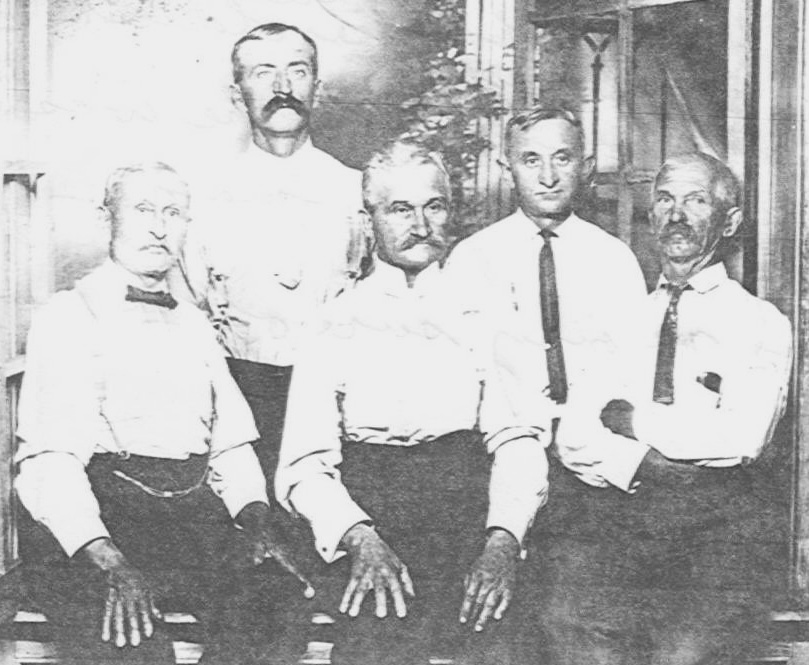
The Adam Brothers

When five of the six living sons of Timothée and Marguerite (Chicoine) Adam gathered in the Midwest circa 1913, it was deemed an occasion worthy of a photograph.1 From left are pictured brothers Louis (1848-1927), Peter (1852-1936), Joseph (1850-1926), Prosper (1867-1943), and Timothy Adam (1846-1919). Although the twenty-one year span in age of these brothers is impressive, in fact, twenty-seven years passed between the births of their eldest sibling and the youngest, who arrived when his mother was fifty years old. At least fourteen children were born in total, with all but the youngest born in Quebec. All got their start in life in the cotton mills of Indian Orchard, Hampden County, Massachusetts, which had lured the Adam family from rural Quebec to America.2

Brothers Louis, Peter, Joseph, Prosper, and Timothy Adam(s), ca. 1913; digital image 2010, privately held by Melanie Frick, 2018. Image courtesy of Dorothy Bouchard.

Timothy, at right, likely resided in Jefferson, Union County, South Dakota at the time this picture was taken,3 not far from Peter, second from left, and Prosper, second from right, who had both settled in Sioux City, Woodbury County, Iowa.4 Joseph, at center, had apparently traveled from his home in Ponca City, Kay County, Oklahoma to reunite with his brothers, as well as, undoubtedly, his twin sister, who lived in Jefferson.5 Louis, the one brother to have remained in Hampden County, Massachusetts, traveled the greatest distance for this reunion.6 The only living Adam brother not pictured here was Euclid John (1856-1940), who spent his adult life in Southbridge, Worcester County, Massachusetts.7 Whether he lost touch with his brothers or was simply unable to make the trip to visit them at the time that this photograph was taken is not known.

The Adam brothers, some of whom adopted the surname Adams in addition to Anglicized versions of their given names, held a variety of trades between them. Census records indicate that after leaving the cotton mills, some went on to become carpenters, barbers, homesteaders, clerks, pool hall operators, and hotel-keepers, among other occupations. All married, and all but Joseph had children of their own.

This photograph is a photocopy of what was said to be a real photo postcard, a format designed to be easily sent by mail to friends or relatives. Like the only known (or suspected) photograph of the mother of the Adam brothers, the original is believed to have been lost.8 Despite the poor quality of this photocopy, it is apparent that the brothers have dressed sharply, with their hair neatly combed and several in ties, although this was apparently not such a formal occasion that they opted to wear jackets. It is also plausible that it was quite hot, if their reunion took place in the summer months, and the gentlemen may well have opted to be as comfortable as possible. Several appear to wear sleeve garters, arm bands that helped to adjust the length of one’s sleeves.9 While the men’s appearances are distinct from one another, particularly given their disparate ages, similarly prominent noses—and, when visible, even hands—help to link them convincingly as brothers.

Copyright © 2018 Melanie Frick. All Rights Reserved.
Continue reading
Tombstone Tuesday: Timothy and Odile (Millette) Adam

Timothy and Odile (Millette) Adam experienced nearly forty years of marriage together that were anything but ordinary.

Timothy, baptized in St. Pie, Quebec on 8 August 1846, the son of Timothée Adam and Marguerite Chicoine, crossed into America with his family as a teenager.1 They settled near the textile mills of Indian Orchard, Hampden County, Massachusetts, which is where Timothy married at the age of twenty-one on 22 September 1867 to Odile Millette.2 Odile had been born in the French Canadian community of Rouse’s Point, Clinton County, New York on 11 July 1847, the daughter of Maurice Millet and Isabelle Quemeneur dit Laflamme.3 She, too, had relocated to Massachusetts as a teenager, where she also found work in the mills.

The couple was said to have had ten children together, eight of whom have been identified: Timothy Maurice, Alexander Amadée Edmond (known as Edward), Joseph Frederick (known as Alfred), Marie Julie Malvina, Albina Lena, Henry Joseph, Martin Theodore, and Permelia Marie.4 Only five of these children are known to have survived to adulthood; at least one succumbed to scarlet fever as a toddler.5

In 1883, the family made the decision to move west.6 I have to wonder if this move was spurred by the deaths of at least two of their own young children circa 1880, as well as by the deaths of Timothy’s younger brother and sister who died within a week of each other in February of 1883: one of pneumonia at twenty and the other of tuberculosis at twenty-four.7 In fact, tuberculosis had caused the death of Timothy’s mother just five years before.8 Perhaps the idea of fresh air and the countryside appealed to the couple as they must have feared for the health of their children.

Timothy and Odile first joined French Canadian relations in southeastern South Dakota, where a son was born to them in the summer of 1885.9 In December of the following year, Timothy claimed a homestead a short distance away near Moville, Woodbury County, Iowa.10 The family would remain here for a number of years; by 1900, they had relocated to a dairy farm closer to Sioux City.11

The coming years were unexpectedly tumultuous for Timothy and Odile. First, in 1900, their twenty-nine-year-old son Edward, who had been out of touch for nearly a decade, returned home and began harassing his parents and younger siblings. Timothy went to court in order to obtain a restraining order against him.12 Then, over the next several years, Timothy and Odile may have suffered marital discord. Timothy was not recorded in the 1903 Sioux City Directory; he appeared again in the same household as his wife the following year.13 In 1905 he was again absent, and it was at this time that Odile implored the enumerator of the 1905 Iowa State Census to bring her any word of her two eldest sons, Edward and Fred, who had traveled west and had not been heard from in several years.14 It was also in 1905 that Odile recorded her will, leaving her real estate to her three youngest children: Henry, Theodore, and Permelia. No mention was made of her absent sons – or her husband.15

IMG_3451

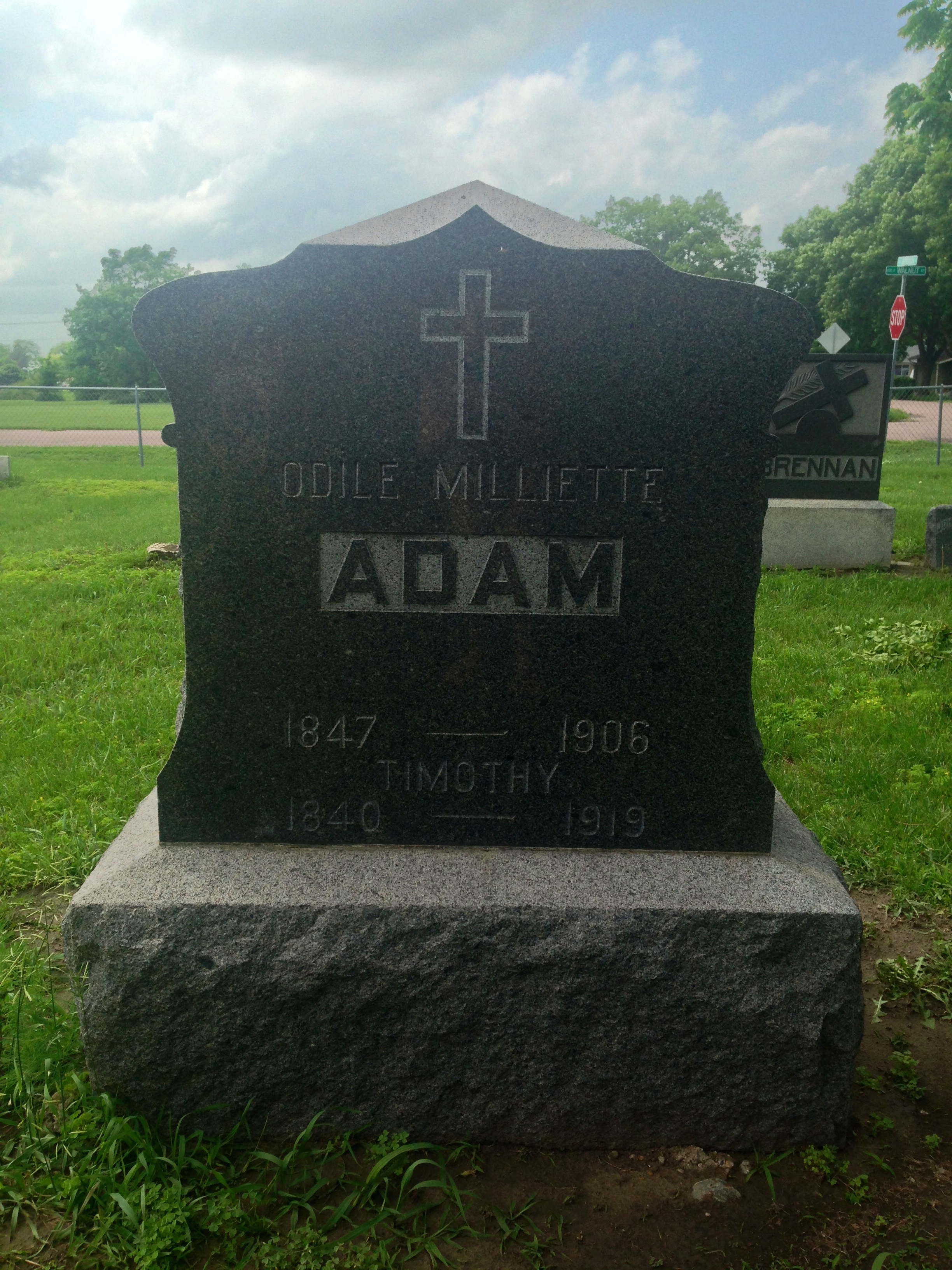
Grave of Odile Milliette Adam (1847-1906) and Timothy Adam (1840-1919), St. Joseph Cemetery, Elk Point, Union County, South Dakota; 2014, privately held by Melanie Frick, 2015. Note: Timothy’s date of birth on his gravestone is incorrect. He was born in 1846.

In 1906, the final year of Odile’s life, she operated a boarding house at 508 Perry in Sioux City.16 Notably, Timothy resided not at home, but at the Washington House Hotel.17 It does seem possible, however, that the couple reconciled whatever differences they may have had by the time of fifty-nine-year-old Odile’s death from hepatitis on 16 December 1906 in Elk Point, Union County, South Dakota.18 When the 1907 Sioux City Directory was printed at some point in late 1906, likely shortly before her death, both Odile and Timothy were named as residents of 508 Perry.19

Timothy, a carpenter again as he had been in his younger years, remained in the house with his children for only a short time before resettling in nearby Jefferson, Union County, South Dakota. He remained here for the next decade; as of 1910, he operated a billiard hall in this small, largely French Canadian community.20

By 1917, Timothy, now seventy, had returned to Sioux City where he lived with his married daughter.21 He died there on 22 February 1919 at the age of seventy-two, his cause of death recorded as senility.22 Timothy Adam was buried beside his wife, Odile Millette, at St. Joseph Cemetery in Elk Point, Union County, South Dakota, his name squeezed as though an afterthought at the base of her gravestone.

Copyright © 2015 Melanie Frick. All Rights Reserved.

Continue reading

The Last Canadian

In honor of Canada Day, I introduce my last ancestor to live and die a Canadian: Leon Chicoine, who was baptized Joseph Leon Chicoine on 12 April 1785 at St-Charles-sur-Richelieu, Quebec, the son of Francois Chicoine and Marie Elizabeth Tetreault.1

St-Charles-sur-Richelieu

“View of St-Charles-sur-Richelieu from St-Marc-sur-Richelieu,” 2014, Saint-Charles-sur-Richelieu, Montérégie, Québec, Canada; Wikimedia Commons, copyright Tango7174.

Little is known of Leon’s early years. By the time he was twenty-five, he had made his way to Longueuil, located on the south shore of Montreal. It was there that he married Longueuil native Marie Varry on 17 September 1810.2 Their marriage took place at the impressive Cathédrale St-Antoine-de-Padoue in a ceremony led by Father Augustin Chaboillez, who, according to contemporary accounts, managed his parishioners with a firm hand. In fact, earlier that same year, he had a parishioner jailed for daring to interrupt his sermon!3

Leon and Marie did not remain there for long; they soon settled in St-Marc-sur-Richelieu, a rural community just across the Richelieu River from where Leon himself had been born. They remained in this area for the rest of their lives.4 Family lore states that Leon served in the military during the War of 1812.5 Then, twenty-five years later, war came to St-Marc when British troops defeated a number of Canadian rebels there during what is known as the Patriot War.6 Leon was in his fifties at this time; might he have participated in the futile attack? We may never know for sure.

Attack-on-Saint-Charles

“Attack on Saint-Charles 25th Novr. 1837,” 1840, Lord Charles Beauclerk (1813-1842); McCord Museum, Montreal, Quebec.

In any case, the majority of Leon’s life was likely spent in a more peaceful manner as a forgeron, or blacksmith.7 He fathered at least thirteen children, including my ancestor Marguerite Chicoine, although not all survived to adulthood. Sadly, Leon’s wife, Marie, passed away before she was forty; Leon remarried to Francoise Desautels in 1829.8

Leon Chicoine would live to the age of ninety two. When his granddaughter recorded his death in January 1877, she noted that he was by that time the grandfather of fifty-six grandchildren.9 His burial occurred at his birth parish of St-Charles-sur-Richelieu, likely in the churchyard of the striking eighteenth-century stone church located on the banks of the Richelieu River.10

Copyright © 2015 Melanie Frick. All Rights Reserved.

Continue reading