Tag Archives: Germany

Wedding Wednesday: Puffed Sleeves, Revisited

It has been nearly a decade since I first featured this photograph on Homestead Genealogy, and at that time, I had never seen the original. The old photocopy in my possession was washed out and grainy, the young couple’s faces barely discernible, and the border with the photographer’s mark was not included. When a nearly pristine original made its way to me last year, I was elated: finally, every detail of the 1896 wedding portrait of my great-grandparents Mathias and Elisabeth (Hoffmann) Noehl of North Washington, Chickasaw County, Iowa, could be fully appreciated, and, in addition, the photographer’s mark offered a new clue about the couple’s lives as newlyweds.

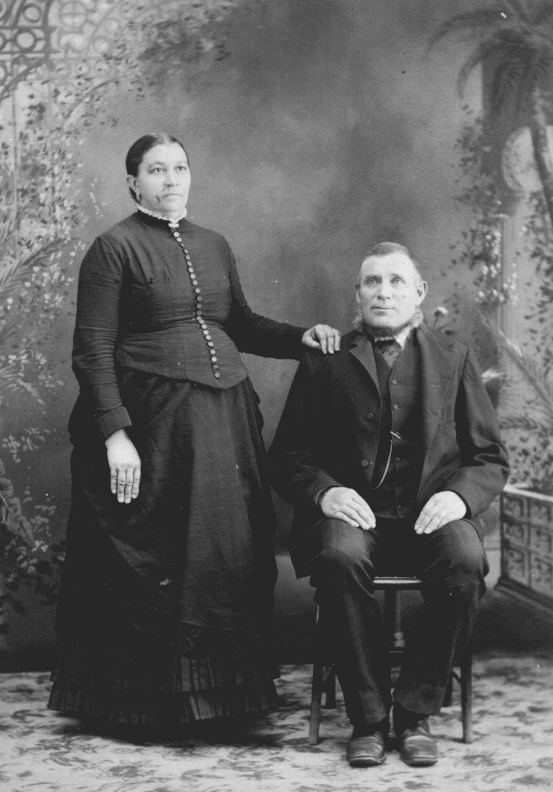
Mathias Noehl and Elisabeth (Hoffman) Noehl, St. Peter, Nicollet County, Minnesota, 1896; digital image 2023, privately held by Melanie Frick, 2024. Courtesy of Richard Buscher (1933-2023).

In this photograph, Elisabeth, with dark hair and eyes and full brows that would be the envy of many young women of today, gazes steadily into the distance, her right hand on her husband’s shoulder and her left holding what is likely a Catholic prayerbook. Her dark dress boasts the elegantly puffed sleeves so popular in the mid-1890s, and a floor-length veil is affixed to the back of her head. A substantial floral arrangement is perched atop her head, cascading over her forehead, while smaller floral sprigs are fastened to her collar and her gathered bodice. These may well have been wax flowers, and appear to be orange blossoms, which were a popular choice for bridal wreaths. Elisabeth, who had immigrated to America from Germany at the age of twenty, had celebrated her twenty-seventh birthday less than a week prior to her marriage.

Mathias, blond and with a fair complexion, gazes in the opposite direction as his bride, his posture upright but casual as he poses seated in a wicker chair, one elbow resting on the arm. He wears a dark suit and vest with a white shirt and necktie, and a floral corsage has been attached to the front of his jacket. What may be a watch chain peeks out underneath. Mathias wears his hair short and has a full mustache; like Elisabeth, his expression is serious. Twenty-eight years old, Mathias had by that point spent a decade in America after emigrating from his native Germany.

Years later, he wrote of his meeting with Elisabeth:

“One day I was standing in front of the house of a venerable old priest, in whose service for five years I found living a good woman. She was reflecting what vocation she should choose. The old pastor had advised her to spend the rest of her life with him, as housekeeper, but on the other side of the house, the nuns beckoned to her, “Come and join us, Lizzie.” Then it happened that I passed by. I was in a neglected condition. My suit of clothes appeared to have seen better days. A hailstorm seemed to have come over my hat. My blond hair lay around my temples unkempt like dried up flowers of the cemetery. When she heard that I had come from her neighborhood village, Holsthum, she said to herself, “That is a disgrace to the whole valley of Prüm. He must be hidden from the streets of North Washington, even if I have to marry him. Perhaps there is hidden in that neglected and careless fellow a good provider, and, if I succeed in making a good Christian out of him, I can earn besides a good crown in heaven.” She thought further, “This is Leap Year and Eve had the job in paradise, a breath-taking job it was, to make the marriage offer. At my first attack, he fell on my breast. Father Probst then tied me to him, on the twenty-second day of September 1896, and he made the knot so tight that I could not think to get away from him anymore.”

Memoirs of Mathias Noehl (Translation)

Although the couple married in Iowa, the mark of the photographer Bancroft on this cabinet card reveals that their wedding portrait was not taken there. St. Peter, Minnesota was well over one hundred miles from North Washington, Iowa, where their marriage had been solemnized on 22 September 1896. What could have brought Mathias and Elisabeth there? I don’t have a good answer. It seems highly unlikely that the couple, certainly not well-to-do, would have set off on a leisurely honeymoon tour of the Midwest; more plausible is that they ventured to Minnesota, where Mathias had spent his first years in America, in order to visit Mathias’s aunts and uncles and/or to scout out a potential place to settle. Mathias and Elisabeth did later reside in Minnesota, but only briefly; after their first two children were born in Iowa, their third child was born in Meeker County, Minnesota in the spring of 1900 following a failed stint in Alberta. However, within months, the family had returned to Chickasaw County, Iowa. A few years later, they made a brief attempt to homestead in Saskatchewan, but, again, ultimately returned to Iowa to raise their nine children. In any case, it is known that Mathias had connections in Minnesota, and undoubtedly some familiarity with the rail lines—one of which did indeed pass through St. Peter.

As North Washington was a small community—its population has hovered between about one hundred to one hundred fifty residents for the past century—a photographer was presumably not available to Mathias and Elisabeth on the day of their marriage. Thus, the couple may have made a point to seek out a photographer during their travels north. Whether Elisabeth traveled with her own veil and flowers or obtained them from the photographer, it seems that this “photo op” must have been carefully planned, and indeed, as Mathias’s parents remained in Germany, it may have meant a great deal to the couple to have a portrait taken in order for Mathias to be able to introduce his parents to his bride.

Copyright © 2024 Melanie Frick. All Rights Reserved.

Continue reading
Tombstone Tuesday: Anna Barbara (Ruckdäschel) Poesch (1811-1887)

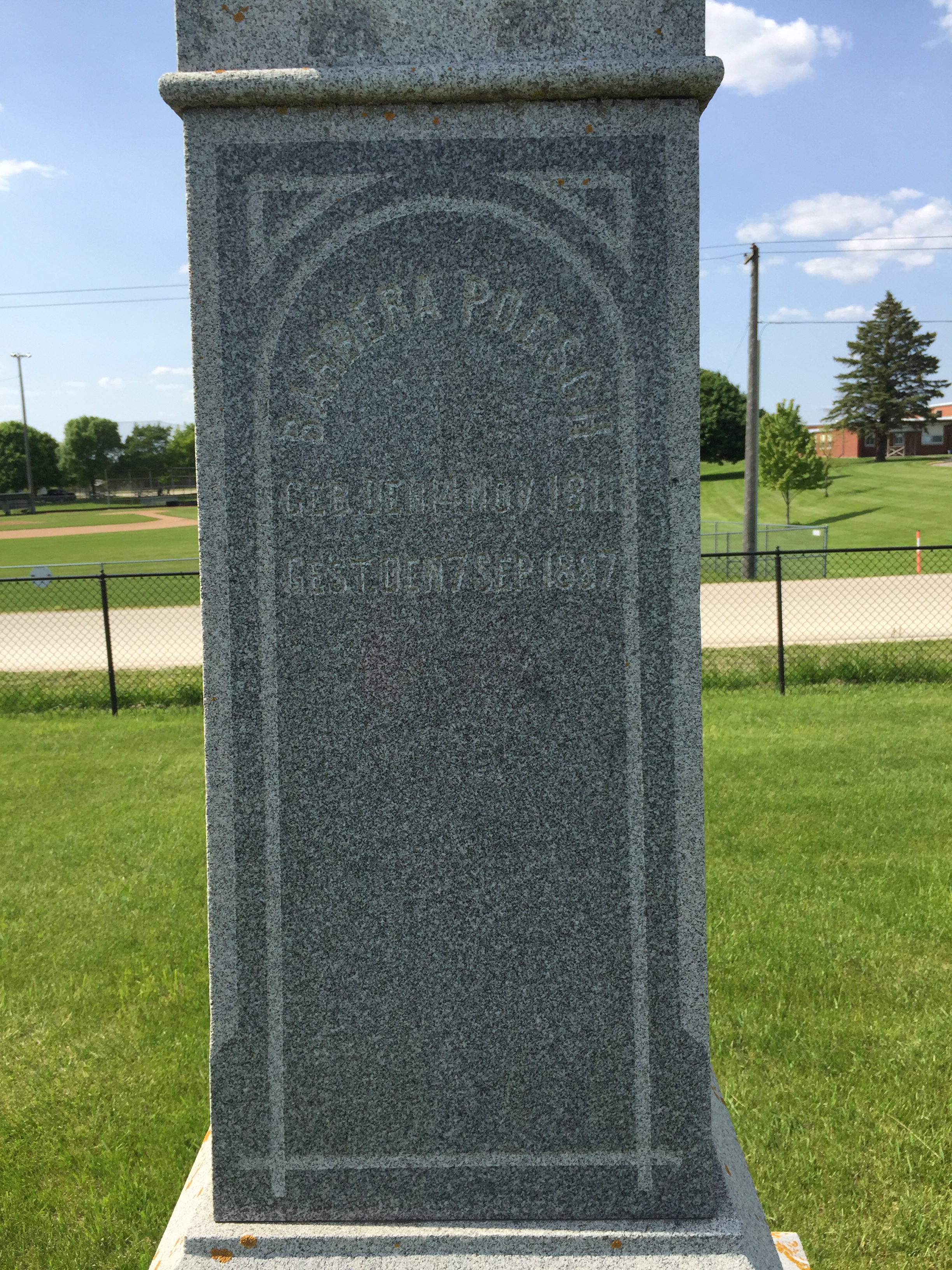
Anna Barbara (Ruckdäschel) Poesch was forty-two years old before she saw something of the world. Born on 14 November 1811 in the village of Schönlind near what is now Weißenstadt, Bavaria, Germany, she was said to have been the daughter of Johann Georg Ruckdäschel and Eva Margaretha Brodmerkel. Nothing is known of her early years, but Barbara, as she was known, married shoemaker Wolfgang Poesch on 22 April 1833 when she was twenty-one years old. Five known children would be born to the couple in the years to come, the first that same year: Johann (1833), Catharina (1835), Anna Margaretha (1838), Lorenz (1847), and Paulus (1850).

In 1852, Barbara bade farewell to her eldest son when he departed in the company of another local family, that of Paulus and Elisabeth (Schmidt) Thoma, to seek a better life in America. Young Johann, nineteen at the time of his passage, must have sent a favorable report to his parents of his new home in northeastern Iowa; in 1854, Barbara, Wolfgang, and their four remaining children packed a trunk and left the village of Weißenstadt behind forever.

After making the trek to Bremen and then stepping aboard the Heinrich Von Gagern, the family was at sea for what may have been as long as two months. Barbara must have struggled to keep her family clean and fed in cramped conditions, but surely took solace in the companionship of others from their home village who traveled with them. Her eldest daughters, Catharina, eighteen, and Anna Margaretha, fifteen, would have been a great help to her in caring for the two little boys, Lorenz, seven, and Paulus, just four.

Barbara and her family disembarked in New Orleans on 27 Apr 1854. They may have been wary of lingering long in this bustling port; a devastating yellow fever epidemic had swept through the city the previous summer, and as April turned to May, the weather would likely have become increasingly hot, humid, and inhospitable. A steamboat would have provided the family relatively quick and reliable passage north, at the very least to St. Louis if not all the way to Iowa.

After an arduous journey across the Atlantic and through the Gulf of Mexico, then up the Mississippi River, Barbara was no doubt thrilled to finally be reunited with her eldest son upon their arrival in Clayton County, Iowa; in fact, numerous familiar faces from their home village would have greeted the Poesch family.

However, tragedy would soon strike—if indeed it hadn’t already. Four-year-old Paulus, listed as the youngest member of the family on the 1854 ship manifest, was not present at the time the family was recorded in the 1856 Iowa State Census, which suggests that he had died at some point in the intervening years, either in Iowa or en route there. Then, most likely within a year of that same census, Wolfgang succumbed to sunstroke. In his early fifties at the time, the physical demands of farming in the heat of an Iowa summer were apparently too much for him.

Although Wolfgang did not live to commemorate his silver wedding anniversary with Barbara, the couple was able to celebrate the marriages of their two eldest children: son Johann to fellow immigrant Catharina Weiss, and, in 1855, daughter Catharina to Friederich Thoma. Then, in 1857, Anna Margaretha married Wilhelm Heinrich Thoma. The Poesch sisters had, in fact, married two brothers, members of the same family with whom their brother Johann had emigrated from Weißenstadt in 1852. This made their children—nineteen between them—double first cousins.

Find A Grave, Inc., Find A Grave, digital image (www.findagrave.com : accessed 25 March 2024), photograph, Barbera Poesch (1811-1887), Memorial No. 148724753, Garnavillo Community Cemetery, Garnavillo, Clayton County, Iowa; photograph by Ken Johnson, 2016.

Barbara survived Wolfgang by approximately twenty years. The year 1860 found her living with the family of her daughter Catharina; a few years later, her son Lorenz would serve with the 12th Iowa Infantry in the Civil War, surely an anxious time for Barbara. Lorenz survived the war and married Wilhelmina Best in 1868. In 1870, Barbara lived with the family of her son Johann, and was perhaps still a member of his household during a bitter cold snap in early March of 1873 when her fourteen-year-old granddaughter, her namesake, sadly perished. Young Barbara, who had been ill, had entered an unheated room one night where she fell and lay undetected until morning, by which time her arms and legs were said to have frozen and she was too weakened to recover.

By 1885, Barbara resided in the town of Garnavillo with her daughter Anna Margaretha, who was by that point also widowed. Barbara’s occupation was recorded as “Old Mother.” Having raised four children of her own to adulthood, and having likely had a hand in raising a total of twenty-five grandchildren as well, Barbara certainly earned her title.

Anna Barbara (Ruckdäschel) Poesch died at the home of her daughter in Garnavillo, Clayton County, Iowa, on 07 September 1887, when she was seventy-five years old. Her obituary, printed in a local newspaper, stated, “Her remains were conveyed to their last resting place on Saturday, followed by a large concourse of sorrowing relatives and friends. Rev. F. Sommerlad conducted the ceremony in his usual impressive manner.”

Copyright © 2024 Melanie Frick. All Rights Reserved.

Continue reading

The Thatcher’s Family

When Matthias Hoffmann died in 1879 at the age of fifty-eight, he left a widow and six children, the youngest of whom was only four years old. Matthias, a thatcher by trade, had lived with his family in the village of Prümzurlay, Eifelkreis Bitburg-Prüm, Rhineland-Palatinate, Germany, near Luxembourg. He and his wife, Anna Marbach, had married in the village of Ernzen on 24 September 1861, and six children were born to them over the next fourteen years: Clara (1861), Nicolaus (1864), Jacob (1867), Elisabeth (1869), Eva (1872), and Matthias (1875).

It is not known how the Hoffmann family supported themselves after Matthias’s death, but as Anna did not remarry, she and her eldest daughters may have been able to earn an income from spinning, weaving, or the like, while her eldest sons may have hired out as shepherds or farm laborers. Perhaps Nicolaus, who was fourteen when his father died, was fortunate enough to have already had an apprenticeship in place; eventually he married and settled in the area, living out his life in Germany.

Prümzurlay, Rheinland-Pfalz, Germany photograph, 2009; privately held by Melanie Frick, 2024.

For the others, however, new horizons were sought. Jacob, the second eldest son, who had been twelve years old at the time of his father’s death, was the first to immigrate to America. He traveled alone from Antwerp to New York in the spring of 1887 when he was twenty years old. One can well imagine the hard work that he—and his mother and siblings—must have undertaken in order to book his passage, quite likely with the expectation that he would pave the way for the rest of the family to eventually join him overseas. Jacob then made his way to northeastern Iowa.

Three years later, in the spring of 1890, his sisters Clara and Elisabeth followed. Within a month of their arrival in North Washington, Chickasaw County, Iowa, Clara, who was twenty-eight, married fellow immigrant John Seelhammer. One wonders whether they had been acquainted in Germany, or whether Jacob may have facilitated the match. Elisabeth, twenty, was not so quick to settle down; she found employment as a housekeeper for the local priest, Father Probst, who was a native of Luxembourg.

In the spring of 1891, matriarch Anna (Marbach) Hoffmann, who was by then fifty-five years old, voyaged from Antwerp to New York with her two youngest children, Eva, eighteen, and Matthias, sixteen. They too were bound for Chickasaw County, Iowa, where they would reunite with Jacob, Clara, and Elisabeth.

The 1895 Iowa state census indicates that Anna and at least four of her children resided in Chickasaw County: Anna headed a household that included her sons Jacob and Matthias, both of whom farmed; Clara lived with her husband, a shoemaker, and their children; Elisabeth resided at her place of employment with Father Probst and the Sisters of Charity. Eva is absent from the 1895 Iowa state census, but whether this is because she had moved elsewhere or was simply missed by the census enumerator is not known.

It was in Chickasaw County that Jacob married Margaret Nosbisch in 1895, and where Elisabeth married fellow immigrant Mathias Noehl in 1896. In 1898, however, tragedy struck the Hoffmann family, when Matthias, the youngest child of Matthias and Anna (Marbach) Hoffmann, died at the age of twenty two or twenty three. Another blow occurred that year when Jacob and his wife lost a child at one day old.

It was also in 1898, however, that Eva married in Chicago to Mathias Weyer, and by 1900, her mother had joined her there. Chicago wasn’t a surprising destination for them; Anna’s mother and two of her sisters had settled there decades earlier. Although her mother had since passed away, Anna would have had the opportunity to reunite with her sisters and to meet her nieces and nephews.

Ultimately, Anna seems to have remained in Chicago until her death in 1907; the cause was attributed to asthma. Clara and Elisabeth both raised large families in Chickasaw County, with Clara having eight children and Elisabeth nine. Eva had one child with her first husband, a farm laborer and beer peddler; after she was widowed, she remarried in 1913 to Milton Jonas, and lived out her life in Chicago.

Jacob, whom a local newspaper described as being “of that hustling, genial disposition which makes him companionable and agreeable whether the weather, or something else is or is not just to his liking,” set his sights on South Dakota shortly after the dawn of the new century, and later settled in Hidalgo County, Texas, with his wife and son—who was ultimately the only one of his six children to survive infancy.

Brother and sister Jacob Hoffmann and Elisabeth (Hoffmann) Noehl, Hidalgo County, Texas, 1940; digital image courtesy of Jacky Sommer, 2018.

Whether the scattered Hoffmann siblings were able to remain in close contact in the decades following their mother’s death is unknown, but it is known that Jacob returned to Iowa to bury his wife in 1929, and there is also evidence—in the form of a photograph—that Elisabeth visited her older brother Jacob at his orange grove in Mission, Texas, in 1940. Eva had died in 1936; Jacob would pass away in 1954, Clara in 1955, and Elisabeth in 1957. Of the fate of their brother Nicolaus who was said to have remained in Germany, however, nothing is yet known.

Copyright © 2024 Melanie Frick. All Rights Reserved.

Continue reading

The Sattlermeister of Trarbach

August Heitz, one of a dozen children born to Carl Theodor Heitz and Anna Maria Moog, was born on 26 March 1846 in Trarbach, Bernkastel-Wittlich, Rhineland-Palatinate, Germany. His father was a tanner, and August was destined to work with leather as well: following an apprenticeship to learn the trade, and time spent as a journeyman to hone his skills, he became a sattlermeister, or master saddler.

Trarbach, Marktplatz vor dem Stadtbrand von 1857 [Marketplace before the Town Fire of 1857], Holzstich; ; Wikimedia Commons, copyright Bligny.

August was thirty-one, likely well established in his trade, when he married Julianna Carolina Faust on 18 August 1877. Julianna, then twenty-one years of age, was the daughter of a cooper and likewise a native of Trarbach. The couple settled in their hometown, idyllically situated along the Mosel River and surrounded by abundant vineyards, and raised five children there: Julchen, Carolina, Anna Maria, Ida, and Adolf Heitz. A sixth child, August, died in infancy.

As a saddler in the final years before automobiles became widespread, August would have worked to make and repair saddles, bridles, and harnesses. He would also have trained others who wished to learn his trade, and the handwritten contract of at least one of his apprentices is extant. On 20 June 1901, the widow Anna Faust contracted her son, Otto, to a three-year apprenticeship under August Heitz, paying him a one-time fee of fifty marks for his tutelage. August promised to provide Otto with thorough instruction, health insurance and “contributions from his means,” whereas Otto agreed to diligent, orderly work and conduct. Otto would also be free on certain days to assist his mother “with her own work.” Interestingly, this contract notes that August was a tapezierer, or upholsterer, in addition to being a saddler.

It is unknown whether August also shared his knowledge of his trade with his surviving son, Adolf, as he ultimately made his career as a wine merchant. This trade was shared by two of August’s sons-in-law, as well, the husbands of both Julchen and Ida; Carolina’s husband was an innkeeper. Only Anna Maria did not marry; she joined a religious order.

August Heitz photograph, circa 1910, Germany; digital image 2011, privately held by Melanie Frick, 2023.

Little else is known of August’s life in Trarbach, although it appears that through his trade he was able to provide a comfortable life for his family. The only known photograph of him seems to have been taken when he was in his sixties, sometime around the year 1910. Sporting a dapper mustache and a pleasant expression, he wore a collared shirt, necktie, vest, and double-breasted wool suit coat for the occasion.

August Heitz died at the age of sixty-seven on 23 December 1913, survived by his wife, five children, and, eventually, six grandchildren.

Copyright © 2023 Melanie Frick. All Rights Reserved.

Continue reading

Michael and Magdalena

Little is known about Michael Noehl and Magdalena Hoffman, a couple who spent their married life in the village of Holsthum, Eifelkreis Bitburg-Prüm, Rhineland-Palatinate, Germany. Holsthum was described by one of their sons as “situated in a lovely valley of rich agricultural land, crowned with fruit trees, and further off, with magnificent forests, between nurseries and rose plantations.” Even now it remains a quaint, pastoral village.

Michael Noehl, one of at least eight children of Johannes Noehl and Elisabeth Gierens, was born in Niederstedem, Eifelkreis Bitburg-Prüm, Rhineland-Palatinate, Germany on 22 June 1828. Nothing is known of his childhood, but as a young man, he entered the military. According to the memoirs of his son, Michael served as a Prussian soldier in Koblenz between the years 1847-1851; during the Baden Revolution in 1848, he stood sentry at the Ehrenbreitstein Fortress.

After his service, Michael married Magdalena Hoffman, who was born on 21 Jul 1833 in Holsthum, one of at least four children of Mathias Hoffman and Magdalena Ehr. Michael and Magdalena were married on 12 February 1857; Michael was twenty-eight and Magdalena twenty-three at the time of their marriage, which was recorded at Schankweiler. The Schankweiler Klaus is an eighteenth-century chapel and hermitage tucked into the forest approximately two miles from the village of Holsthum, and still stands today.

Schankweiler, Rheinland-Pfalz, Germany photograph, 2009; privately held by Melanie Frick, 2022.

Together, the couple had seven sons: Mathias (1858), Michael (1860), Nikolaus (1864), Nikolaus (1866), Mathias (1868), Johann (1870), and Jakob (1873). Notably, despite name repetition among their sons, it is believed that all survived to adulthood. (This is not the first case of name repetition among children of this region that I have observed.)

Mathias Noehl (1868-1950), second from right, with brothers, perhaps Nikolaus, Johan, and Jakob Noehl, Holsthum, Germany, 1938; digital image 2009, privately held by Roland Noehl, Holsthum, Germany, 2009.

A great-grandson of Michael and Magdalena remembered being told that Michael was a forester, and Magdalena certainly had her hands full raising seven sons, but few details are known of their adult lives. One of their sons recalled completing school at the age of fourteen and going to work herding sheep to help his parents pay off a debt on their property; later this same son was apprenticed to a rose grower, so it may be assumed that their other sons were similarly established with apprenticeships.

Michael saw several of his siblings immigrate to America in the nineteenth century; his sister Susanna and his brothers Matthias and Johann all settled in Minnesota. Likewise, Magdalena saw a paternal aunt and a paternal uncle immigrate to Minnesota and Iowa. Later, Michael and Magdalena bade farewell to two of their own children who left their homeland to try their luck on American soil: Michael in 1881 and Mathias (1868) in 1886. From these two sons then came fifteen American grandchildren whom Michael and Magdalena never had the opportunity to meet.

Michael and Magdalena lived out their lives in Holsthum, surviving at least to their sixties, as it is known that their son Mathias came from America to visit in 1894 and found them in good health at that time. To the best of my knowledge, however, their graves, according to German custom, have long since been recycled and are no longer marked.

Copyright © 2022 Melanie Frick. All Rights Reserved.

Continue reading

The Canada Experiment

Mathias Noehl attempted to settle in Canada on at least two occasions after emigrating from Germany to the Midwest as a young man in 1886. After a stint living among relatives in Minnesota, he married fellow immigrant Elisabeth Hoffmann in North Washington, Chickasaw County, Iowa, in 1896. The couple had a son in 1897 and a daughter in 1898, and in 1899, as Mathias later wrote in his memoir, “The desire for migratory life befell us again.” He continued:

“We loaded all that we possessed into a railway car, and traveled to the plains of Alberta, Canada, to meet another stroke of ill fortune, which we had not expected. The climate and the foodstuffs of that country did not agree with us, so we took sick and the doctor advised us to return to the U.S. We went back to the forests of Minnesota, where between 1886 and 1894 I had built my air castles, with which I comforted my wife. My wife felt disappointed when we arrived there, and all I possessed consisted in nothing else but air castles. Besides, we had the terrible cold weather in winter 1899. We stayed there until spring; when the birds flew northward, we remembered the fleshpots of Iowa, and this drove us back to where in 1896 I had found my Waterloo. There, the death of two old people had pity on us, which made a dwelling available for our children and us […]. In 1900 we returned in bitter disappointment to North Washington, with all our savings lost, and one more child. That child is all we gained with our adventures in Canada.”

It is unknown where exactly in “the plains of Alberta” the Noehl family lived in 1899, but it is possible that they were in Pincher Creek, a settlement that attracted German-American Catholics around this time.

Despite finding failure in Alberta, Mathias remained convinced that Canada was in his future. In the spring of 1903, now thirty-four years old and the father of four children, he applied for a homestead in Saskatchewan. The homestead was located eighty-five miles east of Saskatoon near the village of Muenster, in an area known as St. Peter’s Colony. This colony, founded in 1902, was the brainchild of the Benedictine order, the German American Land Company, and the Catholic Settlement Society of St. Paul, Minnesota; land was set aside specifically for German Catholics, who responded to advertisements for the colony and flocked north from the Midwestern states. Here there was to be ample farmland, a colony of like-minded people who shared their language and faith, and a new monastery at the helm, to boot.

Screen Shot 2021-06-20 at 4.09.37 PM

The Noehl family was the target audience for this venture, but ultimately did not remain long enough to prove the homestead. A grandson recalled being told that the family found the water in Saskatchewan to be too alkaline, and apparently many settlers were displeased with the brush-covered land. As the Noehl family’s fourth child was born in Iowa in the spring of 1904, it seems that their time spent in Saskatchewan amounted to less than one year.

Mathias, ever filled with wanderlust, attempted once more to relocate from the Midwest, although he no longer had his sights set on Canada. As the story goes, he visited Oregon several years later and, finding a welcoming German community (perhaps Mt. Angel) and stunning forests that reminded him of his homeland, began to make plans for his family to move once again. However, as his wife was at that point expecting their seventh or eighth child, she put her foot down—and in Iowa they remained for good.

Copyright © 2021 Melanie Frick. All Rights Reserved.

Continue reading

The Frick Family of Rohrbach, Heidelberg, Germany

Although it is believed that our particular Frick family originated in Switzerland, they were present in Rohrbach, Heidelberg, Baden-Württemberg, Germany, at least as early as 1699. It was then and there that Johann Georg Frick, allegedly a native of Switzerland, was said to have married Anna Margaretha Nachbauer, and it was there that he died in 1712 at the age of thirty-six. Rohrbach is a district of the renowned city of Heidelberg, situated on the Neckar River in southwestern Germany. Heidelberg today is home to Heidelberg University, which was established in the fourteenth century, as well as the ruins of the thirteenth-century Heidelberg Castle.

View of Heidelberg, Baden-Württemberg, Germany, 2019; privately held by Melanie Frick, 2021.

While there is a region in northwestern Switzerland known as Fricktal (“Frick Valley”), it is yet unknown where exactly in Switzerland Johann Georg Frick and his predecessors may have lived. The seventeenth century was a tumultuous time in early modern Europe, and Switzerland saw great religious upheaval; it can be considered whether this might have inspired the Frick family to relocate. Heidelberg also faced turmoil at this time, and was in ruins by 1693 due to French invasions. In the years thereafter, grappling with severe winters as well as warfare, thousands of Protestants living in the German Palatinate would flee, settling elsewhere in Europe and in the “New World” colonies. The Fricks, however, stayed.

Melanchthonkirche, Rohrbach, Heidelberg, Baden-Württemberg, Germany, 2019; privately held by Melanie Frick, 2021.

The most recent member of our Frick family to live out his life in Rohrbach was Ludwig Frick. Ludwig was born in Rohrbach on 12 November 1883, the son of Martin Frick (1857-1935), who worked as a civil servant for the railroad, and Katharina Feigenbutz (1863-1918). Ludwig was the eldest of eight children; his seven younger siblings included Joseph (1885), Katharina (1886), Johann (1889), Christina (1891), Johann (1894), Susanna (1895), and Peter (1899). Ultimately, however, only Katharina and Susanna would live to adulthood alongside Ludwig.

Ludwig Frick with wife Anna Katharina (Schilling) Frick, center, and daughters Elsa and Marta, likely pictured in Rohrbach, Heidelberg, Germany, circa 1940; privately held by [personal information withheld], 2021.

Ludwig Frick and Anna Katharina Schilling married in nearby Münzesheim, Anna’s hometown, on 09 January 1908, and settled in Rohrbach. Ludwig worked as a locksmith, and he and Anna had seven children together: Wilfried (1908), Elsa Elisabeth (1909), Otto Jacob (1911), Elsa (1912), Erne Elisabeth (1914), Marta (1916), and Wilhelm (1919). Both Elsa Elisabeth and Erne Elisabeth died as infants.

Anna Katharina (Schilling) Frick with her son Wilfried Frick (right) and an infant, likely her son Otto Jacob Frick, Rohrbach, Heidelberg, Germany, circa 1911; privately held by [personal information withheld], 2021.

Few details are known about Ludwig beyond his occupation and the fact that he played piano. It is believed that he and his wife, like generations of his family before him, attended the Melanchthon Church; city directories indicate that they lived for many years on Max-Joseph-Strasse in Rohrbach, in a corner house bordered by a narrow garden. Ludwig died at the age of seventy-four on 28 December 1957; Anna survived him by a number of years, and is remembered as a kindly woman who made lamb-shaped cakes for her grandchildren.


Copyright © 2021 Melanie Frick. All Rights Reserved.


SOURCES

“Baden and Hesse Germany, Lutheran Baptisms, Marriages, and Burials, 1502-1985,” index, Ancestry.com (www.ancestry.com : accessed 30 May 2021), marriage of Ludwig Frick and Anna Kathar. Schilling, 1908, Münzesheim.

“Baden, Germany, Lutheran Baptisms, Marriages, and Burials, 1502-1985,” index, Ancestry.com (www.ancestry.com : accessed 30 May 2021), burial of Ludwig Frick, 1957, Rohrbach.

“Baden, Germany, Lutheran Baptisms, Marriages, and Burials, 1502-1985,” index, Ancestry.com (www.ancestry.com : accessed 30 May 2021), marriage of Martin Frick and Kath. Elisabetha Feigenbutz, 1883, Rohrbach.

“Germany and Surrounding Areas, Address Books, 1815-1974,” index and images, Ancestry.com (www.ancestry.com : accessed 30 May 2021), Ludwig Frick, 1927, Rohrbach.

“Germany and Surrounding Areas, Address Books, 1815-1974,” index and images, Ancestry.com (www.ancestry.com : accessed 30 May 2021), Ludwig Frick, 1940, Rohrbach.

“Germany, Select Marriages, 1558-1929,” index, Ancestry.com (www.ancestry.com : accessed 30 May 2021), marriage of Johannes Schilling and Elisabetha Christina Kaiser, 1873, Münzesheim.

Grandchild of Ludwig and Anna Katharina [Schilling] Frick, conversation with the author, 2019; notes in author’s files.

Norbert Emmerich, “Johann Georg Frick,” Schweizer Einwanderer in Heidelberg und Umgebung [Swiss Immigrants in Heidelberg and the Surrounding Area] (https://sehum.dynv6.net/201405/11/ofb3k10314.html : accessed 30 May 2021).

Wikipedia (www.wikipedia.org), “Heidelberg,” rev. 14:53, 19 May 2021.

Wikipedia (www.wikipedia.org), “Reformation in Switzerland,” rev. 21:01, 26 May 2021.

A German American Family in Chicago

Several years after German immigrants Fred and Emma (Stube) Wiese of Chicago, Cook County, Illinois posed for a photograph together in their garden, they were photographed outdoors once again, this time with their children.

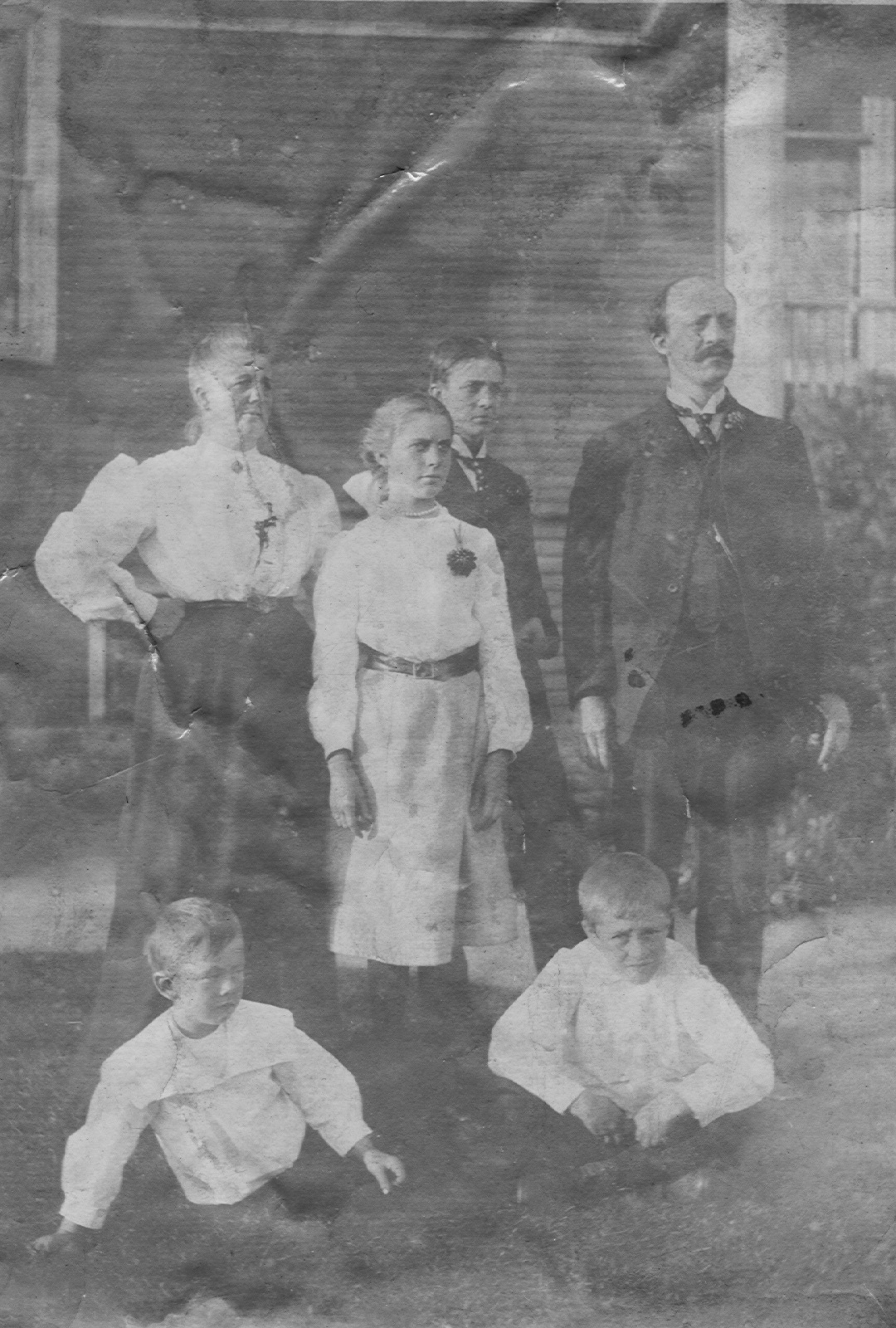
Fred and Emma (Stube) Wiese with children, from left, Leonard, Rose, George, and Oliver, circa 1904, Chicago, Illinois; digital image circa 2000, provenance of the original unknown.

Their youngest son, Leonard, seated at left, provides the biggest clue in dating this photograph, as his age is the easiest to pinpoint: assuming that he was, perhaps, three years old here, it can be dated circa 1904.1 George, standing between his parents, would have turned seventeen that year, Rose would have turned twelve, and Oliver, seated at right, would have turned eight.2 Sadly, Fred and Emma’s oldest daughter, Lillie, had died of meningitis as an eight year old in 1897.3

The Wiese family is pictured outside what may have been their own Victorian-style home at 2502 North Neva Avenue in Chicago’s Montcalm neighborhood.4 Only one of the six looks directly at the camera. Perhaps a second photographer was off to the side, where the other five members of the family directed their attention. This image is a scan of an original of an undetermined medium; it is rather heavily damaged with wrinkles, scuffs, and blotches.

Fred, who was a cigar maker by trade, sports a full mustache and wears a dark suit and tie.5 He is in his late thirties here.6 Emma, also in her late thirties, wears a white collared shirtwaist with a brooch at her throat, paired with a walking skirt in a darker color.7 A belt with a decorative clasp can be seen at her waist. A skilled seamstress, Emma was especially known for crocheting elegant garters, a talent she used to help support her family in her later years.8 It can well be imagined that she had a hand in making sure that she, her husband, and their children were well-dressed.

George wears a suit and tie much like his father’s; his fair-haired younger brothers sport rather voluminous white shirts and dark pants. Rose’s hair is pulled back into a braid and set off with a large bow; her simple shirtwaist and skirt, which falls mid-calf, are accessorized with a belt tied at her waist, a corsage, and a string of beads at her neck. These beads resemble pearls, although her mother was also known to make fragrant, darker-colored beads out of crushed rose petals which she would then alternate with pearl beads to create a necklace.9

This is the only known photograph of Fred and Emma (Stube) Wiese with their children. Despite the beating that the original print appears to have taken, it remains a special memento of a day in the life of this German American family in Chicago.

Copyright © 2019 Melanie Frick. All Rights Reserved.

Continue reading

Pomeranian Roots

For decades, the precise origins of German-speaking immigrants Joachim and Sophia (Cammin) Wiese of Chicago, Cook County, Illinois were forgotten.1

There were clues: a scrawled place name on the Hamburg Passagierlisten, an intriguing DNA connection.2

Finally, a dedicated on-site researcher uncovered several records that definitively placed Joachim and Sophia within the arms of their families in the neighboring villages of Wendisch Baggendorf and Barkow, located in present-day Vorpommern-Rügen, Mecklenburg-Vorpommern, Germany.3

Joachim, christened Joachim Christian Friedrich Wiese, was born on 20 October 1840 in Wendisch Baggendorf, the son of laborer Johann Adam Wiese and Beate Elisabeth Hanna Schult.4

Sophia, christened Catharina Sophia Joachime Cammin, was born on 07 November 1842 in Barkow, the daughter of laborer Johann Christian Cammin and Christina Dorothea Ahrends.5

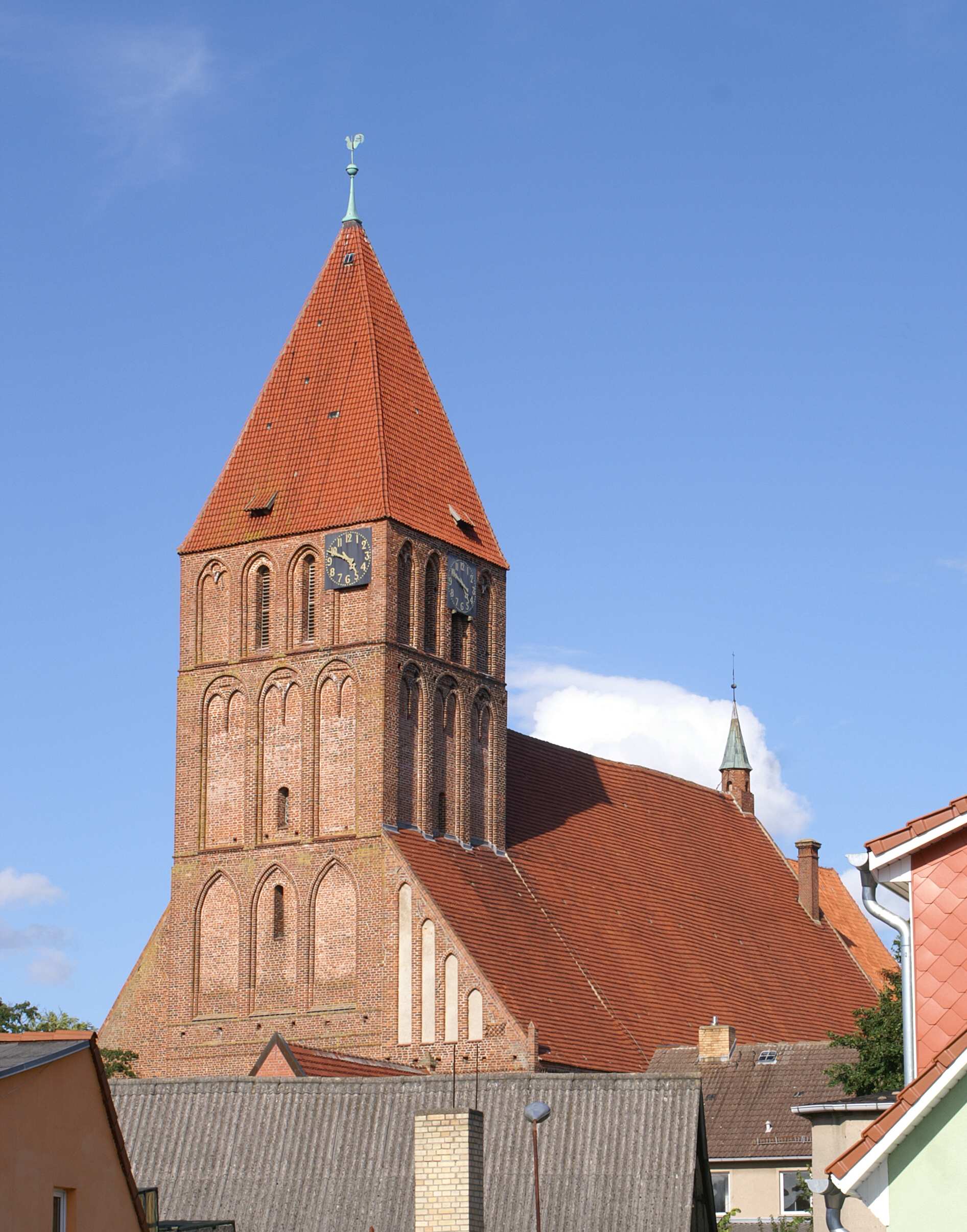
Joachim and Sophia married on 03 April 1864 in Grimmen, a village of perhaps a couple thousand inhabitants located a short distance from the state-owned estate at Barkow where Joachim was employed as a laborer.6 They were married by Carl Bindemann at St-Marien-Kirche, an early Gothic construction that dates to the thirteenth century.7

“St.-Marien-Kirche in Grimmen,” 2007, Grimmen, Mecklenburg-Vorpommern, Germany; Wikimedia Commons, copyright Erell.

The couple’s first child, christened Carl Christian Friedrich Wiese, was born later that year on 17 September 1864.8 He did not survive childhood.9 Their second child, christened Friedrich Carl Christian Wiese, was born on 22 August 1866.10

When they prepared to board the Electric at Hamburg in November of 1868, however, Joachim and Sophia stated that their two-year-old son, nicknamed Fritz, was only nine months of age.11 It seems plausible that a free or reduced rate of passage might have been granted infants under one, and if the Wiese family did not happen to encounter a sympathetic ticketing agent, it can easily be imagined that Sophia might have bundled Fritz in a shawl close to her chest to conceal his true age until the family was safely aboard the ship.

Joachim and Sophia (Cammin) Wiese, ca. 1889, Chicago, Cook, Illinois; digital image ca. 2000.

Whatever the case, the Wiese family arrived in New York the day after Christmas 1868, after enduring a nearly eight week crossing during which time Sophia marked her twenty-sixth birthday.12 Among their fellow steerage passengers were several relatives, including Sophia’s widowed mother; Joachim’s widowed father came aboard a different ship.13 They soon made their way to Chicago, where they joined a wave of immigrants like themselves who contributed to the city’s unprecedented expansion.

It was there, during the years of regrowth that followed the Chicago Fire of 1871, that Joachim would work his way up to become a tailor, while Sophia would raise six children.14 And it was in Chicago that the Wiese family would face new struggles and new opportunities as they adapted to an urban environment vastly different from their rural homeland near the Baltic Sea.

Copyright © 2019 Melanie Frick. All Rights Reserved.

Continue reading

Tombstone Tuesday: Lorenz Stoehr (1790-1876)

Lorenz Stoehr was born in or near Weißenstadt, Upper Franconia, Bavaria, Germany, a village located a mere twenty miles from what is now the Czech Republic.1 Weißenstadt was named “white city” as a nod to its landmark white church, and is situated on the shore of a lake in the Fichtel Mountains.2 From the inscription on Lorenz’s tombstone, his birthdate can be calculated to 04 September 1790.3

As a young man, Lorenz served approximately six years in the military during the Napoleonic Wars, first under Napoleon and then, as allegiances shifted, with the Germans.4 As the story goes, he was eventually wounded on a march to Paris and was then discharged and granted a pension.5 Lorenz was trained as a master tailor, a trade he pursued during the winter months as the summer months were consumed with his labors as a farmer.6 Amazingly, several mementos of these chapters of his life survive today: buttons from his military uniform, his discharge and pension paperwork which granted him the amount of five Gulden each month for the remainder of his life, and an 1828 purchase agreement for approximately one and a half acres of land in the Weißenstadt area.7

Lorenz was married to Barbara Feicht in 1820 or shortly thereafter, and with her had the following known children: Margaretha B. (1824-1897), Johann Wolfgang (1826-1883), Eva Margaretha (1831-1906), George Adam (1833-1915), and Johann Friedrich (1842-circa 1857).8

In 1853, at the age of sixty-two, Lorenz arrived in New York harbor aboard the Solon.9 Traveling with him were his wife and youngest daughter; his sons had made their way to America the year prior, disembarking in New Orleans before making their way up the Mississippi River to the community of Garnavillo, Clayton County, Iowa.10

Find A Grave, Inc., Find A Grave, digital image (www.findagrave.com : accessed 26 January 2019), photograph, Lorenz Stoehr (1790-1876), Memorial No. 69221239, Elgin City Cemetery, Elgin, Fayette County, Iowa; photograph by Tammy Miller, 2015.

Lorenz was widowed in 1855 and spent the years thereafter at the homes of his children.11 In 1856, he lived with his daughter Eva and her husband Hiram Hammond on their farm in Clayton County; in 1860 and 1870, he could be found at the home of his son George, a jeweler and dry goods merchant, first in Clayton County and then in neighboring Fayette County, Iowa.12

Lorenz Stoehr died at the age of eighty-six on 07 December 1876, likely at the home of his son in Elgin, Fayette County, Iowa.13 He is buried at the Elgin City Cemetery where an upright tombstone marks his grave.14

Copyright © 2019 Melanie Frick. All Rights Reserved.
Continue reading