Tag Archives: Iowa

Tombstone Tuesday: Fred and Matilda (Hammond) Thoma

Fred and Matilda (Hammond) Thoma, or Fritz and Tillie as they were known in their community, spent their childhoods and the entirety of their married lives in the same rural county in northeastern Iowa. Fred Thoma was born to Bavarians Wilhelm Heinrich and Anna Margaretha (Poesch) Thoma on 4 December 1857 in Garnavillo, Clayton County, Iowa.1 Matilda Hammond was born to Hiram H. and Eva Margaret (Stoehr) Hammond on 4 May 1859 in Volga, Clayton County, Iowa.2 While Matilda’s father was a native of Ohio and an early settler in Iowa, her mother hailed from the same Bavarian village of Weißenstadt as Matilda’s in-laws.3

SCAN0126

Grave of Matilda Thoma (1857-1947) and Fred Thoma (1857-1924), Garnavillo Community Cemetery, Garnavillo, Clayton County, Iowa; image date unknown, privately held by Melanie Frick, 2015.

It seems likely that the couple crossed paths as children, although they lived in separate communities; the Weißenstadt immigrants were surely a close-knit bunch. Fred and Matilda married on 29 December 1879 at the Zion Evangelical Lutheran Church in Clayton Center.4 The next year found them living in Garnavillo, where Fred was a clerk in his late father’s country store.5 That autumn, the couple became parents to the first of their eventual five children: George Hiram, Leonard Christopher Julius, Ludelia Maria, Roselyn Anna, and Norma Evaline.6 All but Norma survived to adulthood; sadly, she died in a diphtheria outbreak when she was ten years old.7

What few details are known of Fred and Matilda’s lives come from recollections of their granddaughters.8 The first thirty years of their marriage were spent in the town of Garnavillo, where Fred later had a restaurant and then worked as a laborer.9 Matilda was said to have been a midwife who delivered many children in Clayton County, although such skills were not recorded in the census. Fred allegedly had a fondness for drink, so when Matilda received an inheritance, she bought a farm away from town – and the saloons.10 The empty nesters enjoyed life in the countryside for the next fifteen years until Fred’s death in Clayton on 10 January 1925.11

As a widow, Matilda spent time in the homes of her daughter and granddaughter. In 1930, she experienced a different climate in Houston, Texas; by 1940, she had returned to the Midwest and resided in Wisconsin.12 It was there in Bridgeport, Crawford County, Wisconsin that she died on 21 August 1947 when she was approaching ninety years of age. She is buried beside her husband at the Garnavillo Community Cemetery.13

Copyright © 2015 Melanie Frick. All Rights Reserved.

Continue reading

A Fatal Scratch: The Death of a Pioneer Woman

Anna_Margaretha_Poesch_Thoma_Obituary“After almost a week of extreme suffering, caused from blood poisoning, Mrs. Margaretha Thoma, one of Garnavillo’s oldest residents, passed away at 4:00 o’clock last Saturday afternoon. About two weeks ago the lady accidentally scratched the back of one of her hands with a pin. The scratch at the time was a mere trifle and was given no further thought by her until a few days after when the hand began to swell and cause more or less pain. A physician was called and found it necessary to lance the hand, but desired results did not follow and twice later the lance was employed, and still no relief came to her sufferings, but instead the wound continued to grow worse and the swelling commenced extending into the arm. Everything possible was done to allay the pain and comfort her in her unendurable suffering, but nothing could be administered that would combat with the situation and the result was death came as a relief after nearly a week of incessant torture.”1

Anna Margaretha (Poesch) Thoma was born in Weißenstadt, Wunsiedel, Bavaria, the daughter of Wolfgang and Barbara Poesch.2 She came to Iowa with her family at a young age, and was later deemed “one of the venerable and loved pioneer women of Clayton County.”3 Margaretha married William Henry Thoma, a local merchant, in 1857, when she was still in her teens.4 They had eleven children before his death in 1876; Margaretha never remarried, and in fact continued to operate his mercantile in the years following his death.5 Perhaps it was this role in her community that brought her the recognition to be remembered so fondly in the years following her death from blood poisoning on 9 November 1907.6

Margaretha’s unfortunate plight might remind some of Caroline Ingalls’ encounter with a rusty nail in a particularly drama-filled episode of Little House on the Prairie. Indeed, albeit tragically, little could have been done to relieve Margaretha’s suffering at this time and place. Her age, estimated at near seventy, might also have contributed to her susceptibility to infection, whether she in fact suffered from sepsis or tetanus. Although not soon enough for Margaretha, it would be just a matter of time before the use of penicillin – and the tetanus vaccine – would become widespread. 

Copyright © 2015 Melanie Frick. All Rights Reserved.

Continue reading

A Paper Moon

When I began researching the topic of paper moon photography, I was surprised to find that these crescent moon photo booth props are making a comeback by way of trendy, vintage-style wedding decor. In case you didn’t know, flappers are big these days, and the popularity of this era has influenced a new generation to pose for classic shots with a smiling man in the moon. However, paper moon photo booths got their start even before the days of Gatsby, likely around the turn of the twentieth century.1

SCAN0096

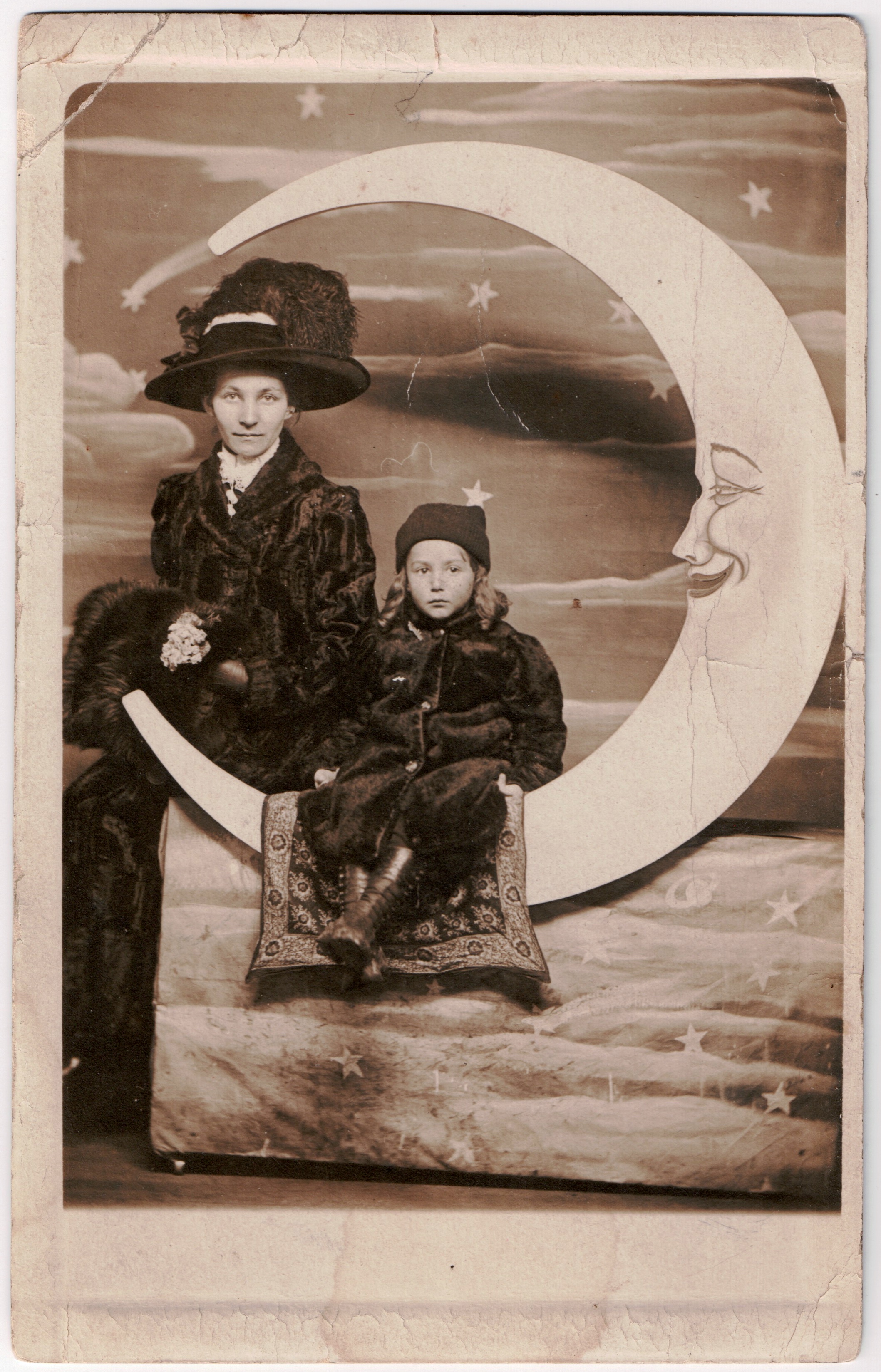
Melanie (Lutz) and son Gerald Adam, Sioux City, Iowa, ca. 1912; digital image 2014, privately held by Melanie Frick, 2015. Collection courtesy of David Adam.

This particular paper moon photograph was printed on a real photo postcard circa 1912. The moon backdrop itself is not one of the more elaborate, with an obvious break in the night sky for seating purposes. In fact, what looks like a wheel to roll the seat into place is also visible, and a small “magic carpet” conceals the primary seating area. The crescent moon smiles, and the stars, as is typical among paper moon photography, are present even within the crescent – where, realistically, they would be blocked by the moon in shadow. A shooting star can be spotted at the upper tip of the crescent, and a planet appears below the moon.

The mother and son posed here are Melanie (Lutz) and Gerald “Jerry” Adam of Sioux City, Woodbury County, Iowa. Both are dressed in long fur coats, Melanie’s of a fashionable collared design while Jerry’s is fastened simply with three large buttons. A glimpse of Melanie’s leather gloves is visible, and a stylish plumed hat is atop her head. Jerry wears a practical stocking cap and high button boots. His curls are long, to his shoulders, which was not atypical among young boys of the era.

Given their attire, it is obvious that this photograph was taken on a cold winter’s day. Perhaps the paper moon photo booth was set up outdoors or in an unheated (or under-heated) space as a temporary attraction; this mother and son may have simply stumbled upon it and decided to surprise Jerry’s father with their fun souvenir. As Jerry was born in the summer of 1908,2 it seems most likely that this photograph dates to the winter of 1911-1912, or, at the latest, the winter of 1912-1913. January 1912 in particular was a cold month, with Sioux City registering a record low of −35°F on 12 January.3 However, even beyond such extremes, Sioux City was no stranger to weather that would have required one’s warmest winter coats for a visit to the moon!

Copyright © 2015 Melanie Frick. All Rights Reserved.
Continue reading

Tombstone Tuesday: Mathias and Elisabeth (Hoffmann) Noehl

At the tail end of the nineteenth century, two German immigrants made the decision to forge their lives together in America. Mathias Noehl was born to Michael and Magdalena (Hoffmann) Noehl on 22 April 1868 in the village of Holsthum, Germany,1 and Elisabeth Hoffman was born to Mathias and Anna (Marbach) Hoffmann on 16 September 1869 in the neighboring village of Prümzurlay.2 They never met as children, and both made their own ways to America, Mathias in 1886 and Elisabeth in 1890.3

Mathias_Noehl_Grave

Grave of Mathias Noehl (1868-1950) and Elizabeth Noehl (1869-1957), St. Aloysius Cemetery, Calmar, Winneshiek County, Iowa; digital image date unknown, privately held by Melanie Frick, 2014.

Elisabeth soon found a place for herself in North Washington, Chickasaw, Iowa, where she kept house for a local priest, Father Probst. According to her husband’s memoirs, it was during this time that Mathias, who had recently made his way from unfruitful ventures in Minnesota in search for new opportunities in Iowa, happened to pass by Elisabeth’s home. He wrote:

“I was in a neglected condition: My suit of clothes appeared to have seen better days. A hailstorm seemed to have come over my hat. My blond hair lay around my temples unkempt like dried up flowers of the cemetery. When she heard that I had come from her neighborhood village, Holsthum, she said to herself, ‘That is a disgrace to the whole valley of Prüm. He must be hidden from the streets of North Washington, even if I have to marry him.'”4

Marry they did on 22 September 1896, by the same Father Probst who had been Elisabeth’s employer.5 Mathias later wrote of the “joyless” early years of their marriage, during which time the couple struggled to make a living in Alberta and Minnesota before finally returning, poverty stricken, to Iowa. He wrote, “Although children are not always a blessing for parents, they help to lead many a marriage through the inevitable storms between two persons, whose different characters must be adjusted to each other.”6 Whether his statements were sincere or tongue-in-cheek is unknown, but the couple would, indeed, go on to celebrate the births of nine children: Leo, Helen, Kathryn, Elinor, John, Aloysius, Francis “Frank,” Frances, and Joseph Noehl.

Although Mathias once dreamed of relocating with his family to Oregon or Canada, in the end they farmed for many years near New Hampton, Chickasaw, Iowa. In 1946, a year after their retirement from farm life, Mathias and Elisabeth celebrated fifty years of marriage surrounded by their children and grandchildren.7 Mathias died in Calmar, Winneshiek, Iowa, on 31 January 1950; Elisabeth died seven years later on 9 February 1957. Both are buried at St. Aloysius Cemetery in Calmar.8

Continue reading

A Mystery in the Margins

All I can think is that Odile must have been desperate. She hadn’t seen her eldest son, Edward, in five years, and it had been at least two since she’d laid eyes on his younger brother, Fred. The last she’d heard, the two men, both in their thirties, had left the state, and she had no way of contacting them.

OdileMilletteAdam

Odile (Millette) Adam, Sioux City, Iowa, circa 1900; digital image 2004, privately held by Melanie Frick, 2014.

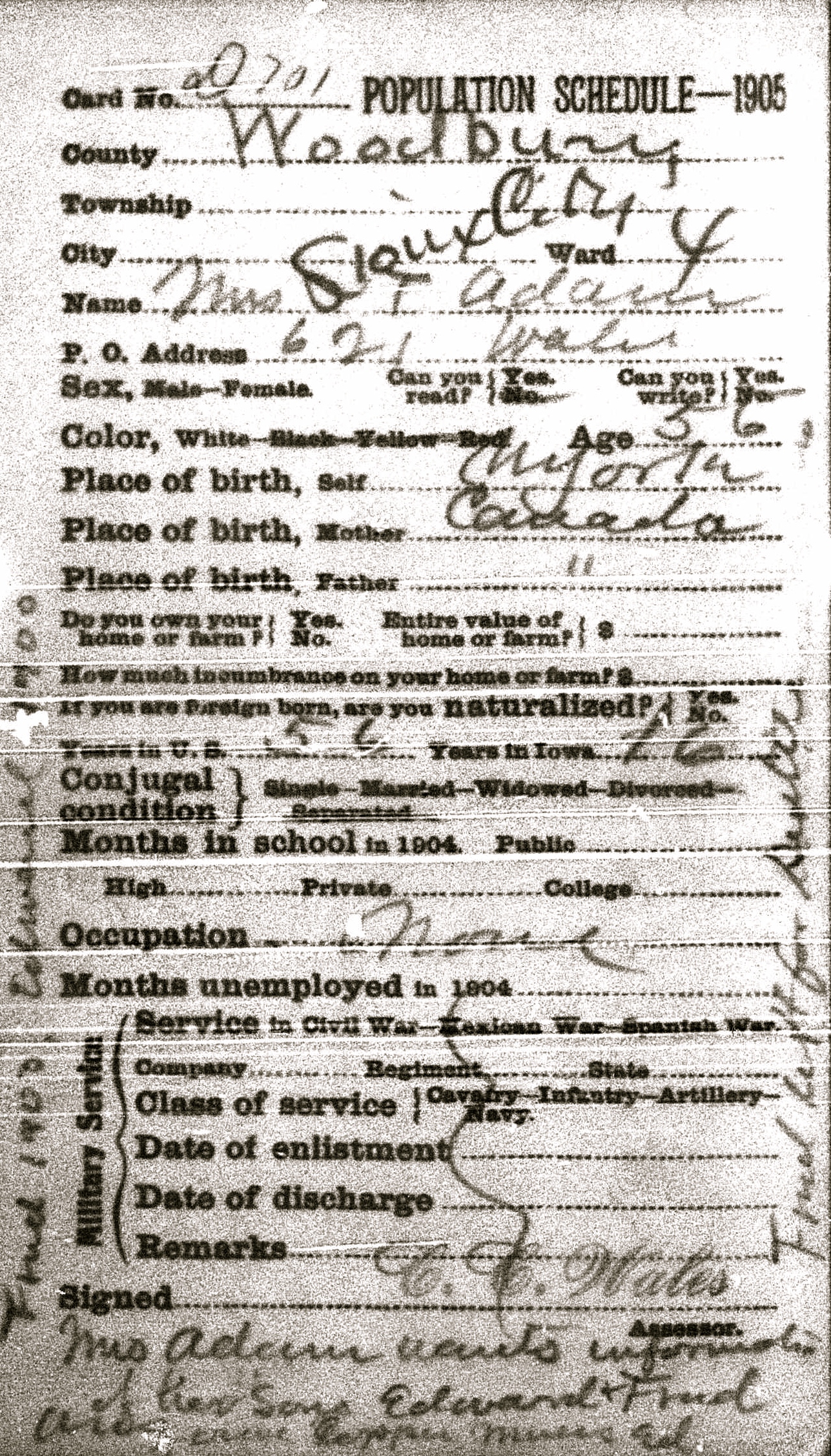
When the census enumerator arrived at the door of her home in Sioux City, Woodbury, Iowa, Odile (Millette) Adam saw in him a reason to hope. Here was someone who surely knew a thing or two about tracking people down. If nothing else, perhaps he could ask around? Had anyone seen her sons, Edward and Fred? The census enumerator strayed from the lines gathering information about Odile’s age, address, and origin, and jotted some hasty notes in the margins:

“Mrs. Adam wants information of her sons Edward and Fred. […] copper mines Ed. Fred left for Seattle. Fred 1903. Edward 1900.”1

Odile Adam 1905

“Iowa, State Census, 1905,” Sioux City, Woodbury County, Iowa, O.T. Adam [Mrs. T. Adam]; digital images, FamilySearch (http://www.familysearch.org : accessed 08 October 2014).

Although some words are indistinct (can anyone make out what it says?), the message is clear: The Adam boys had made their way west, and, whether dead or alive, they had disappeared without a trace. There may not have been much of anything that the census enumerator could have done, save for keeping his eyes and ears open in case the men turned up around town, but at the very least, he appears to have been sympathetic to Odile’s concerns.

Fred, also known as Alfred G. Adam, would eventually return to Sioux City, though perhaps not for a few more years; records suggest he returned to the area around 1909.2 Of Edward Adam, however, there seems to be no paper trail. In the summer of 1900, the Sioux City Journal reported that the then twenty-nine-year-old Edward, who had left home at the age of fourteen, had returned to his family, but his behavior towards them was “abusive, inconsiderate, and contemptuous.”3 His ailing father submitted a petition requesting a restraining order against him in order to protect himself as well as his minor children, and Edward, at least under his given name, is seemingly absent from record thereafter.4

Odile’s apparent distress according to the 1905 Iowa State Census is made more interesting by the fact that her husband of nearly forty years, Timothy Adam, was not recorded as a member of her household.5 Was he away searching for their sons, or was he simply visiting relatives across the state line in South Dakota or in his native Massachusetts? Was he aware that Odile was seeking word of their sons, or had he washed his hands of them? We may never know, just as Odile may never have learned the fate of her two eldest surviving sons before her death late the following year.6

The 1905 Iowa State Census images are available for free on FamilySearch. Even if there aren’t any notes written in the margins, you can learn a great deal about an ancestor from the details that were formally requested, including military status, level of education, and number of years as a resident of the state. If you would like to know who lived in the same household as your ancestor before turning to the individual cards, see the index available in the Iowa State Census Collection on Ancestry.com.

Continue reading

Photographing an Edwardian Toddler

These charming studio portraits are the nearest thing to baby pictures that exist for Fern Lavonne Thoma, whose birth was celebrated one hundred and seven years ago today. Born to George Hiram and Anna Leota (Fenton) Thoma on 30 September 1907 in Sioux City, Woodbury, Iowa, she was named Fern Neilson in her birth record;1 for reasons yet unknown, her father used an alias for a period of time. By the time these photographs were taken, however, Fern was about two years old, and may well have had no recollection of ever being named anything but Fern Thoma.

Fern Thoma 01

Fern Thoma, Iowa or Nebraska, circa 1909; digital image 2013, privately held by Melanie Frick, 2014.

In the first photograph, Fern poses with a rustic iron piece that looks like a rather uncomfortable type of corner chair. Her head barely reaches the top of the frame as she stands beside it, and she clutches something small in her hand, perhaps a treat to entice her to stand still. The second child and first daughter born to her parents, Fern is dressed beautifully in an immaculate white dress complete with ruffles and eyelet trim. Whites and creams in soft fabrics were popular choices for small girls at the tail end of the Edwardian era.2 Fern’s dress falls above the knees, revealing  black stockings and shiny black shoes. The golden curls about her face evidently took some care, and she peers at the camera with an impish grin and bright blue eyes.

Fern Thoma 02

Fern Thoma, Iowa or Nebraska, circa 1909; digital image 2013, privately held by Melanie Frick, 2014.

Fern’s expression is more demure in the second photograph, in which she is perched atop the iron chair and gazes away from the camera. She has evidently tried her best to keep her small hands still in her lap, as a gold bracelet, clamped around one chubby forearm, is more visible in this photograph. So, too, is the lovely floral eyelet trim of her dress. This photograph has a softer focus, likely unintentional but rather caused by Fern’s motion.

A photographer by the name of Phelps penciled his name below these photographs on their original cream-colored mats. An inscription by Fern’s mother on the back of one suggests that the family was living in Basset, Rock, Nebraska, at this time, although it’s also possible that the photographs were taken in Sioux City before the family moved west.

These are darling portraits of an Edwardian toddler, and provide evidence that even an average Midwestern family would have known how to fashionably style a little girl for a photograph. However, one can easily imagine the off-screen coaxing by both photographer and mother that certainly must have taken place in order to convince this active toddler to be still!

Continue reading

Donning a Daycap for a Tintype Portrait

This woman, born perhaps in the first decade of the nineteenth century, likely lived to witness the Civil War. As inexpensive tintype photographs gained popularity, so did ornate albums where families could collect photographs of loved ones and famous folk alike.1 This tintype, measuring 1.5 x 2 inches, is closest in size to what was considered a sixteenth plate. The embossed paper sleeve in which it was placed brings the size to that of a carte de visite, allowing the tintype to be slipped easily into a slot in an album.2 Paper sleeves such as these were common in the 1860s; while this example doesn’t have a patriotic design that would directly suggest a date during the Civil War, it nevertheless seems probable that it is of that same era.

The woman’s dress has full sleeves, a high collar with possible tatted detail, and a row of fabric-covered buttons down the bodice. Her hair has a center part and is covered by a frilly, old-fashioned daycap with long ribbons that, left untied, frame her face.3 Although her mouth is turned downward, her expression seems kind as she gazes directly at the camera with large, light-colored eyes, her head tilted gently to the side.

Scanned Image 33

Unidentified woman wearing a daycap, possibly Mount Pleasant, Henry, Iowa, ca. 1860-1865; digital image 2012, privately held by Melanie Frick, 2014.

I can’t imagine that the woman is younger than fifty years of age; depending on how strenuous her experiences in life may have been, she could also be significantly older but in comparatively good health. She has pleasant features, and, though slim, she doesn’t appear terribly frail. However, her age is apparent as her face and neck are lined and her eyes are deeply set. Daycaps, such as the one she wears, were popular with conservative, older women during this decade.4

This unidentified photograph comes from an album linked to the family of Civil War veteran Jesse M. Smith of Mount Pleasant, Henry, Iowa.5 If I were to attempt to identify the woman in a related family tree, I would look for a woman born circa 1800-1810, perhaps a grandmother or aunt who may have been close to the family. Although paper sleeves made it easier to label tintypes with the names of loved ones – as did photograph albums – perhaps this woman’s identity was so well known to the family that they saw no reason to record her name.

Continue reading

Back to the Land: Finding an Ancestor’s Iowa Homestead

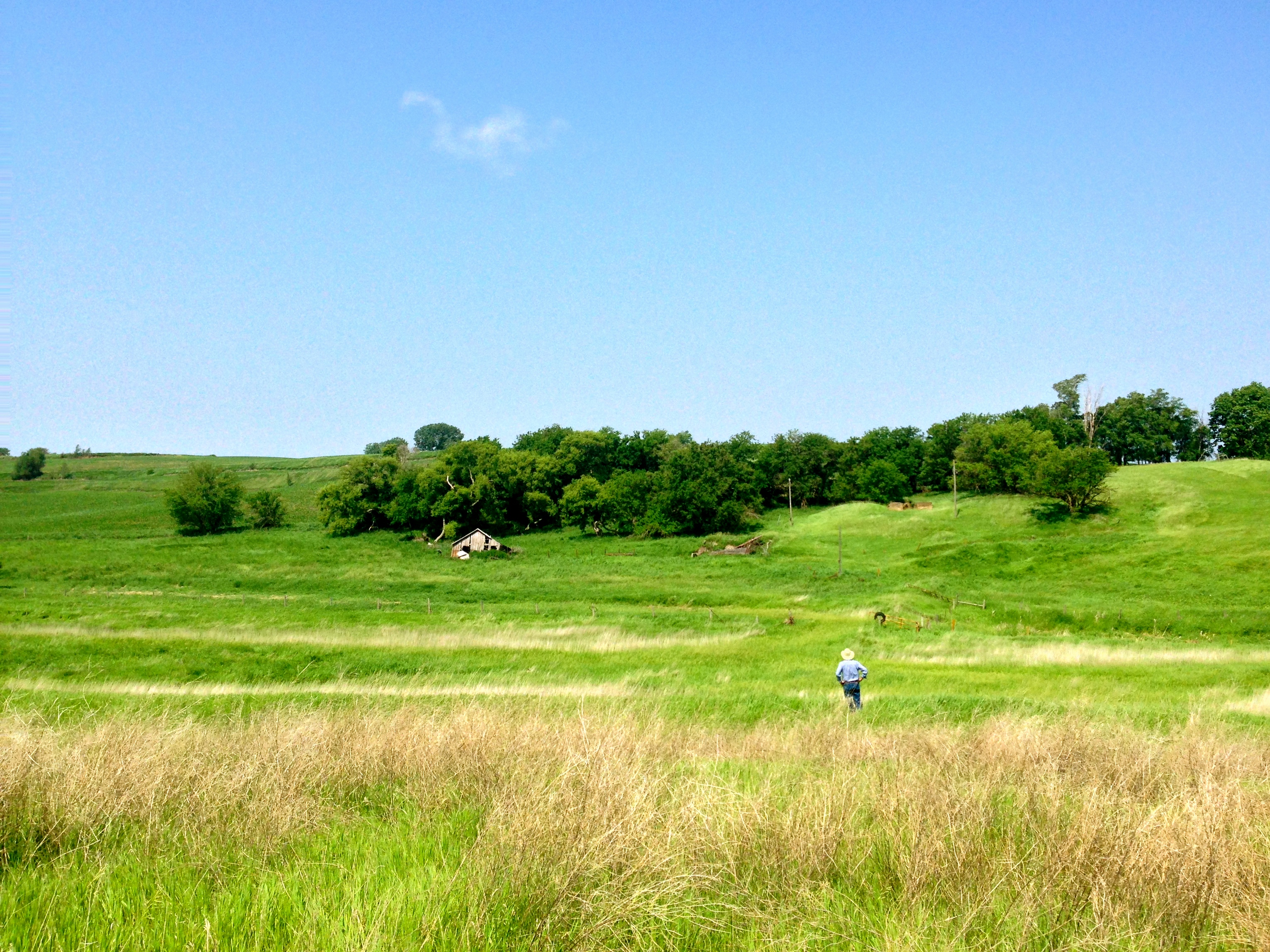
While tracking down the exact location of your ancestor’s land may seem daunting, last month, I learned that it’s entirely possible to get from this: Timothy Adam BLM…to this:

IMG_3409

Timothy Adam Homestead Site, Moville Township, Woodbury County, Iowa; digital image 2014, privately held by Melanie Frick, 2014.

It wasn’t until recently that I learned that my ancestor Timothy Adam homesteaded in Woodbury County, Iowa.1 I was excited to find that his homestead was just a short hop from the Woodbury County Fairgrounds in rural Moville Township, making it an area that, thanks to my years in 4-H, is familiar to me. I thought how funny it would be if I would happen to know who lived on his land today.

That thought remained in the back of my mind as I prepared to plot the location of the NE ¼ of Section 29, information obtained online from the Bureau of Land Management General Land Office Records and verified in record copies from the National Archives. Armed with the legal land description, I turned to the Plat Book of Woodbury County, Iowa, available online through the Iowa Digital Library.

After locating the quarter section where the Adam family spent the latter part of the nineteenth century, I took note of any landmarks – including nearby towns, roads, and waterways – that would help pinpoint the homestead site on a modern map. As Moville Township is still comprised of farmland broken into the orderly squares that make up the Midwest’s patchwork landscape, it was easy enough to identify the right quarter section via satellite image on Google Maps.

Timothy Adam Google MapsAfter zooming in on a grove of trees on the appropriate quarter, it was even possible to see that there was an old home site located there. Thank you, Google Maps!

Timothy Adam Home Site Google MapsThe next step, of course, was to visit the land where Timothy and Odile (Millette) Adam, pictured here, once lived. My parents and I embarked on an expedition to the back roads southeast of Moville, where we stopped at a neighboring farm to ask if we might have permission to trek to the home site. There, we discovered that the owners were, indeed, a family that we knew from 4-H! Despite the shock of us showing up on her doorstep for perhaps the most unexpected reason imaginable, our friend kindly gave us permission to take a shortcut across the pasture with our truck.

According to a local newspaper, a tornado that hit the area in 1928 was said to have caused significant damage to what remained of the homestead: “Southwest of Moville on the old Timothy Adam farm now owned by W. H. Rawson trees in the orchard were uprooted, corn crib, machine shed, barn, hog house and chicken house were swept away. The house is the only building left standing.”2 Today, not even a house remains, but it was fascinating to explore the old foundations and to imagine just how little, perhaps, the view from the homestead had changed.

IMG_3431

Timothy Adam Homestead Site, Moville Township, Woodbury County, Iowa; digital image 2014, privately held by Melanie Frick, 2014.

Continue reading

Wedding Wednesday: A Question of Nationality

I’m not sure if it was meant as a joke, or if newlyweds Gerald and Fern (Thoma) Adam of Sioux City, Woodbury County, Iowa were genuinely confused. When asked to state their nationalities at the time of their marriage, their answers should have been simple; they were the American-born children of American-born parents, after all, so there was really no question that they were American themselves. Jerry, however, stated that he was of French nationality, while Fern declared that she was German-English.1

GeraldAdam1929

Gerald Joseph Adam, Sioux City, Iowa, ca. 1929; digital image 2012, privately held by Melanie Frick, 2014.

FernThomaAdam1929

Fern Lavonne Thoma, Sioux City, Iowa, ca. 1929; digital image 2012, privately held by Melanie Frick, 2014.

From a genealogical perspective, I love it. How often does one have the chance to learn what their forebears knew of their own ancestry? However, if I didn’t already know so much about this couple and their heritage, I might have been thrown off. Jerry’s ancestry was indeed French – and French Canadian, and Polish. Fern’s ancestors, many of whom were likely early arrivals on American soil, can thus far be traced to Germany and the British Isles.

I don’t know when exactly the couple met while on their way downtown to the movie theater, but Jerry and Fern married in their hometown on 8 June 1929 – eighty-five years ago this week.2 Fern was twenty-one, and although Jerry would not celebrate his twenty-first birthday for eleven more days,3 he claimed to be the same age as Fern.4 Their wedding attendants were close friends Merle Montgomery and Dorothy Thompson,5 and, following their ceremony, led by Reverend R. M. LeCair of St. Jean Baptiste Church, the couple took a “motor trip” to the Black Hills of South Dakota.6

Gerald_Adam_Fern_Thoma_Marriage_1929

“Iowa, Marriage Records, 1923-1937,” digital images, Ancestry.com (http://www.ancestry.com : accessed 10 June 2014), Gerald Adam and Fern Thoma, 8 June 1929, Sioux City; citing “Iowa Marriage Records, 1923–37,” microfilm, State Historical Society of Iowa, Des Moines.

If your ancestors married in Iowa between 1923 and 1937, be sure to visit Ancestry.com’s digital image collection, “Iowa, Marriage Records, 1923-1937,” new this year. This database has plenty of detail to offer, as marriage records included such information as age, place of residence, occupation, place of birth, father’s name, mother’s maiden name, number of marriages, and the names of the officiant and witnesses. It’s also an opportunity to see the signatures of the couple – likely the last time the bride would sign her maiden name. Have you found any surprises in this record set?

Continue reading

All Aboard Mr. Laughlin’s Palace Photo Car

Not all photograph studios were stationary. Your ancestors may have had their photographs taken aboard a boat or even a specially outfitted railroad car, as did this group of gentlemen around the turn of the last century.

GeorgeHiramThoma

George Hiram Thoma a.k.a. George A. Neilson, top right, Iowa or Nebraska, ca. 1900; digital image 2010, privately held by Melanie Frick, 2014.

George Hiram Thoma, also known as George A. Neilson, is the slim, fair-haired young man pictured at top right in this photograph taken aboard Mr. Laughlin’s Palace Photo Car.1 George, born in 1880,2 was raised in Clayton County, Iowa,3 but his exact whereabouts during his late teenage years and early manhood are up for debate. He may have spent some time in Cedar County, Nebraska,6 before winding up in Osceola County, Iowa, where he married in 1902.5 This photograph was likely taken at a train station somewhere in northwestern Iowa or northeastern Nebraska circa 1900.

The men all wear dapper hats, jackets, and ties. The man next to George seems to be the trendsetter of the group with a check or plaid jacket, striped bow tie, eyeglasses, and his soft felt bowler or derby hat at a jaunty angle. The man at front right is the only one who is not clean shaven; he also appears to be somewhat older than the others.

Who were these men, and what were their relationships to one another? None bear a remarkable resemblance to George, with the exception, perhaps, of the man next to him. Perhaps the men were friends or business associates, although thanks to George’s elusive lifestyle prior to his marriage and his use of an alias, much is left to the imagination as to with whom, exactly, he may have associated.

Perhaps somewhere there exists another copy – or three – of this very photograph, taken long ago aboard Mr. Laughlin’s Palace Photo Car.

Continue reading