Tag Archives: real photo postcard

A July 4th Celebration

On 04 July 1910, a group of twenty people—plus one dog—came together for a photograph somewhere in Yankton County, South Dakota. Presumably, they had gathered to celebrate Independence Day, and several chairs were brought outside for their assemblage before a backdrop of trees. All present appear to be well if not formally dressed for the day. The men wear no jackets and several go without vests or ties, suggesting that the weather was quite warm, and several of the women and girls, most of whom wear light-colored, summer dresses, have their sleeves pushed to their elbows. At least one woman wears an apron. A man’s straw boater hat is cast to the side, and a dog rests, alert, at a girls’ feet. However, despite the fact that this was a warm summer day and that even the men have shed some layers, the children all seem to have been required to wear stockings and shoes as there are no comfortably bare feet in sight.
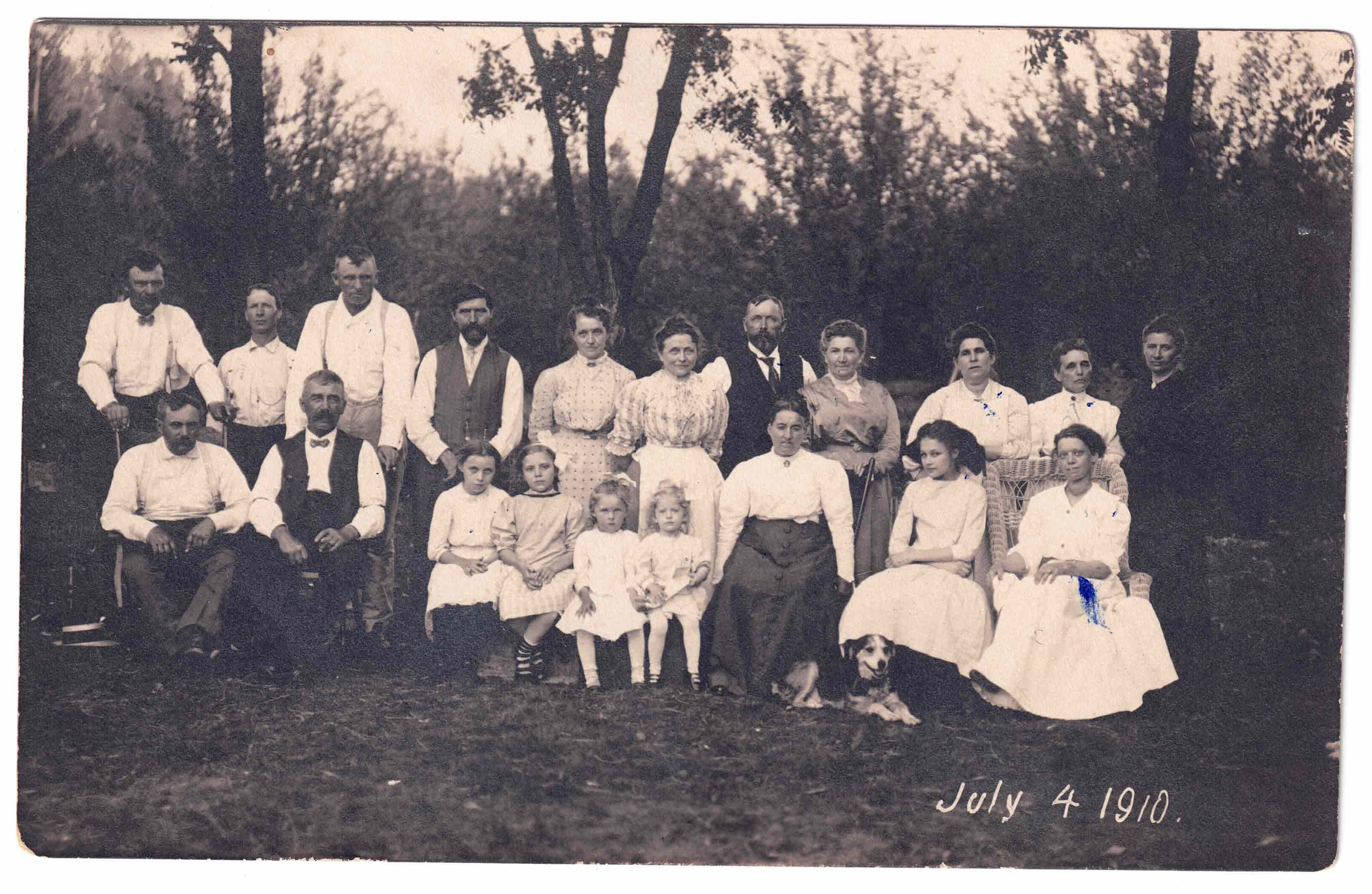
Independence Day celebration featuring descendants of Niels and Juliane (Hennike) Olsen and friends, Yankton County, South Dakota, 1910; digital image 2025, privately held by Greg Smith. Back, left to right: Jens Christian Nielsen?, Marius Larsen, Henry Schaller, John Nielsen, Cecilia (Nielsen) Boysen, Stena (Nielsen) Callesen, Jacob Nissen, Elizabeth Bruhn, Mrs. Schaller, Dorothea (Neilsen) Nissen, and Mary (Jacobsen) Nielsen. Front, left to right: Chris Callesen?, Erick Boysen, Herta Scheel Callesen, Cleora Nielsen, Grace Nielsen?, Violet Larsen, Jennie (Burton) Nielsen?, Henrietta Bruhn, and Helena (Nielsen) Larsen.

Thanks to a loose handwritten note that accompanied this photograph, as well as comparisons made with a 1902 group photograph that included many of the same individuals, most people have been identified with reasonable certainty. Present were at least five if not six of the eight adult children of the late Niels and Juliane (Hennicke) Olsen, Danish immigrants who had settled in Yankton County, Dakota Territory, in the early 1870s: John, Cecilia, Christina (Stena), Dorothea, and Helena Nielsen (also spelled Nielson or Nelson), along with their spouses. Their brother Jens Christian and his wife may have been there as well. Also present were several friends, who, according to the handwritten note, were members of the Henry Schaller and Henry Bruhn families.

The woman in the apron near the center of the photograph, who, given her attire, may have been the hostess of the event, is Christina “Stena” (Nielsen) Callesen (1860-1951). In 1910, Stena and her husband Christian “Chris” Callesen were living in Utica, Yankton County, South Dakota with their nine-year-old foster daughter Herta. Chris, whose name appears twice in the handwritten list of identifications, is likely seated at far left, while the child at left is Herta. Herta Scheel Callesen had been living with the Callesens since she was four years old and lost her father. Her mother, left with seven young children to feed, had made what must have been a difficult decision to allow her youngest daughter to be separated from the family—including from her twin brother—and raised by the Callesens. Stena was known to have had only one child of her own, a daughter who died in infancy. Herta, however, was one of as many as six children that the Callesens fostered or adopted over the years, some for only a short while and some, like Herta, to adulthood.

Seated to the right of Herta Scheel Callesen is her cousin Cleora Nielsen, the youngest daughter of John and Mary (Jacobsen) Nielsen. Cleora, eight years old, had been born in South Dakota but now lived in Santa Clara County, California. She and her parents had most likely returned to South Dakota for a summer visit with relatives; it is possible that her older siblings, the youngest already sixteen, remained in California, as they are not pictured here.

Next to Herta and Cleora are two young girls, between, perhaps, the ages of two and four. Only one was identified in the handwritten note, although it is not immediately clear which one: two-year-old Violet Larsen, the only child of Marius and Helena (Nielsen) Larsen. Tragically, Violet would live only to the age of four, and I have no other photographs of her. Although it was not indicated which girl is Violet, because the child on the right appears to me to be closer to the age of two—she fidgets with her skirt and her feet don’t quite reach the ground from the bench on which she appears to be sitting—that is my guess. There also seems to be a space left between the names of Cleora and Violet in the handwritten note.

Could the bigger of the two littlest girls be, perhaps, Grace Nielsen, four-year-old daughter of Jens Christian and Jennie (Burton) Nielsen? Jens, known familiarly as J. C. or Chris, was not named in the handwritten note accompanying the photograph, nor was his wife, but he bears some resemblance to the man at back left and his wife to the unidentified woman seated in the front row to the right of the children. The Nielsens, like the Callesens, lived in the small farming community of Utica, so it is reasonable to consider that they might have been present to spend the holiday with kin.

Jens Christian Nielsen, known as J.C. or Chris, is pictured at left in 1902. Could he be the man at right in 1910?

JaneJennie” (Burton) Nielsen is pictured at left in 1902. Could she be the woman at right in 1910?

The fact that this photograph was taken during a census year is particularly helpful in confirming the identities of the children, as it is possible to see exactly who resided in which household just a few months prior. It can be determined that the Bruhn and Schaller families, for example, did not have any young daughters who might have been seated beside little Violet Larsen. Unexpectedly, the census provided another important clue about this photograph: the identity of the photographer. It had seemed curious that family friend Henry Bruhn was not pictured alongside his wife, Elizabeth, and fourteen-year-old daughter, Henrietta, but according to the 1910 United States census, Henry Bruhn was, in fact, a photographer, and therefore may very well have been the person behind the camera.

Census records are of course less helpful when attempting to determine the identities of adults who are close in age, particularly considering the similarities in appearance among those with both shared heritages and lifestyles. Perhaps this is why whoever created the handwritten note accompanying the photograph named Chris Callesen twice! Cross-referencing with other more confidently identified photographs is key, and fortunately, in Chris’s case, there are two other known photographs that can be used as points of comparison and provide some degree of confidence.

Christian “Chris” Callesen is pictured at upper left in 1902 and at lower left in 1911. It is believed that he is the man at right in 1910.

Large group photographs like this are particular treasures in a family archive as they provide insight not only into the bonds of family and friendship, but also the occasions that brought people together. As they are less formal than studio portraits, they can also offer greater glimpses into personality and personal style, as well as the surroundings in which people lived. For a number of the Olsen descendants and their friends, 04 July 1910 looked to be a pleasant day spent in the fresh air, perhaps with a bountiful noon meal to share.

Copyright © 2025 Melanie Frick. All Rights Reserved.

Continue reading
The Adam Brothers

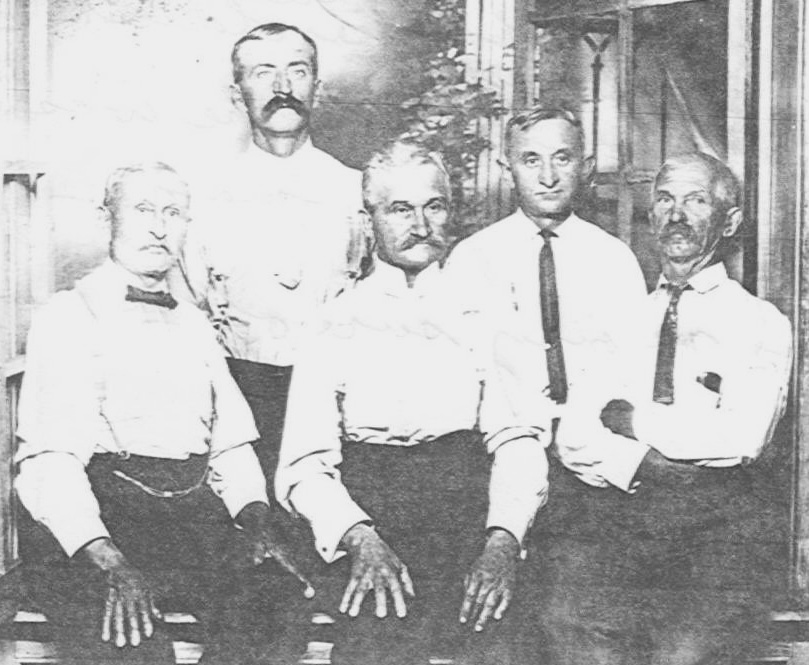
When five of the six living sons of Timothée and Marguerite (Chicoine) Adam gathered in the Midwest circa 1913, it was deemed an occasion worthy of a photograph.1 From left are pictured brothers Louis (1848-1927), Peter (1852-1936), Joseph (1850-1926), Prosper (1867-1943), and Timothy Adam (1846-1919). Although the twenty-one year span in age of these brothers is impressive, in fact, twenty-seven years passed between the births of their eldest sibling and the youngest, who arrived when his mother was fifty years old. At least fourteen children were born in total, with all but the youngest born in Quebec. All got their start in life in the cotton mills of Indian Orchard, Hampden County, Massachusetts, which had lured the Adam family from rural Quebec to America.2

Brothers Louis, Peter, Joseph, Prosper, and Timothy Adam(s), ca. 1913; digital image 2010, privately held by Melanie Frick, 2018. Image courtesy of Dorothy Bouchard.

Timothy, at right, likely resided in Jefferson, Union County, South Dakota at the time this picture was taken,3 not far from Peter, second from left, and Prosper, second from right, who had both settled in Sioux City, Woodbury County, Iowa.4 Joseph, at center, had apparently traveled from his home in Ponca City, Kay County, Oklahoma to reunite with his brothers, as well as, undoubtedly, his twin sister, who lived in Jefferson.5 Louis, the one brother to have remained in Hampden County, Massachusetts, traveled the greatest distance for this reunion.6 The only living Adam brother not pictured here was Euclid John (1856-1940), who spent his adult life in Southbridge, Worcester County, Massachusetts.7 Whether he lost touch with his brothers or was simply unable to make the trip to visit them at the time that this photograph was taken is not known.

The Adam brothers, some of whom adopted the surname Adams in addition to Anglicized versions of their given names, held a variety of trades between them. Census records indicate that after leaving the cotton mills, some went on to become carpenters, barbers, homesteaders, clerks, pool hall operators, and hotel-keepers, among other occupations. All married, and all but Joseph had children of their own.

This photograph is a photocopy of what was said to be a real photo postcard, a format designed to be easily sent by mail to friends or relatives. Like the only known (or suspected) photograph of the mother of the Adam brothers, the original is believed to have been lost.8 Despite the poor quality of this photocopy, it is apparent that the brothers have dressed sharply, with their hair neatly combed and several in ties, although this was apparently not such a formal occasion that they opted to wear jackets. It is also plausible that it was quite hot, if their reunion took place in the summer months, and the gentlemen may well have opted to be as comfortable as possible. Several appear to wear sleeve garters, arm bands that helped to adjust the length of one’s sleeves.9 While the men’s appearances are distinct from one another, particularly given their disparate ages, similarly prominent noses—and, when visible, even hands—help to link them convincingly as brothers.

Copyright © 2018 Melanie Frick. All Rights Reserved.
Continue reading

A Paper Moon

When I began researching the topic of paper moon photography, I was surprised to find that these crescent moon photo booth props are making a comeback by way of trendy, vintage-style wedding decor. In case you didn’t know, flappers are big these days, and the popularity of this era has influenced a new generation to pose for classic shots with a smiling man in the moon. However, paper moon photo booths got their start even before the days of Gatsby, likely around the turn of the twentieth century.1

SCAN0096

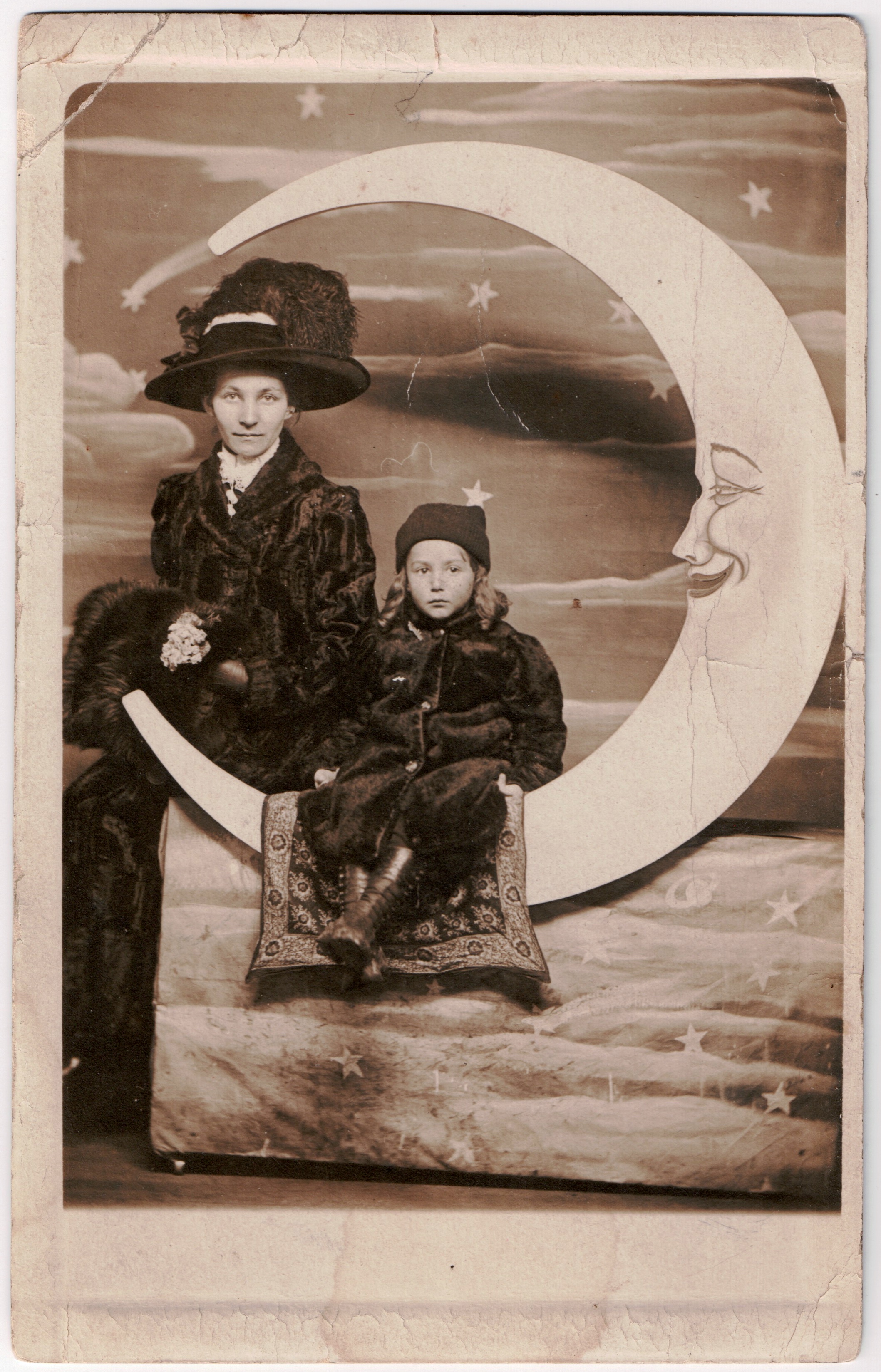
Melanie (Lutz) and son Gerald Adam, Sioux City, Iowa, ca. 1912; digital image 2014, privately held by Melanie Frick, 2015. Collection courtesy of David Adam.

This particular paper moon photograph was printed on a real photo postcard circa 1912. The moon backdrop itself is not one of the more elaborate, with an obvious break in the night sky for seating purposes. In fact, what looks like a wheel to roll the seat into place is also visible, and a small “magic carpet” conceals the primary seating area. The crescent moon smiles, and the stars, as is typical among paper moon photography, are present even within the crescent – where, realistically, they would be blocked by the moon in shadow. A shooting star can be spotted at the upper tip of the crescent, and a planet appears below the moon.

The mother and son posed here are Melanie (Lutz) and Gerald “Jerry” Adam of Sioux City, Woodbury County, Iowa. Both are dressed in long fur coats, Melanie’s of a fashionable collared design while Jerry’s is fastened simply with three large buttons. A glimpse of Melanie’s leather gloves is visible, and a stylish plumed hat is atop her head. Jerry wears a practical stocking cap and high button boots. His curls are long, to his shoulders, which was not atypical among young boys of the era.

Given their attire, it is obvious that this photograph was taken on a cold winter’s day. Perhaps the paper moon photo booth was set up outdoors or in an unheated (or under-heated) space as a temporary attraction; this mother and son may have simply stumbled upon it and decided to surprise Jerry’s father with their fun souvenir. As Jerry was born in the summer of 1908,2 it seems most likely that this photograph dates to the winter of 1911-1912, or, at the latest, the winter of 1912-1913. January 1912 in particular was a cold month, with Sioux City registering a record low of −35°F on 12 January.3 However, even beyond such extremes, Sioux City was no stranger to weather that would have required one’s warmest winter coats for a visit to the moon!

Copyright © 2015 Melanie Frick. All Rights Reserved.

Continue reading

…and a Happy New Year!

George Fenton Thoma, the son of George Hiram and Anna Leota (Fenton) Thoma, was eight years old when he scrawled these holiday greetings to his cousin, Glen Hoffman.1 Glen, the son of Joseph and Minnie Bell (Fenton) Hoffman, was one year Fenton’s senior.2 Whether the boys – Fenton in Nebraska, Glen in Iowa – had actually met or were merely pen pals at their mothers’ urging is unknown, as the sentiments expressed on the postcard are not of a particularly personal nature:

SCAN0133

George Fenton Thoma school postcard, Decatur, Nebraska, 1911; digital image 2014, privately held by Melanie Frick, 2014. Collection courtesy of David Adam.

This postcard is another piece of the puzzle of the Thoma family. A decade prior, Fenton’s father, George Hiram Thoma, had married under the alias of George A. Neilson, and he proceeded to use the Neilson surname along with his wife and children at least until 1909. The family moved frequently throughout Iowa and Nebraska; according to the postmark here, they may have resided in or near Decatur, Burt, Nebraska, as of late 1911. It is also possible that they were guests in the home of Leota’s mother during the holiday season and in fact lived elsewhere.3 Unfortunately, Fenton did not sign his full name – so it is up for debate whether he was a Neilson or a Thoma at the time!

SCAN0132

George Fenton Thoma school postcard, Decatur, Nebraska, 1911; digital image 2014, privately held by Melanie Frick, 2014. Collection courtesy of David Adam.

The reverse of this postcard shows a school photograph. Fenton can be spotted in the first row of students, third from left, in a collared striped shirt and dark trousers. The gathering of students is casual – there are untucked shirts, fidgeting hands, smiles and scowls. Fenton, his expression eager, has his eyes directly on the camera and seems to edge forward as his head partially obscures that of the boy behind him.

While I have in my collection many postcard-style photographs, this may be the only one that was actually addressed and mailed as a postcard. At some point thereafter, it was apparently returned to the Thoma family, as it was found in the collection of Fenton’s younger sister. Perhaps it was returned after Fenton’s unexpected death at the age of forty-four, as it is likely one of only a few photographs of him as a child.4 The cost of the one cent postage was likely well worth it to Fenton in exchange for the chance to show off his class picture and his painstaking penmanship as he wrote to his cousin, “I wish you a Merry Xmas and happy new years.”

Continue reading