Tag Archives: Yankton

A Baby Carriage in Dakota Territory

A new arrival in the family has meant that blogging my research findings has taken a backseat in recent months, but with babies on the mind, here is a peek at a sweet little one posed with his mother in the nineteenth century:

nielson_harry_andresen_hannah_1888

Hannah Marie (Andersen) Nielsen with Harry Niels Nielsen, Yankton, Dakota Territory, 1888-89; digital image 2014, privately held by [personal information withheld].

Pictured is Hannah Marie (Andersen) Nielsen, wife of Ole Nielsen of Yankton, Yankton County, South Dakota, with her infant son Harry Niels Nielsen.1 Harry was to be the couple’s only surviving child; a daughter died in infancy.2 He was born 25 May 1888 in the town of Yankton,3 only a few months after the infamous Children’s Blizzard; his parents, both Danish immigrants, had married in 1880.4 At the time of Harry’s birth, Ole managed a dray line in Yankton, transporting heavy loads in a specially built wagon.5 Later, he would take up farming east of the nearby community of Mission Hill.6

In this photograph, Hannah, forty years of age, wears a dress with a full skirt, fitted sleeves, and a bodice fastened with no less than a dozen buttons.7 A brooch is pinned at her high collar and a flat-brimmed hat atop her head is adorned with feathers, adding an elegant statement to her otherwise relatively simple attire. What appears to be a strip of fabric is wrapped around the palm of her visible hand.

Harry, who looks to be less than a year old, dating this picture to South Dakota’s pre-statehood days of 1888-89, is dressed in a light-colored gown and a snug bonnet. He looks directly at the camera and a belt around his middle secures him to the seat of a baby carriage. The slatted basket is long enough that a smaller baby could lay flat until, like Harry, sitting upright against the fringed backboard would be possible.

I love that a baby carriage is featured here, unlike in any of the other nineteenth century baby photographs in my collection. However, I do have to wonder how practical it would have been at this time and place. While a bustling prairie town in its own right, Yankton was not, by any stretch of the imagination, a particularly urban environment, where a baby carriage might have proven more useful. Was it a prop at the Janousek studio, then, or did it belong to the Nielson familyperhaps a special luxury for a woman who had waited out eight years of marriage for a healthy child?

Whatever the case, this is a charming look at a proud mother and her well-behaved infant striking an elegant pose on the frontier. And, I have to say, the picturesque baby carriages of the nineteenth century were certainly more worthy of studio portraits than those of today!

Copyright © 2017 Melanie Frick. All Rights Reserved.
Continue reading

A Golden Anniversary Celebration

One warm afternoon during the summer of 1902, a crowd gathered at the home of local pioneers Niels and Juliane Sophie (Hennike) Olsen. The couple, who had retired from farm life several years before, was celebrating fifty years of marriage, and all of their children and grandchildren were invited to their home located near the center of town at 605 Broadway in Yankton, South Dakota.1 The event was surely a memorable affair, and the local newspaper gave a glowing report of the afternoon’s activities:

Mr. and Mrs. Nels Olson celebrated their golden wedding yesterday afternoon at their home on Broadway. All their children, eight in number, were present with their families. Their names are as follows; Ole Nelson, Mission Hill; John Nelson, Viborg; Christ Nelson, Lakeport; Fred Nelson, Lakeport; Mrs. J. Nissen, Yankton; Mrs. C. Calleson, Yankton; and Miss Helena Nelson, Yankton. Rev. C.K. Solberg spoke a few words appropriate to the occasion and presented to the venerable couple two fine presents from the children, a gold headed cane to “father” and pair of gold glasses to “mother.” The “old folks” came from Denmark in 1874 and made their first home in America near Lakeport, S.D. Eight years ago they moved to Yankton, their present home. They are in fairly good health and enjoy comfort and happiness surrounded by kind children.2

Niels Olsen and Juliane Sophie Hennecke had married in Haraldsted, Soro, Denmark, on 30 July 1852.3 For the first twenty-two years of their married life, they resided in Denmark; their twenty-second anniversary, however, was spent aboard ship as they ventured to America.4 Their years since had been spent in southeastern South Dakota, where they claimed a homestead and where Niels had recently served a term as a rural postmaster. All eight of their surviving children remained in the area, and to commemorate their fiftieth anniversary, an informal group photograph was arranged on the porch of their home beneath the shade of several large trees.

Olsen Golden Anniversary

Olsen Golden Anniversary, Yankton, South Dakota, July 1902; digital image 2010, privately held by Melanie Frick, 2014.

The couple of honor is seated near the center, surrounded by those in attendance. Niels wears a wool three-piece suit and tie, as do most of the men, while Juliane wears a patterned shirtwaist with a bow at the neckline. Patterned, striped, or light-colored cotton fabrics seem to be popular choices among the women for their summertime wear. The adults, including the couple’s children, sit or stand in two rows, and three infants are perched on laps. Nine young grandchildren – including four sisters in matching dresses – cram together in the front, sitting cross-legged on the wooden plank floorboards. The group is relaxed; there are a few smiles, several women cross their arms comfortably, and a few maternal faces are turned away from the camera, intent on minding the couple’s many grandchildren.

I have to hope that this well-dressed crowd had the opportunity to partake in some refreshing lemonade in honor of the occasion!

In the back row, from left to right, are Reverend Solberg, Mrs. Solberg, Harry Nissen, Fred Nelson, Ole Nielsen, Harry Nielsen, John Nielsen, Eric Boysen, unknown, and Chris Callesen. In the middle row, from left to right, are unknown, Dora Nissen, Cleora Nielsen, Hannah Nielsen, Stena Callesen, Cecilia Boysen, J. Chris Nelson, Niels Olsen, Juliana Olsen, Helena Olsen, Jennie Nelson, Edith Nelson (child), Christine Nelson, and Helen Nelson (child). In the front row, from left to right, are Robert Nelson, Anna Nelson, Louise Nelson, Andrea Nelson, Julia Nelson, Bessie Nelson, Ole Nelson, Alvin Nielsen, and George Boysen.5

Continue reading

Dressing Well in Dakota Territory

SCAN0009

Christine Marie [Schmidt] Nelson,  Yankton County, Dakota Territory, ca. 1886-1888; digital image 2013, privately held by Melanie Frick, 2014.

Christine Marie Schmidt, spelled “Christiane” on the back of this photograph and called “Dana” by her close friends, would not have remembered Denmark, as she was still an infant when she accompanied her parents to America in June of 1870.1 Her father homesteaded in Dakota Territory later that year, and Christine grew up a hardworking farm girl on the prairie near what is now Tabor, Bon Homme County, South Dakota.2

This photograph may have been taken in Yankton, the onetime capital of Dakota Territory located a dozen or so miles east of the family’s homestead. Christine’s hair is styled in true 1880s fashion with frizzled bangs – which could not have been easy to achieve – and a smooth high bun.3 She wears what looks to be a heavy pleated dress with velvet panels adorning the bodice vertically from shoulder to waist.4 The same velvet trims the collar and cuffs, where a white under-layer peeks out. No fewer than twelve large buttons adorn her dress, and a horizontal pin is affixed to the stylish high collar. Christine is clearly corseted to enhance her hourglass figure.5

Christine married in the spring of 1890 at the age of twenty-one; her wedding portrait suggests that she was a bit younger when this photograph was taken.6 My guess is that she was about eighteen, give or take a year, dating this photograph circa 1886-1888. Although green cardstock, as seen on this cabinet card, technically peaked in popularity several years earlier,7 another photograph from my personal collection with cardstock of the same dark green color dates to approximately 1889. Its popularity may well have been ongoing, at least in the Midwest.

Christine almost certainly sewed her dress herself, likely in the company of her mother and older sister, and she stands so as to display it to its best advantage. A subtle painted backdrop nearly touches the floor behind her as she rests her left hand on the back of an upholstered chair, gazing into the distance. In spite of her rural upbringing, Christine strikes an elegant pose, demonstrating that the latest fashions had found a place even in Dakota Territory.

Continue reading

A Slumber Party at “The Bee Hive”

SCAN0854

    The Bee Hive, Yankton County, South Dakota, ca. 1918; digital image 2014, privately held by [personal information withheld].

The Bee Hive, Yankton County, South Dakota, ca. 1918; digital image 2014, privately held by [personal information withheld].

Slumber parties, as it turns out, have a long history among teenage girls. The caption, “They look happy don’t they? No wonder for they are just going home from a slumber party at ‘The Bee Hive,'” is penned on the back of this South Dakota snapshot, dated circa 1918.

In the photograph, a gaggle of girls crowds together on the porch of a clapboard building, located in or near Yankton County, South Dakota. All are dressed informally in simple cotton dresses. Several wear sailor-style neckerchiefs, a nod to the ongoing war abroad, and one dons a cap. Their short sleeves suggest warm weather; in southeastern South Dakota, this may have been anytime from May through September. Two squirming kittens can be spotted on the girls’ laps as they all lean together, their eyes on the camera.

From left to right sit Helena Nelson, Marguerite Miller, Andrea Nelson, Louise Nelson, Edith Nelson, and Mary Nelson. Helena, Andrea, Louise, and Mary were sisters; Edith was their cousin, and Marguerite was a close friend and neighbor in Township 93, near present-day Tabor. At some point, all attended the Southern State Normal School in nearby Springfield, where they gained the credentials needed to teach at the local country schools.1

What, exactly, was the Bee Hive? In September 1918, Andrea Nelson wrote in her diary that, following a barn dance held in honor of a local soldier home on furlough, “Jim, Anne, little ones, Helena, Mary, and I stayed at the Beehive from three till morning.” Although Andrea’s guest list indicated that all present in the photograph were guests at this particular dance, it must not have been the same occasion, as, “About five Jim took Helena on to town, as she was to start by car with Kecks at six for the fair at Huron. The rest of us had a late breakfast. Then went to church.”2

She made one more mention of the Bee Hive in her diary when, several weeks later, she wrote, “Julia called up from Yankton after school. She said that a lady would be at the Beehive tomorrow night to demonstrate the preparation of sugar beets. She wanted us to come up.”3 This suggests to me that the Bee Hive may not merely have been a clever nickname for a friend’s home, but may actually have been a sort of social club or church-based organization – a place where one might stay the night but also take part in educational programs. I wonder if any locals still recall the name.

This photograph most likely dates to the summer of 1918. Mary, the youngest of the girls, pictured at far right, was fourteen that summer,4 and although her skirts still seem a tad shorter than those of the others, her hair is in the same style of twist as that of her seventeen-year-old sister, Helena.5 Andrea, the eldest at twenty-one, died unexpectedly late that year.6 This photograph was likely tucked away as a memento of a happy time when all were together for a lighthearted slumber party.

Continue reading

‘Round the Maypole

Helen Nelson was a student at the rural Southern State Normal School in Springfield, Bon Homme County, South Dakota, or perhaps a recent graduate, when she pasted this series of photographs in her scrapbook.1 A group of young girls dance ’round a Maypole twined with ribbons, certainly in celebration of the first of May. They were likely students at a local one-room schoolhouse, perhaps from a teaching assignment near Helen’s home in Yankton County, South Dakota, or from the “practice school” near Springfield.2

Raising a Maypole for a May Day celebration seems just the type of thing that an enthusiastic young teacher would have arranged to brighten a typical school day. Andrea Nelson, Helen’s elder sister, wrote in her diary of spontaneous recess games such as “Pump Pump Pull Away,” as well as moving class outdoors in good weather.3 This Maypole must have been a planned affair; the ten or so girls, ranging in age from perhaps six to twelve, seem to be dressed in their best summer dresses, with most in white or pastels. Several wear bows in their hair as well as sashes at their waists. In the final photograph, they bow to each other as their dance concludes.

Although this celebration took place near 1920, Maypoles were certainly nothing new. The American Girls Handy Book, originally published in 1887, mentions the ancient origins of the day and gives the following instructions for a Maypole dance:

“An even number of persons are required for this dance; half the number take the end of a ribbon in the right hand and half in the left; they then stand facing alternately right and left. When the dance commences, each dancer facing the right passes under the ribbon held by the one opposite facing the left; she then allows the next person going to the left to pass under her ribbon, and so, tripping in and out, under and over, the ribbons are woven around the pole.”4

The dance goes on, including variations to weave the ribbons together, and all the while, according to the Handybook, “An appropriate song, with words set to a dancing air, should be sung by those taking part in the May-pole dance.”5

Continue reading

The Three Amigos

Fred_Nelson_Seven_Falls_01

Peter Jorgensen, Fred Nelson, and Chris Callesen, Seven Falls, South Cheyenne Canon, Colorado; digital image 2014, privately held by [personal information withheld], 2014.

This souvenir photograph features three mustachioed men in sombreros posing astride burros in front of a rugged western landscape. In 1911, Peter Jorgensen, Fred Nelson, and Chris Callesen of Yankton County, South Dakota, pictured here from left to right, ventured west to Seven Falls in the South Cheyenne Canon near Colorado Springs, El Paso County, Colorado. I can’t know for sure what brought them west; I do know that, decades earlier, brothers-in-law Fred and Chris had traveled at least as far as the Black Hills to sell eggs to the miners.1 It’s possible that this trip to Colorado, however, was purely an opportunity for sightseeing and adventure, rather than business.

Fred_Nelson_Seven_Falls_02The reverse side of the photograph, mounted on heavy card stock, provides printed detail about the South Cheyenne Canon, famed for its natural beauty and sites of historical interest. The Seven Falls Photo & Curio Co. was responsible for this photograph, which was “taken at the foot of the famous Seven Falls.” It was possible to order duplicates by referencing the number shown on the photograph. (The number on the mat came only recently.) Given the number 716, it seems that plenty of these souvenir photographs must exist; I spotted several on eBay and on The Henry Ford Online Collection.
Did the men ride to the Falls on the burros? As of 1911, there was, in fact, a Cheyenne Burro & Carriage Co. in operation,2 so if they weren’t part of the package when the men paid for their photograph, they may have opted to rent the burros independently to ease their exploration of the area – or just for fun. The same may go for their sombreros!

Continue reading

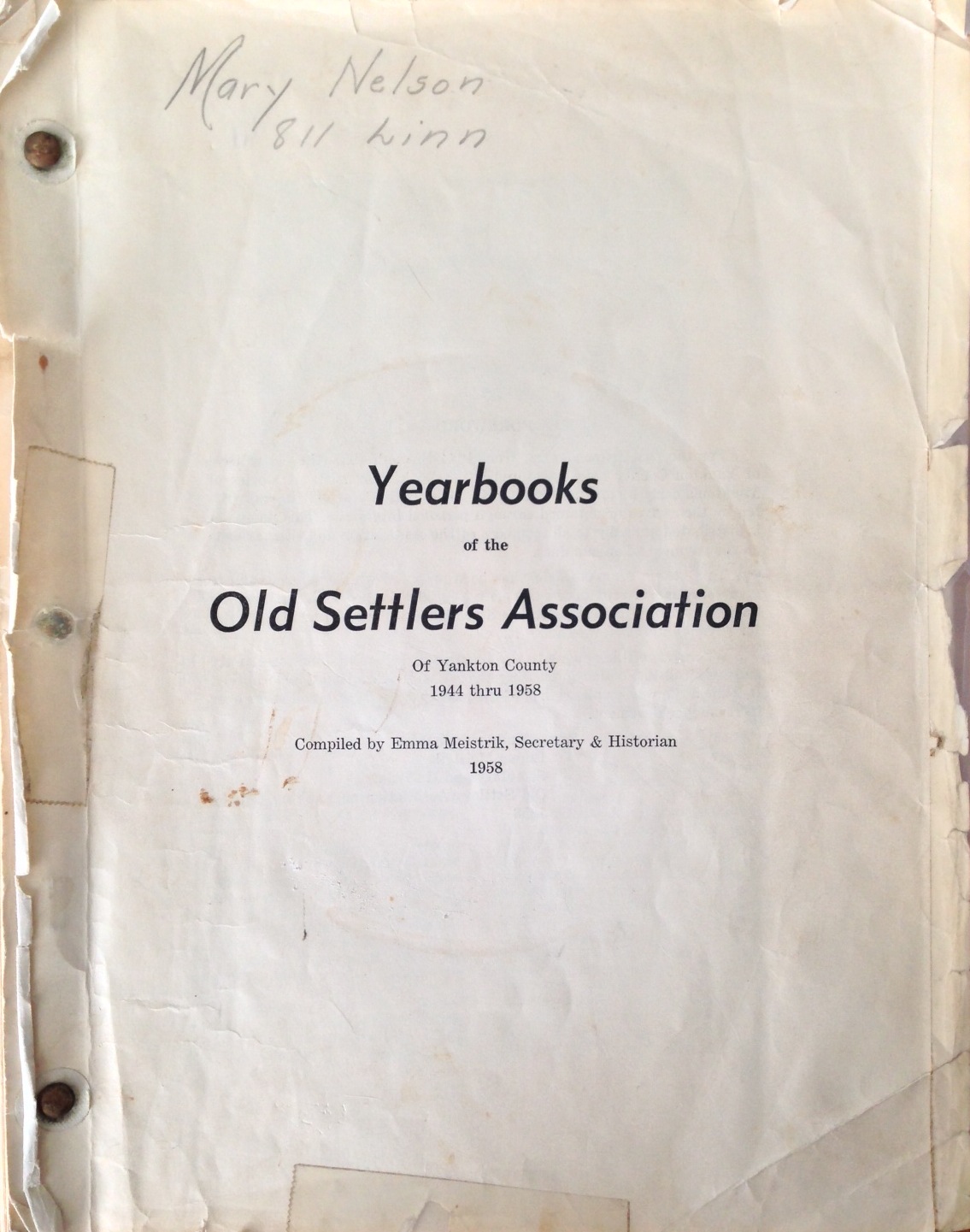
Yearbooks of the Old Settlers Association of Yankton County, South Dakota

For fifteen years, from 1944 through 1958, the old settlers of Yankton County, South Dakota sponsored a yearbook that compiled their own fascinating stories of life in southeastern South Dakota in the late nineteenth and early twentieth centuries. These yearbooks were later bound and filed with the local library and the state historical society. As written by Emma Meistrik, Secretary and Historian of the Old Settlers Association of Yankton County, “We dedicate this volume to the future old settlers of Yankton County and may call it Volume I, trusting that it will be continued indefinitely. It is upon the worthwhile things of the past that the future builds for ever increasing achievement.”1

OldSettlersAssociationYanktonCounty

Yearbooks of the Old Settlers Association of Yankton County, 1944-1958 (Yankton, South Dakota: Old Settlers Association of Yankton County, 1958); private collection of Melanie Frick.

My copy, once in the possession of an aunt, was not bound professionally, and I’m unsure whether all of the yearbooks are included. However, the stories within are rich with detail. Many of the settlers recount their experiences as immigrants, the establishment of their homesteads, and their survival of the deadly blizzard of 1888, as did Christine (Schmidt) Nelson of Yankton County, South Dakota.

She shared her recollections with her daughter, who wrote, “As an old settler of Yankton county she has many memories of the early years in her community. She recalls the old Indian trail which brought Indian traders to the home of her parents, Mr. and Mrs. Jens Smith, early settlers of Bon Homme county. On the old stage trail between Springfield, Fort Randall and Sioux City, the Smith farm was used as a place to change horses for the carrying of the mail.”2

Of the aforementioned blizzard, it was said, “Mrs. Nelson attended the Breezy Hill school and recalls the blizzard of 1888 when her only brother, Mads Smith, spent the night in the schoolhouse. The next morning after the storm, the sun was shining brightly and the family were overjoyed to see the young boy walking over the sparkling hard drifts after his night’s vigil.”3

The brief autobiography concludes, in part, “Mrs. Nelson is well-known by her many friends and relatives as a person who always has a warm welcome hand extended to all those who call at her home. Even today, at the age of 85, she is active with her household duties and retains an active interest in what is going on about her. She is cordial and sympathetic with the many young people who come her way. She is truly one of Dakota’s pioneer mothers who still looks ahead and enjoys her home and family.”4

As with A Yearbook from the Southern State Normal School, Springfield, South Dakota, 1916, copies of the compiled Yearbooks of the Old Settlers Association of Yankton County, 1944-1958 are likely not widely available to most researchers. Although my copy may not be complete, the individuals named below are included as featured settlers:

Continue reading

Choose Your Own Backdrop

When they posed with their children for this photograph in 1893, Niels and Juliane Sophie (Hennike) Olsen of Yankton County, South Dakota had been married for just over forty years. They had raised nine children to adulthood, eight of whom were born in their native Denmark.1

nielsolsenfamily1893

Family of Niels and Juliane (Hennike) Olsen, 1893, Yankton County, South Dakota; privately held by Melanie Frick, 2013.

Niels and Juliane had purchased a farm upon their arrival in America, but in their later years, they moved to a more comfortable life in town. The couple would go on to celebrate fifty years of marriage in 1902,2 although their youngest son, Andrew, would be missing from that gathering. He drowned in 1897 while hunting ducks on the nearby Swan Lake.3

The photograph is a large print, roughly 8×10 inches, pasted onto cardboard with the date marked on the back. Do you notice anything strange about the backdrop? The family poses in front of a backdrop of painted trees that is slightly too small for a group of that size. To one side, the edge of the backdrop of a wallpapered room is visible, and the backdrop cuts off altogether on the other. All seem to be dressed in their best, the men in dark suits and the women in good black dresses. In 1896, Godey’s wrote, “All of us who are wise, possess a black gown.”4

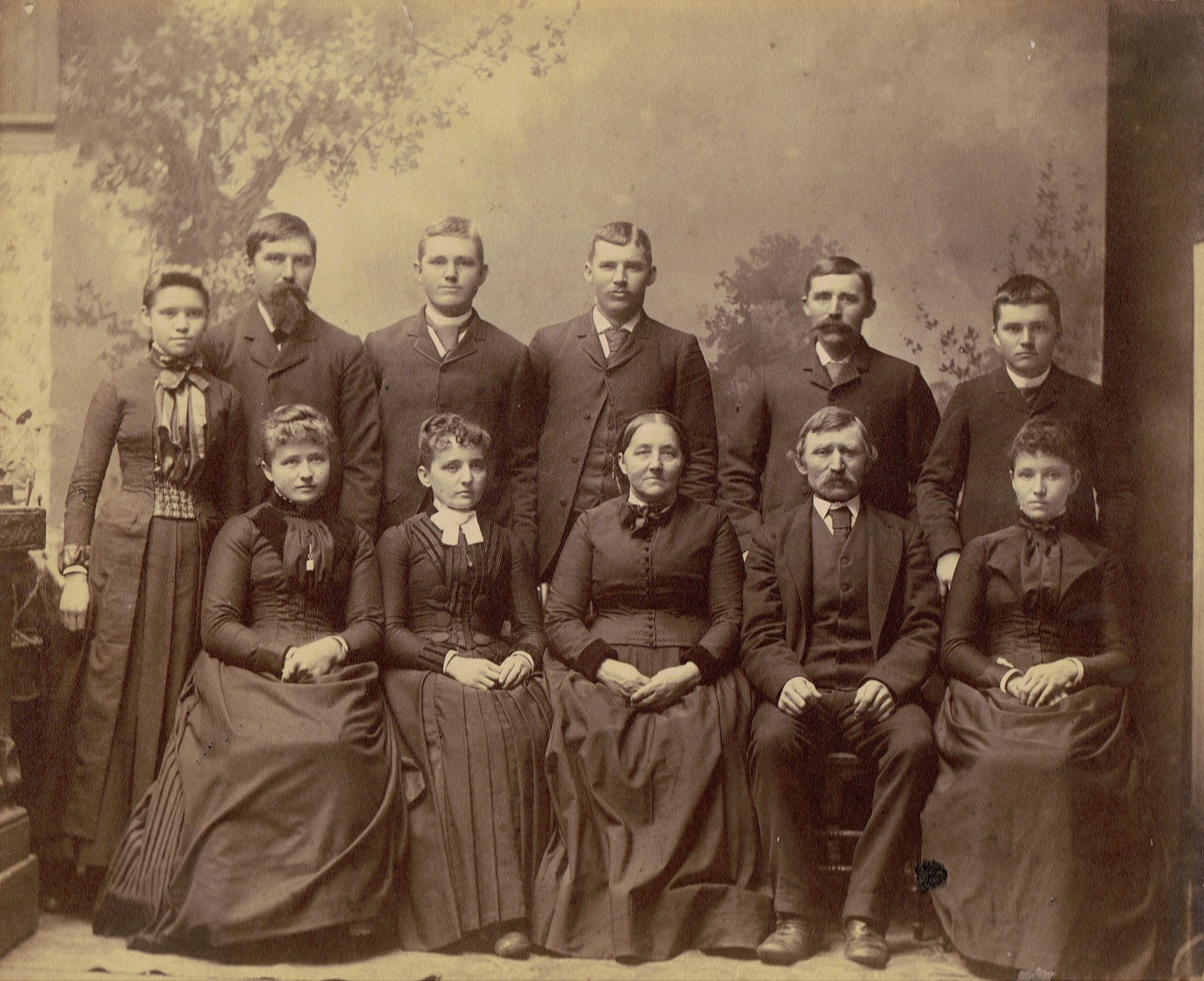
The women’s dresses are distinct, although the two sisters seated on opposite ends, Stena and Cecilie, could easily have made their dresses from the same pattern. Their sisters’ dresses also bear similarities, though all have their own touches – pleats, contrasting material, or, in Dora’s case, large decorative buttons. Their mother’s dress, however, has no unnecessary frills. Notably, all of the women’s sleeves are of the fitted fashion of the previous decade; as the 1890s went on, puffed sleeves gained popularity. Perhaps this fashion had not yet become popular in Yankton County, or maybe these women simply didn’t care for the new style enough to want to rework dresses that were still perfectly serviceable.

Standing, left to right, are Helena (Neilsen) Larsen, John Neilsen, Andrew Neilsen, Fred Neilsen, Ole Neilsen, and Chris Neilsen. Seated, left to right, are Stena (Neilsen) Callesen, Dora (Neilsen) Nissen, Juliane Sophie (Hennike) Olsen, Niels Olsen, and Cecilie (Neilsen) Boysen. Variations of the surname, including Nelson, were also used by some members of the family.


SOURCES
1 Harold W. Jorgensen, “Olsen, Niels,” in Ben Van Osdel and Don Binder, editors, History of Yankton County, South Dakota (Yankton, South Dakota: Curtis Media Corporation and the Yankton County Historical Society, 1987), 53.
2 Jorgensen, “Olsen, Niels,” 53.
3 Jorgensen, “Olsen, Niels,” 53.
2 Jorgensen, “Olsen, Niels,” 53.
4 Joan Severa, Dressed for the Photographer: Ordinary Americans and Fashion, 1840-1900 (Kent, Ohio: Kent State University Press), 460.

A South Dakota Thanksgiving

How did your ancestors celebrate Thanksgiving? As the cooking commences, I can’t help but wonder when Thanksgiving truly became a tradition among the different branches of my family tree, and how the celebrations might have varied.

NelsonFamilyFarm

Fred and Christine (Schmidt) Nelson Family Farm, Yankton County, South Dakota, ca. 1911-1917; digital image 2013, privately held by [personal information withheld].

I do know that the family of Fred and Christine (Schmidt) Nelson of Tabor, Yankton County, South Dakota celebrated the holiday more than a century ago. In 1908, their daughter Anna, seventeen, wrote in her diary, “Nov. 26, Thanksgiving day. Uncle Andrew, Aunt Mary and little cousins, also John S[ch]neider came down and had dinner with us and spent the day. It was cloudy most of the day and a rather cold wind.”1

Her guest list indicates that they had quite a crowd for dinner. By 1908, the Nelson family numbered ten,2 so with the addition of John Schneider and Andrew and Inger Marie “Mary” (Schmidt) Schmidt, who came with their three young children,3 the number at the table was brought to sixteen.

TurkeyValleySchool

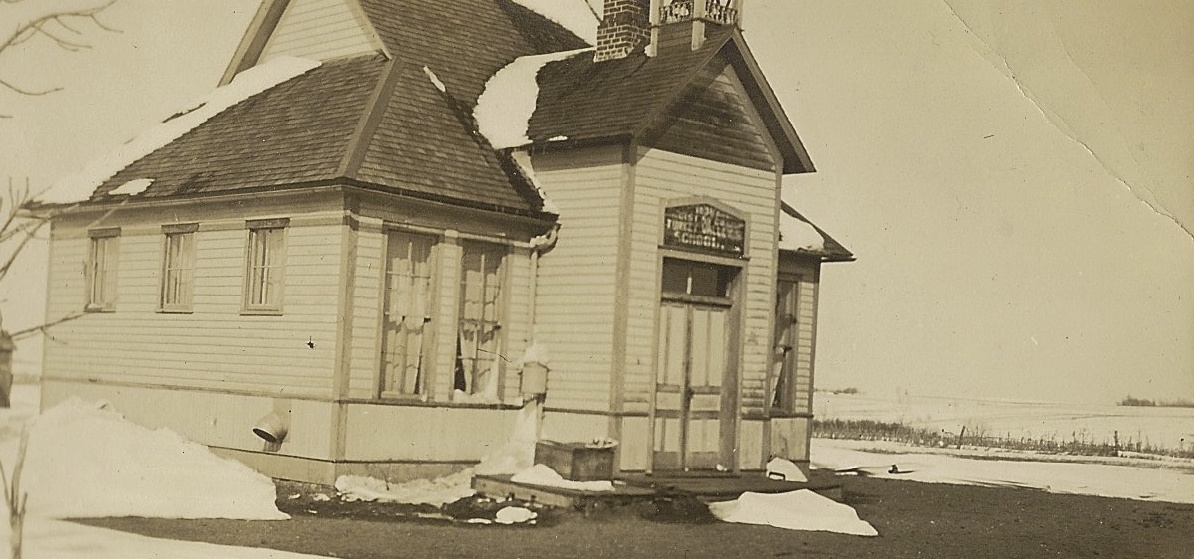
Turkey Valley School, date unknown, Turkey Valley, Yankton County, South Dakota; digital image 2010, privately held by [personal information withheld].

As the Nelson children grew and completed school, several of the six daughters scattered about the county on teaching assignments. In the fall of 1916, Andrea, age nineteen, boarded with the Skov family in Turkey Valley. Andrea was in the midst of her first term as a schoolteacher, having recently graduated from the Springfield Normal School.4

On 18 November 1916, Andrea wrote to her parents, explaining that she had spoken to the members of the local school board to ask if she could take off the day after Thanksgiving:

“Mr. Hinseth said that for his part he didn’t care how many we took off as he had no kids to send and Mr. Mikkleson said sure we could take the day then could see later about making it up. […] I haven’t asked Mr. Andreason about the day but it won’t do him much good to kick as it’s three against one.”5

Andrea was pleased, as this meant that she could return home for Thanksgiving and the three days following. No doubt she was eager to show off her new overshoes, purchased the previous afternoon in Irene. Although she reported woefully that they had made a dent in her monthly “warrant,” she continued, “Mr. Skov gave his ‘womenfolks’ a scolding because we hadn’t gotten overshoes a week ago Sat. when we were in town so I thot [sic] I had better get me a pair yesterday or I’d be scolded again, ha!”6

With these overshoes, Andrea would have been prepared for the blustery winter days on the eastern South Dakota prairie, and she would have stayed warm for the duration of the forty-mile journey home for the holidays. Now, if only we knew what was served for dinner!


SOURCES
1 Nelson, Anna. “Diary.” MS. Yankton County, South Dakota, 1908. Privately held by [personal information withheld].
2 1910 U.S. census, Yankton County, South Dakota, population schedule, Township 93 Range 57, enumeration district (ED) 447, sheet 2-A, p. 186 (stamped), dwelling 24, family 24, Fred Nelson; digital image, Ancestry.com (http://www.ancestry.com : accessed 26 November 2013), citing National Archives microfilm publication T624, roll 1489.
3 1910 U.S. census, Yankton County, South Dakota, population schedule, Township 93 Range 57, enumeration district (ED) 447, sheet 3-A, p. 187 (stamped), dwelling 46, family 48, Andrew Schmidt; digital image, Ancestry.com (http://www.ancestry.com : accessed 26 November 2013), citing National Archives microfilm publication T624, roll 1489.
4 The Echo, Vol. 1, “Andrea Nelson,” Springfield, South Dakota, 1916; privately held by [personal information withheld].
5 Andrea Nelson to Fred and Christine (Schimdt) Nelson, letter, detailing Thanksgiving plans, 18 November 1916; privately held by [personal information withheld].
6 Andrea Nelson to Fred and Christine (Schmidt) Nelson, letter.

The Nelson Family

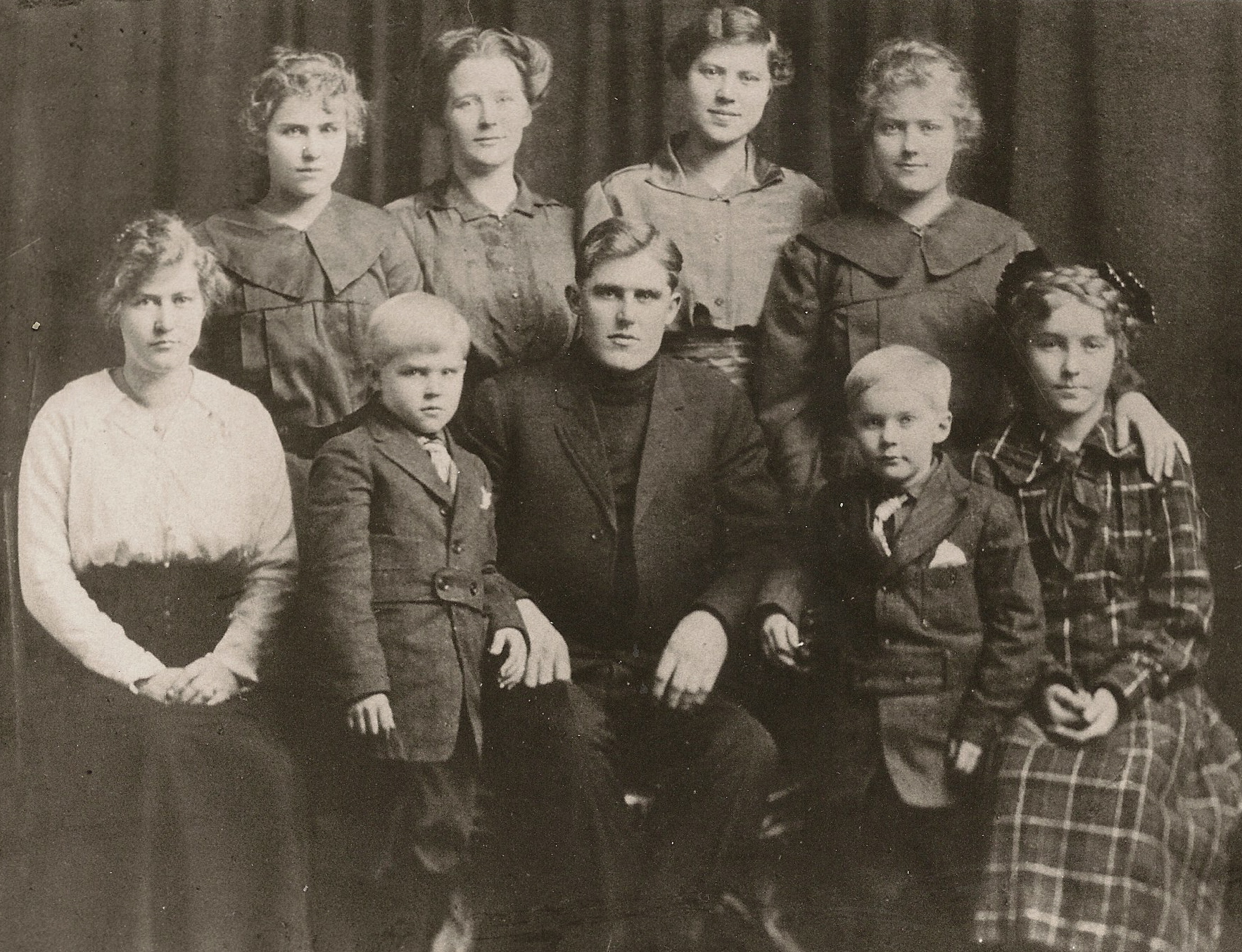
The nine children of Fred and Christine (Schmidt) Nelson of Tabor, Yankton County, South Dakota pose together here circa 1915. These six sisters and three brothers span nineteen years in age; from eldest to youngest, they are Anna, Julia, Ole, Andrea, Louise, Helena, Mary, Fred, and Myron Nelson. [Update: Since writing this piece, I have located another copy of this photograph with a date of December 1917 handwritten on the back.]

FredNelsonChildren1915

Family of Fred and Christina (Schmidt) Nelson, ca. 1915, Yankton County, South Dakota; digital image 2010, privately held by [personal information withheld], 2013.

A strong family resemblance can be seen in the nine Nelson siblings. Anna and Julia stand at center; they are wearing plain buttoned blouses and skirts, as is Andrea, seated left. Louise and Helena, standing at left and right, wear almost identical dresses with wide collars, pleated bodices, and belted waists. Their dresses were almost certainly sewn by hand from the same pattern.

Mary, the youngest sister, seated at right, is dressed in the most striking manner in a plaid dress with a ring of beautiful braids coiled atop her head. As the story goes, while they were growing up, the Nelson sisters would line up each morning to braid the hair of the sister standing before them.1 Someone clearly spent extra time on Mary’s hair on the morning that this photograph was taken!

The brothers, regardless of age, wear sturdy wool jackets. Ole’s jacket is open over a dark shirt or sweater that seems to be in the style of a turtleneck, while young (and very blond) Fred and Myron wear their jackets buttoned over shirts and ties. They lean towards Ole, their arms propped beside his on the arms of his chair.

In 1915, not all of the Nelson children remained at home, although all continued to live in the area. Anna, the eldest, was married, and had started a family.2 Julia was a schoolteacher,3 the profession pursued by her younger sisters, Andrea and Louise, who were students at the nearby Springfield Normal School.4 They would soon be followed by Helena and Mary, who at this point likely still attended the local school with Fred and Myron. Ole, the eldest brother, was a carpenter, and worked on the family farm.5

Was there an occasion for this photograph? In March of 1915, Fred and Christina (Schmidt) Nelson would have celebrated their twenty-fifth wedding anniversary.6 Perhaps a photograph of their progeny was in order, either by their request or as a gift from their children. Regardless, this is the last known photograph of all of the Nelson children together, and it’s a lovely one.


SOURCES
1 Phyllis (Wiese) Adam, conversations with the author, 2012; notes in author’s files.
2 1920 U.S. census, Yankton County, South Dakota, population schedule, Mission Hill, Enumeration District (ED) 251, p. 6151 (penned), sheet 1-B, dwelling 10, family 10, Anna Jorgensen; digital image, Ancestry.com (http://www.ancestry.com : accessed 4 November 2013), citing National Archives microfilm T625, roll 1726.
3 “South Dakota, State Census, 1915,” index and images, FamilySearch (https://familysearch.org : accessed 04 Nov 2013), Julia Nelson, Tabor, Yankton, South Dakota, United States.
4 The Echo, Vol. 1 (Springfield, South Dakota: Springfield Normal School, 1916); private collection of Brian Adam [personal information withheld].
5“South Dakota, State Census, 1915,” index and images, FamilySearch (https://familysearch.org : accessed 04 Nov 2013), Ole Nelson, Tabor, Yankton, South Dakota, United States.
6“In Memoriam: Christine M. Nelson,” undated clipping, ca. January 1961, from unidentified newspaper.