Author Archives: Melanie Frick

Unknown's avatar

About Melanie Frick

Melanie Frick, MLS, holds a Certificate in Genealogical Research and has been researching her family history for two decades. An Iowa native with Midwestern roots, she lives in the Pacific Northwest.

Friendship Clubs and Funny Quotes: Finding Family in Yearbooks

Several years before they would meet and marry, teenagers Fern and Jerry were unsuspecting students at Central High School in Sioux City, Woodbury County, Iowa.1 They were not in the same grade, and this was a large school; Fern moved to Sioux City only in time for her senior year, and as Jerry graduated two years later, it’s possible that they never crossed paths during their brief overlap as students at the imposing sandstone building dubbed “The Castle on the Hill.”2

Fern_Thoma_Yearbook_1925

The Maroon and White, Vol. XXI (Sioux City, Iowa: Central High School, 1925), 67; digital image, Ancestry.com (http://www.ancestry.com : accessed 24 March 2014).

Fern Lavonne Thoma graduated from Central High School in 1925. In her yearbook photo, she wore a long necklace and, true to the times, styled her hair in a fashionable, chin-length bob. The only club that Fern had joined was the “Friendship Club,” which, apparently, was mandatory for all female students.3 From what I remember her telling me, she enjoyed her time at this school, especially a banquet for the upperclassmen during which the school gymnasium was decorated like a boat. She thought this event was “just wonderful!”4

Gerald_Adam_Yearbook_1927

The Maroon and White, Vol. XXIII (Sioux City, Iowa: Central High School, 1927), 34; digital image, Ancestry.com (http://www.ancestry.com : accessed 24 March 2014).

Gerald “Jerry” Joseph Adam graduated from Central High School in 1927. According to the yearbook, he was in the general course of study and had been involved in Civics, no surprise given his penchant for writing to politicians later in his life, as well as the Spanish Club. His handsome photo was paired with the quote, “Who shows you your place when you go to the Princess?”5 As a teenager, Jerry earned money as an usher at the Princess Theatre in downtown Sioux City, surely a popular place among his movie-going peers.6

In fact, Fern and Jerry reportedly met while on their way to the movies. Fern and her friend Florence were walking downtown when two young men, who were known to Florence, drove up in their rental car and offered the girls a ride. Fern approached the front to sit next to the driver, when Jerry suggested that she sit in the back with him. Fern later claimed that Florence had set her up, while Jerry liked to say that when he first laid eyes on Fern, he proclaimed, “That’s the girl I’m going to marry!”7

If you would like to find yearbook photos of your ancestors (or even yourself), check out the yearbook collections on Ancestry.com. In my experience, yearbooks don’t always appear as strong “shaky leaf” matches, so I have found it helpful to search specifically within the category “Schools, Directories & Church Histories” in order to bring all relevant results to the top.

Also consider searching the yearbooks individually as your ancestor’s full name may not have been given for every appearance, particularly if he or she was an underclassman or appeared in additional club or athletic photographs. As a bonus, see if you can find his or her autograph scrawled in the back of the book. You never know what you might learn about the glory days of your ancestor’s youth!

Continue reading

How to Research at the Los Angeles County Archives

It’s been a year since my husband and I moved to Southern California, and, slowly but surely, I’m becoming familiar with the various record repositories in the area. This isn’t without effort, as Los Angeles County, with an area of 4,752 square miles and a population of 10 million, is so overwhelming that it can be hard to know where to begin! When I needed to hunt down some probate records, however, I knew that I would have to visit the Los Angeles County Archives and Records Center.

In preparation, I referred to a blog post by The SoCal Genie. I found it so helpful that I thought I would share an updated version for anyone who might be planning to visit this facility, as the official website isn’t terribly informative. The Los Angeles County Archives and Records Center is the go-to place for probate, divorce, and civil court cases more than five years old. 

First, I would recommend accessing the facility via Metro, as it’s located immediately off the Civic Center/Grand Park Station on the Red Line. I would also recommend that you resign yourself to spending some quality time at the facility, which, to be honest, is not a particularly nice place to spend the day. It’s essentially an underground warehouse – think concrete floors and fluorescent lighting – in need of more than a little TLC. That said, the employees were as nice as can be, so I imagine they’re doing the best they can under the circumstances. Not all archives are created equal!

IMG_2134It can be difficult to find the entrance to the Archives. As you face the Civic Center from the sidewalk, look to the left until you spot the outdoor elevator structure. This will take you underground to the Archives. At the second lower level, follow the signs through the hallway, which, at least when I was there, was piled with boxes and wooden pallets and looked like a place that would be off-limits to the public. However, further down the hall, a line had formed in front of the information desk.

Continue reading

A Deadwood Mystery

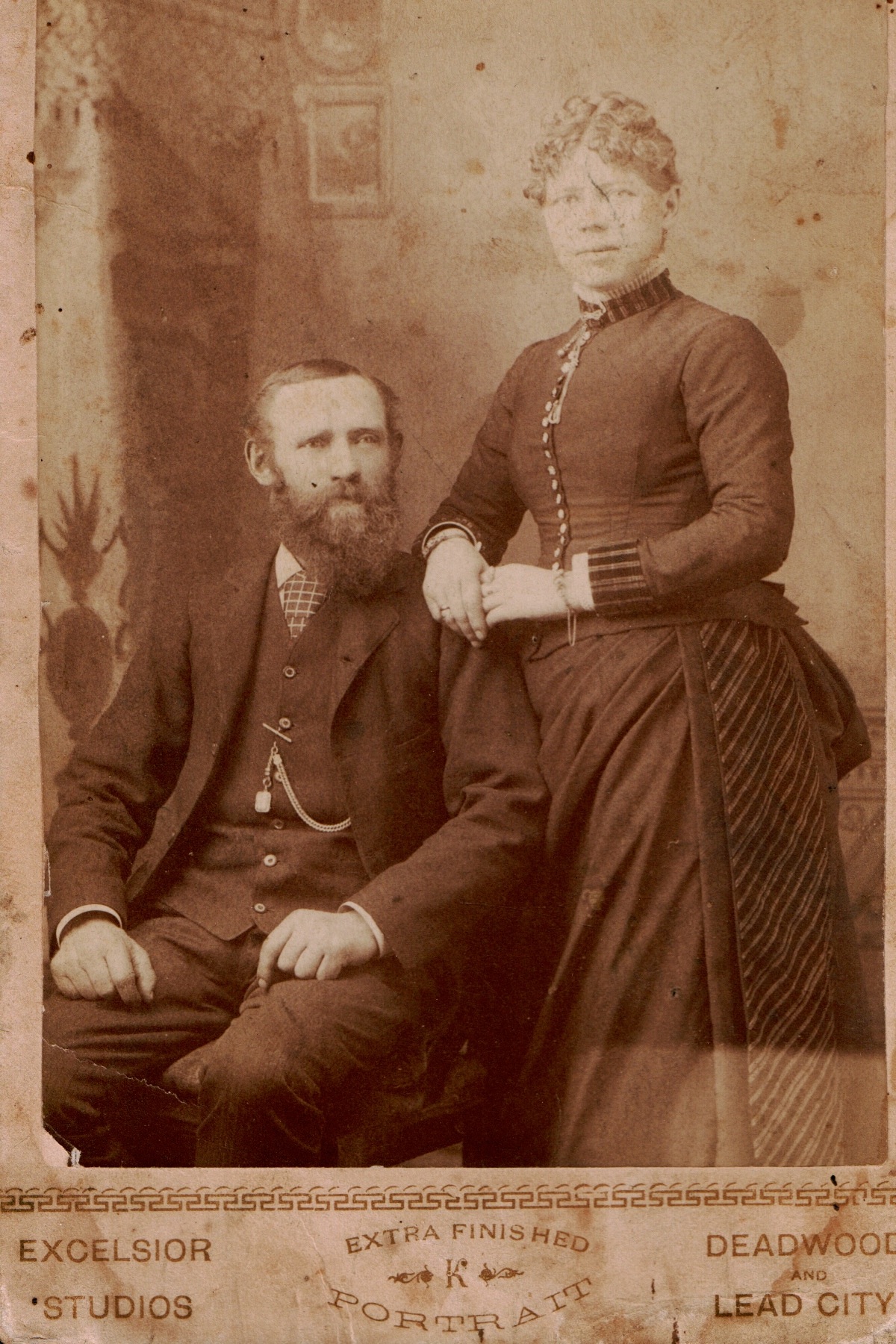
After years of wondering about an unidentified photograph from Deadwood in my family’s collection, a second photograph of the same couple turned up in the collection of an extended family member. In my mind, while just one might have come from, say, a neighbor who had gone off to the Wild West and wished to be remembered to those back in southeastern South Dakota, where this branch of my family lived, two suggest that this couple may actually have had a closer connection to my family. Were they friends, or were they relatives?

Unidentified_Deadwood_Couple_01

Unidentified couple, Deadwood or Lead City, Dakota Territory, ca. 1884-1890; digital image 2013, privately held by [personal information withheld], 2014.

Unidentified_Deadwood_Couple_02In the first photograph, a couple poses for what could be a wedding portrait, as the woman arranges her hands in such a way that a ring is visible along with two bracelets. The man has a distinctive high forehead, large ears, and a long beard. He wears a dark three-piece suit and a plaid tie. The woman has a broad face and light-colored eyes; her hair is curled at the temples and arranged in a looped braid at the back, a style that became popular in the 1870s.1 She is corseted and wears what looks to be a heavy gown, with a high collar and bustle. A single row of buttons adorns her bodice, and matching patterned material is visible at her collar, cuffs, and on a unique side panel of her skirt.

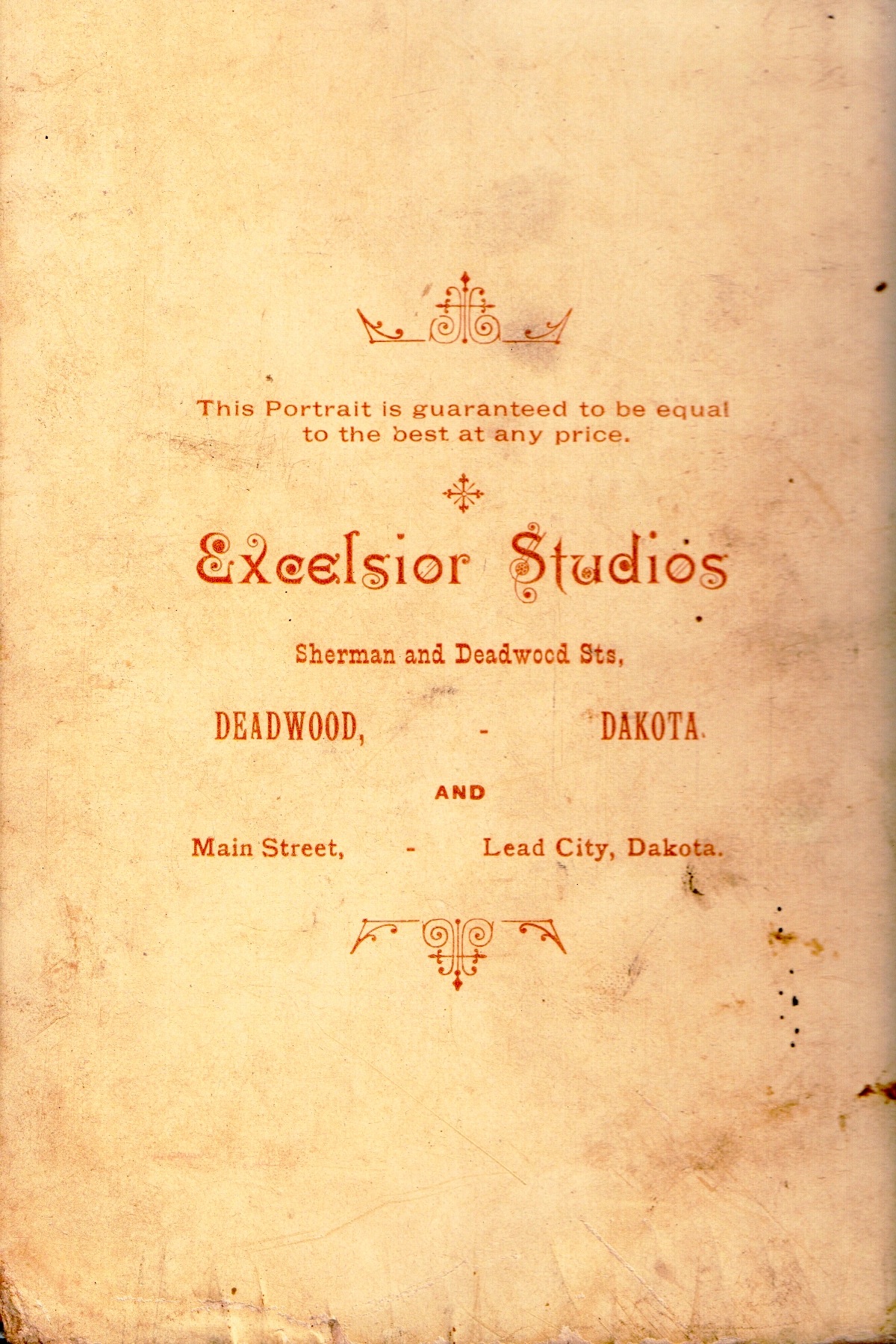
According to the information stamped on this cabinet card, it was made at Excelsior Studios, located either in Deadwood or Lead City, Dakota. Deadwood and Lead were founded in 1876 during the Black Hills Gold Rush, and the place name “Dakota” suggests that the portrait was made before (or immediately after) South Dakota achieved statehood in 1889. Thus, an initial time span for this photograph, as well as the one to follow, can be set at 1876-1890.

I’ve been unable to turn up anything about the Excelsior Studio online, although the small “K” emblem made me wonder whether any early photographers in Deadwood had the last initial “K.” As it turns out, a strikingly similar style of cabinet card can be attributed to Deadwood photographer Charles Kersting; perhaps he operated his business under the name Excelsior for a period of time. Online sources suggest that he may have arrived in Deadwood in 1884, at which time he joined forces with photographer George W. Scott.2
Unidentified_Deadwood_Family

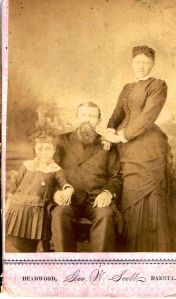
Unidentified family, Deadwood, Dakota Territory, ca. 1883-1887; digital image 2010, privately held by Melanie Frick, 2014.

The second photograph seems to feature the same couple, although at a different time; the woman appears more slender and has styled her hair differently, and, of course, she and her husband both wear different clothes. This time, a young girl joins them in the photograph, most certainly their daughter. She looks to be about five or six years old; while standing next to her seated father, she places her hand over her his and leans back against his shoulder. Her dropped waist dress falls to her knees with a pleated skirt, belt, and a fancy collar. Her mother again wears a row of buttons on her bodice, and her draped overskirt over knife pleats was of a style popular in the mid-1880s.3 In many ways, her dress is similar in style to that of the previous photograph.

This cabinet card, printed with a pink pattern, bears the name of the photographer Geo. W. Scott. Biographical information suggests that Scott was in operation in Deadwood for four years, beginning in 1883.4 It was in 1884 that Charles Kersting allegedly took over a branch of his business.5

Initially, I wanted to date the photograph of the couple alone before that of the couple with their child; however, the dates of operation of the Deadwood photography studios suggest that the reverse may also have been true. Perhaps it was not a wedding portrait after all! In any case, for a child of five or six to have been photographed by Scott in Deadwood between the years of 1883 and 1887, a birth date of somewhere between 1877 and 1881 can be assumed. This provides an essential clue.

The next step is to learn whether any of my direct ancestors had kin who lived in or near Deadwood. If a couple had a daughter between roughly 1877 and 1881, who happened to be the only child in their household at some point between 1883 and 1887, then that would make them strong contenders for the individuals featured in these photographs. Whoever they may be, I imagine that they must have had interesting stories to tell about life in Deadwood’s first decade!

Continue reading

A (Somewhat Lackluster) Homestead File

When I sent away to the National Archives for a copy of a homestead file, I was sure that I was in for a treat. I was aware that, in addition to the homestead application and final certificate, a homestead entry file would typically include proof documents in the form of testimony from the applicant and two witnesses. I couldn’t wait to read what this testimony would have to say about the home, family, and farm of Jens Madsen Schmidt of Bon Homme County, South Dakota.1 Jens had applied for a homestead on 23 November 1870,2 just months after his arrival from Denmark and less than a decade after the passage of the Homestead Act of 1862.3

As it turned out, I shouldn’t have gotten too excited. Apparently, on 8 June 1877, Luman N. Judd, Register of the Land Office at Springfield, had better things to do than to fill in the three blank lines meant to describe the home of Jens Madsen Schmidt, or the additional three blank lines meant to detail the improvements made upon his land.4 Of course, perhaps Mr. Judd isn’t to blame, and the witnesses – Peter Anderson and John Haase – were either unable to communicate these facts in English or were particularly reticent that day.5 To be fair, these men likely had crops to get back to and saw no reason to belabor the details, especially if they were equally well acquainted with Jens and knew that nothing stood in the way of his patent.

JensSchmidt

Jens Madsen Schmidt, Bon Homme County, South Dakota, ca. 1900; digital image 2003, privately held by Melanie Frick, 2014.

All was not lost with the homestead file. I learned that, in 1877, Jens had cultivated about forty acres of land.6 I learned, too, that his inclination to Anglicize his Danish name to James Smith had caused some issues with the paperwork; in 1878, he signed a document swearing that the “correct orthography” of his name was, in fact, Jens Madsen Schmidt.7

Regardless of the details – or lack thereof – of the homestead file, Jens Madsen Schmidt became the proud owner of one hundred and sixty acres of land located in Section 1, Township 93, Range 58 of Bon Homme County, South Dakota.8

If you would like to order your ancestor’s own homestead file, I would suggest beginning with the General Land Office Records of the Bureau of Land Management, where you will be able to locate the necessary information to order the file from the National Archives. I used their online form, and found it quick and easy. Fifty dollars and a few weeks later, perhaps you will find that your ancestor’s neighbors had at least a few things to say about his living situation!

Continue reading

A Spectacle in Spectacles

A close look at this photograph reveals something rather unusual: all four women wear pince-nez spectacles.1 In addition, one appears to clutch a writing tablet of sorts, lending a studious air to the scene despite the blur of a moving animal at left. Although these four women have posed for a tintype, which might lead one to believe that it was taken before card photographs exploded in popularity, this image can in fact be dated to the late 1880s.

Unidentified_Spectacle_Tintype.jpg

Four unidentified women wearing spectacles, likely Mount Pleasant, Henry, Iowa, ca. 1885-1890; digital image 2012, privately held by Melanie Frick, 2014.

The bespectacled women are firmly corseted in high-collared dresses. The single and double rows of close-set buttons featured on their bodices were in vogue at this time, as were their high, ruffled collars.2 Pleats at the hems of their skirts can also be attributed to this time period.3

This tintype comes from an album that can be linked to the family of Jesse M. Smith of Mount Pleasant, Henry County, Iowa. The album page in which this tintype rests is labeled in pencil, with the names Exsie and Mollie at the top, and Franc and Laura at the bottom.4 It’s possible, given the date of this photograph and the perceived age of the young woman at lower right, that this Laura could be the daughter of Jesse M. Smith, Laura B. Smith, pictured here when she was, perhaps, eighteen or twenty years old.5

There are other possibilities. As Exsie is an unusual name, I decided to search on Ancestry.com for young women named Exsie who might have resided in Iowa in the 1880s. A stroke of luck revealed just one – Exsie B. Sayles, who was a resident of Mount Pleasant as of 1885.6 A local history page shared that Exsie was a member of the Mount Pleasant High School graduating class of 1886, along with, notably, Franc Pitcher, Laura S. Mitts, Mary Wright, and a handful of others. 7 Mollie can be a nickname for Mary, so could these be other contenders for the women in the photograph? Although Laura B. Smith was not named as a graduate, school records may provide additional clues.

One might assume that these women had the specific goal of appearing scholarly for all to agree to be photographed in their spectacles. It seems likely that they were friends or classmates; perhaps they were celebrating an educational achievement, such as their high school graduation, or were acknowledging their involvement in an intellectual club of some kind, such as a literary society. No matter the occasion, this tintype offers a suggestion of the women’s personalities and interests, as well as a fun look at stylish vintage eyewear.

Continue reading

Tombstone Tuesday: Nancy Stilley

Nancy Stilley was raised on the Illinois frontier, and died a pioneer in Kansas. From what little I know about her life, she’s a perfect example of a “Fearless Female” whose story should be shared in honor of National Women’s History Month.

nancy_stilley_hall

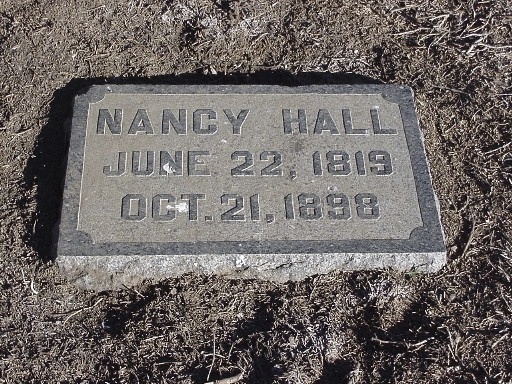
Grave of Nancy (Stilley) Holman Edwards Hall (1819-1898), Gypsum Cemetery, Gypsum, Saline County, Kansas, image date unknown, privately held by V.S.H. [personal information withheld], 2014.

According to her obituary, Nancy Stilley was born 19 June 1819 in Franklin County, Illinois.1 It’s likely that she never attended school,2 although she was said to have joined the Baptist church at the age of thirteen.3 Records suggest that she may have married as many as three times. Her first marriage took place in 1836; she married Thomas Holman of Hamilton County, Illinois.4 Her second marriage took place in 1843; she married Joseph Edwards of Washington County, Illinois.5 Her third and final marriage took place in 1847; she married Elithan Hall of Washington County, Illinois.6 This marriage, too, was short-lived. After her husband’s death in May of 1860,7 Nancy, still just forty years old, was left a widow with nine children at home.8 This time, she did not remarry.

Although it must have been difficult, Nancy seems to have managed her household and farm through the tumultuous years of the Civil War. Following the settlement of her husband’s estate in 1868,9 she relocated to Kansas with her children, including those who now had families of their own.10

By 1870, Nancy had settled in Solomon, Saline County, Kansas, where she held a respectable amount of real estate worth $1100 and personal property worth $600.11 Four children, between the ages of twelve and sixteen, were at home.12 Nancy was to remain in Kansas for the remainder of her life, eventually joining the household of her eldest son.13 She lived to the age of seventy-nine, her death the result of an unfortunate accident during what was likely a routine visit to her children and grandchildren:

“Last Friday morning, October 21, 1898, Mrs. T. G. McCance hitched a team to a buggy for the purpose of driving her mother, Mrs. Nancy Hall, to the residence of her son, E. L. McCance. Just as the ladies started the team suddenly turned the vehicle enough to throw the occupants to the ground. Mrs. Hall struck the ground with sufficient force to tear the flesh from one side of the face, break the cheek bone and inflict internal injuries, from which she died in a few hours.”14

Nancy was buried two days later, her burial attended “by a large number of friends and relatives,” in the Gypsum Cemetery in Gypsum, Saline County, Kansas.15

Continue reading

A Vintage Photo Strip

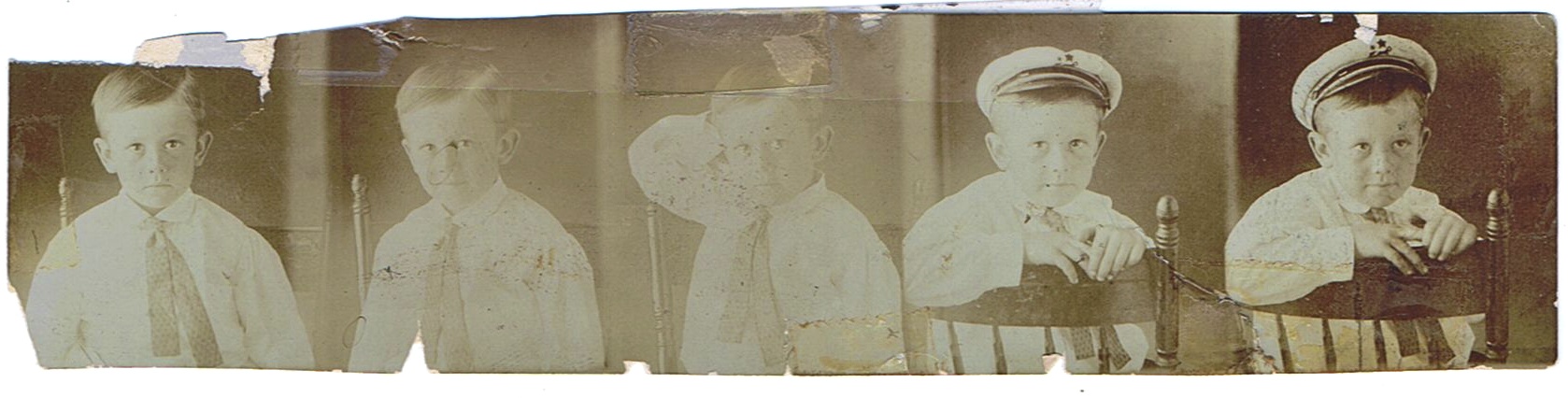
Long before photo booths gained popularity, Leonard Wiese of Chicago, Cook County, Illinois posed for this quaint series of photographs. Printed on a strip of flimsy paper, each individual photograph is about the size of a postage stamp. Leonard, the son of German immigrants Fred and Emma (Stübe) Wiese, was the youngest of five children,1 although an elder sister had died before he was born.2 He likely spent his early years at 46 Thomas Street,3 before his family moved to a new home, a large frame house, at 2502 North Neva Avenue.4 His father earned a living as a cigar maker, and must have done well in order to be able afford this home for his family.5

Leonard_Wiese_Photo_Strip_1905

Leonard Wiese, ca. 1905, Chicago, Cook, Illinois; digital image 2010, privately held by Melanie Frick, 2014.

Leonard looks to be about five years old in these photographs, dating them to approximately 1905. His hair is parted sleekly to the side, and he wears a white collared shirt with a patterned necktie. In the first three photographs, he poses formally while sitting upright in a chair. He has the hint of a smile in one, and artfully places his hand behind his head in another. In the final two photographs, he sports a pint-sized sailor cap while leaning playfully over the back of a wooden chair. His neat hair and dress suggest that these photographs were planned, yet the poses and setting seem more informal than what I would typically expect from a studio.

My first inclination, given the photo strip format, was to think that these photographs came from some sort of early predecessor to a photo booth, as automated photo booths didn’t spring up until 1926. Could there have been some sort of inexpensive arcade studio popular twenty years before? I also wondered if they might have been taken with an early model of a Kodak Brownie camera; another possibility is that they were proofs from which larger prints could be ordered. What do you think? This photo strip could easily have been cut apart and the individual photographs shared with friends or relatives. However, left intact, it allows a glimpse into several moments in Leonard’s boyhood in Chicago more than a century ago.

Continue reading

The FAN Principle: Finding Family in Southern Illinois

Isaac_Hall_Probate01

Washington County, Illinois, Isaac Hall probate file, Box 22, County Court; Illinois State Archives, Springfield.

Of course, it would have been too easy if Isaac Hall of Washington County, Illinois had named all of his surviving children in his last will and testament. Although probate records can be excellent resources for genealogists, they don’t always provide all of the details that one would hope. When Isaac dictated his wishes to two witnesses in January of 1852, he stated only that his “eldest son,” Jonathan Hall, was to receive all of his lands, goods, and chattels.1 He named this same son as the sole executor of his estate. Isaac made his mark, and went on to live less than two months more; his will was filed on 15 March 1852.2

Fortunately, there are other resources that provide clues as to who at least some of the other children of Isaac Hall may have been. Among them is the 1850 U.S. census for District 20, Washington County, Illinois, which counts three Hall households in a row. In the first lived Elathan Hall, thirty-seven, a farmer from Tennessee.3 In the second lived Isaac Hall, forty-five, also a farmer from Tennessee.4 In the third lived Jonathan Hall, fifty, a farmer who was a native of North Carolina,5 as was the only other adult male resident of the household, Isaac Hall, seventy-four.6 Although relationships between members of a household were not recorded in the 1850 census, based on the information provided, it seems logical to assume that the senior Isaac was Jonathan’s father, and that they were, in fact, the same Isaac and Jonathan of the aforementioned probate record. Their living arrangement suggests why Isaac may have felt so indebted to his eldest son when it came time to pen his will. Perhaps he had spent many years in the care of his son’s family.

And what of the younger Isaac Hall and Elathan Hall who lived next door, or, rather, on neighboring farms? No, they had not been born in North Carolina – but Tennessee falls between North Carolina and southern Illinois, making it a likely stop for a family that may have gradually migrated west. The thirteen-year age span between Jonathan, the younger Isaac, and Elithan suggests a possible sibling relationship. An exploration of additional records indicates that these families were closely linked for decades.

This is a perfect example of the importance of Cluster Research, also called the FAN Principle – an awareness of an ancestor’s Friends, Associates, and Neighbors – explored by Elizabeth Shown Mills.7 I should note that my dad stressed the importance of this principle to me in my research long before we knew that it had a name! How have you used the FAN Principle in your research?

Continue reading

A Keepsake from Denmark

KathrineChristensen01

Kathrine Christensen, ca. 1905, Thisted, Refs, Denmark; digital image 2013, privately held by Nicole Kilanowski, 2014.

This is a beautiful cabinet card portrait by L. H. Gram of Thisted, Refs, Denmark, whose stamp features a quaint floral pattern. Kathrine Christensen of Vestervig, Thisted, Refs, Denmark, pictured here circa 1905, wears a dress with a high “officer’s” collar, set off by a simple looped chain necklace.1 A fine decorative fabric with crocheted lace trim is draped over her shoulders, something  like a shawl or an open collar. Her seemingly abundant hair is piled elegantly in the style of the time, with a few soft curls at her forehead.

Kathrine gazes just beyond the camera, her expression serious. In the summer of 1906, she would leave Denmark behind – saying farewell forever to her father and three of her siblings – to join five other siblings and their families in Iowa.2 This photograph was previously in the possession of her young niece, who immigrated to America with her parents a year before Kathrine.3 Perhaps Kathrine sent it along as a keepsake to be shared with her older siblings in advance of her own arrival; at least one of her sisters had not seen her since she was a toddler.4 It’s possible that additional copies remained in Denmark with her family and friends.

I have only a few photographs of Kathrine, my mother’s grandmother, and never would have seen this one in particular if it weren’t for my Public Member Tree on Ancestry.com. Several months ago, I heard from a member of the family of Kathrine’s aforementioned niece – a niece I hadn’t known existed until I found her in the records and added her to my tree a few days previously – who had come into possession of a collection of her family photos.5 This treasure was among them.

Continue reading

A Dastardly Act: Making the News in 1893

Mrs. Hiram Hammond barely had a chance to settle in to her retirement in the town of Postville, Allamakee County, Iowa, before an unfortunate event warranted her a mention in the local newspaper.1

PostvilleReview29May1893Hammond.jpg

“Local Review,” The Postville (Iowa) Weekly Review, 29 May 1893, p. 1, col. 4; digital images, Newspaper Archive (http://www.newspaperarchive.com : accessed 18 February 2014).

As reported in The Postville Weekly Review on 29 May 1893, “Some miserable sneak thief stole some potted house plants from the residence of Mrs. Hiram Hammond, on Tuesday night. The most contemptible part of it was that those not carried off were mashed and destroyed. They were left out of doors without thought of danger. A man that would do such a dastardly act is not a safe member of society in any respect.”2

Well then! I can only imagine that poor Mrs. Hiram Hammond – born Eva Margaret Stoehr – must have been most distressed at this unexpected turn of events. She had likely only recently moved to town, while her husband prepared to put their farm up for sale.3 Hiram had turned eighty that year, while his wife was over sixty.4 After years of labor on their farm, they must have looked forward to a quiet life in town.

Postville was certainly not a large community, yet apparently large enough that a man (or, perhaps much more likely, a teenage boy) could get away with a destructive prank. However, if this was the worst that Postville had to report, it seems that things really may not have been all that bad! One can only hope that in the years to come, Mrs. Hiram Hammond was able to enjoy her potted house plants without further incident.

What is one of your favorite stories about an ancestor that you’ve found in a historic newspaper database? There are several excellent databases out there; so far, I’ve had positive experiences with Chronicling America (free) and NewspaperArchive (subscription). Be aware that different databases may offer access to different areas and periods of coverage. Also be sure to find out whether your local library provides free access to any useful newspaper databases, which can often be accessed from home.

Continue reading