“Matilda was a midwife,” so goes the family story, “and delivered a lot of babies in the county.” Despite a lack of definitive documentation, and almost certain lack of opportunity for any formal training, this nevertheless seems plausible. Matilda J. (Hammond) Thoma (1859-1947) of Clayton County, Iowa birthed five children of her own, and it does not seem unlikely that she might have assisted at the births of others in her close-knit community. She had numerous nieces and nephews whose births she might have supported, and she may even have served as midwife at the births of some of her own grandchildren. Indeed, it was her granddaughter Ina Fischer, born in 1907, who recalled nearly eighty years later that Matilda had been a midwife, and a 1920 newspaper announcement indicated that another granddaughter, Jacqueline Chaney, was in fact born at Matilda’s home.
Matilda (Hammond) Thoma and Franque (Friend) Curtis photograph, circa 1922, Clayton County, Iowa; digital image 2023, privately held by Melanie Frick, 2023.
Here, in one of only two photographs known to exist of Matilda, she poses with granddaughter Franque Friend. Matilda would have been in her early sixties at the time that this photograph was taken circa 1922; her hair, loosely coiled into a bun atop her head, seems to have gone mostly white. She wears a somewhat rumpled striped dress with buttons up the front and a wide collar in a contrasting fabric; this was not a studio portrait, but a casual snapshot apparently taken at home. Matilda appears to sit on a sofa near a window, a potted plant beside her, and striped wallpaper is visible in the background. She offers a small smile to the camera. Young Franque, perhaps ten years old here, stands next to her grandmother, grinning beneath the broad brim of a straw hat with a fringe of dark hair just peeking out. She wears a white dress with scalloped cuffs, a bow at the collar, and a leather belt.
Matilda, the daughter of Hiram H. Hammond (1813-1896) and Eva Margaret Stoehr (1831-1906), spent more than sixty-five years in Clayton County, Iowa, where she was born and later married Frederick Thoma (1857-1925). Four of their five children lived to adulthood; the youngest sadly died in a diphtheria outbreak at the age of ten. Following her husband’s death, Matilda eventually relocated, first to Texas with her daughter Roselyn and then to Wisconsin where she lived with her granddaughter Jacqueline. Few other details are known of her life, but what little is known suggests that she was a kind, competent, and maternal individual—just the sort to lend a hand as a midwife.
August Heitz, one of a dozen children born to Carl Theodor Heitz and Anna Maria Moog, was born on 26 March 1846 in Trarbach, Bernkastel-Wittlich, Rhineland-Palatinate, Germany. His father was a tanner, and August was destined to work with leather as well: following an apprenticeship to learn the trade, and time spent as a journeyman to hone his skills, he became a sattlermeister, or master saddler.
Trarbach, Marktplatz vor dem Stadtbrand von 1857 [Marketplace before the Town Fire of 1857], Holzstich; ; Wikimedia Commons, copyright Bligny.
August was thirty-one, likely well established in his trade, when he married Julianna Carolina Faust on 18 August 1877. Julianna, then twenty-one years of age, was the daughter of a cooper and likewise a native of Trarbach. The couple settled in their hometown, idyllically situated along the Mosel River and surrounded by abundant vineyards, and raised five children there: Julchen, Carolina, Anna Maria, Ida, and Adolf Heitz. A sixth child, August, died in infancy.
As a saddler in the final years before automobiles became widespread, August would have worked to make and repair saddles, bridles, and harnesses. He would also have trained others who wished to learn his trade, and the handwritten contract of at least one of his apprentices is extant. On 20 June 1901, the widow Anna Faust contracted her son, Otto, to a three-year apprenticeship under August Heitz, paying him a one-time fee of fifty marks for his tutelage. August promised to provide Otto with thorough instruction, health insurance and “contributions from his means,” whereas Otto agreed to diligent, orderly work and conduct. Otto would also be free on certain days to assist his mother “with her own work.” Interestingly, this contract notes that August was a tapezierer, or upholsterer, in addition to being a saddler.
It is unknown whether August also shared his knowledge of his trade with his surviving son, Adolf, as he ultimately made his career as a wine merchant. This trade was shared by two of August’s sons-in-law, as well, the husbands of both Julchen and Ida; Carolina’s husband was an innkeeper. Only Anna Maria did not marry; she joined a religious order.
August Heitz photograph, circa 1910, Germany; digital image 2011, privately held by Melanie Frick, 2023.
Little else is known of August’s life in Trarbach, although it appears that through his trade he was able to provide a comfortable life for his family. The only known photograph of him seems to have been taken when he was in his sixties, sometime around the year 1910. Sporting a dapper mustache and a pleasant expression, he wore a collared shirt, necktie, vest, and double-breasted wool suit coat for the occasion.
August Heitz died at the age of sixty-seven on 23 December 1913, survived by his wife, five children, and, eventually, six grandchildren.
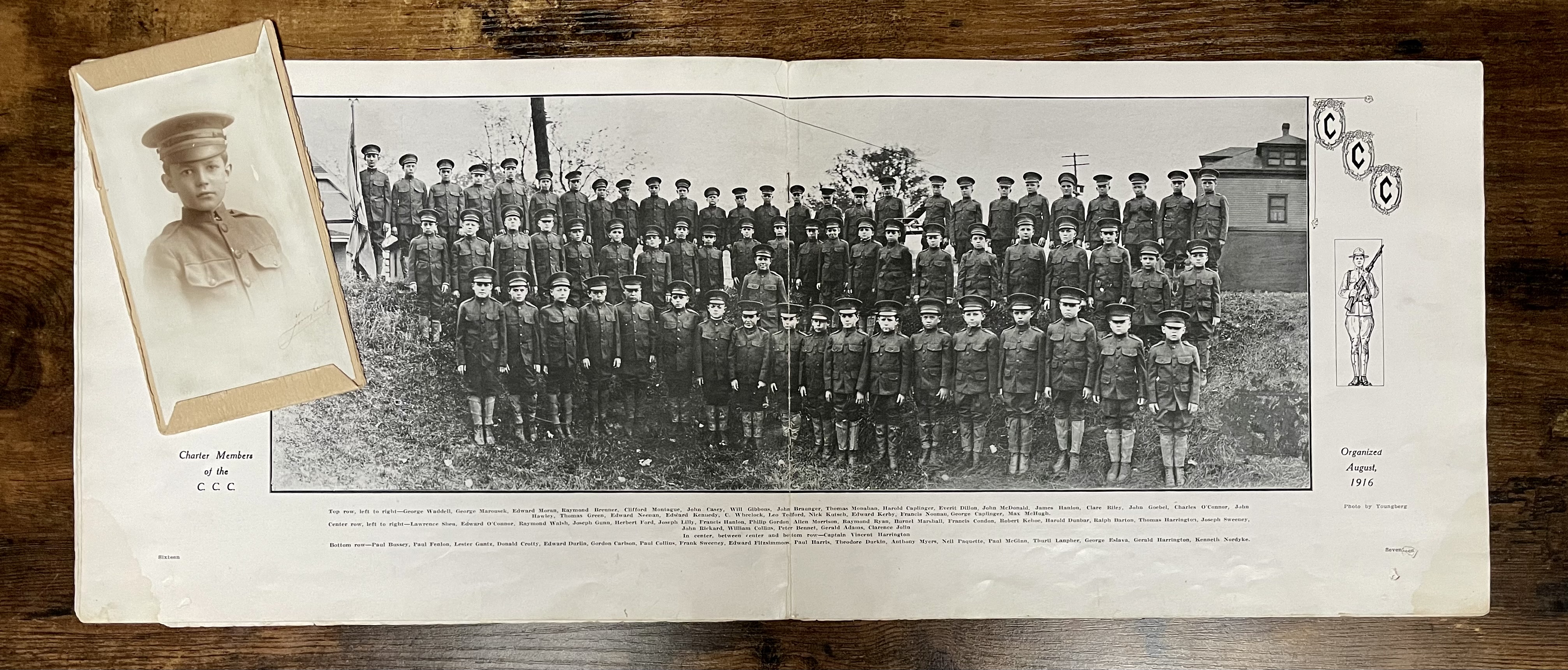
In the summer of 1916, Gerald “Jerry” Adam of Sioux City, Woodbury County, Iowa, celebrated his eighth birthday. Shortly thereafter, he became a charter member of the city’s newly-established Catholic Cadet Corps under the leadership of Reverend Henry A. Janse, Reverend Thomas M. Parle, Sergeant C. A. Butler, and Charles Parsons.
Gerald Joseph Adam and the Charter Members of the C.C.C. (Gerald pictured second row, second from right), 1917 Year Book of the Catholic Cadet Corps (Perkins Bros. Co. : Sioux City, Iowa, 1917); privately held by Melanie Frick, 2023. Collection courtesy of David Adam.
“The Catholic Cadet Corps was organized for the Catholic boys of Sioux City. It is now a citywide organization, and at the present time has a membership of 170. Companies are being formed in the various parishes of the city, so that all the Catholic boys of the city can enjoy the benefits of the C.C.C. For years the need of some such organization has been felt to solve the ‘boy problem.’ Until recently our Catholic boy had no organization of his own and experience has taught us that many of our boys drifted into the Y.M.C.A. on that account.
The Y.M.C.A. is a protestant organization in which our boy is not welcome, in which he can neither vote nor hold office and in which it is constantly insinuated that he is not even a Christian. Naturally this environment is not conducive to the best interest of our boy. The C.C.C. movement was inaugurated with the purpose of giving the Catholic boy surroundings which are in harmony with his faith. A tremendous amount of work has been done to make the C.C.C. attractive, instructive and helpful.”
1917 Year Book of the Catholic Cadet Corps
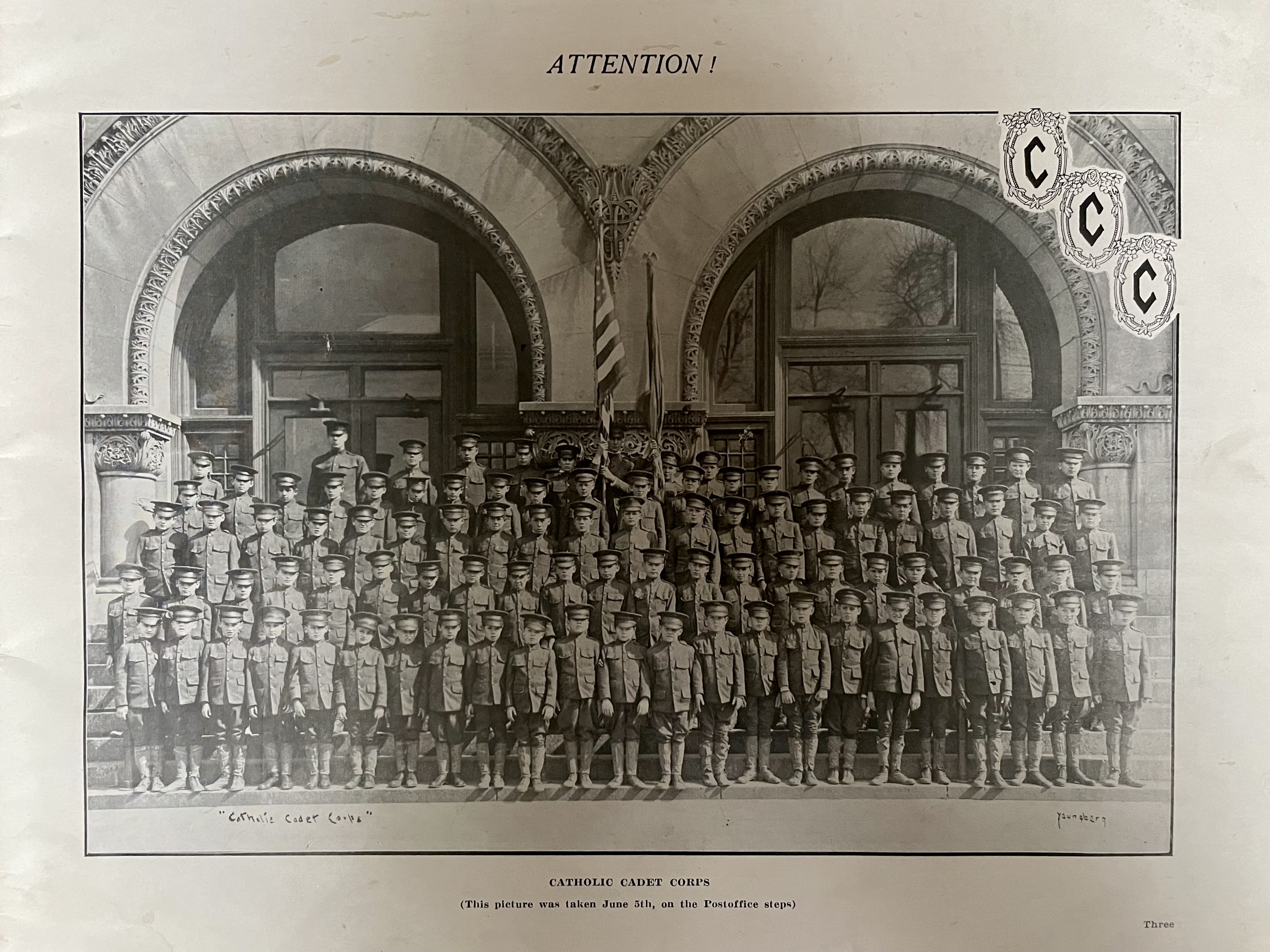
As a member of the Catholic Cadet Corps, Jerry would have participated in military drills and athletics, marched in parades and decorated the graves of Civil War veterans. He may have been among the group of young cadets who sang “America” at a local theater on Decoration Day 1917 to much applause. The C.C.C. also organized an ambulance corp that took part in numerous aid efforts, and afforded recreational opportunities for its members such as hiking, picnicking, and swimming at the nearby Trinity College.
Catholic Cadet Corps, June 5, 1917 (Gerald Adam pictured second row, sixth from right), 1917 Year Book of the Catholic Cadet Corps (Perkins Bros. Co. : Sioux City, Iowa, 1917); privately held by Melanie Frick, 2023. Collection courtesy of David Adam.
Perhaps most significantly, the Catholic Cadet Corps may have provided Jerry with a sense of community and belonging at a place and time when Catholicism was not necessarily mainstream. “Boys of the C.C.C. are not ashamed of being Catholics—they are proud of it in this free land of the U.S.A.” The 1917 Year Book of the Catholic Cadet Corps made clear that uniforming each young member in a tailored wool suit was an intentional choice. “The fact that the Cadets have the best uniforms in the city makes them think more of their personal appearance, increases their self-respect and has a good influence on their every day lives—they strive to be as good as they look. The boys wear their uniforms to school. This places all the boys on the same level—no distinction between rich and poor—all are Cadets and all try to do their best in school.” Jerry even wore his uniform for a family photograph believed to have been taken circa 1916.
It is not known how long Jerry might have been involved with the Catholic Cadet Corps, but the year he turned ten was a tumultuous one for him. Not only was 1918 marred by war and a global pandemic, but his father was away for long stretches of time due to his employment at a naval shipyard, and then, tragically, his younger brother died at age five following a horrific accident. Jerry was left an only child with a grieving mother and a father occupied with the war effort; it can well be imagined that the leadership and friendship offered by the C.C.C. may have filled a void for him at this time.
Jerry would not be a lifelong Catholic, but his experiences in the Catholic Cadet Corps may have influenced him regardless. At the age of eighteen, he joined the Marine Corps Reserve, and at twenty, he and his bride—although she was not Catholic—were married by Reverend Le Cair of St. Jean Baptiste Catholic Church in Sioux City. Although Jerry’s involvement with the Catholic church waned after that point, he continued to be actively involved in his community through fraternal organizations, as a Little League coach, and as a businessman and entrepreneur. As for Sioux City’s Catholic Cadet Corps, the wartime years seem to have been its heyday and any mention of the organization in the local newspaper dropped off within a few years thereafter.
On a March day more than two hundred years ago, a young girl stitched her name, age, and the date onto her sampler: “Elisabeth Gibbons Aged 12 Years Old March 21 1812.”
The alphabet and numerals to fifteen are featured at the top of the sampler, embroidered in faded thread of green, pale blue, and beige, and at the lower right, significantly faded, is an apparent religious quotation: “Fear God. Your parents well obey. For you will have no friend but they.”
Sampler, Elisabeth Gibbons, 1812; privately held by Melanie Frick, 2023.
No Biblical connection to this quotation is immediately apparent. According to a Google search, the line, “Your parents well obey” appears in the book Divine Miscellanies, or, Sacred Poems, written by James Maxwell, which was first printed in England in 1756 with a second edition printed in Scotland in 1787. However, it is possible that this quotation was inspired by a sensational epic poem published in England in the late eighteenth century, entitled: The Gloucestershire Tragedy, Being an Account of Miss Mary Smith in Thornbury, Who Poison’d Her Father Sir John Smith, for Love of a Young Man. Within this poem are the strikingly similar lines, “Serve God, your parents well obey / For you’ve no friends alive but they.” Might Elisabeth Gibbons have read and been moved by this emotional account?
The sampler is bordered by a vine of leaves and flowers, the green of the vine still relatively bold, the flowers faded to beige and cream and the faintest pinks and blues. Perhaps natural dyes were used to color Elisabeth’s thread; the colors were likely once more vibrant. The inclusion of the floral border indicates that this sampler was indeed intended to be displayed with pride. At the time of its purchase at a Washington state antique shop in 2023, the sampler was framed as pictured, but the provenance of the frame itself is not immediately apparent.
What is known of Elisabeth Gibbons can be summed up quite succinctly. She was born at some point between March 1799 and March 1800; she spoke English; she was Christian; she received some manner of education in an environment that allowed her the time and opportunity to learn, at the very least, her letters and the art of embroidery. She may have liked poetry and the color green, as evidenced by the dominant color of thread used in her sampler.
Elisabeth might have lived in the eastern United States, Canada, or the British Isles; the Gibbons surname originates there. It seems unlikely that she would have spent her childhood on the American frontier but rather that she lived somewhere settled enough to have opportunities for the education of young girls from genteel families. If her mother had been educated herself, Elisabeth could also have been under her tutelage rather than that of a female instructor.
Birth records from the late eighteenth and early nineteenth century are unfortunately sparse. While a handful of birth records for girls named Elisabeth Gibbons—and common variations of the name—born between March 1799 and March 1800 have been indexed and are available via online databases, it is impossible to say how many others bearing that name may never have had their births formally recorded.
Without an exact date of birth, a location, or the name of a school stitched onto this sampler, the odds of connecting it to a specific Elisabeth Gibbons are slim. However, should another sampler turn up with, for example, a similar floral border and a similar religious quotation, made around the same year, then perhaps it could be surmised that the samplers were made under the direction of the same individual and more clues could be gathered as a result.
For now, Elisabeth’s sampler stands alone as a relic of early nineteenth century girlhood, a lost memento of one young girl’s educational accomplishments at a time when opportunities for such an education were far from universal.
Hedwig Cichos—Hattie to those who knew her—was first widowed at the age of thirty-one. Her husband of twelve years, Joseph Lutz, had succumbed to tuberculosis, leaving her with four young daughters to provide for on her own. The oldest was just ten and the youngest not yet three; with so many mouths to feed, it comes as little surprise that Hattie remarried before the year was out. On 29 December 1887, not quite eight months after Joseph’s death, Hattie married Albert Rindfleisch, a fellow Silesian immigrant who was more than five years her junior.
Albert and Hattie made their home in Minnesota Lake, Faribault County, Minnesota, the same village where Hattie had settled with her parents when she had immigrated to America in 1873. In the years to come, Hattie would have five children with Albert: Edward in 1888, Agnes in 1890, Albert (II) in 1892, Elsie in 1893, and Frank in 1895. The 1895 Minnesota state census, recorded before Frank’s birth, indicates that only the youngest of Hattie’s daughters from her first marriage, Melanie, eleven, still lived under her roof. Her eldest daughter, Julia, had married at the age of sixteen in 1893 and moved out of state; the whereabouts of her middle daughters, Anna and Hattie (II), for the year 1895 are unknown. According to the census, Albert was a laborer and had worked for eight months of the previous year.
In the summer of 1899, everything changed for the Rindfleisch family. First, charged with “whipping his wife,” Albert, then thirty-eight, was jailed at the county seat of Blue Earth. He somehow managed to escape the sheriff, board a train, and travel one hundred miles west—but then his luck ran out. The Slayton Gazette and Murray County Pioneer reported:
Run Over by the Cars. Albert Rindfleisch, of Minnesota Lake, was run over by the west bound freight at this place Tuesday morning and had both legs taken off below the knee. He boarded the train here intending to go to either Hadley or Lake Wilson, and as the train pulled out he was standing alone on the front end of the accommodations car. He claims the cars gave a bump and he was thrown forward. He fell between the cars with both legs across the north rail and his body north of the track. The accommodation car passed over his legs and he was not seen by the train men. His cries attracted passersby and he was taken to the depot and from there to the poor house to be cared for. Dr. Morell, the railway physician, assisted by Dr. Lowe, amputated both his legs, one just above the ankle and the other just below the knee. A bottle containing a small amount of whiskey was found near him when picked up. He had thrown it away so as not to have it on his person. This has given rise to the suspicion that he may have been under the influence of liquor at the time of the accident. He claimed to have been looking for work. He has a wife and five children at Minnesota Lake.
Slayton Gazette and Murray County Pioneer, 03 August 1899
Two months later, the same newspaper provided an update:
Sandy McDonald, sheriff of Faribault county, was here last Saturday and took back with him Albert Rindfleisch who had been an inmate of our poorhouse since he had his legs taken off by the cars here two months ago. Rindfleisch was in jail at Blue Earth for whipping his wife and escaped from the sheriff. While fleeing from the sheriff he had his legs taken off here.
Slayton Gazette and Murray County Pioneer, 12 October 1899
It is not known whether Albert ever returned home to Hattie and their children—or whether Hattie would have let him if he had tried—but when the U.S. census was recorded in the summer of 1900, Hattie was reported to be a widow. It is possible that she may have been known in her heavily German-speaking community as a Strohwitwer, a term with the English equivalent “grass widow” that indicated that a couple was separated or that the wife had been effectively abandoned. Albert and Hattie—both Catholic—never divorced, and Hattie was not in fact widowed for the second time for another thirty years.
While Hattie remained in Minnesota Lake, Albert made his way to Wisconsin. Milwaukee city directories indicate that he may have eked out a living as a peddler for a period of time, but ultimately, he spent many years at the Milwaukee County Infirmary, an almshouse and poor farm in neighboring Wauwatosa. The 1920 and 1930 U.S. censuses both indicated that he was an inmate there, although whether alcoholism or the loss of his legs was the primary factor that brought him to this last resort for food and shelter is unknown. His final days were apparently spent in a rooming house in Milwaukee, as that is where he died on 08 May 1930:
Alcoholism, domestic violence, disability—all played a part in Albert’s sad demise, his death ultimately garnering a headline only as an oddity. Hattie, for all the hardships she may have suffered in an unhappy marriage and as a single mother, was resilient. She supported herself and her children as a seamstress and through her own self-sufficiency, keeping a milk cow, chickens, and pigs on three acres of land. Her grandchildren’s memories of her industrious nature and of her home cooking and preserving—ham, bacon, sausage, braunschweiger, pickled pigs feet, sauerkraut—long outlived her. Of Albert, however, little was ever said.
By the time of the 1870 U.S. census, French Canadians Timothée and Marguerite (Chicoine) Adam, both fifty-four years old, had lived in America for approximately five years. Along with their children, who ranged in age from toddlerhood to young adulthood, they had settled among fellow French-speaking immigrants in Springfield, Hampden County, Massachusetts. Their neighborhood, Indian Orchard, boasted a booming cotton mill on the banks of the Chicopee River. This would certainly have been a different environment than they had been accustomed to in the quiet village of Saint-Pie, Quebec where, for the first twenty-five years of their marriage, Timothée had been a farmer and Marguerite had raised more than a dozen children in their humble home. Their move from rural to comparatively urban was certain to have been full of adjustments, but what may be the most striking about their lives in the year 1870 is the impressive number of people with whom they shared one roof: twenty-eight, to be exact.
Their household had grown substantially from their first appearance in the Massachusetts state census in 1865; then, Timothée, who was employed at the mill, headed a household that numbered thirteen, including ten children and one boarder. In 1870, the twenty eight residents, all related, were in fact divided among four households within a single dwelling unit, presumably a tenement block. First recorded was the household headed by Timothée and Marguerite Adam themselves, which included nine of their children—those nine ranging in age from twenty-two down to three. Then came the households of three of their married daughters. The household of Leon and Julienne (Adam) Gay was first; they were the parents of one child. The household of Joseph and Marie (Adam) Noel and their five children was next, and last was that of Jean Baptiste and Marguerite (Adam) Gendreau and their five children.
Although Timothée himself was without an occupation at this time, and Marguerite kept house, nine other members of the combined households worked at the mill. Four of those nine millworkers were under the age of sixteen: Jean Adam was fourteen, Elisa Adam was twelve, Jean Gendreau was twelve, and Euclide Gendreau was eleven. Six children between the ages of six and eleven were at school, and six children between the ages of one and four were at home in the care of their mothers.
Many of Timothée and Marguerite’s children, grandchildren, and even great grandchildren would spend the decades to come employed in the Indian Orchard mill. It was not an easy life; in the years following the 1870 census, several members of the family would succumb to tuberculosis and other respiratory illnesses common among millworkers of the day, who often worked in dismal conditions with poor ventilation and were plagued by both communicable diseases and cotton lint.
“Clarence Noel, 138 Main St., Indian Orchard. Doffer in Hodges Fibre Carpet Co. of Indian Orchard Mfg. Co.,” September 1911, Prints & Photographs Online Catalog, Prints & Photographs Reading Room, Library of Congress, Washington, D.C. (https://www.loc.gov/pictures/item/2018676653/ : accessed 08 January 2023). “Alfred Gengreau [Gendreau], 20 Beaudry St., Joseph Miner, 15 Water St. Both work in Mr. Baker’s room, Indian Orchard Mill,” September 1911, Prints & Photographs Online Catalog, Prints & Photographs Reading Room, Library of Congress, Washington, D.C. (https://www.loc.gov/pictures/item/2018676654/ : accessed 08 January 2023).
Notably, at least two of the couple’s great-grandchildren appear to have been photographed by famed muckraker Lewis Hine, who documented the plight of child laborers in the early twentieth century and whose work was instrumental in child labor reform. Clarence Noel, fifteen, grandson of Timothée and Marguerite’s daughter Marie (Adam) Noel, and Alfred Gendreau, thirteen, grandson of their daughter Marguerite (Adam) Gendreau, were both photographed outside their workplace in September of 1911. Clarence, Hine noted, worked as a doffer and said that he had “made seven dollars last week.” Alfred, who posed with another boy, was said to “work in Mr. Baker’s room, Indian Orchard Mill.”
These boys were not by any means among the youngest of the child laborers that Hine photographed, nor did they work in the most arduous conditions, but still their images are striking. In their knickers and caps, both slight of build, Clarence and Alfred look every bit like schoolboys, although the mill—to which four generations of their family had now been tied—loomed large in the background. Their school days behind them, it was time for the boys to work to support their families.
When Union soldier John Fenton was laid to rest in the summer of 1862, one of hundreds of thousands of soldiers to succumb to infectious disease during the Civil War, he left four orphaned children: Sarah Alice, eighteen; Harriet, seventeen; John Albert, fourteen; and George W., ten.
The Fenton family had emigrated from England to America circa 1848-49, and had settled first in Ohio. That is where John’s wife, Ann (Bowskill) Fenton, died at some point between 1852-59. John and his children then moved to an area known as Buckeye Prairie near Pana, Christian County, Illinois, and in 1861, at the age of forty-six, John volunteered for Company M of the 3rd Illinois U.S. Cavalry. His children were thus left without a parent to look after them—first temporarily, and then permanently.
“Battle of Pea Ridge, Arkansas March 8th 1862,” Prints & Photographs Online Catalog, Prints & Photographs Reading Room, Library of Congress, Washington, D.C. (http://www.loc.gov/pictures/item/90709337 : accessed 25 July 2022). John Fenton of Company M of the 3rd Illinois U.S. Cavalry saw action at the Battle of Pea Ridge.
What became of the children? There is some indication that they may have resided with the family of James and Eliza Tylar during John’s absence at war; one daughter was a domestic in their household as of 1860, and at the time of John’s death in 1862, a hospital steward wrote a letter expressing John’s desire that his children give his best wishes “to Mr. Tylar and others that I have forgotten their names.” It seems perhaps more likely, however, that the children may have been hired out to different households when John enlisted, and it is unknown how their living situations may have changed when word was received of his death.
SarahAlice Fenton, who was known as Sallie, married in 1863 to Frederick Augustus Stockbridge, a widowed farmer fifteen years her senior. Together they had six children: Clara Violet, Nellie Jane, Elva Cecelia, Chester Foote, Emily Grace, and Frederick Fenton Stockbridge. Sarah’s eldest daughter, Clara, became the wife of Baptist minister Reverend Henry Stills Black, and with him traveled west. While in northern Idaho’s Silver Valley, Clara became acquainted with a photographer who was in need of an assistant, and she recommended her younger sister, Nellie, for the job. Nellie ultimately spent the next six decades as a photographer in Wallace, Idaho, with her work—now held by the University of Idaho, and also on display at the Barnard-Stockbridge Museum—providing a rich historical record of the area. Sarah did not settle in Idaho herself, nor did she follow her daughter Elva to Oklahoma, her daughter Emily to Oregon, or her son Chester to eastern Washington; she remained in Pana for most of her adult life. Eventually, however, some years after she was widowed, she moved to western Washington state to live with her youngest son, Frederick, and she died in Tacoma in 1927 at the age of eighty-three.
Harriet Fenton, or Hattie, as she was called, never married. She lived out her life in Pana, where she spent some time supporting herself as a domestic servant and as a dressmaker before moving in with her sister’s family. By 1887, she was known to be suffering from breast cancer, and in 1893, at the age of forty-eight, she passed away as a result of what the local newspaper called “petrifying cancer.” Newspapers far and wide printed this fact, stating briefly and without further detail, “A large portion of her body was completely petrified.”
John Albert Fenton followed in his father’s footsteps and joined the Union army in 1864 at the age of sixteen—although he claimed to be eighteen. He served in Company H of the 61st Illinois Infantry, survived the war, and in 1874, married Ella Elvira Cogan in Parke County, Indiana. They had four children, two of whom survived to adulthood: Harry Cogan and Anna A. Fenton. Harry, notably, graduated from Wabash College and became a reporter, working for the Indianapolis News as well as the Associated Press in Washington, D.C. He then served as secretary to Indiana Governor Warren T. McCray and became further involved in Indiana politics, eventually serving on the state’s alcoholic beverages commission. Anna married in and lived out her life in Indiana. As for John himself, he worked for many years as a teamster and then as a foreman at a Crawfordsville, Indiana brick factory before his death in 1919 at the age of seventy-one.
George W. Fenton, the youngest of the four, left Illinois in 1871 at the age of nineteen, having likely spent most of his teenage years as a farm laborer. In the company of two other ambitious young men, he made his way to Saline County, Kansas, where he settled in 1872. The following year, he married sixteen-year-old Sarah Ellen Hall, and they had three daughters: Minnie Belle, Alpha, and Anna Leota Fenton. All three went on to marry and have children of their own, ultimately settling in Minnesota, Colorado, and Iowa, respectively. George, however, faced an untimely end when he was accidentally shot and killed by his brother-in-law in 1880 at the age of twenty-eight.
Did the eleven far-flung grandchildren of John Fenton ever meet? It seems doubtful. The cousins were likely aware of each other, at least at one point; when John’s surviving children pursued a military pension in 1887, documentation was required regarding the names and ages of his children and, as George was deceased, the names and ages of George’s children as well. Within the pension file is a letter that Sarah’s teenage daughter Elva penned in response to a request for information, which noted, “Uncle George was born in Monroe Falls Ohio and died at in Saline Co. Kansas Oct. 10 1880. We have no record of his children’s age and the letter which had them in is lost. As near as we can remember Minnie will be 12 next June Alpha 10 next March and Leota 8 next Feb.” In the years to come, however, as the families of John’s children and grandchildren became even more geographically dispersed, further contact may well have ceased.
Little is known about Michael Noehl and Magdalena Hoffman, a couple who spent their married life in the village of Holsthum, Eifelkreis Bitburg-Prüm, Rhineland-Palatinate, Germany. Holsthum was described by one of their sons as “situated in a lovely valley of rich agricultural land, crowned with fruit trees, and further off, with magnificent forests, between nurseries and rose plantations.” Even now it remains a quaint, pastoral village.
Michael Noehl, one of at least eight children of Johannes Noehl and Elisabeth Gierens, was born in Niederstedem, Eifelkreis Bitburg-Prüm, Rhineland-Palatinate, Germany on 22 June 1828. Nothing is known of his childhood, but as a young man, he entered the military. According to the memoirs of his son, Michael served as a Prussian soldier in Koblenz between the years 1847-1851; during the Baden Revolution in 1848, he stood sentry at the Ehrenbreitstein Fortress.
After his service, Michael married Magdalena Hoffman, who was born on 21 Jul 1833 in Holsthum, one of at least four children of Mathias Hoffman and Magdalena Ehr. Michael and Magdalena were married on 12 February 1857; Michael was twenty-eight and Magdalena twenty-three at the time of their marriage, which was recorded at Schankweiler. The Schankweiler Klaus is an eighteenth-century chapel and hermitage tucked into the forest approximately two miles from the village of Holsthum, and still stands today.
Schankweiler, Rheinland-Pfalz, Germany photograph, 2009; privately held by Melanie Frick, 2022.
Together, the couple had seven sons: Mathias (1858), Michael (1860), Nikolaus (1864), Nikolaus (1866), Mathias (1868), Johann (1870), and Jakob (1873). Notably, despite name repetition among their sons, it is believed that all survived to adulthood. (This is not the first case of name repetition among children of this region that I have observed.)
Mathias Noehl (1868-1950), second from right, with brothers, perhaps Nikolaus, Johan, and Jakob Noehl, Holsthum, Germany, 1938; digital image 2009, privately held by Roland Noehl, Holsthum, Germany, 2009.
A great-grandson of Michael and Magdalena remembered being told that Michael was a forester, and Magdalena certainly had her hands full raising seven sons, but few details are known of their adult lives. One of their sons recalled completing school at the age of fourteen and going to work herding sheep to help his parents pay off a debt on their property; later this same son was apprenticed to a rose grower, so it may be assumed that their other sons were similarly established with apprenticeships.
Michael saw several of his siblings immigrate to America in the nineteenth century; his sister Susanna and his brothers Matthias and Johann all settled in Minnesota. Likewise, Magdalena saw a paternal aunt and a paternal uncle immigrate to Minnesota and Iowa. Later, Michael and Magdalena bade farewell to two of their own children who left their homeland to try their luck on American soil: Michael in 1881 and Mathias (1868) in 1886. From these two sons then came fifteen American grandchildren whom Michael and Magdalena never had the opportunity to meet.
Michael and Magdalena lived out their lives in Holsthum, surviving at least to their sixties, as it is known that their son Mathias came from America to visit in 1894 and found them in good health at that time. To the best of my knowledge, however, their graves, according to German custom, have long since been recycled and are no longer marked.
When Mary (Hall) Rhine, the wife of William Rhine, both of Washington County, Illinois, died on 20 May 1898 at the age of eighty-nine, she was the mother of fourteen, grandmother of thirty-one, great-grandmother of thirty-nine, and great-great-grandmother of four children.
Mary is presumed to be the daughter of Isaac Hall (1776-1852) and sister of Jonathan, Isaac, and Elithan Hall, all of whom ultimately settled in Washington County, Illinois. Her identity—both as a Hall and as a member of this particular Hall family—remains unconfirmed, but there are compelling connections.
Mary was said to have been born in Montgomery County, Tennessee, in 1809, and married William Rhine circa 1825 in what is now Saline County, Illinois, where they spent the first years of their married life. Her presumed eldest brother, Jonathan, owned a neighboring parcel of land, and another neighbor, James Hampton, husband of Mary Elizabeth Hall, was believed to be kin. In 1832, William Rhine served with James Hampton’s Company in the Black Hawk War, enlisting in Gallatin County—as did Jonathan Hall, Mary’s presumed brother.
In the 1840s, William and Mary acquired land in what was known as Three Mile Prairie in Washington County. The first parcel purchased was located catercorner from land owned by Isaac Hall (whether this was Mary’s presumed father or brother is unknown) and the additional parcels that they purchased in the years to come were all located within the vicinity of land owned by Mary’s presumed brothers Jonathan, Isaac, and Elithan Hall. Worth note is that in 1868, following Elithan’s death, William Rhine received approximately ten dollars owed to him from his estate. Indeed, the Hall brothers, like Mary, all lived out the rest of their lives in Washington County, and she was not the only one to live to an advanced age; Isaac, too, lived well into his eighties and was said to have enjoyed long walks even in his later years.
Mary (Hall) Rhine, Washington County, Illinois, circa 1860; courtesy of the Nashville (Illinois) Public Library.
Even if it turns out that Mary was not a member of this Hall family, her obituary relates experiences that may have been common among southern Illinois settlers of the 1810s:
“Mrs. Rhine was one of our county’s and state’s oldest settlers, having come to the state with her parents, who settled in Salene [sic] county before Illinois was admitted to statehood. The relating of her experiences during the early days in this state would make interesting pages of history. She had seen the great state of Illinois in its natural and undeveloped state. She had witnessed the scalping of her playmates and neighbors by the unruly Indians when the settlers were compelled to live in forts as a protection against the Red Men.”
Mary and her family, of course, were among those whose westward movements displaced and antagonized local Indigenous communities. If she was indeed a daughter of Isaac Hall, it is estimated that she and her family remained in Tennessee at least until 1813, when Mary’s presumed brother Elithan was said to have been born there, and arrived in Illinois at some point before it achieved statehood in 1818.
A number of Mary’s descendants appear as autosomal DNA matches to descendants of her presumed brothers Jonathan, Isaac, and Elithan Hall, lending further credibility to their connection. However, additional research is necessary to confirm their relationship and formally add to the Hall family story.
On 09 November 1921, a taffy pulling party was held in a small Nebraska town. The Decatur Herald reported, “A number of young folks were present and [a] real jovial evening was spent” at the home of Mr. and Mrs. George Thoma. Hosting this event, I suspect, was their eldest daughter, fourteen-year-old Fern Thoma, who was in ninth grade at the local school. Taffy pulls became popular in the nineteenth century and involved boiling up a sugary mixture that was then pulled, folded, and pulled again by teams of individuals with well-buttered hands, the end result being a quantity of candy to share and eat. As a social event, taffy pulls were particularly popular among mixed groups of young women and young men.
Fern, the daughter of a local merchant, was by all accounts a social girl; the newspaper shared several accounts of her activities as a young teenager before her family left Decatur in March 1922. During her eighth grade year, in February 1921, the Decatur Herald had noted, “Fern Thoma, Ina Lambert, Maxine Choyce, Elizabeth Akins, Gladys Gilson and Eleanor Darling gave a party at the home of Fern Thoma on Friday night. There were 28 boys and girls present, and the evening was spent in games.” Perhaps this party included Fern’s entire class; while only seventeen youth are pictured in her ninth grade class photograph, her eighth grade class may have been larger. As an eighth-grader, as shared in the Decatur Herald, Fern also participated in a Junior Audubon Society with the role of reporter.
Fern Thoma (1907-2006), front center, with ninth grade class, Decatur, Nebraska, October 1921; digital image 2010, privately held by Melanie Frick, 2021.
Outside of school, Fern, along with several of her aforementioned girlfriends, were piano students of local teacher Mrs. E. A. Sears. In April 1919, when Fern was in sixth grade, the Decatur Herald shared: “The younger pupils of Mrs. E. A. Sears will give a program at the home of Mrs. E. A. Hanson’s on Tuesday evening, April 22nd, at 8 o’clock, for the benefit of the organ fund of the Episcopal Church. Everyone cordially invited to attend, and bring a silver offering. Those taking part in the program, are the Misses Maxine Choyce, Rachael Hanson, Ina Lambert, Helen Farrens, Edith Skalovsky, Agnes Busse, Eleanor Darling, Fern Thoma, and Evelyn French; Masters Albert Bysse and Gerald Eagleton. Come and hear the ‘Bell Symphony’ and see the ‘Fairy Queen.'” Later that year, Fern was one of two girls who performed “beautiful solos” at a Decoration Day event.
As a ninth grader, Fern played the Valse-Arabesque by Theodore Lack at a musical program for the “older students” of Mrs. E. A. Sears, which, again, included a number of her girlfriends. It is not known if Fern continued with her musical instruction after her family left Decatur for another small Nebraska town; in any case, while she was not known to be musical as an adult, playing popular songs on the piano would have been a lively way for her to entertain friends as a teenager—when her hands were not covered in sticky taffy, of course!




 Homestead Genealogy