Category Archives: Uncategorized

The Iowa Asylum

“Timothy Adams, living near Moville, was sent to the insane asylum the past week.”1

When a casual online search turned up this statement printed long ago in a small-town Iowa newspaper, I was intrigued. There are three generations of Timothys in my family, and all three might have lived near Moville, Woodbury County, Iowa at the time of publication of this issue of the Sioux Valley News on 9 January 1890.2 Which Timothy, then, was sent to the insane asylum? For that matter, which asylum? And why?

As it turns out, this Timothy Adam was the youngest of the three, the son of Timothy and Odile (Millette) Adam, and the grandson of Timothée and Marguerite (Chicoine) Adam. He was born on 26 September 1869 in Chicopee, Hampden County, Massachusetts,3 where his parents, French Canadian immigrants, were employed in the area’s cotton mills.4 The family remained in Massachusetts until 1883 when they traveled west, first to southeastern South Dakota and then to homestead near the community of Moville in northwestern Iowa.5

When Timothy, Jr. was seven years old, he suffered a fever that led him to experience what was described as a fit.6 These fits continued, “sometimes three or four in succession,” although a week could pass before another occurrence.7 Apparently, however, Timothy “was never [a] very bright boy,” and furthermore, as he grew older, his condition became more unmanageable.8 He suffered memory loss and “wanted to run away constantly without occasion.”9 It was for these reasons, including his first unmanageable fit, that his father had Timothy evaluated and committed to the Clarinda State Hospital in Clarinda, Page County, Iowa, on 7 January 1890.10

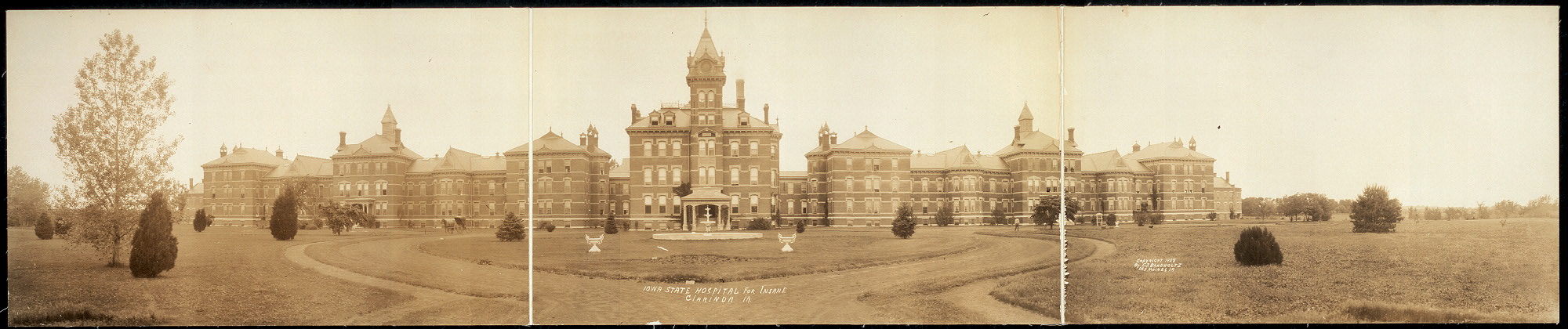
“Iowa State Hospital for Insane, Clarinda, Iowa (1908),” Prints & Photographs Online Catalog, Prints & Photographs Reading Room, Library of Congress, Washington, D.C. (http://hdl.loc.gov/loc.pnp/pan.6a04897 : accessed 28 March 2017).

One can only speculate as to what condition or conditions might have ailed Timothy. While the fits he suffered were perhaps epileptic seizures, low intelligence and a desire to run away from home were noted as secondary issues. Timothy was not the only child to cause his parents similar distress, as his younger brother, Edward, had run away several years earlier. In addition, upon Timothy’s entry into the asylum, it was noted that a member of his extended family had also been institutionalized: his mother’s younger brother, Joseph Millette, had entered the poorhouse in Beekmantown, Clinton County, New York, in 1869 at the age of nineteen.11 Records state that Joseph was an “imbecile,” intemperate, and, though he was of “respectable parentage,” his parents, too, were unable to care for him.12

At the time of Timothy’s admission to the asylum in the winter of 1890, the Clarinda State Hospital was brand new. Its first patients were received less than thirteen months before, and in fact, construction would not be complete until 1897.13 The Second Biennial Report of the Board of Trustees of the Iowa Hospital for the Insane at Clarinda reported a commitment to humane treatment, with avoidance of extreme measures such as restraint and isolation, and it can be hoped that Timothy and his fellow patients were treated with respect and kindness.14 Indeed, whether embellished or not, the Second Biennial Report stated of the years 1890-91, “Perfect harmony seems to exist between our superintendent and his subordinates.”15

The hospital housed a daily average of two hundred and sixty-one patients in January of 1890, a number that climbed over to over three hundred within a month.16 Although Superintendent Lewellen applauded the facilities as a whole, he also admitted that the hospital was overcrowded due to an influx of patients, many of whom had transferred from Iowa’s other mental institutions.17 However, the Second Biennial Report offered an encouraging perspective as to the overall conditions of the hospital, and plans were outlined for future improvements, including additions to the building and grounds as well as opportunities for patients to engage in both amusements and meaningful work.18

Timothy was discharged “without improvement” on 31 October 1891 after nearly two years at the hospital, perhaps once it was determined that no available treatment would be of help to him.19 It is not known whether he ever returned to his family. Sadly, Timothy died at the Clarinda State Hospital on 1 December 1894 at the age of twenty-five. Epilepsy was reported as his cause of death, which suggests he may have returned to the hospital due to a fatal seizure.20 He is buried in the hospital’s cemetery, many miles from his family and his former home.21

Copyright © 2017 Melanie Frick. All Rights Reserved.
Continue reading
An Ancestor with an Alias Revisited

In the past, I’ve touched upon the mystery surrounding George Hiram Thoma, who used an alias for a number of years before reverting back to the use of his original name. Born on 29 September 1880 in Clayton County, Iowa to Fred and Matilda (Hammond) Thoma, census records indicate that George remained in his home county at least until 1895.1 Family lore states that he left home as a teenager due to a poor relationship with his father;2 he was said to have bicycled from northeast to northwest Iowa where the next definitive record of his existence shows him marrying Anna Leota Fenton in the spring of 1902.3 However, he married under the assumed name of George A. Neilson, and later affidavits attest that this was one and the same person.4 George continued to use this assumed name for a number of years before finally reverting to the Thoma surname.

Now, a century has passed, and none of his living descendants, including his youngest daughter, seem to have even heard of the Neilson alias! In an effort to learn more about the potential cause of George’s name-change, a closer look was taken at his movements during his late teens and early twenties:

Did George leave home as a teenager? It was said that George had a poor relationship with his father, and recently uncovered evidence shows that he did, in fact, leave home as a teenager. However, at least at first, he didn’t go far. At the time of the 1895 Iowa State Census, George was fourteen and lived at home in the community of Garnavillo.5 Two years later, sixteen-year-old George attended high school in Postville, a town about twenty-five miles away.6 As George’s maternal grandmother also resided there, it’s certainly possible that he may have lived with her while completing his education.

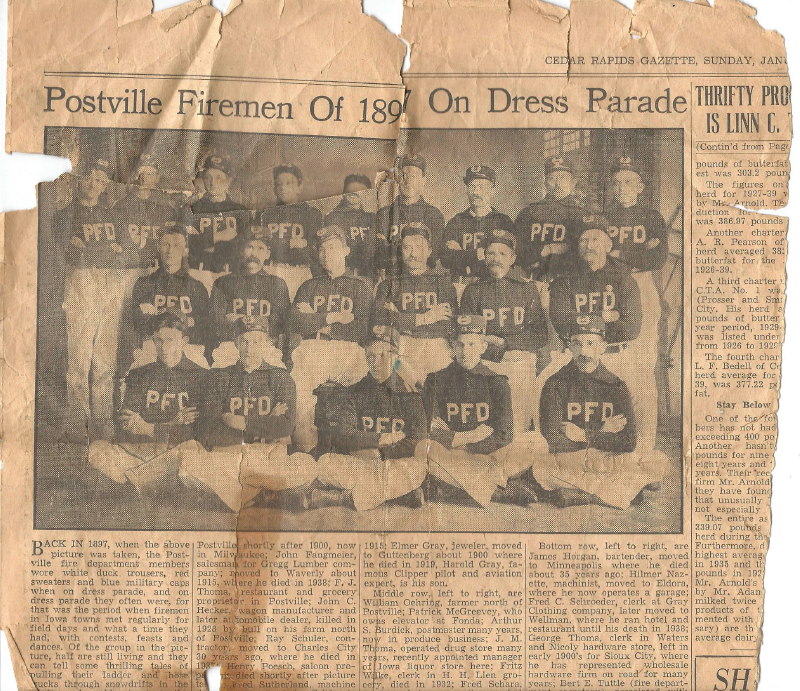
“Postville Firemen Of 1897 On Dress Parade,” 28 January 1940, Cedar Rapids (Iowa) Gazette; clipping privately held by David Adam, 2016. George Thoma is seated second from right; text reads, “George Thoma, clerk in Waters and Nicol[a]y hardware store, left in early 1900’s for Sioux City where he has represented wholesale hardware firm on road for many years.”

Also in 1897, George served with the Postville Fire Department.As reported in a local newspaper decades later, “Back in 1897 […] the Postville fire department members wore white duck trousers, red sweaters and blue military caps when on dress parade, and on dress parade they often were, for that was the period when firemen in Iowa towns met regularly for field days and what a time they had, with contests, feasts, and dances.”8 George, slim and clean-shaven, sits cross-legged in the front row of the group of twenty men, among whom he may have counted both former classmates and kin. At this time, after having dabbled previously with the idea of becoming a tinner,9 he was a clerk at a local hardware store.10

Did George really ride a bicycle across Iowa? Although family lore states that George left home as a teenager and bicycled across Iowa, I’ve always questioned whether this particular tale was entirely true or, indeed, even possible. As it turns out, George did, in fact, have access to a bicycle, and according to a blurb in the Postville Review in the summer of 1898, he “took an overland trip by bicycle to Farmersburg last Saturday, returning on Sunday.”11 From Postville to Farmersburg was a distance of more than fifteen miles—more than thirty miles roundtrip—which, with an eye to both the quality of bicycles of the era as well as the condition of the roads, frankly impressed me. Maybe he did bicycle across Iowa, or at least part of it, but from this clipping we are able to learn that he did not make the journey before he was eighteen; he remained close to home and was known as George Hiram Thoma at least until 1899. In January of that year, the Postville Review shared that he had spent several days visiting his parents in Garnavillo.12

How long did George use an alias? Thanks to the record of his daughter’s birth as well as the discovery of the record of his relinquished homestead, a fairly concrete date can be determined for the conclusion of George’s alias. His eldest daughter was born Fern Neilson in September of 1907;13 George A. Neilson appeared in a city directory printed in late 1908;14 and in February 1909, George H. Thoma made application for a homestead in western Nebraska.15 Perhaps the need to sign a record at the federal level inspired George to embrace his true identity once again! As for when George first used his alias, however, I have as of yet discovered no definitive records of his life between February of 1899, when he was known locally as George Thoma, and March of 1902, when he was married as George A. Neilson.16

What could have happened in those three years to give George reason to change his name? His experiences between the ages of eighteen and twenty-one remain a mystery to me. While I don’t yet know why George Hiram Thoma used an alias throughout a seven to ten year period of his early adulthood, however, I do have a more complete picture of his life during his late teens: he was a high school student, clerk, and fireman who lived apart from his immediate family but maintained a relationship with them, and he was apparently known well enough in his community to be mentioned routinely in the local newspapers.

Further complicating matters, however, is the fact that, in December 1905, during the midst of his documented use of an alias, a newspaper in his home county noted that “George Thoma, from Nebraska, is visiting with home folks since Friday.” This suggests both a continued relationship with his parents as well as the fact that his alias was either unknown or unacknowledged by those in northeastern Iowa. In any case, further information gleaned from historic newspapers could ultimately narrow the search for answers as to why, exactly, George Hiram Thoma was known as George A. Neilson.

Copyright © 2016 Melanie Frick. All Rights Reserved.
Continue reading
A Goodly Bit of Romance

The newspaper headline must have brought a few chuckles: “OLD FOLKS HAVE ROMANCE.” The story continued, “Romance is not all reserved for young people, as the marriage of Isaac N. Holman, aged 70, of Decatur, Neb., to Mrs. Sarah E. Fenton, aged 51, of Springdale, in Sioux City, will testify. […] This is the third marriage for each of the contracting parties. Both are well along the avenue of life and to them the marriage represents good judgment as well as a goodly bit of romance. They have known each other a long time and the mutual admiration they have entertained has grown gradually until the marriage yesterday placed its happy seal upon their growing affection.” Following their marriage on 24 August 1908 at the home of the Reverend W. H. Montgomery of the Haddock Methodist Episcopal Church in Sioux City, Woodbury County, Iowa, the couple was to visit Omaha. They would settle in Decatur, Burt County, Nebraska, where Holman, “said to be quite well to do,” made his home.1

That evening, their story appeared in another Sioux City newspaper: “LOOKING FOR LAND HE FINDS HELPMATE.” This version of the story was written with a level of flowery detail that, while entertaining, I don’t quite trust:

“I.N. Holman, a wealthy retired farmer of Decatur, Neb., came to Sioux City several months ago on a land deal. At the office of a real estate dealer he met a charming black-eyed widow, Mrs. Sarah E. Fenton, who had chanced in there on business. When they were introduced, he immediately lost all interest in Sioux City property or any property for that matter, and devoted all his time to the widow. Holman is 70 years old, and he pressed his suit with such ardor that before he returned to Decatur he had made a contract for something which he wouldn’t trade for all the farms in Iowa, namely the attractive widow. Today he returned to close the deal, which he says is the best he ever made. A license was issued this afternoon, the bride giving her age as 51. They will be married this evening and after a two weeks’ wedding trip will make their home at Decatur. “Maybe people think we’re foolish,” said the bride, blushing like a school girl, “but we don’t, we’re too happy.”2

This is far from the whole story. First, there are, in fact, two stories presented by these competing news articles. Did the couple meet at the land office, or had they been acquainted for years? This we may never know for sure; it seems unlikely, but not impossible, that the couple had crossed paths before meeting in Sioux City. Second, the “attractive widow” most likely did not have the black eyes of Bess the landlord’s daughter, charming as the description may be.3 And was she even a widow? Well, yes and no. Her first husband, George W. Fenton, died tragically in 1880 when accidentally shot by her brother-in-law.4 Her second husband, however, was still alive and well at the time of her third marriage; Sarah had divorced John Hoffman in 1902 citing his drunkenness and death threats.5 However, it would have been far from unusual for a woman to claim widowhood over divorce.

SarahEHall

Sarah Ellen (Hall) Fenton Hoffman Holman Eklof, Iowa or Nebraska, ca. 1908; digital image 2001, privately held by Melanie Frick, 2015.

Finally, would Isaac and Sarah live happily ever after? Unfortunately not. Isaac was granted a divorce from Sarah in 1914;6 a probate petition filed by his son the previous year, while suggesting that Isaac “indulged in intoxicating liquors to excess” and was “changeable, forgetful, and stubborn,” also stated that “the amount of money demanded from him by his current wife annoyed him considerable.”7 Oh dear. Isaac did not remarry before his death in 1922,8 but Sarah would marry – and divorce – once more.9 She resumed the use of the Holman name and at the time of her death in 1930, she was referenced as the widow of Isaac Newton Holman. Her short-lived marriage to this “wealthy landowner” was, perhaps, her one claim to local fame and financial stability.10

Lesson learned? Never assume. I had assumed that because this was the couple’s third marriage, and because they married in a community with a population greater than thirty thousand, that no mention would be made of their marriage in the local newspaper. In fact, I didn’t bother to check until their names turned up in the Findmypast database featuring a newspaper from across the state, and then learned that more than one version of the story existed. As it turns out, you never know what details of your ancestor’s experience might have made a compelling story deemed worthy of reprint!

Copyright © 2015 Melanie Frick. All Rights Reserved.

Continue reading

The Proud Owners of a New Piano

You never know what might have made the news a century ago. In Iowa, for example, news might have been made when someone acquired a piano. Although mail-order catalogues like Sears, Roebuck & Company made owning a piano more affordable than ever thanks to convenient financing options,1 such a substantial purchase was still of great interest to those in rural communities and small towns across America.

These were the years before Victrolas became widespread.2 Pianos were a ready source of music and entertainment, and people of all ages might have enjoyed gathering at the home of a friend or family member with a piano for an evening of playing and singing.

pianoloc

“A Pleasant Evening at Home,” Prints & Photographs Online Catalog, Prints & Photographs Reading Room, Library of Congress, Washington, D.C. (http://www.loc.gov/pictures/item/90709337 : accessed 5 August 2015).

In the northwestern corner of Iowa, The Sibley Gazette reported on 24 May 1900:

John Hoffman and family are the proud owners of a new piano.3

And in the northeastern corner of the state, The Guttenberg Press reported on 25 June 1909:

Miss Roselyn Thoma is the happy and proud possessor of a new piano.4

John Hoffman was the second husband of Sarah Ellen Hall; married since 1883, they would undergo a tumultuous divorce in 1902. At the turn of the century, however, they were still married with a twenty-year-old daughter and a sixteen-year-old son at home.5 Their acquisition of a piano adds a bit of brightness to what was painted in their divorce proceedings as a rather dim time. Although Sarah led a difficult life, her granddaughter remembered that she had loved fine things; this piano was likely a prized possession.6 As she was said to be a religious woman, perhaps she enjoyed hymns played on the piano either by herself or her children.

Roselyn Thoma was the daughter of Fred and Matilda (Hammond) Thoma and was seventeen years of age in 1909.7 She was the last of four surviving children still at home, her younger sister having been lost to a diphtheria outbreak three years prior.8 Perhaps it was with a newfound appreciation to seize the moment that her parents supported such an extravagance for their daughter, or perhaps the same inheritance that had recently spurred them to purchase a farm made the purchase of a piano possible as well.9 Roselyn would marry two years later, and one can imagine that her piano might have accompanied her to her new home.10

Whether the Hoffman and Thoma families enjoyed idyllic moments crowded around their pianos à la Little Women or not, it is clear that the addition of a piano to a household in their humble Midwestern communities was worthy of note – and pride. However, even in these rural areas, it would be only a matter of time before new forms of entertainment overtook the novelty of owning a piano.

Copyright © 2015 Melanie Frick. All Rights Reserved.

Continue reading

The Last Canadian

In honor of Canada Day, I introduce my last ancestor to live and die a Canadian: Leon Chicoine, who was baptized Joseph Leon Chicoine on 12 April 1785 at St-Charles-sur-Richelieu, Quebec, the son of Francois Chicoine and Marie Elizabeth Tetreault.1

St-Charles-sur-Richelieu

“View of St-Charles-sur-Richelieu from St-Marc-sur-Richelieu,” 2014, Saint-Charles-sur-Richelieu, Montérégie, Québec, Canada; Wikimedia Commons, copyright Tango7174.

Little is known of Leon’s early years. By the time he was twenty-five, he had made his way to Longueuil, located on the south shore of Montreal. It was there that he married Longueuil native Marie Varry on 17 September 1810.2 Their marriage took place at the impressive Cathédrale St-Antoine-de-Padoue in a ceremony led by Father Augustin Chaboillez, who, according to contemporary accounts, managed his parishioners with a firm hand. In fact, earlier that same year, he had a parishioner jailed for daring to interrupt his sermon!3

Leon and Marie did not remain there for long; they soon settled in St-Marc-sur-Richelieu, a rural community just across the Richelieu River from where Leon himself had been born. They remained in this area for the rest of their lives.4 Family lore states that Leon served in the military during the War of 1812.5 Then, twenty-five years later, war came to St-Marc when British troops defeated a number of Canadian rebels there during what is known as the Patriot War.6 Leon was in his fifties at this time; might he have participated in the futile attack? We may never know for sure.

Attack-on-Saint-Charles

“Attack on Saint-Charles 25th Novr. 1837,” 1840, Lord Charles Beauclerk (1813-1842); McCord Museum, Montreal, Quebec.

In any case, the majority of Leon’s life was likely spent in a more peaceful manner as a forgeron, or blacksmith.7 He fathered at least thirteen children, including my ancestor Marguerite Chicoine, although not all survived to adulthood. Sadly, Leon’s wife, Marie, passed away before she was forty; Leon remarried to Francoise Desautels in 1829.8

Leon Chicoine would live to the age of ninety two. When his granddaughter recorded his death in January 1877, she noted that he was by that time the grandfather of fifty-six grandchildren.9 His burial occurred at his birth parish of St-Charles-sur-Richelieu, likely in the churchyard of the striking eighteenth-century stone church located on the banks of the Richelieu River.10

Copyright © 2015 Melanie Frick. All Rights Reserved.

Continue reading

Crestleaf.com’s Guess My Family Heritage Blogathon Contest Entry

I love any incentive to digitize and share old photographs, so today I am taking part in a blog contest hosted by Crestleaf.com, a collaborative genealogy website.

Participants have been asked to share a family photograph and to invite their blog readers to guess their heritage (or, for those of us with rather diverse backgrounds, the heritage of those pictured). If you would like to take part in the contest, details are available on their blog.

Crestleaf_Contest

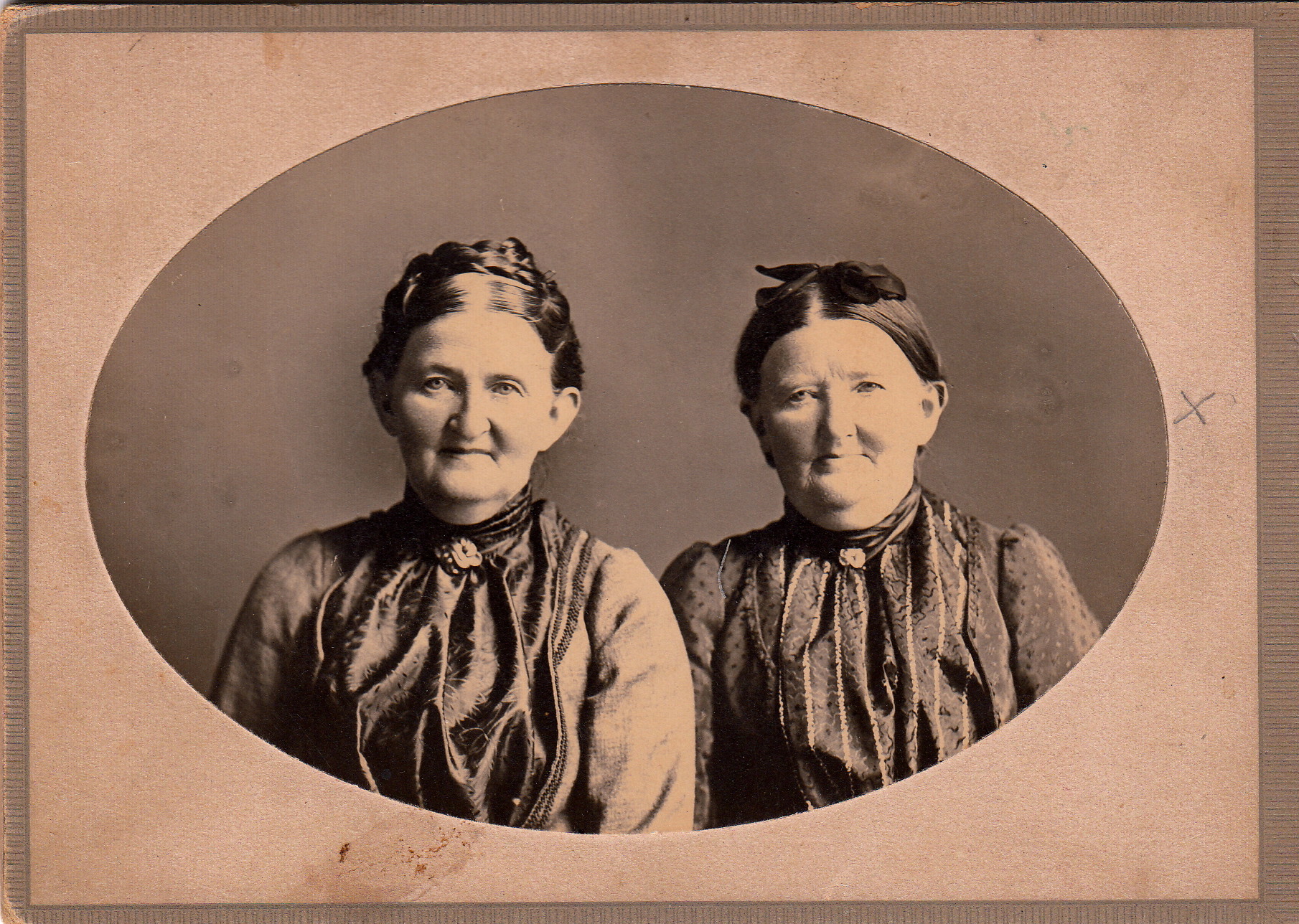
This cabinet card photograph depicts one of my ancestors, at right, with her sister. Can you guess their heritage? You are welcome to leave a comment! There is no prize for a correct answer, but I look forward to reading any responses. Check back after April 20th for the story of these sisters.

Update 4/22: Sisters Matilda Bramsen, left, and Anna Bramsen, daughters of Eric and Inger Marie (Hansen) Bramsen, were born in Denmark and later settled in South Dakota.

Thank you to Crestleaf.com for promoting the preservation of family memories through the Guess My Family Heritage Blogathon Contest!

Copyright © 2015 Melanie Frick. All Rights Reserved.

A Fatal Scratch: The Death of a Pioneer Woman

Anna_Margaretha_Poesch_Thoma_Obituary“After almost a week of extreme suffering, caused from blood poisoning, Mrs. Margaretha Thoma, one of Garnavillo’s oldest residents, passed away at 4:00 o’clock last Saturday afternoon. About two weeks ago the lady accidentally scratched the back of one of her hands with a pin. The scratch at the time was a mere trifle and was given no further thought by her until a few days after when the hand began to swell and cause more or less pain. A physician was called and found it necessary to lance the hand, but desired results did not follow and twice later the lance was employed, and still no relief came to her sufferings, but instead the wound continued to grow worse and the swelling commenced extending into the arm. Everything possible was done to allay the pain and comfort her in her unendurable suffering, but nothing could be administered that would combat with the situation and the result was death came as a relief after nearly a week of incessant torture.”1

Anna Margaretha (Poesch) Thoma was born in Weißenstadt, Wunsiedel, Bavaria, the daughter of Wolfgang and Barbara Poesch.2 She came to Iowa with her family at a young age, and was later deemed “one of the venerable and loved pioneer women of Clayton County.”3 Margaretha married William Henry Thoma, a local merchant, in 1857, when she was still in her teens.4 They had eleven children before his death in 1876; Margaretha never remarried, and in fact continued to operate his mercantile in the years following his death.5 Perhaps it was this role in her community that brought her the recognition to be remembered so fondly in the years following her death from blood poisoning on 9 November 1907.6

Margaretha’s unfortunate plight might remind some of Caroline Ingalls’ encounter with a rusty nail in a particularly drama-filled episode of Little House on the Prairie. Indeed, albeit tragically, little could have been done to relieve Margaretha’s suffering at this time and place. Her age, estimated at near seventy, might also have contributed to her susceptibility to infection, whether she in fact suffered from sepsis or tetanus. Although not soon enough for Margaretha, it would be just a matter of time before the use of penicillin – and the tetanus vaccine – would become widespread. 

Copyright © 2015 Melanie Frick. All Rights Reserved.

Continue reading

Remembering the Children’s Blizzard

Even seventeen Dakota winters could not have prepared the Danish immigrant family of Jens Madsen and Anna (Bramsen) Schmidt for what they faced in 1888.

January 12 dawned bright and clear in southeastern Dakota Territory. The weather was so pleasant that many children set off to school wearing only light jackets and wraps.1 In the Schmidt family, just twelve-year-old Mads was still in school; while he settled in with his classmates, his mother and older sisters, Mary and Christine, tinkered eagerly with the new sewing machine that had been delivered to them just that morning.2

Within a few hours, however, a dark cloud appeared on the horizon, bringing with it a wind so powerful that it roared as it whirled snow and ice into the air. The temperature dropped abruptly, and the snow and ice, said to be as fine as flour, made it impossible to see. Those unfortunate enough to be caught on the open prairie – or even in their barnyards – had little hope of making it to shelter.3

Through the remainder of the day and into the night, the Schmidt family waited in agony, a lantern burning in their window. They had no way of knowing whether Mads had taken shelter at school, or whether he had tried, in vain, to run for home. To search for him would be futile until the storm had ceased.

The next morning, which dawned bright and beautiful, Mads trudged home over the sparkling drifts of snow. The joy and relief that he, his sisters, and his parents must have felt at this reunion can only be imagined. As it turned out, the schoolteacher at the Breezy Hill School had managed to convince all of the children to stay in the shelter of the schoolhouse overnight, which, thankfully, had been sturdy enough to withstand the winds and had had enough fuel to keep them from freezing.4

JensMadsenSchmidtHomestead

Schmidt Family Homestead, near Tabor, Bon Homme County, South Dakota, ca. 1888-1889; digital image 2013, privately held by Melanie Frick, 2015. From left: Inger Marie “Mary,” Mads, Christine, Jens Madsen, and Anna (Bramsen) Schmidt.

Others had not been so lucky. Remembered as the “Children’s Blizzard” for the high number of school-aged victims, the storm tore apart some of the flimsier schoolhouses, forcing the teachers and children to flee into the storm, often in insufficient clothing due to the balmy weather of the morning.5 Others thought that they could beat the worst of it home, but on the open prairie where some children walked miles to reach school, many became disoriented in the storm or were forced by the wind in different directions. It became impossible for them to spot familiar landmarks either because of the fine and blinding snow or because their eyes had frozen shut.6

Later, two sewing machine salesmen, who had made their last stop at the Schmidt family homestead in Bon Homme County, were found huddled in the box of their bobsled just three miles to the west. They had frozen to death; their horses, tied in a grove of trees, survived. For years, locals referred to the area as Dead Man’s Grove.7

The Children’s Blizzard claimed an estimated two hundred fifty to five hundred lives across the Midwestern prairie, with the majority of the casualties in southeastern Dakota Territory.
8 As reported by historian David Laskin, “The pioneers were by and large a taciturn lot, reserved and sober Germans and Scandinavians […]. Even those who never wrote another word about themselves put down on paper everything they could remember about the great blizzard of 1888. Indeed, it was the storm that has preserved these lives from oblivion.”9

Copyright © 2015 Melanie Frick. All Rights Reserved.

Continue reading
A Mystery in the Margins

All I can think is that Odile must have been desperate. She hadn’t seen her eldest son, Edward, in five years, and it had been at least two since she’d laid eyes on his younger brother, Fred. The last she’d heard, the two men, both in their thirties, had left the state, and she had no way of contacting them.

OdileMilletteAdam

Odile (Millette) Adam, Sioux City, Iowa, circa 1900; digital image 2004, privately held by Melanie Frick, 2014.

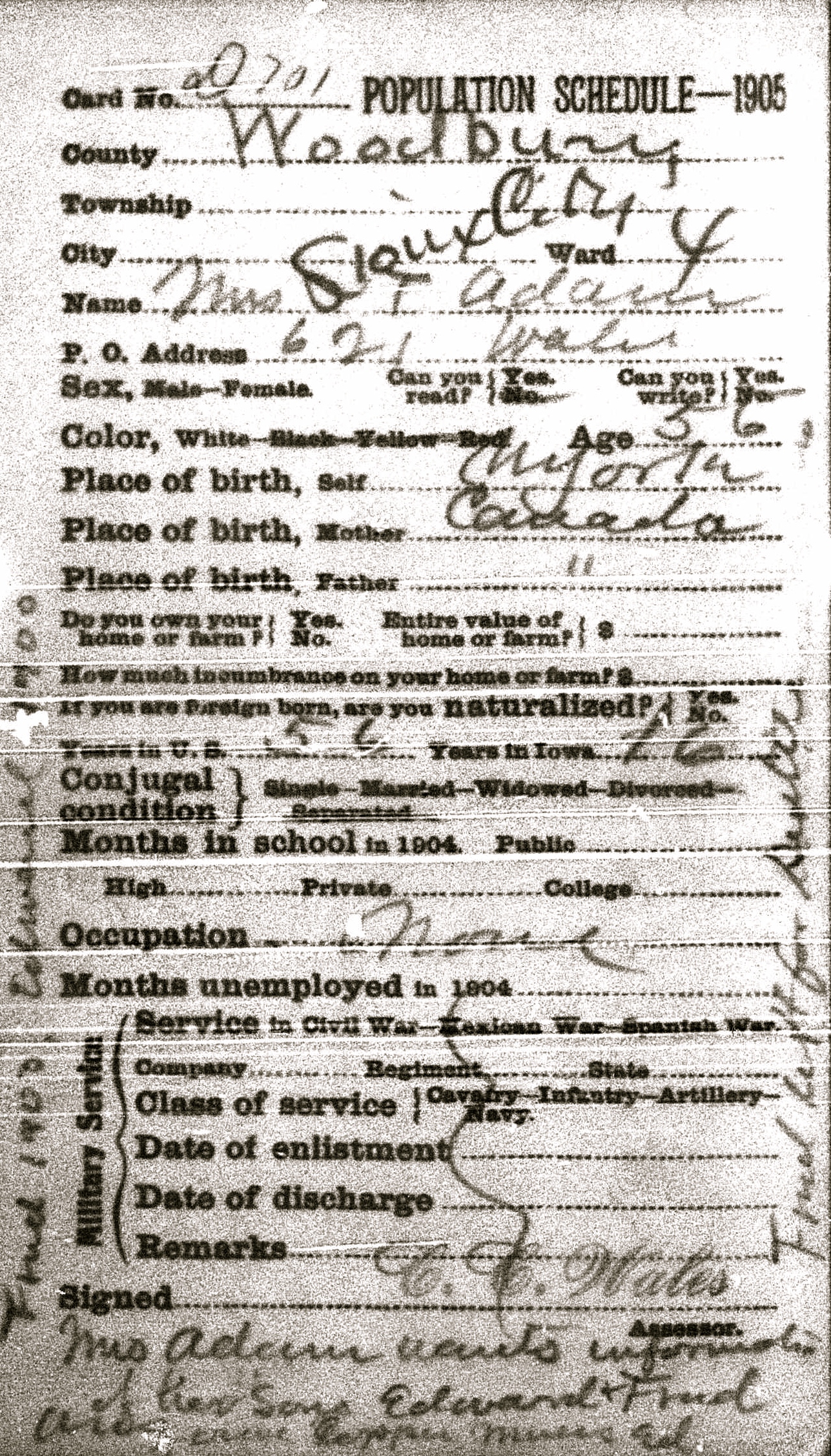
When the census enumerator arrived at the door of her home in Sioux City, Woodbury, Iowa, Odile (Millette) Adam saw in him a reason to hope. Here was someone who surely knew a thing or two about tracking people down. If nothing else, perhaps he could ask around? Had anyone seen her sons, Edward and Fred? The census enumerator strayed from the lines gathering information about Odile’s age, address, and origin, and jotted some hasty notes in the margins:

“Mrs. Adam wants information of her sons Edward and Fred. […] copper mines Ed. Fred left for Seattle. Fred 1903. Edward 1900.”1

Odile Adam 1905

“Iowa, State Census, 1905,” Sioux City, Woodbury County, Iowa, O.T. Adam [Mrs. T. Adam]; digital images, FamilySearch (http://www.familysearch.org : accessed 08 October 2014).

Although some words are indistinct (can anyone make out what it says?), the message is clear: The Adam boys had made their way west, and, whether dead or alive, they had disappeared without a trace. There may not have been much of anything that the census enumerator could have done, save for keeping his eyes and ears open in case the men turned up around town, but at the very least, he appears to have been sympathetic to Odile’s concerns.

Fred, also known as Alfred G. Adam, would eventually return to Sioux City, though perhaps not for a few more years; records suggest he returned to the area around 1909.2 Of Edward Adam, however, there seems to be no paper trail. In the summer of 1900, the Sioux City Journal reported that the then twenty-nine-year-old Edward, who had left home at the age of fourteen, had returned to his family, but his behavior towards them was “abusive, inconsiderate, and contemptuous.”3 His ailing father submitted a petition requesting a restraining order against him in order to protect himself as well as his minor children, and Edward, at least under his given name, is seemingly absent from record thereafter.4

Odile’s apparent distress according to the 1905 Iowa State Census is made more interesting by the fact that her husband of nearly forty years, Timothy Adam, was not recorded as a member of her household.5 Was he away searching for their sons, or was he simply visiting relatives across the state line in South Dakota or in his native Massachusetts? Was he aware that Odile was seeking word of their sons, or had he washed his hands of them? We may never know, just as Odile may never have learned the fate of her two eldest surviving sons before her death late the following year.6

The 1905 Iowa State Census images are available for free on FamilySearch. Even if there aren’t any notes written in the margins, you can learn a great deal about an ancestor from the details that were formally requested, including military status, level of education, and number of years as a resident of the state. If you would like to know who lived in the same household as your ancestor before turning to the individual cards, see the index available in the Iowa State Census Collection on Ancestry.com.

Continue reading

A Golden Anniversary Celebration

One warm afternoon during the summer of 1902, a crowd gathered at the home of local pioneers Niels and Juliane Sophie (Hennike) Olsen. The couple, who had retired from farm life several years before, was celebrating fifty years of marriage, and all of their children and grandchildren were invited to their home located near the center of town at 605 Broadway in Yankton, South Dakota.1 The event was surely a memorable affair, and the local newspaper gave a glowing report of the afternoon’s activities:

Mr. and Mrs. Nels Olson celebrated their golden wedding yesterday afternoon at their home on Broadway. All their children, eight in number, were present with their families. Their names are as follows; Ole Nelson, Mission Hill; John Nelson, Viborg; Christ Nelson, Lakeport; Fred Nelson, Lakeport; Mrs. J. Nissen, Yankton; Mrs. C. Calleson, Yankton; and Miss Helena Nelson, Yankton. Rev. C.K. Solberg spoke a few words appropriate to the occasion and presented to the venerable couple two fine presents from the children, a gold headed cane to “father” and pair of gold glasses to “mother.” The “old folks” came from Denmark in 1874 and made their first home in America near Lakeport, S.D. Eight years ago they moved to Yankton, their present home. They are in fairly good health and enjoy comfort and happiness surrounded by kind children.2

Niels Olsen and Juliane Sophie Hennecke had married in Haraldsted, Soro, Denmark, on 30 July 1852.3 For the first twenty-two years of their married life, they resided in Denmark; their twenty-second anniversary, however, was spent aboard ship as they ventured to America.4 Their years since had been spent in southeastern South Dakota, where they claimed a homestead and where Niels had recently served a term as a rural postmaster. All eight of their surviving children remained in the area, and to commemorate their fiftieth anniversary, an informal group photograph was arranged on the porch of their home beneath the shade of several large trees.

Olsen Golden Anniversary

Olsen Golden Anniversary, Yankton, South Dakota, July 1902; digital image 2010, privately held by Melanie Frick, 2014.

The couple of honor is seated near the center, surrounded by those in attendance. Niels wears a wool three-piece suit and tie, as do most of the men, while Juliane wears a patterned shirtwaist with a bow at the neckline. Patterned, striped, or light-colored cotton fabrics seem to be popular choices among the women for their summertime wear. The adults, including the couple’s children, sit or stand in two rows, and three infants are perched on laps. Nine young grandchildren – including four sisters in matching dresses – cram together in the front, sitting cross-legged on the wooden plank floorboards. The group is relaxed; there are a few smiles, several women cross their arms comfortably, and a few maternal faces are turned away from the camera, intent on minding the couple’s many grandchildren.

I have to hope that this well-dressed crowd had the opportunity to partake in some refreshing lemonade in honor of the occasion!

In the back row, from left to right, are Reverend Solberg, Mrs. Solberg, Harry Nissen, Fred Nelson, Ole Nielsen, Harry Nielsen, John Nielsen, Eric Boysen, unknown, and Chris Callesen. In the middle row, from left to right, are unknown, Dora Nissen, Cleora Nielsen, Hannah Nielsen, Stena Callesen, Cecilia Boysen, J. Chris Nelson, Niels Olsen, Juliana Olsen, Helena Olsen, Jennie Nelson, Edith Nelson (child), Christine Nelson, and Helen Nelson (child). In the front row, from left to right, are Robert Nelson, Anna Nelson, Louise Nelson, Andrea Nelson, Julia Nelson, Bessie Nelson, Ole Nelson, Alvin Nielsen, and George Boysen.5

Continue reading