Tag Archives: 1860s

A Farewell to Canada

Timothée Adam was only a year old when he lost his father. Born to Charles Pierre Adam and Marie Marguerite Saint Michel on 02 April 1816 in Beloeil, Quebec, he was baptized as Joseph Timothée Adam and was the seventh of eight children born to the couple; his younger sister was born just two weeks after their father’s death in August of 1817. Their mother, who had married at sixteen, was now a widow at the age of thirty, and considering how many small mouths she had to feed, it is not at all surprising that she remarried the following summer.

Although little is known about Marie Marguerite’s second husband, Louis Amable Pineau, after several generations had passed an oral tradition remained that the surname Pineau was somehow linked to the Adam line. Marie Marguerite had no children with Louis, who was ten years her junior, but he was the only father that the youngest of her children would have ever known. Her children would also have known her parents, their grandparents Joseph Michel and Marie Josephe Patenaude, as they spent their later years living in the same parish as Marie Marguerite and her family. Perhaps Joseph, who was born in exile in Massachusetts in 1757 following Le Grand Dérangement, the tragic expulsion of the French-speaking Acadians of Nova Scotia by the British, shared stories of his origins and the family’s eventual return to Canada—or perhaps not.

Timothée married Marguerite Chicoine in Saint-Marc-sur-Richelieu, a village just north of Beloeil on the Richelieu River, on 24 October 1837, when he was twenty-one. The couple then moved approximately thirty miles east to the village of Saint-Pie, where Timothée supported his family as a cultivateur, or farmer. The couple’s first ten children (of an eventual sixteen) were born in Saint-Pie, and the family appeared in the census there in 1851. It was noted that they resided in a one-level home made of wood, although interestingly, not all of their children lived within their household. Two of their daughters, who were eight and two, were found with their grandmother in another household in the same community, although perhaps this was only a temporary arrangement.

A decade later, at the time of the 1861 census, Timothée and Marguerite shared their household with all of their minor children, while their two eldest daughters, both married and with children of their own, were enumerated directly before them in the census. All were recorded as residents of Rang Saint-Charles, a rural road that runs southeast of Saint-Pie and south of the Noire River. This was not far from Saint-Paul-d’Abbotsford, where several of their younger children were baptized.

View of Mont Yamaska from Grand Rang Saint-Charles, Saint-Pie, Quebec

By June of 1865, Timothée had relocated with his family to Massachusetts. One has to wonder whether he recognized the irony in returning to the same place where his grandfather had been born in exile—but what drew him and his family to Massachusetts, a little more than a century after Le Grand Dérangement, was almost certainly the cotton mills. Contemporary news accounts referenced, sometimes scathingly, the “hordes of French Canadians” who traveled by rail from the border crossing at St. Alban’s, Vermont, to Massachusetts, where entire families crowded into tenements and worked at the mills. Indeed, the 1865 Massachusetts State Census places Timothée, Marguerite, and their ten unmarried children, who were between the ages of three and twenty-one, in Ward 8 of Springfield, Hampden County, Massachusetts, where Timothée and the five eldest children were all employed at the Indian Orchard mill.

There may have been another driving factor that caused Timothée to uproot his entire family, however, and that was the potential threat of a military draft in Canada and associated unrest that presumably might have affected his eldest sons. A Massachusetts newspaper printed the following in January 1865: “There is quite a little rebellion in Canada now, and all about a militia draft for frontier service. The French Canadians at Quebec resisted the draft made upon them last week and drove away the officers. Four companies of the volunteer militia were immediately called out and the insurrection will be a short lived one.”

By the time of the 1870 U.S. census, Timothée, by then fifty-four and with nine children still in his immediate household, continued to reside in Indian Orchard but was without an occupation. His six eldest unmarried children, who were between the ages of twelve and twenty, were all millworkers, and their earnings no doubt supported the entire family. Incredibly, the grand total of individuals in Timothée and Marguerite’s multigenerational household, which included their married children and their own large families, numbered twenty-eight.

View of Springfield, Massachusetts on the Connecticut River,” ca. 1840-1845, Thomas Chambers (1808-1869); oil on canvas, private collection, photographed while on loan to the Metropolitan Museum of Art, New York, New York; Wikimedia Commons.

Tragedy struck in 1878, when Timothée first lost two grandsons who drowned while fishing in the Chicopee River, and then lost his wife of forty years when Marguerite succumbed to consumption at the age of sixty-two. Timothée did not appear in the 1880 U.S. census, but city directories indicate that he resided at 83 Main in Indian Orchard. His unmarried children, ranging in age from fourteen to thirty, were enumerated together on Main Street; perhaps Timothée’s absence was an accidental omission, or perhaps he was traveling at the time that the census was recorded. It is known that he ventured to Dakota Territory a short time later, as he was documented as a parishioner at St. Peter’s Parish in what is now Jefferson, Union County, South Dakota in 1885, along with two of his adult sons and their families. The recent deaths of several family members, including two of Timothée’s adult children and multiple young grandchildren, may have spurred this move away from crowded tenement life.

Timothée is absent from the Springfield, Massachusetts city directories of 1885-1895. He makes a reappearance in 1896, boarding at 69 Main, Indian Orchard; this was the home of his daughter, Marie, and her husband, Gabriel Noel. Had Timothée spent the intervening years with his children in the Midwest?

On 19 March 1897, a newspaper in Sioux City, Woodbury County, Iowa, printed the following: “T. Adams, father of P.P. Adams of Davidson Bros., died while visiting relatives at Indian Orchard, Mass., at the age of 84 years.” Timothée would have been, in fact, eighty years old at the time, but this was not the only misprint regarding his death.

The death register for the city of Springfield, Massachusetts, which encompassed Indian Orchard, does not have a record of the death of any individual by the name of Timothée Adam at that time—but it does name one “Mathieu A. Adam,” son of Pierre Adam of Canada, who was reportedly eighty years, ten months, and seventeen days at the time of his death on 09 March 1897.

The dates are close enough that they might be considered a mathematical error—Timothée would have reached the age of eighty years, eleven months, and seven days at the time of his death. His father’s middle name had been Pierre, and it’s quite possible that that is how he was more commonly known. But “Mathieu”? One guess is that entries on the death register were recorded based on other handwritten records or notes, and that a scrawled “Timothée” was mis-transcribed as “Mathieu,” another French name with a “th” in the middle. His cause of death was attributed to “Old age: Indigestion,” and Timothée’s grave, presumably near that of his wife at the Saint Aloysius Cemetery in Indian Orchard, is unmarked.

His will, filed in Springfield in March of 1896, a year prior to his death, is succinct in regards to his wishes and suggests that he may have spent extended time in the care of his second-eldest daughter Marie:

“After the payment of my just debts and funeral charges, I bequeath and devise as follows. First: To my daughter Mary Noel wife of Gabriel Noel of said Springfield, all the estate both real and personal of which I shall die seized and possessed and to which I shall be entitled at the time of my decease. I purposely give no bequest or devise in this will to my only living children, or the issue of any deceased child, having provided for them in my lifetime and I exclude them and their issue from any claim upon my estate of every nature and description. Second: I direct that my executrix hereinafter named expend the sum of Fifteen dollars for a high mass over my remains.”

Hampden County, Massachusetts Probate Records

So little is known of who Timothée Adam was as a person. He was a French Canadian by birth and an immigrant who may have faced contempt and discrimination in the United States due to his language, faith, and culture. He was a farmer and a millworker—but as his eldest surviving son was a carpenter, one can speculate that Timothée may also have possessed these skills. Two of his younger sons played the fiddle, and another sang; was Timothée musical as well? He was a lifelong Catholic, and desired that a portion of his (presumably not large) estate be set aside in order for him to receive a high mass upon his death. He was the father of sixteen known children, fourteen of whom survived to adulthood, and the names of his eldest sons suggest strong familial bonds: Timothée, Louis (like his stepfather), Joseph (like his maternal grandfather), Pierre (like his father and paternal grandfather). Notable too is the name of his youngest son, the only one of his children born outside of Canada: Prosper, named perhaps in recognition of Timothée’s hopes for his family to flourish in a new home.

Copyright © 2024 Melanie Frick. All Rights Reserved.

Continue reading

A Tale of Two Johns

There has been an assumption made in multiple online family trees that the John Fenton who was born in 1785 in Sturton-le-Steeple, Nottinghamshire, England and the John Fenton who died in 1881 in the Union Workhouse in Clarborough, Nottinghamshire, England were one and the same.

However, when I considered the details, something didn’t quite seem to add up.

The John Fenton who was baptized on 06 May 1785 in Sturton-le-Steeple, the son of Benjamin and Zillah (Williamson) Fenton, had married Sarah Halcon in Bole, Nottinghamshire, England, in 1809. They had eight children together and spent their married life in Bole, where John was a shoemaker, or cordwainer. John and Sarah can be found there in the 1841 England Census; Sarah died as a result of “Bilious Complaint” in 1843, but John was still the head of a household in Bole at the time of the 1851 England Census, when he lived with his second eldest son, Isaac. Two years later, Isaac married, and in the 1861 England Census, John can be found living with Isaac and his family at the Brandywharf Public House of Waddingham, Lincolnshire, England.

Photograph of the Cordwainer Statue on Watling Street in the Cordwainer Ward of the City of London; Wikimedia Commons, copyright Alma Boyes, 2007.

This is where accounts of John’s following years diverge. While some initially attributed records of a John Fenton who appears with wife Ann in the poorhouse of Clarborough, Nottinghamshire, England in 1871 and 1881 to the aforementioned John, the 1861 England Census makes evident that these were in fact two different men. At the same time that our widowed John Fenton, seventy-five, a retired cordwainer and native of Bole, was a resident of Waddingham, Lincolnshire, England, another John Fenton, sixty-seven, a woodman and native of South Leverton, lived with his wife, Ann, in Treswell, Nottinghamshire, England.

With confirmation of two John Fentons in two nearby places at the same time, and spurred by the recent release of the General Register Office for England and Wales’ digital image collection, I decided to search for any John Fentons who may have died in Waddingham or in Gainsborough—where Isaac Fenton resided as of 1871, his father no longer a member of his household—between 1861-1871. And, in short order, a record was located:

“England and Wales Death Registration Record,” John Fenton, 27 July 1862, death, Gainsborough, Lincolnshire; digital image, General Register Office for England and Wales (https://www.gro.gov.uk/gro/content/certificates/indexes_search.asp : accessed 08 July 2023), citing HM Passport Office.

Our John Fenton died on 27 July 1862 at Nottingham Place in Gainsborough, Lincolnshire, England, presumably at the home of his son, with whom he had resided in nearby Waddingham the previous year. Nottingham Place was what was known as a yard, or tenement housing, located near the banks of the River Trent. The death register noted that John had been seventy-seven years of age, that he was “Formerly a Cordwainer,” and that his death was a result of bronchitis. Present at his death was Frances Fenton; she was John’s daughter-in-law who had presumably cared for him throughout his last sickness.

This all makes much more logical sense than had our John Fenton died at the age of ninety-six—which would have been quite a feat for someone living in a poorhouse whom one can only assume was not receiving the best of care. Indeed, the idea that our John would have been in a poorhouse at all seemed suspect given his decades-long career as a shoemaker and his having at least one adult child who, as evidenced by the census, was able to take him in under his roof as necessary in his later years.

John in fact had three surviving children in England at the time of his death, and it is possible that he rotated between households in his later years. Five of his eight children preceded him in death, although one by a matter of mere weeks: his eldest son, John (Jr.), the only one of his children to emigrate from England, succumbed to typhoid fever while serving in the Union Cavalry in the American Civil War on 07 June 1862. It seems likely that John Fenton died unaware of his son’s fate.

Copyright © 2023 Melanie Frick. All Rights Reserved.

Continue reading

A Full House in a Mill Town

By the time of the 1870 U.S. census, French Canadians Timothée and Marguerite (Chicoine) Adam, both fifty-four years old, had lived in America for approximately five years. Along with their children, who ranged in age from toddlerhood to young adulthood, they had settled among fellow French-speaking immigrants in Springfield, Hampden County, Massachusetts. Their neighborhood, Indian Orchard, boasted a booming cotton mill on the banks of the Chicopee River. This would certainly have been a different environment than they had been accustomed to in the quiet village of Saint-Pie, Quebec where, for the first twenty-five years of their marriage, Timothée had been a farmer and Marguerite had raised more than a dozen children in their humble home. Their move from rural to comparatively urban was certain to have been full of adjustments, but what may be the most striking about their lives in the year 1870 is the impressive number of people with whom they shared one roof: twenty-eight, to be exact.

Their household had grown substantially from their first appearance in the Massachusetts state census in 1865; then, Timothée, who was employed at the mill, headed a household that numbered thirteen, including ten children and one boarder. In 1870, the twenty eight residents, all related, were in fact divided among four households within a single dwelling unit, presumably a tenement block. First recorded was the household headed by Timothée and Marguerite Adam themselves, which included nine of their children—those nine ranging in age from twenty-two down to three. Then came the households of three of their married daughters. The household of Leon and Julienne (Adam) Gay was first; they were the parents of one child. The household of Joseph and Marie (Adam) Noel and their five children was next, and last was that of Jean Baptiste and Marguerite (Adam) Gendreau and their five children.

Although Timothée himself was without an occupation at this time, and Marguerite kept house, nine other members of the combined households worked at the mill. Four of those nine millworkers were under the age of sixteen: Jean Adam was fourteen, Elisa Adam was twelve, Jean Gendreau was twelve, and Euclide Gendreau was eleven. Six children between the ages of six and eleven were at school, and six children between the ages of one and four were at home in the care of their mothers.

Many of Timothée and Marguerite’s children, grandchildren, and even great grandchildren would spend the decades to come employed in the Indian Orchard mill. It was not an easy life; in the years following the 1870 census, several members of the family would succumb to tuberculosis and other respiratory illnesses common among millworkers of the day, who often worked in dismal conditions with poor ventilation and were plagued by both communicable diseases and cotton lint.

“Clarence Noel, 138 Main St., Indian Orchard. Doffer in Hodges Fibre Carpet Co. of Indian Orchard Mfg. Co.,” September 1911, Prints & Photographs Online Catalog, Prints & Photographs Reading Room, Library of Congress, Washington, D.C. (https://www.loc.gov/pictures/item/2018676653/ : accessed 08 January 2023).
“Alfred Gengreau [Gendreau], 20 Beaudry St., Joseph Miner, 15 Water St. Both work in Mr. Baker’s room, Indian Orchard Mill,” September 1911, Prints & Photographs Online Catalog, Prints & Photographs Reading Room, Library of Congress, Washington, D.C. (https://www.loc.gov/pictures/item/2018676654/ : accessed 08 January 2023).

Notably, at least two of the couple’s great-grandchildren appear to have been photographed by famed muckraker Lewis Hine, who documented the plight of child laborers in the early twentieth century and whose work was instrumental in child labor reform. Clarence Noel, fifteen, grandson of Timothée and Marguerite’s daughter Marie (Adam) Noel, and Alfred Gendreau, thirteen, grandson of their daughter Marguerite (Adam) Gendreau, were both photographed outside their workplace in September of 1911. Clarence, Hine noted, worked as a doffer and said that he had “made seven dollars last week.” Alfred, who posed with another boy, was said to “work in Mr. Baker’s room, Indian Orchard Mill.”

These boys were not by any means among the youngest of the child laborers that Hine photographed, nor did they work in the most arduous conditions, but still their images are striking. In their knickers and caps, both slight of build, Clarence and Alfred look every bit like schoolboys, although the mill—to which four generations of their family had now been tied—loomed large in the background. Their school days behind them, it was time for the boys to work to support their families.

Copyright © 2023 Melanie Frick. All Rights Reserved.

Continue reading

The Soldier’s Orphans

When Union soldier John Fenton was laid to rest in the summer of 1862, one of hundreds of thousands of soldiers to succumb to infectious disease during the Civil War, he left four orphaned children: Sarah Alice, eighteen; Harriet, seventeen; John Albert, fourteen; and George W., ten.

The Fenton family had emigrated from England to America circa 1848-49, and had settled first in Ohio. That is where John’s wife, Ann (Bowskill) Fenton, died at some point between 1852-59. John and his children then moved to an area known as Buckeye Prairie near Pana, Christian County, Illinois, and in 1861, at the age of forty-six, John volunteered for Company M of the 3rd Illinois U.S. Cavalry. His children were thus left without a parent to look after them—first temporarily, and then permanently.

“Battle of Pea Ridge, Arkansas March 8th 1862,” Prints & Photographs Online Catalog, Prints & Photographs Reading Room, Library of Congress, Washington, D.C. (http://www.loc.gov/pictures/item/90709337 : accessed 25 July 2022). John Fenton of Company M of the 3rd Illinois U.S. Cavalry saw action at the Battle of Pea Ridge.

What became of the children? There is some indication that they may have resided with the family of James and Eliza Tylar during John’s absence at war; one daughter was a domestic in their household as of 1860, and at the time of John’s death in 1862, a hospital steward wrote a letter expressing John’s desire that his children give his best wishes “to Mr. Tylar and others that I have forgotten their names.” It seems perhaps more likely, however, that the children may have been hired out to different households when John enlisted, and it is unknown how their living situations may have changed when word was received of his death.

Sarah Alice Fenton, who was known as Sallie, married in 1863 to Frederick Augustus Stockbridge, a widowed farmer fifteen years her senior. Together they had six children: Clara Violet, Nellie Jane, Elva Cecelia, Chester Foote, Emily Grace, and Frederick Fenton Stockbridge. Sarah’s eldest daughter, Clara, became the wife of Baptist minister Reverend Henry Stills Black, and with him traveled west. While in northern Idaho’s Silver Valley, Clara became acquainted with a photographer who was in need of an assistant, and she recommended her younger sister, Nellie, for the job. Nellie ultimately spent the next six decades as a photographer in Wallace, Idaho, with her work—now held by the University of Idaho, and also on display at the Barnard-Stockbridge Museum—providing a rich historical record of the area. Sarah did not settle in Idaho herself, nor did she follow her daughter Elva to Oklahoma, her daughter Emily to Oregon, or her son Chester to eastern Washington; she remained in Pana for most of her adult life. Eventually, however, some years after she was widowed, she moved to western Washington state to live with her youngest son, Frederick, and she died in Tacoma in 1927 at the age of eighty-three.

Harriet Fenton, or Hattie, as she was called, never married. She lived out her life in Pana, where she spent some time supporting herself as a domestic servant and as a dressmaker before moving in with her sister’s family. By 1887, she was known to be suffering from breast cancer, and in 1893, at the age of forty-eight, she passed away as a result of what the local newspaper called “petrifying cancer.” Newspapers far and wide printed this fact, stating briefly and without further detail, “A large portion of her body was completely petrified.”

John Albert Fenton followed in his father’s footsteps and joined the Union army in 1864 at the age of sixteen—although he claimed to be eighteen. He served in Company H of the 61st Illinois Infantry, survived the war, and in 1874, married Ella Elvira Cogan in Parke County, Indiana. They had four children, two of whom survived to adulthood: Harry Cogan and Anna A. Fenton. Harry, notably, graduated from Wabash College and became a reporter, working for the Indianapolis News as well as the Associated Press in Washington, D.C. He then served as secretary to Indiana Governor Warren T. McCray and became further involved in Indiana politics, eventually serving on the state’s alcoholic beverages commission. Anna married in and lived out her life in Indiana. As for John himself, he worked for many years as a teamster and then as a foreman at a Crawfordsville, Indiana brick factory before his death in 1919 at the age of seventy-one.

George W. Fenton, the youngest of the four, left Illinois in 1871 at the age of nineteen, having likely spent most of his teenage years as a farm laborer. In the company of two other ambitious young men, he made his way to Saline County, Kansas, where he settled in 1872. The following year, he married sixteen-year-old Sarah Ellen Hall, and they had three daughters: Minnie Belle, Alpha, and Anna Leota Fenton. All three went on to marry and have children of their own, ultimately settling in Minnesota, Colorado, and Iowa, respectively. George, however, faced an untimely end when he was accidentally shot and killed by his brother-in-law in 1880 at the age of twenty-eight.

Did the eleven far-flung grandchildren of John Fenton ever meet? It seems doubtful. The cousins were likely aware of each other, at least at one point; when John’s surviving children pursued a military pension in 1887, documentation was required regarding the names and ages of his children and, as George was deceased, the names and ages of George’s children as well. Within the pension file is a letter that Sarah’s teenage daughter Elva penned in response to a request for information, which noted, “Uncle George was born in Monroe Falls Ohio and died at in Saline Co. Kansas Oct. 10 1880. We have no record of his children’s age and the letter which had them in is lost. As near as we can remember Minnie will be 12 next June Alpha 10 next March and Leota 8 next Feb.” In the years to come, however, as the families of John’s children and grandchildren became even more geographically dispersed, further contact may well have ceased.

Copyright © 2022 Melanie Frick. All Rights Reserved.

Continue reading

Tombstone Tuesday: Wilhelm Heinrich Thoma (1827-1876)

Wilhelm Heinrich Thoma was born on 16 December 1827 in the village of Weißenstadt, located in what is now Upper Franconia, Bavaria, Germany, the son of Paulus and Elisabeth (Schmidt) Thoma. At the age of twenty-four, Wilhelm, along with his parents and six siblings, immigrated to America. Traveling aboard the Uhland, the family left Bremen bound for New Orleans, where they arrived in June 1852.

New Orleans was not to be their final destination; the family traveled up the Mississippi River until reaching northeastern Iowa, where they soon settled in the village of Garnavillo in Clayton County. A biography within The History of Clayton County, Iowa notes, “Upon coming to the United States, William Thoma proved himself an ambitious young man whose courage and determination were shown in definite action.”

On 28 May 1857, when Wilhelm, also known as William, was twenty-nine years old, he married eighteen-year-old Anna Margaretha Poesch, a fellow immigrant who also hailed from Weißenstadt. The couple had eleven known children: Frederick (1857-1925), Anna Katharina (1859-1919), John Lorenz (1861-1886), Anna Rosina (1862-1934), Margaretha B. (1864-1902), John Wilhelm (1866-1890), John Paulus (1868-1911), Anna Paulina (1869-1950), Maria Magdelena (1872-1954), John Christopher (1874-1934), and John Charles Thoma (1875-1932).

Find A Grave, Inc., Find A Grave, digital image (www.findagrave.com : accessed 25 July 2020), photograph, Wilhelm H. Thoma (1827-1876), Memorial No. 146616631, Garnavillo Community Cemetery, Garnavillo, Clayton County, Iowa; photograph by Ken Johnson, 2016.

Wilhelm first entered the mercantile business while in his twenties, shortly after arriving in Iowa. In 1859, he established his own general store in Garnavillo, offering groceries and dry goods, which he operated until the time of his death. It was said at that time that “in his personal and business relations with the people he was the ‘soul of honor,’ a good, honest, straight forward man.”

Wilhelm was active in his community throughout his adulthood; his obituary noted, “In public matters Mr. Thoma has taken a lively interest, and exhibited a degree of earnest zeal in the advancement of his fellow countrymen, enjoying their confidence and support. He has held minor offices of trust, discharging the duties thereof satisfactory to the people.” One incident of note is that during the grasshopper plague of 1874, following an appeal from Kossuth County, Iowa, Wilhelm’s name was included among a list of individuals “designated to receive contributions for the grasshopper sufferers.” Furthermore, William was a member of the county Board of Supervisors at the time of his death, an office he was said to have held in “a most excellent and upright” manner.

Wilhelm Heinrich Thoma died in Garnavillo on 27 July 1876; he was forty-eight years old. Lengthy obituaries in multiple local newspapers did not share the cause of his death, but lauded his talents, one noting that he had “been counted among Clayton County’s best and most public spirited citizens,” and that “his own village loses a citizen whom it was equally a pleasure and honor to name as a friend.” Another commented upon his wealth and prominence, and called him “a man universally honored and beloved where known.” Wilhelm was buried at the Garnavillo City Cemetery in Garnavillo, Clayton County, Iowa.

Copyright © 2020 Melanie Frick. All Rights Reserved.

Continue reading

The Olsens in the Old Country

Niels Olsen and Juliane Sophie Hennike spent the first twenty-two years of their married life in their native Denmark before venturing together to America.

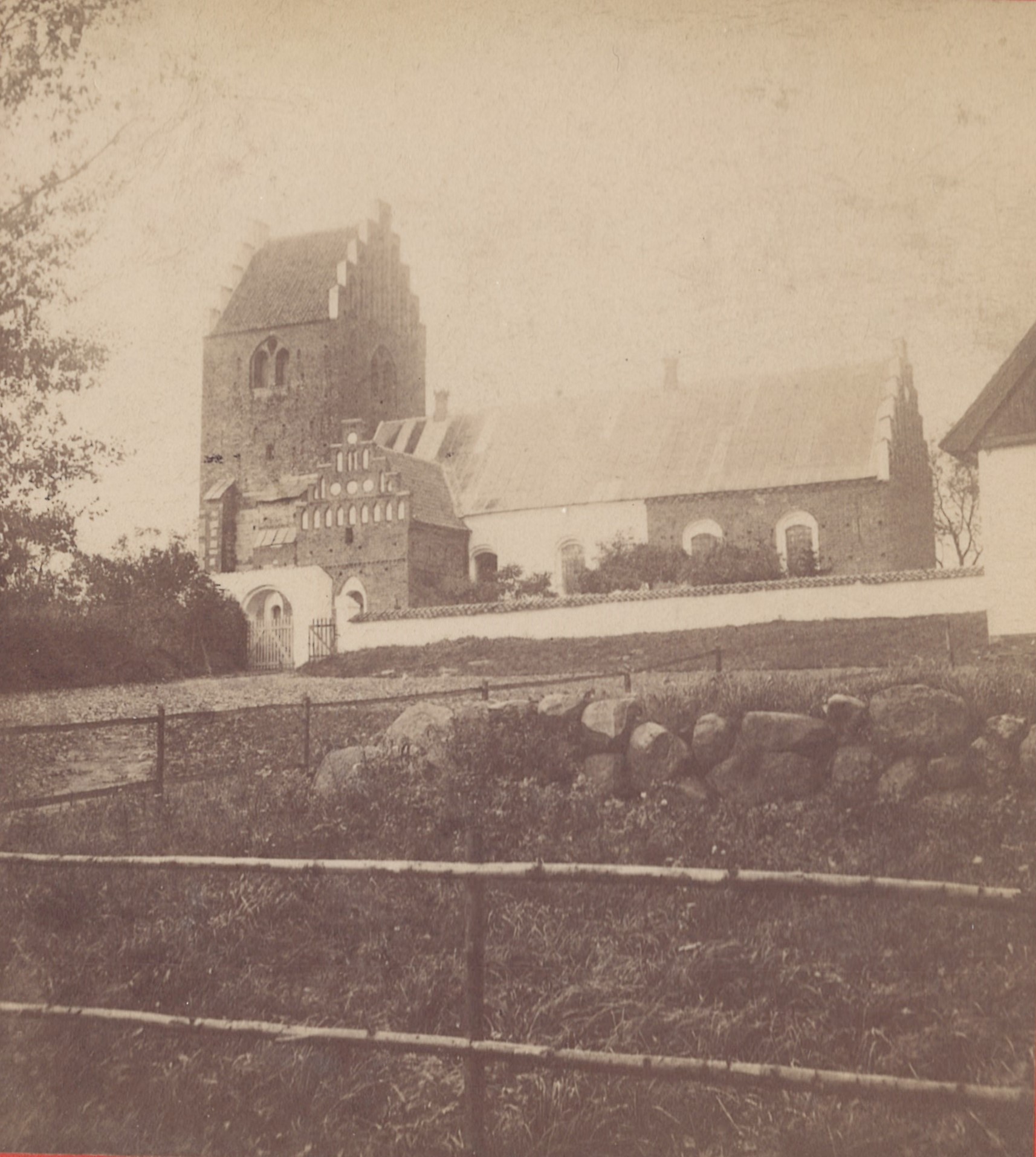
They had married on 30 July 1852 in Haraldsted, Soro, Denmark. A nineteenth-century stereoscope image of what appears to be the church at Haraldsted was handed down through descendants of their second son, along with a stereoscope image that preserves the view of the village itself.

Haraldsted, Soro, Denmark, 1800s; digital image 2019, privately held by Stevan Worley.

The couple resided in Osted, ten miles or so northeast of Haraldsted, in the early years of their marriage; this is where their sons Ole and Johan Henrik were born and baptized in 1853 and 1855. Niels, Juliane, and Ole appeared in the 1855 census here with two servants in their household, prior to the birth of Johan Henrik. Niels was a farmer.

The family relocated to the Orslevvester district five miles southwest of Haraldsted, near the village of Gyrstinge, within a year or two. Here their children Karen Sophia Dorthea, Karen Kirstine, Sesilie Johanne, Frederik, Anders Christian, Jens Christian, and Anders Julius were born and baptized between the years 1857 and 1871.

Haraldsted, Soro, Denmark, 1800s; digital image 2019, privately held by Stevan Worley.

The 1860 and 1870 Danish census records raise questions about the family’s living situation. In 1860, Niels and Juliane, by then the parents of three children, lived only with their youngest child at the time, daughter Karen Sophie Dorthea, age three. Where were their sons Ole and Johan Henrik? Ole, age seven, lived in Osted with his maternal grandmother. Johan Henrik’s location is less clear, but a census index indicates that a “Jens” Nielsen, age four, born in Osted, was a “foster child” in Jyrstup, located roughly between Osted and Orslevvester.

Although it seems odd that the Ole and Johan would not have lived in their parents’ household, it should be noted that Juliane was in the late stages of pregnancy in early 1860. One could speculate that she might have been unwell and therefore her older children were placed with relatives or friends for a temporary period.

There was no census in 1865 to give an idea of the family’s household structure, but in 1870, Niels and Juliane continued to reside in Orslevvester with five of their seven surviving children: Johan Henrik, Karen Kristine, Sesilie Johanne, Frederick, and Jens Christian.

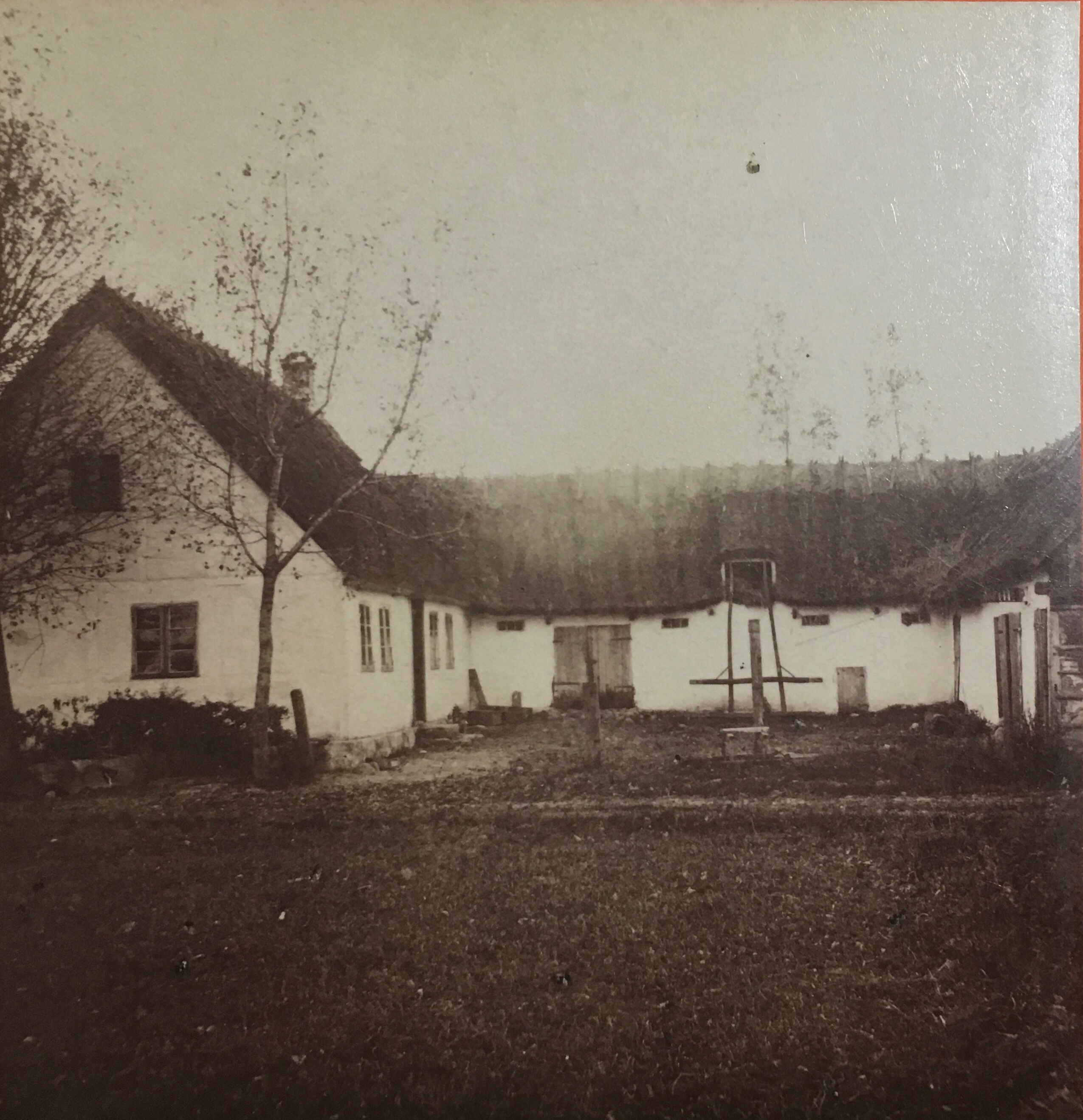
Olsen Family Home, Soro, Denmark, 1800s; digital image 2019, privately held by Stevan Worley.

Their oldest son Ole, sixteen, and oldest daughter Karen Sophie Dorthea, twelve, resided in a household in Haraldsted where they were recorded as foster children. Three servants, ages sixteen, eighteen, and twenty also resided in the household, so it is notable that their statuses differed from those of Ole and Dorthea; however, the sixteen-year-old servant was female, and one possible theory is that males might not have been considered to be grown men and therefore actual servants until an older age. It seems plausible that the brother and sister may have worked in exchange for room and board, if not yet for a wage; whether they had left their family home for work experience or due to space constraints or poverty is unknown.

In any case, a nineteenth-century stereoscope image of what is believed to have been the family home, presumably in Orslevvester, has also been preserved by descendants. It appears to be an example of a u-shaped housebarn, a practical structure that connects the barn and the house and allows for protection from the elements in a cold climate.

In 1873, sons Ole and Johan Henrik immigrated to America, and in 1874, Niels, Juliane, and their six younger children, namely Karen Sophie Dorthea, Karen Kristine, Sesilie Johanne, Frederick, Jens Christian, and Anders Julius, followed. Their youngest child, Helena, would be born in Dakota Territory in 1875.

Family lore indicates that Niels purchased his farm near present-day Yankton, South Dakota for five hundred dollars; perhaps the sale of the family home in Denmark allowed him to make this cash purchase of good farmland at a time when many other immigrants opted to homestead for a nominal filing fee.

Niels and Juliane made a comfortable life for themselves and their children in America—and it can easily be imagined that they may have gathered around a stereoscope from time to time to view these very images and reminisce about their old home in Denmark.

Copyright © 2020 Melanie Frick. All Rights Reserved.

Continue reading
Pomeranian Roots

For decades, the precise origins of German-speaking immigrants Joachim and Sophia (Cammin) Wiese of Chicago, Cook County, Illinois were forgotten.1

There were clues: a scrawled place name on the Hamburg Passagierlisten, an intriguing DNA connection.2

Finally, a dedicated on-site researcher uncovered several records that definitively placed Joachim and Sophia within the arms of their families in the neighboring villages of Wendisch Baggendorf and Barkow, located in present-day Vorpommern-Rügen, Mecklenburg-Vorpommern, Germany.3

Joachim, christened Joachim Christian Friedrich Wiese, was born on 20 October 1840 in Wendisch Baggendorf, the son of laborer Johann Adam Wiese and Beate Elisabeth Hanna Schult.4

Sophia, christened Catharina Sophia Joachime Cammin, was born on 07 November 1842 in Barkow, the daughter of laborer Johann Christian Cammin and Christina Dorothea Ahrends.5

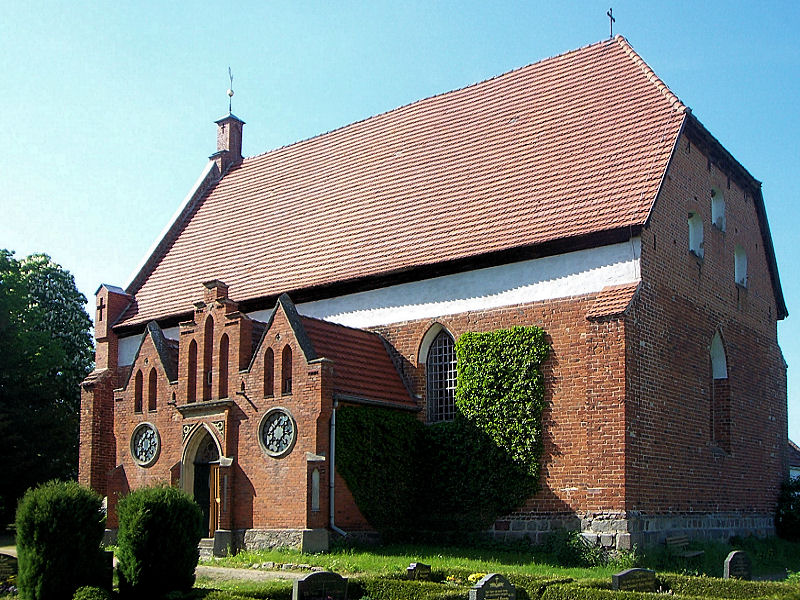
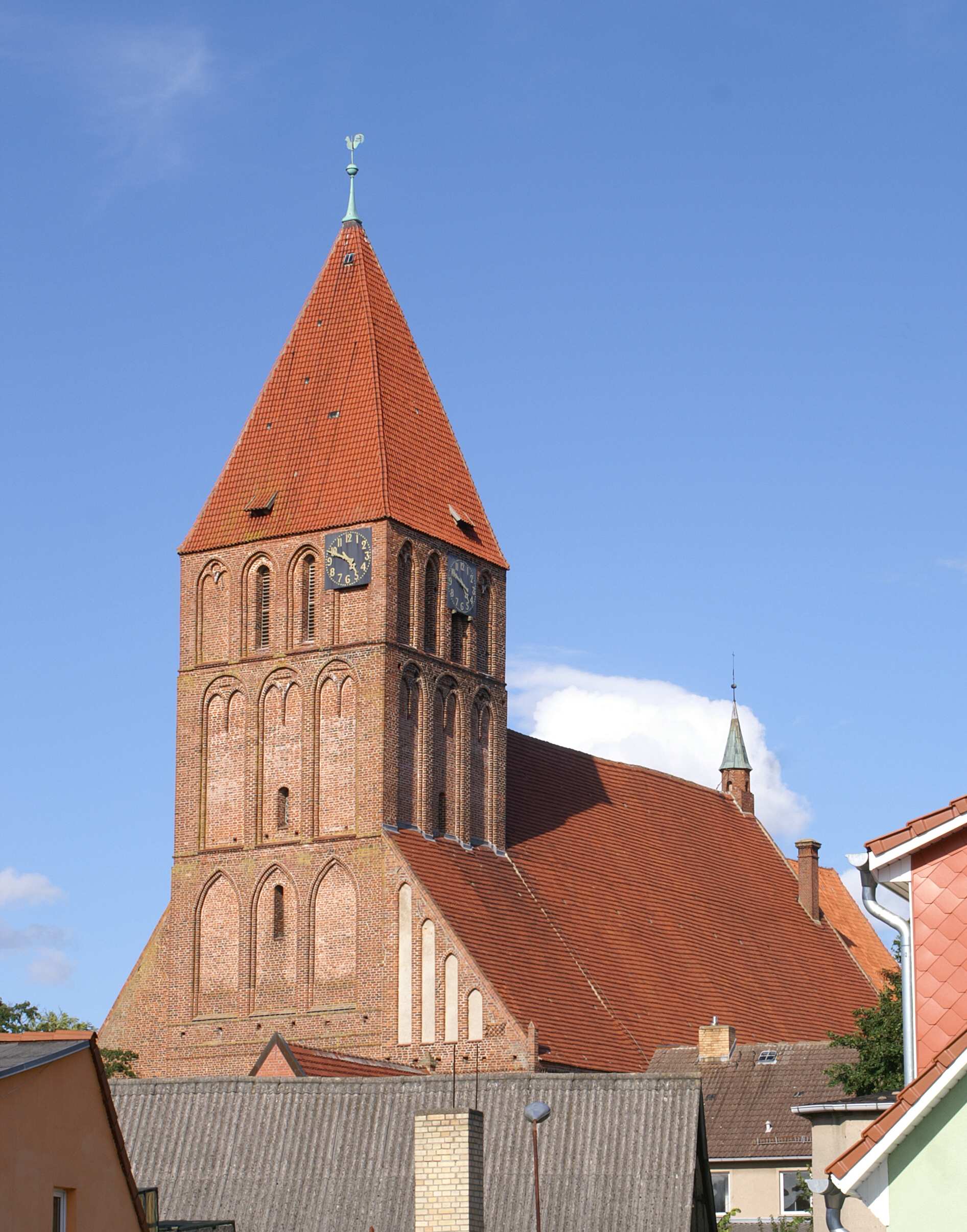
Joachim and Sophia married on 03 April 1864 in Grimmen, a village of perhaps a couple thousand inhabitants located a short distance from the state-owned estate at Barkow where Joachim was employed as a laborer.6 They were married by Carl Bindemann at St-Marien-Kirche, an early Gothic construction that dates to the thirteenth century.7

“St.-Marien-Kirche in Grimmen,” 2007, Grimmen, Mecklenburg-Vorpommern, Germany; Wikimedia Commons, copyright Erell.

The couple’s first child, christened Carl Christian Friedrich Wiese, was born later that year on 17 September 1864.8 He did not survive childhood.9 Their second child, christened Friedrich Carl Christian Wiese, was born on 22 August 1866.10

When they prepared to board the Electric at Hamburg in November of 1868, however, Joachim and Sophia stated that their two-year-old son, nicknamed Fritz, was only nine months of age.11 It seems plausible that a free or reduced rate of passage might have been granted infants under one, and if the Wiese family did not happen to encounter a sympathetic ticketing agent, it can easily be imagined that Sophia might have bundled Fritz in a shawl close to her chest to conceal his true age until the family was safely aboard the ship.

Joachim and Sophia (Cammin) Wiese, ca. 1889, Chicago, Cook, Illinois; digital image ca. 2000.

Whatever the case, the Wiese family arrived in New York the day after Christmas 1868, after enduring a nearly eight week crossing during which time Sophia marked her twenty-sixth birthday.12 Among their fellow steerage passengers were several relatives, including Sophia’s widowed mother; Joachim’s widowed father came aboard a different ship.13 They soon made their way to Chicago, where they joined a wave of immigrants like themselves who contributed to the city’s unprecedented expansion.

It was there, during the years of regrowth that followed the Chicago Fire of 1871, that Joachim would work his way up to become a tailor, while Sophia would raise six children.14 And it was in Chicago that the Wiese family would face new struggles and new opportunities as they adapted to an urban environment vastly different from their rural homeland near the Baltic Sea.

Copyright © 2019 Melanie Frick. All Rights Reserved.

Continue reading

Johann Wiese and a DNA Connection

Johann Wiese of Mecklenburg-Vorpommern, Germany was sixty-five years old and a widower when he boarded the Borussia in Hamburg on 31 October 1868.1 He traveled with Caroline Wiese, twenty, as well as with a young man whom Caroline would marry within months of their arrival in America.2 All named Wendisch Baggendorf, a landed estate located near the town of Grimmen in Mecklenburg-Vorpommern, as their place of origin.3

Interestingly, one day later, several other Wieses departed from Hamburg: Carl Wiese, twenty-three, with his wife, both also of Wendisch Baggendorf, and Joachim Wiese, twenty-seven, with his wife and child.4 They resided in Barkow, an estate located near modern-day Klevenow, which is only a few miles from Wendisch Baggendorf.5 Both Carl and Joachim and their families traveled aboard the Electric, which, like the Borussia, was bound for New York.6

“Kirche in Kirche Baggendorf,” 2009, Kirche Baggendorf (near Wendisch Baggendorf), Mecklenburg-Vorpommern, Germany; Wikimedia Commons, copyright Klugschnacker.

I might not have noted the connection between the Wieses who left Hamburg for New York one day apart if it were not for spotting several interesting member matches within the AncestryDNA results for my grandmother, the great-granddaughter of Joachim Wiese. Each of these matches named Caroline Wiese as a direct ancestor, which led me to the ship manifest that revealed that Caroline had traveled with a Johann Wiese of an appropriate age to be her father; appropriate, too, that a father would accompany his yet-unmarried daughter overseas.

Caroline, as stated, married shortly after her arrival in America; she and Gustav Beth were wed on 10 January 1869 in Dundee, Kane County, Illinois.7 Carl and Joachim Wiese, on the other hand, both settled in Chicago’s 15th Ward with their families.8 While Johann Wiese has not been located in the 1870 or 1880 censuses, and does not appear in the households of Caroline, Carl, or Joachim, it is possible he was simply not counted in the census if, for example, he was en route to the home of another child and was missed by the census enumerator, or if a neighbor provided information about the family to the census enumerator and failed to mention him.

Cook County, Illinois, death certificate no. 28339, John Wiese; Cook County Clerk, Chicago.

Ultimately, it appears Johann Wiese spent the final fifteen years of his life in Illinois, although thus far little is known about how he spent those years.9 Similarly, little is known about his life in Pomerania; records note only that he was a laborer, and as serfdom was abolished in the area in 1820, he was perhaps contracted to work on an estate in Wendisch Baggendorf or the vicinity.10

According to his death record, he died on 02 August 1883 at 144 Newton Street in Chicago at the age of eighty.11 His death was attributed to old age.12 Intriguingly, Carl Wiese resided at this address, further strengthening the potential of a connection beyond their shared Wendisch Baggendorf origins and their emigration one day apart.13 It seems logical to assume that Johann Wiese might have been cared for in his last days by his son.

Johann Wiese is buried in Chicago’s Graceland Cemetery; today, while the location of his grave has been identified, it is unmarked.14

Copyright © 2017 Melanie Frick. All Rights Reserved.
Continue reading
A Marriage in Mecklenburg-Schwerin

Although more and more genealogical records are being digitized and made available online, images of German church books—those faded ledgers filled with seemingly indecipherable old script that record baptisms, marriages, and burials—are often few and far between. That’s why it was a cause for celebration when I discovered that the scope of Ancestry.com’s “Germany, Lutheran Baptisms, Marriages, and Burials, 1519-1969” encompassed the middle-of-nowhere German communities where a number of my ancestors lived and worshiped in the nineteenth century.

I knew something about the lives of Ernst and Friederike (Wegner) Stübe in America, where they had immigrated with their two-year-old daughter in 1869, but I had known little about their lives in the old country, the former Mecklenburg-Schwerin. Thanks to this record collection, I learned the following:

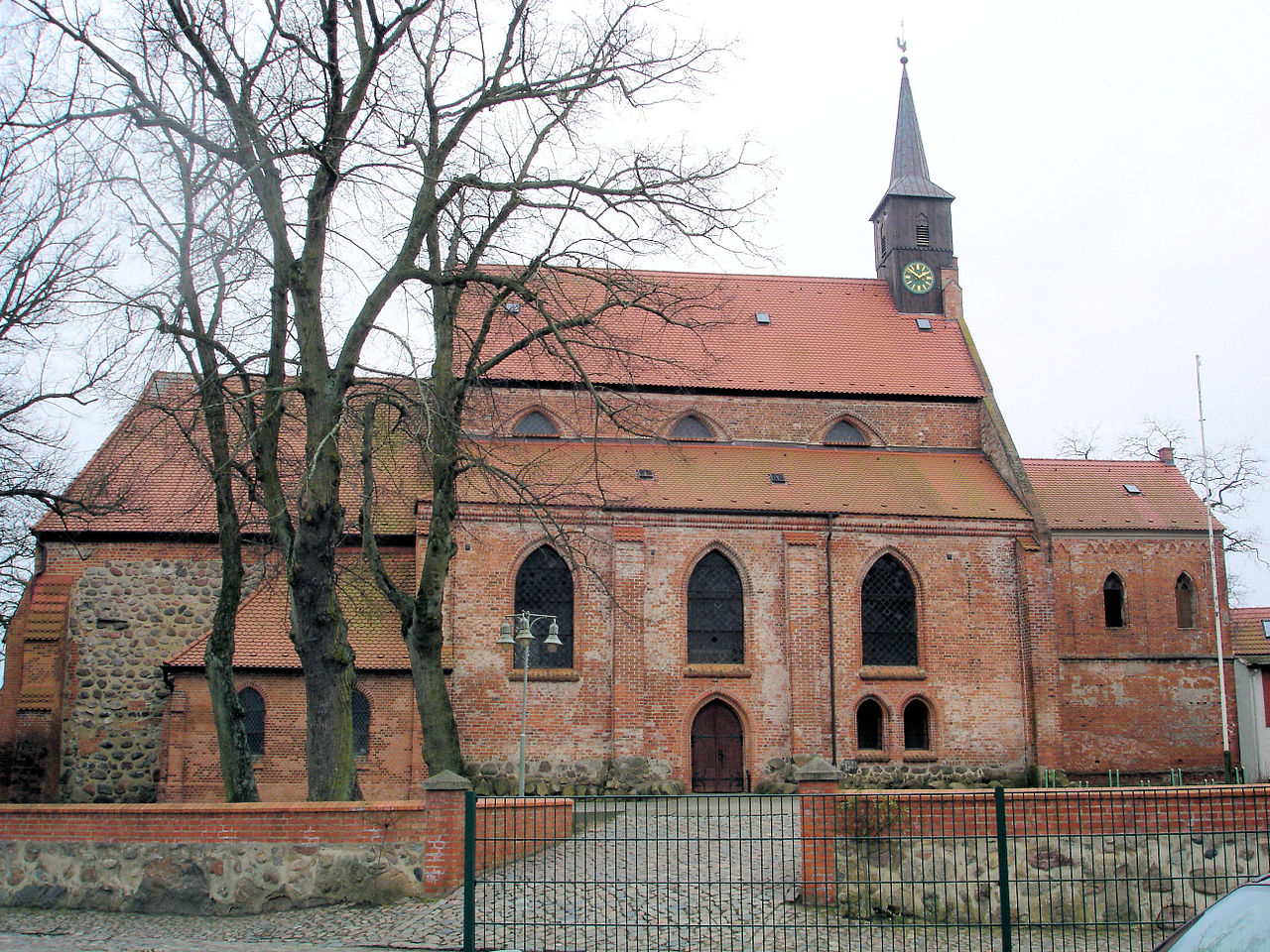
  • Ernst was christened Ernst Daniel Joachim Stübe following his birth on 29 January 1839 in present-day Starkow, Thelkow, Rostock, Mecklenburg-Vorpommern, Germany, the son of Hans Arend Heinrich Stübe and Maria Elisabeth Ewert.1 He was baptized on 3 February 1839 at the village church of nearby Walkendorf, which still stands today.2

“Dorfkirche in Walkendorf,” 2008, Walkendorf, Rostock, Mecklenburg-Vorpommern, Germany; Wikimedia Commons, copyright Ch. Pagenkopf.

  • Friederike was christened Friederike Johanna Dorothea Christiana Wegner following her birth on 9 August 1841 in present-day Selpin, Rostock, Mecklenburg-Vorpommern, Germany, the daughter of Johann Wegner and Regina Lewerenz.3 She was baptized on 15 August 1841 at the village church of nearby Vilz, which still stands today.4

“Kirche in Vilz bei Tessin,” 2008, Vilz, Rostock, Mecklenburg-Vorpommern, Germany; Wikimedia Commons, copyright Schiwago.

It is likely that Ernst and Friederike grew up on the manorial estates where their fathers were day laborers (Tägelohner).5 Serfdom had ceased in Mecklenburg-Schwerin only in 1820; landless men remained tied to the land where they toiled as contracted laborers on these estates, their wives often working alongside them.6 As children, Ernst and Friederike would have lived in estate-owned huts that were shared with their immediate families as well as, perhaps, their extended families or the families of other laborers.7

Childhood, however, was brief; by the time they were seven years old, Ernst and Friederike may have been hired out to work, or at the very least by the time they reached adolescence. Granted room and board for their services as a farm hand and maid, respectively, they would also have received a modest annual wage.8 Throughout their years of service, they may have moved among different estates and had the opportunity to mingle with a number of other young people at local festivals, and perhaps this is ultimately how they became acquainted.9

  • When they married on 24 October 1866, Ernst was twenty-seven and Friederike was twenty-five; they were married at St. Johannis in present-day Tessin, Stadt Tessin, Mecklenburg-Vorpommern, Germany, which still stands today.10

“Stadtkirche St. Johannis in Tessin,” 2008, Tessin, Rostock, Mecklenburg-Vorpommern, Germany; Wikimedia Commons, copyright Schiwago.

As it so happens, Ernst and Friederike’s wedding day fell upon the date that the contract year for laborers typically concluded; as this was the beginning of a three-day holiday after which contracts might be renewed or laborers shifted to different estates, the young couple may have decided that this would be a practical time to marry and set up house once permission had been granted for their marriage.11 Indeed, as marriage restrictions in Mecklenburg-Schwerin remained strict at this time, a wedding was a true celebration and traditionally included several days of feasting.12

Following their marriage, Ernst and Friederike appear to have lived on the grounds of the estate Friedrichshof, located between Selpin and Walkendorf, where Ernst, like his father before him, was a day laborer.13 Friedrichshof is no more, although notably, it was the birthplace of Richard Wossidlo, a renowned folk historian and ethnographer.14 It was likely here at Friedrichshof where the Stübe couple’s first child, Emma, was born on 27 September 1867.15 Two years later, amidst a stream of emigrants from Mecklenburg-Schwerin, Ernst, Friederike, and Emma Stübe boarded a ship at Hamburg, and the rest, as they say, is history.16 

Copyright © 2017 Melanie Frick. All Rights Reserved.
Continue reading
Searching for Marguerite

There is both good and bad news about this photograph:

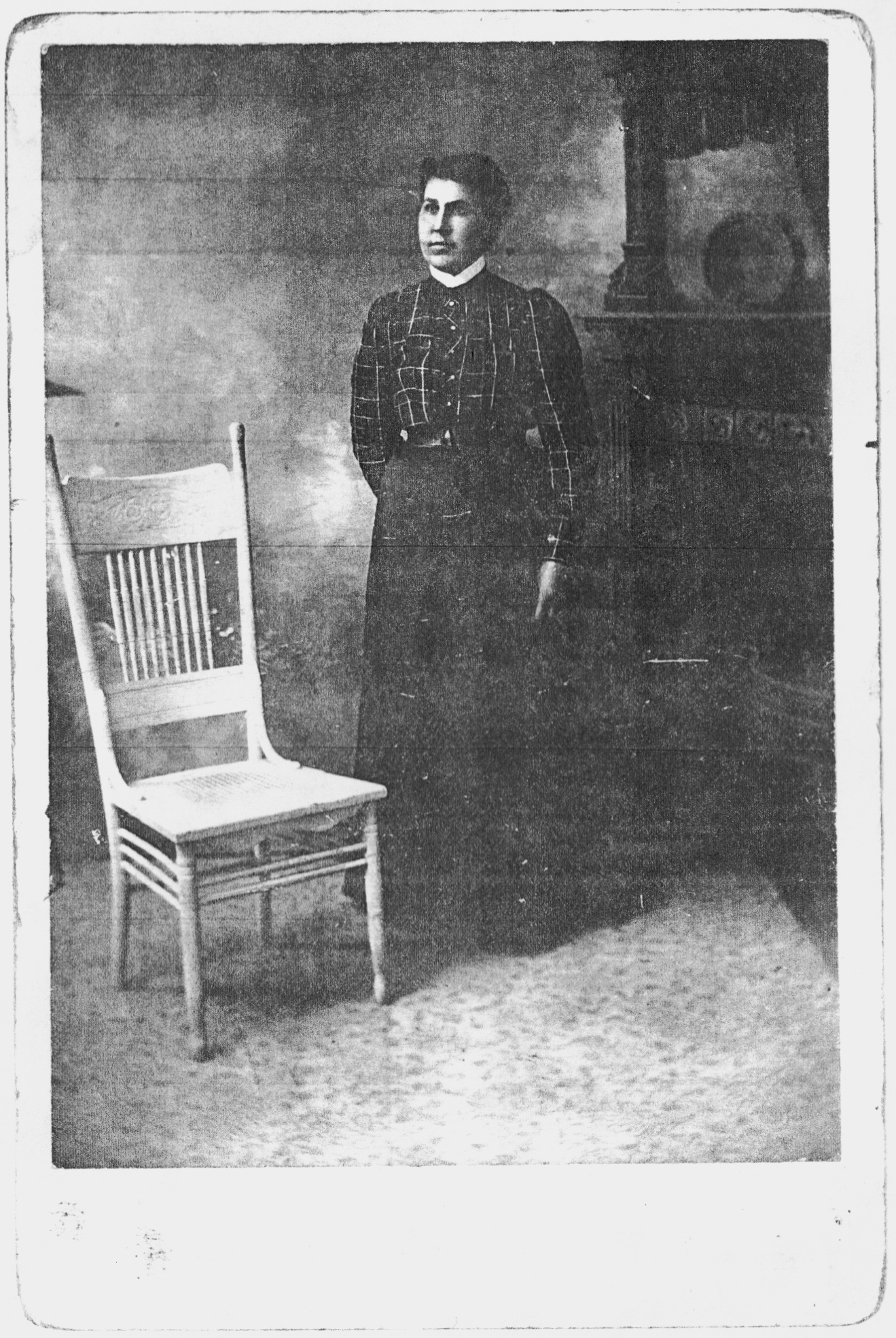
Unidentified_Marguerite_Chicoine_Adam

Unidentified photograph, ca. 1860-1866; digital image 2015, privately held by Melanie Frick, 2015. Image courtesy of D.B.

Twenty-seven years ago, my parents traveled to Massachusetts and made a stop in the community of Indian Orchard, where, my father knew, his ancestors had lived for a time in the latter half of the nineteenth century. As it turned out, these French Canadian immigrants had descendants who still lived in the area, and thanks to the staff at Saint Aloysius Parish, he was able to connect with one such descendant. Later, he began corresponding with two more cousins, both of whom were kind enough to share their research about our shared French Canadian and Acadian ancestors. Family lore and even a few photographs were also exchanged – including this photocopied image thought to be a photograph of Marguerite (Chicoine) Adam (1816-1878).1

Marguerite Chicoine is one of the first ancestral names I learned as a child and amateur family historian. I loved hearing that she was said to be Native American – a bit of family lore since (mostly) disproven, but it did work quite effectively to capture my attention at the time. I had always hoped to see the original of this photograph that was sent to us by our late cousin, but learned two years ago that an original may no longer exist. Apparently, when she was moved to a nursing home, her family history materials were thrown out.2 This serves as an important reminder to make an estate plan for the preservation of your own family history materials.

While I can’t rule out that somewhere out there, a cousin might hold another copy of this same photograph – that fortunate scenario has happened before – it’s also possible that this is the only version of this photograph that I will ever see. In any case, let’s take a look. Could this realistically be a photograph of Marguerite Chicoine?

Marguerite died in Massachusetts in 1878 at the age of 62.3 Thus, this photograph would have to predate 1878. As the photocopy indicates that this was a carte de visite – most popular between approximately 1860 and 1866 – that is entirely possible.4 All of Marguerite’s fifteen known children were born before 1862, with the exception of her youngest, who was born five years later. As Marguerite relocated with her family from Quebec to Massachusetts circa 1864-65, it seems plausible that she may have had her picture taken during this time period as a memento to share with relatives at home.5

Marguerite was fifty years old when her youngest child was born at the tail end of the most likely timeframe for this photograph; in order to have had a healthy pregnancy so late, perhaps she had a more youthful appearance than one might otherwise imagine for a mother of fifteen. The woman appears to have dark hair without noticeable graying, and her dark complexion and strong nose make it easy to see how rumors of significant Native American ancestry could have gotten started. However, I find it difficult to get a sense for her age, due in part to the poor quality of the image. Could she be over forty-five, or is this woman in fact decades younger?

Marguerite did have three daughters who would have reached adulthood by the 1860s: Marguerite Adam, Marie Adam, and Julienne Adam.6 While I do have a photograph of Marguerite, who does not appear to be a match, could this photograph show instead either Marie or Julienne as a young woman in her early to mid-twenties?

The woman wears a buttoned shirtwaist with a windowpane pattern, the sleeves neither significantly fitted nor puffed, and a high linen band collar is visible.7 Her belted skirt is of a straightforward design. Notably, it is not worn with a fashionable hoop as one would typically expect in the 1860s; this more unassuming skirt would perhaps have been in line with what a woman in rural Quebec or an immigrant in a New England mill town might wear.8 The backdrop is similarly domestic in style with a practical wooden chair and what looks to be a fireplace.

The good news? This could be a photograph of Marguerite Chicoine. It depicts a dark-complected woman of evidently simple means who was photographed in the 1860s, a physical description, socioeconomic background, and timeline that fit with what is known about Marguerite.

The bad news? We may never know for sure. It seems equally plausible that could be a photograph of one of Marguerite’s daughters or a close relative. Lacking an original for closer examination, it can still be hoped that another copy of this photograph might exist in different branch of the family, and that it may hold additional clues regarding the true identification of the mysterious dark-haired Québécois.

Copyright © 2015 Melanie Frick. All Rights Reserved.

Continue reading