Tag Archives: 1870s

A Visit to an Alsatian Village

I can never forget the moment when I knocked at the door of a home in a small French village, a copy of my family tree chart in my hands as I stammered the phrase, “Bonjour. L’histoire de ma famille! to the startled teenage girl who answered. Thankfully, before long, with our fathers by our side—her father just so happened to be the mayor of Sondersdorf, Haut-Rhin, Alsace, France—we managed to reach a mutual understanding of the fact that my father and I had ancestral roots in this village and would love to take a peek at the old records.

Sondersdorf_2006_02

Sondersdorf, Haut-Rhin, Alsace, France photograph, 2006; privately held by Melanie Frick, 2016.

This was ten years ago, when I first traveled to Europe. Along with a few days spent in Paris and the ancestral village of my mother’s German grandfather, we also paid a visit to the charming Alsace region of northeastern France where my father’s great-great-grandfather had lived and served in the Franco-Prussian War.

Joseph Lutz, the son of Francois Joseph Lutz and Switzerland-native Marguerite Meister, was born 31 May 1844 in Sondersdorf, Haut Rhin, Alsace, France.1 In his mid-twenties when the Franco-Prussian War of 1870-71 broke out, family lore states that Joseph served and was injured.2 Following the war and its German victory, the residents of the newly annexed region of Alsace were informed that they could remain French citizens by removing to France by the fall of 1872, or they could stay in their homes and default to German citizenship.3 Joseph’s parents, who were over seventy by this time, apparently opted to stay in Sondersdorf; a move to French territory may well have proven to have been a great hardship, no matter if they would have preferred to remain French.4 In any case, it was said that Joseph did not wish to live under German rule.5 Thus, at the age of twenty-eight, he left Sondersdorf for America, where he settled in Faribault County, Minnesota, near other relatives.6

Sondersdorf_Cemetery_2006

Sondersdorf, Haut-Rhin, Alsace, France photograph, 2006; privately held by Melanie Frick, 2016.

It was a treat to see Sondersdorf, although it was not quite the rugged and rocky village that my father had long envisioned. Although in a mountainous area with the snow-capped Alps within view, Sondersdorf boasted a tidy village situated among rolling green fields. We enjoyed exploring a beautiful old cemetery, where the Lutz surname was prominent, and paid a visit to the village church. If I recall correctly, it was a local who called down an inquisitive greeting from a shutter-framed window who directed us to the mayor’s home for our genealogical questions. After becoming acquainted with the mayor and his daughter in a mix of broken English, French, and German, we made plans to meet the next day to see the old vital records held in the local school building.

Ferrette_2006

Ferrette, Haut-Rhin, Alsace, France photograph, 2006; privately held by Melanie Frick, 2016.

We were treated equally well by the people of Ferrette, a larger village nearby, where we stayed the night. Hearty Alsatian meals and investigating the crumbling castle ruins on its picturesque hillside kept us well entertained until it was time to return to Sondersdorf. There, we met again with the mayor, who allowed us to page through the centuries-old record books, brown ink faded on the pages. Although we didn’t conduct in-depth research, not wanting to take advantage of the mayor’s time, it was incredible to see so many family names recorded in their original form. Upon our departure, the mayor kindly presented me with a book about the history of the churches of the region, in which he inscribed the date and the place—much as Joseph Lutz had inscribed his prayerbook upon his departure from Sondersdorf, long ago.

Copyright © 2016 Melanie Frick. All Rights Reserved.
Continue reading

Herman and Augusta Rice, “The Most Extraordinary Dwarfs of the Age”

Headlined as “The Musical Midgets,” Herman and Augusta Rice were deemed in one newspaper advertisement to be “the most interesting little people now before the public.”1 Another called them “German Midgets” and noted that they were “The Most Extraordinary Dwarfs of the Age.”2 This carte de visite of Herman and Augusta Rice, like that of the sideshow performer Ada Zingara, was found in an antique album that once belonged to an unidentified family of Kaukauna, Wisconsin.3

SCAN0915

Herman and Augusta Rice photograph, ca. 1880s, New York, New York; digital image 2014, privately held by Melanie Frick, 2014.

Herman and Augusta Rice appear dressed in fine Victorian fashion and stand next to pillars to emphasize their short stature. Augusta’s hairstyle is particularly striking; a flat bow adorns the top of her head, and small curls are arranged across her forehead in such a way that it almost seems as though they could be part of a hairpiece. The bow and flattened style of her bangs were fashionable in the late 1870s.4 She wears a carefully fitted gown with a train and no shortage of flounces, ruffles, and lace trim. With a locket or pendant necklace and a bracelet setting off her ensemble, Augusta appears to be dressed very well indeed. Herman looks equally sharp in a formal fitted dinner jacket with a pocket watch and freshly shined shoes.

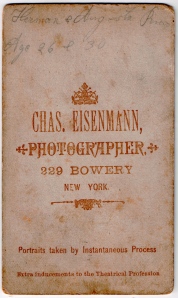
SCAN0916The photograph was taken by Charles Eisenmann, a photographer in the rough-and-tumble Bowery district of New York City who frequently photographed performers such as these.5 Although he was employed as a photographer in the city as early as 1876,6 he didn’t make the move to 229 Bowery, the address stamped on the back of this photograph, until 1879 or 1880.7 Eisenmann remained at this location at least until 1883.8
Herman and Augusta Rice, an alleged brother-sister pair, appeared at Harris’ Mammoth Museum in Cincinnati in 1883,9 were affiliated with Keith and Batcheller’s Mammoth Museum in Boston in 1884,10 and were showcased as curiosities at Forepaugh’s Dime Museum in Philadelphia in 1885.11 They had toured with P. T. Barnum in 1877, at which time they, along with a third sibling, Johanna, used the more Germanic surname Reis.12 One wonders, however, whether these names were merely a part of their identities as performers.

Who were they, and what became of them when their dime show days were over?

Continue reading

Tombstone Tuesday: Joachim and Sophia (Cammin) Wiese

It can often feel like a lost cause to submit Find A Grave Photo Requests for graves that are situated in enormous, urban cemeteries, but as I learned last week, when an anonymous contributor answered my plea for two photographs from Concordia Cemetery in Cook County, Illinois, it is possible to get lucky.

Joachim Wiese Grave

Find A Grave, Inc., Find A Grave, digital image (http://www.findagrave.com : accessed 13 July 2014), photograph, Joachim Wiese (1841-1915), Memorial No. 123360232, Concordia Cemetery, Forest Park, Cook, Illinois; photograph by Anonymous, 2014. Note: The German script reads, “Hier ruhet in Gott” [Here rests in God].

Joachim and Sophia (Cammin) Wiese were Pomeranian immigrants who spent most of their adult lives in Chicago, Cook County, Illinois. On 1 November 1868, accompanied by their young son, Frederick “Fritz” Wiese, and a host of other relatives, they boarded the Electric in the great port of Hamburg.1 Their voyage lasted nearly two months; they arrived in New York the day after Christmas, 1868.2

Apparently without further ado, the family made their way to the Midwest. 1870 found them living in the urban center of Chicago, where Joachim was employed as a day laborer.3 The Chicago Fire of 1871 must have had an impact on their early years in the city; the family belonged to the predominantly German First Bethlehem Lutheran Church,4 established in an area that was developed in the years following the fire.5 By 1880, Joachim Wiese was employed as a tailor,6 a trade he continued at least for the next two decades.7 Perhaps Sophia was able to assist her husband with his work, in addition to raising their children.

Sophia Wiese Grave

Find A Grave, Inc., Find A Grave, digital image (http://www.findagrave.com : accessed 13 July 2014), photograph, Sophia Wiese (1843-1907), Memorial No. 123360289, Concordia Cemetery, Forest Park, Cook, Illinois; photograph by Anonymous, 2014. Note: The German script reads, “Hier ruhet in Gott” [Here rests in God].

In all, six children were born to the Wiese family: Frederick (1866-1914),8 Mary (1870),9 John C. (1873-1943),10 Minna (1876-1945),11 William (1879-1882),12 and Arthur Louis (1886-1932).13 Five children survived to adulthood; sadly, William died of diphtheria at the age of two.14

Sophia (Cammin) Wiese died of pneumonia at their home on Marion Place on 26 May 1907, at which time she was said to be sixty-four years of age.15 Joachim Wiese died at home on 2 June 1915 at seventy-four years of age.16 Their funeral services were held at the First Bethlehem Lutheran Church, and they are buried beside their son at Concordia Cemetery in Forest Park, Cook County, Illinois.

Continue reading

A Prayer Book from Home

Before Joseph Lutz left his home village, he carefully inscribed his name inside a leather-bound prayer book, small enough to be tucked inside a coat pocket. “This book belongs to me, Joseph Lutz of Sondersdorf,” he penned in French. The book, however, was printed in German; Joseph spoke both languages, having grown up in an area that was the subject of dispute between France and Germany.1

Joseph_Lutz_Prayer_Book_01

Joseph Lutz prayer book, Adam Family Collection; privately held by Brian Adam (personal information withheld), 2014.

Joseph Lutz of Sondersdorf, Haut Rhin, Alsace, France, the son of François Joseph and Marguerite (Meister) Lutz, was baptized on 31 May 1844.2 He left his homeland following  the Franco-Prussian War of 1870-1871. It was said that he had been injured during his time of service, which may have limited his opportunities for occupation, and, furthermore, he did not wish to live under Prussian rule.3 Thus, like many of his relatives, he set his sights on Minnesota.

Once settled, Joseph may have read from his prayer book with his wife, a Polish immigrant who also spoke German, as they began their life together.4 Perhaps it inspired his generosity during his career as a butcher, when he was said to have provided gifts of meat to struggling immigrants. When he later became a saloon keeper, it may have given him the strength to avoid the temptation of alcohol, a quality appreciated by his wife.5 Perhaps the prayer book brought him peace as he suffered from tuberculosis, an illness that claimed his life on 3 May 1887 when he was forty-two years old.6

Joseph_Lutz

Joseph Lutz prayer book, Adam Family Collection; privately held by Brian Adam (personal information withheld), 2014.

Joseph was said to have been buried in Danville, Blue Earth County, Minnesota, and though a wooden cross once marked his grave, it is no more.7 His well-worn prayer book was passed down to his daughters, who kept his tintype – his only known photograph – tucked inside to ensure its safety. These items may have been their sole mementos of their father, a slim man with a handlebar mustache, a Catholic, a veteran, and a businessman who hailed from the border of France and Switzerland.

Continue reading

The Country Store: Family Groceries, the Best of Brandy, and Excellent Beer

The Bavarian William Henry Thoma of Garnavillo, Clayton County, Iowa, was a businessman by the age of thirty.1 In 1859, the Clayton County Journal reported:

“William Thoma, Grocer, Main Street, Garnavillo, Iowa, keeps constantly on hand all kinds of family groceries, such as Coffee, Sugar, Tea, Milasses, ice, &c. The best of Brandy and excellent Beer is also always to be found at this establishment.”2

William must have found success as a grocer and purveyor of alcoholic beverages, as his business was apparently in operation for at least two decades. He was named a merchant in the 1860 census,3 and in the 1870 census it was noted that he was the keeper of a “country store.”4 This must have allowed him to provide a comfortable lifestyle for his wife and eleven children; in 1870, he owned real estate valued at $12,000 and personal estate valued at $3,000.5

William_Thoma_1870

1870 U.S. census, Clayton County, Iowa, population schedule, Garnavillo, p. 13 (penned), dwelling 87, family 86, Wm Toma; digital image, Ancestry.com (http://www.ancestry.com : accessed 16 April 2014), citing National Archives microfilm M593, roll 383.

After William’s death in the summer of 1876,6 his widow, Anna Margaretha (Poesch) Thoma, with a handful of young children still at home, took over as merchant. She maintained the business for a number of years, while her eldest son assisted as a clerk in the store.7

I like to wonder whether William’s store was anything like that featured at Iowa’s Living History Farms, which boasts the fictional 1875 Town of Walnut Hill. Images of the picturesque Greteman Brothers General Store can be seen here. It’s well worth a visit if you find yourself in central Iowa and have ever wondered what life was like for your Midwestern ancestors in the years following the Civil War. The impact of the Industrial Revolution on rural communities is visible, although, according to the Living History Farms, “The railroad will always be a few years away for Walnut Hill.”8

Of course, I also have to wonder whether William and Anna Margaretha (Poesch) Thoma were anything like Nels and Harriet Oleson of Little House on the Prairie. Let’s just hope that their children weren’t as spoiled as the infamous Nellie and Willie!

Continue reading

An Iowa Teacher’s Report to Parents, 1925

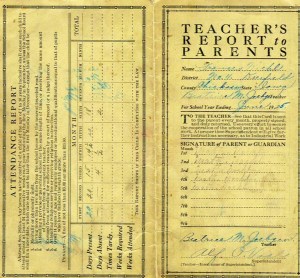
The first of June 1925 was an important day for Frances Marie Noehl of Deerfield, Chickasaw County, Iowa. She completed the eighth grade in District No. 11 with flying colors, even rallying over the course of the year to bring up her lagging grade in conduct.1 However, although she was a successful student, with high average marks equivalent to straight A’s, she would not go on to graduate from high school.2

ReportCard1

Frances Noehl, Teacher’s Report to Parents, 1925, Deerfield, Iowa; digital image 2003, privately held by V. P. [personal information withheld], 2014.

Frances was the eighth of nine children born to Matthias and Elizabeth (Hoffman) Noehl, German immigrants who farmed in northeastern Iowa.3 Once her schooling was completed, Frances was needed at home, although her father did prize education. In his memoirs, he wrote of his schooldays in Germany, “I entered into the arena, and took it up not only with the alphabet, but with all my classmates. As at that time there was no special talent in our school of eighty-four pupils, I succeeded in taking the first place among all the boys.”4 His education concluded at the age of fourteen, but he was pleased to be allowed to keep his books, writing tablet, slate, and pencil.5 Perhaps he had once dreamed that his children would be fortunate enough to further their educations, but, at least in the case of his youngest daughter, that dream was unfulfilled.

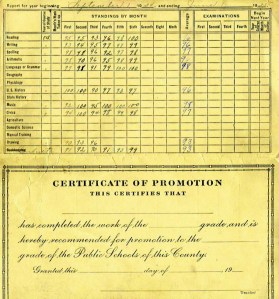
During the course of her eighth grade year, Frances was instructed by Miss Beatrice Joebgen, a local teacher who was still a teenager herself.6 Frances was graded in Reading, Writing, Spelling, Arithmetic, Grammar, U.S. History, Music, Civics, Drawing, and Conduct, with all of her marks falling between 90 and 100 and her averages between 93 and 98. Her father’s signature was recorded on her report card at the end of each term.7

ReportCard2

Frances Noehl, Teacher’s Report to Parents, 1925, Deerfield, Iowa; digital image 2003, privately held by V. P. [personal information withheld], 2014.

Attendance rules for the time indicate that Frances would not have been required to complete additional schooling, as she had fulfilled the educational qualifications of an eighth grade pupil. Other reasons for exemption from public schooling included being mentally or physically unfit, living more than two miles from the school house by the nearest traveled road, or attending a private or parochial school, receiving instruction from a competent teacher, court order, religious instruction, or regular employment for one over the age of fourteen.8

Although Frances may have liked very much to have had the opportunity to graduate from high school, duty to her family, it seems, kept her at home.

Continue reading

A (Somewhat Lackluster) Homestead File

When I sent away to the National Archives for a copy of a homestead file, I was sure that I was in for a treat. I was aware that, in addition to the homestead application and final certificate, a homestead entry file would typically include proof documents in the form of testimony from the applicant and two witnesses. I couldn’t wait to read what this testimony would have to say about the home, family, and farm of Jens Madsen Schmidt of Bon Homme County, South Dakota.1 Jens had applied for a homestead on 23 November 1870,2 just months after his arrival from Denmark and less than a decade after the passage of the Homestead Act of 1862.3

As it turned out, I shouldn’t have gotten too excited. Apparently, on 8 June 1877, Luman N. Judd, Register of the Land Office at Springfield, had better things to do than to fill in the three blank lines meant to describe the home of Jens Madsen Schmidt, or the additional three blank lines meant to detail the improvements made upon his land.4 Of course, perhaps Mr. Judd isn’t to blame, and the witnesses – Peter Anderson and John Haase – were either unable to communicate these facts in English or were particularly reticent that day.5 To be fair, these men likely had crops to get back to and saw no reason to belabor the details, especially if they were equally well acquainted with Jens and knew that nothing stood in the way of his patent.

JensSchmidt

Jens Madsen Schmidt, Bon Homme County, South Dakota, ca. 1900; digital image 2003, privately held by Melanie Frick, 2014.

All was not lost with the homestead file. I learned that, in 1877, Jens had cultivated about forty acres of land.6 I learned, too, that his inclination to Anglicize his Danish name to James Smith had caused some issues with the paperwork; in 1878, he signed a document swearing that the “correct orthography” of his name was, in fact, Jens Madsen Schmidt.7

Regardless of the details – or lack thereof – of the homestead file, Jens Madsen Schmidt became the proud owner of one hundred and sixty acres of land located in Section 1, Township 93, Range 58 of Bon Homme County, South Dakota.8

If you would like to order your ancestor’s own homestead file, I would suggest beginning with the General Land Office Records of the Bureau of Land Management, where you will be able to locate the necessary information to order the file from the National Archives. I used their online form, and found it quick and easy. Fifty dollars and a few weeks later, perhaps you will find that your ancestor’s neighbors had at least a few things to say about his living situation!

Continue reading

Tombstone Tuesday: Marguerite Chicoine

Whenever I hear that someone is a Chicoine, I assume that we’re related. From what I’ve been able to learn, most, if not all of those who bear the Chicoine surname – in the United States, at least – can trace their ancestry to the early settlers of Quebec. In the latter half of the nineteenth century, many of these French Canadian Chicoines immigrated to New England, and from there, many moved on to settle in southeastern South Dakota. The Ancestry.com surname map reflects this migration pattern.

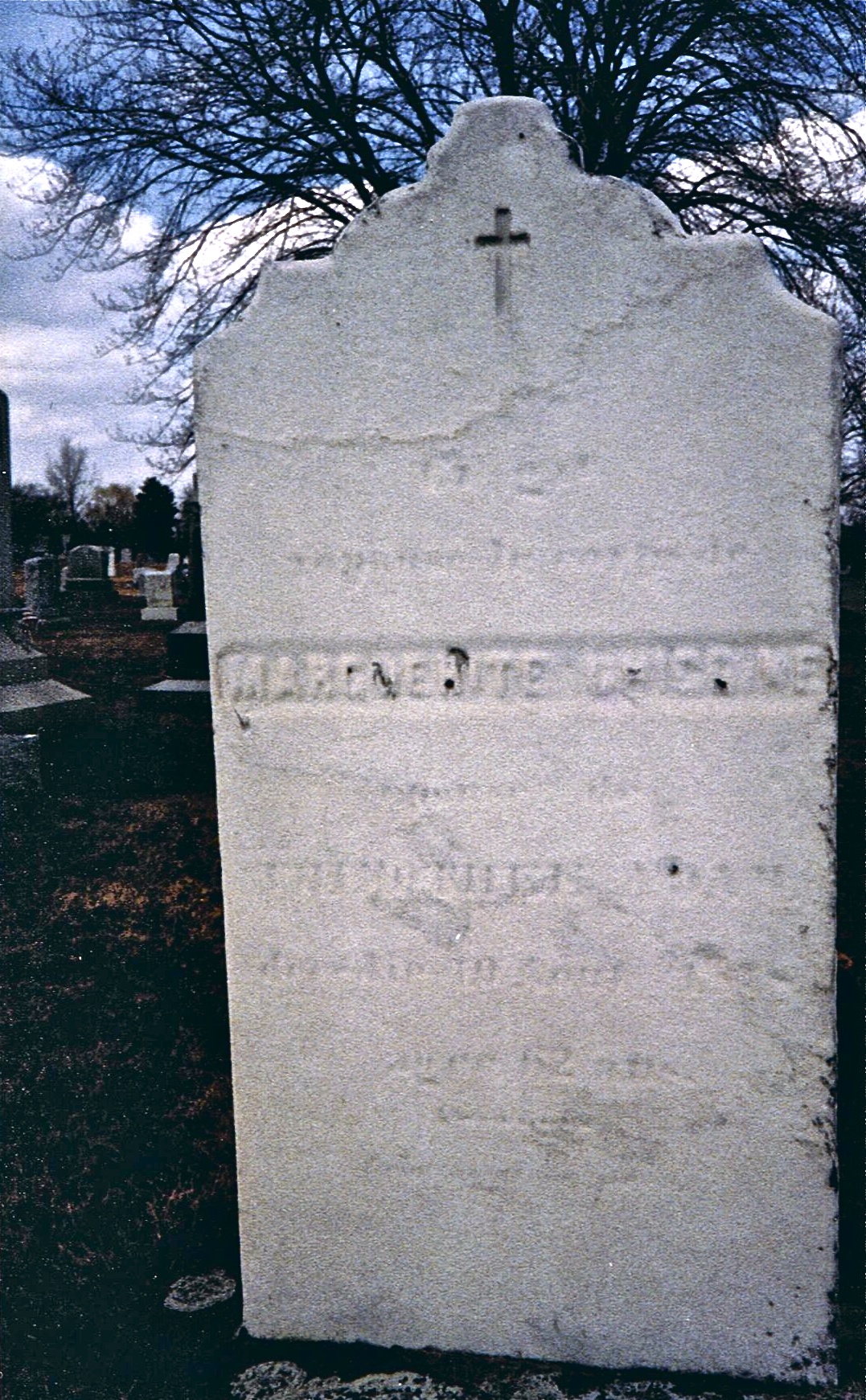
SaintAloysiusCemeteryMargueriteChicoine

Grave of Marguerite (Chicoine) Adam, 1816-1878, Saint Aloysius Cemetery, Indian Orchard, Hampden, Massachusetts; image date 1987, privately held by Brian Adam [personal information withheld].

The last of my ancestors to carry the Chicoine surname was Marguerite Chicoine of Indian Orchard, Hampden County, Massachusetts.1 Marguerite was baptized on 31 August 1816 in Saint-Antoine-sur-Richelieu, Quebec, the daughter of Leon Chicoine, a forgeron, or blacksmith, and Marie Varie.2 According to family lore, which has not been verified, Marguerite was of Native American (First Nation) descent through her mother.3

Marguerite married Timothée Adam on 23 October 1837 in Saint-Marc-sur-Richelieu, Quebec.4 They farmed in Saint-Hyacinthe County,5 and together, they had at least sixteen children, fourteen of whom survived to adulthood: Timothee (I), Marguerite, Marie, Julienne, Timothee (II), Louis, Joseph, Marie Vitaline, Pierre Pie, Joseph Magloire, Euclide, Marie Elisa, Marie Arcelia, Elzear Henry, Prosper Phillip Adam, and an anonymous infant who did not live longer than two days.

By 1865, Marguerite had relocated with her family to Massachusetts, to a community where many, including her husband, sought work in the cotton mills.6 However, her time there was short-lived; Marguerite succumbed to consumption on 12 September 1878, days after she turned sixty-two.7 She is buried at the Saint Aloysius Cemetery in Indian Orchard, Hampden County, Massachusetts.8

Note: This blog post was updated on 27 May 2020 to include the name of an additional child of Marguerite Chicoine.

Continue reading