Tag Archives: 1910s

Farm Girls

Sisters Helena, Louise, and Andrea Nelson donned overalls and posed on their family’s farm near Tabor, Yankton County, South Dakota in this candid photograph dated circa 1916. Andrea, nineteen in the summer of 1916, had recently completed her studies at the Southern State Normal School in Springfield.1 Both Helena, fifteen, and Louise, sixteen, would be students there in the fall, while Andrea would go on to her first term as a teacher at a one-room country school.2

Helena, Louise, and Andrea Nelson, Yankton County, South Dakota, ca. 1916-1918; digital image 2017, privately held by Melanie Frick, 2017.

Pitching in to help out on the farm would have been the norm for the Nelson girls, the three middle children in a family of nine. Helena’s daughter later recalled her mother’s stories of working in the fields in the summertime,3 and in a letter dated 1918, in response to a question from her cousin about taking summer courses, Andrea replied, “Oh, how I’d love to, but guess it’s chickens to tend etc. and overalls to wear. Suppose that too will be sport, but after all, is there anything like being a schoolgirl?”4 The Nelson girls would have been especially needed on the farm that summer, as their older brother, Ole, was in the service.

While many decades had yet to pass before women wearing pants would become truly mainstream, I can’t imagine that it would have been unusual at this time for young women to wear the clothing most suitable for farm labor while at home among family. The overalls and loose collared shirts worn by the Nelson girls might have been hand-me-downs from their father and brother (even Levi Strauss & Co. didn’t begin to make jeans especially for women until the 1930s!), and, positioned side-by-side in a field with wide-brimmed straw hats atop their heads, the sisters—or the photographer—clearly recognized that this was a photo op not to be missed.

Copyright © 2017 Melanie Frick. All Rights Reserved.
Continue reading

Fun on the Farm

Farm kids have long learned to make their own fun, and Frances Marie Noehl of Deerfield, Chickasaw County, Iowa was no exception. Pictured here circa 1920, Frances is grinning as she sits on a wooden cart pulled by her dog, Shep. If his expression can be interpreted, he appears to have been game to take part in the shenanigans of Frances and her siblings: Leo, Helen, Kathryn, Elinor, John, Al, Frank, and Joe. Frances, born in the spring of 1911, fell between Frank and Joe in age as the second-to-youngest of the nine children of German immigrants Mathias and Elizabeth (Hoffman) Noehl.

Noehl_Frances_Shep_c1920_Iowa

Frances Marie Noehl with Shep, Chickasaw County, Iowa, circa 1920; digital image 2015, privately held by Valene Petersen, 2016.

Although the Noehls were not prosperous and bounced around from farm to farm while their children were young, the available recollections of their children indicate that plenty of fun was to be found in the country—after chores, of course. Following brief, unsuccessful stints in Canada and Minnesota around the turn of the century, the Noehls returned to Chickasaw County where they rented a farm near New Hampton.1 As a small child, Frances’s brother John, who was seven years her senior, could apparently often be found in the maple grove, contentedly sipping sweet sap from a tin cup under the watchful eye of another beloved dog, Sultan.2

Next, the family moved to an acreage in the town of North Washington, where the older children attended Catholic school and learned English for the first time.3 After three years there, the man who owned their property offered them a chance to rent out his farm in Deerfield, near the community of Alta Vista.4 John recalled his mother’s happiness as they prepared to resume farm life, teaching him to sing, “For to plow / For to mow / For to reap / For to sow / For to be a farmer’s boy.”5 It was now around 1910, and the family would remain on this farm for years to come. Aside from playtime with the family dog, rumor has it that Frances and her siblings also liked to have spitting contests while perched in the hayloft.6

With her bobbed haircut and loose-fitting, short-sleeved cotton dress, complete with a tie about the neck à la a sailor suit, Frances looks every bit an energetic 1920s tween.7 Her worn leather shoes appear to be barely staying on her feet and she sits relaxed with one bare (or stockinged) leg folded underneath. A massive barn with a stone foundation is visible behind her. This informal snapshot was likely taken by a family member, although since I have seen very few photographs of the Noehl family in general, I wonder if photography may have been only a passing hobby. In any case, it’s a pleasure to have a rare glimpse into a long-ago childhood.

Copyright © 2016 Melanie Frick. All Rights Reserved.
Continue reading

The Relinquished Homestead

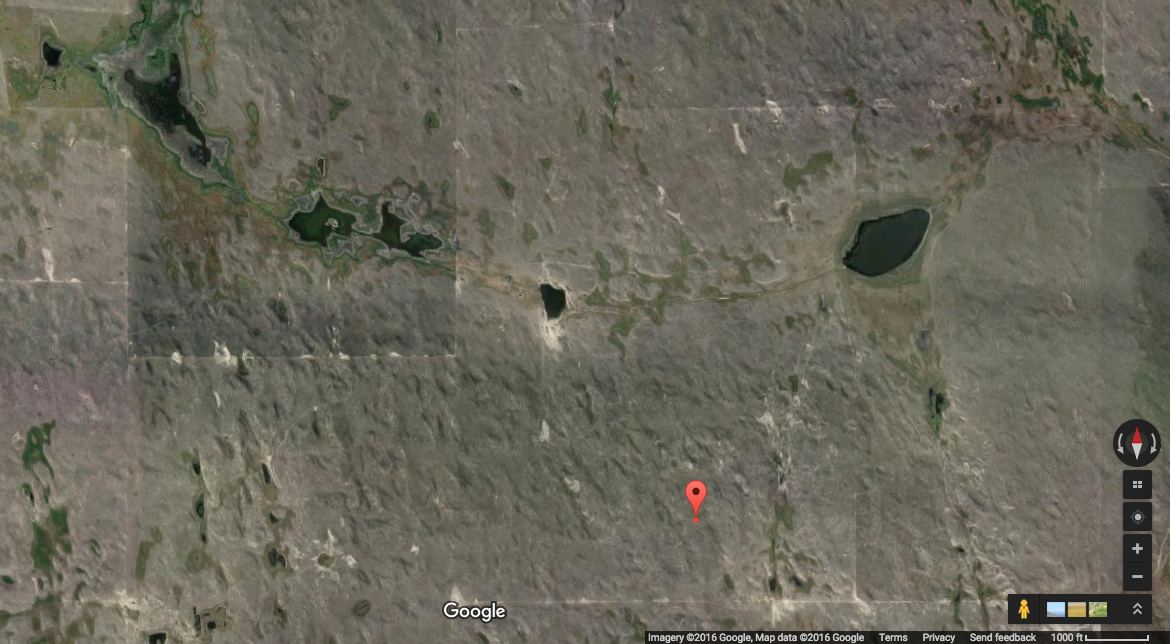
Not all homesteaders made it. As far as I know, George Hiram Thoma was the last of my direct ancestors to stake a claim, which he did in western Nebraska on a February day in 1909. George and his brother-in-law Clare Eugene Gibson arrived together at the land office in Valentine in order to pay their respective filing fees; each was granted about six hundred acres of land on adjoining claims in the desolate Sandhills of nearby Rock County, Nebraska.1 While earlier claims under the Homestead Act of 1862 allowed each individual only one hundred and sixty acres, later amendments granted settlers more land in certain areas where, for example, the soil and climate might be less conducive to raising crops. The Kincaid Act of 1904 applied specifically to thirty-seven counties in northwestern Nebraska that contained non-irrigable land.2

Screen Shot 2016-02-29 at 1.12.48 PM

Google Earth certainly doesn’t make this part of the country look particularly inviting, and life there may have been even more difficult than expected. The homesteads were located more than twenty miles from the nearest town of Bassett, and the families had likely never experienced such isolation. However, Clare Gibson, along with his wife, Alpha, and their four children, Bernice, Pauline, James, and Florence, stuck it out; his homestead was patented in February 1913,3 and the Gibson family remained there for years to come.4

George Thoma and his wife Leota, on the other hand, lasted only a little more than a year. On 4 May 1910, George relinquished his homestead,5 acknowledging defeat and, apparently, accommodating his wife’s wishes to leave an area that his daughter later described as “all sand, horrible, no trees.”6 To make matters worse, there were rattlesnakes, and with a rambunctious six-year-old son, Fenton, and a two-year-old daughter, Fern, to keep safe, this was perhaps more than the couple had bargained for. They cut their losses, bade farewell to Clare and Alpha—sisters Alpha and Leota would never again have the opportunity to live as neighbors—and moved to town.7

Thoma_George_Homestead_01

George H. Thoma (Rock County) homestead file, case no. 1383, Valentine, Nebraska, Land Office; Serialized Land Entry Case Files That Were Canceled, Relinquished, or Rejected, ca. 1909-ca. 1918; Records of the Bureau of Land Management, Record Group 49; National Archives at Kansas City.

I may never have come across this record had I not attended the course “Advanced Research Tools: Land Records” at the Salt Lake Institute of Genealogy. [Read about my experience HERE.] It was there that I learned about tract books, bound volumes maintained by the Bureau of Land Management that faithfully recorded the filing of all land transactions—including claims that were later canceled, relinquished, or rejected. These claims cannot be found indexed at the Bureau of Land Management, typically my go-to resource for locating land records. Fortunately, however, the United States Bureau of Land Management Tract Books are available online at FamilySearch, and a handy Tract Books Coverage Table makes it possible to navigate the unindexed record images.

While I knew my great-grandmother had said that her father had homesteaded near Bassett, Nebraska, when no final patent could be found on the Bureau of Land Management’s database, I initially came to the conclusion that he must not have actually homesteaded there. Perhaps the family had lived with relatives or rented a farm during their brief time in Bassett, I thought. After all, my grandmother was only a toddler at the time, so her recollections might well have been dim. Well, as it turns out, George Hiram Thoma did indeed have his very own homestead, albeit briefly, and as a bit of a research bonus, the federal records that this homestead created mark the conclusion of his mysterious use of an alias.

Copyright © 2016 Melanie Frick. All Rights Reserved.
Continue reading

A Goodly Bit of Romance

The newspaper headline must have brought a few chuckles: “OLD FOLKS HAVE ROMANCE.” The story continued, “Romance is not all reserved for young people, as the marriage of Isaac N. Holman, aged 70, of Decatur, Neb., to Mrs. Sarah E. Fenton, aged 51, of Springdale, in Sioux City, will testify. […] This is the third marriage for each of the contracting parties. Both are well along the avenue of life and to them the marriage represents good judgment as well as a goodly bit of romance. They have known each other a long time and the mutual admiration they have entertained has grown gradually until the marriage yesterday placed its happy seal upon their growing affection.” Following their marriage on 24 August 1908 at the home of the Reverend W. H. Montgomery of the Haddock Methodist Episcopal Church in Sioux City, Woodbury County, Iowa, the couple was to visit Omaha. They would settle in Decatur, Burt County, Nebraska, where Holman, “said to be quite well to do,” made his home.1

That evening, their story appeared in another Sioux City newspaper: “LOOKING FOR LAND HE FINDS HELPMATE.” This version of the story was written with a level of flowery detail that, while entertaining, I don’t quite trust:

“I.N. Holman, a wealthy retired farmer of Decatur, Neb., came to Sioux City several months ago on a land deal. At the office of a real estate dealer he met a charming black-eyed widow, Mrs. Sarah E. Fenton, who had chanced in there on business. When they were introduced, he immediately lost all interest in Sioux City property or any property for that matter, and devoted all his time to the widow. Holman is 70 years old, and he pressed his suit with such ardor that before he returned to Decatur he had made a contract for something which he wouldn’t trade for all the farms in Iowa, namely the attractive widow. Today he returned to close the deal, which he says is the best he ever made. A license was issued this afternoon, the bride giving her age as 51. They will be married this evening and after a two weeks’ wedding trip will make their home at Decatur. “Maybe people think we’re foolish,” said the bride, blushing like a school girl, “but we don’t, we’re too happy.”2

This is far from the whole story. First, there are, in fact, two stories presented by these competing news articles. Did the couple meet at the land office, or had they been acquainted for years? This we may never know for sure; it seems unlikely, but not impossible, that the couple had crossed paths before meeting in Sioux City. Second, the “attractive widow” most likely did not have the black eyes of Bess the landlord’s daughter, charming as the description may be.3 And was she even a widow? Well, yes and no. Her first husband, George W. Fenton, died tragically in 1880 when accidentally shot by her brother-in-law.4 Her second husband, however, was still alive and well at the time of her third marriage; Sarah had divorced John Hoffman in 1902 citing his drunkenness and death threats.5 However, it would have been far from unusual for a woman to claim widowhood over divorce.

SarahEHall

Sarah Ellen (Hall) Fenton Hoffman Holman Eklof, Iowa or Nebraska, ca. 1908; digital image 2001, privately held by Melanie Frick, 2015.

Finally, would Isaac and Sarah live happily ever after? Unfortunately not. Isaac was granted a divorce from Sarah in 1914;6 a probate petition filed by his son the previous year, while suggesting that Isaac “indulged in intoxicating liquors to excess” and was “changeable, forgetful, and stubborn,” also stated that “the amount of money demanded from him by his current wife annoyed him considerable.”7 Oh dear. Isaac did not remarry before his death in 1922,8 but Sarah would marry – and divorce – once more.9 She resumed the use of the Holman name and at the time of her death in 1930, she was referenced as the widow of Isaac Newton Holman. Her short-lived marriage to this “wealthy landowner” was, perhaps, her one claim to local fame and financial stability.10

Lesson learned? Never assume. I had assumed that because this was the couple’s third marriage, and because they married in a community with a population greater than thirty thousand, that no mention would be made of their marriage in the local newspaper. In fact, I didn’t bother to check until their names turned up in the Findmypast database featuring a newspaper from across the state, and then learned that more than one version of the story existed. As it turns out, you never know what details of your ancestor’s experience might have made a compelling story deemed worthy of reprint!

Copyright © 2015 Melanie Frick. All Rights Reserved.

Continue reading

…and a Happy New Year!

George Fenton Thoma, the son of George Hiram and Anna Leota (Fenton) Thoma, was eight years old when he scrawled these holiday greetings to his cousin, Glen Hoffman.1 Glen, the son of Joseph and Minnie Bell (Fenton) Hoffman, was one year Fenton’s senior.2 Whether the boys – Fenton in Nebraska, Glen in Iowa – had actually met or were merely pen pals at their mothers’ urging is unknown, as the sentiments expressed on the postcard are not of a particularly personal nature:

SCAN0133

George Fenton Thoma school postcard, Decatur, Nebraska, 1911; digital image 2014, privately held by Melanie Frick, 2014. Collection courtesy of David Adam.

This postcard is another piece of the puzzle of the Thoma family. A decade prior, Fenton’s father, George Hiram Thoma, had married under the alias of George A. Neilson, and he proceeded to use the Neilson surname along with his wife and children at least until 1909. The family moved frequently throughout Iowa and Nebraska; according to the postmark here, they may have resided in or near Decatur, Burt, Nebraska, as of late 1911. It is also possible that they were guests in the home of Leota’s mother during the holiday season and in fact lived elsewhere.3 Unfortunately, Fenton did not sign his full name – so it is up for debate whether he was a Neilson or a Thoma at the time!

SCAN0132

George Fenton Thoma school postcard, Decatur, Nebraska, 1911; digital image 2014, privately held by Melanie Frick, 2014. Collection courtesy of David Adam.

The reverse of this postcard shows a school photograph. Fenton can be spotted in the first row of students, third from left, in a collared striped shirt and dark trousers. The gathering of students is casual – there are untucked shirts, fidgeting hands, smiles and scowls. Fenton, his expression eager, has his eyes directly on the camera and seems to edge forward as his head partially obscures that of the boy behind him.

While I have in my collection many postcard-style photographs, this may be the only one that was actually addressed and mailed as a postcard. At some point thereafter, it was apparently returned to the Thoma family, as it was found in the collection of Fenton’s younger sister. Perhaps it was returned after Fenton’s unexpected death at the age of forty-four, as it is likely one of only a few photographs of him as a child.4 The cost of the one cent postage was likely well worth it to Fenton in exchange for the chance to show off his class picture and his painstaking penmanship as he wrote to his cousin, “I wish you a Merry Xmas and happy new years.”

Continue reading

Military Monday: A Duty to His Family

Today marks the World War I centenary, although it would be a few more years before Ole James Nelson, a young farmer from rural Yankton County, South Dakota, would make his way overseas as a mechanic with the U.S. Navy Aviation Section.

Ole enlisted on 3 May 1917 at the age of twenty-two, within a month of the United States entering the war.1 According to a county history, he served in Eastleigh, Hampshire, England.2 His journey to Eastleigh, however, may have been a roundabout one; in fact, he may not have left American soil for at least a year after his enlistment. One photograph suggests that he completed his training in Buffalo, New York;3 another photograph was sent to his family from Charleston, South Carolina, in May of 1918.4 That October, his sister wrote to him, commenting, “Wonder if you are still at Quebec.”5

SCAN0858

Ole Nelson, Charleston, South Carolina, 1918; digital image 2013, privately held by Melanie Frick, 2014.

Ole’s time in Eastleigh was likely brief. The United States Navy established a naval air station in Eastleigh in July of 1918 to assemble and repair aircraft, including Caproni Ca.5 and Airco DH.4 and DH.9 bombers.6 This, almost certainly, is how Ole made use of his time as a mechanic. The base was in operation, however, for only a matter of months, as it closed following the armistice later that year.7

As it turned out, Ole’s days in the service were numbered, although not because the “war to end all wars” was winding down. After receiving notification of his father’s unexpected death, which had taken place a matter of days before the armistice,8 Ole applied for an honorable discharge, which was granted on 29 January 1919.9 As the eldest son, Ole was to return home to manage his family’s farm and to care for his mother and younger siblings; what he did not learn until his return, however, was that one of his sisters had also passed away in his absence, having succumbed to what was said to be a combination of Spanish Influenza and shock at the death of her father.10

A return to the farm, following what must have been an exciting time in this young man’s life, was perhaps not what Ole had initially had in mind for his future, but after duty to his country, he had a duty to his family.

Continue reading

A Slumber Party at “The Bee Hive”

SCAN0854

    The Bee Hive, Yankton County, South Dakota, ca. 1918; digital image 2014, privately held by [personal information withheld].

The Bee Hive, Yankton County, South Dakota, ca. 1918; digital image 2014, privately held by [personal information withheld].

Slumber parties, as it turns out, have a long history among teenage girls. The caption, “They look happy don’t they? No wonder for they are just going home from a slumber party at ‘The Bee Hive,'” is penned on the back of this South Dakota snapshot, dated circa 1918.

In the photograph, a gaggle of girls crowds together on the porch of a clapboard building, located in or near Yankton County, South Dakota. All are dressed informally in simple cotton dresses. Several wear sailor-style neckerchiefs, a nod to the ongoing war abroad, and one dons a cap. Their short sleeves suggest warm weather; in southeastern South Dakota, this may have been anytime from May through September. Two squirming kittens can be spotted on the girls’ laps as they all lean together, their eyes on the camera.

From left to right sit Helena Nelson, Marguerite Miller, Andrea Nelson, Louise Nelson, Edith Nelson, and Mary Nelson. Helena, Andrea, Louise, and Mary were sisters; Edith was their cousin, and Marguerite was a close friend and neighbor in Township 93, near present-day Tabor. At some point, all attended the Southern State Normal School in nearby Springfield, where they gained the credentials needed to teach at the local country schools.1

What, exactly, was the Bee Hive? In September 1918, Andrea Nelson wrote in her diary that, following a barn dance held in honor of a local soldier home on furlough, “Jim, Anne, little ones, Helena, Mary, and I stayed at the Beehive from three till morning.” Although Andrea’s guest list indicated that all present in the photograph were guests at this particular dance, it must not have been the same occasion, as, “About five Jim took Helena on to town, as she was to start by car with Kecks at six for the fair at Huron. The rest of us had a late breakfast. Then went to church.”2

She made one more mention of the Bee Hive in her diary when, several weeks later, she wrote, “Julia called up from Yankton after school. She said that a lady would be at the Beehive tomorrow night to demonstrate the preparation of sugar beets. She wanted us to come up.”3 This suggests to me that the Bee Hive may not merely have been a clever nickname for a friend’s home, but may actually have been a sort of social club or church-based organization – a place where one might stay the night but also take part in educational programs. I wonder if any locals still recall the name.

This photograph most likely dates to the summer of 1918. Mary, the youngest of the girls, pictured at far right, was fourteen that summer,4 and although her skirts still seem a tad shorter than those of the others, her hair is in the same style of twist as that of her seventeen-year-old sister, Helena.5 Andrea, the eldest at twenty-one, died unexpectedly late that year.6 This photograph was likely tucked away as a memento of a happy time when all were together for a lighthearted slumber party.

Continue reading

‘Round the Maypole

Helen Nelson was a student at the rural Southern State Normal School in Springfield, Bon Homme County, South Dakota, or perhaps a recent graduate, when she pasted this series of photographs in her scrapbook.1 A group of young girls dance ’round a Maypole twined with ribbons, certainly in celebration of the first of May. They were likely students at a local one-room schoolhouse, perhaps from a teaching assignment near Helen’s home in Yankton County, South Dakota, or from the “practice school” near Springfield.2

Raising a Maypole for a May Day celebration seems just the type of thing that an enthusiastic young teacher would have arranged to brighten a typical school day. Andrea Nelson, Helen’s elder sister, wrote in her diary of spontaneous recess games such as “Pump Pump Pull Away,” as well as moving class outdoors in good weather.3 This Maypole must have been a planned affair; the ten or so girls, ranging in age from perhaps six to twelve, seem to be dressed in their best summer dresses, with most in white or pastels. Several wear bows in their hair as well as sashes at their waists. In the final photograph, they bow to each other as their dance concludes.

Although this celebration took place near 1920, Maypoles were certainly nothing new. The American Girls Handy Book, originally published in 1887, mentions the ancient origins of the day and gives the following instructions for a Maypole dance:

“An even number of persons are required for this dance; half the number take the end of a ribbon in the right hand and half in the left; they then stand facing alternately right and left. When the dance commences, each dancer facing the right passes under the ribbon held by the one opposite facing the left; she then allows the next person going to the left to pass under her ribbon, and so, tripping in and out, under and over, the ribbons are woven around the pole.”4

The dance goes on, including variations to weave the ribbons together, and all the while, according to the Handybook, “An appropriate song, with words set to a dancing air, should be sung by those taking part in the May-pole dance.”5

Continue reading

The Three Amigos

Fred_Nelson_Seven_Falls_01

Peter Jorgensen, Fred Nelson, and Chris Callesen, Seven Falls, South Cheyenne Canon, Colorado; digital image 2014, privately held by [personal information withheld], 2014.

This souvenir photograph features three mustachioed men in sombreros posing astride burros in front of a rugged western landscape. In 1911, Peter Jorgensen, Fred Nelson, and Chris Callesen of Yankton County, South Dakota, pictured here from left to right, ventured west to Seven Falls in the South Cheyenne Canon near Colorado Springs, El Paso County, Colorado. I can’t know for sure what brought them west; I do know that, decades earlier, brothers-in-law Fred and Chris had traveled at least as far as the Black Hills to sell eggs to the miners.1 It’s possible that this trip to Colorado, however, was purely an opportunity for sightseeing and adventure, rather than business.

Fred_Nelson_Seven_Falls_02The reverse side of the photograph, mounted on heavy card stock, provides printed detail about the South Cheyenne Canon, famed for its natural beauty and sites of historical interest. The Seven Falls Photo & Curio Co. was responsible for this photograph, which was “taken at the foot of the famous Seven Falls.” It was possible to order duplicates by referencing the number shown on the photograph. (The number on the mat came only recently.) Given the number 716, it seems that plenty of these souvenir photographs must exist; I spotted several on eBay and on The Henry Ford Online Collection.

Did the men ride to the Falls on the burros? As of 1911, there was, in fact, a Cheyenne Burro & Carriage Co. in operation,2 so if they weren’t part of the package when the men paid for their photograph, they may have opted to rent the burros independently to ease their exploration of the area – or just for fun. The same may go for their sombreros!

Continue reading

A Witness to the Ruff Disaster of 1918

RuffFireSiouxCity1918

Ruff Building Collapse and Fire, Sioux City, Iowa, 1918; digital image 2010, privately held by Melanie Frick, 2014.

This photograph of the Ruff Disaster of 1918 in Sioux City, Woodbury County, Iowa comes from my family’s collection. Saturday, 29 June 1918 was a typical afternoon in downtown Sioux City; although the Oscar Ruff Drug Company at Fourth and Douglas was being remodeled, everyone continued to go about their business there and at the adjoining shops, including the Chain Grocery. Then, abruptly, at 1:30 pm, the building collapsed. It was later determined that the building was much too deteriorated to have been subjected to these renovations, which involved lowering the first floor to ground level. It was only a matter of minutes before a fire broke out, and rescue workers struggled to attend to those trapped in the rubble. In the end, thirty-nine people perished.1

Although from this photograph it appears that the fire had gone on for some time – the first images show bystanders kept at bay while the firemen hose the building – the chaos is still evident.2 Debris litters the ground, crowds mill about, and someone even moved out of the frame of the photograph so quickly that only his leg appears. What looks like a firetruck can be seen in the rear, in front of the clouds of smoke.

I don’t know how my family came to have a copy of this photograph, but it looks as though it could have been a print of one that might have originally appeared in a newspaper. Circled at right is a person identified as my second great grandfather, Henry Adam. However, I’m not convinced that this was actually Henry, and not his son. As of September 1918, I know that Henry was employed as a carpenter in the Norfolk Navy Yard of Portsmouth, Virginia; as a result, he may or may not have been home in Sioux City in June of that year.3

Although Henry was of short stature, the person circled also appears quite young. He wears a casual newsboy cap as opposed to the hats donned by the men around him. I’m inclined to believe that he may actually be Gerald “Jerry” Adam of Sioux City, Woodbury County, Iowa, who would have been ten years old at the time.4 Jerry lived just half a mile from the scene of the Ruff Disaster, so it certainly seems plausible that he may have wandered down to the scene to catch a glimpse of the disaster firsthand.5

Did any of your ancestors fall victim to or witness a disaster? If family lore and local histories don’t provide you with enough information, check out historic newspapers or GenDisasters, a website that shares information about the floods, fires, tornadoes, and other unfortunate events that may have impacted your ancestors’ lives.

Continue reading