Tag Archives: antique photograph

Brotherly Love

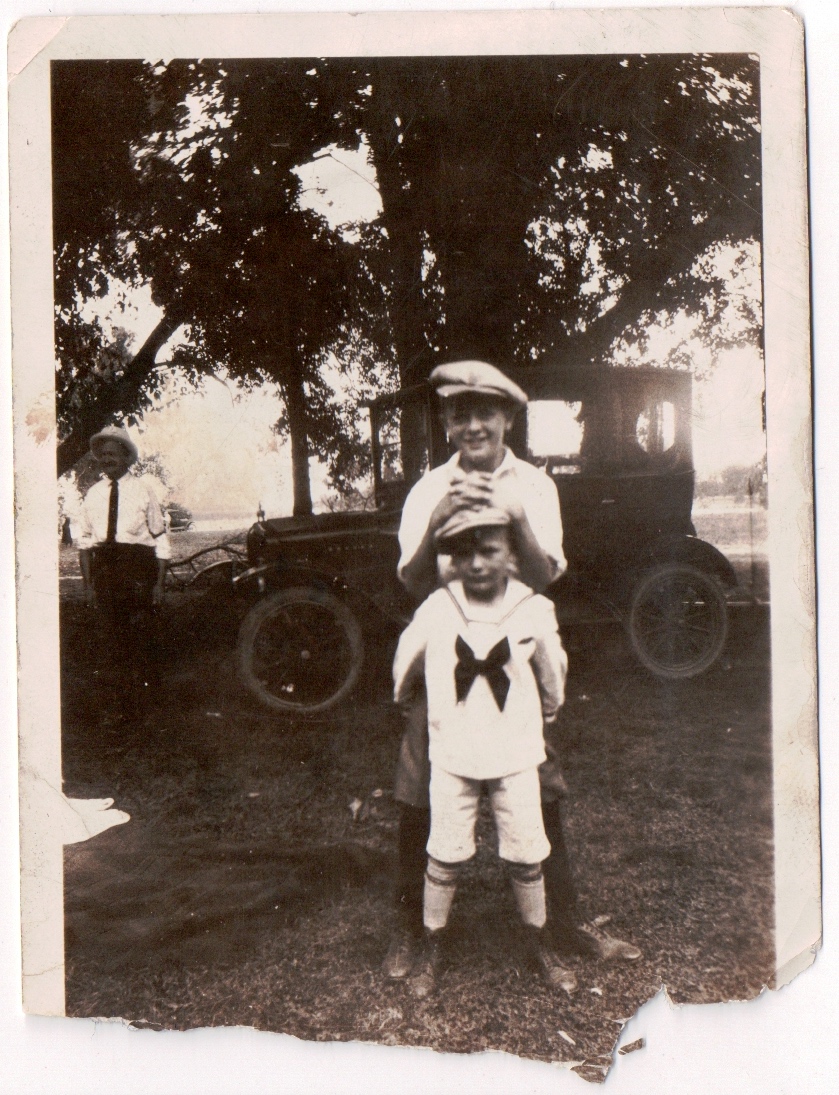
It might have been a late summer’s day when brothers Roy and James Walsted of Sioux City, Woodbury County, Iowa posed for this snapshot circa 1924. Six years apart in age, Roy was perhaps twelve and Jim perhaps six when this photograph was taken some ninety years ago.1 The park-like setting and the blanket at their feet suggest that the occasion may have been a picnic. Classic car aficionados could likely date the vehicle parked behind the boys.

SCAN0323 - Version 2

Roy Louis Christian Walsted (back) and James Herman Walsted (front), Sioux City, Iowa, ca. 1924; digital image 2015, privately held by Valene Petersen, 2015.

Roy suffered from polio as a child, which resulted in a limp as one leg was left shorter than the other. His younger brother was said to have come to his defense when Roy was bullied or was the last to be chosen for a neighborhood baseball team.2 Even in this photograph, it appears that Jim stands guard in front of his brother, his arms protectively curved back around Roy’s legs as Roy clasps his hands atop his brother’s head. Both boys wear short pants and newsboy caps; Jim is in a sailor suit, a style that remained popular for young boys in the post World War I era.3

I have to wonder who the man off to the side of the photograph could be. I have only seen two small snapshots of Roy and Jim’s father, both of which were taken late in his life. (I suppose there is a third if I count a postmortem photograph of him at his own funeral.) From those, I know that he was a man of slight build, but beyond that, I have no way of telling whether this gentleman in a straw boater hat and rolled shirtsleeves is in fact James Jacob Walsted or not. If this picnic was a family affair, perhaps the boys’ mother, Kathrine, was behind the camera.

This charming snapshot is one of a handful of photographs that I have in my digital collection of the Walsted brothers and their parents, both immigrants who came to Iowa from Denmark in the early twentieth century. For more photographs of the family of James Jacob Walsted (1886-1956) and Kathrine Christensen (1886-1971), check out my new Walsted Family Album

Copyright © 2015 Melanie Frick. All Rights Reserved.

Continue reading

The Pomeranians: Identifying a Family Photo

If you’d asked me about this photograph a few years ago, I might said that Joachim and Sophia were, in fact, Ernst and Friederike. That is, I might never have identified the couple in this cabinet card photograph if it weren’t for a few subtle clues that pointed me conclusively in the direction of one immigrant couple over another.

My grandmother’s paternal grandparents both came to America as infants, the son and daughter of Pomeranians from the region now known as Mecklenburg-Vorpommern, Germany. The first couple to reach America, Joachim and Sophia (Cammin) Wiese, traveled from Hamburg in 1868.1 The second couple, Ernst and Friederike (Wagner) Stübe, traveled from Hamburg in 1869.2 Both couples settled initially in Chicago, although within a few years, Ernst and Friederike would move to a rural community outside the city. The couples were born within several years of each other, and no other identified photographs of either couple existed in my collection in order to aid in their identification. Based on the provenance of this photograph in a family collection, I knew that it must show one of these two couples.

JoachimWieseSophiaCammin

Joachim and Sophia (Cammin) Wiese, ca. 1885-1890, Chicago, Cook, Illinois; digital image ca. 2000.

The man and woman in this photograph are perhaps in their mid-fifties, give or take a decade. The photograph itself, taken by an unidentified Hansen of Chicago, is a cabinet card, a style that became popular after the Civil War.3 This, of course, fits the time period in which the Wieses and Stübes would have lived in Chicago. However, as both couples were only around thirty years of age in 1870, this photograph was more likely taken at some point between 1880 and 1900.

The woman in the photograph wears her hair parted in the middle and pulled back snugly, a no-nonsense style that is not specific to any era. Her ears are pierced and she wears what appears to be a dark wool suit with a fitted basque jacket featuring a high ruffled collar, a single row of buttons, and cuffed sleeves. Notable is the double row of boxed pleats on her underskirt; this style was popular in the latter half of the 1880s, as was the style of her jacket.4

The man is clean-shaven except for a trimmed neckbeard, and his hair is brushed away from his face. He has light-colored eyes – blue or green – and wears a typical three-piece suit. The age of the couple in this photograph as well as their style of dress suggest that, if this photograph was taken to mark a particular occasion, it may have been to commemorate an event such as their twenty-fifth anniversary.

Joachim and Sophia would have celebrated their twenty-fifth anniversary circa 1890, a date calculated based on their ages and the birthdate of their eldest known child.5 Ernst and Friederike, however, did not reach such a milestone; Ernst died in 1879 at the age of forty.6 As the woman’s clothing in particular is markedly different from the styles of the 1870s, this photograph could not have been taken before 1879, and thus cannot be a photograph of Ernst and Friederike (Wagner) Stübe.

A final clue comes from the notation penned at the bottom of the cabinet card by a descendant: “Fatte + Matte?”7 A letter written by the granddaughter-in-law of Joachim and Sophia noted that his grandsons could not recall their names, but had called them “Fatta” and “Mota.”8 Coincidence? I don’t think so. My hunch is that these are phonetic spellings of perhaps an old dialect-based variation of the German words for father and mother, Vater and Mutter. This is how Joachim and Sophia (Cammin) Wiese were remembered by their children and grandchildren.

Copyright © 2015 Melanie Frick. All Rights Reserved.
Continue reading

The Trailblazers

Jensine Kathrine and Lars Marinus Walsted were the first of their siblings to leave Denmark for America. Sine (also spelled Sena) was eighteen and Lars Marinus twenty when they arrived in Boston on 19 April 1886 aboard the Catalonia and made their way to Council Bluffs, Pottawattamie County, Iowa.1 It would be seven years before they would see another member of their family, although eventually, all of their surviving siblings would make their way to America.

Marinus_Walsted_Jensine_Walsted_1887

Lars Marinus “Charles” Walsted, 21, and Jensine Kathrine “Sine” Walsted, 19, half-siblings, Council Bluffs, Iowa, 1887; digital image 2014, privately held by Dianne Anderson, 2015.

This 1887 cabinet card photograph was likely taken outside in the summertime, as real grass appears in front of the outdoorsy backdrop. In addition, Sine poses with a parasol, certainly a warm-weather accessory. Both are smartly dressed, Lars Marinus in a light-colored three-piece suit and Sine in a plaid dress with a straight skirt and snug sleeves that, as was typical of the time, do not quite reach her wrists.2 A flower is pinned at her throat. Their hats – Sine’s quite elaborate – rest at their feet. Lars Marinus parted and combed his hair neatly, while Sine’s hair is pulled back tightly and does not seem to be styled in any special way. Iowa summers can be hot and humid, rather unforgiving to the curled fringe often worn by young women of the era!

At nineteen and twenty-one, these fair-complexioned half-siblings had their lives ahead of them. Having become established among a community of Danes in the Council Bluffs area, Sine and Lars Marinus may have wanted to have their picture made so that their parents could see how well they were doing after a year away from home. As the eldest children and trailblazers for life in America, they may also have hoped to encourage their five siblings to join them when they were able. While this photograph remained in Sine’s possession until she gifted it to her daughter in 1932, it’s easy to imagine that another copy may very well have accompanied a letter home to Denmark.

Copyright © 2015 Melanie Frick. All Rights Reserved.

Continue reading

Searching for Marguerite

There is both good and bad news about this photograph:

Unidentified_Marguerite_Chicoine_Adam

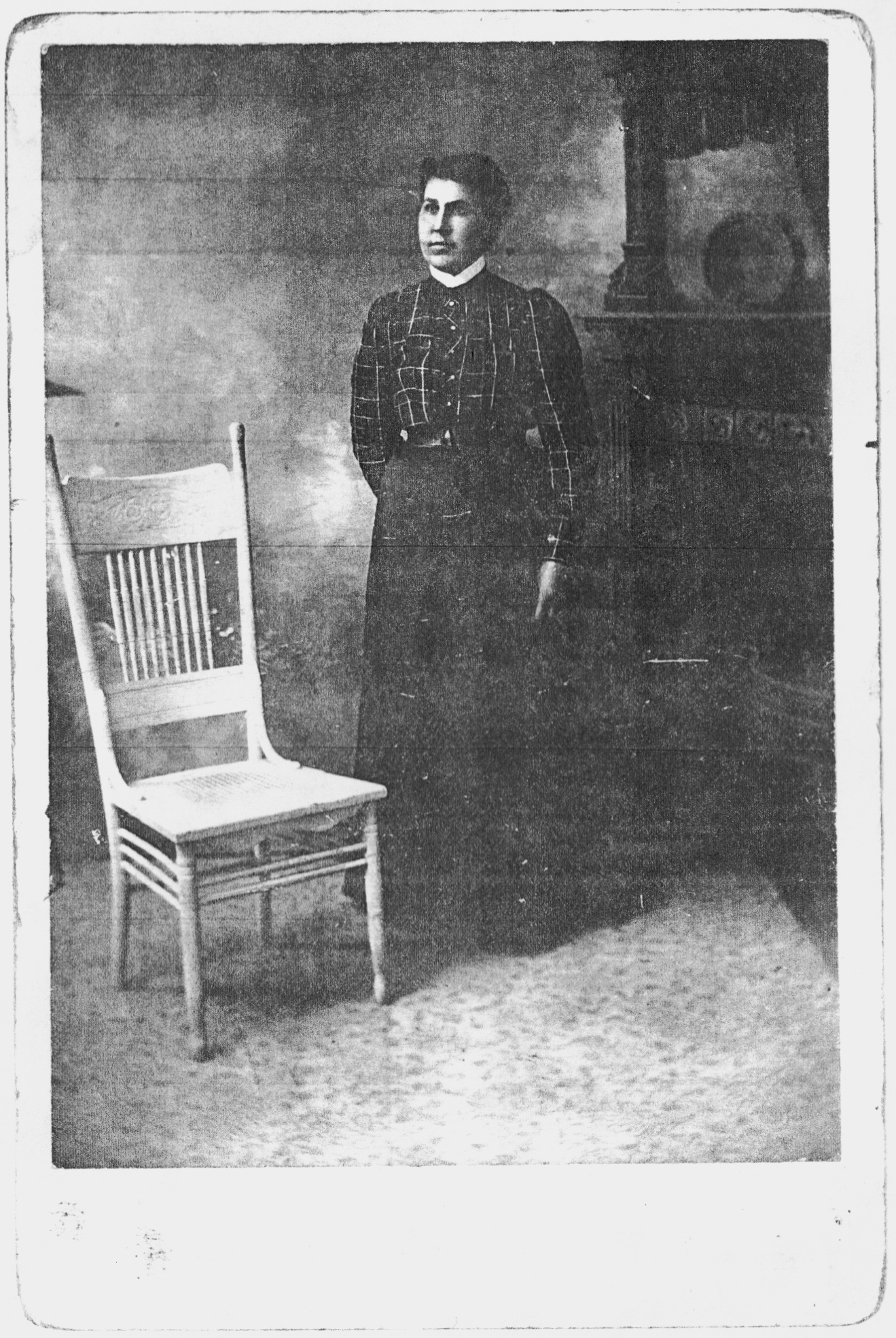
Unidentified photograph, ca. 1860-1866; digital image 2015, privately held by Melanie Frick, 2015. Image courtesy of D.B.

Twenty-seven years ago, my parents traveled to Massachusetts and made a stop in the community of Indian Orchard, where, my father knew, his ancestors had lived for a time in the latter half of the nineteenth century. As it turned out, these French Canadian immigrants had descendants who still lived in the area, and thanks to the staff at Saint Aloysius Parish, he was able to connect with one such descendant. Later, he began corresponding with two more cousins, both of whom were kind enough to share their research about our shared French Canadian and Acadian ancestors. Family lore and even a few photographs were also exchanged – including this photocopied image thought to be a photograph of Marguerite (Chicoine) Adam (1816-1878).1

Marguerite Chicoine is one of the first ancestral names I learned as a child and amateur family historian. I loved hearing that she was said to be Native American – a bit of family lore since (mostly) disproven, but it did work quite effectively to capture my attention at the time. I had always hoped to see the original of this photograph that was sent to us by our late cousin, but learned two years ago that an original may no longer exist. Apparently, when she was moved to a nursing home, her family history materials were thrown out.2 This serves as an important reminder to make an estate plan for the preservation of your own family history materials.

While I can’t rule out that somewhere out there, a cousin might hold another copy of this same photograph – that fortunate scenario has happened before – it’s also possible that this is the only version of this photograph that I will ever see. In any case, let’s take a look. Could this realistically be a photograph of Marguerite Chicoine?

Marguerite died in Massachusetts in 1878 at the age of 62.3 Thus, this photograph would have to predate 1878. As the photocopy indicates that this was a carte de visite – most popular between approximately 1860 and 1866 – that is entirely possible.4 All of Marguerite’s fifteen known children were born before 1862, with the exception of her youngest, who was born five years later. As Marguerite relocated with her family from Quebec to Massachusetts circa 1864-65, it seems plausible that she may have had her picture taken during this time period as a memento to share with relatives at home.5

Marguerite was fifty years old when her youngest child was born at the tail end of the most likely timeframe for this photograph; in order to have had a healthy pregnancy so late, perhaps she had a more youthful appearance than one might otherwise imagine for a mother of fifteen. The woman appears to have dark hair without noticeable graying, and her dark complexion and strong nose make it easy to see how rumors of significant Native American ancestry could have gotten started. However, I find it difficult to get a sense for her age, due in part to the poor quality of the image. Could she be over forty-five, or is this woman in fact decades younger?

Marguerite did have three daughters who would have reached adulthood by the 1860s: Marguerite Adam, Marie Adam, and Julienne Adam.6 While I do have a photograph of Marguerite, who does not appear to be a match, could this photograph show instead either Marie or Julienne as a young woman in her early to mid-twenties?

The woman wears a buttoned shirtwaist with a windowpane pattern, the sleeves neither significantly fitted nor puffed, and a high linen band collar is visible.7 Her belted skirt is of a straightforward design. Notably, it is not worn with a fashionable hoop as one would typically expect in the 1860s; this more unassuming skirt would perhaps have been in line with what a woman in rural Quebec or an immigrant in a New England mill town might wear.8 The backdrop is similarly domestic in style with a practical wooden chair and what looks to be a fireplace.

The good news? This could be a photograph of Marguerite Chicoine. It depicts a dark-complected woman of evidently simple means who was photographed in the 1860s, a physical description, socioeconomic background, and timeline that fit with what is known about Marguerite.

The bad news? We may never know for sure. It seems equally plausible that could be a photograph of one of Marguerite’s daughters or a close relative. Lacking an original for closer examination, it can still be hoped that another copy of this photograph might exist in different branch of the family, and that it may hold additional clues regarding the true identification of the mysterious dark-haired Québécois.

Copyright © 2015 Melanie Frick. All Rights Reserved.

Continue reading

A Paper Moon

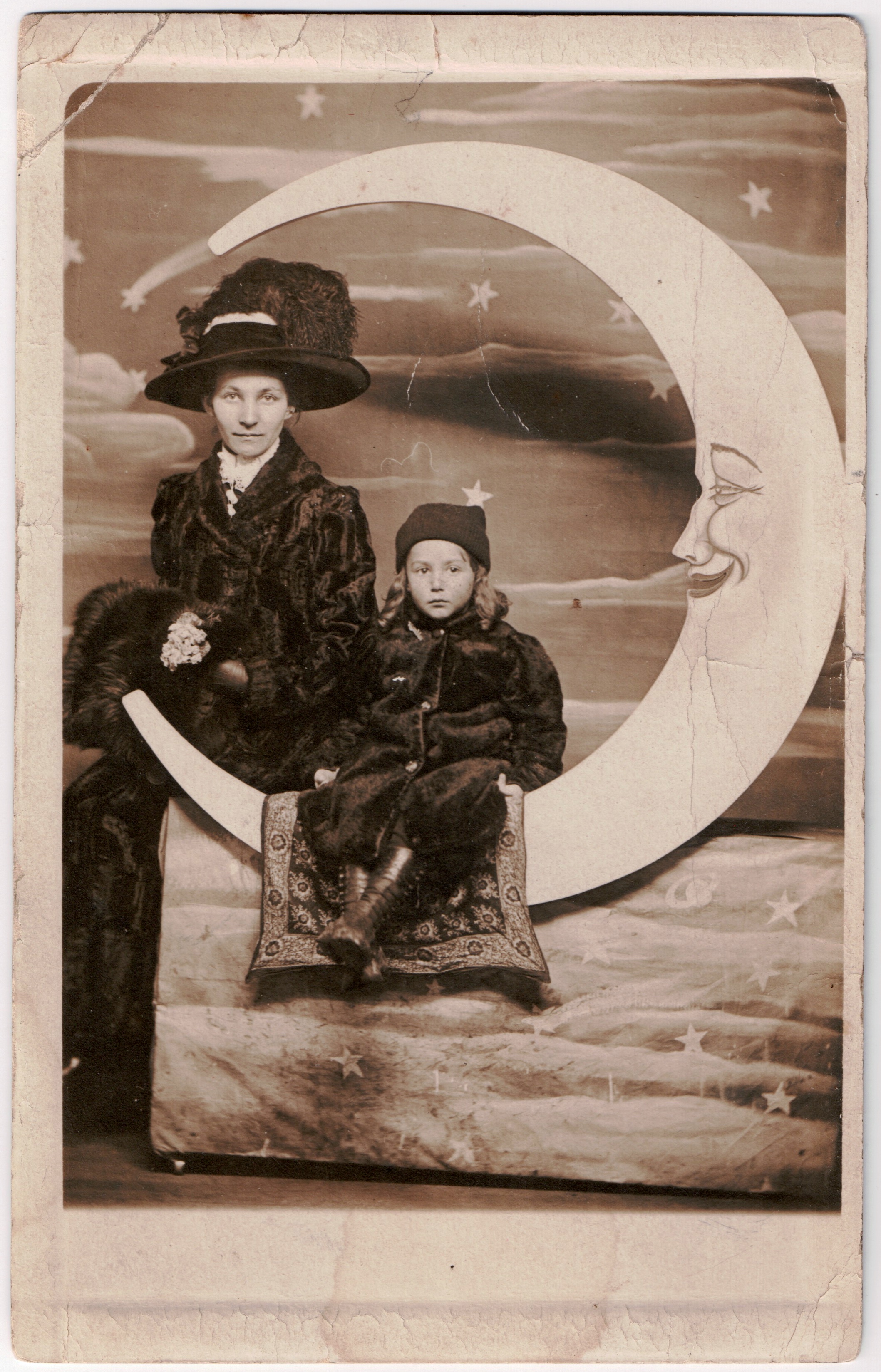
When I began researching the topic of paper moon photography, I was surprised to find that these crescent moon photo booth props are making a comeback by way of trendy, vintage-style wedding decor. In case you didn’t know, flappers are big these days, and the popularity of this era has influenced a new generation to pose for classic shots with a smiling man in the moon. However, paper moon photo booths got their start even before the days of Gatsby, likely around the turn of the twentieth century.1

SCAN0096

Melanie (Lutz) and son Gerald Adam, Sioux City, Iowa, ca. 1912; digital image 2014, privately held by Melanie Frick, 2015. Collection courtesy of David Adam.

This particular paper moon photograph was printed on a real photo postcard circa 1912. The moon backdrop itself is not one of the more elaborate, with an obvious break in the night sky for seating purposes. In fact, what looks like a wheel to roll the seat into place is also visible, and a small “magic carpet” conceals the primary seating area. The crescent moon smiles, and the stars, as is typical among paper moon photography, are present even within the crescent – where, realistically, they would be blocked by the moon in shadow. A shooting star can be spotted at the upper tip of the crescent, and a planet appears below the moon.

The mother and son posed here are Melanie (Lutz) and Gerald “Jerry” Adam of Sioux City, Woodbury County, Iowa. Both are dressed in long fur coats, Melanie’s of a fashionable collared design while Jerry’s is fastened simply with three large buttons. A glimpse of Melanie’s leather gloves is visible, and a stylish plumed hat is atop her head. Jerry wears a practical stocking cap and high button boots. His curls are long, to his shoulders, which was not atypical among young boys of the era.

Given their attire, it is obvious that this photograph was taken on a cold winter’s day. Perhaps the paper moon photo booth was set up outdoors or in an unheated (or under-heated) space as a temporary attraction; this mother and son may have simply stumbled upon it and decided to surprise Jerry’s father with their fun souvenir. As Jerry was born in the summer of 1908,2 it seems most likely that this photograph dates to the winter of 1911-1912, or, at the latest, the winter of 1912-1913. January 1912 in particular was a cold month, with Sioux City registering a record low of −35°F on 12 January.3 However, even beyond such extremes, Sioux City was no stranger to weather that would have required one’s warmest winter coats for a visit to the moon!

Copyright © 2015 Melanie Frick. All Rights Reserved.
Continue reading

…and a Happy New Year!

George Fenton Thoma, the son of George Hiram and Anna Leota (Fenton) Thoma, was eight years old when he scrawled these holiday greetings to his cousin, Glen Hoffman.1 Glen, the son of Joseph and Minnie Bell (Fenton) Hoffman, was one year Fenton’s senior.2 Whether the boys – Fenton in Nebraska, Glen in Iowa – had actually met or were merely pen pals at their mothers’ urging is unknown, as the sentiments expressed on the postcard are not of a particularly personal nature:

SCAN0133

George Fenton Thoma school postcard, Decatur, Nebraska, 1911; digital image 2014, privately held by Melanie Frick, 2014. Collection courtesy of David Adam.

This postcard is another piece of the puzzle of the Thoma family. A decade prior, Fenton’s father, George Hiram Thoma, had married under the alias of George A. Neilson, and he proceeded to use the Neilson surname along with his wife and children at least until 1909. The family moved frequently throughout Iowa and Nebraska; according to the postmark here, they may have resided in or near Decatur, Burt, Nebraska, as of late 1911. It is also possible that they were guests in the home of Leota’s mother during the holiday season and in fact lived elsewhere.3 Unfortunately, Fenton did not sign his full name – so it is up for debate whether he was a Neilson or a Thoma at the time!

SCAN0132

George Fenton Thoma school postcard, Decatur, Nebraska, 1911; digital image 2014, privately held by Melanie Frick, 2014. Collection courtesy of David Adam.

The reverse of this postcard shows a school photograph. Fenton can be spotted in the first row of students, third from left, in a collared striped shirt and dark trousers. The gathering of students is casual – there are untucked shirts, fidgeting hands, smiles and scowls. Fenton, his expression eager, has his eyes directly on the camera and seems to edge forward as his head partially obscures that of the boy behind him.

While I have in my collection many postcard-style photographs, this may be the only one that was actually addressed and mailed as a postcard. At some point thereafter, it was apparently returned to the Thoma family, as it was found in the collection of Fenton’s younger sister. Perhaps it was returned after Fenton’s unexpected death at the age of forty-four, as it is likely one of only a few photographs of him as a child.4 The cost of the one cent postage was likely well worth it to Fenton in exchange for the chance to show off his class picture and his painstaking penmanship as he wrote to his cousin, “I wish you a Merry Xmas and happy new years.”

Continue reading

A Turn of the Century Danish Confirmation

Like most young Danes, Kathrine Christensen was just about fourteen years old when she was confirmed as a member of the Lutheran church.1 This ceremony, which took place on 22 April 1900, would also have signified the conclusion of her formal schooling, making it, in a sense, a graduation ceremony as well.2 Kathrine, the youngest daughter of Laust Christensen and Ane Nielsen of the rural community of Taabel, was confirmed at the imposing Vestervig Abbey, said to be the largest village church in all of Scandinavia.

KathrineChristensen02

Kathrine Christensen, 1900, Hurup, Thisted, Denmark; digital image 2013, privately held by Nicole Kilanowski, 2014.

For Kathrine, this occasion may have warranted posing for a formal portrait in her elegant confirmation dress, as this photograph is believed to have been taken in honor of her confirmation. The photographer, A.B. Hansen, was based in Hurup, a railroad town about seven kilometers east of Vestervig. Perhaps Kathrine ventured there for her portrait, or else an enterprising photographer may have seen reason to take advantage of the confirmation crowd by setting up a temporary studio in Vestervig.

This cabinet card portrait features Kathrine standing before a painted backdrop and behind a high back chair, upon which she rests her arms in a way that hides her fingertips but displays a wide ring on her left hand. Perhaps this was a confirmation gift, as despite what its placement suggests today, it is certainly not a wedding ring. Kathrine’s brown hair is pulled into a braid or bun, with a few soft curls loosely framing her face. Her dress is of a popular pigeon-breasted style and appears to be white. It has sweet eyelet lace trim at the high neck and long sleeves, which are slightly puffed on the upper arms. Kathrine’s expression is serious, even cautious; although her attire is sophisticated, she still looks very much like the thirteen-year-old she is.

Kathrine Christensen Confirmation 1900

Vestervig Parish (Vestervig, Denmark), Konfirmerede Piger, Kathrine Christensen (1900). Record courtesy of Janet Walsted.

In addition to acknowledging the completion of schooling, at one time, confirmation records in Denmark also typically included a notation of whether the individual had received a smallpox vaccination. This practice, started around 1814, must have been the most feasible method of ensuring that all were vaccinated in order to prevent the spread of disease.3 Today, certainly, medical records are maintained apart from the church, and of course, Danish youth attend school beyond eighth grade. While confirmation ceremonies remain significant in Danish culture, as a whole these affairs are commonly celebrated in a traditional sense and are more secular than in the past – if not entirely secular, as “nonfirmations” have also become part of the norm. Danes honor their coming-of-age with family, friends, a formal dinner, and lavish gifts.4

At the time of Kathrine’s confirmation, several of her siblings had already immigrated to America. This photograph was found among the possessions of one of their descendants, which suggests that it was originally sent to those who might have liked to have seen how their youngest sister was growing up. In fact, another photograph in this collection shows Kathrine as she neared her twentieth birthday, shortly before she, too, said farewell to Denmark.5

Continue reading

Herman and Augusta Rice, “The Most Extraordinary Dwarfs of the Age”

Headlined as “The Musical Midgets,” Herman and Augusta Rice were deemed in one newspaper advertisement to be “the most interesting little people now before the public.”1 Another called them “German Midgets” and noted that they were “The Most Extraordinary Dwarfs of the Age.”2 This carte de visite of Herman and Augusta Rice, like that of the sideshow performer Ada Zingara, was found in an antique album that once belonged to an unidentified family of Kaukauna, Wisconsin.3

SCAN0915

Herman and Augusta Rice photograph, ca. 1880s, New York, New York; digital image 2014, privately held by Melanie Frick, 2014.

Herman and Augusta Rice appear dressed in fine Victorian fashion and stand next to pillars to emphasize their short stature. Augusta’s hairstyle is particularly striking; a flat bow adorns the top of her head, and small curls are arranged across her forehead in such a way that it almost seems as though they could be part of a hairpiece. The bow and flattened style of her bangs were fashionable in the late 1870s.4 She wears a carefully fitted gown with a train and no shortage of flounces, ruffles, and lace trim. With a locket or pendant necklace and a bracelet setting off her ensemble, Augusta appears to be dressed very well indeed. Herman looks equally sharp in a formal fitted dinner jacket with a pocket watch and freshly shined shoes.

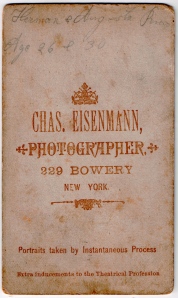
SCAN0916The photograph was taken by Charles Eisenmann, a photographer in the rough-and-tumble Bowery district of New York City who frequently photographed performers such as these.5 Although he was employed as a photographer in the city as early as 1876,6 he didn’t make the move to 229 Bowery, the address stamped on the back of this photograph, until 1879 or 1880.7 Eisenmann remained at this location at least until 1883.8

Herman and Augusta Rice, an alleged brother-sister pair, appeared at Harris’ Mammoth Museum in Cincinnati in 1883,9 were affiliated with Keith and Batcheller’s Mammoth Museum in Boston in 1884,10 and were showcased as curiosities at Forepaugh’s Dime Museum in Philadelphia in 1885.11 They had toured with P. T. Barnum in 1877, at which time they, along with a third sibling, Johanna, used the more Germanic surname Reis.12 One wonders, however, whether these names were merely a part of their identities as performers.

Who were they, and what became of them when their dime show days were over?

Continue reading

The Lutz Sisters

HattieJuliaAnnaMelanieLutz

Sisters Hedwig, Julia, Anna, and Melanie Lutz, ca. 1900, Minnesota; digital image 2010, privately held by Melanie Frick, 2013.

Julia, Anna Marie, Hedwig “Hattie” Eulalie, and Melanie Veronica Lutz were the daughters of French and Polish immigrants, respectively Joseph and Hedwig (Cichos) Lutz of Minnesota Lake, Faribault County, Minnesota.1 By the time that this photograph was taken, circa 1900, Joseph had passed away, and Hedwig had remarried and given birth to five additional children.2 Her eldest daughters must have been close, however, as they chose to have a photograph taken of just the four of them.

Standing with her arms protectively behind her seated sisters is Hattie, who would have turned nineteen in the year 1900.3 Although her position suggests that she was the eldest, she was not; it’s possible that she may have been the tallest, however, if the photographer were to have posed the sisters based on height. She is also the only sister wearing a dress with a white collar, offering contrast; the other sisters seem to be wearing their good black dresses. None of the dresses, however, are alike, each having unique decorative pleats, panels, and/or bows. The collars are extremely high, perhaps an example of what would have been known as “officer’s” collars.4

Julia is seated at right, her dark eyes serious. She would have turned twenty-four in 1900, and was the eldest of the sisters.5 Seated at the center is Anna, who would have turned twenty-two that year.6 Melanie, the youngest, is at left; she would have celebrated her sixteenth birthday in 1900.7

At this time, all four sisters had left their mother’s household.8 Julia was married with two young children at home; she and her husband kept a hotel,9 and Anna was employed as a servant there.10 Hattie lived with her elderly maternal grandparents.11 As Melanie cannot be located in the 1900 U.S. census, she may have been away at school, where she trained to become a teacher. Later in life, Julia, Anna, Hattie, and Melanie made their homes in four different communities across three different states, but their sisterly bond is apparent in this photograph of them as young women.


SOURCES
1 “Minnesota, Marriages, 1849-1950,” index, FamilySearch (https://familysearch.org : accessed 15 Nov 2013), Joseph Lutz and Hedwig Joice, 19 April 1875. Cichos was likely transcribed incorrectly as Joice.
2 1900 U.S. census, Faribault County, Minnesota, population schedule, Minnesota Lake, enumeration district (ED) 92, sheet 10-B, p. 4834 (penned), dwelling 178, family 178, Hattie Rendfleisch; digital image, Ancestry.com (http://www.ancestry.com : accessed 15 November 2013), citing National Archives microfilm publication T623, roll 763. Rendfleisch was a variation of Rindfleisch.
3 “Minnesota, Births and Christenings, 1840-1980,” index, FamilySearch (https://familysearch.org : accessed 15 Nov 2013), Hedwig Lutz, 06 September 1881.
4 Joan Severa, Dressed for the Photographer: Ordinary Americans and Fashion, 1840-1900 (Kent, Ohio: Kent State University Press, 1995), 526.
5 “Minnesota, Births and Christenings, 1840-1980,” index, FamilySearch (https://familysearch.org : accessed 15 Nov 2013), Julia Lutz, 13 December 1876.
6 “Minnesota, Births and Christenings, 1840-1980,” index, FamilySearch (https://familysearch.org : accessed 15 Nov 2013), Anna Lutz, 12 May 1878.
7 “Minnesota, Births and Christenings, 1840-1980,” index, FamilySearch (https://familysearch.org : accessed 15 Nov 2013), Melanie Veronica Lutz, 28 May 1884.
8 1900 U.S. census, Faribault Co., Minn., pop. sch., Minnesota Lake, ED 92, sheet 10-B, p. 4834, dwell. 178, fam. 178, Hattie Rendfleisch.
9 1900 U.S. census, Nobles County, Minnesota, population schedule, Adrian, enumeration district (ED) 209, sheet 2-B, p. 43 (penned), dwelling 29, family 29, Julia McColm; digital image, Ancestry.com (http://www.ancestry.com : accessed 15 November 2013), citing National Archives microfilm publication T623, roll 778.
10 1900 U.S. census, Nobles County, Minnesota, population schedule, Adrian, enumeration district (ED) 209, sheet 2-B, p. 43 (penned), dwelling 29, family 29, Anna M. Lutz; digital image, Ancestry.com (http://www.ancestry.com : accessed 15 November 2013), citing National Archives microfilm publication T623, roll 778.
11 1900 U.S. census, Faribault County, Minnesota, population schedule, Minnesota Lake, enumeration district (ED) 92, sheet 5-A, p. 4719 (penned), dwelling 73, family 73, Hattie Lutz; digital image, Ancestry.com (http://www.ancestry.com : accessed 15 November 2013), citing National Archives microfilm publication T623, roll 763.

Ada Zingara, Sideshow Performer

Tucked into the slots of an antique album filled with photographs of an unidentified family of Kaukauna, Outagamie County, Wisconsin, are several photographs of sideshow performers.1

Ada Zingara photograph, ca. 1890s, Chicago, Illinois; digital image 2013, privately held by Melanie Frick, 2013.

Ada Zingara photograph, ca. 1890s, Chicago, Illinois; digital image 2013, privately held by Melanie Frick, 2013.

The name Ada Zingara is handwritten on the back of this photograph, which features a woman posing in a rather scandalous fashion. Her dress is short, and she stands with one leg elevated on a bench as she pretends to fasten her pointy-toed shoe. Her stockings feature bold zigzags, and her dress is patterned as well. The bodice is trimmed with lace and loose cap sleeves, and the border of her lace-trimmed petticoat is also visible. She wears earrings, and a large, bejeweled crucifix lies at her throat. What is most striking is her hairstyle: Ada’s hair is teased into an Afro.

A search for Ada Zingara informed me that, in the early 1900s, she was a snake charmer. A 1906 sideshow advertisement specified that she had a den of “Five Big Anacondas.”2 However, I wondered why she was not posing with snakes in this picture, which was surely printed for publicity. And why did she have such a dramatic hairstyle?

Further research informed me that the circus great P.T. Barnum began exhibiting women with this hairstyle in the 1865, calling them Circassian Beauties. According to reports of the time, the women of the mountainous region near the Black Sea were particularly beautiful, and were prized by Turkish sultans who kidnapped them for their harems. Barnum capitalized on this sensational story, seeking first to purchase one of these slave girls abroad, and eventually settling for a local girl with teased hair (which was not an accurate Circassian style) who was merely marketed as a Circassian.3 Eventually, as the popularity of the Circassian Beauties waned, the women adopted other acts, including routines as equally alluring snake charmers.4

A close look at her face reveals that Ada Zingara is not very young. There are lines around her eyes, which gaze warmly at the camera. Her lips part in a faint smile, showing her teeth – and a possible missing tooth. Why did Ada turn to sideshows, and what became of her? What was her real name?

What I find especially interesting is the fact that this photograph occupies the very first page of the album – the page usually reserved for an important family member or the primary subject of the album.4 Of course, it’s possible that the photographs were rearranged in the years that this album made its way from its original home to the antique store. Whatever the case, it should be noted that this is not the only photograph of a circus or sideshow performer located in the album. The family of Kaukauna, Wisconsin must have enjoyed these attractions!

Did your ancestors collect photographs of circus or sideshow performers?


SOURCES
1 Unidentified Album of a Kaukauna, Wisconsin Family, ca. 1870-1900; privately held by Melanie Frick, 2013.
2 “Ada Zingara,” The Billboard, 14 April 1906, digital image, Old Fulton Post Cards (http://www.fultonhistory.com : accessed 27 September 2013).
3 Wikipedia (http://www.wikipedia.org), “Circassian Beauties,” rev. 18:32, 3 July 2013.
4 Katherine H. Adams and Michael L. Keene, Women of the American Circus, 1880-1940 (Jefferson, North Carolina: McFarland and Company, 2012), 142; digital images, Google Books (http://books.google.com : accessed 27 September 2013).
5 “’Reading’ A Family Photo Album,” Photo Detective with Maureen A. Taylor, 22 September 2013 (http://blog.familytreemagazine.com/photodetectiveblog/ : accessed 27 September 2013).