Tag Archives: immigrants

Wedding Wednesday: Puffed Sleeves

On a late September day in 1896, Elizabeth Hoffman of North Washington, Chickasaw County, Iowa affixed a gauzy, floor-length veil to her hair. It may have been crowned with flowers, although the faded photograph does not make this clear. Flowers or foliage of some kind – perhaps even autumn leaves? – were indeed attached to the front of her dress, although she wore no white gown. Her best dress was likely black or another dark color and fashionably made with a gathered bodice, narrow waist, and sleeves generously puffed to the elbow. (Anne Shirley would have been envious.)

Elizabeth’s attire is evidence that, at this time, even recent immigrants living in rural areas of the United States were aware of the latest fashion trends. Corsets were not worn by all women in the 1890s, and Elizabeth, already slim, was not dramatically corseted if she was at all.1 The gathered bodice was of a style worn throughout the decade, and while the care of these full leg o’ mutton sleeves was time-consuming, they were at the height of popularity in the middle of the decade.2

MathiasElizabethWedding

Mathias Noehl and Elizabeth Hoffman, wedding, North Washington, Iowa, 1896; digital image 2001, original held by J.H., 2015.

At the age of twenty-seven – her birthday had been just the week before – Elizabeth was to marry a fellow immigrant, Mathias Noehl.3 As it so happened, he hailed from the village of Holsthum, Bitburg-Prum, Rheinland-Pfalz, Germany, which neighbored her own home village of Prümzurlay.4 By all accounts, however, their first meeting took place in northeastern Iowa, where Mathias encountered Elizabeth, whom he called Lizzie, at the Immaculate Conception Church in North Washington. She lived there as the housekeeper of Father Probst and the Sisters of Charity.5 The couple was married there on 22 September 1896 and may have celebrated with Elizabeth’s mother and siblings, who had also made Chickasaw County their home.6

A copy of Mathias and Elizabeth’s wedding portrait was shared with me by a relative; I suspect the original is a cabinet card photograph, popular at the turn of the century. I can’t make out much of the setting (is it grass or a rug at their feet?), but Mathias sits in a wicker chair while Elizabeth stands to the side, her right hand on his shoulder. In her left hand is clutched a small book, perhaps a prayerbook. As was typical of the time, neither of the newlyweds smile, and their faces are so faded in the copy that it’s difficult to see the direction of their gazes. Mathias has short hair; in his memoirs, he wrote that that, upon meeting Elizabeth, his blond hair was “unkempt like dried up flowers of the cemetery,” so a haircut may have been in order!7 He has a tidy mustache and wears a wool suit and white shirt. At twenty-eight, having recovered from an earlier heartbreak during his first years in America, he was prepared to settle down and start a family.8 Mathias and Elizabeth would go on to raise nine children on their farm.

This wedding portrait is one of several photographs that I have in my digital collection of the family of Mathias and Elizabeth (Hoffman) Noehl, both immigrants who came to Iowa from Germany in the late nineteenth century. For more photographs of the family of Mathias Noehl (1868-1950) and Elizabeth Hoffman (1869-1957), check out my new Noehl Family Album

Copyright © 2015 Melanie Frick. All Rights Reserved.
Continue reading

Tombstone Tuesday: Timothy and Odile (Millette) Adam

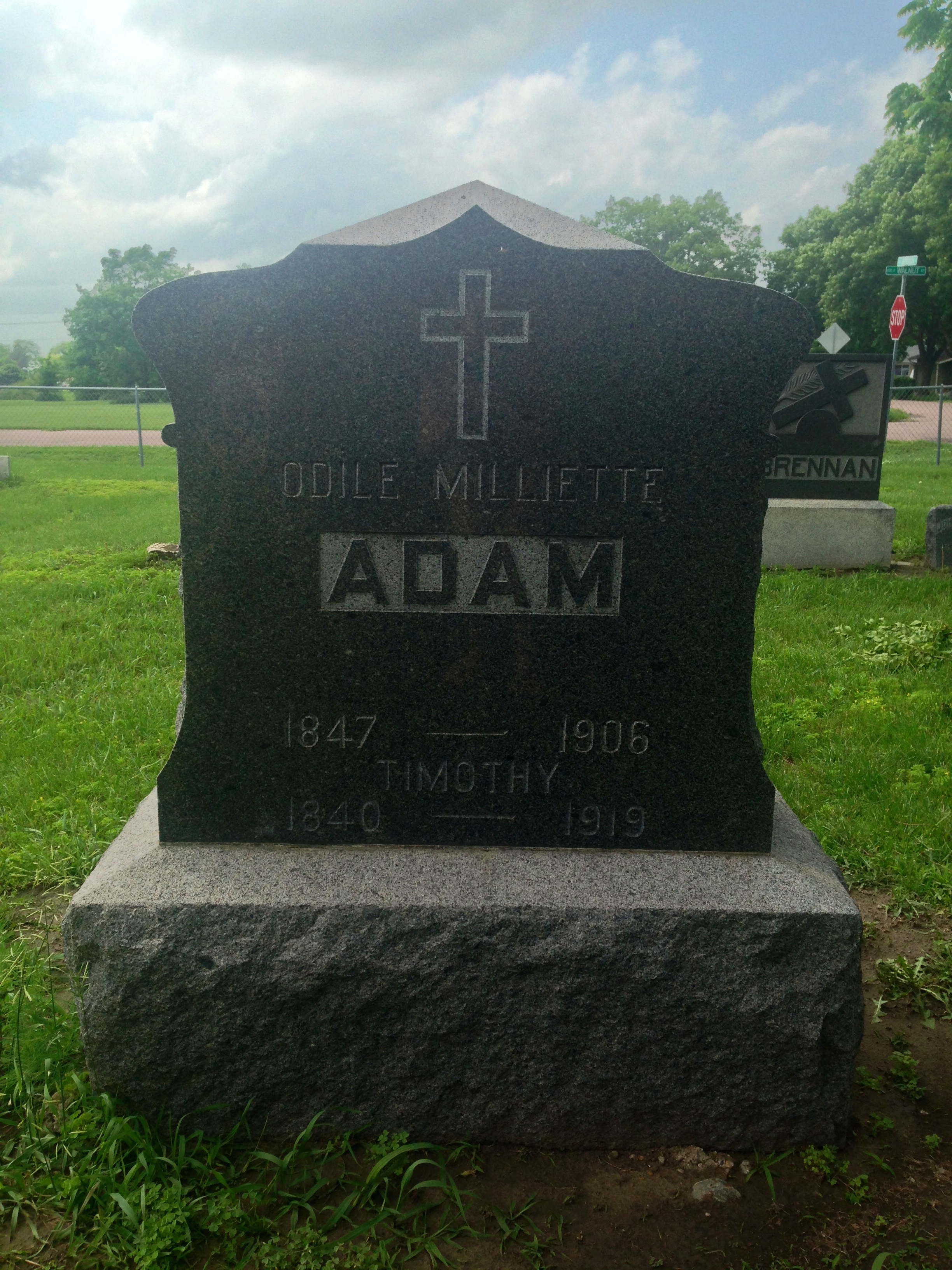
Timothy and Odile (Millette) Adam experienced nearly forty years of marriage together that were anything but ordinary.

Timothy, baptized in St. Pie, Quebec on 8 August 1846, the son of Timothée Adam and Marguerite Chicoine, crossed into America with his family as a teenager.1 They settled near the textile mills of Indian Orchard, Hampden County, Massachusetts, which is where Timothy married at the age of twenty-one on 22 September 1867 to Odile Millette.2 Odile had been born in the French Canadian community of Rouse’s Point, Clinton County, New York on 11 July 1847, the daughter of Maurice Millet and Isabelle Quemeneur dit Laflamme.3 She, too, had relocated to Massachusetts as a teenager, where she also found work in the mills.

The couple was said to have had ten children together, eight of whom have been identified: Timothy Maurice, Alexander Amadée Edmond (known as Edward), Joseph Frederick (known as Alfred), Marie Julie Malvina, Albina Lena, Henry Joseph, Martin Theodore, and Permelia Marie.4 Only five of these children are known to have survived to adulthood; at least one succumbed to scarlet fever as a toddler.5

In 1883, the family made the decision to move west.6 I have to wonder if this move was spurred by the deaths of at least two of their own young children circa 1880, as well as by the deaths of Timothy’s younger brother and sister who died within a week of each other in February of 1883: one of pneumonia at twenty and the other of tuberculosis at twenty-four.7 In fact, tuberculosis had caused the death of Timothy’s mother just five years before.8 Perhaps the idea of fresh air and the countryside appealed to the couple as they must have feared for the health of their children.

Timothy and Odile first joined French Canadian relations in southeastern South Dakota, where a son was born to them in the summer of 1885.9 In December of the following year, Timothy claimed a homestead a short distance away near Moville, Woodbury County, Iowa.10 The family would remain here for a number of years; by 1900, they had relocated to a dairy farm closer to Sioux City.11

The coming years were unexpectedly tumultuous for Timothy and Odile. First, in 1900, their twenty-nine-year-old son Edward, who had been out of touch for nearly a decade, returned home and began harassing his parents and younger siblings. Timothy went to court in order to obtain a restraining order against him.12 Then, over the next several years, Timothy and Odile may have suffered marital discord. Timothy was not recorded in the 1903 Sioux City Directory; he appeared again in the same household as his wife the following year.13 In 1905 he was again absent, and it was at this time that Odile implored the enumerator of the 1905 Iowa State Census to bring her any word of her two eldest sons, Edward and Fred, who had traveled west and had not been heard from in several years.14 It was also in 1905 that Odile recorded her will, leaving her real estate to her three youngest children: Henry, Theodore, and Permelia. No mention was made of her absent sons – or her husband.15

IMG_3451

Grave of Odile Milliette Adam (1847-1906) and Timothy Adam (1840-1919), St. Joseph Cemetery, Elk Point, Union County, South Dakota; 2014, privately held by Melanie Frick, 2015. Note: Timothy’s date of birth on his gravestone is incorrect. He was born in 1846.

In 1906, the final year of Odile’s life, she operated a boarding house at 508 Perry in Sioux City.16 Notably, Timothy resided not at home, but at the Washington House Hotel.17 It does seem possible, however, that the couple reconciled whatever differences they may have had by the time of fifty-nine-year-old Odile’s death from hepatitis on 16 December 1906 in Elk Point, Union County, South Dakota.18 When the 1907 Sioux City Directory was printed at some point in late 1906, likely shortly before her death, both Odile and Timothy were named as residents of 508 Perry.19

Timothy, a carpenter again as he had been in his younger years, remained in the house with his children for only a short time before resettling in nearby Jefferson, Union County, South Dakota. He remained here for the next decade; as of 1910, he operated a billiard hall in this small, largely French Canadian community.20

By 1917, Timothy, now seventy, had returned to Sioux City where he lived with his married daughter.21 He died there on 22 February 1919 at the age of seventy-two, his cause of death recorded as senility.22 Timothy Adam was buried beside his wife, Odile Millette, at St. Joseph Cemetery in Elk Point, Union County, South Dakota, his name squeezed as though an afterthought at the base of her gravestone.

Copyright © 2015 Melanie Frick. All Rights Reserved.

Continue reading

The Pomeranians: Identifying a Family Photo

If you’d asked me about this photograph a few years ago, I might said that Joachim and Sophia were, in fact, Ernst and Friederike. That is, I might never have identified the couple in this cabinet card photograph if it weren’t for a few subtle clues that pointed me conclusively in the direction of one immigrant couple over another.

My grandmother’s paternal grandparents both came to America as infants, the son and daughter of Pomeranians from the region now known as Mecklenburg-Vorpommern, Germany. The first couple to reach America, Joachim and Sophia (Cammin) Wiese, traveled from Hamburg in 1868.1 The second couple, Ernst and Friederike (Wagner) Stübe, traveled from Hamburg in 1869.2 Both couples settled initially in Chicago, although within a few years, Ernst and Friederike would move to a rural community outside the city. The couples were born within several years of each other, and no other identified photographs of either couple existed in my collection in order to aid in their identification. Based on the provenance of this photograph in a family collection, I knew that it must show one of these two couples.

JoachimWieseSophiaCammin

Joachim and Sophia (Cammin) Wiese, ca. 1885-1890, Chicago, Cook, Illinois; digital image ca. 2000.

The man and woman in this photograph are perhaps in their mid-fifties, give or take a decade. The photograph itself, taken by an unidentified Hansen of Chicago, is a cabinet card, a style that became popular after the Civil War.3 This, of course, fits the time period in which the Wieses and Stübes would have lived in Chicago. However, as both couples were only around thirty years of age in 1870, this photograph was more likely taken at some point between 1880 and 1900.

The woman in the photograph wears her hair parted in the middle and pulled back snugly, a no-nonsense style that is not specific to any era. Her ears are pierced and she wears what appears to be a dark wool suit with a fitted basque jacket featuring a high ruffled collar, a single row of buttons, and cuffed sleeves. Notable is the double row of boxed pleats on her underskirt; this style was popular in the latter half of the 1880s, as was the style of her jacket.4

The man is clean-shaven except for a trimmed neckbeard, and his hair is brushed away from his face. He has light-colored eyes – blue or green – and wears a typical three-piece suit. The age of the couple in this photograph as well as their style of dress suggest that, if this photograph was taken to mark a particular occasion, it may have been to commemorate an event such as their twenty-fifth anniversary.

Joachim and Sophia would have celebrated their twenty-fifth anniversary circa 1890, a date calculated based on their ages and the birthdate of their eldest known child.5 Ernst and Friederike, however, did not reach such a milestone; Ernst died in 1879 at the age of forty.6 As the woman’s clothing in particular is markedly different from the styles of the 1870s, this photograph could not have been taken before 1879, and thus cannot be a photograph of Ernst and Friederike (Wagner) Stübe.

A final clue comes from the notation penned at the bottom of the cabinet card by a descendant: “Fatte + Matte?”7 A letter written by the granddaughter-in-law of Joachim and Sophia noted that his grandsons could not recall their names, but had called them “Fatta” and “Mota.”8 Coincidence? I don’t think so. My hunch is that these are phonetic spellings of perhaps an old dialect-based variation of the German words for father and mother, Vater and Mutter. This is how Joachim and Sophia (Cammin) Wiese were remembered by their children and grandchildren.

Copyright © 2015 Melanie Frick. All Rights Reserved.

Continue reading

The Trailblazers

Jensine Kathrine and Lars Marinus Walsted were the first of their siblings to leave Denmark for America. Sine (also spelled Sena) was eighteen and Lars Marinus twenty when they arrived in Boston on 19 April 1886 aboard the Catalonia and made their way to Council Bluffs, Pottawattamie County, Iowa.1 It would be seven years before they would see another member of their family, although eventually, all of their surviving siblings would make their way to America.

Marinus_Walsted_Jensine_Walsted_1887

Lars Marinus “Charles” Walsted, 21, and Jensine Kathrine “Sine” Walsted, 19, half-siblings, Council Bluffs, Iowa, 1887; digital image 2014, privately held by Dianne Anderson, 2015.

This 1887 cabinet card photograph was likely taken outside in the summertime, as real grass appears in front of the outdoorsy backdrop. In addition, Sine poses with a parasol, certainly a warm-weather accessory. Both are smartly dressed, Lars Marinus in a light-colored three-piece suit and Sine in a plaid dress with a straight skirt and snug sleeves that, as was typical of the time, do not quite reach her wrists.2 A flower is pinned at her throat. Their hats – Sine’s quite elaborate – rest at their feet. Lars Marinus parted and combed his hair neatly, while Sine’s hair is pulled back tightly and does not seem to be styled in any special way. Iowa summers can be hot and humid, rather unforgiving to the curled fringe often worn by young women of the era!

At nineteen and twenty-one, these fair-complexioned half-siblings had their lives ahead of them. Having become established among a community of Danes in the Council Bluffs area, Sine and Lars Marinus may have wanted to have their picture made so that their parents could see how well they were doing after a year away from home. As the eldest children and trailblazers for life in America, they may also have hoped to encourage their five siblings to join them when they were able. While this photograph remained in Sine’s possession until she gifted it to her daughter in 1932, it’s easy to imagine that another copy may very well have accompanied a letter home to Denmark.

Copyright © 2015 Melanie Frick. All Rights Reserved.
Continue reading

Searching for Marguerite

There is both good and bad news about this photograph:

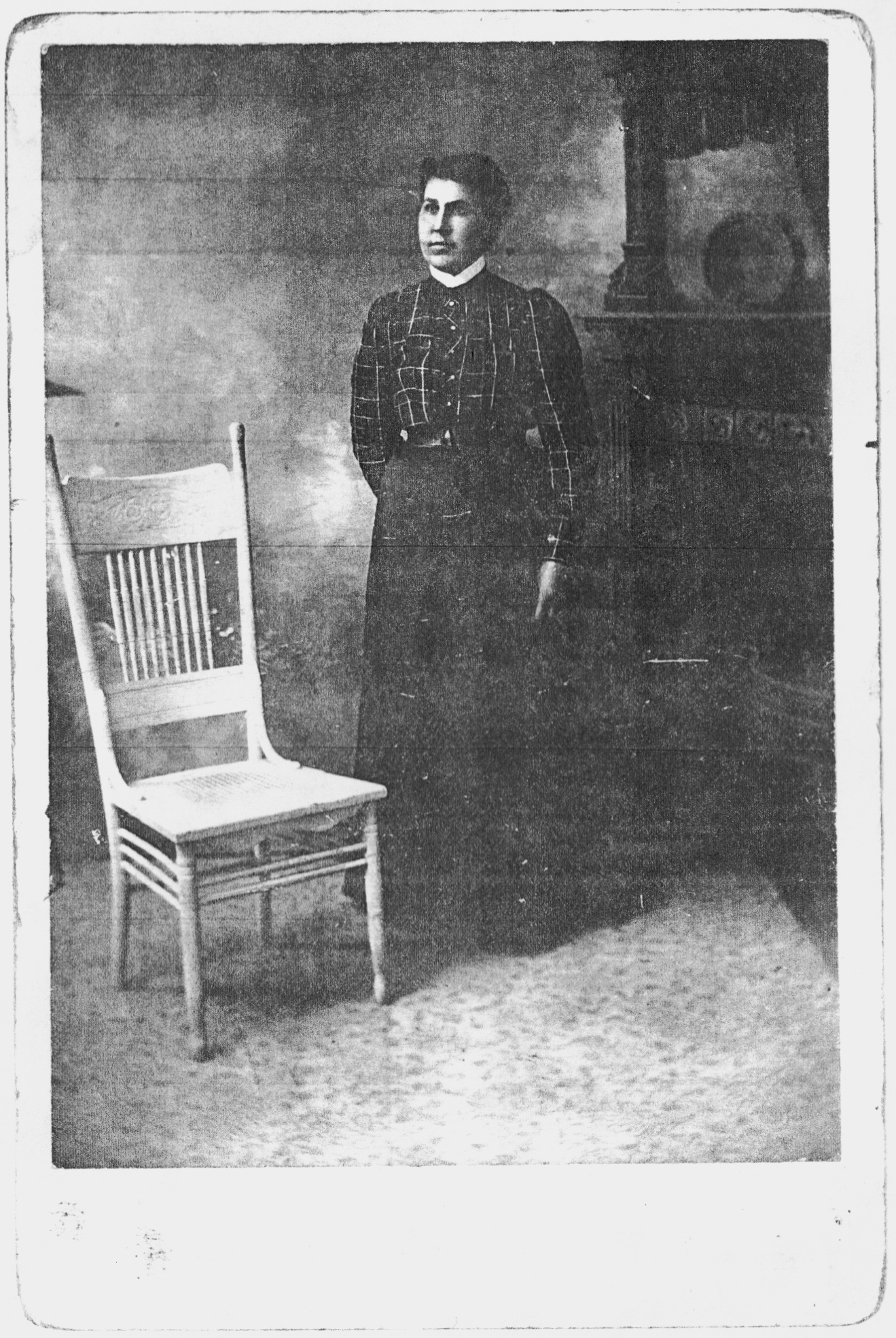
Unidentified_Marguerite_Chicoine_Adam

Unidentified photograph, ca. 1860-1866; digital image 2015, privately held by Melanie Frick, 2015. Image courtesy of D.B.

Twenty-seven years ago, my parents traveled to Massachusetts and made a stop in the community of Indian Orchard, where, my father knew, his ancestors had lived for a time in the latter half of the nineteenth century. As it turned out, these French Canadian immigrants had descendants who still lived in the area, and thanks to the staff at Saint Aloysius Parish, he was able to connect with one such descendant. Later, he began corresponding with two more cousins, both of whom were kind enough to share their research about our shared French Canadian and Acadian ancestors. Family lore and even a few photographs were also exchanged – including this photocopied image thought to be a photograph of Marguerite (Chicoine) Adam (1816-1878).1

Marguerite Chicoine is one of the first ancestral names I learned as a child and amateur family historian. I loved hearing that she was said to be Native American – a bit of family lore since (mostly) disproven, but it did work quite effectively to capture my attention at the time. I had always hoped to see the original of this photograph that was sent to us by our late cousin, but learned two years ago that an original may no longer exist. Apparently, when she was moved to a nursing home, her family history materials were thrown out.2 This serves as an important reminder to make an estate plan for the preservation of your own family history materials.

While I can’t rule out that somewhere out there, a cousin might hold another copy of this same photograph – that fortunate scenario has happened before – it’s also possible that this is the only version of this photograph that I will ever see. In any case, let’s take a look. Could this realistically be a photograph of Marguerite Chicoine?

Marguerite died in Massachusetts in 1878 at the age of 62.3 Thus, this photograph would have to predate 1878. As the photocopy indicates that this was a carte de visite – most popular between approximately 1860 and 1866 – that is entirely possible.4 All of Marguerite’s fifteen known children were born before 1862, with the exception of her youngest, who was born five years later. As Marguerite relocated with her family from Quebec to Massachusetts circa 1864-65, it seems plausible that she may have had her picture taken during this time period as a memento to share with relatives at home.5

Marguerite was fifty years old when her youngest child was born at the tail end of the most likely timeframe for this photograph; in order to have had a healthy pregnancy so late, perhaps she had a more youthful appearance than one might otherwise imagine for a mother of fifteen. The woman appears to have dark hair without noticeable graying, and her dark complexion and strong nose make it easy to see how rumors of significant Native American ancestry could have gotten started. However, I find it difficult to get a sense for her age, due in part to the poor quality of the image. Could she be over forty-five, or is this woman in fact decades younger?

Marguerite did have three daughters who would have reached adulthood by the 1860s: Marguerite Adam, Marie Adam, and Julienne Adam.6 While I do have a photograph of Marguerite, who does not appear to be a match, could this photograph show instead either Marie or Julienne as a young woman in her early to mid-twenties?

The woman wears a buttoned shirtwaist with a windowpane pattern, the sleeves neither significantly fitted nor puffed, and a high linen band collar is visible.7 Her belted skirt is of a straightforward design. Notably, it is not worn with a fashionable hoop as one would typically expect in the 1860s; this more unassuming skirt would perhaps have been in line with what a woman in rural Quebec or an immigrant in a New England mill town might wear.8 The backdrop is similarly domestic in style with a practical wooden chair and what looks to be a fireplace.

The good news? This could be a photograph of Marguerite Chicoine. It depicts a dark-complected woman of evidently simple means who was photographed in the 1860s, a physical description, socioeconomic background, and timeline that fit with what is known about Marguerite.

The bad news? We may never know for sure. It seems equally plausible that could be a photograph of one of Marguerite’s daughters or a close relative. Lacking an original for closer examination, it can still be hoped that another copy of this photograph might exist in different branch of the family, and that it may hold additional clues regarding the true identification of the mysterious dark-haired Québécois.

Copyright © 2015 Melanie Frick. All Rights Reserved.

Continue reading

A Fatal Scratch: The Death of a Pioneer Woman

Anna_Margaretha_Poesch_Thoma_Obituary“After almost a week of extreme suffering, caused from blood poisoning, Mrs. Margaretha Thoma, one of Garnavillo’s oldest residents, passed away at 4:00 o’clock last Saturday afternoon. About two weeks ago the lady accidentally scratched the back of one of her hands with a pin. The scratch at the time was a mere trifle and was given no further thought by her until a few days after when the hand began to swell and cause more or less pain. A physician was called and found it necessary to lance the hand, but desired results did not follow and twice later the lance was employed, and still no relief came to her sufferings, but instead the wound continued to grow worse and the swelling commenced extending into the arm. Everything possible was done to allay the pain and comfort her in her unendurable suffering, but nothing could be administered that would combat with the situation and the result was death came as a relief after nearly a week of incessant torture.”1

Anna Margaretha (Poesch) Thoma was born in Weißenstadt, Wunsiedel, Bavaria, the daughter of Wolfgang and Barbara Poesch.2 She came to Iowa with her family at a young age, and was later deemed “one of the venerable and loved pioneer women of Clayton County.”3 Margaretha married William Henry Thoma, a local merchant, in 1857, when she was still in her teens.4 They had eleven children before his death in 1876; Margaretha never remarried, and in fact continued to operate his mercantile in the years following his death.5 Perhaps it was this role in her community that brought her the recognition to be remembered so fondly in the years following her death from blood poisoning on 9 November 1907.6

Margaretha’s unfortunate plight might remind some of Caroline Ingalls’ encounter with a rusty nail in a particularly drama-filled episode of Little House on the Prairie. Indeed, albeit tragically, little could have been done to relieve Margaretha’s suffering at this time and place. Her age, estimated at near seventy, might also have contributed to her susceptibility to infection, whether she in fact suffered from sepsis or tetanus. Although not soon enough for Margaretha, it would be just a matter of time before the use of penicillin – and the tetanus vaccine – would become widespread. 

Copyright © 2015 Melanie Frick. All Rights Reserved.

Continue reading