Tag Archives: South Dakota

The Adam Brothers

When five of the six living sons of Timothée and Marguerite (Chicoine) Adam gathered in the Midwest circa 1913, it was deemed an occasion worthy of a photograph.1 From left are pictured brothers Louis (1848-1927), Peter (1852-1936), Joseph (1850-1926), Prosper (1867-1943), and Timothy Adam (1846-1919). Although the twenty-one year span in age of these brothers is impressive, in fact, twenty-seven years passed between the births of their eldest sibling and the youngest, who arrived when his mother was fifty years old. At least fourteen children were born in total, with all but the youngest born in Quebec. All got their start in life in the cotton mills of Indian Orchard, Hampden County, Massachusetts, which had lured the Adam family from rural Quebec to America.2
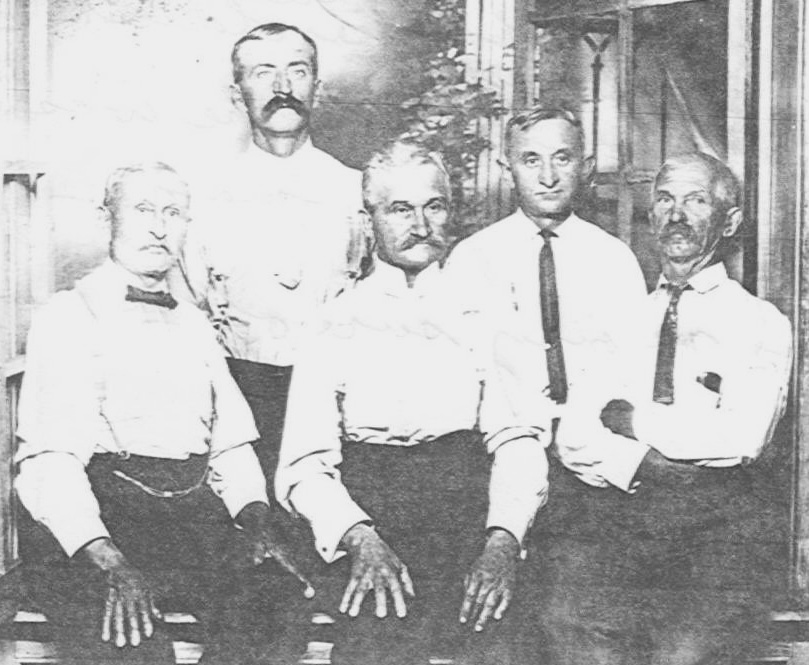
Brothers Louis, Peter, Joseph, Prosper, and Timothy Adam(s), ca. 1913; digital image 2010, privately held by Melanie Frick, 2018. Image courtesy of Dorothy Bouchard.

Timothy, at right, likely resided in Jefferson, Union County, South Dakota at the time this picture was taken,3 not far from Peter, second from left, and Prosper, second from right, who had both settled in Sioux City, Woodbury County, Iowa.4 Joseph, at center, had apparently traveled from his home in Ponca City, Kay County, Oklahoma to reunite with his brothers, as well as, undoubtedly, his twin sister, who lived in Jefferson.5 Louis, the one brother to have remained in Hampden County, Massachusetts, traveled the greatest distance for this reunion.6 The only living Adam brother not pictured here was Euclid John (1856-1940), who spent his adult life in Southbridge, Worcester County, Massachusetts.7 Whether he lost touch with his brothers or was simply unable to make the trip to visit them at the time that this photograph was taken is not known.

The Adam brothers, some of whom adopted the surname Adams in addition to Anglicized versions of their given names, held a variety of trades between them. Census records indicate that after leaving the cotton mills, some went on to become carpenters, barbers, homesteaders, clerks, pool hall operators, and hotel-keepers, among other occupations. All married, and all but Joseph had children of their own.

This photograph is a photocopy of what was said to be a real photo postcard, a format designed to be easily sent by mail to friends or relatives. Like the only known (or suspected) photograph of the mother of the Adam brothers, the original is believed to have been lost.8 Despite the poor quality of this photocopy, it is apparent that the brothers have dressed sharply, with their hair neatly combed and several in ties, although this was apparently not such a formal occasion that they opted to wear jackets. It is also plausible that it was quite hot, if their reunion took place in the summer months, and the gentlemen may well have opted to be as comfortable as possible. Several appear to wear sleeve garters, arm bands that helped to adjust the length of one’s sleeves.9 While the men’s appearances are distinct from one another, particularly given their disparate ages, similarly prominent noses—and, when visible, even hands—help to link them convincingly as brothers.

Copyright © 2018 Melanie Frick. All Rights Reserved.
Continue reading
The Nelson Family at Home

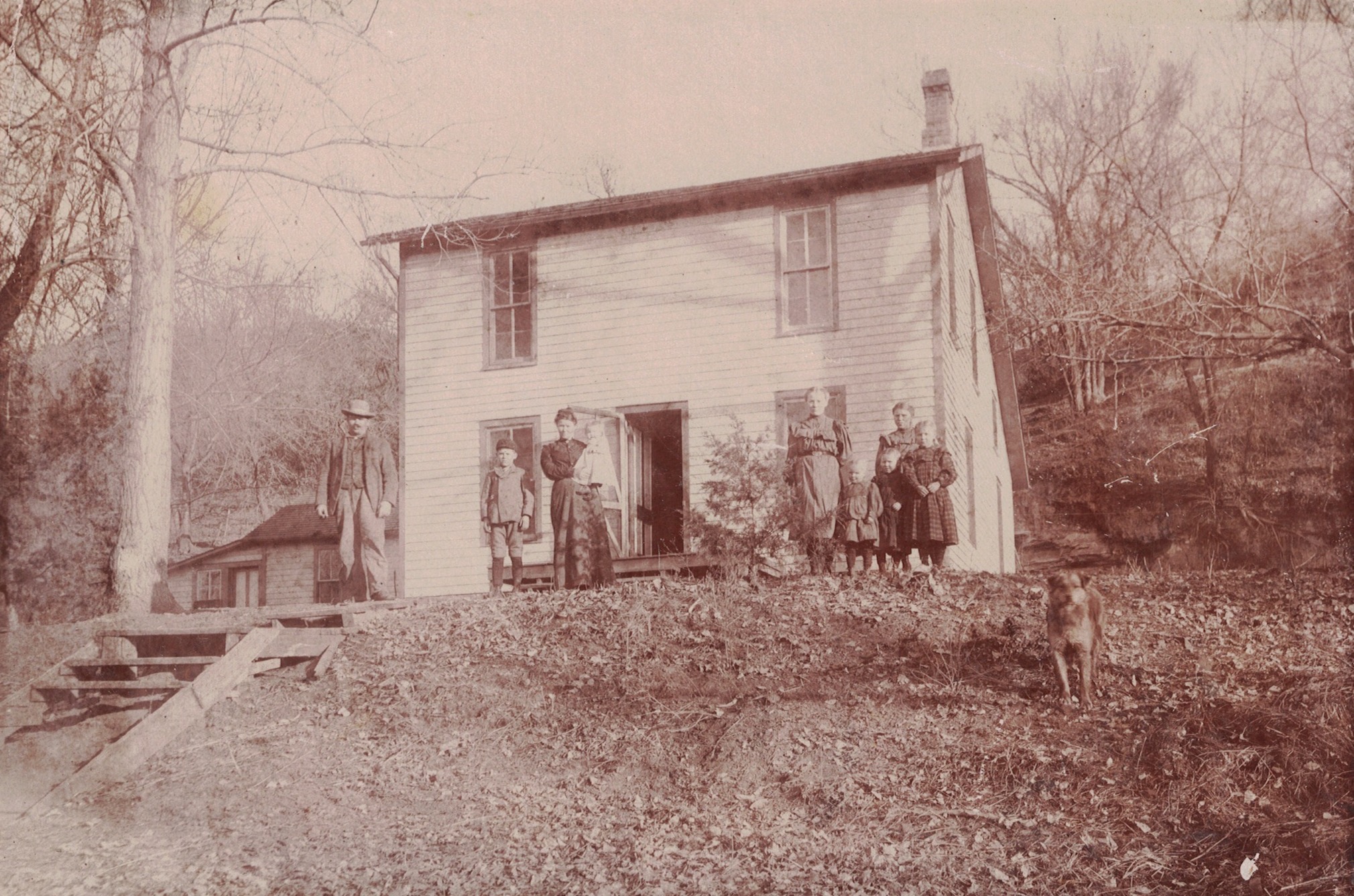
The leaves had already fallen from the trees surrounding the modest two-story farmhouse belonging to Fred and Christina (Schmidt) Nelson when this photograph was taken in late 1904.1 Situated near the scenic bluffs along the Missouri River west of Yankton, Yankton County, South Dakota, the house was said to have had a creek running through the corner of the kitchen as a source of fresh water.2 Its simple, symmetric design featured a center door and four front windows on its clapboard walls, with a chimney appearing above the gable roof on one side. The house was likely painted white with a trim of a different color around the windows and door. Many trees surrounded the house, which was situated on an incline; the remote, wooded landscape seems to lend truth to family lore of the children fearing howling wolves (or coyotes?) as they walked to and from the nearest country school.3

Fred and Christina (Schmidt) Nelson and Family, Yankton County, South Dakota, 1904; digital image 2017, privately held by Melanie Frick, 2017.

Fred and Christina, both of whom immigrated from Denmark as children, married in 1890.4 Fred, at left, was forty years old in late 1904; he wears a loose-fitting sack suit and hat and sports a mustache.5 At center stands son Ole, ten, beside Christina, thirty-five.6 She holds baby Mary, who was born in February of that year.7 While Ole is clearly dressed for the outdoors in a coat and cap, Christina, like her daughters, wears no jacket or shawl. Her simple buttoned bodice and unadorned skirt appear comfortable for a nursing mother as well as household duties.

The open door behind Christina suggests that perhaps she and the girls had just stepped outside for the photograph. In a cluster at right stand Anna, thirteen; Helena, nearly or barely four; Louise, five; Julia, twelve; and Andrea, nearly eight.8 All of the girls wear their hair neatly parted and plaited down the back; it was said that the sisters would line up each morning, oldest to youngest, to braid each other’s hair.9 They wear dresses that, with the exception of the youngest’s, fall below the knees, and all wear dark stockings. Their dresses have high necks and full bishop sleeves; a few additional details can be distinguished, such as the plaid fabric of Andrea’s dress and the belt at Anna’s waist.10

The occasion for this photograph is not known, although perhaps it was taken by an itinerant photographer who made stops at rural homes throughout the Midwest. Unlike formal studio portraits of the era, this photograph is as much about the place as the people, allowing a glimpse into the lives of the Nelson family that would otherwise be missed.

Copyright © 2017 Melanie Frick. All Rights Reserved.
Continue reading

Farm Girls

Sisters Helena, Louise, and Andrea Nelson donned overalls and posed on their family’s farm near Tabor, Yankton County, South Dakota in this candid photograph dated circa 1916. Andrea, nineteen in the summer of 1916, had recently completed her studies at the Southern State Normal School in Springfield.1 Both Helena, fifteen, and Louise, sixteen, would be students there in the fall, while Andrea would go on to her first term as a teacher at a one-room country school.2

Helena, Louise, and Andrea Nelson, Yankton County, South Dakota, ca. 1916-1918; digital image 2017, privately held by Melanie Frick, 2017.

Pitching in to help out on the farm would have been the norm for the Nelson girls, the three middle children in a family of nine. Helena’s daughter later recalled her mother’s stories of working in the fields in the summertime,3 and in a letter dated 1918, in response to a question from her cousin about taking summer courses, Andrea replied, “Oh, how I’d love to, but guess it’s chickens to tend etc. and overalls to wear. Suppose that too will be sport, but after all, is there anything like being a schoolgirl?”4 The Nelson girls would have been especially needed on the farm that summer, as their older brother, Ole, was in the service.

While many decades had yet to pass before women wearing pants would become truly mainstream, I can’t imagine that it would have been unusual at this time for young women to wear the clothing most suitable for farm labor while at home among family. The overalls and loose collared shirts worn by the Nelson girls might have been hand-me-downs from their father and brother (even Levi Strauss & Co. didn’t begin to make jeans especially for women until the 1930s!), and, positioned side-by-side in a field with wide-brimmed straw hats atop their heads, the sisters—or the photographer—clearly recognized that this was a photo op not to be missed.

Copyright © 2017 Melanie Frick. All Rights Reserved.
Continue reading
The Danish Pioneers

Erik and Inger Marie (Hansen) Bramsen were in their sixties when they left their native Denmark to settle with their adult children in Dakota Territory.1 They had married on 1 September 1832 at Skrydstrup Kirke in Skrydstrup, Gram, Haderslev, Denmark, when Erik was twenty-eight and Inger Marie twenty-four.2 It was four decades later when they bade a final farewell to their farm, Hørløkkegaard, and their homeland.3

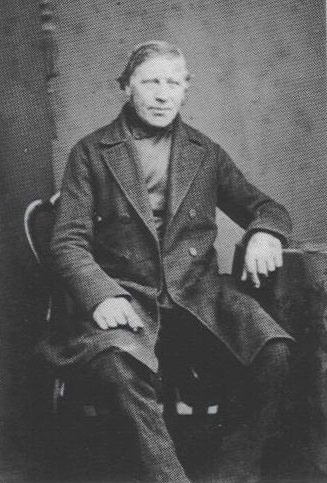
Erik Bramsen (1803-188–), circa 1870-1880; digital image 2010, privately held by Melanie Frick, 2017.

Inger Marie (Hansen) Bramsen (1808-1885), circa 1870-1880; digital image 2010, privately held by Melanie Frick, 2017.

These undated photographs, circa 1870-1880, may have been taken before or after the couple made their ocean voyage; as I have not seen the originals, only photocopies, I am unsure of their format or any other identifying information. Erik wears an unbuttoned double-breasted wool overcoat; while seated, it reaches his knees. Little detail can be discerned about the shirt he wears underneath, which has no visible buttons, but his trousers are of a straight, loose cut. He is clean-shaven, his hair is trimmed and combed to the side, and his eyes appear light in color. Seated in a chair with an arched back, Erik rests his left arm on a small table covered with an embroidered cloth. Tassels from a curtain are visible in the background.

Inger Marie sits before the same background, with the chair situated to the right of the table instead of the left and her right elbow resting on the table. It seems possible that she has suffered a stroke, as her mouth appears uneven and one eye droops. A bonnet with a white frilled trim frames her face and ties below her chin with a large bow. Her dress has fitted sleeves with ruched cuffs, and the bodice is of a darker color than the full skirt. The fabric has a sheen to it, and, while simple, the dress appears well-made and carefully fitted. Several elements of her attire support a date sometime in the 1870s, including the frilled trim on her bonnet and its substantial bow.4

The couple arrived in New York aboard the Cimbria on 14 August 1872, within weeks of their fortieth wedding anniversary.5 They appear in the 1880 U.S. census for Yankton County, Dakota Territory,6 and both passed away in the years thereafter, Erik circa 1880 and Inger Marie in the spring of 1885 when she succumbed to tuberculosis.7 Erik and Inger Marie (Hansen) Bramsen are said to be buried in unmarked graves at Elm Grove Cemetery (formerly Maple Grove Cemetery) near Tabor, Yankton County, South Dakota, alongside many of their children and grandchildren who, like them, were pioneers.8

Copyright © 2017 Melanie Frick. All Rights Reserved.
Continue reading

A Baby Carriage in Dakota Territory

A new arrival in the family has meant that blogging my research findings has taken a backseat in recent months, but with babies on the mind, here is a peek at a sweet little one posed with his mother in the nineteenth century:

nielson_harry_andresen_hannah_1888

Hannah Marie (Andersen) Nielsen with Harry Niels Nielsen, Yankton, Dakota Territory, 1888-89; digital image 2014, privately held by [personal information withheld].

Pictured is Hannah Marie (Andersen) Nielsen, wife of Ole Nielsen of Yankton, Yankton County, South Dakota, with her infant son Harry Niels Nielsen.1 Harry was to be the couple’s only surviving child; a daughter died in infancy.2 He was born 25 May 1888 in the town of Yankton,3 only a few months after the infamous Children’s Blizzard; his parents, both Danish immigrants, had married in 1880.4 At the time of Harry’s birth, Ole managed a dray line in Yankton, transporting heavy loads in a specially built wagon.5 Later, he would take up farming east of the nearby community of Mission Hill.6

In this photograph, Hannah, forty years of age, wears a dress with a full skirt, fitted sleeves, and a bodice fastened with no less than a dozen buttons.7 A brooch is pinned at her high collar and a flat-brimmed hat atop her head is adorned with feathers, adding an elegant statement to her otherwise relatively simple attire. What appears to be a strip of fabric is wrapped around the palm of her visible hand.

Harry, who looks to be less than a year old, dating this picture to South Dakota’s pre-statehood days of 1888-89, is dressed in a light-colored gown and a snug bonnet. He looks directly at the camera and a belt around his middle secures him to the seat of a baby carriage. The slatted basket is long enough that a smaller baby could lay flat until, like Harry, sitting upright against the fringed backboard would be possible.

I love that a baby carriage is featured here, unlike in any of the other nineteenth century baby photographs in my collection. However, I do have to wonder how practical it would have been at this time and place. While a bustling prairie town in its own right, Yankton was not, by any stretch of the imagination, a particularly urban environment, where a baby carriage might have proven more useful. Was it a prop at the Janousek studio, then, or did it belong to the Nielson familyperhaps a special luxury for a woman who had waited out eight years of marriage for a healthy child?

Whatever the case, this is a charming look at a proud mother and her well-behaved infant striking an elegant pose on the frontier. And, I have to say, the picturesque baby carriages of the nineteenth century were certainly more worthy of studio portraits than those of today!

Copyright © 2017 Melanie Frick. All Rights Reserved.
Continue reading

Tombstone Tuesday: Timothy and Odile (Millette) Adam

Timothy and Odile (Millette) Adam experienced nearly forty years of marriage together that were anything but ordinary.

Timothy, baptized in St. Pie, Quebec on 8 August 1846, the son of Timothée Adam and Marguerite Chicoine, crossed into America with his family as a teenager.1 They settled near the textile mills of Indian Orchard, Hampden County, Massachusetts, which is where Timothy married at the age of twenty-one on 22 September 1867 to Odile Millette.2 Odile had been born in the French Canadian community of Rouse’s Point, Clinton County, New York on 11 July 1847, the daughter of Maurice Millet and Isabelle Quemeneur dit Laflamme.3 She, too, had relocated to Massachusetts as a teenager, where she also found work in the mills.

The couple was said to have had ten children together, eight of whom have been identified: Timothy Maurice, Alexander Amadée Edmond (known as Edward), Joseph Frederick (known as Alfred), Marie Julie Malvina, Albina Lena, Henry Joseph, Martin Theodore, and Permelia Marie.4 Only five of these children are known to have survived to adulthood; at least one succumbed to scarlet fever as a toddler.5

In 1883, the family made the decision to move west.6 I have to wonder if this move was spurred by the deaths of at least two of their own young children circa 1880, as well as by the deaths of Timothy’s younger brother and sister who died within a week of each other in February of 1883: one of pneumonia at twenty and the other of tuberculosis at twenty-four.7 In fact, tuberculosis had caused the death of Timothy’s mother just five years before.8 Perhaps the idea of fresh air and the countryside appealed to the couple as they must have feared for the health of their children.

Timothy and Odile first joined French Canadian relations in southeastern South Dakota, where a son was born to them in the summer of 1885.9 In December of the following year, Timothy claimed a homestead a short distance away near Moville, Woodbury County, Iowa.10 The family would remain here for a number of years; by 1900, they had relocated to a dairy farm closer to Sioux City.11

The coming years were unexpectedly tumultuous for Timothy and Odile. First, in 1900, their twenty-nine-year-old son Edward, who had been out of touch for nearly a decade, returned home and began harassing his parents and younger siblings. Timothy went to court in order to obtain a restraining order against him.12 Then, over the next several years, Timothy and Odile may have suffered marital discord. Timothy was not recorded in the 1903 Sioux City Directory; he appeared again in the same household as his wife the following year.13 In 1905 he was again absent, and it was at this time that Odile implored the enumerator of the 1905 Iowa State Census to bring her any word of her two eldest sons, Edward and Fred, who had traveled west and had not been heard from in several years.14 It was also in 1905 that Odile recorded her will, leaving her real estate to her three youngest children: Henry, Theodore, and Permelia. No mention was made of her absent sons – or her husband.15

IMG_3451

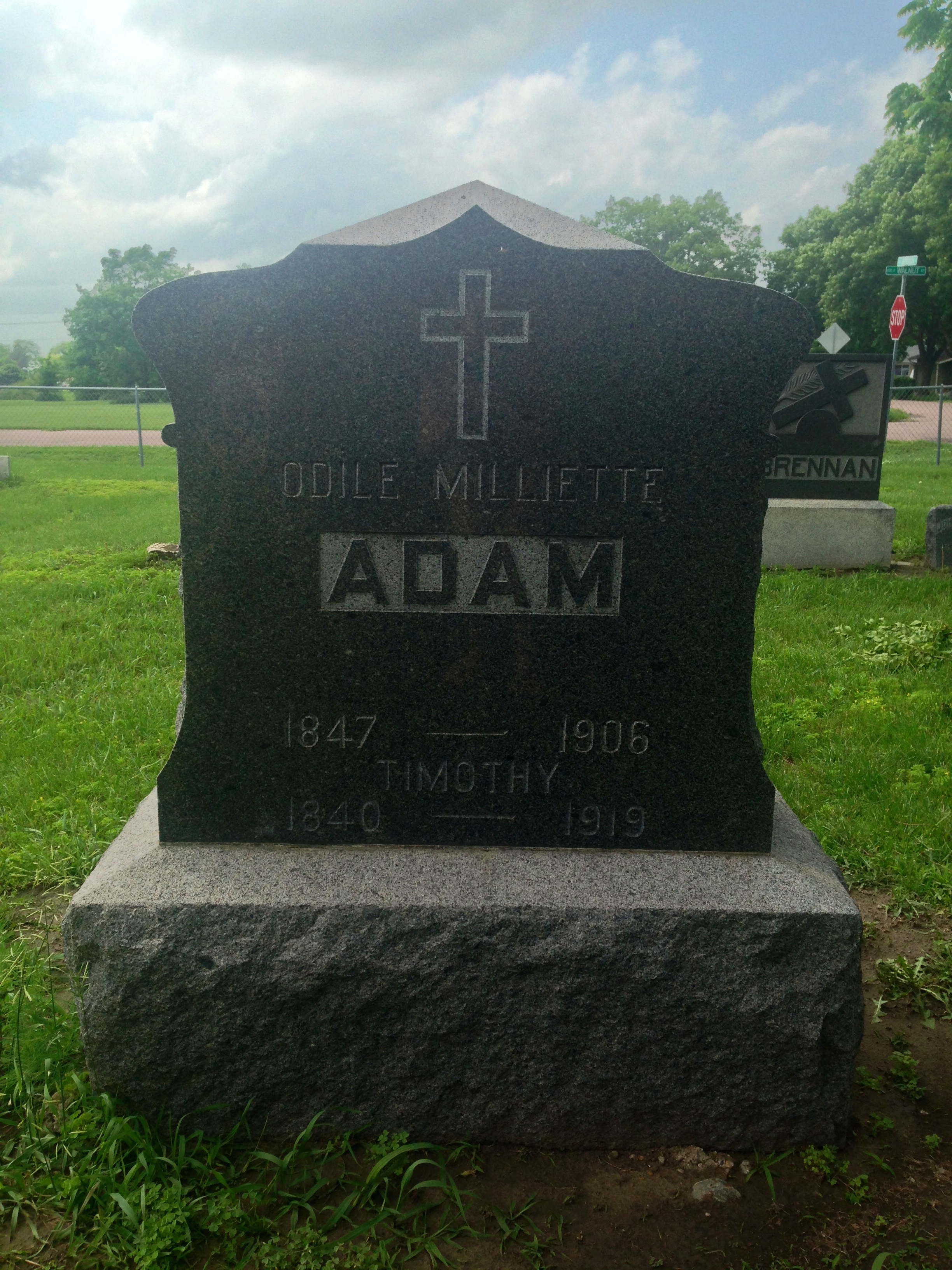
Grave of Odile Milliette Adam (1847-1906) and Timothy Adam (1840-1919), St. Joseph Cemetery, Elk Point, Union County, South Dakota; 2014, privately held by Melanie Frick, 2015. Note: Timothy’s date of birth on his gravestone is incorrect. He was born in 1846.

In 1906, the final year of Odile’s life, she operated a boarding house at 508 Perry in Sioux City.16 Notably, Timothy resided not at home, but at the Washington House Hotel.17 It does seem possible, however, that the couple reconciled whatever differences they may have had by the time of fifty-nine-year-old Odile’s death from hepatitis on 16 December 1906 in Elk Point, Union County, South Dakota.18 When the 1907 Sioux City Directory was printed at some point in late 1906, likely shortly before her death, both Odile and Timothy were named as residents of 508 Perry.19

Timothy, a carpenter again as he had been in his younger years, remained in the house with his children for only a short time before resettling in nearby Jefferson, Union County, South Dakota. He remained here for the next decade; as of 1910, he operated a billiard hall in this small, largely French Canadian community.20

By 1917, Timothy, now seventy, had returned to Sioux City where he lived with his married daughter.21 He died there on 22 February 1919 at the age of seventy-two, his cause of death recorded as senility.22 Timothy Adam was buried beside his wife, Odile Millette, at St. Joseph Cemetery in Elk Point, Union County, South Dakota, his name squeezed as though an afterthought at the base of her gravestone.

Copyright © 2015 Melanie Frick. All Rights Reserved.

Continue reading
Remembering the Children’s Blizzard

Even seventeen Dakota winters could not have prepared the Danish immigrant family of Jens Madsen and Anna (Bramsen) Schmidt for what they faced in 1888.

January 12 dawned bright and clear in southeastern Dakota Territory. The weather was so pleasant that many children set off to school wearing only light jackets and wraps.1 In the Schmidt family, just twelve-year-old Mads was still in school; while he settled in with his classmates, his mother and older sisters, Mary and Christine, tinkered eagerly with the new sewing machine that had been delivered to them just that morning.2

Within a few hours, however, a dark cloud appeared on the horizon, bringing with it a wind so powerful that it roared as it whirled snow and ice into the air. The temperature dropped abruptly, and the snow and ice, said to be as fine as flour, made it impossible to see. Those unfortunate enough to be caught on the open prairie – or even in their barnyards – had little hope of making it to shelter.3

Through the remainder of the day and into the night, the Schmidt family waited in agony, a lantern burning in their window. They had no way of knowing whether Mads had taken shelter at school, or whether he had tried, in vain, to run for home. To search for him would be futile until the storm had ceased.

The next morning, which dawned bright and beautiful, Mads trudged home over the sparkling drifts of snow. The joy and relief that he, his sisters, and his parents must have felt at this reunion can only be imagined. As it turned out, the schoolteacher at the Breezy Hill School had managed to convince all of the children to stay in the shelter of the schoolhouse overnight, which, thankfully, had been sturdy enough to withstand the winds and had had enough fuel to keep them from freezing.4

JensMadsenSchmidtHomestead

Schmidt Family Homestead, near Tabor, Bon Homme County, South Dakota, ca. 1888-1889; digital image 2013, privately held by Melanie Frick, 2015. From left: Inger Marie “Mary,” Mads, Christine, Jens Madsen, and Anna (Bramsen) Schmidt.

Others had not been so lucky. Remembered as the “Children’s Blizzard” for the high number of school-aged victims, the storm tore apart some of the flimsier schoolhouses, forcing the teachers and children to flee into the storm, often in insufficient clothing due to the balmy weather of the morning.5 Others thought that they could beat the worst of it home, but on the open prairie where some children walked miles to reach school, many became disoriented in the storm or were forced by the wind in different directions. It became impossible for them to spot familiar landmarks either because of the fine and blinding snow or because their eyes had frozen shut.6

Later, two sewing machine salesmen, who had made their last stop at the Schmidt family homestead in Bon Homme County, were found huddled in the box of their bobsled just three miles to the west. They had frozen to death; their horses, tied in a grove of trees, survived. For years, locals referred to the area as Dead Man’s Grove.7

The Children’s Blizzard claimed an estimated two hundred fifty to five hundred lives across the Midwestern prairie, with the majority of the casualties in southeastern Dakota Territory.
8 As reported by historian David Laskin, “The pioneers were by and large a taciturn lot, reserved and sober Germans and Scandinavians […]. Even those who never wrote another word about themselves put down on paper everything they could remember about the great blizzard of 1888. Indeed, it was the storm that has preserved these lives from oblivion.”9

Copyright © 2015 Melanie Frick. All Rights Reserved.

Continue reading

Military Monday: A Duty to His Family

Today marks the World War I centenary, although it would be a few more years before Ole James Nelson, a young farmer from rural Yankton County, South Dakota, would make his way overseas as a mechanic with the U.S. Navy Aviation Section.

Ole enlisted on 3 May 1917 at the age of twenty-two, within a month of the United States entering the war.1 According to a county history, he served in Eastleigh, Hampshire, England.2 His journey to Eastleigh, however, may have been a roundabout one; in fact, he may not have left American soil for at least a year after his enlistment. One photograph suggests that he completed his training in Buffalo, New York;3 another photograph was sent to his family from Charleston, South Carolina, in May of 1918.4 That October, his sister wrote to him, commenting, “Wonder if you are still at Quebec.”5

SCAN0858

Ole Nelson, Charleston, South Carolina, 1918; digital image 2013, privately held by Melanie Frick, 2014.

Ole’s time in Eastleigh was likely brief. The United States Navy established a naval air station in Eastleigh in July of 1918 to assemble and repair aircraft, including Caproni Ca.5 and Airco DH.4 and DH.9 bombers.6 This, almost certainly, is how Ole made use of his time as a mechanic. The base was in operation, however, for only a matter of months, as it closed following the armistice later that year.7

As it turned out, Ole’s days in the service were numbered, although not because the “war to end all wars” was winding down. After receiving notification of his father’s unexpected death, which had taken place a matter of days before the armistice,8 Ole applied for an honorable discharge, which was granted on 29 January 1919.9 As the eldest son, Ole was to return home to manage his family’s farm and to care for his mother and younger siblings; what he did not learn until his return, however, was that one of his sisters had also passed away in his absence, having succumbed to what was said to be a combination of Spanish Influenza and shock at the death of her father.10

A return to the farm, following what must have been an exciting time in this young man’s life, was perhaps not what Ole had initially had in mind for his future, but after duty to his country, he had a duty to his family.

Continue reading

A Golden Anniversary Celebration

One warm afternoon during the summer of 1902, a crowd gathered at the home of local pioneers Niels and Juliane Sophie (Hennike) Olsen. The couple, who had retired from farm life several years before, was celebrating fifty years of marriage, and all of their children and grandchildren were invited to their home located near the center of town at 605 Broadway in Yankton, South Dakota.1 The event was surely a memorable affair, and the local newspaper gave a glowing report of the afternoon’s activities:

Mr. and Mrs. Nels Olson celebrated their golden wedding yesterday afternoon at their home on Broadway. All their children, eight in number, were present with their families. Their names are as follows; Ole Nelson, Mission Hill; John Nelson, Viborg; Christ Nelson, Lakeport; Fred Nelson, Lakeport; Mrs. J. Nissen, Yankton; Mrs. C. Calleson, Yankton; and Miss Helena Nelson, Yankton. Rev. C.K. Solberg spoke a few words appropriate to the occasion and presented to the venerable couple two fine presents from the children, a gold headed cane to “father” and pair of gold glasses to “mother.” The “old folks” came from Denmark in 1874 and made their first home in America near Lakeport, S.D. Eight years ago they moved to Yankton, their present home. They are in fairly good health and enjoy comfort and happiness surrounded by kind children.2

Niels Olsen and Juliane Sophie Hennecke had married in Haraldsted, Soro, Denmark, on 30 July 1852.3 For the first twenty-two years of their married life, they resided in Denmark; their twenty-second anniversary, however, was spent aboard ship as they ventured to America.4 Their years since had been spent in southeastern South Dakota, where they claimed a homestead and where Niels had recently served a term as a rural postmaster. All eight of their surviving children remained in the area, and to commemorate their fiftieth anniversary, an informal group photograph was arranged on the porch of their home beneath the shade of several large trees.

Olsen Golden Anniversary

Olsen Golden Anniversary, Yankton, South Dakota, July 1902; digital image 2010, privately held by Melanie Frick, 2014.

The couple of honor is seated near the center, surrounded by those in attendance. Niels wears a wool three-piece suit and tie, as do most of the men, while Juliane wears a patterned shirtwaist with a bow at the neckline. Patterned, striped, or light-colored cotton fabrics seem to be popular choices among the women for their summertime wear. The adults, including the couple’s children, sit or stand in two rows, and three infants are perched on laps. Nine young grandchildren – including four sisters in matching dresses – cram together in the front, sitting cross-legged on the wooden plank floorboards. The group is relaxed; there are a few smiles, several women cross their arms comfortably, and a few maternal faces are turned away from the camera, intent on minding the couple’s many grandchildren.

I have to hope that this well-dressed crowd had the opportunity to partake in some refreshing lemonade in honor of the occasion!

In the back row, from left to right, are Reverend Solberg, Mrs. Solberg, Harry Nissen, Fred Nelson, Ole Nielsen, Harry Nielsen, John Nielsen, Eric Boysen, unknown, and Chris Callesen. In the middle row, from left to right, are unknown, Dora Nissen, Cleora Nielsen, Hannah Nielsen, Stena Callesen, Cecilia Boysen, J. Chris Nelson, Niels Olsen, Juliana Olsen, Helena Olsen, Jennie Nelson, Edith Nelson (child), Christine Nelson, and Helen Nelson (child). In the front row, from left to right, are Robert Nelson, Anna Nelson, Louise Nelson, Andrea Nelson, Julia Nelson, Bessie Nelson, Ole Nelson, Alvin Nielsen, and George Boysen.5

Continue reading

Dressing Well in Dakota Territory

SCAN0009

Christine Marie [Schmidt] Nelson,  Yankton County, Dakota Territory, ca. 1886-1888; digital image 2013, privately held by Melanie Frick, 2014.

Christine Marie Schmidt, spelled “Christiane” on the back of this photograph and called “Dana” by her close friends, would not have remembered Denmark, as she was still an infant when she accompanied her parents to America in June of 1870.1 Her father homesteaded in Dakota Territory later that year, and Christine grew up a hardworking farm girl on the prairie near what is now Tabor, Bon Homme County, South Dakota.2

This photograph may have been taken in Yankton, the onetime capital of Dakota Territory located a dozen or so miles east of the family’s homestead. Christine’s hair is styled in true 1880s fashion with frizzled bangs – which could not have been easy to achieve – and a smooth high bun.3 She wears what looks to be a heavy pleated dress with velvet panels adorning the bodice vertically from shoulder to waist.4 The same velvet trims the collar and cuffs, where a white under-layer peeks out. No fewer than twelve large buttons adorn her dress, and a horizontal pin is affixed to the stylish high collar. Christine is clearly corseted to enhance her hourglass figure.5

Christine married in the spring of 1890 at the age of twenty-one; her wedding portrait suggests that she was a bit younger when this photograph was taken.6 My guess is that she was about eighteen, give or take a year, dating this photograph circa 1886-1888. Although green cardstock, as seen on this cabinet card, technically peaked in popularity several years earlier,7 another photograph from my personal collection with cardstock of the same dark green color dates to approximately 1889. Its popularity may well have been ongoing, at least in the Midwest.

Christine almost certainly sewed her dress herself, likely in the company of her mother and older sister, and she stands so as to display it to its best advantage. A subtle painted backdrop nearly touches the floor behind her as she rests her left hand on the back of an upholstered chair, gazing into the distance. In spite of her rural upbringing, Christine strikes an elegant pose, demonstrating that the latest fashions had found a place even in Dakota Territory.

Continue reading