Category Archives: Photograph Analysis

A Baby Carriage in Dakota Territory

A new arrival in the family has meant that blogging my research findings has taken a backseat in recent months, but with babies on the mind, here is a peek at a sweet little one posed with his mother in the nineteenth century:

nielson_harry_andresen_hannah_1888

Hannah Marie (Andersen) Nielsen with Harry Niels Nielsen, Yankton, Dakota Territory, 1888-89; digital image 2014, privately held by [personal information withheld].

Pictured is Hannah Marie (Andersen) Nielsen, wife of Ole Nielsen of Yankton, Yankton County, South Dakota, with her infant son Harry Niels Nielsen.1 Harry was to be the couple’s only surviving child; a daughter died in infancy.2 He was born 25 May 1888 in the town of Yankton,3 only a few months after the infamous Children’s Blizzard; his parents, both Danish immigrants, had married in 1880.4 At the time of Harry’s birth, Ole managed a dray line in Yankton, transporting heavy loads in a specially built wagon.5 Later, he would take up farming east of the nearby community of Mission Hill.6

In this photograph, Hannah, forty years of age, wears a dress with a full skirt, fitted sleeves, and a bodice fastened with no less than a dozen buttons.7 A brooch is pinned at her high collar and a flat-brimmed hat atop her head is adorned with feathers, adding an elegant statement to her otherwise relatively simple attire. What appears to be a strip of fabric is wrapped around the palm of her visible hand.

Harry, who looks to be less than a year old, dating this picture to South Dakota’s pre-statehood days of 1888-89, is dressed in a light-colored gown and a snug bonnet. He looks directly at the camera and a belt around his middle secures him to the seat of a baby carriage. The slatted basket is long enough that a smaller baby could lay flat until, like Harry, sitting upright against the fringed backboard would be possible.

I love that a baby carriage is featured here, unlike in any of the other nineteenth century baby photographs in my collection. However, I do have to wonder how practical it would have been at this time and place. While a bustling prairie town in its own right, Yankton was not, by any stretch of the imagination, a particularly urban environment, where a baby carriage might have proven more useful. Was it a prop at the Janousek studio, then, or did it belong to the Nielson familyperhaps a special luxury for a woman who had waited out eight years of marriage for a healthy child?

Whatever the case, this is a charming look at a proud mother and her well-behaved infant striking an elegant pose on the frontier. And, I have to say, the picturesque baby carriages of the nineteenth century were certainly more worthy of studio portraits than those of today!

Copyright © 2017 Melanie Frick. All Rights Reserved.
Continue reading

Fun on the Farm

Farm kids have long learned to make their own fun, and Frances Marie Noehl of Deerfield, Chickasaw County, Iowa was no exception. Pictured here circa 1920, Frances is grinning as she sits on a wooden cart pulled by her dog, Shep. If his expression can be interpreted, he appears to have been game to take part in the shenanigans of Frances and her siblings: Leo, Helen, Kathryn, Elinor, John, Al, Frank, and Joe. Frances, born in the spring of 1911, fell between Frank and Joe in age as the second-to-youngest of the nine children of German immigrants Mathias and Elizabeth (Hoffman) Noehl.

Noehl_Frances_Shep_c1920_Iowa

Frances Marie Noehl with Shep, Chickasaw County, Iowa, circa 1920; digital image 2015, privately held by Valene Petersen, 2016.

Although the Noehls were not prosperous and bounced around from farm to farm while their children were young, the available recollections of their children indicate that plenty of fun was to be found in the country—after chores, of course. Following brief, unsuccessful stints in Canada and Minnesota around the turn of the century, the Noehls returned to Chickasaw County where they rented a farm near New Hampton.1 As a small child, Frances’s brother John, who was seven years her senior, could apparently often be found in the maple grove, contentedly sipping sweet sap from a tin cup under the watchful eye of another beloved dog, Sultan.2

Next, the family moved to an acreage in the town of North Washington, where the older children attended Catholic school and learned English for the first time.3 After three years there, the man who owned their property offered them a chance to rent out his farm in Deerfield, near the community of Alta Vista.4 John recalled his mother’s happiness as they prepared to resume farm life, teaching him to sing, “For to plow / For to mow / For to reap / For to sow / For to be a farmer’s boy.”5 It was now around 1910, and the family would remain on this farm for years to come. Aside from playtime with the family dog, rumor has it that Frances and her siblings also liked to have spitting contests while perched in the hayloft.6

With her bobbed haircut and loose-fitting, short-sleeved cotton dress, complete with a tie about the neck à la a sailor suit, Frances looks every bit an energetic 1920s tween.7 Her worn leather shoes appear to be barely staying on her feet and she sits relaxed with one bare (or stockinged) leg folded underneath. A massive barn with a stone foundation is visible behind her. This informal snapshot was likely taken by a family member, although since I have seen very few photographs of the Noehl family in general, I wonder if photography may have been only a passing hobby. In any case, it’s a pleasure to have a rare glimpse into a long-ago childhood.

Copyright © 2016 Melanie Frick. All Rights Reserved.
Continue reading

A Sioux City Streetcar

One might not expect that a community in Iowa was the first in the world to have an electric-powered elevated streetcar system, but in the early 1890s, Sioux City blazed that trail.1 It was already the third city in the United States—after New York and Kansas City—to host a non-electric elevated streetcar system, and for years to come, streetcars served to connect its far-flung neighborhoods, offering a convenient and affordable transportation option to its citizens.2

Henry_Adam_Streetcar

Henry Joseph Adam, center, Sioux City, Iowa, circa 1903-07; digital image 2010, privately held by Melanie Frick, 2016.

As a newlywed in his mid-twenties, Henry Joseph Adam of Sioux City, Woodbury County, Iowa worked as a conductor for the Sioux City Rapid Transit Company, also known as the Sioux City Service Company.3 This photograph, dated circa 1903-07, shows him in uniform, his suit rather baggy on his slight frame and a cap atop his head. Half a dozen men and women pictured behind him are in the process of boarding the streetcar, while three men at the front seem to be investigating an issue with either the tracks or the car itself. As this seems an unlikely place for passengers to board the car, suspended as they were over the Floyd River, I suspect there was a problem with the streetcar and the passengers had temporarily disembarked, an inconvenience on such a chilly day. That might also explain the occasion for the photograph; the original, mounted on a large piece of cardboard, looks as though it could be a copy of a local press photograph.

Just a few years before, Henry’s parents had had an unfortunate encounter with Sioux City’s elevated streetcars. In the summer of 1896, the Sioux City Journal reported:

Yesterday afternoon Timothy Adams and wife, of Moville, were about to cross the track of the elevated railway at Hedges station, Morning Side, when they met with a severe accident. They were driving a team to a light wagon, and as the electric car approached the horses became frightened. The tongue of the wagon broke and stuck into the ground, throwing Mrs. Adams violently over the dash board. The wheels passed over her, but when Dr. Brown was called it was found she was not much hurt and that no bones were broken.4

Seriously injured or not, Henry’s mother filed a suit against the Sioux City Rapid Transit Company and received one hundred and twenty-five dollars.5 Little could she have known that her son would soon become their employee, and, fortunately for Henry, if this incident was recalled, it must not have been held against him! He was employed there for only a few years, between approximately 1903-07, and spent the rest of his life as a carpenter. In the above photograph, he is working the route from East 4th and College to Greenville, which necessitated crossing the Floyd River on an elevated track.6

As for the streetcars of Sioux City, they peaked in 1933 with around forty-five miles of track that traversed multiple neighborhoods and even crossed the state line into South Sioux City, Nebraska.7 By the 1940s, however, with the introduction of a more-flexible bus system, streetcars quickly became obsolete, and after sixty years of service to the community, operations ceased in 1948.8

Copyright © 2016 Melanie Frick. All Rights Reserved.

Continue reading

The Best (Early) Christmas Surprise

Christmas came early for me this year in the form of a long-lost antique photograph – thanks to the efforts of a state historical society and a random act of kindness by a fellow genealogist. It was early on a Saturday morning when I sleepily picked up my phone to check the time, only to see a notification that someone had sent me a message via this blog. The first line read, “I thought you might be interested to know that there is a photograph in the online archives of the Kansas Historical Society that I believe shows members of your Fenton family.”1

Interested? INTERESTED? I was up in an instant. The message included a link to a photograph digitized and made available online courtesy of Kansas Memory and the Kansas Historical Society, and while the description has since been updated, on that Saturday morning it was simply titled “Family in Gypsum, Kansas.”

Well, I did have family in Gypsum, Kansas, a small community in rural Saline County. Pioneers George W. Fenton and his wife Sarah Ellen Hall married there in 1873 and had three daughters – Minnie Belle, Alpha Doretta, and Anna Leota – before George was accidentally shot and killed by his brother-in-law in 1880.2 Sarah later had a son, Charles Alfred, with her second husband, John Hoffman, whom she married in 1883.3 According to the original caption, based on a handwritten notation on the back of the photograph, the individuals were identified as Charlie, Belle, Alpha, and Ota, but their last name was unknown. Could it be…?

Hoffman_Charles_Fenton_Belle_Alpha_Leota_c_1890

Charles Alfred Hoffman with half-sisters, from left to right, Belle, Alpha, and Ota Fenton, Gypsum, Saline County, Kansas, ca. 1890-1892; digital image 2015, courtesy of KansasMemory.org, Kansas State Historical Society. Used with permission.

It was. Pictured circa 1890-92, half-siblings Belle, Alpha, and Ota Fenton and Charlie Hoffman posed for this cabinet card photograph at Kassebaum’s in Gypsum City, Kansas. I have found little information about the photographer, but local newspapers place him in the county at the appropriate time. A J.A. Kassebaum was a resident of Saline County, Kansas as early as 1890 when a newspaper announced his marriage; in 1893, it was reported in the column “Gypsum City News” that “Kassebaum is kept busy taking pictures of our citizens and residences.”4

Apparently, these four siblings were some of the very citizens he photographed. Minnie Belle Fenton, likely between sixteen and eighteen at the time, is dressed fashionably, and, as the eldest, is the central subject of the photograph. The bodice of her dress is very finely detailed, featuring a high collar and a double row of large, decorative buttons. Her sleeves, as commonly seen between 1890-92, are fitted, but looser at the upper arm and with a modest puff at the top of the shoulder, and she wears a bracelet on her right wrist.5 There are two decorative velvet bands at the cuffs of her sleeves and three at the bottom of her skirt. Belle would marry Joseph Anthony Hoffman, the younger brother of her stepfather, in 1893, at the age of eighteen.6

Alpha Doretta Fenton, reclining against her older sister, was likely between fourteen and sixteen in this photograph. The dark-eyed teenager wears a fitted dress of a much more simple design than Belle, but it is still flattering with attention to detail. There is a bunch of ruffled lace pinned at the bodice and a brooch at her throat, adorning the folded collar. Her hands are curled in her lap, and like Belle she appears to hide her fingertips; perhaps these country girls did not want to call attention to unmanicured nails. Alpha would marry Clare Eugene Gibson in 1895, at the age of nineteen.7

Anna Leota Fenton, standing behind her sisters, was perhaps ten or twelve at the oldest when this photograph was taken, and she stands straight with a direct gaze. Small and slim, she was not yet corseted like her older sisters, although like them her bangs were frizzled in the latest fashion.8 Her dark dress – which features a row of buttons and a lace collar – is almost surely a hand-me-down, perhaps made over to be suitable for her. Ota would marry George Hiram Thoma in 1902 at the age of twenty-two.9

Charles Alfred Hoffman, the little blond half-brother of the Fenton sisters, was likely around six or eight in this photograph. His resigned expression seems to bear evidence of the burden of having three older sisters; his mouth is clamped shut, his eyes fixed purposefully on the photographer, and his small hand is a blur as he was unable to keep completely still. He wears a jacket and his buttoned shoes are polished to shine. Charlie would marry late in life, and unlike his sisters, had no children of his own.10

All of the children bear a strong resemblance to photographs in my collection that picture them as adults, but this is by far the oldest photograph I have seen of any member of this family. In fact, I had previously seen no photographs whatsoever from their years in Kansas, so this window into their lives is priceless. Gypsum was a rural community of just over 500 residents in 1890; for a photographer to be numbered among its businessmen must have been somewhat significant.11 Kassebaum’s studio featured a somewhat amateur painted backdrop of a parlor setting, a carpeted floor, and animal skin rugs, which created a rather rustic yet elegant setting for the Fenton and Hoffman siblings. It seems possible that this might have been the first studio the children had ever visited.

I am grateful to Kansas Memory and the Kansas Historical Society for preserving and sharing this image in their digital repository and for generously allowing me to display it here. If you have Kansas ancestors, this database is well worth a thorough look. Beyond numerous photographs of people and places, I spotted transcribed nineteenth-century journals (how fun would it be to find a mention of your ancestor?), correspondence, advertisements, and a host of other primary source material fascinating to the historian and genealogist. And if an unidentified photograph happens to pique your interest, consider running a search on the information available as a fellow genealogist did for me – you never know when you might run into a descendant seeking those very ancestors!

Copyright © 2015 Melanie Frick. All Rights Reserved.

Continue reading

Suiting Up at the Turn of the Century

I’ll admit I feel rather proud of my namesake for marrying such a debonaire young man. Henry Joseph Adam of Sioux City, Woodbury County, Iowa, pictured at right, married Melanie Veronica Lutz in 1905 at the age of twenty-four, which allows this photograph to be dated to approximately 1900-1905.1

Henry_Adam_1900

Henry Joseph Adam, at right, with an unknown individual, Akron, Iowa, ca. 1900; digital image 2014, privately held by Melanie Frick, 2015. Collection courtesy of David Adam.

Census records confirm that the photographer who made this cabinet card, Gene Frank of Akron, Plymouth County, Iowa, did indeed operate a photography studio in the early twentieth century.2 However, I’m not entirely sure what Henry was doing in Akron himself. He lived in Sioux City, thirty miles south, where there were certainly a number of photographers; however, Akron was a bit closer to the French Canadian communities of southeastern South Dakota where Henry had a number of relatives. It’s also possible that he had hired out to work in the area or that he had simply gone there for a visit – or, as the case may be, for a shopping expedition.

As with all photographs, an important question comes to mind: “What was the occasion?” While I don’t note a strong family resemblance between the other young man and Henry’s male relatives, one possibility is that he could have been a cousin. He could not have been a classmate, as Henry attended school only through eighth grade, but it is possible that he and Henry worked together in some capacity. If nothing else, he was a friend, and I wonder if he and Henry purchased these suits together. The textured suit jackets are nearly identical in terms of cut and fabric, but not quite, while the stiff-collared shirts seem to be the same; the young men expressed their individuality by way of their accessories. The friend, with wet hair slicked in a part, wears a vest with a knotted striped necktie and a watch chain, while Henry omits the vest in favor of a fleur-de-lis-printed necktie tied in a bow. It wouldn’t have been unusual in this era for two young men to have a photograph taken together to document their friendship.

What strikes me about this photograph is that from what I know of Henry, he wasn’t typically quite so refined! He spent his teenage years as a dairy farmer and his adult years as a carpenter, so such dapper attire was in all likelihood limited to his early adulthood and might have been worn to church or while courting. The high detachable collar fully encased his neck, and I particularly like that he wore the fleur-de-lis as an apparent nod to his French Canadian heritage; Henry in fact spoke both French and English.

There are a number of photographs of Henry in my collection, but this may be the most dapper of them all. For more photographs of the family of Henry Joseph Adam (1881-1944) and Melanie Veronica Lutz (1884-1973), stay tuned for the new Adam Family Album. 

Copyright © 2015 Melanie Frick. All Rights Reserved.

Continue reading

Wedding Wednesday: Puffed Sleeves

On a late September day in 1896, Elizabeth Hoffman of North Washington, Chickasaw County, Iowa affixed a gauzy, floor-length veil to her hair. It may have been crowned with flowers, although the faded photograph does not make this clear. Flowers or foliage of some kind – perhaps even autumn leaves? – were indeed attached to the front of her dress, although she wore no white gown. Her best dress was likely black or another dark color and fashionably made with a gathered bodice, narrow waist, and sleeves generously puffed to the elbow. (Anne Shirley would have been envious.)

Elizabeth’s attire is evidence that, at this time, even recent immigrants living in rural areas of the United States were aware of the latest fashion trends. Corsets were not worn by all women in the 1890s, and Elizabeth, already slim, was not dramatically corseted if she was at all.1 The gathered bodice was of a style worn throughout the decade, and while the care of these full leg o’ mutton sleeves was time-consuming, they were at the height of popularity in the middle of the decade.2

MathiasElizabethWedding

Mathias Noehl and Elizabeth Hoffman, wedding, North Washington, Iowa, 1896; digital image 2001, original held by J.H., 2015.

At the age of twenty-seven – her birthday had been just the week before – Elizabeth was to marry a fellow immigrant, Mathias Noehl.3 As it so happened, he hailed from the village of Holsthum, Bitburg-Prum, Rheinland-Pfalz, Germany, which neighbored her own home village of Prümzurlay.4 By all accounts, however, their first meeting took place in northeastern Iowa, where Mathias encountered Elizabeth, whom he called Lizzie, at the Immaculate Conception Church in North Washington. She lived there as the housekeeper of Father Probst and the Sisters of Charity.5 The couple was married there on 22 September 1896 and may have celebrated with Elizabeth’s mother and siblings, who had also made Chickasaw County their home.6

A copy of Mathias and Elizabeth’s wedding portrait was shared with me by a relative; I suspect the original is a cabinet card photograph, popular at the turn of the century. I can’t make out much of the setting (is it grass or a rug at their feet?), but Mathias sits in a wicker chair while Elizabeth stands to the side, her right hand on his shoulder. In her left hand is clutched a small book, perhaps a prayerbook. As was typical of the time, neither of the newlyweds smile, and their faces are so faded in the copy that it’s difficult to see the direction of their gazes. Mathias has short hair; in his memoirs, he wrote that that, upon meeting Elizabeth, his blond hair was “unkempt like dried up flowers of the cemetery,” so a haircut may have been in order!7 He has a tidy mustache and wears a wool suit and white shirt. At twenty-eight, having recovered from an earlier heartbreak during his first years in America, he was prepared to settle down and start a family.8 Mathias and Elizabeth would go on to raise nine children on their farm.

This wedding portrait is one of several photographs that I have in my digital collection of the family of Mathias and Elizabeth (Hoffman) Noehl, both immigrants who came to Iowa from Germany in the late nineteenth century. For more photographs of the family of Mathias Noehl (1868-1950) and Elizabeth Hoffman (1869-1957), check out my new Noehl Family Album

Copyright © 2015 Melanie Frick. All Rights Reserved.

Continue reading

Brotherly Love

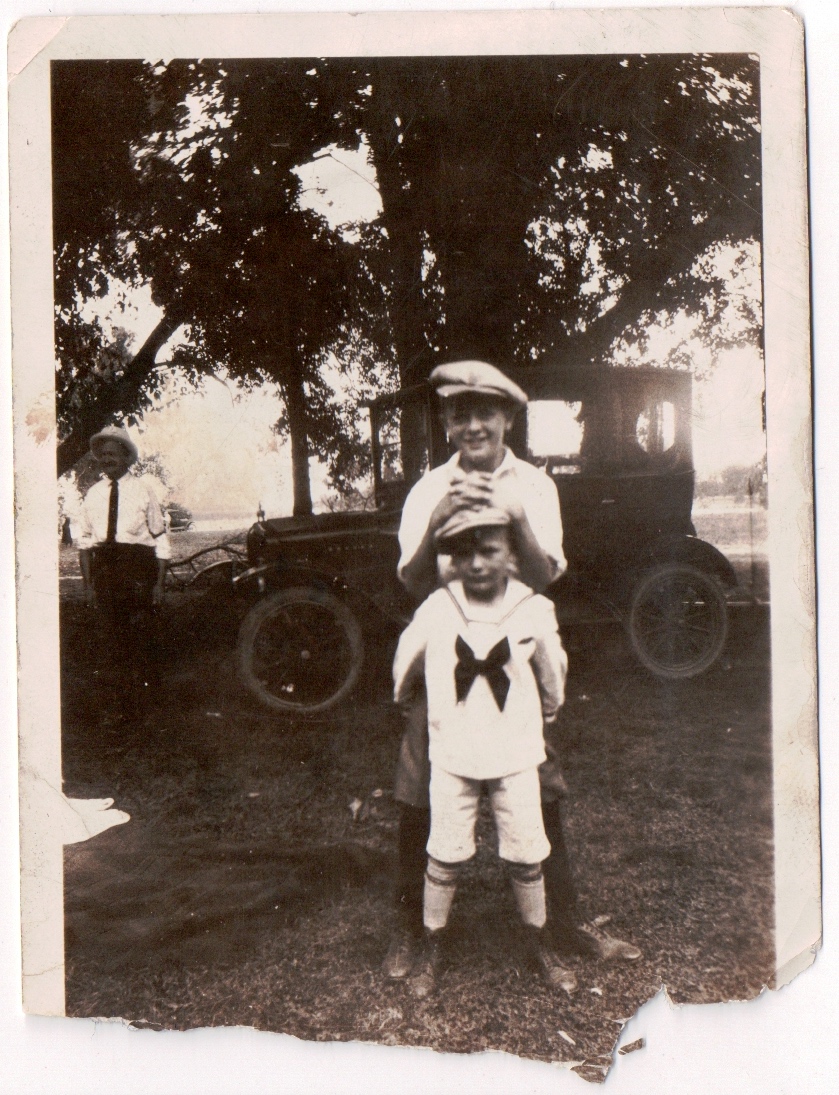
It might have been a late summer’s day when brothers Roy and James Walsted of Sioux City, Woodbury County, Iowa posed for this snapshot circa 1924. Six years apart in age, Roy was perhaps twelve and Jim perhaps six when this photograph was taken some ninety years ago.1 The park-like setting and the blanket at their feet suggest that the occasion may have been a picnic. Classic car aficionados could likely date the vehicle parked behind the boys.

SCAN0323 - Version 2

Roy Louis Christian Walsted (back) and James Herman Walsted (front), Sioux City, Iowa, ca. 1924; digital image 2015, privately held by Valene Petersen, 2015.

Roy suffered from polio as a child, which resulted in a limp as one leg was left shorter than the other. His younger brother was said to have come to his defense when Roy was bullied or was the last to be chosen for a neighborhood baseball team.2 Even in this photograph, it appears that Jim stands guard in front of his brother, his arms protectively curved back around Roy’s legs as Roy clasps his hands atop his brother’s head. Both boys wear short pants and newsboy caps; Jim is in a sailor suit, a style that remained popular for young boys in the post World War I era.3

I have to wonder who the man off to the side of the photograph could be. I have only seen two small snapshots of Roy and Jim’s father, both of which were taken late in his life. (I suppose there is a third if I count a postmortem photograph of him at his own funeral.) From those, I know that he was a man of slight build, but beyond that, I have no way of telling whether this gentleman in a straw boater hat and rolled shirtsleeves is in fact James Jacob Walsted or not. If this picnic was a family affair, perhaps the boys’ mother, Kathrine, was behind the camera.

This charming snapshot is one of a handful of photographs that I have in my digital collection of the Walsted brothers and their parents, both immigrants who came to Iowa from Denmark in the early twentieth century. For more photographs of the family of James Jacob Walsted (1886-1956) and Kathrine Christensen (1886-1971), check out my new Walsted Family Album

Copyright © 2015 Melanie Frick. All Rights Reserved.

Continue reading

The Pomeranians: Identifying a Family Photo

If you’d asked me about this photograph a few years ago, I might said that Joachim and Sophia were, in fact, Ernst and Friederike. That is, I might never have identified the couple in this cabinet card photograph if it weren’t for a few subtle clues that pointed me conclusively in the direction of one immigrant couple over another.

My grandmother’s paternal grandparents both came to America as infants, the son and daughter of Pomeranians from the region now known as Mecklenburg-Vorpommern, Germany. The first couple to reach America, Joachim and Sophia (Cammin) Wiese, traveled from Hamburg in 1868.1 The second couple, Ernst and Friederike (Wagner) Stübe, traveled from Hamburg in 1869.2 Both couples settled initially in Chicago, although within a few years, Ernst and Friederike would move to a rural community outside the city. The couples were born within several years of each other, and no other identified photographs of either couple existed in my collection in order to aid in their identification. Based on the provenance of this photograph in a family collection, I knew that it must show one of these two couples.

JoachimWieseSophiaCammin

Joachim and Sophia (Cammin) Wiese, ca. 1885-1890, Chicago, Cook, Illinois; digital image ca. 2000.

The man and woman in this photograph are perhaps in their mid-fifties, give or take a decade. The photograph itself, taken by an unidentified Hansen of Chicago, is a cabinet card, a style that became popular after the Civil War.3 This, of course, fits the time period in which the Wieses and Stübes would have lived in Chicago. However, as both couples were only around thirty years of age in 1870, this photograph was more likely taken at some point between 1880 and 1900.

The woman in the photograph wears her hair parted in the middle and pulled back snugly, a no-nonsense style that is not specific to any era. Her ears are pierced and she wears what appears to be a dark wool suit with a fitted basque jacket featuring a high ruffled collar, a single row of buttons, and cuffed sleeves. Notable is the double row of boxed pleats on her underskirt; this style was popular in the latter half of the 1880s, as was the style of her jacket.4

The man is clean-shaven except for a trimmed neckbeard, and his hair is brushed away from his face. He has light-colored eyes – blue or green – and wears a typical three-piece suit. The age of the couple in this photograph as well as their style of dress suggest that, if this photograph was taken to mark a particular occasion, it may have been to commemorate an event such as their twenty-fifth anniversary.

Joachim and Sophia would have celebrated their twenty-fifth anniversary circa 1890, a date calculated based on their ages and the birthdate of their eldest known child.5 Ernst and Friederike, however, did not reach such a milestone; Ernst died in 1879 at the age of forty.6 As the woman’s clothing in particular is markedly different from the styles of the 1870s, this photograph could not have been taken before 1879, and thus cannot be a photograph of Ernst and Friederike (Wagner) Stübe.

A final clue comes from the notation penned at the bottom of the cabinet card by a descendant: “Fatte + Matte?”7 A letter written by the granddaughter-in-law of Joachim and Sophia noted that his grandsons could not recall their names, but had called them “Fatta” and “Mota.”8 Coincidence? I don’t think so. My hunch is that these are phonetic spellings of perhaps an old dialect-based variation of the German words for father and mother, Vater and Mutter. This is how Joachim and Sophia (Cammin) Wiese were remembered by their children and grandchildren.

Copyright © 2015 Melanie Frick. All Rights Reserved.

Continue reading

The Trailblazers

Jensine Kathrine and Lars Marinus Walsted were the first of their siblings to leave Denmark for America. Sine (also spelled Sena) was eighteen and Lars Marinus twenty when they arrived in Boston on 19 April 1886 aboard the Catalonia and made their way to Council Bluffs, Pottawattamie County, Iowa.1 It would be seven years before they would see another member of their family, although eventually, all of their surviving siblings would make their way to America.

Marinus_Walsted_Jensine_Walsted_1887

Lars Marinus “Charles” Walsted, 21, and Jensine Kathrine “Sine” Walsted, 19, half-siblings, Council Bluffs, Iowa, 1887; digital image 2014, privately held by Dianne Anderson, 2015.

This 1887 cabinet card photograph was likely taken outside in the summertime, as real grass appears in front of the outdoorsy backdrop. In addition, Sine poses with a parasol, certainly a warm-weather accessory. Both are smartly dressed, Lars Marinus in a light-colored three-piece suit and Sine in a plaid dress with a straight skirt and snug sleeves that, as was typical of the time, do not quite reach her wrists.2 A flower is pinned at her throat. Their hats – Sine’s quite elaborate – rest at their feet. Lars Marinus parted and combed his hair neatly, while Sine’s hair is pulled back tightly and does not seem to be styled in any special way. Iowa summers can be hot and humid, rather unforgiving to the curled fringe often worn by young women of the era!

At nineteen and twenty-one, these fair-complexioned half-siblings had their lives ahead of them. Having become established among a community of Danes in the Council Bluffs area, Sine and Lars Marinus may have wanted to have their picture made so that their parents could see how well they were doing after a year away from home. As the eldest children and trailblazers for life in America, they may also have hoped to encourage their five siblings to join them when they were able. While this photograph remained in Sine’s possession until she gifted it to her daughter in 1932, it’s easy to imagine that another copy may very well have accompanied a letter home to Denmark.

Copyright © 2015 Melanie Frick. All Rights Reserved.

Continue reading

Searching for Marguerite

There is both good and bad news about this photograph:

Unidentified_Marguerite_Chicoine_Adam

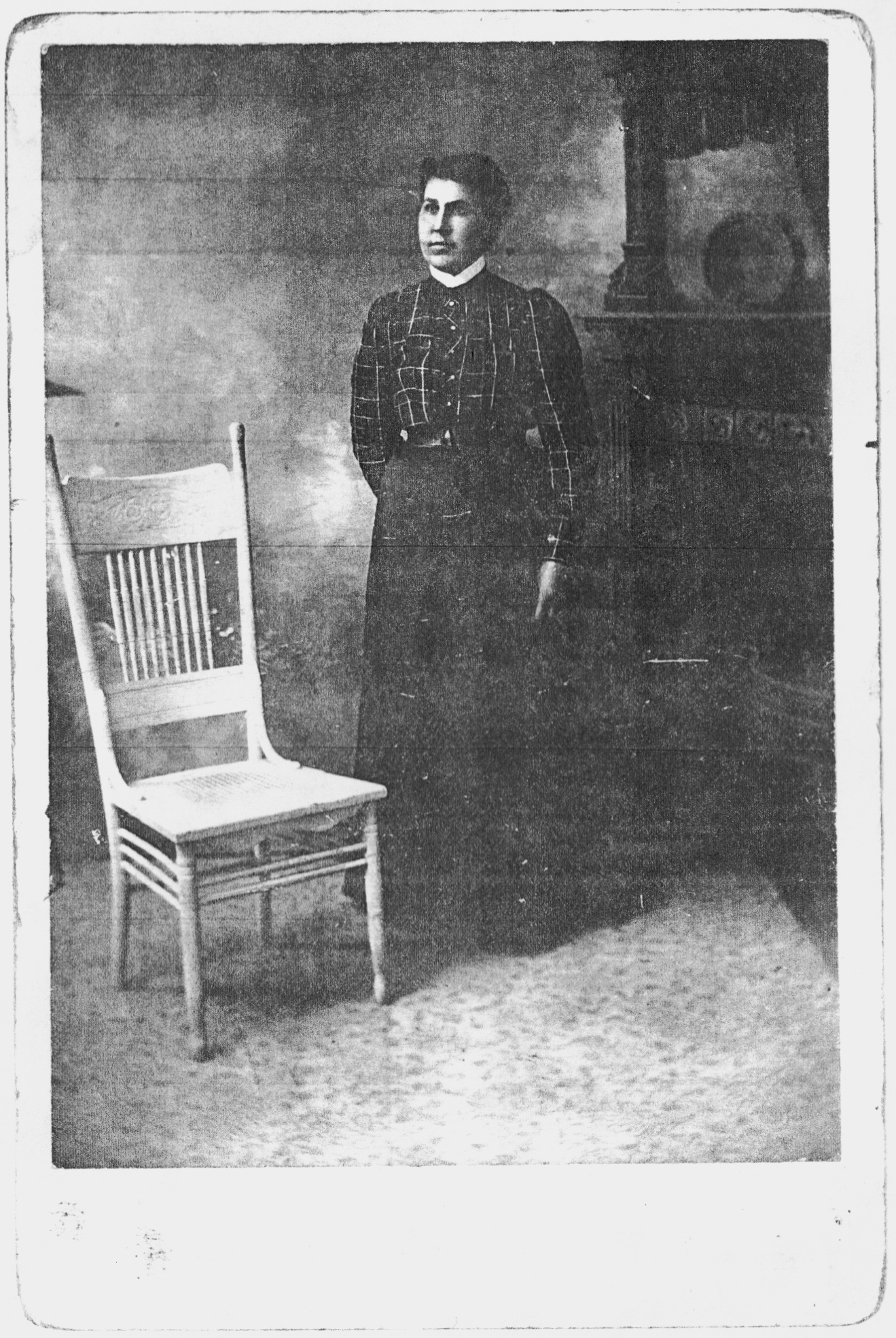
Unidentified photograph, ca. 1860-1866; digital image 2015, privately held by Melanie Frick, 2015. Image courtesy of D.B.

Twenty-seven years ago, my parents traveled to Massachusetts and made a stop in the community of Indian Orchard, where, my father knew, his ancestors had lived for a time in the latter half of the nineteenth century. As it turned out, these French Canadian immigrants had descendants who still lived in the area, and thanks to the staff at Saint Aloysius Parish, he was able to connect with one such descendant. Later, he began corresponding with two more cousins, both of whom were kind enough to share their research about our shared French Canadian and Acadian ancestors. Family lore and even a few photographs were also exchanged – including this photocopied image thought to be a photograph of Marguerite (Chicoine) Adam (1816-1878).1

Marguerite Chicoine is one of the first ancestral names I learned as a child and amateur family historian. I loved hearing that she was said to be Native American – a bit of family lore since (mostly) disproven, but it did work quite effectively to capture my attention at the time. I had always hoped to see the original of this photograph that was sent to us by our late cousin, but learned two years ago that an original may no longer exist. Apparently, when she was moved to a nursing home, her family history materials were thrown out.2 This serves as an important reminder to make an estate plan for the preservation of your own family history materials.

While I can’t rule out that somewhere out there, a cousin might hold another copy of this same photograph – that fortunate scenario has happened before – it’s also possible that this is the only version of this photograph that I will ever see. In any case, let’s take a look. Could this realistically be a photograph of Marguerite Chicoine?

Marguerite died in Massachusetts in 1878 at the age of 62.3 Thus, this photograph would have to predate 1878. As the photocopy indicates that this was a carte de visite – most popular between approximately 1860 and 1866 – that is entirely possible.4 All of Marguerite’s fifteen known children were born before 1862, with the exception of her youngest, who was born five years later. As Marguerite relocated with her family from Quebec to Massachusetts circa 1864-65, it seems plausible that she may have had her picture taken during this time period as a memento to share with relatives at home.5

Marguerite was fifty years old when her youngest child was born at the tail end of the most likely timeframe for this photograph; in order to have had a healthy pregnancy so late, perhaps she had a more youthful appearance than one might otherwise imagine for a mother of fifteen. The woman appears to have dark hair without noticeable graying, and her dark complexion and strong nose make it easy to see how rumors of significant Native American ancestry could have gotten started. However, I find it difficult to get a sense for her age, due in part to the poor quality of the image. Could she be over forty-five, or is this woman in fact decades younger?

Marguerite did have three daughters who would have reached adulthood by the 1860s: Marguerite Adam, Marie Adam, and Julienne Adam.6 While I do have a photograph of Marguerite, who does not appear to be a match, could this photograph show instead either Marie or Julienne as a young woman in her early to mid-twenties?

The woman wears a buttoned shirtwaist with a windowpane pattern, the sleeves neither significantly fitted nor puffed, and a high linen band collar is visible.7 Her belted skirt is of a straightforward design. Notably, it is not worn with a fashionable hoop as one would typically expect in the 1860s; this more unassuming skirt would perhaps have been in line with what a woman in rural Quebec or an immigrant in a New England mill town might wear.8 The backdrop is similarly domestic in style with a practical wooden chair and what looks to be a fireplace.

The good news? This could be a photograph of Marguerite Chicoine. It depicts a dark-complected woman of evidently simple means who was photographed in the 1860s, a physical description, socioeconomic background, and timeline that fit with what is known about Marguerite.

The bad news? We may never know for sure. It seems equally plausible that could be a photograph of one of Marguerite’s daughters or a close relative. Lacking an original for closer examination, it can still be hoped that another copy of this photograph might exist in different branch of the family, and that it may hold additional clues regarding the true identification of the mysterious dark-haired Québécois.

Copyright © 2015 Melanie Frick. All Rights Reserved.

Continue reading