Category Archives: Uncategorized

Who Was Jordan Stilley?

Jordan Stilley was a southern Illinois settler of the early nineteenth century who had a family of twelve children. His name appears on only a smattering of records, and at a time and place where efforts to keep vital records were scant if not entirely nonexistent, developing a picture of his life is not unlike attempting to assemble a jigsaw puzzle with only a few of the pieces available.

Born in either 1797 or 1799 in Hyde County, North Carolina, Jordan Stilley was one of nine known children of Hezekiah Stilley and Sarah Davis. No record exists of Jordan’s birth, and no record has been located that documents the marriage of his parents; this information has been pieced together thanks to transcriptions of a faded nineteenth-century family Bible by the late genealogist Peggy (Stilley) Morgan, the 1802 will of Jordan’s maternal grandfather, and early census records.

Jordan likely made his first appearance in federal records as a tick mark in the 1800 United States census. Hezekiah Stilley was recorded as the head of a household of eight individuals in Hyde County, North Carolina that included a male and a female between the ages of 26-44, two males between the ages of 10-15, three males under the age of 10 (one, presumably, being Jordan), and one female under the age of 10.

Before Jordan was ten years old, he had trekked eight hundred miles west with his parents and siblings as well as members of his extended family. Their destination was the Illinois Territory, and it was there that his father’s name appeared on a petition for three hundred and twenty acres of land in what is now Cave-in-Rock Township, Hardin County, Illinois. This petition indicated that Hezekiah, among others, had been squatting there prior to a legislative act which took place on 03 March 1807.

Cave-in-Rock, located on the Ohio River, would have been a rough place for a child to grow up, as it was known at the time as a hotbed of river pirates, outlaws, and highwaymen. In the winter of 1811-1812, when Jordan was twelve years old, he would have felt the rumblings of the New Madrid earthquakes, the epicenter one hundred-some miles away. Did his family’s frontier home survive, or was destruction such that they were forced to rebuild or relocate?

“The Great Earthquake at New Madrid,” ca. 1877, woodcut, artist unknown; Wikimedia Commons.

In December of 1812, Jordan’s eldest brothers—Davis, John, and Stephen, all of whom were over the age of twenty-one—are believed to have signed a petition put forth by residents of the Big Creek Settlement in Illinois Territory. Jordan’s father’s name was not included on this petition; if he were still living, which he may not have been, he would have been around fifty years of age at this time.

Jordan Stilley made his first appearance in the United States census by name in 1820 as “Jourdan Stilly,” head of a household in the area of Frankfort, Franklin County, Illinois that included one male and one female between the ages of 16-25 and one female under the age of 10. The age of the adults and presence of only one young child suggests that Jordan was relatively recently married, and it is notable that he was enumerated next to the household of his brother Davis Stilley. Also notable is the presence of both a William Farris and a John Farris in Franklin County. Although the county’s marriage records are incomplete, it is believed that Jordan Stilley married Phoebe Farris here circa 1818.

According to recent research, Phoebe Farris, whose name is known only from the obituary and cemetery records of her youngest daughter, appears to have been the daughter of Virginia-native William Farris and his presumed wife Mary “Polly” Bunnell. Genealogist George J. Farris has indicated that all of the children of brothers William Farris and John Farris have been identified with the notable exception of one daughter of William, who was acknowledged via tick mark in the 1810 United States census in Green County, Kentucky. This daughter would have been born between 1797-1800—and it now seems likely that this daughter was Phoebe, as she lived in the right place at the right time to have become the wife of Jordan Stilley. DNA connections between Farris/Bunnell and Stilley/Farris descendants tentatively support this relationship.

Jordan relocated with his family at least once again between 1820 and 1830, at which time he was enumerated in the United States census in Washington County, Illinois. His household now included one male and one female 30-39, two males under 5, one male 5-9, one female under 5, one female 5-9, and one female 10-14—a total of two adults and six children. His brothers Davis and Hezekiah resided nearby. Little is known about Jordan’s life in the next decade save for the fact that in January of 1838, there is record of his purchase of one bay mare, one yoke of oxen, one wagon, one sorrel mare, and one colt from his brother Davis Stilley, who operated a mill.

In 1840, Jordan remained in Washington County where he was enumerated in the United States census with a household that included one male and one female 40-49, one male under 5, one male 5-9, two males 10-14, one male 15-19, one female under 5, one female 5-9, one female 10-14, and one female 20-29. This equates to nine children at home; his two eldest daughters were known to have married before 1840 and were no longer living at home. The household of Mary Stilley, who was the widow of his brother Hezekiah, was recorded next on the census, and, according to The History of Washington County, Illinois, both Jordan and Mary were constituent members of the Concord Baptist Church at the time of its founding in 1841. The Baptist tradition was strong in the Stilley family; Jordan’s paternal uncle was Elder Stephen Stilley, who was a missionary and founder of the Big Creek Baptist Church, not far from Cave-in-Rock, in 1806.

Tragedy befell Jordan’s family when his son, also named Hezekiah, enlisted to serve in the Mexican-American War and died in Buena Vista, Mexico, in the spring of 1847. The following year, Jordan was involved in a bounty land transaction for one hundred and sixty acres of land in Pettis County, Missouri; this was due to the service of his late son, who died without wife or children, and confirms that “Jourdan Stilley” was “father and heir at law of Hezekiah Stilley deceased, late a Private in Capt. Coffey’s Compy. 2nd Regt. Illinois Vols.”

Jordan must have lost his wife Phoebe at some point between 1844-1850; their youngest child was born in 1844, and on 19 March 1850, Jordan married Malinda (White) Vaughn, a young widow who had a four-year-old child of her own. Oddly, Jordan and Malinda do not appear in the 1850 United States census with Jordan’s youngest children nor her young son, and some of Jordan’s children can be found living in the households of their adult siblings. Although no will has been located, it is believed that Jordan died circa 1854. It was in that year that Jordan’s apparently disabled daughter Sarah Ann—who was documented as being “idiotic” and “insane” in the 1860 and 1870 United States censuses—was entered into the guardianship of an older brother, and Jordan himself signed with an X. In 1857, Sarah Ann, “minor heir of Jordon Stilley,” was entered into the guardianship of Ebenezer Davis of Washington County, Illinois.

Based on research by genealogists William D. Stilley and the late Dr. Bernard “Bud” Hall, as well as information compiled from census records, land records, newspapers, military pension files, and personal correspondence, the following twelve individuals are believed to be the children of Jordan Stilley and his first wife, Phoebe Farris:

  1. Nancy (Stilley) Holman Edwards Hall, born 22 June 1819, died 21 October 1898
  2. Hester Ann (Stilley) Rogers, born about 1821, died before 1860
  3. Hezekiah Stilley, born about 1823, died 19 April 1847
  4. William J. Stilley, born about 1825, died about 1857
  5. Robert M. Stilley, born about 1827, died 1856
  6. Mary A. (Stilley) West, born about 1829, died March 1870
  7. Jeremiah Stilley, born about 1832, died 1876
  8. Mary Jane (Stilley) Dennis, born 16 March 1835, died 31 October 1914
  9. James Albertus Stilley, born 18 June 1837, died 15 December 1890
  10. Sarah Ann Stilley, born about 1839, died after 1870
  11. Isabelle (Stilley) Nicolay, born 23 September 1841, died 03 December 1905
  12. Wilson Stilley, born 22 February 1844, died 18 February 1899

The birth order of the children is not set in stone due to the absence of birth dates of more than half; however, there is some evidence of common naming conventions having been followed, such as the potential eldest son being named for the paternal grandfather and the potential second eldest son being named for the maternal grandfather. In any case, it is not a linear process to establish familial relationships between individuals when there is an absence of vital records, and the twelve inferred children of Jordan Stilley make for a particularly tangled web.

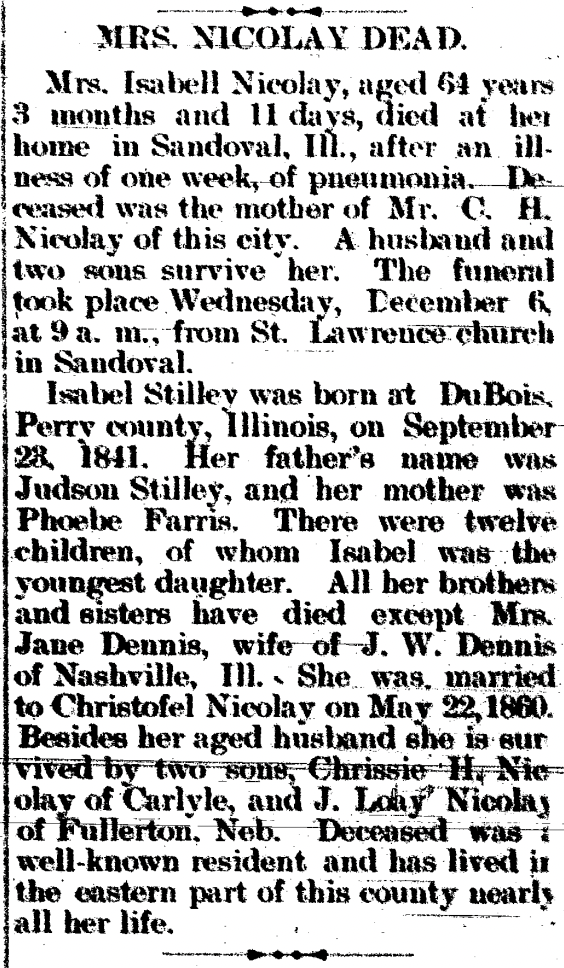
The most definitive piece of evidence regarding the Stilley family structure is a 1905 obituary of Isabelle (Stilley) Nicolay which names her as the youngest daughter of the twelve children of “Judson Stilley and Phoebe Farris” and as a sister of Mary Jane (Stilley) Dennis. However, a Marion County, Illinois cemetery index lists Isabelle’s parents as Jordan Stilley and Phoebe Farris. Considering the lack of evidence of the existence of a Judson Stilley in southern Illinois in the nineteenth century, it stands to reason that the name Judson was printed in her obituary in error and should have been Jordan.

“Mrs. Nicolay Dead,” Carlyle [Illinois] Constitution, 08 December 1905; digital image, Abraham Lincoln Presidential Library (https://presidentlincoln.illinois.gov/ : accessed 17 July 2019).

Another striking piece of evidence is a handwritten letter from a son of Wilson Stilley to his first cousin, a son of Nancy (Stilley) Hall, after Wilson’s death in 1899, which establishes that Nancy and Wilson were brother and sister, and that “Aunt Bell” (Isabelle), “Aunt Jane” (Mary Jane), and “Uncle Jerry” (Jeremiah) were their siblings as well. Some of these connections are also supported through the obituaries of both Wilson Stilley and Nancy (Stilley) Hall, which link them as siblings of Mary Jane (Stilley) Dennis, as well as through newspaper social columns, which connect Nancy, Mary Jane, and Isabelle as sisters. In those it was noted that Isabelle (Stilley) Nicolay visited “her sister” Nancy (Stilley) Hall in Saline County, Kansas in 1890 and 1892, as well as “her sister” Mary Jane (Stilley) Dennis in Washington County, Illinois in 1903.

Federal records also provide clues. The aforementioned 1848 bounty land record confirms that Hezekiah Stilley, who died while serving in the Mexican-American War, was the son of “Jourdan Stilley.” The Civil War pension files of both Wilson Stilley and James Albertus Stilley include handwritten depositions that link Wilson, James, Isabelle (Stilley) Nicolay, and Hester (Stilley) Rogers as siblings.

In addition, an 1854 Washington County, Illinois guardians’ bond held at the Illinois Regional Archives Depository at Southern Illinois University places Sarah A. Stilley, a minor, into the guardianship of William J. Stilley, presumably her brother, in a document signed also by “Jorden Stilley” and witnessed by Robert West, presumably the husband of her sister Mary A. Stilley. An 1857 court record from the same county names Sarah Ann Stilley as a “minor heir of Jordon [sic] Stilley, late of said county, deceased.”

It is highly unlikely that a singular smoking gun, so to speak, that clearly defines the relationships between Jordan Stilley, his wife, and all of his children, will ever be revealed, due to both scant documentation and an 1843 fire at the Franklin County, Illinois courthouse that destroyed many early records. However, their story has been slowly but surely puzzled together through a range of sources and an understanding of the norms of the time that make it possible to infer relationships with a reasonable level of confidence. To have raised twelve children to adulthood on the Illinois frontier was no small feat, and Jordan and Phoebe (Farris) Stilley, though their graves are unmarked and the details of their stories lost to time, are worth remembering.

Copyright © 2025 Melanie Frick. All Rights Reserved.

Continue reading
A Farewell to Canada

Timothée Adam was only a year old when he lost his father. Born to Charles Pierre Adam and Marie Marguerite Saint Michel on 02 April 1816 in Beloeil, Quebec, he was baptized as Joseph Timothée Adam and was the seventh of eight children born to the couple; his younger sister was born just two weeks after their father’s death in August of 1817. Their mother, who had married at sixteen, was now a widow at the age of thirty, and considering how many small mouths she had to feed, it is not at all surprising that she remarried the following summer.

Although little is known about Marie Marguerite’s second husband, Louis Amable Pineau, after several generations had passed an oral tradition remained that the surname Pineau was somehow linked to the Adam line. Marie Marguerite had no children with Louis, who was ten years her junior, but he was the only father that the youngest of her children would have ever known. Her children would also have known her parents, their grandparents Joseph Michel and Marie Josephe Patenaude, as they spent their later years living in the same parish as Marie Marguerite and her family. Perhaps Joseph, who was born in exile in Massachusetts in 1757 following Le Grand Dérangement, the tragic expulsion of the French-speaking Acadians of Nova Scotia by the British, shared stories of his origins and the family’s eventual return to Canada—or perhaps not.

Timothée married Marguerite Chicoine in Saint-Marc-sur-Richelieu, a village just north of Beloeil on the Richelieu River, on 24 October 1837, when he was twenty-one. The couple then moved approximately thirty miles east to the village of Saint-Pie, where Timothée supported his family as a cultivateur, or farmer. The couple’s first ten children (of an eventual sixteen) were born in Saint-Pie, and the family appeared in the census there in 1851. It was noted that they resided in a one-level home made of wood, although interestingly, not all of their children lived within their household. Two of their daughters, who were eight and two, were found with their grandmother in another household in the same community, although perhaps this was only a temporary arrangement.

A decade later, at the time of the 1861 census, Timothée and Marguerite shared their household with all of their minor children, while their two eldest daughters, both married and with children of their own, were enumerated directly before them in the census. All were recorded as residents of Rang Saint-Charles, a rural road that runs southeast of Saint-Pie and south of the Noire River. This was not far from Saint-Paul-d’Abbotsford, where several of their younger children were baptized.

View of Mont Yamaska from Grand Rang Saint-Charles, Saint-Pie, Quebec

By June of 1865, Timothée had relocated with his family to Massachusetts. One has to wonder whether he recognized the irony in returning to the same place where his grandfather had been born in exile—but what drew him and his family to Massachusetts, a little more than a century after Le Grand Dérangement, was almost certainly the cotton mills. Contemporary news accounts referenced, sometimes scathingly, the “hordes of French Canadians” who traveled by rail from the border crossing at St. Alban’s, Vermont, to Massachusetts, where entire families crowded into tenements and worked at the mills. Indeed, the 1865 Massachusetts State Census places Timothée, Marguerite, and their ten unmarried children, who were between the ages of three and twenty-one, in Ward 8 of Springfield, Hampden County, Massachusetts, where Timothée and the five eldest children were all employed at the Indian Orchard mill.

There may have been another driving factor that caused Timothée to uproot his entire family, however, and that was the potential threat of a military draft in Canada and associated unrest that presumably might have affected his eldest sons. A Massachusetts newspaper printed the following in January 1865: “There is quite a little rebellion in Canada now, and all about a militia draft for frontier service. The French Canadians at Quebec resisted the draft made upon them last week and drove away the officers. Four companies of the volunteer militia were immediately called out and the insurrection will be a short lived one.”

By the time of the 1870 U.S. census, Timothée, by then fifty-four and with nine children still in his immediate household, continued to reside in Indian Orchard but was without an occupation. His six eldest unmarried children, who were between the ages of twelve and twenty, were all millworkers, and their earnings no doubt supported the entire family. Incredibly, the grand total of individuals in Timothée and Marguerite’s multigenerational household, which included their married children and their own large families, numbered twenty-eight.

View of Springfield, Massachusetts on the Connecticut River,” ca. 1840-1845, Thomas Chambers (1808-1869); oil on canvas, private collection, photographed while on loan to the Metropolitan Museum of Art, New York, New York; Wikimedia Commons.

Tragedy struck in 1878, when Timothée first lost two grandsons who drowned while fishing in the Chicopee River, and then lost his wife of forty years when Marguerite succumbed to consumption at the age of sixty-two. Timothée did not appear in the 1880 U.S. census, but city directories indicate that he resided at 83 Main in Indian Orchard. His unmarried children, ranging in age from fourteen to thirty, were enumerated together on Main Street; perhaps Timothée’s absence was an accidental omission, or perhaps he was traveling at the time that the census was recorded. It is known that he ventured to Dakota Territory a short time later, as he was documented as a parishioner at St. Peter’s Parish in what is now Jefferson, Union County, South Dakota in 1885, along with two of his adult sons and their families. The recent deaths of several family members, including two of Timothée’s adult children and multiple young grandchildren, may have spurred this move away from crowded tenement life.

Timothée is absent from the Springfield, Massachusetts city directories of 1885-1895. He makes a reappearance in 1896, boarding at 69 Main, Indian Orchard; this was the home of his daughter, Marie, and her husband, Gabriel Noel. Had Timothée spent the intervening years with his children in the Midwest?

On 19 March 1897, a newspaper in Sioux City, Woodbury County, Iowa, printed the following: “T. Adams, father of P.P. Adams of Davidson Bros., died while visiting relatives at Indian Orchard, Mass., at the age of 84 years.” Timothée would have been, in fact, eighty years old at the time, but this was not the only misprint regarding his death.

The death register for the city of Springfield, Massachusetts, which encompassed Indian Orchard, does not have a record of the death of any individual by the name of Timothée Adam at that time—but it does name one “Mathieu A. Adam,” son of Pierre Adam of Canada, who was reportedly eighty years, ten months, and seventeen days at the time of his death on 09 March 1897.

The dates are close enough that they might be considered a mathematical error—Timothée would have reached the age of eighty years, eleven months, and seven days at the time of his death. His father’s middle name had been Pierre, and it’s quite possible that that is how he was more commonly known. But “Mathieu”? One guess is that entries on the death register were recorded based on other handwritten records or notes, and that a scrawled “Timothée” was mis-transcribed as “Mathieu,” another French name with a “th” in the middle. His cause of death was attributed to “Old age: Indigestion,” and Timothée’s grave, presumably near that of his wife at the Saint Aloysius Cemetery in Indian Orchard, is unmarked.

His will, filed in Springfield in March of 1896, a year prior to his death, is succinct in regards to his wishes and suggests that he may have spent extended time in the care of his second-eldest daughter Marie:

“After the payment of my just debts and funeral charges, I bequeath and devise as follows. First: To my daughter Mary Noel wife of Gabriel Noel of said Springfield, all the estate both real and personal of which I shall die seized and possessed and to which I shall be entitled at the time of my decease. I purposely give no bequest or devise in this will to my only living children, or the issue of any deceased child, having provided for them in my lifetime and I exclude them and their issue from any claim upon my estate of every nature and description. Second: I direct that my executrix hereinafter named expend the sum of Fifteen dollars for a high mass over my remains.”

Hampden County, Massachusetts Probate Records

So little is known of who Timothée Adam was as a person. He was a French Canadian by birth and an immigrant who may have faced contempt and discrimination in the United States due to his language, faith, and culture. He was a farmer and a millworker—but as his eldest surviving son was a carpenter, one can speculate that Timothée may also have possessed these skills. Two of his younger sons played the fiddle, and another sang; was Timothée musical as well? He was a lifelong Catholic, and desired that a portion of his (presumably not large) estate be set aside in order for him to receive a high mass upon his death. He was the father of sixteen known children, fourteen of whom survived to adulthood, and the names of his eldest sons suggest strong familial bonds: Timothée, Louis (like his stepfather), Joseph (like his maternal grandfather), Pierre (like his father and paternal grandfather). Notable too is the name of his youngest son, the only one of his children born outside of Canada: Prosper, named perhaps in recognition of Timothée’s hopes for his family to flourish in a new home.

Copyright © 2024 Melanie Frick. All Rights Reserved.

Continue reading
A Sad Accident: The Death of George W. Fenton, Revisited

Sometimes, there’s more to the story.

Eleven years ago, when I first wrote about the accidental death of Kansas pioneer George W. Fenton, the number of historic newspapers that were readily available to search online was still relatively slim. I was aware that George’s death had made the news—but at that time, I was not yet aware that several differing accounts of the incident had circulated, nor that the news had spread throughout Kansas and beyond.

George W. Fenton—a son of English immigrants who was orphaned at the age of ten when his father perished in the Civil War—had overcome his difficult childhood in Ohio and Illinois and settled down to a farmer’s life near Gypsum Creek in Saline County, Kansas. He had been married for seven years and was the father of three young daughters when, at the age of twenty-eight, he was accidentally shot and killed by his brother-in-law.

As it turned out, George had had another brush with misfortune with a firearm only days before his death. On 02 October 1880, the Salina Herald reported: “Mr. George Fenton had his eyes badly burned by the premature discharge of a gun last week. He is now able to see out of one of them, and hopes they are not seriously injured.”

Perhaps George was still taking things easy on the afternoon of Sunday, 10 October 1880, when he and his family visited at the homestead of his mother-in-law, Nancy (Stilley) Hall. However, that is when tragedy struck. The following Thursday, the Saline County Journal reported:

A Sad Accident. A very painful accident happened last Saturday which resulted in the death of George Fenton, of Gypsum creek. Mr. Fenton with his family was upon a visit to his mother-in-law, who resides about eighteen miles south-east of town, and with whom was residing “Bud” Hall, her son and brother-in-law of Mr. Fenton. During the afternoon while those two persons were engaged in some boyish pranks, Hall playfully presented a shot gun at Fenton (which Hall supposed was unloaded), cocked it and snapped the hammer. A charge of shot was lodged in Fenton’s breast, which proved his death wound. He lived for only an hour after the shot. He leaves a wife and three children. How the charge came in the gun is a mystery, as everybody about the house supposed the gun to be unloaded. Hall is nearly distracted over the result of his carelessness. The brothers-in-law were the best of friends—no trouble ever having occurred between them. The occurrence was so clearly a case of accidental shooting that no coroner’s jury was summoned. Mr. Frank Wilkeson came to town for surgical aid and Dr. Switzer hastened quickly to the scene of the accident, but arrived after Fenton’s death. The moral to be drawn from the careless habit of handling “unloaded guns” is too plain to be commented upon here. Will people never learn better?

The Saline County Journal, 14 October 1880

On the same day that the news was first reported in The Saline County Journal, the McPherson Republican printed the following:

Again we are called upon to listen to the sad results of carelessness with fire-arms. On Sunday, October 10, in the south-eastern part of Saline county, Mr. George Fenton  was accidentally shot by his brother-in-law, Bud Hall. They were both playing with the children, little dreaming of the great calamity that was about to befall one of them. Mr. Hall wishing his gun, reached through the door, and not looking at what he was taking in his hand, took hold of a gun that belonged to a person who was visiting him. Thinking it was his own gun and knowing that it was not loaded, he drew it towards him more carelessly than he would have done had he known it was not his own gun. The hammer of the gun struck against the door side and discharged it; the shot striking Mr. Fenton in the left breast and ranging upward lodged under the shoulder blade. Mr. Andrew Sloop, who had passed a moment before, was called back, and sent post haste to Roxbury for a physician. Doctor Zawadsky hastened at the call, but it was of no avail. The results were fatal, he having expired about one and a half hours after the accident, and before the Doctor arrived. Mr. Fenton leaves a wife and three children to mourn his sad loss. Mr. Hall is almost crazed, and does nothing but rave and call with endearing entreaties to the departed one. All the neighbors sympathize with the distressed family, as they show by their willing assistance. – E. October 11, 1880

McPherson Republican, 14 October 1880

Perhaps Bud had not, in fact, been so cavalier as to actually point a gun at George. The McPherson Republican account eliminates some of the blame he might otherwise have assumed by explaining that the gun—which belonged not to Bud but to an unnamed visitor—discharged accidentally when Bud reached for it behind a door. The account also informs us that medical assistance was sought not only by Frank Wilkeson, who went for Dr. Switzer of Salina, but also by Andrew Sloop, who fetched Dr. Zawadsky of Roxbury. However, both physicians arrived after George’s death, which was said to have occurred either one or one and a half hours after he was shot.

The following day, The Canton Monitor printed the following version of the events:

“We are informed by Mr. Banks, of Roxbury, that an accident occurred about five miles north of that place, by which Mr. George Fenton lost his life. The way it happened was this: Mr. Hall, a brother-in-law of Mr. Fenton, went to see him, Fenton, last Sunday. Mr. Hall was sitting in the door watching the children playing with the dogs, when he told one of them, jokingly, that he would shoot his dog, and at the same time reaching behind the door to get a shotgun, where two were standing. As he was taking one, the hammer of the gun caught some way, causing it to go off, the charge striking Mr. Fenton in the breast, killing him almost instantly. The shooting was entirely accidental, as they were the best of friends. Mr. Hall has went crazy from the accident, thus leaving two families as good as fatherless.

The Canton Monitor, 15 October 1880

This account contradicts the first in that it suggests that Bud was visiting George, when in fact The Saline County Journal was most likely correct that George was at the home of his mother-in-law, which is where Bud also resided with his family. (Frank Wilkeson, who went for the doctor, was a neighbor of the Halls.) This account also states that George died almost instantly, which is unlikely as otherwise there would have been no call to send for a doctor. However, The Canton Monitor does give a very specific and perhaps more believable account of what initiated the chain of events that resulted in George’s death. Like in the McPherson Republican, it is indicated that George and Bud were playing with the children at the time of the accident, but The Canton Monitor goes on to say that Bud was joking with the children that he would shoot his dog. (At a time when “mad dogs” were a more commonplace concern and livestock needed to be protected, this joke may have come across as slightly less alarming than it would to a modern audience!) Furthermore, the account agrees with the McPherson Republican that there was more than one gun standing behind the door, and that the hammer of the gun was caught in a way that caused it to unintentionally fire in George’s direction.

The next day, the Salina Herald printed another account of the events of October 10, more closely following the version published in the McPherson Republican and The Canton Monitor:

Sad Accident. Another sad result from the careless handling of guns occurred on Gypsum last Sunday. It appears that Geo. Fenton, living on the west branch of Gypsum creek went over to visit his mother-in-law, Mrs. Nancy Hall, who lived a short distance from him. While there himself and brother-in-law Bud. Hall were talking of hunting. Their gun was standing behind the door. Bud. Hall reached for it to shoot a dog, when the hammer caught in some way, and discharged the load in Fenton’s breast just above the heart. Mr. Wilkinson being near was informed and immediately came in for a physician, but whose service were too late, as Fenton lived only about an hour. The shooting was purely accidental, the thing to be condemned being the careless handling of firearms. Death often appears to be no warning, and almost daily is recorded sad accidents like this. Geo. Fenton was 27 years old and leaves a wife and three children to mourn his loss. He was buried Monday in McQuary’s graveyard on Gypsum Creek.

Salina Herald, 16 October 1880

The same edition of the Salina Herald also noted the following:

Mr. George Fenton, who was killed on Sunday last by the accidental discharge of a gun, was buried on Tuesday. There was a large attendance at the funeral and much sympathy expressed for the widow and her three children so suddenly bereaved of a husband and father. This adds one more instance of the criminal folly of playing with fire arms under any circumstance. Guns and [sic] playthings, but very serious matter of fact implements that carry death and destruction in their path whether accidentally or intentionally used.

Salina Herald, 16 October 1880

News of George’s death reached the Topeka papers before the end of October, and in November, it was reported in Wichita as well as in the Daily Illinois State Register in Springfield, Illinois: “George Fenton, a former resident of Buckeye Prairie, late of Saline county, Kansas, was accidentally shot and killed last week through the criminal carelessness of a a brother-in-law, who snapped a gun at him, not knowing that it was loaded.”

Elithan Davis “Bud” Hall with grandson Armond Beetch, Enid, Oklahoma Territory, circa 1905; digital image 2019, privately held by Iva Foster, 2024.

Elithan Davis “Bud” Hall did apparently recover from the grief and guilt he experienced at the loss of his brother-in-law and close friend. He went on to raise a family a family of four children and lived out his life on the Hall Homestead in Gypsum. A photograph of him as an older man with a grandchild by his side shows him with a kindly expression, and the laughter lines around his eyes make it easy to imagine him as a good-natured, fun-loving young man whose attempt at a joke went awry.

However, George’s young widow, Sarah, may never have fully recovered from the trauma of the loss of the young man she had married at the age of sixteen. Just twenty-three when she was widowed, she would remarry not once but three more times, with each marriage ending in divorce.

It is interesting that no account makes clear whose gun it was that was left loaded. A final report of the inquest held stated the following:

On Oct. 10, 1880, justice of the peace E.W. Mering was summoned to the home of E.D. Hall “near Frank Welkeson’s farm” to ascertain the circumstances stances of a man’s death. In the event that the county coroner could not attend an investigation (which turned out to be the case), Mering named six citizens to serve as jury: John C. Fahring, John M. Crumrine, Simeon Ellis, Jerome Swisher, D.C. Williams and M.M. Root.

The next day when the inquest was held at the Hall place, Mehring subpoenaed the following witnesses:  W. C. Jackson, Alonzo Gosso, Mrs. William Stahl, Mrs. E.D. Hall, Elisha Davidson and James Gaultney. All appeared to testify except Elisha Davidson, who was sick.

Witnesses revealed that George Fenton was shot in the chest by a double barreled shotgun at two in the afternoon of the previous day. The gun had been in the hands of E.D. Hall, Fenton’s brother-in-law. The shooting was ruled accidental.

Whether the double barreled shotgun in question belonged to Bud, George, or one of the witnesses—other neighbors and close kin—who were present at the Hall home that October afternoon is ultimately unknown, but as the gun was in Bud’s hands, he bore full responsibility for the accident.

Copyright © 2024 Melanie Frick. All Rights Reserved.

Continue reading

The Thatcher’s Family

When Matthias Hoffmann died in 1879 at the age of fifty-eight, he left a widow and six children, the youngest of whom was only four years old. Matthias, a thatcher by trade, had lived with his family in the village of Prümzurlay, Eifelkreis Bitburg-Prüm, Rhineland-Palatinate, Germany, near Luxembourg. He and his wife, Anna Marbach, had married in the village of Ernzen on 24 September 1861, and six children were born to them over the next fourteen years: Clara (1861), Nicolaus (1864), Jacob (1867), Elisabeth (1869), Eva (1872), and Matthias (1875).

It is not known how the Hoffmann family supported themselves after Matthias’s death, but as Anna did not remarry, she and her eldest daughters may have been able to earn an income from spinning, weaving, or the like, while her eldest sons may have hired out as shepherds or farm laborers. Perhaps Nicolaus, who was fourteen when his father died, was fortunate enough to have already had an apprenticeship in place; eventually he married and settled in the area, living out his life in Germany.

Prümzurlay, Rheinland-Pfalz, Germany photograph, 2009; privately held by Melanie Frick, 2024.

For the others, however, new horizons were sought. Jacob, the second eldest son, who had been twelve years old at the time of his father’s death, was the first to immigrate to America. He traveled alone from Antwerp to New York in the spring of 1887 when he was twenty years old. One can well imagine the hard work that he—and his mother and siblings—must have undertaken in order to book his passage, quite likely with the expectation that he would pave the way for the rest of the family to eventually join him overseas. Jacob then made his way to northeastern Iowa.

Three years later, in the spring of 1890, his sisters Clara and Elisabeth followed. Within a month of their arrival in North Washington, Chickasaw County, Iowa, Clara, who was twenty-eight, married fellow immigrant John Seelhammer. One wonders whether they had been acquainted in Germany, or whether Jacob may have facilitated the match. Elisabeth, twenty, was not so quick to settle down; she found employment as a housekeeper for the local priest, Father Probst, who was a native of Luxembourg.

In the spring of 1891, matriarch Anna (Marbach) Hoffmann, who was by then fifty-five years old, voyaged from Antwerp to New York with her two youngest children, Eva, eighteen, and Matthias, sixteen. They too were bound for Chickasaw County, Iowa, where they would reunite with Jacob, Clara, and Elisabeth.

The 1895 Iowa state census indicates that Anna and at least four of her children resided in Chickasaw County: Anna headed a household that included her sons Jacob and Matthias, both of whom farmed; Clara lived with her husband, a shoemaker, and their children; Elisabeth resided at her place of employment with Father Probst and the Sisters of Charity. Eva is absent from the 1895 Iowa state census, but whether this is because she had moved elsewhere or was simply missed by the census enumerator is not known.

It was in Chickasaw County that Jacob married Margaret Nosbisch in 1895, and where Elisabeth married fellow immigrant Mathias Noehl in 1896. In 1898, however, tragedy struck the Hoffmann family, when Matthias, the youngest child of Matthias and Anna (Marbach) Hoffmann, died at the age of twenty two or twenty three. Another blow occurred that year when Jacob and his wife lost a child at one day old.

It was also in 1898, however, that Eva married in Chicago to Mathias Weyer, and by 1900, her mother had joined her there. Chicago wasn’t a surprising destination for them; Anna’s mother and two of her sisters had settled there decades earlier. Although her mother had since passed away, Anna would have had the opportunity to reunite with her sisters and to meet her nieces and nephews.

Ultimately, Anna seems to have remained in Chicago until her death in 1907; the cause was attributed to asthma. Clara and Elisabeth both raised large families in Chickasaw County, with Clara having eight children and Elisabeth nine. Eva had one child with her first husband, a farm laborer and beer peddler; after she was widowed, she remarried in 1913 to Milton Jonas, and lived out her life in Chicago.

Jacob, whom a local newspaper described as being “of that hustling, genial disposition which makes him companionable and agreeable whether the weather, or something else is or is not just to his liking,” set his sights on South Dakota shortly after the dawn of the new century, and later settled in Hidalgo County, Texas, with his wife and son—who was ultimately the only one of his six children to survive infancy.

Brother and sister Jacob Hoffmann and Elisabeth (Hoffmann) Noehl, Hidalgo County, Texas, 1940; digital image courtesy of Jacky Sommer, 2018.

Whether the scattered Hoffmann siblings were able to remain in close contact in the decades following their mother’s death is unknown, but it is known that Jacob returned to Iowa to bury his wife in 1929, and there is also evidence—in the form of a photograph—that Elisabeth visited her older brother Jacob at his orange grove in Mission, Texas, in 1940. Eva had died in 1936; Jacob would pass away in 1954, Clara in 1955, and Elisabeth in 1957. Of the fate of their brother Nicolaus who was said to have remained in Germany, however, nothing is yet known.

Copyright © 2024 Melanie Frick. All Rights Reserved.

Continue reading

A Jolly Sleighing Party

It was a chilly January night in 1905 when a group of six young people set out on a sleighing party, traversing the thirteen miles from Center to Bloomfield in northeastern Nebraska. The Bloomfield Monitor reported:

A jolly sleighing party from Center, composed of Mr. and Mrs. Geo. A. Neilson, Mr. and Mrs. C.A. Saunders, Miss Maud Walton and O.A. Danielson took in the “Adventures of Fra Diavolo” at the opera house in Bloomfield last Saturday night. After the play, they, in company with the Misses Neff, Peterson and Lee of the Bloomfield schools, and Miss Dunham, were invited to the hospitable and commodious home of Mr. and Mrs. W. B. Frymire, where they were regaled with oyster stews and entertained with music until the wee sma’ hour when the Center people started for home, all vowing that Bloomfield is not so worse and that Mr. and Mrs. Frymire are the best.

Bloomfield Monitor, Bloomfield, Nebraska, 26 January 1905

George A. Neilson had married Anna Leota Fenton three years prior, and both were twenty-four years old at the time of this particular sleighing party. Their son, Fenton, would celebrate his second birthday just a few days later, on January 26, and he was undoubtedly left in the care of a neighbor or his visiting grandmother while his parents were out, a nighttime outing on the snowy plains not being at all suitable for a toddler! George had managed the Edwards and Bradford Lumber Company in Center ever since his marriage, and as he was known to be an affable and outgoing young man, it is no surprise that he and his wife had a lively circle of friends.

Anna Leota (Fenton) Thoma and George Hiram Thoma, alias George A. Neilson, circa 1900-1905; digital images 2010, privately held by Melanie Frick, 2024. Composite image created by the author.

Notably, however, George A. Neilson was not his real name. Born George Hiram Thoma, son of Fred and Matilda (Hammond) Thoma of Clayton County, Iowa, George is believed to have initiated the use of an assumed name around the year 1900. He is thought to have left his home in northeastern Iowa in 1899, and as of June 1900, he can be found recorded in the U.S. Federal Census of Belden, Cedar County, Nebraska, as George Thoma. Employed as a clerk, he boarded with the family of Charles and Anna Nelson, who were Swedish immigrants, along with a number of other young men between the ages of eighteen and thirty-two: William Reynolds, Morris Nielsen, Thomas Caverhill, William Graham, Arthur Knapp, Albert Brodbrochs, Edgar Stevenson, and Ed Evans. However, a January 1901 news clipping tentatively presumed to refer to him and one of his fellow boarders uses the surname Neilson:

George Neilson and Art Knapp of Belden attended a party in Coleridge Friday evening.

The Coleridge Blade, Coleridge, Nebraska, 24 January 1901

At the time of his marriage in March 1902, which took place in northwestern Iowa, George presented himself officially as George A. Neilson. Decades later, affidavits from George, his mother, and his brother attested that this was an assumed name and that George Hiram Thoma and George A. Neilson were one and the same person. A marriage announcement used the name George Neilson as well and noted an impending move to Nebraska:

George Neilson and Miss Ota Fenton were married Sunday afternoon at the home of the bride’s mother, Mrs. John Hoffman, Rev. Fegtley officiating. Mr. Neilson has been an able assistant in the Edwards & Bradford Lumber Co. for some time past and is a worthy young man. The bride has lived in Ashton for a number of years and needs no introduction. The many friends join in wishing them many happy years of wedded life. Mr. Neilson expects soon to be moved to Nebraska where he will have charge of a lumber yard for the above named firm.

The Sibley Gazette, Sibley, Iowa, 27 March 1902

This move was to Center, where George immediately began placing newspaper advertisements for the Edwards & Bradford Lumber Company under the name George Neilson. He continued to use this alias until at least 1908, through several more moves; by 1909, when he applied for a homestead in western Nebraska, he had reverted to the use of his original name. No reason has yet been uncovered for George’s use of an alias, although it appears to have emerged sometime between June 1900 and January 1901 during his residence in Belden—or perhaps prior, if by chance he had shared his true name with the census enumerator in private.

“Beggar Prince Comic Opera Co. ‘Fra Diavolo,'” Bloomfield Monitor, 12 January 1905; wspapers.com (www.newspapers.com : accessed 25 January 2024).

As he squeezed into a crowded sleigh on the wintry evening of January 21, 1905, however, any secrets that George may have suppressed were likely at the back of his mind. Along with Leota and their group of friends, he enjoyed a play performed at Bloomfield’s opera house by a traveling theater troupe, followed by oyster stew, music, and good company at the home of the owner of a prosperous local hardware store. As night crept on to morning, it was time for the sleighing party to make their return trip to Center, and, just a month or so later, George and Leota—still, at that time, Neilsons—bade their friends a fond farewell as they moved on to the eastern Nebraska town of Newcastle.

Copyright © 2024 Melanie Frick. All Rights Reserved.

Continue reading

A Tale of Two Johns

There has been an assumption made in multiple online family trees that the John Fenton who was born in 1785 in Sturton-le-Steeple, Nottinghamshire, England and the John Fenton who died in 1881 in the Union Workhouse in Clarborough, Nottinghamshire, England were one and the same.

However, when I considered the details, something didn’t quite seem to add up.

The John Fenton who was baptized on 06 May 1785 in Sturton-le-Steeple, the son of Benjamin and Zillah (Williamson) Fenton, had married Sarah Halcon in Bole, Nottinghamshire, England, in 1809. They had eight children together and spent their married life in Bole, where John was a shoemaker, or cordwainer. John and Sarah can be found there in the 1841 England Census; Sarah died as a result of “Bilious Complaint” in 1843, but John was still the head of a household in Bole at the time of the 1851 England Census, when he lived with his second eldest son, Isaac. Two years later, Isaac married, and in the 1861 England Census, John can be found living with Isaac and his family at the Brandywharf Public House of Waddingham, Lincolnshire, England.

Photograph of the Cordwainer Statue on Watling Street in the Cordwainer Ward of the City of London; Wikimedia Commons, copyright Alma Boyes, 2007.

This is where accounts of John’s following years diverge. While some initially attributed records of a John Fenton who appears with wife Ann in the poorhouse of Clarborough, Nottinghamshire, England in 1871 and 1881 to the aforementioned John, the 1861 England Census makes evident that these were in fact two different men. At the same time that our widowed John Fenton, seventy-five, a retired cordwainer and native of Bole, was a resident of Waddingham, Lincolnshire, England, another John Fenton, sixty-seven, a woodman and native of South Leverton, lived with his wife, Ann, in Treswell, Nottinghamshire, England.

With confirmation of two John Fentons in two nearby places at the same time, and spurred by the recent release of the General Register Office for England and Wales’ digital image collection, I decided to search for any John Fentons who may have died in Waddingham or in Gainsborough—where Isaac Fenton resided as of 1871, his father no longer a member of his household—between 1861-1871. And, in short order, a record was located:

“England and Wales Death Registration Record,” John Fenton, 27 July 1862, death, Gainsborough, Lincolnshire; digital image, General Register Office for England and Wales (https://www.gro.gov.uk/gro/content/certificates/indexes_search.asp : accessed 08 July 2023), citing HM Passport Office.

Our John Fenton died on 27 July 1862 at Nottingham Place in Gainsborough, Lincolnshire, England, presumably at the home of his son, with whom he had resided in nearby Waddingham the previous year. Nottingham Place was what was known as a yard, or tenement housing, located near the banks of the River Trent. The death register noted that John had been seventy-seven years of age, that he was “Formerly a Cordwainer,” and that his death was a result of bronchitis. Present at his death was Frances Fenton; she was John’s daughter-in-law who had presumably cared for him throughout his last sickness.

This all makes much more logical sense than had our John Fenton died at the age of ninety-six—which would have been quite a feat for someone living in a poorhouse whom one can only assume was not receiving the best of care. Indeed, the idea that our John would have been in a poorhouse at all seemed suspect given his decades-long career as a shoemaker and his having at least one adult child who, as evidenced by the census, was able to take him in under his roof as necessary in his later years.

John in fact had three surviving children in England at the time of his death, and it is possible that he rotated between households in his later years. Five of his eight children preceded him in death, although one by a matter of mere weeks: his eldest son, John (Jr.), the only one of his children to emigrate from England, succumbed to typhoid fever while serving in the Union Cavalry in the American Civil War on 07 June 1862. It seems likely that John Fenton died unaware of his son’s fate.

Copyright © 2023 Melanie Frick. All Rights Reserved.

Continue reading

Back to School

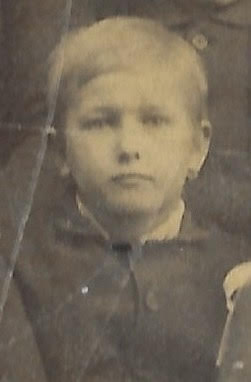
I first glimpsed this photograph behind clouded glass more than fifteen years ago. I was visiting the Garnavillo Historical Society in northeastern Iowa, a short distance from the Mississippi River, and I was thrilled to spy the face of my great-great-grandfather as a little boy in this cabinet card photograph of the Garnavillo School. However, due to its semi-permanent placement inside glass, it wasn’t until more recent efforts by the historical society to refresh their exhibits and digitize their collections that I was, happily, able to obtain a clear copy.

Garnavillo School, circa 1888, Clayton County, Iowa; digital image 2023, privately held by the Garnavillo Historical Society, 2023. Image shared with permission.

George Hiram Thoma, the son of Frederick Thoma and Matilda Hammond, was born in Garnavillo, Clayton County, Iowa on 29 September 1880. His parents were natives of Clayton County, and, right around the time that George would have started school, his father was known to have operated a restaurant in Garnavillo. Pictured here in the second row, fifth from right, fair-haired George, perhaps eight years old, regards the photographer with a still and serious expression, mimicking his teacher more so than some of his wiggly classmates. Thirty-six students were present for “Picture Day” at the Garnavillo School; this photograph, initially believed to have been taken circa 1886, was in fact more likely taken about two years later based on the birth dates of some of the youngest children pictured.

The teacher, Julia Downey, was said to have taught school in Clayton County for thirteen years prior to her 1893 marriage. Her students, with birth year in parentheses if available, are identified below:

Front row, left to right: Sophia Maack (1877), Ora Ahlitz (1879), Emma Harnack (1879), Severa Wirkler (1881), Harvey Maurer (1882), Norma Maurer (1884), Edna Brumm (1883), Adelia Kuhlman (1880).

Second row, left to right: Aerney Tangeman (1881), Alto (Realto) Schumacher (1881), Erwin Wirkler (1880), Billy Gilmore ( ), Will Schumacher (1880), George Thoma (1880), Gretchen Gilmore ( ), Waldemar Krasinsky (1880), Louise Rohde (1881), Elizabeth Siebertz ( ).

Third row, left to right: George Tangeman (1878), George Hill (1882), Paul Rantzow (1879), Miss Julia Downey, Orville Roebken (1879), Gruel ( ), Abner Roebken (1881), Fred Nieter (1880), Fred Stickfort (1879), Emil Schumacher (1879).

Back row, left to right: Irving Maurer (1879), Bruno Tangeman (1879), Ed Breitsprecher (1879), William Blunck (1877), Henry H. Stickfort (1878), Julius H. Rohde (1879), Gruel ( ), Elmer G. Brumm (1878), Arthur (Art) Gruetzmacher (1878).

Courtesy of the Garnavillo Historical Society

Garnavillo boasted a brick, two-story schoolhouse with four rooms; however, this photograph seems to have been taken instead at the studio of the photographer, Mr. Tangeman, as a hanging backdrop is evident. The students pictured here were between the ages of approximately four and eleven, and one can imagine that a field trip to the photographer’s studio would have made for an exciting school day for them.

George Hiram Thoma, detail from Garnavillo School, circa 1888, Clayton County, Iowa; digital image 2023, privately held by the Garnavillo Historical Society, 2023. Image used with permission.

Little is known about young George’s school days, although he was apparently a motivated student as would go on to complete high school. The high school that he attended was not in Garnavillo, however, but in the town of Postville in neighboring Allamakee County. As his grandparents resided there, it is possible that he boarded with them during his high school years. As a teenager, George worked for a time at a local hardware store, volunteered with the fire department, and then, according to family lore, made his way west with his bicycle and changed his name—but that’s another story!

Copyright © 2023 Melanie Frick. All Rights Reserved.

Continue reading

A Yankton County Girl at the 1918 South Dakota State Fair

As the summer of 1918 drew to close, seventeen-year-old Helena Nelson of Yankton County, South Dakota prepared to compete at the South Dakota State Fair as a participant in a local 4-H club.

YANKTON TO SEND CONTESTANTS TO FAIR

Yankton, S.D., Sept. 2.—After a series of contests here, Wilma Gilreath, Elsie Frick, Helena Nelson and Albena Sailer, will represent this county in the state contest at the state fair at Huron in September in the Liberty Food Club. In addition Wilma Gilreath, winner in the food contest, will also be in the canning contest, and will be associated with Lois and Dorothy Gross to make up the team in the canning contest.

Tabor Independent, 05 September 1918

In 1918, Helena was a student at the Southern State Normal School in Springfield, South Dakota. This was not terribly far from her family’s farm in Tabor, west of Yankton, where she had likely spent the summer before the fall semester began. In addition to pitching in on the farm that summer, Helena was also involved with the activities of the Liberty Food Club.

Helena’s older sister, Andrea, wrote in her diary that on the morning of Sunday, 08 September, “About five Jim took Helena on to town, as she was to start by car with Kecks at six for the fair at Huron. The rest of us had a late breakfast.” Helena and her siblings had attended a barn dance hosted in honor of a local soldier on furlough the night before, but that didn’t stop her from hitching a ride from her brother-in-law that morning after only a few hours of sleep! It was time to make her way to the state fair, one hundred and twenty miles to the north.

Helena Margaret Nelson photograph, circa 1918, Yankton County, South Dakota; digital image 2010, privately held by Melanie Frick, 2023. Based on family recollections, it is possible, but unconfirmed, that Helena is pictured here wearing a “uniform” of the Liberty Food Club.

The South Dakota State Fair, which dates to 1885, first introduced activities for youth in 1915 when a Boys State Fair Camp was held. Delegates were judged on their agricultural skills in regards to crops and livestock. The first Girls State Fair Camp took place in 1918, and included both food canning demonstrations and Liberty Food Clubs.

Liberty Food Clubs were a wartime invention and encouraged participants to assist with the war effort. An official bulletin of the United States government stated, “In order to become a member of this club each boy and girl enrolled in club work must sign a card pledging himself or herself, through food production and food conservation, to help win the war and world peace.”

While it is not known exactly what their exhibit or presentation may have entailed, the Yankton County girls did walk away as the winners of their event at the South Dakota State Fair. The Daily Argus-Leader of Sioux Falls reported, “Nearly a hundred valuable prizes were won by members of South Dakota boys’ and girls’ clubs in the final contests of the year at the state fair.” The different competition classes, aside from Liberty Food, included Pig Club, Baby Beef, Sheep, Stock Judging, Canning, and Sewing. Of Liberty Food, it was noted, “First, Yankton, State banner. Team Wilma Gilreath, Elsie Frick and Helena Nelson, all of Yankton. Second, Hughes county team, Alma Swanson Harrold, Ina Putnam Oahe, and Janice Lantz, Pierre.” One source suggests that twenty-four Liberty Food teams had competed in all.

Members of the Liberty Food Club who had successfully completed the work of the club for the entire year were to be given a diploma of achievement, but it is unknown whether Helena received such an honor. Not long after the South Dakota State Fair, Spanish Influenza struck her community and within a few short months she ultimately lost both her father and her sister Andrea. This was a tumultuous time for the Nelson family, especially as Helena’s older brother Ole was still away at war, and it seems very likely that any extracurricular endeavors would have fallen by the wayside.

The following year, the Boys State Fair Camp and Girls State Fair Camp became more formally known as 4-H clubs under the oversight of the State College Extension Service. World War I had come to a close, and Helena herself had completed her studies and become a country school teacher.

Copyright © 2023 Melanie Frick. All Rights Reserved.

Continue reading

Matilda the Midwife

“Matilda was a midwife,” so goes the family story, “and delivered a lot of babies in the county.” Despite a lack of definitive documentation, and almost certain lack of opportunity for any formal training, this nevertheless seems plausible. Matilda J. (Hammond) Thoma (1859-1947) of Clayton County, Iowa birthed five children of her own, and it does not seem unlikely that she might have assisted at the births of others in her close-knit community. She had numerous nieces and nephews whose births she might have supported, and she may even have served as midwife at the births of some of her own grandchildren. Indeed, it was her granddaughter Ina Fischer, born in 1907, who recalled nearly eighty years later that Matilda had been a midwife, and a 1920 newspaper announcement indicated that another granddaughter, Jacqueline Chaney, was in fact born at Matilda’s home.

Matilda (Hammond) Thoma and Franque (Friend) Curtis photograph, circa 1922, Clayton County, Iowa; digital image 2023, privately held by Melanie Frick, 2023.

Here, in one of only two photographs known to exist of Matilda, she poses with granddaughter Franque Friend. Matilda would have been in her early sixties at the time that this photograph was taken circa 1922; her hair, loosely coiled into a bun atop her head, seems to have gone mostly white. She wears a somewhat rumpled striped dress with buttons up the front and a wide collar in a contrasting fabric; this was not a studio portrait, but a casual snapshot apparently taken at home. Matilda appears to sit on a sofa near a window, a potted plant beside her, and striped wallpaper is visible in the background. She offers a small smile to the camera. Young Franque, perhaps ten years old here, stands next to her grandmother, grinning beneath the broad brim of a straw hat with a fringe of dark hair just peeking out. She wears a white dress with scalloped cuffs, a bow at the collar, and a leather belt.

Matilda, the daughter of Hiram H. Hammond (1813-1896) and Eva Margaret Stoehr (1831-1906), spent more than sixty-five years in Clayton County, Iowa, where she was born and later married Frederick Thoma (1857-1925). Four of their five children lived to adulthood; the youngest sadly died in a diphtheria outbreak at the age of ten. Following her husband’s death, Matilda eventually relocated, first to Texas with her daughter Roselyn and then to Wisconsin where she lived with her granddaughter Jacqueline. Few other details are known of her life, but what little is known suggests that she was a kind, competent, and maternal individual—just the sort to lend a hand as a midwife.

Copyright © 2023 Melanie Frick. All Rights Reserved.

Continue reading

The Sattlermeister of Trarbach

August Heitz, one of a dozen children born to Carl Theodor Heitz and Anna Maria Moog, was born on 26 March 1846 in Trarbach, Bernkastel-Wittlich, Rhineland-Palatinate, Germany. His father was a tanner, and August was destined to work with leather as well: following an apprenticeship to learn the trade, and time spent as a journeyman to hone his skills, he became a sattlermeister, or master saddler.

Trarbach, Marktplatz vor dem Stadtbrand von 1857 [Marketplace before the Town Fire of 1857], Holzstich; ; Wikimedia Commons, copyright Bligny.

August was thirty-one, likely well established in his trade, when he married Julianna Carolina Faust on 18 August 1877. Julianna, then twenty-one years of age, was the daughter of a cooper and likewise a native of Trarbach. The couple settled in their hometown, idyllically situated along the Mosel River and surrounded by abundant vineyards, and raised five children there: Julchen, Carolina, Anna Maria, Ida, and Adolf Heitz. A sixth child, August, died in infancy.

As a saddler in the final years before automobiles became widespread, August would have worked to make and repair saddles, bridles, and harnesses. He would also have trained others who wished to learn his trade, and the handwritten contract of at least one of his apprentices is extant. On 20 June 1901, the widow Anna Faust contracted her son, Otto, to a three-year apprenticeship under August Heitz, paying him a one-time fee of fifty marks for his tutelage. August promised to provide Otto with thorough instruction, health insurance and “contributions from his means,” whereas Otto agreed to diligent, orderly work and conduct. Otto would also be free on certain days to assist his mother “with her own work.” Interestingly, this contract notes that August was a tapezierer, or upholsterer, in addition to being a saddler.

It is unknown whether August also shared his knowledge of his trade with his surviving son, Adolf, as he ultimately made his career as a wine merchant. This trade was shared by two of August’s sons-in-law, as well, the husbands of both Julchen and Ida; Carolina’s husband was an innkeeper. Only Anna Maria did not marry; she joined a religious order.

August Heitz photograph, circa 1910, Germany; digital image 2011, privately held by Melanie Frick, 2023.

Little else is known of August’s life in Trarbach, although it appears that through his trade he was able to provide a comfortable life for his family. The only known photograph of him seems to have been taken when he was in his sixties, sometime around the year 1910. Sporting a dapper mustache and a pleasant expression, he wore a collared shirt, necktie, vest, and double-breasted wool suit coat for the occasion.

August Heitz died at the age of sixty-seven on 23 December 1913, survived by his wife, five children, and, eventually, six grandchildren.

Copyright © 2023 Melanie Frick. All Rights Reserved.

Continue reading