Tag Archives: Adam

A Farewell to Canada

Timothée Adam was only a year old when he lost his father. Born to Charles Pierre Adam and Marie Marguerite Saint Michel on 02 April 1816 in Beloeil, Quebec, he was baptized as Joseph Timothée Adam and was the seventh of eight children born to the couple; his younger sister was born just two weeks after their father’s death in August of 1817. Their mother, who had married at sixteen, was now a widow at the age of thirty, and considering how many small mouths she had to feed, it is not at all surprising that she remarried the following summer.

Although little is known about Marie Marguerite’s second husband, Louis Amable Pineau, after several generations had passed an oral tradition remained that the surname Pineau was somehow linked to the Adam line. Marie Marguerite had no children with Louis, who was ten years her junior, but he was the only father that the youngest of her children would have ever known. Her children would also have known her parents, their grandparents Joseph Michel and Marie Josephe Patenaude, as they spent their later years living in the same parish as Marie Marguerite and her family. Perhaps Joseph, who was born in exile in Massachusetts in 1757 following Le Grand Dérangement, the tragic expulsion of the French-speaking Acadians of Nova Scotia by the British, shared stories of his origins and the family’s eventual return to Canada—or perhaps not.

Timothée married Marguerite Chicoine in Saint-Marc-sur-Richelieu, a village just north of Beloeil on the Richelieu River, on 24 October 1837, when he was twenty-one. The couple then moved approximately thirty miles east to the village of Saint-Pie, where Timothée supported his family as a cultivateur, or farmer. The couple’s first ten children (of an eventual sixteen) were born in Saint-Pie, and the family appeared in the census there in 1851. It was noted that they resided in a one-level home made of wood, although interestingly, not all of their children lived within their household. Two of their daughters, who were eight and two, were found with their grandmother in another household in the same community, although perhaps this was only a temporary arrangement.

A decade later, at the time of the 1861 census, Timothée and Marguerite shared their household with all of their minor children, while their two eldest daughters, both married and with children of their own, were enumerated directly before them in the census. All were recorded as residents of Rang Saint-Charles, a rural road that runs southeast of Saint-Pie and south of the Noire River. This was not far from Saint-Paul-d’Abbotsford, where several of their younger children were baptized.

View of Mont Yamaska from Grand Rang Saint-Charles, Saint-Pie, Quebec

By June of 1865, Timothée had relocated with his family to Massachusetts. One has to wonder whether he recognized the irony in returning to the same place where his grandfather had been born in exile—but what drew him and his family to Massachusetts, a little more than a century after Le Grand Dérangement, was almost certainly the cotton mills. Contemporary news accounts referenced, sometimes scathingly, the “hordes of French Canadians” who traveled by rail from the border crossing at St. Alban’s, Vermont, to Massachusetts, where entire families crowded into tenements and worked at the mills. Indeed, the 1865 Massachusetts State Census places Timothée, Marguerite, and their ten unmarried children, who were between the ages of three and twenty-one, in Ward 8 of Springfield, Hampden County, Massachusetts, where Timothée and the five eldest children were all employed at the Indian Orchard mill.

There may have been another driving factor that caused Timothée to uproot his entire family, however, and that was the potential threat of a military draft in Canada and associated unrest that presumably might have affected his eldest sons. A Massachusetts newspaper printed the following in January 1865: “There is quite a little rebellion in Canada now, and all about a militia draft for frontier service. The French Canadians at Quebec resisted the draft made upon them last week and drove away the officers. Four companies of the volunteer militia were immediately called out and the insurrection will be a short lived one.”

By the time of the 1870 U.S. census, Timothée, by then fifty-four and with nine children still in his immediate household, continued to reside in Indian Orchard but was without an occupation. His six eldest unmarried children, who were between the ages of twelve and twenty, were all millworkers, and their earnings no doubt supported the entire family. Incredibly, the grand total of individuals in Timothée and Marguerite’s multigenerational household, which included their married children and their own large families, numbered twenty-eight.

View of Springfield, Massachusetts on the Connecticut River,” ca. 1840-1845, Thomas Chambers (1808-1869); oil on canvas, private collection, photographed while on loan to the Metropolitan Museum of Art, New York, New York; Wikimedia Commons.

Tragedy struck in 1878, when Timothée first lost two grandsons who drowned while fishing in the Chicopee River, and then lost his wife of forty years when Marguerite succumbed to consumption at the age of sixty-two. Timothée did not appear in the 1880 U.S. census, but city directories indicate that he resided at 83 Main in Indian Orchard. His unmarried children, ranging in age from fourteen to thirty, were enumerated together on Main Street; perhaps Timothée’s absence was an accidental omission, or perhaps he was traveling at the time that the census was recorded. It is known that he ventured to Dakota Territory a short time later, as he was documented as a parishioner at St. Peter’s Parish in what is now Jefferson, Union County, South Dakota in 1885, along with two of his adult sons and their families. The recent deaths of several family members, including two of Timothée’s adult children and multiple young grandchildren, may have spurred this move away from crowded tenement life.

Timothée is absent from the Springfield, Massachusetts city directories of 1885-1895. He makes a reappearance in 1896, boarding at 69 Main, Indian Orchard; this was the home of his daughter, Marie, and her husband, Gabriel Noel. Had Timothée spent the intervening years with his children in the Midwest?

On 19 March 1897, a newspaper in Sioux City, Woodbury County, Iowa, printed the following: “T. Adams, father of P.P. Adams of Davidson Bros., died while visiting relatives at Indian Orchard, Mass., at the age of 84 years.” Timothée would have been, in fact, eighty years old at the time, but this was not the only misprint regarding his death.

The death register for the city of Springfield, Massachusetts, which encompassed Indian Orchard, does not have a record of the death of any individual by the name of Timothée Adam at that time—but it does name one “Mathieu A. Adam,” son of Pierre Adam of Canada, who was reportedly eighty years, ten months, and seventeen days at the time of his death on 09 March 1897.

The dates are close enough that they might be considered a mathematical error—Timothée would have reached the age of eighty years, eleven months, and seven days at the time of his death. His father’s middle name had been Pierre, and it’s quite possible that that is how he was more commonly known. But “Mathieu”? One guess is that entries on the death register were recorded based on other handwritten records or notes, and that a scrawled “Timothée” was mis-transcribed as “Mathieu,” another French name with a “th” in the middle. His cause of death was attributed to “Old age: Indigestion,” and Timothée’s grave, presumably near that of his wife at the Saint Aloysius Cemetery in Indian Orchard, is unmarked.

His will, filed in Springfield in March of 1896, a year prior to his death, is succinct in regards to his wishes and suggests that he may have spent extended time in the care of his second-eldest daughter Marie:

“After the payment of my just debts and funeral charges, I bequeath and devise as follows. First: To my daughter Mary Noel wife of Gabriel Noel of said Springfield, all the estate both real and personal of which I shall die seized and possessed and to which I shall be entitled at the time of my decease. I purposely give no bequest or devise in this will to my only living children, or the issue of any deceased child, having provided for them in my lifetime and I exclude them and their issue from any claim upon my estate of every nature and description. Second: I direct that my executrix hereinafter named expend the sum of Fifteen dollars for a high mass over my remains.”

Hampden County, Massachusetts Probate Records

So little is known of who Timothée Adam was as a person. He was a French Canadian by birth and an immigrant who may have faced contempt and discrimination in the United States due to his language, faith, and culture. He was a farmer and a millworker—but as his eldest surviving son was a carpenter, one can speculate that Timothée may also have possessed these skills. Two of his younger sons played the fiddle, and another sang; was Timothée musical as well? He was a lifelong Catholic, and desired that a portion of his (presumably not large) estate be set aside in order for him to receive a high mass upon his death. He was the father of sixteen known children, fourteen of whom survived to adulthood, and the names of his eldest sons suggest strong familial bonds: Timothée, Louis (like his stepfather), Joseph (like his maternal grandfather), Pierre (like his father and paternal grandfather). Notable too is the name of his youngest son, the only one of his children born outside of Canada: Prosper, named perhaps in recognition of Timothée’s hopes for his family to flourish in a new home.

Copyright © 2024 Melanie Frick. All Rights Reserved.

Continue reading
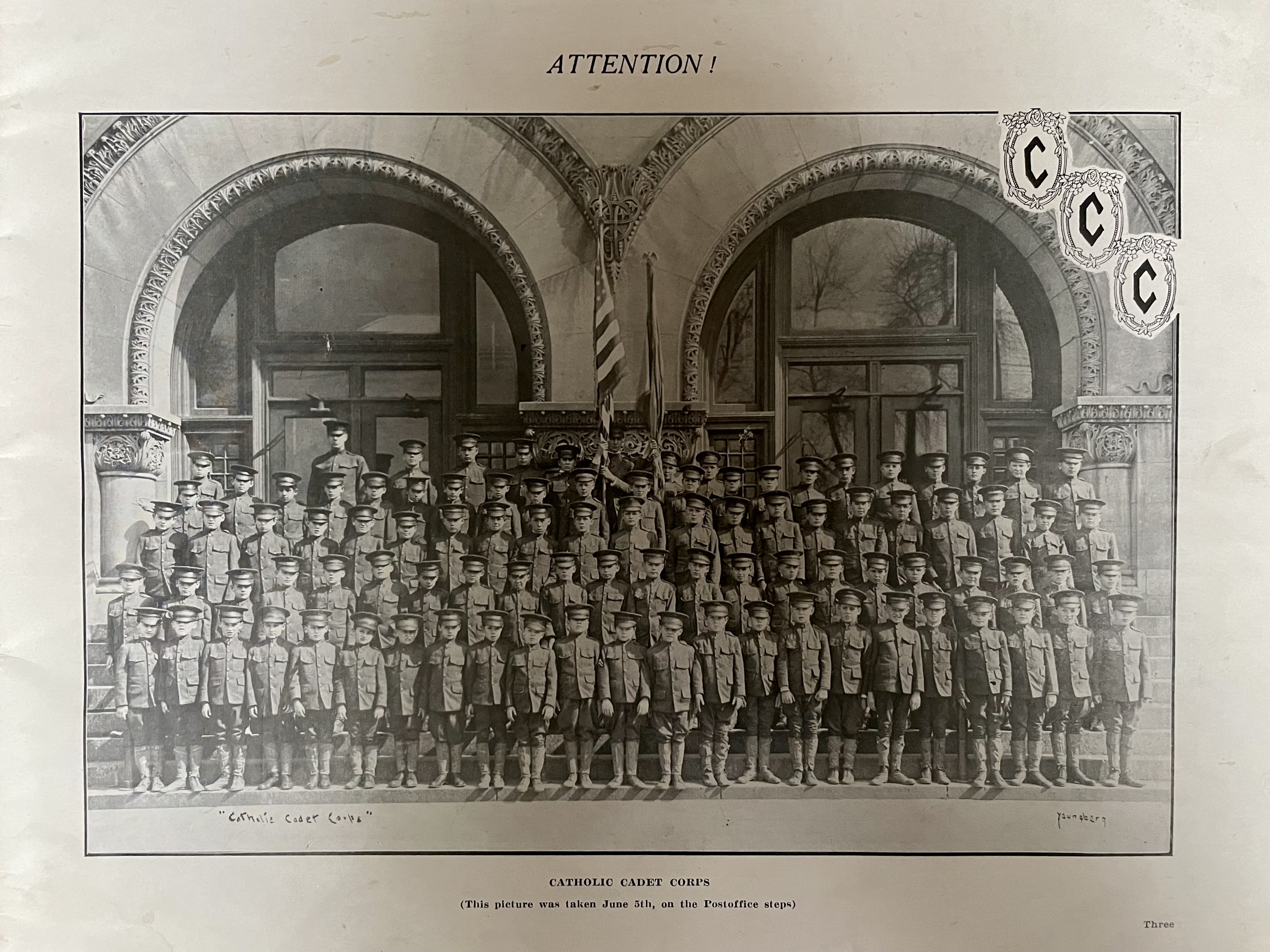
A Young Member of the Catholic Cadet Corps

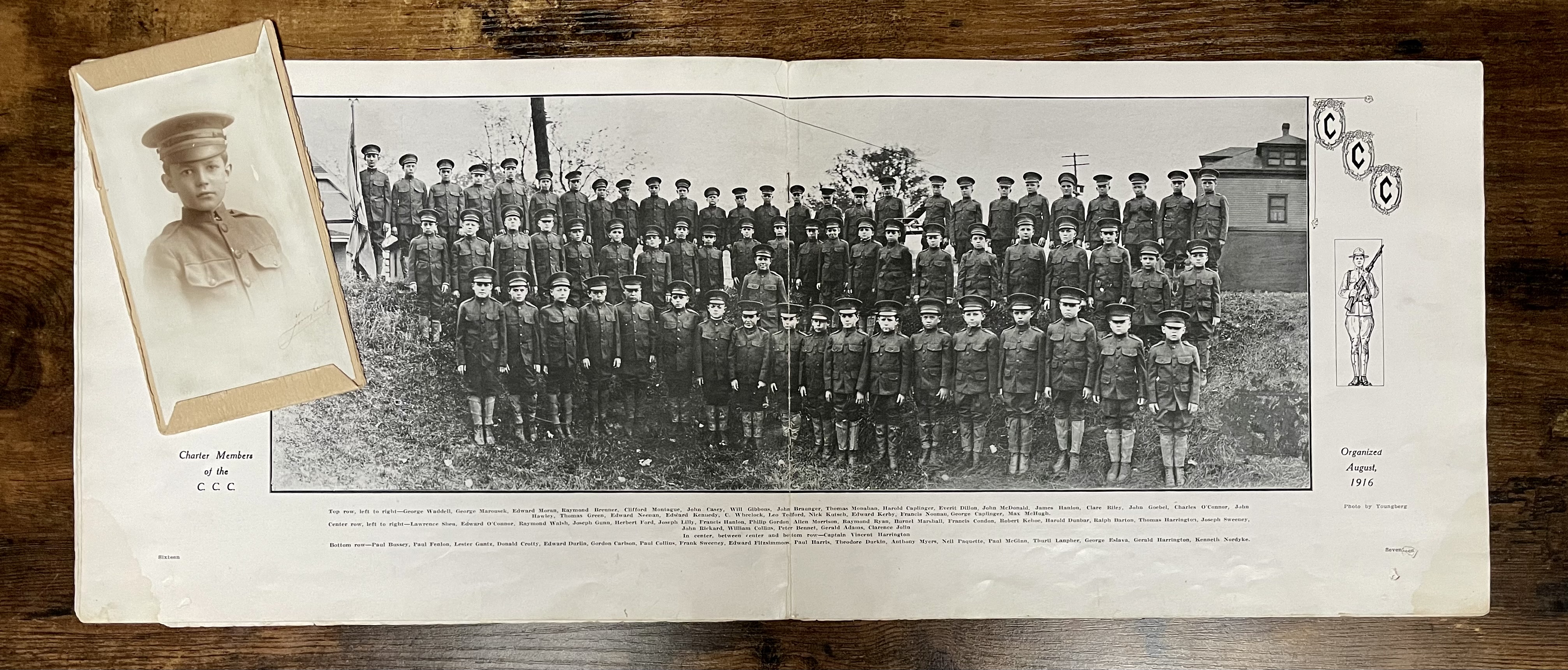
In the summer of 1916, Gerald “Jerry” Adam of Sioux City, Woodbury County, Iowa, celebrated his eighth birthday. Shortly thereafter, he became a charter member of the city’s newly-established Catholic Cadet Corps under the leadership of Reverend Henry A. Janse, Reverend Thomas M. Parle, Sergeant C. A. Butler, and Charles Parsons.

Gerald Joseph Adam and the Charter Members of the C.C.C. (Gerald pictured second row, second from right), 1917 Year Book of the Catholic Cadet Corps (Perkins Bros. Co. : Sioux City, Iowa, 1917); privately held by Melanie Frick, 2023. Collection courtesy of David Adam.

“The Catholic Cadet Corps was organized for the Catholic boys of Sioux City. It is now a citywide organization, and at the present time has a membership of 170. Companies are being formed in the various parishes of the city, so that all the Catholic boys of the city can enjoy the benefits of the C.C.C. For years the need of some such organization has been felt to solve the ‘boy problem.’ Until recently our Catholic boy had no organization of his own and experience has taught us that many of our boys drifted into the Y.M.C.A. on that account.

The Y.M.C.A. is a protestant organization in which our boy is not welcome, in which he can neither vote nor hold office and in which it is constantly insinuated that he is not even a Christian. Naturally this environment is not conducive to the best interest of our boy. The C.C.C. movement was inaugurated with the purpose of giving the Catholic boy surroundings which are in harmony with his faith. A tremendous amount of work has been done to make the C.C.C. attractive, instructive and helpful.”

1917 Year Book of the Catholic Cadet Corps

As a member of the Catholic Cadet Corps, Jerry would have participated in military drills and athletics, marched in parades and decorated the graves of Civil War veterans. He may have been among the group of young cadets who sang “America” at a local theater on Decoration Day 1917 to much applause. The C.C.C. also organized an ambulance corp that took part in numerous aid efforts, and afforded recreational opportunities for its members such as hiking, picnicking, and swimming at the nearby Trinity College.

Catholic Cadet Corps, June 5, 1917 (Gerald Adam pictured second row, sixth from right), 1917 Year Book of the Catholic Cadet Corps (Perkins Bros. Co. : Sioux City, Iowa, 1917); privately held by Melanie Frick, 2023. Collection courtesy of David Adam.

Perhaps most significantly, the Catholic Cadet Corps may have provided Jerry with a sense of community and belonging at a place and time when Catholicism was not necessarily mainstream. “Boys of the C.C.C. are not ashamed of being Catholics—they are proud of it in this free land of the U.S.A.” The 1917 Year Book of the Catholic Cadet Corps made clear that uniforming each young member in a tailored wool suit was an intentional choice. “The fact that the Cadets have the best uniforms in the city makes them think more of their personal appearance, increases their self-respect and has a good influence on their every day lives—they strive to be as good as they look. The boys wear their uniforms to school. This places all the boys on the same level—no distinction between rich and poor—all are Cadets and all try to do their best in school.” Jerry even wore his uniform for a family photograph believed to have been taken circa 1916.

It is not known how long Jerry might have been involved with the Catholic Cadet Corps, but the year he turned ten was a tumultuous one for him. Not only was 1918 marred by war and a global pandemic, but his father was away for long stretches of time due to his employment at a naval shipyard, and then, tragically, his younger brother died at age five following a horrific accident. Jerry was left an only child with a grieving mother and a father occupied with the war effort; it can well be imagined that the leadership and friendship offered by the C.C.C. may have filled a void for him at this time.

Jerry would not be a lifelong Catholic, but his experiences in the Catholic Cadet Corps may have influenced him regardless. At the age of eighteen, he joined the Marine Corps Reserve, and at twenty, he and his bride—although she was not Catholic—were married by Reverend Le Cair of St. Jean Baptiste Catholic Church in Sioux City. Although Jerry’s involvement with the Catholic church waned after that point, he continued to be actively involved in his community through fraternal organizations, as a Little League coach, and as a businessman and entrepreneur. As for Sioux City’s Catholic Cadet Corps, the wartime years seem to have been its heyday and any mention of the organization in the local newspaper dropped off within a few years thereafter.

Copyright © 2023 Melanie Frick. All Rights Reserved.

Continue reading

A Full House in a Mill Town

By the time of the 1870 U.S. census, French Canadians Timothée and Marguerite (Chicoine) Adam, both fifty-four years old, had lived in America for approximately five years. Along with their children, who ranged in age from toddlerhood to young adulthood, they had settled among fellow French-speaking immigrants in Springfield, Hampden County, Massachusetts. Their neighborhood, Indian Orchard, boasted a booming cotton mill on the banks of the Chicopee River. This would certainly have been a different environment than they had been accustomed to in the quiet village of Saint-Pie, Quebec where, for the first twenty-five years of their marriage, Timothée had been a farmer and Marguerite had raised more than a dozen children in their humble home. Their move from rural to comparatively urban was certain to have been full of adjustments, but what may be the most striking about their lives in the year 1870 is the impressive number of people with whom they shared one roof: twenty-eight, to be exact.

Their household had grown substantially from their first appearance in the Massachusetts state census in 1865; then, Timothée, who was employed at the mill, headed a household that numbered thirteen, including ten children and one boarder. In 1870, the twenty eight residents, all related, were in fact divided among four households within a single dwelling unit, presumably a tenement block. First recorded was the household headed by Timothée and Marguerite Adam themselves, which included nine of their children—those nine ranging in age from twenty-two down to three. Then came the households of three of their married daughters. The household of Leon and Julienne (Adam) Gay was first; they were the parents of one child. The household of Joseph and Marie (Adam) Noel and their five children was next, and last was that of Jean Baptiste and Marguerite (Adam) Gendreau and their five children.

Although Timothée himself was without an occupation at this time, and Marguerite kept house, nine other members of the combined households worked at the mill. Four of those nine millworkers were under the age of sixteen: Jean Adam was fourteen, Elisa Adam was twelve, Jean Gendreau was twelve, and Euclide Gendreau was eleven. Six children between the ages of six and eleven were at school, and six children between the ages of one and four were at home in the care of their mothers.

Many of Timothée and Marguerite’s children, grandchildren, and even great grandchildren would spend the decades to come employed in the Indian Orchard mill. It was not an easy life; in the years following the 1870 census, several members of the family would succumb to tuberculosis and other respiratory illnesses common among millworkers of the day, who often worked in dismal conditions with poor ventilation and were plagued by both communicable diseases and cotton lint.

“Clarence Noel, 138 Main St., Indian Orchard. Doffer in Hodges Fibre Carpet Co. of Indian Orchard Mfg. Co.,” September 1911, Prints & Photographs Online Catalog, Prints & Photographs Reading Room, Library of Congress, Washington, D.C. (https://www.loc.gov/pictures/item/2018676653/ : accessed 08 January 2023).
“Alfred Gengreau [Gendreau], 20 Beaudry St., Joseph Miner, 15 Water St. Both work in Mr. Baker’s room, Indian Orchard Mill,” September 1911, Prints & Photographs Online Catalog, Prints & Photographs Reading Room, Library of Congress, Washington, D.C. (https://www.loc.gov/pictures/item/2018676654/ : accessed 08 January 2023).

Notably, at least two of the couple’s great-grandchildren appear to have been photographed by famed muckraker Lewis Hine, who documented the plight of child laborers in the early twentieth century and whose work was instrumental in child labor reform. Clarence Noel, fifteen, grandson of Timothée and Marguerite’s daughter Marie (Adam) Noel, and Alfred Gendreau, thirteen, grandson of their daughter Marguerite (Adam) Gendreau, were both photographed outside their workplace in September of 1911. Clarence, Hine noted, worked as a doffer and said that he had “made seven dollars last week.” Alfred, who posed with another boy, was said to “work in Mr. Baker’s room, Indian Orchard Mill.”

These boys were not by any means among the youngest of the child laborers that Hine photographed, nor did they work in the most arduous conditions, but still their images are striking. In their knickers and caps, both slight of build, Clarence and Alfred look every bit like schoolboys, although the mill—to which four generations of their family had now been tied—loomed large in the background. Their school days behind them, it was time for the boys to work to support their families.

Copyright © 2023 Melanie Frick. All Rights Reserved.

Continue reading

An Iowa National Guardsman

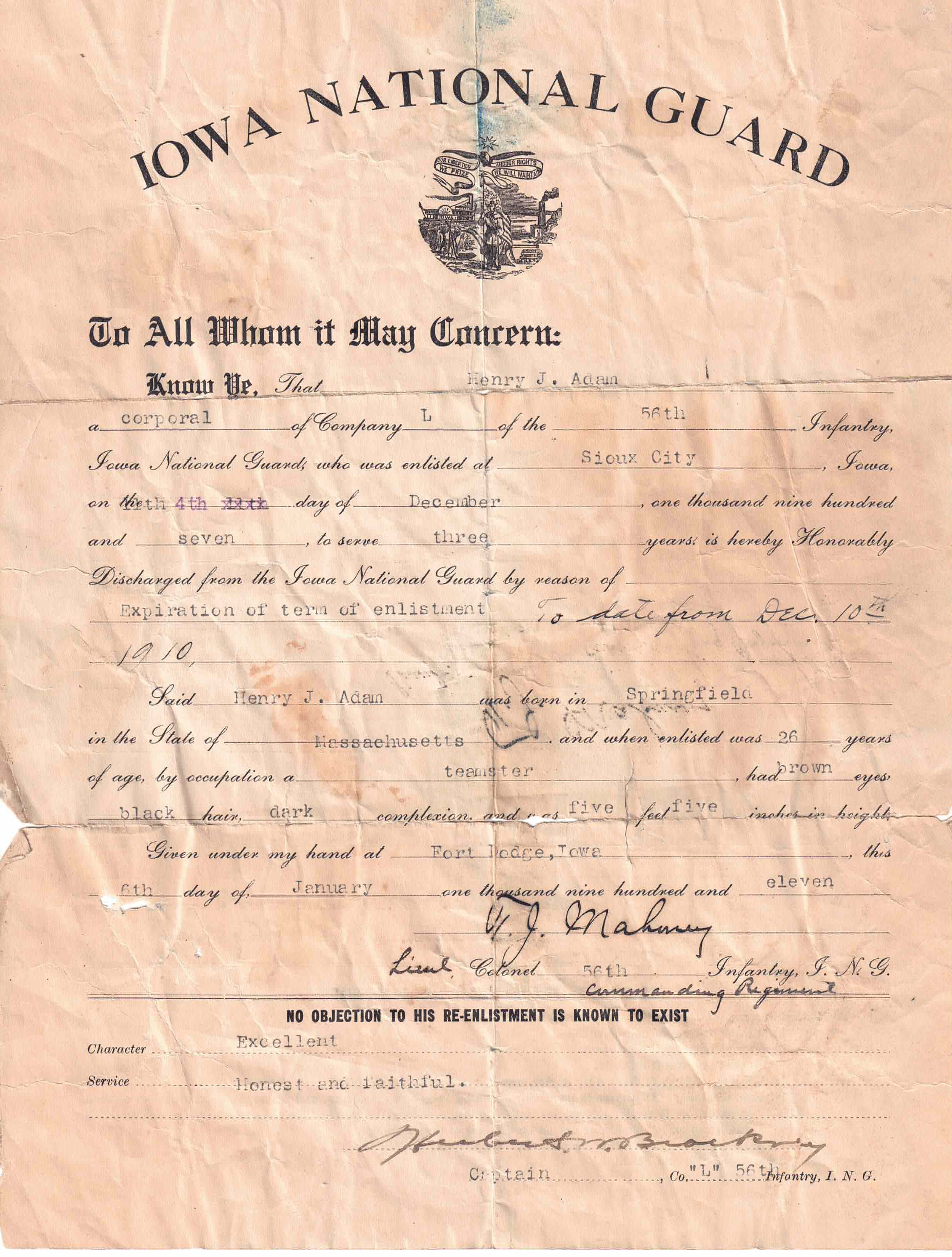
Henry Joseph Adam of Sioux City, Woodbury County, Iowa, was twenty-six years old when he enlisted in the Iowa National Guard in December 1907. He enlisted for a term of three years with Company L of the 56th Infantry, and received an honorable discharge when his term was complete. His character was noted to be “excellent” and his service “honest and faithful.”

Iowa National Guard Certificate for Henry Joseph Adam, Sioux City, Iowa, 1911; digital image 2021, privately held by Melanie Frick, 2021.

In December 1917, ten years after he had first enlisted with the Iowa National Guard, Henry enlisted once again, this time with Company D of the 4th Infantry. The United States had entered the “Great War” in April of that year, and by June the first draft registration was underway. Henry, now thirty-six, was not included in this first draft (which was limited to men between the ages of twenty-one and thirty-one), but perhaps he saw the writing on the wall and considered that service with the National Guard might put him in a better position than if he were to wait to be eventually drafted. In July 1918, he was appointed corporal, but soon thereafter his trajectory was altered.

Henry Joseph Adam, Sioux City, Iowa, ca. 1918; digital image 2010, privately held by Melanie Frick, 2021.

Henry, a carpenter, relocated to Portsmouth, Virginia, where he became an employee of the George Leary Construction Company at the Norfolk Navy Yard. He commenced work on 01 September 1918, and on 12 September, when the third draft registration, for men between the ages of eighteen and forty-five, was initiated, he dutifully completed his registration. He was called home to Iowa in late September when, tragically, his five-year-old son succumbed to extensive burns received when he fell into a fire. It could not have been easy for Henry to bid farewell to his wife and surviving son, who was ten years old, to return to the shipyards once again.

In late October, Henry became an employee of the United States government, assisting in the construction of a power plant at the Norfolk Navy Yard. It was on these grounds, as a skilled laborer in a necessary industrial occupation, that he completed a questionnaire claiming deferred classification of military duties. His work entailed building concrete forms; he stated that he had four years of specific experience, and six years of additional general experience. His daily wages amounted to eight dollars and twenty-five cents, and he was the sole supporter of his wife and child.

The questionnaire was signed and dated on 05 November 1918—less than one week before armistice would occur, marking the conclusion of the war on the eleventh hour of the eleventh day of the eleventh month. Perhaps Henry’s questionnaire was never even submitted, or was returned to him in short order, which might explain how it ended up among other assorted family papers and survived for more than a century.

I have no record of when Henry’s employment at the Norfolk Navy Yard nor his service with the Iowa National Guard formally concluded. However, Henry would continue to apply his carpentry skills in the service of the government periodically throughout the rest of his life. During the Great Depression, he found employment with the Works Progress Administration, and during World War II, he was employed at a United States Air Force base near Sioux City before temporarily relocating to Portland, Oregon, where he once again became an essential worker in the shipyards.


Copyright © 2021 Melanie Frick. All Rights Reserved.


SOURCES

Iowa National Guard Certificate, Henry Joseph Adam, Sioux City, Iowa, 06 January 1911; Adam Family; privately held by Melanie Frick, 2021.

Military Deferment Questionnaire, Form 1001, Office of the Provost Marshall General, for Henry Joseph Adam, Portsmouth, Virginia, 05 November 1918; Adam Family; privately held by Melanie Frick, 2021.

“World War I Draft Registration Cards, 1917-1918,” digital images, Ancestry.com (http://www.ancestry.com : accessed 25 April 2021), card for Henry Joseph Adam, Sioux City, Woodbury County, Iowa; citing World War I Selective Service System Draft Registration Cards, 1917-1918, National Archives microfilm publication M1509; imaged from Family History Library film roll 1,643,352.

“Henry J. Adam” in Lasher, Louis G., Report of the Adjutant General of Iowa: For the Biennial Period Ended June 30, 1920 (Des Moines: The State of Iowa, 1920), 125; from “U.S., Adjutant General Military Records, 1631-1976,” Ancestry.com (http://www.ancestry.com : accessed 25 April 2021).

The Chicoine Family Reunion

Note: An updated post about this photograph, including a new date and additional identifications, was published in September 2021 and is available here.

A century ago, numerous grandchildren and great-grandchildren of the French Canadian blacksmith Leon Chicoine and his wife Marie Vary were in the habit of gathering annually for an extended family reunion at Riverside Park in Sioux City, Woodbury County, Iowa.

In the summer of 1925, the Sioux City Journal printed the following:

200 ATTEND FAMILY PICNIC AT RIVERSIDE

More than 200 members of the Chicoine family, residing in Sioux City and surrounding territory, held their annual picnic at Riverside park Sunday. Several hundred of the family, which is one of the pioneer families of this part of the country, are located in northwestern Iowa, southeastern South Dakota and northeastern Nebraska.

The majority of those who attended the picnic were from Sioux City, Jefferson, S.D., Elk Point, S.D., and Salix, Ia. The oldest member of the family present was Mrs. Philip Bernard, Sioux City, 70 years old, and the youngest was Rose Chicoine, 6-month-old daughter of Mr. and Mrs. Fedora Chicoine, of Jefferson. A basket dinner and a program of games and sports occupied the afternoon and evening.

The following year, a large group photograph—or rather several photographs pieced together—was taken at the family gathering, and featured just shy of one hundred and fifty individuals. The photograph is labeled Griebel Photo along with a street address; according to the 1926 Sioux City Directory, a Henry Griebel was indeed at that address, but his home and studio were elsewhere in 1925. Thus, the 1926 date provided for this photograph seems plausible—and the decade itself is undeniable when taking into account that the women almost uniformly have their hair bobbed! Riverside Park, the location of the reunion, was a popular summer gathering place along the Sioux River, offering swimming, boating, and other recreational activities. 1926 marked the final year that Riverside Park would host the popular Interstate Fair, and an amusement park would open there the following year.

Chicoine Family Reunion, Riverside Park, Sioux City, Woodbury County, Iowa, 1926; digital image 2021, courtesy of Jeanette Borich; privately held by Ken Chicoine, 2021.

There is, fortunately, a key for this photograph, with many thanks to the late Maurice Chicoine. However, it is incomplete and not without error. If you recognize any kin in the photograph, please feel free to comment so that the key can be confirmed and/or updated accordingly. The names from the original key are transcribed below:

Photo 1 Top Row: Agnes Chicoine, Emma Chicoine, Pauline Lambert, Elsie Montagne, Carrie Chicoine, Odile Chicoine, Luella Limoges Chicoine, Delia Brault, Albina Chicoine, Louise Ryan Chicoine, Edna Quintal Chicoine, Mrs. Alphonse Chicoine, Mrs. Bob Wyant, Mrs. Quintal

Photo 1 Middle Row: Alphonse Chicoine, Alex Chicoine, Denis Chicoine, Edgar Chicoine, Edmond Chicoine, Odias Chicoine, Elmer Chicoine, Leo Chicoine, Conrad Chicoine, Emil Chicoine

Photo 1 Front Row: Orville Chicoine, Ferdinand Chicoine, Donald Chicoine, …?, Ilian Bertrand, Wallace Chicoine, Theresa Chicoine, Doris Chicoine, Bernice Chicoine, Veronica Chicoine, Madonna Chicoine, Marc Chicoine, Hubert Chicoine

Photo 2 Top Row: Ora Quintal, Ella Quintal, Rose Montague, Martin Chicoine, Cora Chicoine, Marty …?, Martin Quintal, Adrian Chicoine, Leander Bertrand, Mrs. J. B. Fountain, Ruth Chicoine?, Aloysius Bourassa, Esther Bourassa, Laura Montagne Chicoine, Orise Montagne, Rachel Chicoine Dougherty holding Richard, Dalma Beaubien Montagne

Photo 2 Middle Row: Eugene Chicoine, Philip Bernard, Joe Montagne, Bert Crevier and baby, Fedora Chicoine, Leonard Chicoine, J. B. Fountain, William Chicoine?, T. D. Dougherty and child, Art Chicoine, Louis Beaubien, Clarence Montagne

Photo 2 Front Row: Claire Montagne, Madonna Chicoine, Gabriel Sirois, Oswald Montagne and child, Lucille Crevier, Maurice Chicoine

Photo 3 Top Row: Priest from Salix, Wiska Derauleau, Viola Montagne, Rosella Montagne, …?, Mr. Adams, Mrs. Adams, Sophia Menard, Mrs. Eugene Bosse, Joe Chicoine, Mrs. Joe Chicoine, Obeline Chicoine Lambert, Corrine Chicoine, Mayme Chicoine, Gertie Crevier Chicoine, Leona Chicoine Crevier, Yvone Morin Chicoine, Beatrice Chicoine, Rose Langle Chicoine, Arsenia Allard Chicoine

Photo 3 Middle Row: Joe Gregoire, Sylvester Montagne, Laurence and child, …?, Ernest Menard, Maxine Chicoine, Charlotte Crevier, …?

Photo 4 Top Row: Simone Sirois, Bertha Sirois, Genevieve Sirois, Happy Jauron with child, Mrs. Jauron, Delphine Chicoine, Irene Trudeau, Marie Perrault Chicoine, Amanda Chicoine, Regina Benjamin Chicoine, Elise Chicoine Benjamin, Marcella Chicoine, Christina Chicoine Bourassa, Mrs. Alex Bourassa

Photo 4 Middle Row: Fabien Lambert, Raymond Chaussee, Joe Chicoine, Hermidas Chicoine, Gerome Gadbois and child, Alfred Chicoine, Isaac Benjamin, Alex Bourassa, John Bourassa, Gerard Chicoine

Photo 4 Front Row: …?, …?, Pauline Chicoine, Janette Chicoine, Loretta Chicoine, …?, Bourassa child, Roger Bourassa

Not named in the key are my great-great-grandparents, Henry Joseph Adam and his wife Melanie Veronica Lutz, immediately recognizable to me although I never met either one. Two individuals standing near them, recorded as “Mr. and Mrs. Adams,” are, I believe, Henry’s uncle and aunt, Peter Adam and his wife Elizabeth Courtmanche. Both Peter and Henry’s father Timothy Adam, who died several years before this photograph was taken, were sons of Timothée Adam and Marguerite Chicoine, Marguerite being a daughter of the aforementioned Leon Chicoine and Marie Vary.

I was introduced to this photograph upon meeting for the first time a distant cousin and fellow genealogist, Jeanette Borich, in 2019. We were stunned to find that my great-great-grandmother Melanie (Lutz) Adam was standing immediately to the right of her stylishly-dressed grandmother Viola (Beaubien) Montagne in this photograph, and like to think that they would be pleased that their descendants are in touch nearly a century later.

Copyright © 2021 Melanie Frick. All Rights Reserved.

Continue reading
A Canine in the Courtroom

As much as I love research in historic newspaper collections, it’s not often that I find an ancestor’s name attached to a truly colorful piece. There are the expected mentions at milestones and sometimes occasional notations of one’s comings and goings in small town social columns—but rarely has an ancestor sparked his or her own headline or been featured not just in the local news, but in the newspaper of the state’s capital.

In 1927, my nineteen-year-old great grandfather managed just that. Gerald Joseph Adam, the son of Henry Joseph Adam and Melanie Veronica Lutz, was born in Sioux City, Woodbury County, Iowa, in 1908. Nineteen years later, he became involved in a spirited disagreement regarding the ownership of a particular dog. When this dispute went to court, it caught the attention of a journalist who saw the humor in the situation, and thus half a page—including photographs and sketches—was allotted to the story in the Des Moines Register.

Gerald was a recent graduate of Sioux City’s Central High School and was employed as a doorman at the downtown Princess Theater. He was also the proud owner of a German Shepherd named Fraulein. However, when another Sioux City resident attempted to claim Fraulein as his own, Gerald wound up in court—with his mother and their family cat in tow—to settle his case. He ultimately emerged victorious, but the full story, which featured several unconventional attempts to demonstrate ownership of his dog, is transcribed below:

Spanked the Baby to Settle Court DisputeSpanked the Baby to Settle Court Dispute Sun, Nov 6, 1927 – Page 67 · The Des Moines Register (Des Moines, Iowa) · Newspapers.com

Spanked the Baby to Settle Court Dispute

“Boo-Hoo” Cried Baby Phyllis But Sioux City Justice Found Evidence Inconclusive.

BY WILLIS F. FORBES.

Sioux City, Ia., Nov. 4. – Old King Solomon of biblical fame undoubtedly was a wise old bird, but it is doubtful if ever in all his varied and colorful career he was called on to settle a more perplexing judicial problem than that which recently confronted Charles Lockie, a Sioux City justice of the peace.

Like that famous trial over which the biblical Solomon presided, the case which confronted this modern magistrate was one of disputed ownership. It had to do with a dog – and a beautiful dog it was – a fine, bright eyed, intelligent German police dog of undoubted aristocratic ancestry.

The contending claimants were Gerald Adam and C. C. Terrill, both well known and highly respected citizens with unimpeachable reputations for veracity.

Each claimed the dog and appeared in court, ably seconded by legal talent, ready and eager to produce conclusive evidence of their right to ownership.

Adam testified that he had purchased the dog from Miss Alice Spalding, well known Sioux City society woman, and that the dog later had disappeared. Miss Spalding took the stand and corroborated Adam’s story, positively identifying the animal as one she had sold to Adam.

Terrill, seconded by other witnesses, contended that the dog belonged to him. He said that the animal had been given to him when a pup and that he had raised it. F. Heitzman, who, Terrill said, had given him the dog, was present and substantiated this story. He also identified the dog.

Right at the beginning a dispute arose among the litigants as to the dog’s name. Adam said that its proper name was Fraulein, that being the name which appeared on its pedigree papers. Terrill said that the correct name was Lady, as that was what she had been christened when he first obtained her.

Unfortunately, the dog seemed to understand both German and English, as she responded to one name as readily as to the other.

For purposes of discussion in court the justice ruled that the dog would be known merely as Exhibit No. 2, and a tag bearing that inscription was attached to her collar.

Both sides of the case were prepared with ingenious plans to prove to the justice that the dog was theirs.

Mrs. Adam, the plaintiff’s mother, informed the court that she could prove it was her son’s dog by means of its fondness for cats. She said that Fraulein had always played with cats and she had brought with her the family cat to prove her contention.

The Terrill faction, however, strenuously objected to this test as being no test as all. They had brought with them another dog which they claimed was a full brother of Lady and they said that it wouldn’t chase the cat, either.

So, as the justice and the spectators breathlessly looked on, the cat was released in front of Lady’s alleged brother.

Apparently the brother dog was little interested in the fate of his sister for he had to be awakened from a sound sleep. He opened his eyes just in time to see Miss Kitty retire beneath the office safe.

The dog slowly got to his feet, ambled over to the safe and poked his nose under the strong box in the general vicinity of the cat.

Whether or not he and the pussy came to some sort of a whispered understanding during this process could not be ascertained, but when the cat finally was retrieved and held in front of the dog’s nose he merely sniffed and retired to his corner where he proceeded to go to sleep once more.

The male dog was much better behaved in the courtroom than was the female, who had to be taken out of the room so that the hearing could be conducted quietly. But, of course, he was only a disinterested spectator and she was Exhibit No. 2.

This test having failed, the Terrills presented a test which they said would prove conclusively they were the rightful owners.

They said that whenever anyone spanked a baby in Lady’s presence she would strenuously object. So they had brought 6-year-old Phyllis Theison, Terrill’s granddaughter, to court to prove the argument.

The second test was conducted rather informally in an adjoining room where Exhibit No. 2 had been taken in disgrace. It was carried out without the consent of the justice.

While the spanking process was going on the dog began to whine and jabber. If whining and jabbering could be construed as a protest against the spanking, then the dog protested. But it had been protesting so much during the whole trial that even this could hardly be taken as conclusive proof of identity.

Mrs. Adam further contended that Exhibit No. 2 was her son’s dog because it had a habit of sleeping on a davenport with its head on a pillow and because it would stand on its hind legs and drink out of the kitchen sink.

But unfortunately there was no inviting davenport nor kitchen sink included in the courtroom furniture, so these tests could not be carried out.

Somebody suggested that, inasmuch as Exhibit No. 2 and the male dog claimed to be her brother, resembled each other, a blood test might serve to settle the argument.

This was deemed inadvisable, however, and finally in desperation Justice Lockie asked if either side could produce identification marks to uphold their claim.

The Adam faction hailed this suggestion with delight. They pointed out that the registration papers which Miss Spalding had given them when she had sold Fraulein identified the animal by three little birthmarks on its neck.

The Terrill faction countered this argument by saying the marks were scars left by vaccination and they offered to produce the veterinarian who had done the vaccinating to prove it. So court was adjourned for the day so the Terrills could bring their witness to testify.

The next day Exhibit No. 2 came very near being held in contempt of court for she was late in arriving. The justice and witnesses gathered in court promptly at the designated hour, but Fraulein, or Lady, whichever you prefer to call her, failed to appear.

As it was necessary for the veterinarian to examine the disputed marks before he could testify, there was nothing to do but wait. It probably was the first time in the history of Woodbury county that a court waited for a dog.

But finally Exhibit No. 2 made her appearance and the veterinarian, after examining the spots, decided that they were birthmarks. He said he had vaccinated Terrill’s dog on her left hip.

So far as Terrill was concerned it was a “dawg-gone” case, for the learned justice decided that the dog was the rightful possession of the Adam family, the baby spanking and cat playing tests notwithstanding.

Copyright © 2021 Melanie Frick. All Rights Reserved.

Continue reading

Disturbing the Peace: A Skirmish at a Secret Society

Two days after the birth of his second child, Henry Joseph Adam of Sioux City, Woodbury County, Iowa got himself into a scuffle. On 26 August 1913, the Sioux City Journal reported:

After the Goat, Maybe

H. J. Adams [sic], 218 Market street, was taken into custody at 10 o’clock last night by Patrolman William Dempsey, who declared that Adams tride [sic] to break up a lodge meeting in a hall near Fifth and Douglas streets. Adams said that trouble started when he forgot the password. When the police arrived at the scene a battle was being waged between Adams and the other lodge members. He was charged with disturbing the peace.1

Henry, a carpenter by trade who was at that time thirty-two years old, was slight of build and no more than five feet five inches tall.2 Any further details of his encounter with the lodge members are unknown, including the identity of the lodge itself. The 1912 Sioux City Directory lists a number of “secret societies,” also known as fraternal organizations, located at or near Fifth and Douglas streets. The night of Henry’s encounter was a Monday, and assuming the locations and meeting times did not change between 1911, when the directory was printed, and August 1913, the only lodge meeting held on Monday nights at Fifth and Douglas streets was the Improved Order of Red Men.3 Why Henry was desperate to gain entrance to the meeting is anyone’s guess; perhaps he had a prior conflict with the organization, or perhaps he simply stumbled upon the meeting when out for a night of carousing away from the squalls of a newborn baby.

From left: Melanie (Lutz) Adam, son Gerald Joseph Adam, Henry Joseph Adam, and son Leon Francis Adam, Sioux City, Woodbury County, Iowa, circa 1916; digital image 2010, privately held by Melanie Frick, 2019.

In any case, however, Henry was let off easy. A newspaper headline the next day announced “LENIENCY FOR HUSBAND,” and the subheading stated: “Wife Recently Became Mother, and Man Gets Freedom.” It was reported that Henry had been released the previous day out of “sympathy toward the wife.”4

Henry’s wife of almost eight years, Melanie Veronica (Lutz) Adam, must have been sincerely embarrassed by this turn of events, particularly as she was an upstanding member of a fraternal organization herself. Both Henry and Melanie were also active members of Sioux City’s Saint Jean Baptiste Catholic Church, not to mention the parents of two young children.5 However, if no news—meaning no more headlines—truly meant good news, it seems that Henry may have been able to avoid further trouble with the law for many years to come. As for whether he ever found a place within one of Sioux City’s secret societies, he did, in fact, with the Knights of Columbus.6

Copyright © 2019 Melanie Frick. All Rights Reserved.
Continue reading

The Curious Case of Alfred Adam

In the fall of 1895, just a year after his older brother died as a result of epilepsy, Alfred Adam collapsed on the street in the midst of a seizure.1 Twenty-two at the time, Alfred, the son of Timothy and Odile (Millette) Adam, was an employee of the wholesale grocer Tolerton & Stetson in Sioux City, Woodbury County, Iowa.2 The Sioux City Journal reported the following:

“Fred Adams, a young man in the employ of Tolerton & Stetson, fell in Water street last night in what at first appeared to be an epileptic fit. Symptoms of hydrophobia soon developed and he had the actions of a dog attacked with the rabies. He barked and snapped and was in great agony. It took the combined strength of four men to hold him. The fit lasted almost an hour. The sufferer was taken to the police station and placed in a cell. He finally became calm and said he was bit by a dog thirteen years ago. He believed the fit was the result of that bite. When he talked Mr. Adams seemed to be all right.”3

It of course seems highly improbable that a dog bite more than a decade prior was the reason for Alfred’s “fit,” particularly as his own brother had been similarly afflicted with seizures. Indeed, epilepsy is known today to have a genetic link. However, Alfred may have had good reason to want to downplay this incident: his brother was committed to an asylum as a young adult and died at the age of twenty-five. Unlike his brother, Alfred seemed able to live out a normal life.

Alfred G. “Fred” Adam, Des Moines, Iowa, 1898; image privately held by Jeanette Borich, 2018.

In May of 1898, shortly after the outbreak of the Spanish-American War, Alfred apparently felt well enough to volunteer to serve in Company H of the 52nd Iowa Volunteer Infantry.4 In a portrait that was likely taken shortly after he mustered in at Camp McKinley, which was located at the Iowa State Fairgrounds in Des Moines, he posed proudly in uniform, nearly dwarfed by his musket. Alfred saw no action during the course of the three-month conflict; after time spent stationed in both Des Moines and in Chickamauga, Georgia, the 52nd Iowa Volunteer Infantry was mustered out of service in October of that year.5

His brief time in service, however, may have sparked feelings of wanderlust, as his whereabouts for much of his thirties are unknown. Notes in the margins of his mother’s information card for the 1905 Iowa Census suggest that he headed west to Seattle in 1903, but no more than that is known.6 After eventually resettling in Sioux City, he was employed for many years as a freight checker for the Chicago and North Western Railroad.7

At the age of forty-seven—although he claimed to be fifty—Alfred married Margaret Nelson, a widow with two teenage daughters.8 He is not known to have had any children of his own. Two years after his marriage, in 1923, Alfred filed a patent for an electronic swivel connection, a notable accomplishment for a man who had only attended school through the third grade.9 His application read in part:

“My present invention has for its objects the production of an improved electrical swivel connection adapted to be interposed in a multiple electrical conductor cord, as a telephone or lamp cord to effectually prevent such cord from twisting upon itself and yet form a perfect electrical connection of low resistance.

Furthermore, the invention contemplates a device of this class which is comparatively inexpensive in construction and to and from which the cord conductors may be readily attached and detached.”10

Despite this accomplishment, however, when asked years later about their late uncle Alfred, it was his Springfield rifle that his nephews remembered most.11

Copyright © 2018 Melanie Frick. All Rights Reserved.
Continue reading

Spring at Grandview Park

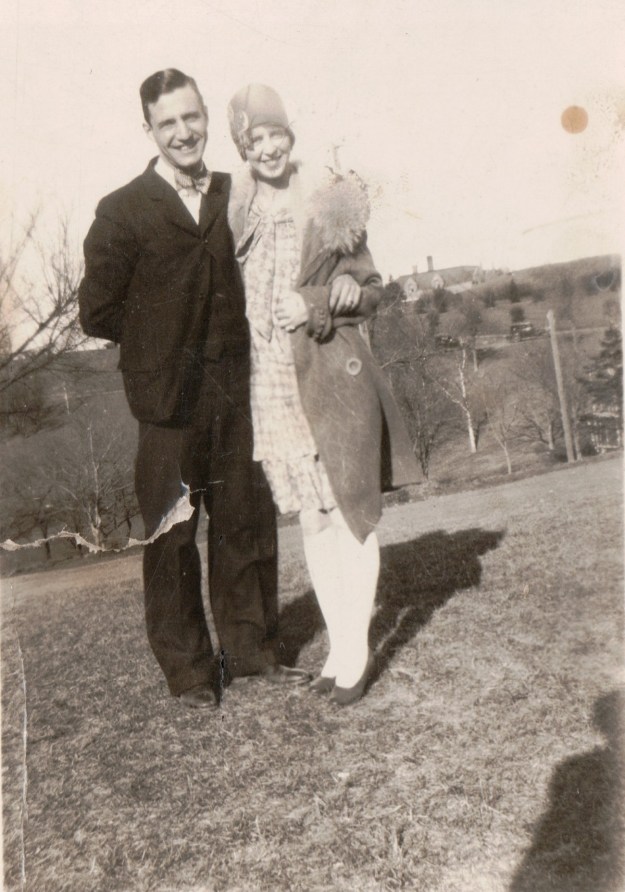
Not long before they married on 08 June 1929, Gerald Adam and Fern Thoma posed for a series of snapshots at Grandview Park in Sioux City, Woodbury County, Iowa.1

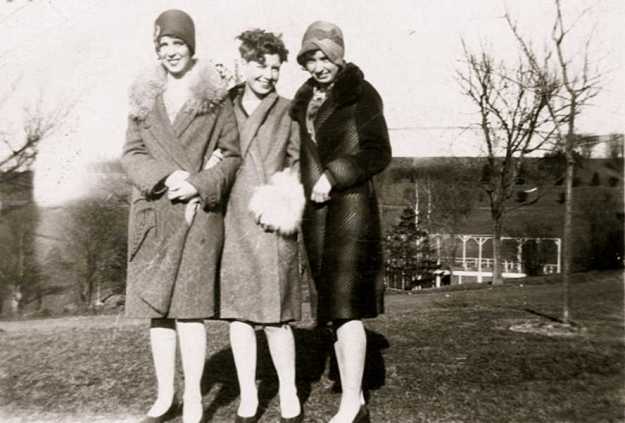
Gerald, known as Jerry, was twenty years old to Fern’s twenty-one at the time these photographs were likely taken; the prints are stamped with the date 19 March 1929. On what was perhaps the first day warm enough to shed their jackets that year, they clowned around with friends Dorothy Thompson, Irene Tasker, and Clifford Thompson, and snapped a number of photographs documenting their time together. Curly-haired Dorothy and Clifford were siblings; Clifford and Irene would later marry.2

Fern wears heels and stockings, and her on-trend long sleeved, drop-waist dress hits just below the knee. Its geometric pattern is indistinct in the photographs, but it features a sailor-esque tie at the v-neck and two rows of ruffles at the hem.3 Her long wool jacket, worn in all but one of the photographs, has a warm fur collar; her two female friends also wear fur-trimmed jackets. Fern’s bob is neatly concealed by her stylishly adorned cloche hat.4 Jerry is smartly dressed as well, wearing a wool suit with a bow tie and a straw hat, his outfit nearly identical to that of his friend’s. His pants, cuffed at the hems, are so wide and loose that they appear to almost skim the grass; they look much like the ready-made “Oxford Bags” that became popular in the mid-1920s. 

Whether the couple was celebrating something in particular—an engagement?—or simply enjoying the spring weather on an afternoon walk with friends, it is interesting to note that several photographs were taken at a memorial for one Mabel Allison More, a Sioux City resident who had died in 1924.5 Given the lighthearted nature of the photographs, it can be assumed that the young people did not know More, but were rather attracted to the charming tiled wall merely as a backdrop and convenient place to climb. Grandview Park was presented to the city of Sioux City in 1908, and soon became a popular gathering place known especially for its trellised rose garden, the beginnings of which may be visible in the photograph of Fern, Dorothy, and Irene, and later for its bandshell.6

A little less than three months after these photographs were printed, Fern and Jerry would marry, with one of their friends pictured here, Dorothy, serving as an attendant.7 Although no photographs of their wedding day, nor their honeymoon in the Black Hills, are known to exist, these snapshots give a glimpse into the relationship of this happy young couple who leaned comfortably into one another and smiled joyfully for the camera.8

Copyright © 2018 Melanie Frick. All Rights Reserved.
Continue reading

The Adam Brothers

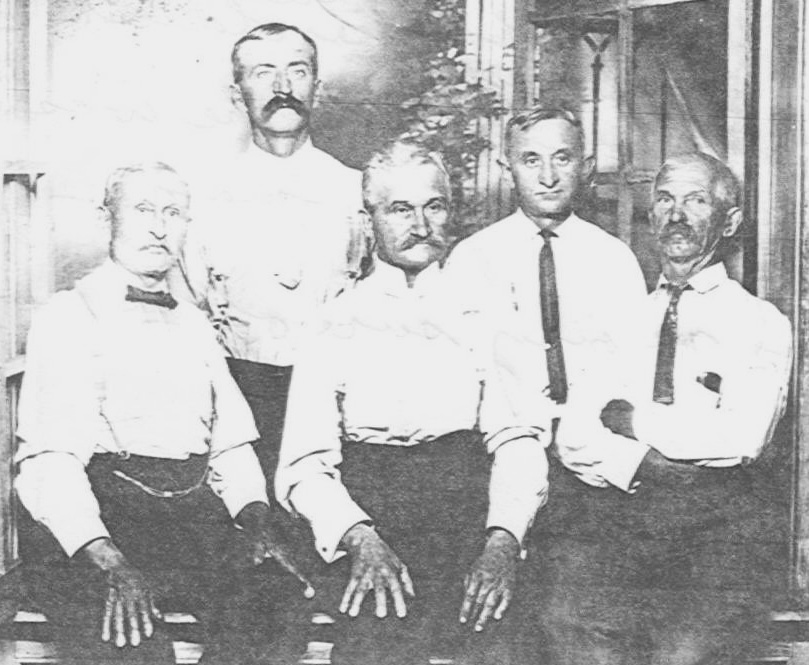
When five of the six living sons of Timothée and Marguerite (Chicoine) Adam gathered in the Midwest circa 1913, it was deemed an occasion worthy of a photograph.1 From left are pictured brothers Louis (1848-1927), Peter (1852-1936), Joseph (1850-1926), Prosper (1867-1943), and Timothy Adam (1846-1919). Although the twenty-one year span in age of these brothers is impressive, in fact, twenty-seven years passed between the births of their eldest sibling and the youngest, who arrived when his mother was fifty years old. At least fourteen children were born in total, with all but the youngest born in Quebec. All got their start in life in the cotton mills of Indian Orchard, Hampden County, Massachusetts, which had lured the Adam family from rural Quebec to America.2

Brothers Louis, Peter, Joseph, Prosper, and Timothy Adam(s), ca. 1913; digital image 2010, privately held by Melanie Frick, 2018. Image courtesy of Dorothy Bouchard.

Timothy, at right, likely resided in Jefferson, Union County, South Dakota at the time this picture was taken,3 not far from Peter, second from left, and Prosper, second from right, who had both settled in Sioux City, Woodbury County, Iowa.4 Joseph, at center, had apparently traveled from his home in Ponca City, Kay County, Oklahoma to reunite with his brothers, as well as, undoubtedly, his twin sister, who lived in Jefferson.5 Louis, the one brother to have remained in Hampden County, Massachusetts, traveled the greatest distance for this reunion.6 The only living Adam brother not pictured here was Euclid John (1856-1940), who spent his adult life in Southbridge, Worcester County, Massachusetts.7 Whether he lost touch with his brothers or was simply unable to make the trip to visit them at the time that this photograph was taken is not known.

The Adam brothers, some of whom adopted the surname Adams in addition to Anglicized versions of their given names, held a variety of trades between them. Census records indicate that after leaving the cotton mills, some went on to become carpenters, barbers, homesteaders, clerks, pool hall operators, and hotel-keepers, among other occupations. All married, and all but Joseph had children of their own.

This photograph is a photocopy of what was said to be a real photo postcard, a format designed to be easily sent by mail to friends or relatives. Like the only known (or suspected) photograph of the mother of the Adam brothers, the original is believed to have been lost.8 Despite the poor quality of this photocopy, it is apparent that the brothers have dressed sharply, with their hair neatly combed and several in ties, although this was apparently not such a formal occasion that they opted to wear jackets. It is also plausible that it was quite hot, if their reunion took place in the summer months, and the gentlemen may well have opted to be as comfortable as possible. Several appear to wear sleeve garters, arm bands that helped to adjust the length of one’s sleeves.9 While the men’s appearances are distinct from one another, particularly given their disparate ages, similarly prominent noses—and, when visible, even hands—help to link them convincingly as brothers.

Copyright © 2018 Melanie Frick. All Rights Reserved.
Continue reading